- Home
- »
- Electronic Devices
- »
-
Pet Wearable Market Size & Share, Industry Report, 2033GVR Report cover
![Pet Wearable Market Size, Share & Trends Report]()
Pet Wearable Market (2026 - 2033) Size, Share & Trends Analysis Report By Technology (RFID, GPS, Sensors), By Product (Smart Collar, Smart Camera, Smart Harness and Vest), By Animal Type, By Component, By Sales Channel, By Application, By Region, And Segment Forecasts
- Report ID: 978-1-68038-729-2
- Number of Report Pages: 120
- Format: PDF
- Historical Range: 2021 - 2025
- Forecast Period: 2026 - 2033
- Industry: Semiconductors & Electronics
- Report Summary
- Table of Contents
- Interactive Charts
- Methodology
- Download FREE Sample
-
 Download Sample Report
Pet Wearable Market Summary
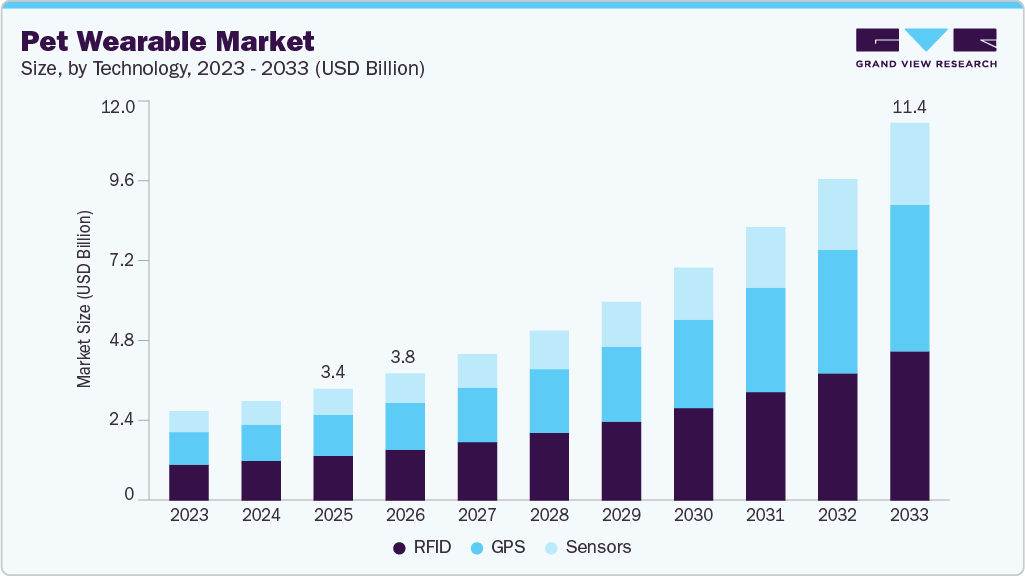
The global pet wearable market size was estimated at USD 3.37 billion in 2025 and is projected to reach USD 11.40 billion by 2033, growing at a CAGR of 16.8% from 2026 to 2033. The industry is driven by the rising humanization of pets, where pet owners increasingly treat companion animals as family members rather than property.
Key Market Trends & Insights
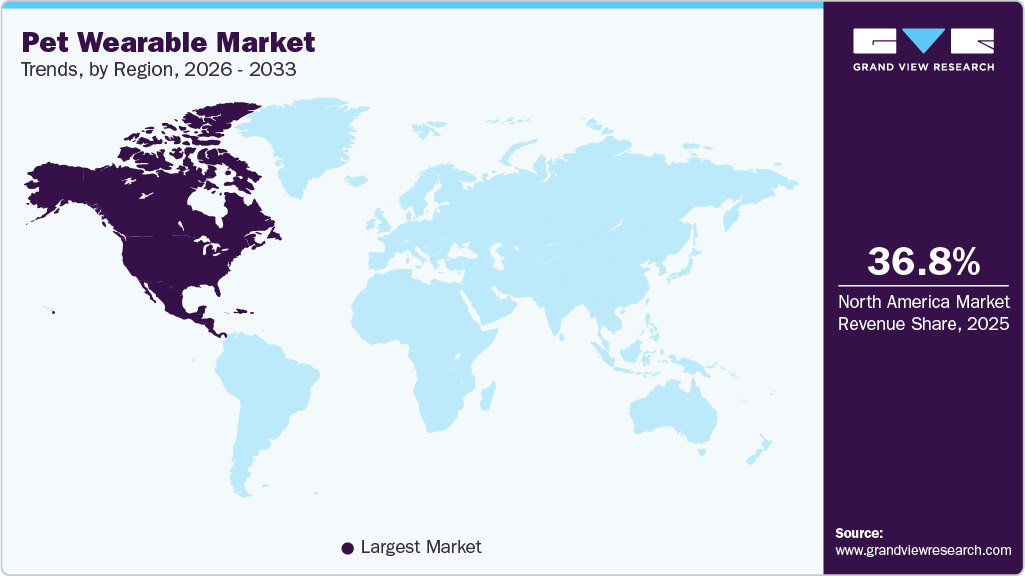
- North America pet wearable market dominated the global industry with the largest revenue share of 36.8% in 2025.
- The pet wearable industry in the U.S. is expected to grow significantly over the forecast period.
- By technology, RFID led the market and held the largest revenue share of 39.9% in 2025.
- By animal type, the cats segment held the dominant position in the market and accounted for the largest revenue share in 2025.
- By application, the behavior monitoring & control segment is expected to grow at a significant CAGR from 2026 to 2033.
Market Size & Forecast
- 2025 Market Size: USD 3.37 Billion
- 2033 Projected Market Size: USD 11.40 Billion
- CAGR (2026-2033): 16.8%
- North America: Largest market in 2025
This shift has led to a greater willingness to spend on premium pet products that enhance pet safety, health, and quality of life. As disposable incomes rise in developed markets and pet ownership expands in urban households, demand for smart collars, GPS trackers, health monitors, and activity devices has strengthened. Millennials and Gen Z pet owners, in particular, are more tech-savvy and receptive to connected devices, creating a favorable demand environment for IoT-enabled pet wearables. Shelter Animals Count (SAC), the national animal sheltering data program operated by the ASPCA, published its 2025 Annual Data Report, highlighting key trends in U.S. animal shelters. The report shows that adoption activity remained resilient in 2024, with shelters placing approximately 4.2 million animals into new homes, representing a modest 0.7% increase from the previous year. According to SAC, stronger adoption performance across both dogs and cats helped sustain overall live outcome rates, underscoring continued public engagement with shelter animals despite broader pressures facing the sector.Technological advancements in sensors, miniaturization, battery efficiency, and connectivity are another critical growth driver. Improvements in biometric sensors, AI-driven analytics, and cloud-based data platforms have made pet wearables more accurate, reliable, and valuable for continuous health monitoring. Integration with smartphone applications, veterinary platforms, and pet insurance ecosystems has enhanced usability and stickiness, making these devices part of a broader digital pet care infrastructure. Lower manufacturing costs for components such as GPS chips and accelerometers have also supported wider adoption beyond premium segments.
Growing awareness of pet health and preventive care is further accelerating market expansion. The rising incidence of obesity, joint issues, anxiety disorders, and chronic conditions in pets has increased demand for devices that track activity levels, heart rate, sleep patterns, and behavioral changes. Veterinarians and pet wellness providers are increasingly recommending data-driven monitoring tools, reinforcing consumer trust in wearable solutions. Additionally, pet insurance providers are beginning to leverage wearable data for risk assessment and personalized coverage, indirectly stimulating adoption.
Technology Insights
The RFID segment dominated the market and accounted for a revenue share of 39.9% in 2025, driven by its cost-effectiveness, reliability, and scalability for pet identification and tracking applications. Unlike GPS-based devices, RFID tags are low-power, lightweight, and maintenance-free, making them ideal for mass adoption in pet collars, microchips, and smart identification systems. Rising regulatory mandates for pet microchipping in several countries, along with increasing concerns around lost or stolen pets, have strengthened demand for RFID-enabled identification solutions.
The GPS segment is anticipated to grow at the highest CAGR during the forecast period, driven by rising concerns around pet safety, loss prevention, and real-time location tracking, particularly as urbanization increases and pets are more frequently kept in densely populated environments. Growing pet mobility through travel, daycare, parks, and boarding facilities has heightened the risk of pets going missing, making GPS-enabled collars and trackers a critical tool for owners. Advancements in satellite positioning, low-power wide-area networks (LPWAN), and cellular connectivity (4G/5G, LTE-M, and NB-IoT) have improved tracking accuracy, battery life, and coverage reliability, making these devices more practical for continuous use.
Product Insights
The smart collar segment dominated the market and accounted for the largest revenue share in 2025 as pet owners increasingly prioritize real-time safety, health monitoring, and behavioral insights in a single integrated device rather than relying on standalone trackers or tags. Advances in GPS, biometric sensors, AI analytics, and long-battery IoT connectivity have made smart collars more reliable, affordable, and multifunctional, combining location tracking, activity monitoring, temperature alerts, and sometimes even virtual fences in one pet product.
The smart camera segment is anticipated to grow at the significant CAGR during the forecast period, driven by rising demand for real-time remote pet monitoring as urban pet ownership increases and owners spend longer hours away from home. Growing concerns around pet separation anxiety, safety, and behavioral tracking have boosted the adoption of camera-enabled wearables that allow live streaming, two-way audio, and AI-based activity alerts via smartphone apps.
Animal Type Insights
The cats segment dominated the market and accounted for the largest revenue share in 2025, driven by rising indoor cat ownership, increasing concerns around feline health, and the need for safety and location tracking in urban environments. As more cats are kept indoors or in apartments, owners are turning to activity monitors, GPS trackers, and behavioral wearables to prevent obesity, detect stress, and monitor mobility and sleep patterns.
The dogs segment is expected to grow at a significant CAGR during the forecast period, driven by high ownership rates, stronger emotional attachment to dogs, and greater spending per pet compared to other animals. Rising concerns around dog safety, particularly for free-roaming, working, or highly active breeds, have increased demand for GPS trackers, smart collars, and real-time location monitoring.
Component Insights
The connectivity integrated circuit segment dominated the market and accounted for the largest revenue share in 2025, driven by the increasing integration of real-time tracking, cloud connectivity, and data transmission capabilities in smart pet devices. Rising adoption of GPS, Bluetooth Low Energy (BLE), LTE-M, and NB-IoT technologies in pet wearables has expanded demand for advanced connectivity ICs that enable seamless location tracking, health monitoring, and app-based analytics.
The processors segment is expected to grow at the highest CAGR during the forecast period, driven by the increasing demand for edge computing, real-time analytics, and low-power intelligent devices that can process biometric and behavioral data directly on the device rather than relying solely on cloud connectivity. As pet wearables integrate more advanced functionalities such as continuous health monitoring, anomaly detection, AI-based behavior analysis, GPS tracking, and voice or sound recognition, the need for high-performance yet energy-efficient microprocessors and system-on-chip (SoC) solutions has intensified.
Sales Channel Insights
The online segment dominated the market and accounted for the largest revenue share in 2025 due to the expanding reach of e-commerce platforms, higher digital adoption among pet owners, and the convenience of comparison-based shopping. Online marketplaces and brand-owned websites enable consumers to evaluate pet product features such as GPS accuracy, battery life, health metrics, subscription plans, and user reviews before purchase, which is particularly important for technology-driven pet products like smart pet wearables.
The offline segment is expected to grow at a significant CAGR during the forecast period, driven by strong consumer preference for physical inspection, trial, and in-store demonstrations of smart pet devices before purchase, particularly for higher-priced GPS trackers and health monitors. Pet specialty stores, veterinary clinics, and large-format retail chains play a critical role by providing expert guidance, after-sales support, and trust factors that remain important for first-time adopters of wearable technology.
Application Insights
The identification & tracking segment dominated the market and accounted for the largest revenue share in 2025 due to escalating concerns over pet safety and the rising incidence of lost or stolen pets, particularly in urban and semi-urban environments. Increasing pet humanization has made owners more risk-averse and willing to invest in GPS-enabled collars, real-time location trackers, and RFID-based identification systems that provide continuous monitoring and rapid recovery capabilities.
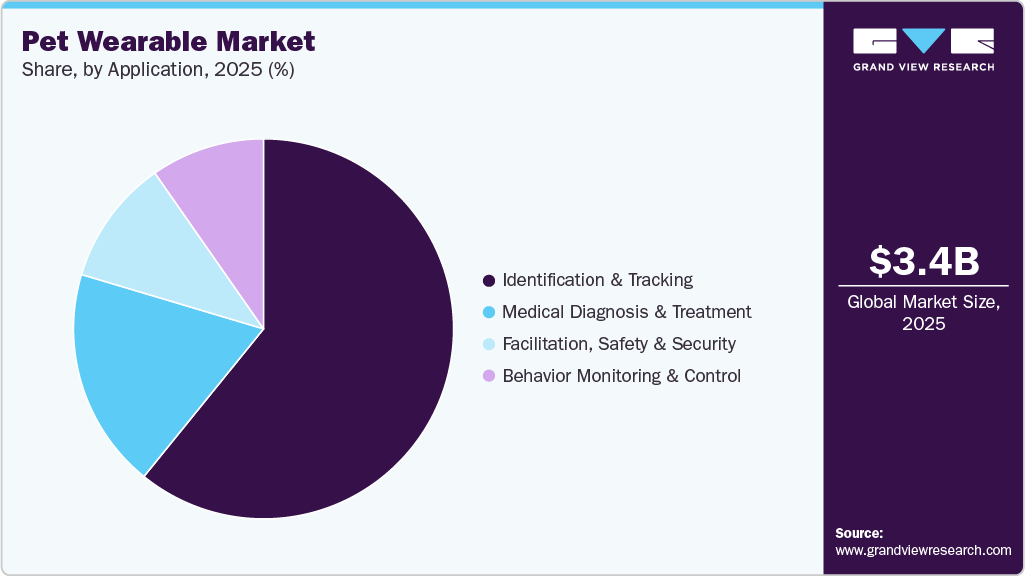
The behavior monitoring & control segment is expected to grow at a significant CAGR over the forecast period, driven by increasing pet owner concern over anxiety, stress, destructive behavior, and overall emotional well-being of pets, particularly as urban lifestyles leave animals alone for longer periods. Advances in AI-enabled activity tracking, sound analysis, and motion sensors allow wearables to detect behavioral anomalies such as excessive barking, pacing, scratching, or inactivity, providing actionable insights through mobile apps.
Regional Insights
North America pet wearable market dominated the global market with the largest revenue share of 36.8% in 2025, driven by high digital adoption, strong IoT infrastructure, and early acceptance of smart pet tech among tech-savvy consumers. Widespread use of connected devices, seamless integration with smartphones, and a mature cloud ecosystem have enabled real-time pet monitoring at scale.
U.S. Pet Wearable Market Trends
The pet wearable market in the U.S. is expected to grow significantly at a CAGR of 15.3% from 2026 to 2033, due to the expansion of pet insurance and value-based pet healthcare models that increasingly rely on wearable-generated data. Insurers and veterinary networks are using activity and health data to personalize care plans, which is incentivizing pet owners to adopt monitoring devices.
Europe Pet Wearable Market Trends
The pet wearable market in Europe is anticipated to register considerable growth from 2026 to 2033 due to stringent animal welfare standards and increasing regulatory focus on pet safety and traceability. Governments and animal welfare organizations are promoting responsible pet ownership, encouraging the use of tracking and monitoring technologies. Sustainability trends are also influencing demand, with the rising preference for eco-friendly, low-energy, and recyclable wearable pet products.
The UK pet wearable market is expected to grow rapidly in the coming years, owing to high urban pet ownership, where space constraints and busy lifestyles increase reliance on remote monitoring solutions. Rising pet separation anxiety concerns, particularly after the pandemic, have pushed demand for behavior-tracking wearables.
The pet wearable market in Germany held a substantial share in 2025, propelled by its leadership in precision engineering, data privacy compliance, and industrial IoT expertise. German consumers show strong trust in scientifically designed products, benefiting high-accuracy biometric pet wearables.
Asia Pacific Pet Wearable Market Trends
The pet wearable market in Asia Pacific held a significant share in the global market in 2025, due to rapid urbanization, rising middle-class pet ownership, and growing exposure to Western pet care trends. Expanding e-commerce penetration and digital payment adoption are making smart pet devices more accessible across emerging markets.
Japan pet wearable market is expected to grow rapidly in the coming years, driven by its aging population, where companion animals play a crucial emotional role in households with fewer children. The country’s advanced robotics, miniaturization capabilities, and sensor technology leadership enable highly sophisticated pet monitoring devices.
The pet wearable market in China held a substantial market share in 2025, due to the rapid commercialization of pet tech through local manufacturing ecosystems and cost-efficient smart hardware production. The booming online pet community and live-streaming commerce have significantly boosted awareness and adoption of wearable devices.
Key Pet Wearable Companies Insights
Key players operating in the pet wearable industry are Datamars, FitBark Service, Garmin Ltd., PETFON, Link my Pet, and LATSEN. The companies are focusing on various strategic initiatives, including new product development, partnerships & collaborations, and agreements to gain a competitive advantage over their rivals. The following are some instances of such initiatives.
Key Pet Wearable Companies:
The following key companies have been profiled for this study on the pet wearable market.
- Avid Identification Systems, Inc.
- Barking Labs
- Datamars
- Felcana
- FitBark Service
- Garmin Ltd.
- GoPro Inc.
- LATSEN
- Link My Pet
- Loc8tor Ltd.
- Mars, Incorporated
- PETFON
- PetPace
- PetTech.co.uk.Ltd.
- Tractive
Recent Developments
-
In December 2025, Garmin Ltd unveiled the Garmin DriveTrack 72, a new GPS navigation system designed specifically for hunters and sporting dog handlers. The device features a 7-inch high-definition screen that allows users to monitor the location, movement, and status of up to 20 dogs simultaneously while remaining inside their vehicle. Beyond tracking, the unit also functions as a comprehensive navigation tool, offering both on-road and off-road mapping along with satellite imagery to help users safely navigate unfamiliar landscapes.
-
In July 2025, Tractive announced its acquisition of Whistle, a connected pet device brand previously owned by Mars Petcare. The deal expands Tractive’s footprint in the rapidly growing pet tech sector by bringing in Whistle’s users, intellectual property, and technological capabilities. Since its founding in 2012, Tractive has scaled into a global player in smart pet tracking, now serving more than 1.4 million active customers worldwide and having sold millions of devices, a position the company says will be further strengthened through this transaction.
-
In May 2025, Mars, Incorporated launched a new suite of AI-driven digital tools designed to help pet owners better track and understand their pets’ health and well-being. The initiative forms part of the company’s broader investment in its Pet Nutrition division, which is focused on embedding advanced digital capabilities across its products and services. The move is intended to make pet care more personalized, data-informed, and convenient while strengthening its position in the rapidly evolving pet tech and nutrition ecosystem.
Pet Wearable Market Report Scope
Report Attribute
Details
Market size in 2026
USD 3.84 billion
Revenue forecast in 2033
USD 11.40 billion
Growth rate
CAGR of 16.8% from 2026 to 2033
Actual data
2021 - 2025
Forecast period
2026 - 2033
Quantitative units
Revenue in USD million/billion and CAGR from 2026 to 2033
Report enterprise size
Revenue forecast, company share, competitive landscape, growth factors, and trends
Segments covered
Technology, product, animal type, component, sales channel, application, region
Regional scope
North America; Europe; Asia Pacific; Latin America; MEA
Country scope
U.S.; Canada; Mexico; UK; Germany; France; China; India; Japan; Australia; South Korea; Brazil; UAE; Kingdom of Saudi Arabia; South Africa
Key companies profiled
Avid Identification Systems; Inc.; Barking Labs; Datamars; Felcana; FitBark Service; Garmin Ltd.; GoPro Inc.; LATSEN; Link My Pet; Loc8tor Ltd.; Mars; Incorporated; PETFON; PetPace; PetTech.co.uk.Ltd.; Tractive
Customization scope
Free report customization (equivalent to 8 analysts working days) with purchase. Addition or alteration to country, regional & segment scope.
Pricing and purchase options
Avail customized purchase options to meet your exact research needs. Explore purchase options
Global Pet Wearable Market Report Segmentation
This report forecasts revenue growth at the global, regional, and country levels and provides an analysis of the latest industry trends in each of the sub-segments from 2021 to 2033. For this study, Grand View Research has segmented the global pet wearable market report based on technology, product, animal type, component, sales channel, application, and region.
-
Technology Outlook (Revenue, USD Billion, 2021 - 2033)
-
RFID
-
GPS
-
Sensors
-
-
Product Outlook (Revenue, USD Billion, 2021 - 2033)
-
Smart Collar
-
Smart Camera
-
Smart Harness and Vest
-
Others
-
-
Animal Type Outlook (Revenue, USD Billion, 2021 - 2033)
-
Dogs
-
Cats
-
Other Animals
-
-
Component Outlook (Revenue, USD Billion, 2021 - 2033)
-
GPS Chips
-
RFID Chips
-
Connectivity Integrated Circuit
-
Bluetooth Chips
-
Wi-Fi Chips
-
Cellular Chips
-
-
Sensors
-
Processors
-
Memory
-
Displays
-
Batteries
-
Others
-
-
Sales Channel Outlook (Revenue, USD Billion, 2021 - 2033)
-
Online
-
Offline
-
-
Application Outlook (Revenue, USD Billion, 2021 - 2033)
-
Identification & Tracking
-
Behavior Monitoring & Control
-
Facilitation, Safety & Security
-
Medical Diagnosis & Treatment
-
-
Regional Outlook (Revenue, USD Billion, 2021 - 2033)
-
North America
-
U.S.
-
Canada
-
Mexico
-
-
Europe
-
UK
-
Germany
-
France
-
-
Asia Pacific
-
China
-
India
-
Japan
-
South Korea
-
Australia
-
-
Latin America
-
Brazil
-
-
Middle East & Africa
-
UAE
-
Saudi Arabia
-
South Africa
-
-
Frequently Asked Questions About This Report
b. The global pet wearable market is expected to grow at a compound annual growth rate of 16.8% from 2026 to 2033, reaching USD 11.40 billion by 2033.
b. The global pet wearable market size was estimated at USD 3.37 billion in 2025 and is expected to reach USD 3.84 million in 2026.
b. North America dominated the global market with the largest revenue share of 36.8% in 2025, driven by high digital adoption, strong IoT infrastructure, and early acceptance of smart pet tech among tech-savvy consumers.
b. Some key players operating in the pet wearable market include Avid Identification Systems, Inc., Barking Labs, Datamars, Felcana, FitBark Service, Garmin Ltd., GoPro Inc., LATSEN, Link My Pet, Loc8tor Ltd., Mars, Incorporated, PETFON, PetPace, PetTech.co.uk.Ltd., Tractive.
b. Key factors that are driving the pet wearable market growth include the rising humanization of pets, where pet owners increasingly treat companion animals as family members rather than property.


Share this report with your colleague or friend.
Need a Tailored Report?
Customize this report to your needs — add regions, segments, or data points, with 20% free customization.


ISO 9001:2015 & 27001:2022 Certified
We are GDPR and CCPA compliant! Your transaction & personal information is safe and secure. For more details, please read our privacy policy.
Trusted market insights - try a free sample
See how our reports are structured and why industry leaders rely on Grand View Research. Get a free sample or ask us to tailor this report to your needs.