Passive Hydroponics Market Summary
The global passive hydroponics market size was estimated at USD 803.2 million in 2025 and is projected to reach USD 2,587.4 million by 2033, expanding at a CAGR of 15.2% from 2026 to 2033. This growth is primarily driven by the rising adoption of low-maintenance, water-efficient cultivation methods, particularly in urban residential settings.
Key Market Trends & Insights
- By type, the kratky/non-circulating systems segment is expected to grow at the fastest CAGR of 17.5% from 2026 to 2033, in terms of revenue.
- By application, the small urban & community farms segment is expected to grow at the fastest CAGR of 19.1% from 2026 to 2033.
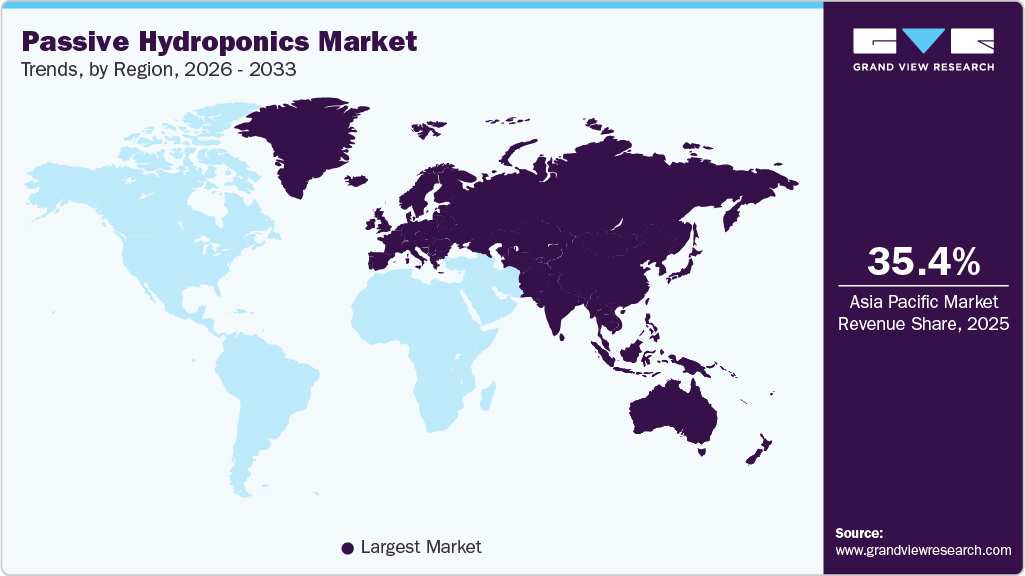
- The Asia Pacific passive hydroponics industry held the largest revenue share of 35.40% in 2025.
Market Size & Forecast
- 2025 Market Size: USD 803.2 Million
- 2033 Projected Market Size: USD 2,587.4 Million
- CAGR (2026-2033): 15.2%
- Asia Pacific: Largest market in 2025
- Europe: Fastest growing market
Increasing interest in indoor gardening, sustainability-focused lifestyles, and space-efficient food production solutions is accelerating demand. Passive systems offer cost advantages over active hydroponics due to the absence of pumps and electricity requirements, making them attractive to first-time users and hobbyists.
A key structural growth driver for the passive hydroponics industry is the expansion of urban populations and the shrinking availability of traditional gardening spaces. Consumers are increasingly turning to compact, soil-free growing systems that require minimal technical expertise. The simplicity of wick-based and Kratky systems reduces entry barriers, supporting rapid penetration across emerging markets. Additionally, growing awareness regarding water conservation and controlled nutrient management further strengthens demand.
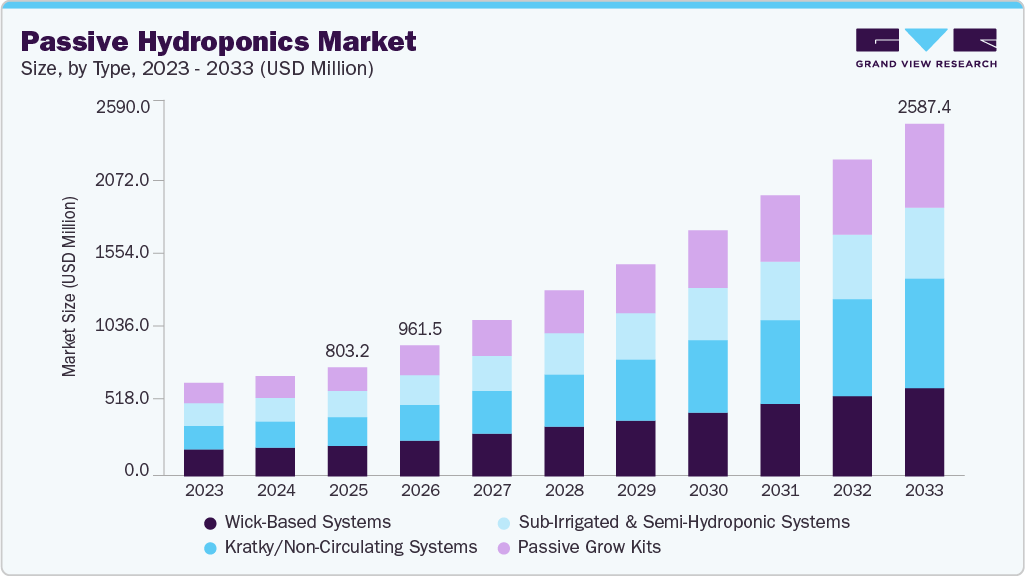
Technological innovation in passive grow kits and aesthetically designed self-watering planters is expanding the addressable consumer base beyond hobbyists to lifestyle-oriented buyers. E-commerce distribution channels and direct-to-consumer brands are improving global product accessibility. Increasing experimentation in small urban farms and ornamental nurseries also contributes to sustained long-term growth.
Market Concentration & Characteristics
The passive hydroponics market remains moderately fragmented, characterized by a mix of regional manufacturers, specialty horticulture suppliers, and emerging direct-to-consumer brands. Unlike large-scale active hydroponics systems, passive solutions have relatively low technological complexity and lower capital requirements, which allows smaller companies to compete effectively. As a result, no single player commands a dominant global share.
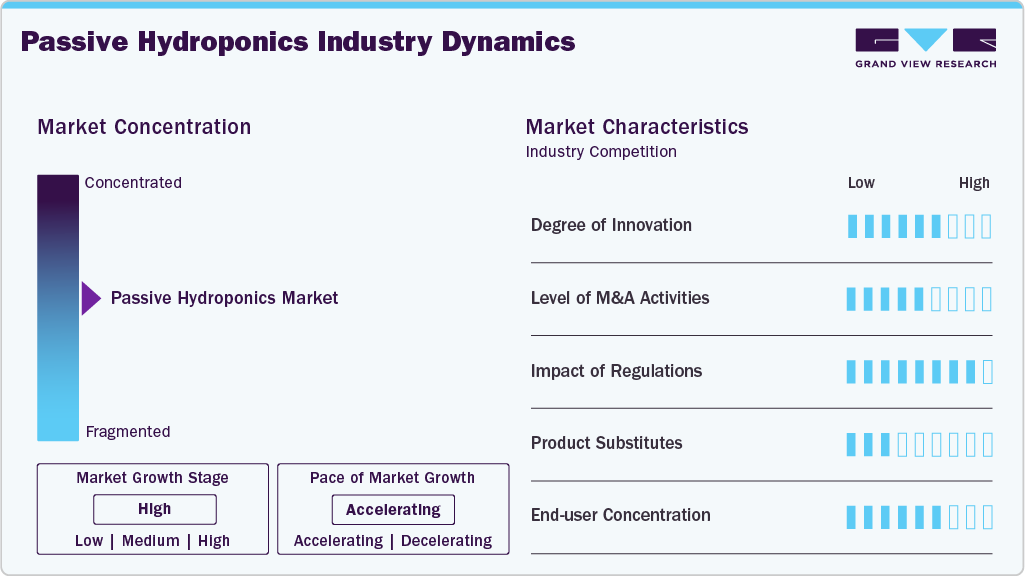
However, consolidation is gradually increasing in developed markets, particularly in North America and Europe, where established gardening brands are expanding into passive hydroponic kits. Private-label retail offerings and online marketplace brands are intensifying competition. While entry barriers are low, brand recognition, distribution reach, and product design differentiation are becoming critical competitive factors.
Type Insights
The wick-based systems segment dominated the passive hydroponics market, accounting for a revenue share of 28.2% in 2025. This growth is driven by its simplicity, low cost, and ease of use. These systems require minimal technical knowledge and no electricity, making them highly suitable for beginners and residential users. Their reliability and compatibility with ornamental plants and leafy greens support strong adoption in hobbyist gardening. Additionally, wick systems are widely available through retail and online channels, reinforcing their volume leadership.
The kratky/Non-Circulating segment is expected to grow at the fastest CAGR of 17.5% during the forecast period. This growth is primarily driven by the increasing awareness of its high efficiency and low maintenance requirements. The method allows growers to cultivate leafy greens and herbs without pumps or aeration systems, thereby reducing operating costs. It is particularly gaining traction among small urban farms and consumers focused on sustainability. Additionally, educational content and social media exposure have further accelerated its adoption globally.
Application Insights
The residential segment dominated the passive hydroponics industry, accounting for a revenue share of 39.05% in 2025. This system is primarily consumer-driven. Rising interest in indoor plants, home-grown herbs, and compact food production has significantly supported this segment. The affordability and plug-and-play nature of passive kits make them accessible to urban households. Increased work-from-home culture and lifestyle gardening trends further strengthened residential adoption.
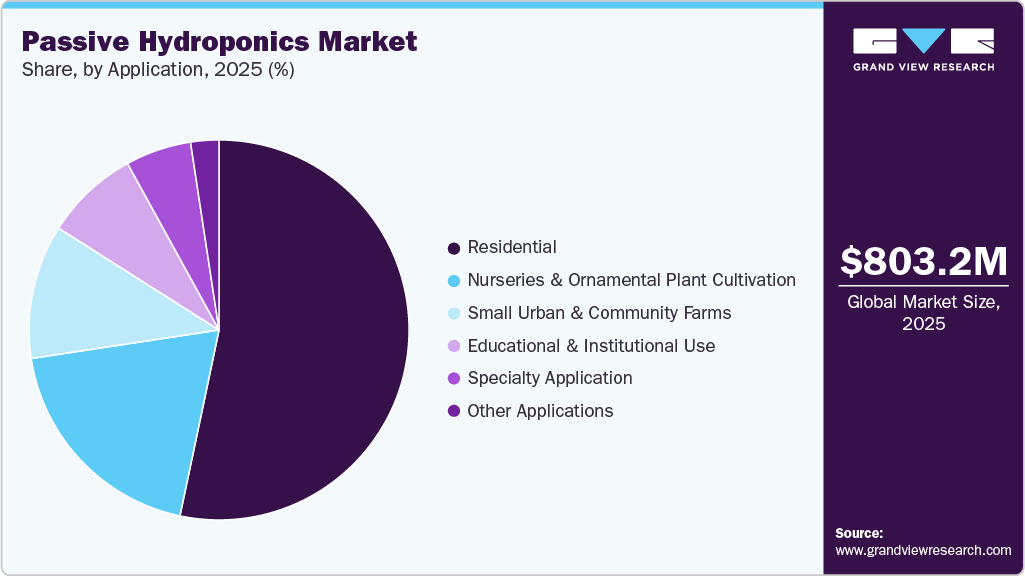
The nurseries & ornamental plant cultivation segment is expected to grow at the fastest CAGR of 7.2% during the forecast period. The increasing demand for controlled plant propagation methods drives this growth. Passive hydroponics supports consistent moisture control and reduced risk of soil-borne diseases, which is attractive to ornamental growers. Rising demand for premium indoor plants and decorative foliage also supports adoption. Commercial nurseries are gradually integrating semi-hydroponic systems to enhance plant quality and resource efficiency.
Regional Insights
Asia Pacific dominated the passive hydroponics market, accounting for a revenue share of 35.40% in 2025. This growth is driven by rapid urbanization, rising disposable incomes, and growing interest in indoor gardening. The region benefits from a strong manufacturing base for low-cost grow kits and containers. Growing middle-class populations in China and Southeast Asia are driving consumer-level adoption. Additionally, water conservation concerns in certain countries support demand for efficient cultivation systems.
The China passive hydroponics market is expected to grow during the forecast period. China is a key growth engine within Asia Pacific due to rapid urbanization and expanding middle-class households. The country benefits from strong domestic manufacturing of affordable hydroponic kits. Increasing government support for modern agriculture and urban farming initiatives supports demand. E-commerce platforms play a major role in driving product penetration.
Europe Passive Hydroponics Market Trends
The Europe passive hydroponics industry is characterized by strong sustainability regulations and environmentally conscious consumers. Countries such as Germany, the Netherlands, and the UK are promoting urban agriculture initiatives, indirectly supporting passive hydroponics. Compact apartment living in major cities encourages the adoption of tabletop and self-watering systems. However, growth remains slightly moderate compared to Asia Pacific.
The Germany passive hydroponics market is a leading region in Europe, driven by high environmental awareness and theadoption of resource-efficient technologies. Urban consumers favor compact, aesthetically pleasing self-watering systems for indoor use. Government emphasis on sustainability and green living indirectly supports passive hydroponics. Specialty horticulture and ornamental cultivation also contribute to steady expansion.
North America Passive Hydroponics Market Trends
North America represents a mature yet innovation-driven market. High awareness of hydroponics, strong retail distribution networks, and active online gardening communities support steady growth. The U.S. accounts for the majority of regional demand due to widespread adoption of home gardening systems. Premium passive kits and design-oriented products are gaining traction.
U.S. Passive Hydroponics Market Trends
The U.S. is the largest market in North America, supported by a well-established gardening culture and high consumer spending. Growing interest in sustainable living and home-grown produce supports demand for passive systems. Educational institutions and community farms are increasingly adopting low-cost non-circulating methods. Strong online retail infrastructure accelerates distribution.
Latin America Passive Hydroponics Market Trends
Latin America is an emerging market driven by rising interest in urban farming and small-scale horticulture. Brazil and Mexico are leading the adoption due to growing middle-class demand and expanding gardening culture. Price sensitivity remains a limiting factor, favoring basic wick-based systems. Distribution expansion through online channels is gradually improving accessibility.
Middle East and Africa Passive Hydroponics Market Trends
The Middle East & Africa region presents long-term potential due to water scarcity concerns and limited arable land. Passive hydroponics offers a low-energy alternative to traditional cultivation, particularly in residential and educational settings. Adoption is currently concentrated in urban centers. However, limited consumer awareness and lower retail penetration restrict short-term growth.
Key Passive Hydroponics Company Insights
The presence of several established horticulture and consumer gardening brands, including AutoPot, EarthBox, LetPot, General Hydroponics, and Hydrofarm Holdings Group, Inc., among others characterizes the global passive hydroponics market. The competitive landscape remains moderately fragmented, with a mix of specialized passive-system providers, nursery-focused suppliers, and emerging direct-to-consumer brands. Companies are actively investing in product innovation, particularly in user-friendly wick-based and non-circulating systems, while expanding their e-commerce presence to strengthen global reach.
Market participants are focusing on portfolio diversification through aesthetically designed self-watering planters and compact grow kits to attract residential and urban consumers. Strategic collaborations with retail chains, garden centers, and online marketplaces are being leveraged to enhance distribution efficiency. Sustainability remains a central theme, with companies emphasizing water efficiency, recyclable growing media, and reduced energy consumption. Additionally, supply chain optimization and localized manufacturing strategies are being adopted to improve cost competitiveness and respond effectively to growing global demand.
Company Overview
AutoPot is a designer and manufacturer of gravity‑fed, power‑free irrigation and container‑based hydroponic systems supplied globally under the AutoPot Watering Systems brand. The business originated in the UK in the early 2000s under founder and designer Jason Ralph‑Smith and now operates through AutoPot Global in the UK and affiliated businesses such as AutoPot Watering Systems U.S., supplying hobby, greenhouse, and commercial growers in more than 60 countries.
Key Passive Hydroponics Companies:
The following key companies have been profiled for this study on the passive hydroponics market.
- AUTOPOT
- Gardyn
- KratkyHydroponics
- WeHydroponics
- Casa De Amor
- Coco and Seed- EcoPlanter
- Ponics Life- Candlestick Hydroponic Wicking Kit
- GroTech Garden Products
- EarthBox
- LetPot
Recent Developments
-
In February 2026, Research conducted by NASA aboard the International Space Station (ISS) demonstrated the feasibility of passive hydroponics in microgravity environments. These experiments highlight the potential of non-circulating and low-energy cultivation systems to support reliable crop production in space. The ability to grow fresh produce is considered critical for long-duration missions, as it contributes to whole-food nutrition, dietary diversity, and the psychological well-being of astronauts during deep space exploration.
Passive Hydroponics Market Report Scope
|
Report Attribute
|
Details
|
|
Market size value in 2026
|
USD 961.5 million
|
|
Revenue forecast in 2033
|
USD 2,587.4 million
|
|
Growth rate
|
CAGR of 15.2% from 2026 to 2033
|
|
Base year for estimation
|
2025
|
|
Historical data
|
2021 - 2024
|
|
Forecast period
|
2026 - 2033
|
|
Quantitative units
|
Revenue in USD million and CAGR from 2026 to 2033
|
|
Report coverage
|
Revenue forecast, company ranking, competitive landscape, growth factors, and trends
|
|
Segments covered
|
Type, application, region
|
|
Regional scope
|
North America; Europe; Asia Pacific; Latin America, Middle East & Africa
|
|
Country scope
|
U.S.; Canada; Mexico; Germany; UK, France; Spain; Italy; China; India; Japan; South Korea; Brazil; Argentina, South Africa; Saudi Arabia.
|
|
Key companies profiled
|
AUTOPOT; KratkyHydroponics; WeHydroponics; Casa De Amor; Coco and Seed- EcoPlanter; Ponics Life- Candlestick Hydroponic Wicking Kit; GroTech Garden Products; EarthBox; LetPot; Gardyn
|
|
Customization scope
|
Free report customization (equivalent up to 8 analysts’ working days) with purchase. Addition or alteration to country, regional & segment scope.
|
|
Pricing and purchase options
|
Avail customized purchase options to meet your exact research needs. Explore purchase options
|
Global Passive Hydroponics Market Report Segmentation
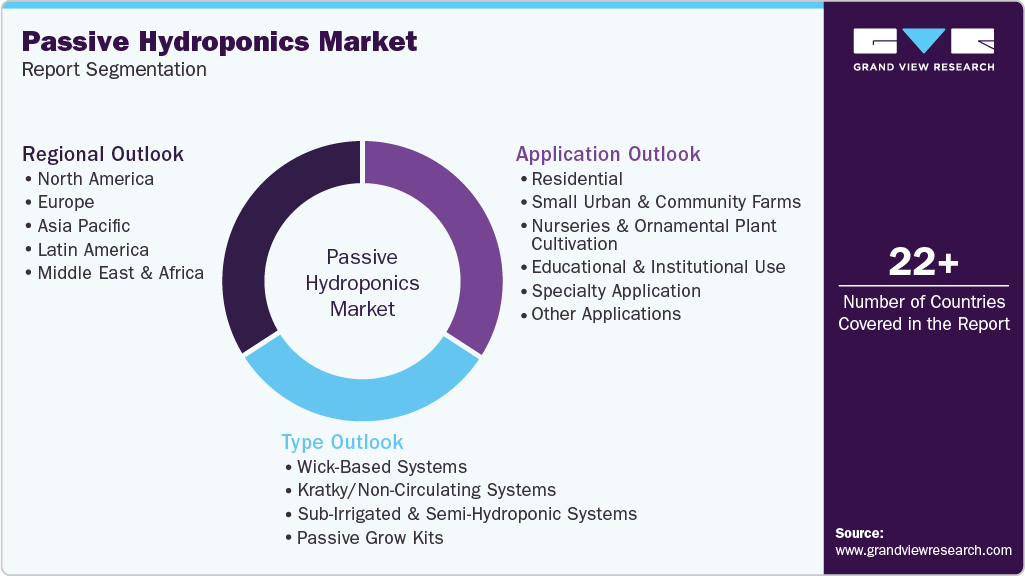
This report forecasts revenue growth at the global, regional, and country levels and provides an analysis of the latest industry trends in each of the sub-segments from 2021 to 2033. For this study, Grand View Research has segmented the global passive hydroponics market report based on type, application, and region:
-
Type Outlook (Revenue, USD Million, 2021 - 2033)
-
Application Outlook (Revenue, USD Million, 2021 - 2033)
-
Residential
-
Small Urban & Community Farms
-
Nurseries & Ornamental Plant Cultivation
-
Educational & Institutional Use
-
Specialty Application
-
Other Applications
-
Regional Outlook (Revenue, USD Million, 2021 - 2033)
-
North America
-
Europe
-
Germany
-
France
-
Spain
-
Italy
-
UK
-
Asia Pacific
-
China
-
India
-
Japan
-
South Korea
-
Latin America
-
Middle East & Africa
-
Saudi Arabia
-
South Africa
Frequently Asked Questions About This Report
b. The global passive hydroponics market size was estimated at USD 803.2 million in 2025 and is expected to reach USD 961.5 billion in 2026.
b. The global passive hydroponics market is expected to grow at a compound annual growth rate of 15.2% from 2026 to 2033 to reach USD 2587.4 million by 2033.
b. Asia Pacific dominated the market with a revenue share of 29.6% value share in 2025. This growth is due to rapid urbanization, increasing disposable incomes, and expanding interest in indoor gardening. The region benefits from a strong manufacturing base for low-cost grow kits and containers.
b. Some key players operating in the passive hydroponics market include AUTOPOT; KratkyHydroponics; WeHydroponics; Casa De Amor; Coco and Seed- EcoPlanter; Ponics Life- Candlestick Hydroponic Wicking Kit; GroTech Garden Products; EarthBox; LetPot, and Gardyn
b. This growth is primarily driven by rising adoption of low-maintenance and water-efficient cultivation methods, particularly in urban residential settings. Increasing interest in indoor gardening, sustainability-focused lifestyles, and space-efficient food production solutions is accelerating demand

 Download Sample Report