Oxidizing Agents Market Summary
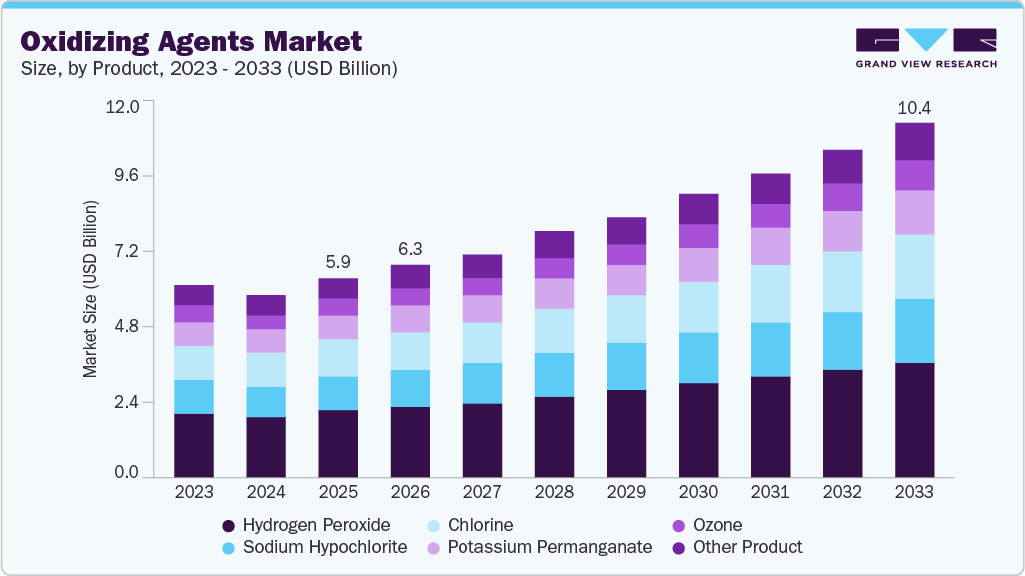
The global oxidizing agents market size was estimated at USD 5.9 billion in 2025 and is projected to reach USD 10.4 billion by 2033, growing at a CAGR of 7.5% from 2026 to 2033. The growing need for municipal and industrial water treatment is a key driver for oxidizing agents, which are essential for disinfection, contaminant removal, and compliance with public health regulations.
Key Market Trends & Insights
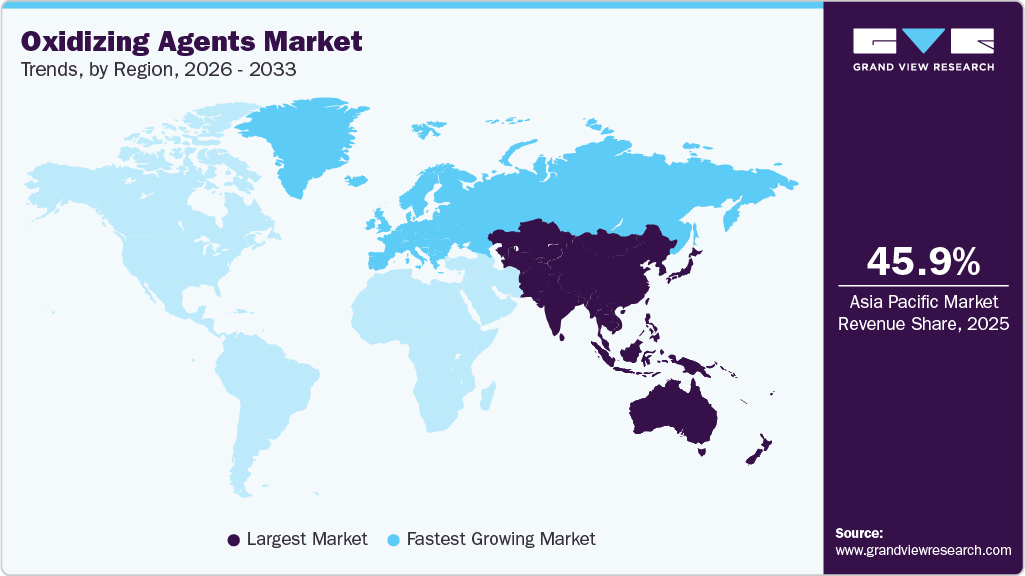
- Asia Pacific dominated the oxidizing agents market with the largest revenue share of 45.9% in 2025.
- In the Asia Pacific, the China oxidizing agents industry is expected to grow at the fastest CAGR of 7.4% from 2026 to 2033.
- By product, the sodium hypochlorite segment is expected to grow at the fastest CAGR of 8.0% from 2026 to 2033 in terms of revenue.
- Based on end-use, the healthcare & sterilization segment is expected to grow at the fastest revenue CAGR of 8.1% during the forecast period.
Market Size & Forecast
- 2025 Market Size: USD 5.9 Billion
- 2033 Projected Market Size: USD 10.4 Billion
- CAGR (2026-2033): 7.5%
- Asia Pacific: Largest market in 2025
- Europe: Fastest growing market
Regulatory frameworks such as the U.S. EPA’s drinking water standards require effective chemical treatment, driving sustained demand for chlorine, chlorine dioxide, and other oxidizers. Increasing urbanization, water scarcity, and stricter effluent discharge limits further amplify market adoption across water utilities and industrial treatment facilities.
Stringent environmental and public health regulations are driving the adoption of oxidizing agents that comply with safety and sustainability standards. Policies such as the Safe Drinking Water Act require treatment practices that rely on reliable chemical oxidizers to control microbial contamination and chemical hazards. As a result, industries are increasingly investing in advanced oxidizing solutions to maintain operational compliance while supporting safe and eco-friendly production processes.
At the same time, these regulatory pressures create a strategic opportunity for companies to develop eco-friendly, low-impact oxidizing agents. By providing biodegradable or peroxide-based solutions, businesses can address growing sustainability demands, differentiate their product offerings, enhance brand reputation, and secure long-term contracts with environmentally conscious clients and municipalities.
Market Concentration & Characteristics
The oxidizing agents industry is moderately concentrated, with a few large multinational producers controlling most of the global supply. These companies benefit from integrated supply chains, technical expertise, and long-term contracts, while high capital costs and strict safety regulations limit new entrants and allow established players to influence pricing in key segments.
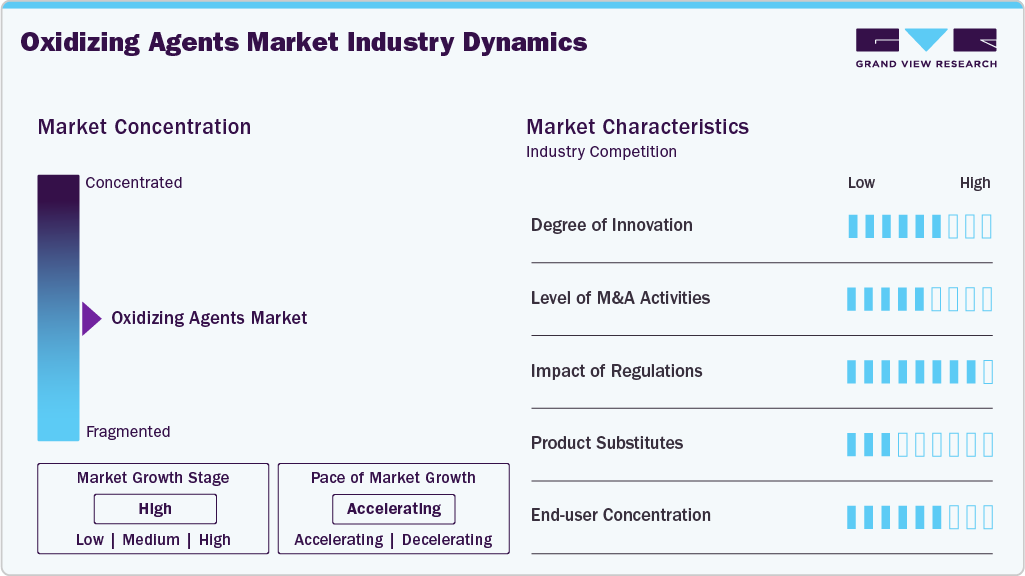
The market also shows diverse characteristics across products, industries, and regions. Core agents like hydrogen peroxide and chlorine compounds serve mature sectors such as water treatment and chemical manufacturing, while specialty and eco-friendly oxidizers are gaining traction. North America and Europe lead in regulatory compliance and infrastructure, whereas Asia-Pacific drives volume growth through rapid industrialization and urban expansion.
Product Insights
Hydrogen peroxide held a dominant position in the global oxidizing agents industry with a revenue share of 33.3% in 2025, due to its wide applicability and low environmental impact, making it suitable for industries such as pulp and paper, textiles, and water treatment. Its ability to decompose into water and oxygen ensures compliance with environmental regulations, while its effectiveness in bleaching, disinfection, and industrial oxidation drives consistent demand from key end users.
Sodium hypochlorite is witnessing strong growth with a revenue CAGR of 8.0% during the forecast period, supported by its essential role in water sanitation and public health. Commonly used as a disinfectant in municipal drinking water systems, healthcare, and commercial facilities, it meets regulatory requirements for effective pathogen control. Expanding investments in water treatment infrastructure and sanitation standards are driving their adoption across municipal and industrial applications.
End-use Insights
Water and wastewater dominated the end use segment with revenue share of 27.9% in 2025, due to the critical role of oxidizing agents in ensuring safe drinking water and regulatory compliance. Chemicals such as hydrogen peroxide and sodium hypochlorite are widely used for disinfection and contaminant removal, helping municipal and industrial utilities meet environmental and public health standards. Ongoing infrastructure upgrades and stringent effluent regulations continue to sustain steady demand in this sector.
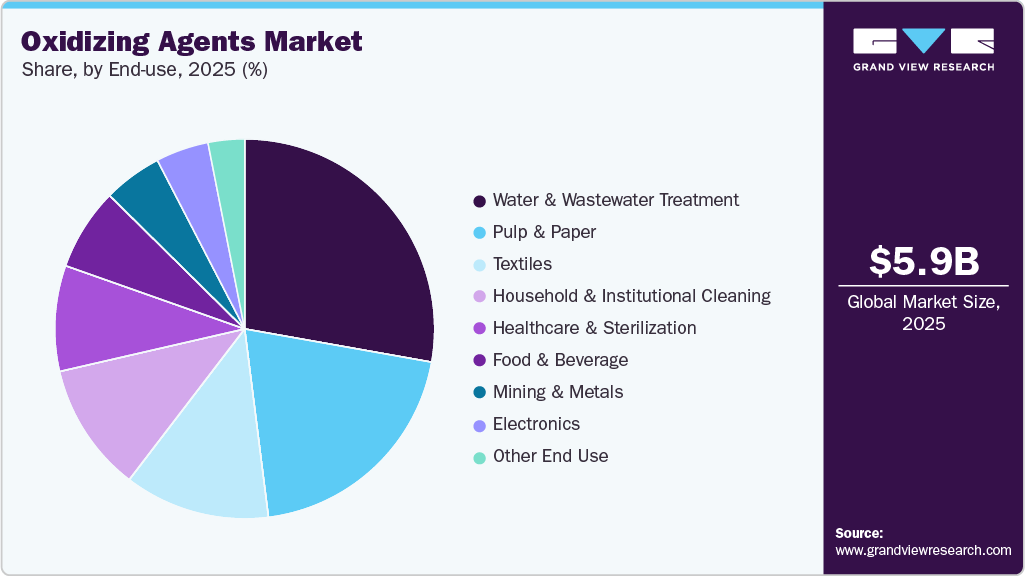
The healthcare and sterilization end use segment is likely to grow at the fastest CAGR of 8.1% over the forecast period, as oxidizing agents are essential for sterilization of medical equipment, surfaces, and water systems. Increasing global healthcare standards, regulatory mandates for infection control, and rising hospital and clinic infrastructure investments are driving demand for high-quality chemical disinfectants, making this one of the fastest-growing applications of oxidizing agents.
Regional Insights
The Asia Pacific oxidizing agents market the held the largest revenue share of 45.9% in 2025, due to rapid industrialization, urbanization, and growing investments in water and sanitation infrastructure. Expanding manufacturing, healthcare, and municipal water treatment initiatives in countries such as China and India are driving demand for oxidizing agents to support environmental compliance and public health programs.
The China oxidizing agents industry expansion is driven by rapid urbanization, industrial growth, and government initiatives to improve water quality, including large-scale municipal water treatment programs and industrial effluent control measures. Oxidizing agents are widely used to meet regulatory standards and support public health objectives.
North America Oxidizing Agents Market Trends
The oxidizing agents industry in North America is driven by stringent environmental regulations and advanced water treatment infrastructure, which require consistent use of oxidizing agents in municipal and industrial applications. Companies in the U.S. and Canada adopt these chemicals to meet federal and state standards for safe drinking water, wastewater management, and industrial effluent control.
U.S. Oxidizing Agents Market Trends
The U.S. oxidizing agents industry is supported by stringent federal and state water and environmental regulations, which require reliable oxidizing agents for drinking water, wastewater treatment, and industrial effluent management. Public health mandates and infrastructure modernization projects ensure steady demand.
Europe Oxidizing Agents Market Trends
The oxidizing agents industry in Europe is witnessing the fastest growth with the revenue CAGR of 7.8% during the forecast period. The market growth is supported by strict environmental standards and sustainability policies, which encourage the use of safe and effective oxidizing agents across industrial, municipal, and healthcare applications. The EU’s regulatory frameworks on water quality, chemical safety, and effluent discharge drive consistent demand from both private and public sectors.
The Germany oxidizing agents industry growth is driven by rigorous environmental and industrial regulations, as well as advanced chemical and wastewater treatment infrastructure. Oxidizing agents are extensively applied in municipal water treatment, industrial processes, and healthcare, aligning with sustainability and safety requirements.
Middle East & Africa Oxidizing Agents Market Trends
The oxidizing agents industry in the Middle East & Africa is driven by increasing investments in urban water infrastructure, industrialization, and public health initiatives. Governments are modernizing municipal water and wastewater treatment facilities, creating strong demand for oxidizing agents to ensure a clean water supply and regulatory compliance.
Latin America Oxidizing Agents Market Trends
The oxidizing agents industry in Latin America is fueled by infrastructure development and rising municipal water treatment needs, as countries invest in safe drinking water systems and sanitation projects. Regulatory agencies are enforcing standards for water quality and industrial effluents, driving the adoption of oxidizing chemicals for public health and industrial applications.
Key Oxidizing Agents Company Insights
The oxidizing agents market is led by major multinational chemical companies that leverage strong production, distribution, and technical capabilities. Strategic initiatives such as capacity expansion, sustainable product development, and partnerships with industrial and municipal clients help maintain market leadership and capture growing demand.
-
BASF is a global chemical leader with a diversified portfolio that includes oxidizing agents for industrial, water treatment, and healthcare applications. The company leverages its extensive R&D capabilities, integrated supply chain, and global manufacturing network to deliver reliable and compliant chemical solutions. Strategic focus on sustainability, process optimization, and partnerships with municipal and industrial clients positions BASF to maintain a strong presence in key markets worldwide.
-
Solvay S.A. produces oxidizing agents for sectors such as water treatment, healthcare, and industrial manufacturing. The company emphasizes innovation and sustainable product development, enabling it to meet stringent regulatory standards and evolving customer requirements. Solvay’s strategic investments in production efficiency and regional expansion support its market competitiveness and long-term growth.
Key Oxidizing Agents Companies:
The following key companies have been profiled for this study on the oxidizing agents market.
- BASF
- Solvay S.A.
- Evonik Industries AG
- AkzoNobel N.V.
- Arkema Group
- Dow
- Clariant AG
- Kemira Oyj
- Aditya Birla Chemicals
- PeroxyChem LLC
Recent Developments
-
In January 2024, Solvay, in collaboration with Huatai Chemical, expanded hydrogen peroxide production at the Shandong Huatai Interox site in China to 48 kilotons annually. The expansion supplied high-purity hydrogen peroxide for the photovoltaic industry, supporting solar cell manufacturing and cleaning processes, while aligning with China’s carbon neutrality objectives.
-
In November 2025, LANXESS launched its Oxone Monopersulfate Compound, a high-performance oxidizing agent designed for next-generation cold‑wash detergents. The product enhances stain removal at lower temperatures, enabling detergent manufacturers to offer energy-efficient and sustainable cleaning solutions. The company also highlighted its potential for broader applications in home care and other industries requiring strong oxidation performance.
Oxidizing Agents Market Report Scope
|
Report Attribute
|
Details
|
|
Market size value in 2026
|
USD 6.3 billion
|
|
Revenue forecast in 2033
|
USD 10.4 billion
|
|
Growth rate
|
CAGR of 7.5% from 2026 to 2033
|
|
Base year for estimation
|
2025
|
|
Historical data
|
2021 - 2024
|
|
Forecast period
|
2026 - 2033
|
|
Quantitative units
|
Revenue in USD million/billion, volume in kilotons, and CAGR from 2026 to 2033
|
|
Report coverage
|
Revenue forecast, volume forecast, company ranking, competitive landscape, growth factors, and trends
|
|
Segments covered
|
Product, end-use, region
|
|
Regional scope
|
North America; Europe; Asia Pacific; Middle East & Africa; Latin America
|
|
Country scope
|
U.S.; Canada; Mexico; Germany; UK; France; Italy; Spain; China; India; Japan; South Korea; Brazil; Argentina; South Africa; Saudi Arabia
|
|
Key companies profiled
|
BASF; Solvay S.A.; Evonik Industries AG; AkzoNobel N.V.; Arkema Group; Dow; Clariant AG; Kemira Oyj; Aditya Birla Chemicals; PeroxyChem LLC
|
|
Customization scope
|
Free report customization (equivalent up to 8 analysts’ working days) with purchase. Addition or alteration to country, regional & segment scope.
|
|
Pricing and purchase options
|
Avail customized purchase options to meet your exact research needs. Explore purchase options
|
Global Oxidizing Agents Market Report Segmentation
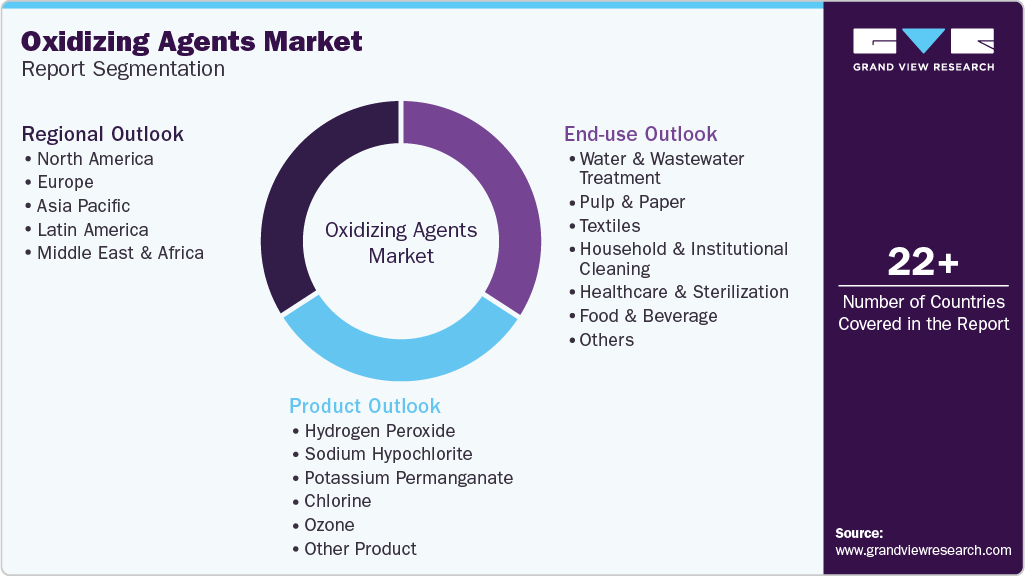
This report forecasts volume & revenue growth at global, regional, and country levels and provides an analysis of the latest industry trends in each of the sub-segments from 2021 to 2033. For this study, Grand View Research has segmented the global oxidizing agents market report based on product, end-use, and region:
-
Product Outlook (Volume, Kilotons; Revenue, USD Million, 2021 - 2033)
-
Hydrogen Peroxide
-
Sodium Hypochlorite
-
Potassium Permanganate
-
Chlorine
-
Ozone
-
Other Product
-
End-use Outlook (Volume, Kilotons; Revenue, USD Million, 2021 - 2033)
-
Water & Wastewater Treatment
-
Pulp & Paper
-
Textiles
-
Household & Institutional Cleaning
-
Healthcare & Sterilization
-
Food & Beverage
-
Mining & Metals
-
Electronics
-
Other End Uses
-
Regional Outlook (Volume, Kilotons; Revenue, USD Million, 2021 - 2033)
-
North America
-
Europe
-
Germany
-
UK
-
France
-
Italy
-
Spain
-
Asia Pacific
-
China
-
India
-
Japan
-
South Korea
-
Latin America
-
Middle East & Africa
-
Saudi Arabia
-
South Africa
Frequently Asked Questions About This Report
b. The global oxidizing agents market size was estimated at USD 5.9 billion in 2025 and is expected to reach USD 6.3 billion in 2026.
b. The oxidizing agents market is expected to grow at a compound annual growth rate of 7.5% from 2026 to 2033 to reach USD 10.4 billion by 2033.
b. Asia Pacific dominated the oxidizing agents market with revenue share of 45.9% in 2025, due to rapid industrialization, urbanization, and growing investments in water and sanitation infrastructure. Expanding manufacturing, healthcare, and municipal water treatment initiatives in countries like China and India are fueling demand for oxidizing agents to support environmental compliance and public health programs.
b. Some of the key players operating in the oxidizing agents market include BASF, Solvay S.A., Evonik Industries AG, AkzoNobel N.V., Arkema Group, Dow, Clariant AG, Kemira Oyj, Aditya Birla Chemicals, PeroxyChem LLC
b. The growing need for municipal and industrial water treatment is a key driver for oxidizing agents, which are essential for disinfection, contaminant removal, and compliance with public health regulations. Regulatory frameworks such as the U.S. EPA’s drinking water standards require effective chemical treatment, driving sustained demand for chlorine, chlorine dioxide, and other oxidizers. Increasing urbanization, water scarcity, and stricter effluent discharge limits further amplify market adoption across water utilities and industrial treatment facilities.
 Download Sample Report