- Home
- »
- Agrochemicals & Fertilizers
- »
-
Organic Fertilizers Market Size, Share, Industry Report 2033GVR Report cover
![Organic Fertilizers Market Size, Share & Trends Report]()
Organic Fertilizers Market (2026 - 2033) Size, Share & Trends Analysis Report By Product (Plant, Animal, Mineral), By Form (Solid, Liquid), By Application (Cereals & Grains, Oilseeds & Pulses, Fruits & Vegetables), By Region, And Segment Forecasts
- Report ID: GVR-4-68040-145-9
- Number of Report Pages: 80
- Format: PDF
- Historical Range: 2018 - 2024
- Forecast Period: 2026 - 2033
- Industry: Bulk Chemicals
- Report Summary
- Table of Contents
- Segmentation
- Methodology
- Download FREE Sample
-
 Download Sample Report
Organic Fertilizers Market Summary
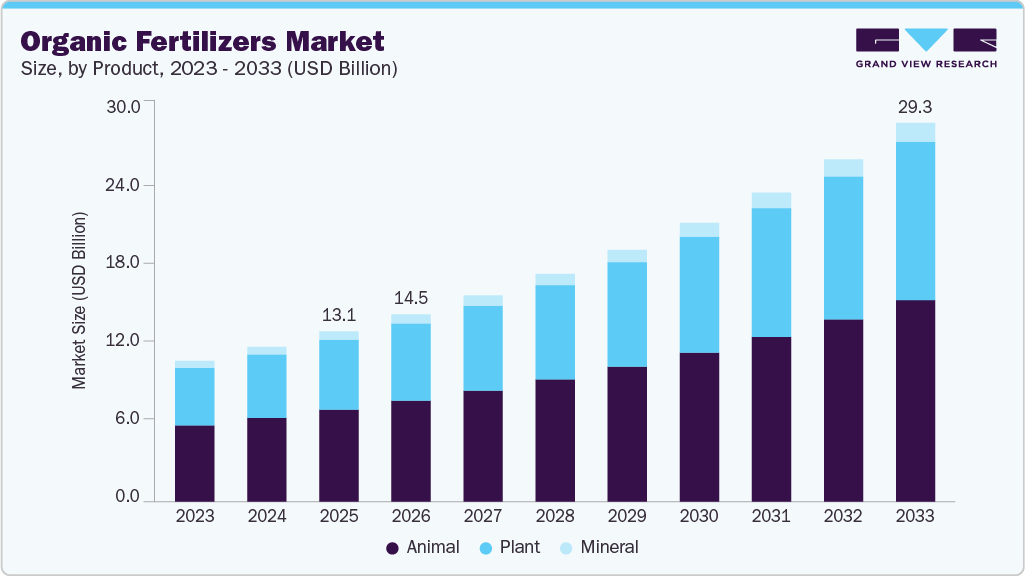
The global organic fertilizers market size was estimated at USD 13,153.2 million in 2025 and is projected to reach USD 29,262.4 million by 2033, growing at a CAGR of 10.6% from 2026 to 2033. Market growth is primarily driven by the rising focus on sustainable agricultural practices and the increasing demand to improve soil health and crop productivity amid growing global food requirements.
Key Market Trends & Insights
- Asia Pacific led the organic fertilizers market with the largest revenue share of 33.2% in 2025.
- China organic fertilizers market accounted for a significant share of 43.1% in 2025.
- By product, the animal-based fertilizers represent the dominant product segment in the global market, accounting for the largest revenue share of 54.0% in 2025.
- By application, the cereals & grains dominated the market with a revenue share of 41.5% in 2025.
- By form, the solid organic fertilizers dominate the global market by form, accounting for the largest revenue share of 65.6% in 2025.
Market Size & Forecast
- 2025 Market Size: USD 13,153.2 Million
- 2033 Projected Market Size: USD 29,262.4 Million
- CAGR (2026-2033): 10.6%
- Asia Pacific: Largest market in 2025
- Latin America: Fastest growing market
Farmers, agribusinesses, and governments are increasingly emphasizing organic inputs to enhance yield quality, restore soil fertility, and reduce dependency on synthetic chemicals. This growth is further supported by the expansion of organic farming, favorable government initiatives promoting eco-friendly agriculture, and growing awareness regarding the long-term benefits of organic fertilizers across major agricultural regions.A key application driving the growth of the industry is commercial agriculture, particularly in the cultivation of cereals, grains, oilseeds, and other large-scale crops. With increasing pressure to enhance soil productivity, improve crop yields, and maintain long-term land fertility, farmers are increasingly adopting organic fertilizers as a sustainable nutrient management solution. These inputs help improve soil structure, microbial activity, and nutrient availability, thereby supporting consistent crop performance and profitability. In addition, agricultural producers are aligning with evolving regulatory frameworks and sustainable farming practices to reduce reliance on synthetic inputs and meet environmental standards. Consequently, large-scale and mechanized farming operations continue to represent one of the most commercially significant application areas within the global industry.
In horticulture and specialty crop production, including fruits, vegetables, and plantation crops, demand for organic fertilizers is steadily increasing due to the intensive nutrient requirements and sensitivity of these crops to soil health conditions. Growers are increasingly adopting high-quality organic inputs to enhance crop quality, improve yield consistency, and maintain soil vitality without compromising environmental safety. The growing emphasis on premium produce, export-quality standards, and compliance with food safety regulations has further encouraged the use of organic fertilizers in these segments. Additionally, the gradual shift toward residue-free cultivation and environmentally friendly farming practices continues to support market growth across high-value crop applications.
Market Concentration & Characteristics
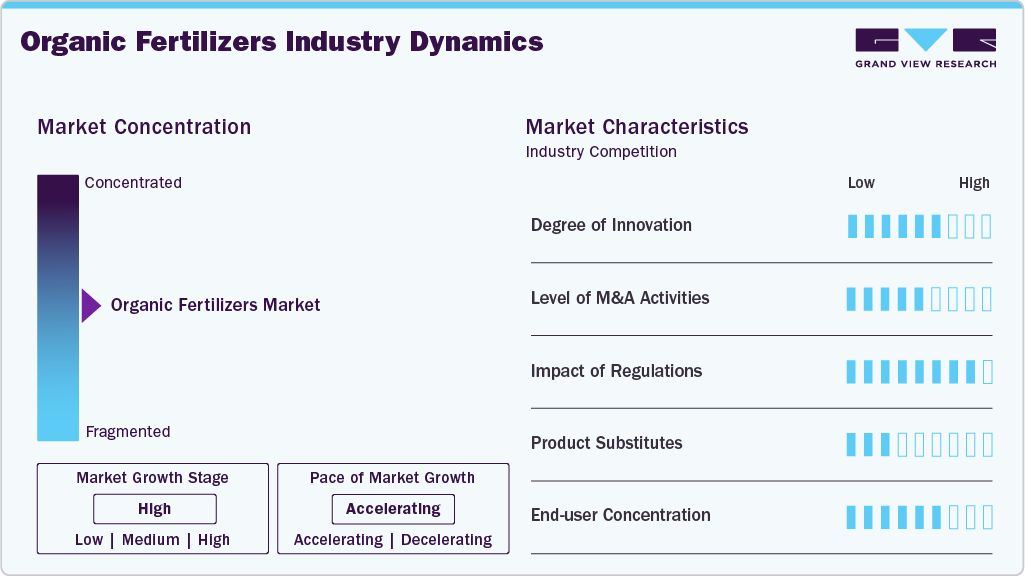
The organic fertilizers industry is moderately fragmented, with market leadership concentrated among several established and vertically integrated agricultural input manufacturers. These key players benefit from economies of scale, strong in-house research and development capabilities, access to diverse organic raw materials, and extensive global distribution networks to maintain a competitive edge. Their integration across the organic fertilizer value chain, from raw material sourcing and processing to formulation, packaging, and distribution, enables improved cost efficiency, consistent product quality, and reliable supply. This strategic positioning allows companies to effectively cater to a wide range of agricultural applications, including cereals and grains, oilseeds, fruits and vegetables, and plantation crops, thereby strengthening their market presence and supporting the broader adoption of sustainable nutrient management solutions globally.
At the same time, emerging players in Asia Pacific, Latin America, and the Middle East & Africa are steadily expanding their presence in the organic fertilizers market by leveraging cost-efficient manufacturing capabilities, favorable agro-climatic conditions, and rising domestic demand for sustainable agricultural inputs. These regional manufacturers are supported by targeted investments in organic processing facilities, raw material sourcing, and localized distribution networks strategically positioned near major agricultural hubs. Their focus is on delivering cost-effective and scalable organic fertilizer solutions across high-demand crop segments such as cereals and grains, oilseeds, fruits and vegetables, and plantation crops. This evolving landscape characterized by global consolidation among established multinational players alongside regionally driven expansion, continues to reshape the competitive dynamics of the global industry.
Product Insights
Animal-based fertilizers represent the dominant product segment in the global market, accounting for the largest revenue share of 54.0% in 2025. This dominance is primarily attributed to their widespread availability, high organic nutrient content, and proven effectiveness in improving soil structure and fertility across major crops, including cereals, grains, and oilseeds. Animal-based fertilizers such as manure, bone meal, and blood meal provide essential macro- and micronutrients while enhancing microbial activity, making them a cost-effective and reliable nutrient source for large-scale agricultural operations. Their broad applicability and long-standing acceptance among farmers have supported their extensive adoption across both developed and emerging agricultural markets.
In addition to animal-based fertilizers, plant-based and mineral-based organic fertilizers continue to witness steady demand due to the growing emphasis on balanced nutrient management and soil health improvement. Plant-based fertilizers contribute to improved organic matter content and gradual nutrient release, while mineral-based organic inputs are increasingly used to address specific soil nutrient deficiencies. Furthermore, increasing regulatory support and sustainability initiatives are encouraging the adoption of certified organic and bio-based fertilizer products that offer improved environmental performance while supporting long-term crop productivity. Together, these product categories enable farmers to optimize nutrient application, improve yield quality, and comply with evolving agricultural and environmental standards worldwide.
Form Insights
Solid organic fertilizers dominate the global market by form, accounting for the largest revenue share of 65.6% in 2025. This dominance is primarily driven by their ease of handling, longer shelf life, and widespread availability across agricultural regions. Solid forms such as compost, manure, pellets, and granules are extensively used in large-scale farming due to their cost-effectiveness and suitability for soil application prior to sowing. These fertilizers support gradual nutrient release, improve soil structure, and enhance microbial activity, making them particularly effective for cereals, grains, and oilseeds.
In addition to solid forms, liquid organic fertilizers are witnessing steady growth due to their rapid nutrient availability and ease of application through foliar spraying and fertigation systems. Liquid formulations are increasingly adopted in horticulture and high-value crops, including fruits and vegetables, where precise nutrient delivery and quick plant uptake are critical. Furthermore, advancements in formulation technologies and growing awareness regarding efficient nutrient management are supporting the adoption of liquid organic fertilizers, particularly in controlled and intensive farming systems. Together, both solid and liquid forms enable farmers to tailor nutrient application strategies in line with crop requirements and sustainability objectives.
Application Insights
Cereals and grains represent the dominant application segment in the market, accounting for the largest revenue share of 41.5% in 2025. This dominance is primarily driven by the extensive cultivation of staple crops such as wheat, rice, maize, and barley, which require sustained nutrient input to maintain soil fertility and achieve stable yields. Organic fertilizers are increasingly used in cereal and grain production to improve soil organic matter, enhance nutrient availability, and support long-term land productivity, particularly in regions facing soil degradation due to intensive farming practices.
In addition to cereals and grains, oilseeds, pulses, fruits, and vegetables continue to generate steady demand for organic fertilizers due to their rising cultivation area and increasing emphasis on quality produce. High-value crops, in particular, benefit from organic nutrient inputs that enhance crop quality, support balanced growth, and align with organic and residue-free farming standards. Also, the growing consumer preference for sustainably produced food, along with supportive government initiatives promoting organic agriculture, continues to encourage the adoption of organic fertilizers across diverse crop applications worldwide.
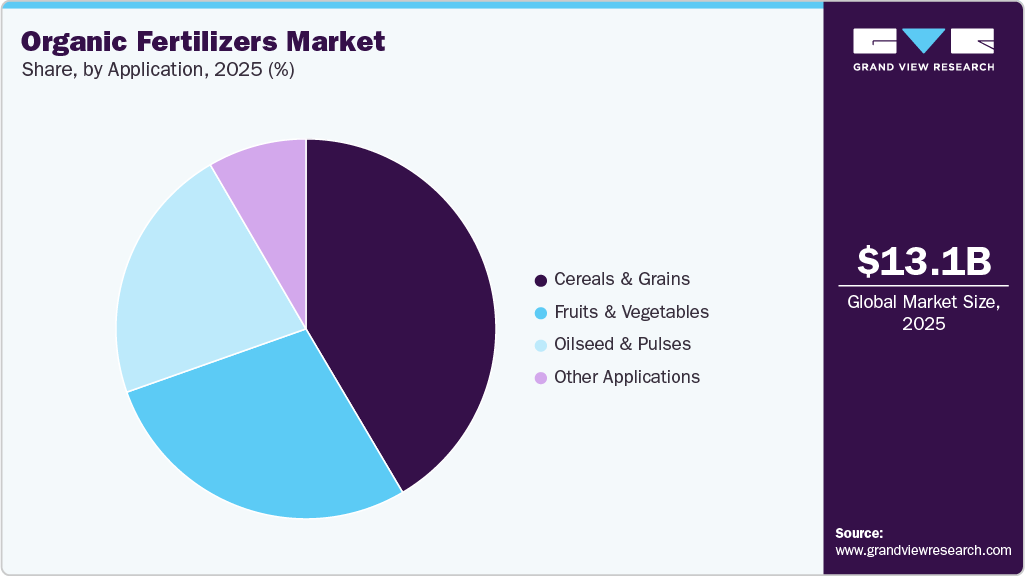
Fruits and vegetables represent the second-largest application segment in the global organic fertilizers market, supported by the rising cultivation of high-value horticultural crops across key agricultural regions. These crops require intensive nutrient management and are highly sensitive to soil health, making organic fertilizers an effective solution for improving nutrient availability, enhancing soil structure, and supporting consistent crop growth. The use of organic fertilizers helps improve quality, yield uniformity, and shelf life, which is particularly important for meeting premium market and export requirements.
In addition, the growing emphasis on residue-free produce, organic certification, and compliance with food safety standards has accelerated the adoption of organic fertilizers in fruits and vegetables. Growers are increasingly focusing on sustainable nutrient inputs that enhance soil microbial activity while minimizing environmental impact. Furthermore, increasing consumer preference for organically grown fruits and vegetables, along with supportive government initiatives promoting sustainable horticulture, continues to strengthen demand for organic fertilizers within this application segment globally.
Regional Insights
Asia Pacific dominated the global organic fertilizers market, accounting for a 33.2% value share in 2025, driven primarily by the region’s vast agricultural land base and extensive cultivation of staple and commercial crops such as rice, wheat, maize, fruits, and vegetables. The region’s strong dependence on agriculture, coupled with increasing pressure to improve soil fertility and crop productivity, has led to rising adoption of organic fertilizers as part of sustainable nutrient management practices. Countries such as China and India play a central role in regional market growth due to their large farming populations, expanding organic farming acreage, and growing focus on environmentally responsible agriculture.
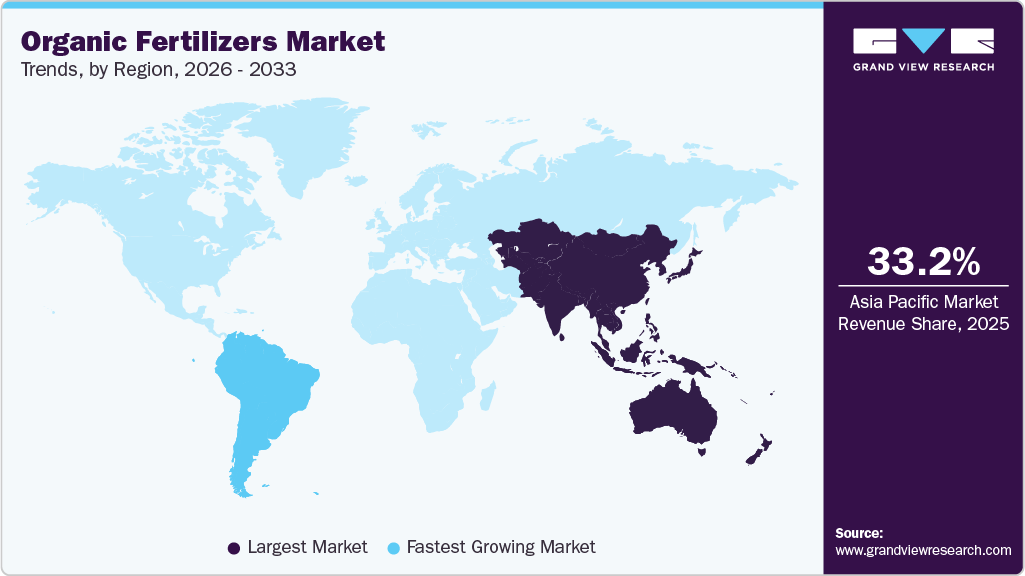
Growth in Asia Pacific is further supported by increasing awareness among farmers regarding soil health restoration, long-term yield stability, and the reduction of chemical fertilizer usage. The widespread application of organic fertilizers across cereals and grains, horticulture, and plantation crops has become an integral component of nutrient management strategies in the region. In addition, supportive government initiatives promoting organic inputs, expanding rural distribution networks, and the presence of both multinational and regional organic fertilizer manufacturers are improving product accessibility and adoption. Ongoing investments in sustainable agriculture and the gradual integration of improved farming practices continue to strengthen Asia Pacific’s leading position in the global market.
China Organic Fertilizers Market Trends
China organic fertilizers market accounted for a significant share of 43.1% in 2025, driven by the country’s extensive cultivation of staple crops such as rice, wheat, maize, and a wide range of fruits and vegetables. China’s large agricultural base, combined with growing concerns over soil degradation and excessive chemical fertilizer usage, has accelerated the adoption of organic fertilizers to improve soil fertility and support sustainable crop production. The increasing shift toward environmentally responsible farming practices has positioned organic fertilizers as a key input across both large-scale and smallholder farming systems.
The use of organic fertilizers in China is further supported by strong government initiatives promoting organic and green agriculture, soil health restoration programs, and reduced reliance on synthetic inputs. Domestic manufacturers and agricultural cooperatives are expanding production capacity and introducing improved organic fertilizer formulations to meet rising demand across major farming regions. In addition, well-established distribution networks, favorable agro-climatic conditions, and ongoing investments in modern agricultural technologies continue to reinforce China’s leading role within the Asia Pacific organic fertilizers market.
North America Organic Fertilizers Market Trends
The organic fertilizers market in North America emerged as the second-largest regional market in 2025, accounting for a 27.9% value share, supported by well-established agricultural infrastructure and the rising adoption of sustainable farming practices across the region. The United States and Canada represent the key contributors, driven by increasing organic acreage and growing use of organic fertilizers in the cultivation of cereals, grains, fruits, and vegetables. The region’s strong focus on soil health management and environmentally responsible agriculture continues to support steady demand for organic nutrient inputs across both commercial and specialty crop farming systems.
Market growth in North America is further strengthened by supportive government policies promoting organic farming, increasing awareness regarding long-term soil fertility, and well-developed distribution channels that ensure easy access to organic fertilizer products. In addition, the presence of established organic fertilizer manufacturers and ongoing investments in product innovation are enhancing formulation quality and application efficiency. Advancements in precision agriculture, along with the integration of data-driven nutrient management practices, are expected to further support the North America organic fertilizers market, reinforcing its position as the second-largest region globally.
U.S. organic fertilizers market has witnessed steady growth, driven by the need to enhance agricultural productivity while adhering to sustainable farming practices and organic certification standards. Farmers across the country rely on organic fertilizers to improve soil health and support crop growth across major crops such as corn, soybean, wheat, and fruits and vegetables. The widespread adoption of modern farming techniques and precision nutrient management has further increased demand for effective and targeted organic fertilizer solutions.
Europe Organic Fertilizers Market Trends
The organic fertilizers market in Europe emerged as the third-largest regional market, accounting for a 22.9% value share in 2025, driven by the increasing emphasis on sustainable agriculture, soil health restoration, and compliance with stringent environmental and food safety regulations. Countries such as Germany, France, and Italy are major contributors, with widespread adoption of organic fertilizers across cereals, grains, fruits, and vegetables. The growing focus on organic farming and reducing synthetic input usage continues to support demand across both commercial and smallholder farming systems.
Market growth in Europe is further strengthened by supportive government policies promoting organic agriculture, well-established distribution networks, and increasing awareness regarding long-term soil fertility and sustainable nutrient management. In addition, the presence of leading regional and multinational organic fertilizer manufacturers, along with ongoing investments in innovative formulations and application technologies, is enhancing product quality and accessibility. Advancements in precision agriculture and integrated farm management practices are expected to further reinforce Europe’s position as a key market within the global organic fertilizers landscape.
Germany organic fertilizers market growth is shaped by Germany’s focus on sustainable agriculture, soil health improvement, and the adoption of eco-friendly organic fertilizers that enhance nutrient availability and reduce dependency on synthetic inputs. Leading organic fertilizer manufacturers are investing in advanced formulations that provide balanced nutrition, improve soil structure, and support regulatory compliance while minimizing environmental impact. Additionally, strong research and development infrastructure, government support for sustainable farming practices, and increasing awareness among farmers regarding efficient nutrient management continue to strengthen Germany’s position as a key market within Europe and the global organic fertilizers landscape.
Latin America Organic Fertilizers Market Trends
The organic fertilizers market in Latin America is supported by government initiatives and regulatory frameworks that encourage the use of sustainable and eco-friendly organic fertilizers. Farmers and agribusinesses are increasingly adopting animal, plant, and mineral-based organic fertilizers to improve soil fertility, enhance crop productivity, and comply with environmental and food safety standards. In addition, growing awareness of sustainable nutrient management practices, precision farming, and environmentally responsible agriculture continues to drive demand for effective and targeted organic fertilizer solutions across Latin America.
Middle East And Africa Organic Fertilizers Market Trends
The organic fertilizers market in the Middle East & Africa is further supported by government initiatives and programs promoting sustainable agriculture and soil fertility enhancement. Farmers and agribusinesses are increasingly adopting organic fertilizers to improve nutrient availability, support crop productivity, and comply with environmental and food safety standards. In addition, growing awareness of efficient nutrient management practices, water-conserving techniques, and environmentally responsible farming continues to drive demand for effective and targeted organic fertilizer solutions across the MEA region.
Key Organic Fertilizers Company Insights
Key players operating in the organic fertilizers market are undertaking various initiatives to strengthen their presence and increase the reach of their products and services. Strategies such as expansion activities and partnerships are key in propelling the market growth.
Key Organic Fertilizers Companies:
The following key companies have been profiled for this study on the organic fertilizers market.
- Lallemand Inc.
- T Stanes & Company Limited
- Madras Fertilizers Limited
- Cropmate Fertilizers Sdn Bhd
- Midwestern BioAg
- Biostar Renewables, LLC
- NatureSafe
- Biolchim Spa
- Rizobacter Argentina S.A.
- PT Pupuk Kalimantan Timur
Recent Developments
- In January 2026, GS Plant Foods launched a new OMRI-listed Organic Liquid Kelp Concentrate made from Norwegian Ascophyllum nodosum for home vegetable gardeners. The cold-processed formula delivers over 60 trace minerals and natural growth hormones, enhancing plant growth and soil health. This launch expands GS Plant Foods’ portfolio of all-natural, award-winning organic fertilizers, catering to the growing demand for sustainable and high-quality nutrient solutions. Such product innovations drive market growth by increasing the adoption of organic fertilizers among home gardeners and small-scale farmers, promoting soil fertility, and supporting the shift toward eco-friendly and residue-free farming practices.
Organic Fertilizers Market Report Scope
Report Attribute
Details
Market size value in 2026
USD 14,468.5 million
Revenue forecast in 2033
USD 29,262.4 million
Growth rate
CAGR of 10.6% from 2026 to 2033
Base year for estimation
2025
Historical data
2018 - 2024
Forecast period
2026 - 2033
Quantitative units
Volume in kilotons, revenue in USD million/billion, and CAGR from 2026 to 2033
Report coverage
Volume & revenue forecast, company ranking, competitive landscape, growth factors, and trends
Segments covered
Product, form, application, region
Regional scope
North America; Europe; Asia Pacific; Middle East & Africa; Latin America
Country scope
U.S.; Canada; Mexico; Germany; France; Spain; Italy; UK; China; India; Japan; South Korea; Brazil; Argentina; South Africa; Saudi Arabia
Key companies profiled
PT Pupuk Kalimantan Timur; Lallemand Inc.; T Stanes & Company Limited; Madras Fertilizers Limited; Cropmate Fertilizers Sdn Bhd; Midwestern BioAg; Biostar Renewables, LLC; NatureSafe; Biolchim Spa; Rizobacter Argentina S.A.
Customization scope
Free report customization (equivalent up to 8 analysts’ working days) with purchase. Addition or alteration to country, regional & segment scope.
Pricing and purchase options
Avail customized purchase options to meet your exact research needs. Explore purchase options
Global Organic Fertilizers Market Report Segmentation
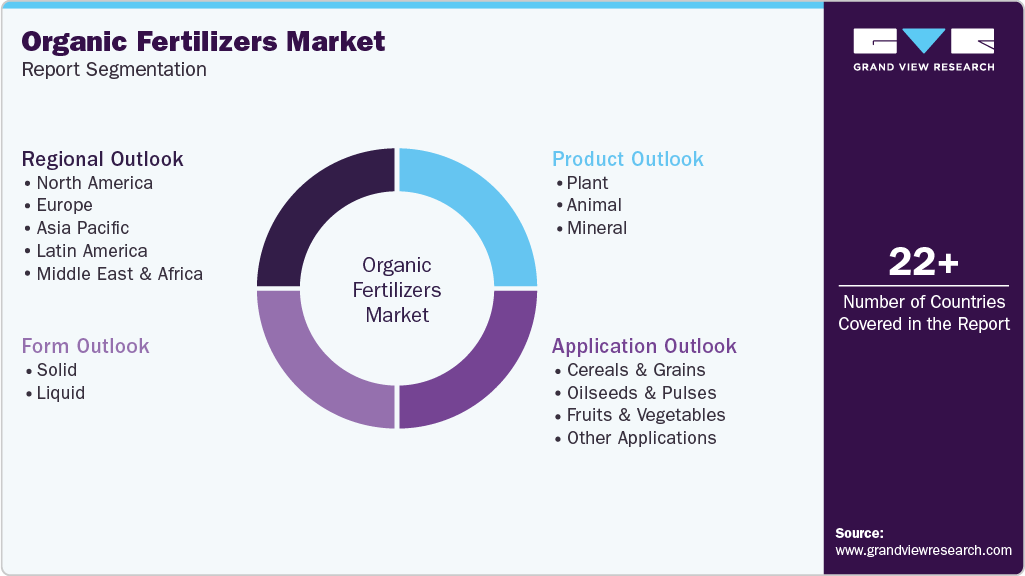
This report forecasts volume & revenue growth at global, regional, and country levels and provides an analysis of the latest industry trends in each of the sub-segments from 2018 to 2033. For this study, Grand View Research has segmented the global organic fertilizers market report based on product, form, application, and region:
-
Product Outlook (Volume, Kilotons; Revenue, USD Million, 2018 - 2033)
-
Plant
-
Compost
-
Seaweed
-
Cottonseed Meal
-
Other Plant-based Fertilizers
-
-
Animal
-
Blood/ Bone Meal
-
Manure
-
Fish Meal
-
Other Animal-based Fertilizers
-
-
Mineral
-
Green Sand
-
Rock Phosphate
-
Other Mineral-based Fertilizers
-
-
-
Form Outlook (Volume, Kilotons; Revenue, USD Million, 2018 - 2033)
-
Solid
-
Liquid
-
-
Application Outlook (Volume, Kilotons; Revenue, USD Million, 2018 - 2033)
-
Cereals & Grains
-
Oilseeds & Pulses
-
Fruits & Vegetables
-
Other Applications
-
-
Regional Outlook (Volume, Kilotons; Revenue, USD Million, 2018 - 2033)
-
North America
-
U.S.
-
Canada
-
Mexico
-
-
Europe
-
Germany
-
France
-
Spain
-
Italy
-
UK
-
-
Asia Pacific
-
China
-
India
-
Japan
-
South Korea
-
-
Latin America
-
Brazil
-
Argentina
-
-
Middle East & Africa
-
Saudi Arabia
-
South Africa
-
-
Frequently Asked Questions About This Report
b. The global organic fertilizers market size was estimated at USD 13,153.2 million in 2025 and is expected to reach USD 14,468.5 million in 2026.
b. The global organic fertilizers market is expected to grow at a compound annual growth rate of 10.6% from 2026 to 2033 to reach USD 29,262.4 million by 2033.
b. The animal-based fertilizers segment held the largest share of 54.0% in 2025. This high share is primarily attributed to the widespread use of animal-based fertilizers due to their high nutrient content, cost-effectiveness, and ability to improve soil fertility across large cultivation areas. Given the focus on sustainable and productive farming, especially among small- and medium-scale agricultural producers, animal-based fertilizers are commonly preferred as a primary nutrient input. Over the forecast period, this continued reliance on animal-based fertilizers is expected to significantly influence overall market growth.
b. Some of the key players operating in the market include PT Pupuk Kalimantan Timur, Lallemand Inc., T Stanes & Company Limited, Madras Fertilizers Limited, Cropmate Fertilizers Sdn Bhd, Midwestern BioAg, Biostar Renewables, LLC, NatureSafe, Biolchim Spa, Rizobacter Argentina S.A.
b. Key factors driving the growth of the organic fertilizers market include the expansion of agricultural activities and increasing mechanization in developing economies across Asia Pacific and Latin America, which are boosting demand for sustainable nutrient management solutions and soil fertility enhancement.


Share this report with your colleague or friend.
Need a Tailored Report?
Customize this report to your needs — add regions, segments, or data points, with 20% free customization.


ISO 9001:2015 & 27001:2022 Certified
We are GDPR and CCPA compliant! Your transaction & personal information is safe and secure. For more details, please read our privacy policy.
Trusted market insights - try a free sample
See how our reports are structured and why industry leaders rely on Grand View Research. Get a free sample or ask us to tailor this report to your needs.