- Home
- »
- Display Technologies
- »
-
Optical Metasurface Market Size, Industry Report, 2033GVR Report cover
![Optical Metasurface Market Size, Share & Trends Report]()
Optical Metasurface Market (2026 - 2033) Size, Share & Trends Analysis Report By Component (Metalenses, Beam Deflectors, Polarization Converters, Meta-holograms), By Material, By Application, By End-use, (Commercial, Industrial, Research & Academia), By Region, And Segment Forecasts
- Report ID: GVR-4-68040-867-4
- Number of Report Pages: 150
- Format: PDF
- Historical Range: 2021 - 2024
- Forecast Period: 2026 - 2033
- Industry: Semiconductors & Electronics
- Report Summary
- Table of Contents
- Segmentation
- Methodology
- Download FREE Sample
-
 Download Sample Report
Optical Metasurface Market Summary
The global optical metasurface market size was valued at USD 170.2 million in 2025 and is projected to reach USD 647.7 million by 2033, growing at a CAGR of 17.8% from 2026 to 2033. This growth is primarily driven by the increasing need for compact, lightweight, and high‑performance optical components across sectors such as consumer electronics, AR/VR, sensing, and imaging.
Key Market Trends & Insights
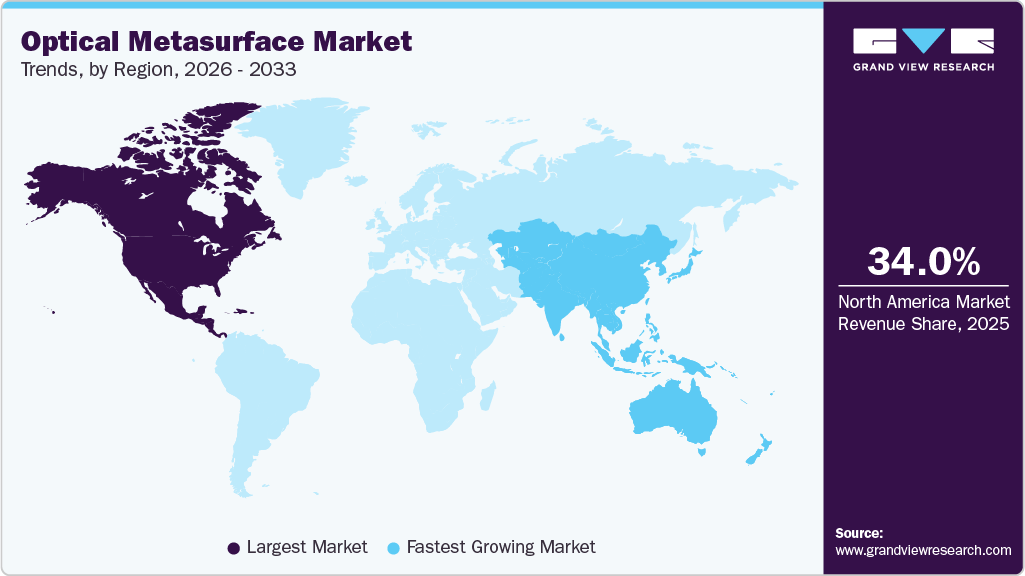
- North America dominated the global optical metasurface market with the largest revenue share of over 34% in 2025.
- The optical metasurface market in the U.S. led the North America market and held the largest revenue share in 2025.
- By component, the metalenses segment accounted for the largest share of over 37% in 2025.
- By application, the AR & VR segment is expected to grow at the fastest CAGR of 21.1% from 2026 to 2033.
- By material, the dielectric metasurfaces segment held the dominant position in the market and accounted for the leading revenue share of 50.5% in 2025.
- By end use, the commercial segment is projected to register the fastest CAGR of 19.5 from 2026 to 2033.
Market Size & Forecast
- 2025 Market Size: USD 170.2 Million
- 2033 Projected Market Size: USD 647.7 Million
- CAGR (2026-2033): 17.8%
- North America: Largest Market in 2025
- Asia Pacific: Fastest Growing Market
In addition, rising R&D investments in photonics and nanofabrication, expanding applications in AR/VR headsets, automotive LiDAR, medical imaging, and secure optical systems, and the gradual transition of lab‑scale metasurface designs into volume‑manufacturable components for industrial and consumer markets are the key factors driving the overall market growth.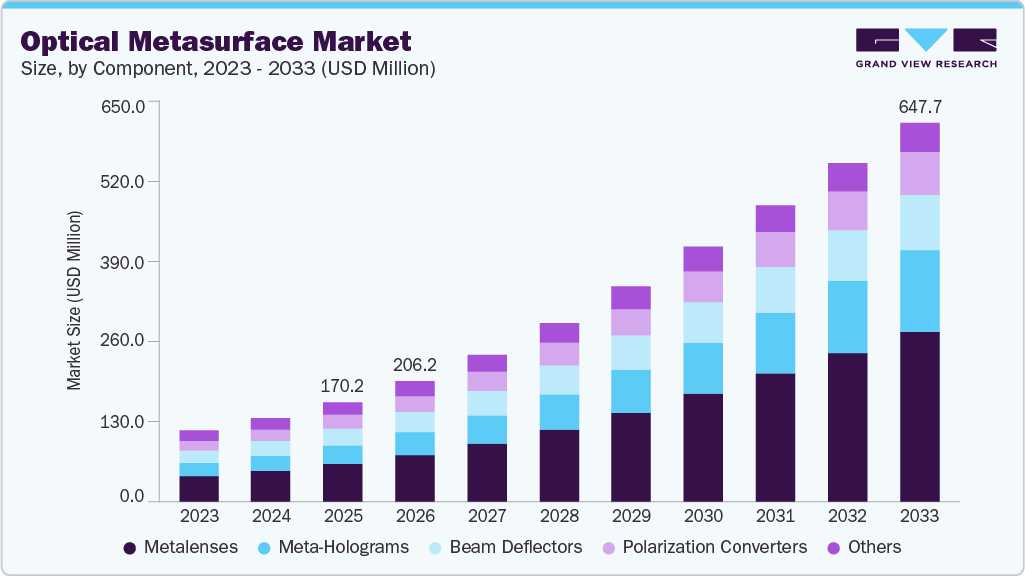
Besides, metasurfaces are rapidly becoming critical in emerging optical applications such as 4D LiDAR, holography, imaging systems, and AR/VR. Technologies such as Lumotive’s Light Control Metasurfaces are enabling solid‑state LiDAR with fast, electronic beam steering, advancing autonomous vehicles and robotics. Meta‑holograms and metalenses enrich AR/VR optics by improving field‑of‑view, resolution, and form‑factor. These futuristic use cases are major contributors to long‑term growth in the optical metasurface industry.
Furthermore, the growing integration of AI and machine learning for inverse design and optimization is accelerating development cycles and performance gains. Traditional trial-and-error methods are giving way to generative AI platforms such as those from Metalenz and Optica, which simulate billions of nanostructures to achieve unprecedented efficiency in metalenses and beam shapers. With AI tools becoming more accessible via cloud-based services, startups and incumbents alike are scaling rapid prototyping, further democratizing metasurface adoption in consumer electronics, biomedical imaging, and next-gen telecommunications.
Moreover, industry collaborations are shaping the expansion of the optical metasurface industry, with major semiconductor firms, optics innovators, and display manufacturers entering into partnerships. For instance, in February 2026, Kymeta Corporation and Japan Display Inc. (JDI) announced a master supply agreement. This partnership develops next-generation multi-band meta-surface apertures for Ku/Ka-band satellite communications, targeting defense first, then commercial applications. These partnerships accelerate commercialization, enhance R&D capabilities, and broaden the deployment scope of metasurface technologies across communications, defense, and automotive sectors.
Component Insights
The metalenses segment dominated the market, accounting for over 37% in 2025, driven by growing demand for ultra‑thin, lightweight, and aberration‑corrected lenses that can replace bulky traditional optics in consumer electronics, imaging, and sensing systems. Furthermore, advancements in nanofabrication are enabling cost‑effective mass production of high‑numerical‑aperture metalenses, pushing adoption in smartphone cameras, AR/VR headsets, LiDAR, and compact medical imaging devices, thereby driving the segmental growth.
The meta holograms segment is expected to grow at a significant CAGR of over 20% from 2026 to 2033. This growth can be attributed to the heightened need for high‑resolution, dynamic, and compact holographic displays and security features that can be embedded into screens, labels, and optical encryption systems. Growing enhancements in reconfigurable metasurfaces and fast modulation techniques are enabling switchable and video‑rate holograms for AR/VR, head‑up displays, and next‑generation 3D visualization, which is expected to drive the segmental growth in the coming years.
Material Insights
The dielectric metasurfaces segment dominated the market in 2025, driven by the need for low‑loss, high‑efficiency flat optics that can replace bulky refractive elements in imaging, sensing, and on‑chip photonics. In addition, the design of multi‑wavelength and polarization‑tunable dielectric arrays, integration with nonlinear and quantum‑photonic circuits, and the use of quasi‑bound‑states‑in‑the‑continuum (quasi‑BIC) modes for ultra‑high‑Q sensors and lab‑on‑a‑chip diagnostics are among the key trends driving the segmental growth.
The hybrid metasurfaces segment is projected to grow rapidly from 2026 to 2033. This growth can be attributed to the growing demand for dynamically reconfigurable optics in LiDAR, AR/VR, and adaptive imaging systems. Emerging trends include electrically or optically tuned hybrid metasurfaces for real‑time beam steering, multi‑modal imaging, and programmable meta‑holograms, as well as hybrid designs tailored for nonlinear and quantum‑optical applications where both field confinement and low dissipation are critical. These trends are expected to drive the segmental growth in the coming years.
Application Insights
The AR & VR segment dominated the market in 2025, driven by the need for ultra‑thin, lightweight, and high‑performance flat optics that replace bulky lens stacks in near‑eye displays, resulting in more compact and comfortable AR glasses and VR headsets. Metasurface‑based metalenses and holographic combiners enable wide fields of view, multi‑depth focus, and vision‑corrected optics while reducing system size and weight, accelerating adoption in consumer wearables, industrial AR tools, and enterprise‑level immersive training and visualization platforms. Growing investments in spatial computing, 3D sensing, and waveguide‑integrated meta‑optics are expected to drive segmental growth in the coming years.
The holography segment is expected to register a significant CAGR from 2026 to 2033. This growth can be attributed to rising demand for compact, high-resolution 3D displays and dynamic meta‑holograms in AR/VR, digital signage, medical visualization, and security applications. Advances in dielectric and hybrid metasurfaces enable full‑color, multi‑depth, and polarization‑multiplexed holograms that can be integrated into waveguides, transparent screens, and lab‑on‑chip systems, driving adoption in consumer electronics, anti‑counterfeiting, and optical encryption.
End-use Insights
The commercial segment dominated the market in 2025, driven by growing demand for miniaturized, high‑performance flat optics in consumer electronics, AR/VR, automotive LiDAR, telecommunications, and healthcare devices. Metasurface‑based metalenses, holograms, and beam‑shaping elements are replacing bulky conventional optics in smartphones, cameras, head‑worn displays, and sensing systems, while improving performance, reducing weight, and enabling new form factors such as glasses‑like AR, which is expected to further drive the segmental growth in the coming years.
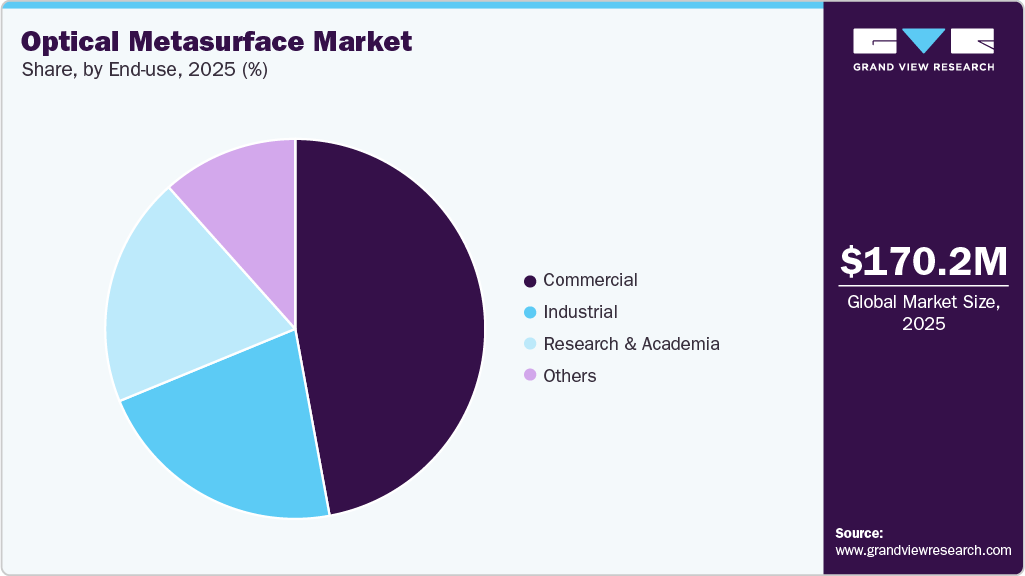
The research & academia segment is expected to grow at a notable CAGR from 2026 to 2033, owing to the sustained government and institutional funding for photonics, nanophotonics, and quantum‑optics programs that support exploratory metasurface projects at universities and national labs. Expanding collaborations between academic groups and industry players are accelerating the development of dielectric, hybrid, and tunable metasurfaces for advanced imaging, sensing, AR/VR, and on‑chip optical systems, while shared fabrication facilities and AI‑driven design platforms are reducing barriers to prototyping and experimentation.
Regional Insights
The North America optical metasurface market dominated the global market with a share of over 34% in 2025, driven by robust R&D ecosystems, defense investments such as U.S. Department of Defense funding for stealth and communication metasurfaces, and high demand from the AR/VR, consumer electronics, aerospace, and healthcare sectors. Key players such as Metalenz and Lumotive are advancing solid-state LiDAR and compact optics, driven by university-industry collaborations and the precision optics needs of telecommunications.
U.S. Optical Metasurface Market Trends
The U.S. optical metasurface industry accounted for the largest share of over 80% in 2025, driven by a sophisticated research ecosystem involving top universities and institutions, coupled with surging demand from consumer electronics, defense, aerospace, telecommunications, AR/VR, LiDAR for autonomous vehicles, and healthcare imaging sectors.
Europe Optical Metasurface Market Trends
The optical metasurface industry in Europe accounted for a share of over 24% in 2025, driven by government‑backed photonics initiatives that fund metasurface projects in healthcare, biophotonics, and optical communications. Strong research ecosystems in countries such as Germany, France, the Netherlands, and Sweden are advancing dielectric and hybrid metasurface technologies for lab‑on‑chip diagnostics, compact imaging systems, and low‑loss waveguide‑integrated optics.
The UK optical metasurface industry is rapidly growing, supported by national photonics and quantum‑technology programs that fund metasurface research in areas such as biophotonics, sensing, and secure optical communications. Leading universities and photonics hubs in regions such as Cambridge, Oxford, and Glasgow are developing compact metasurface‑based imaging systems, miniaturized spectroscopy tools, and AR/VR‑oriented flat optics.
The optical metasurface industry in Germany is expected to grow at a significant rate in the coming years, backed by strong industrial‑photonics clusters and public funding under programs linked to the EU’s Horizon framework and national initiatives in photonics and micro‑opto‑electromechanical systems (MOEMS). German research institutes and companies are advancing dielectric and hybrid metasurfaces for high‑precision imaging, LiDAR, and optical metrology, with applications in automotive, industrial automation, and medical.
Asia Pacific Optical Metasurface Market Trends
The optical metasurface industry in the Asia Pacific is expected to grow at the fastest rate of over 20% from 2026 to 2033, driven by massive manufacturing hubs in electronics, automotive, and textiles that require export compliance to EU standards, alongside rapid digital infrastructure rollout via 5G and IoT investments across emerging economies such as India and Indonesia.
The China optical metasurface industry is expanding rapidly with massive state investments through the Made in China 2025 initiative, driving low-cost, high-volume fabrication for consumer displays, 5G telecom, and surveillance optics. Trends emphasize rapid scaling by firms like Nanjing Technology, supported by domestic semiconductor supply chains, enabling aggressive adoption in smartphones, drones, and AR glasses.
The optical metasurface industry in Japan is growing in popularity, driven by companies' growing focus on AR/VR displays, holography, and satellite communications through strategic partnerships. The growing popularity of robotics imaging and automotive beam-steering LiDAR, with government R&D via NEDO enhancing nanofabrication for compact, high-resolution optics in consumer electronics and automation are key drivers expected to accelerate the market growth in the coming years.
Key Optical Metasurface Company Insights
Some of the key players in the optical metasurface industry include Metalenz and ST Micorelectronics.
-
Metalenz is a pioneering metasurface optics company founded in 2016 as a Harvard Capasso Lab spin-off, holding exclusive IP licenses for commercializing flat meta-optics that replace bulky lens stacks with single-layer nanostructures for superior light control in 3D sensing, biometrics, LiDAR, and AR/VR; by 2025, it shipped over 140 million units via STMicroelectronics partnerships and expanded into system-level solutions like polarization-based face recognition and dot projectors, positioning it as the first to bring metasurfaces to mass consumer markets using semiconductor foundries for scalable production.
-
STMicroelectronics (ST) is a global semiconductor leader manufacturing metasurface optics modules on its unique 300mm platform, integrating optics with electronics for high-volume apps; since partnering with Metalenz in 2022, ST shipped 140M+ FlightSenseToF sensors by July 2025, renewed licenses to target biometrics, robotics, automotive LiDAR, and gesture recognition, leveraging unmatched production scale and cost efficiency.
Lumotive and 2Pi Optics are some of the emerging market participants.
-
Lumotive develops Light Control Metasurfaces (LCMfor solid-state LiDAR beam steering, enabling compact, low-power 4D sensing with rapid electronic control of light beams without moving parts; targeting automotive, robotics, and industrial markets, it raised significant funding and partners for scalable production of high-resolution, long-range perception systems as an emerging force in dynamic optical metasurfaces.
-
2Pi Optics, an MIT spin-off, specializes in scalable flat metasurface optics for AR/VR displays, cameras, and sensors using nanoimprint lithography for high-volume manufacturing; it focuses on polarization-sensitive metalenses and beam shapers, bridging research to commercial viability with partnerships accelerating adoption in consumer electronics and photonics.
Key Optical Metasurface Companies:
The following key companies have been profiled for this study on the optical metasurface market
- Metalenz
- STMicroelectronics
- Moxtek
- MetaOptics Technologies
- NIL Technology (NILT)
- Lumotive
- 2Pi Optics
- Tunoptix
- Kymeta Corporation
- Viavi Solutions
Recent Developments
-
In February 2026, Kymeta Corporation and Japan Display Inc. (JDI) announced a master supply agreement. This partnership develops next-generation multi-band metasurface apertures for Ku/Ka-band satellite communications, targeting defense first, then commercial uses.
-
In July 2025, STMicroelectronics and Metalenz signed a new license agreement expanding ST's IP rights for metasurface optics production on its 300mm platform, targeting biometrics, LiDAR, robotics, and automotive uses.
-
In April 2025, Circularise announced the launch of digital product passports (DPPs) together with Teijin Limited for advanced aramid and carbon fibre materials, enhancing traceability and sustainability data across the materials supply chain in compliance with EU Ecodesign requirements. This launch underscores companies’ role in enabling DPP compliance and transparent lifecycle tracking for high-performance industrial materials.
Optical Metasurface Market Report Scope
Report Attribute
Details
Market size value in 2026
USD 206.2 million
Revenue forecast in 2033
USD 647.7 million
Growth rate
CAGR of 17.8% from 2026 to 2033
Base year for estimation
2025
Historical data
2021 - 2024
Forecast period
2026 - 2033
Quantitative units
Revenue in USD million, and CAGR from 2026 to 2033
Report coverage
Revenue forecast, company ranking, competitive landscape, growth factors, and trends
Segments covered
Component, material, application, end-use, region
Regional scope
North America; Europe; Asia Pacific; Latin America; Middle East & Africa
Country scope
U.S.; Canada; Mexico; Germany; UK; France; China; India; Japan; South Korea; Australia; Brazil; Saudi Arabia; UAE; South Africa
Key companies profiled
Metalenz; STMicroelectronics; Moxtek; MetaOptics Technologies; NIL Technology (NILT); Lumotive; 2Pi Optics; Tunoptix; Kymeta Corporation; Viavi Solutions
Customization scope
Free report customization (equivalent to up to 8 analyst working days) with purchase. Addition or alteration to country, regional & segment scope.
Pricing and purchase options
Avail customized purchase options to meet your exact research needs. Explore purchase options
Global Optical Metasurface Market Report Segmentation
This report forecasts revenue growth at global, regional, and country levels and provides an analysis of the latest industry trends in each of the sub-segments from 2021 to 2033. For this study, Grand View Research has segmented the global optical metasurface market report because of component, material, application, end-use, and region:
-
Component Outlook (Revenue, USD Million, 2021 - 2033)
-
Metalenses
-
Beam Deflectors
-
Polarization Converters
-
Meta-Holograms
-
Others
-
-
Material Outlook (Revenue, USD Million, 2021 - 2033)
-
Dielectric Metasurfaces
-
Metallic Metasurfaces
-
Hybrid Metasurfaces
-
-
Application Outlook (Revenue, USD Million, 2021 - 2033)
-
AR & VR
-
Optical Communication
-
Imaging & Sensing Sys
-
Holography
-
Sensing & Detection
-
Others
-
-
End-use Outlook (Revenue, USD Million, 2021 - 2033)
-
Commercial
-
Industrial
-
Research & Academia
-
Others
-
-
Regional Outlook (Revenue, USD Million, 2021 - 2033)
-
North America
-
U.S.
-
Canada
-
Mexico
-
-
Europe
-
UK
-
Germany
-
France
-
-
Asia Pacific
-
China
-
Japan
-
India
-
South Korea
-
Australia
-
-
Latin America
-
Brazil
-
-
Middle East & Africa
-
UAE
-
Saudi Arabia
-
South Africa
-
-
Frequently Asked Questions About This Report
b. The global optical metasurface market size was estimated at USD 170.2 million in 2025 and is expected to reach USD 206.2 million in 2026.
b. The global optical metasurface market is expected to grow at a compound annual growth rate of 17.8% from 2026 to 2033 to reach USD 647.7 million by 2033.
b. The metalenses segment dominated the market, accounting for over 37% in 2025, driven by growing demand for ultra‑thin, lightweight, and aberration‑corrected lenses that can replace bulky traditional optics in consumer electronics, imaging, and sensing systems.
b. Key players operating in the optical metasurface market include Metalenz, STMicroelectronics, Moxtek, MetaOptics Technologies, NIL Technology (NILT), Lumotive, 2Pi Optics, Tunoptix, Kymeta Corporation, and Viavi Solutions.
b. The rising R&D investments in photonics and nanofabrication, expanding applications in AR/VR headsets, automotive LiDAR, medical imaging, and secure optical systems, and the gradual transition of lab‑scale metasurface designs into volume‑manufacturable components for industrial and consumer markets are the key factors driving the overall market growth.


Share this report with your colleague or friend.
Need a Tailored Report?
Customize this report to your needs — add regions, segments, or data points, with 20% free customization.


ISO 9001:2015 & 27001:2022 Certified
We are GDPR and CCPA compliant! Your transaction & personal information is safe and secure. For more details, please read our privacy policy.
Trusted market insights - try a free sample
See how our reports are structured and why industry leaders rely on Grand View Research. Get a free sample or ask us to tailor this report to your needs.