
- Home
- »
- Display Technologies
- »
-
OLED Display Market Size & Share, Industry Report, 2033GVR Report cover
![OLED Display Market Size, Share & Trends Report]()
OLED Display Market (2025 - 2033) Size, Share & Trends Analysis Report By Display Size (Below 6 Inches, 6 to 20 Inches), By Technology (AMOLED, PMOLED), By Application (Television Sets, Smart Wearables, Automotive Display), By Region, And Segment Forecasts
- Report ID: GVR-4-68040-721-0
- Number of Report Pages: 100
- Format: PDF
- Historical Range: 2021 - 2023
- Forecast Period: 2025 - 2033
- Industry: Semiconductors & Electronics
- Report Summary
- Table of Contents
- Segmentation
- Methodology
- Download FREE Sample
-
 Download Sample Report
OLED Display Market Summary
The global OLED display market size was estimated at USD 44.39 billion in 2024 and is projected to reach USD 191.86 billion by 2033, growing at a CAGR of 18.0% from 2025 to 2033. Increasing investment and demand for consumer electronics such as mobile phones and cameras that use this technology are expected to favorably impact the industry.
Key Market Trends & Insights
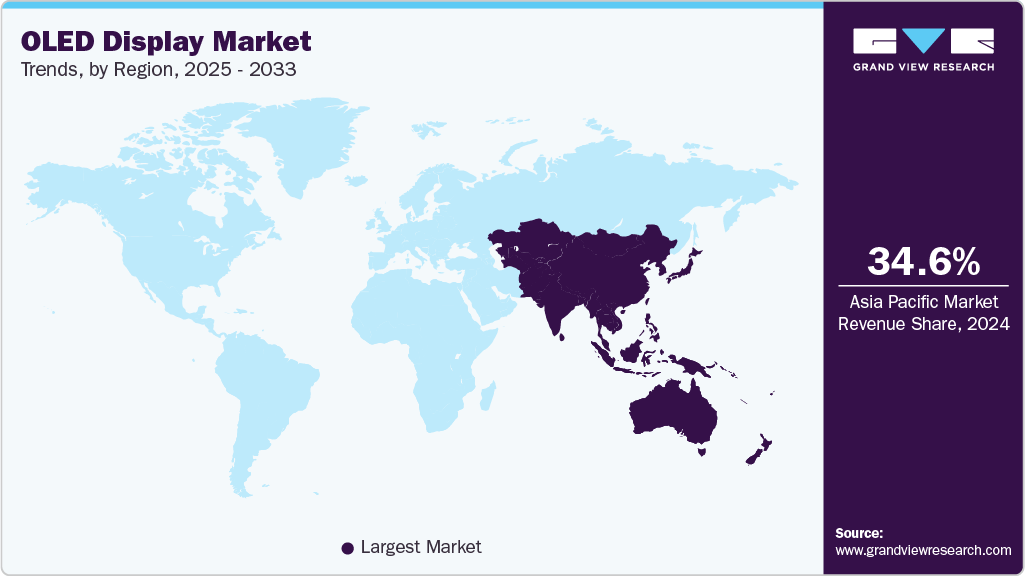
- Asia Pacific dominated the global OLED Display market with the largest revenue share of 34.59% in 2024.
- The U.S. OLED display industry is expected to grow significantly in 2024, driven by the significant expansion of major players in this region.
- By technology, the AMOLED segment led the market with the largest revenue share of 70.74% in 2024.
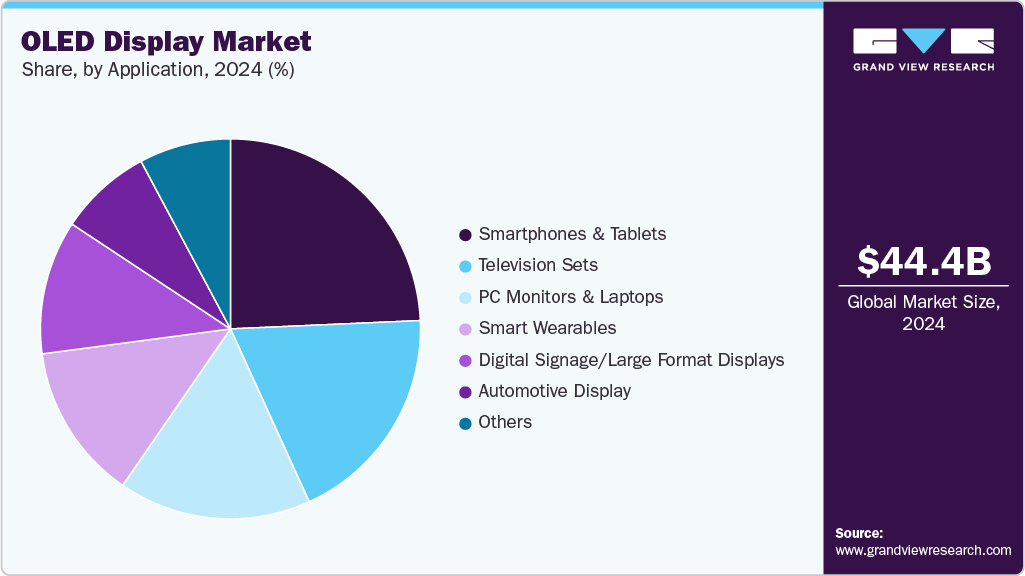
- By application, the smartphones and tablets segment held the dominant market position with the leading revenue share of 24.3% in 2024.
- By display size, the 6 to 20 Inches segment is expected to grow at the fastest CAGR of 19.2% from 2025 to 2033.
Market Size & Forecast
- 2024 Market Size: USD 44.39 Billion
- 2033 Projected Market Size: USD 191.86 Billion
- CAGR (2025-2033): 18.0%
- Asia Pacific: Largest market in 2024
Although OLEDs offer superior performance, declining LCD prices are expected to restrain market growth. The life span of LCDs is also longer; as a result, they are preferred in consumer durables. Due to the lower cost of raw materials and labor in the Asia Pacific, manufacturing activities were mainly concentrated in the region. Developing cost-effective manufacturing techniques is imperative for overcoming business challenges and reducing overall prices.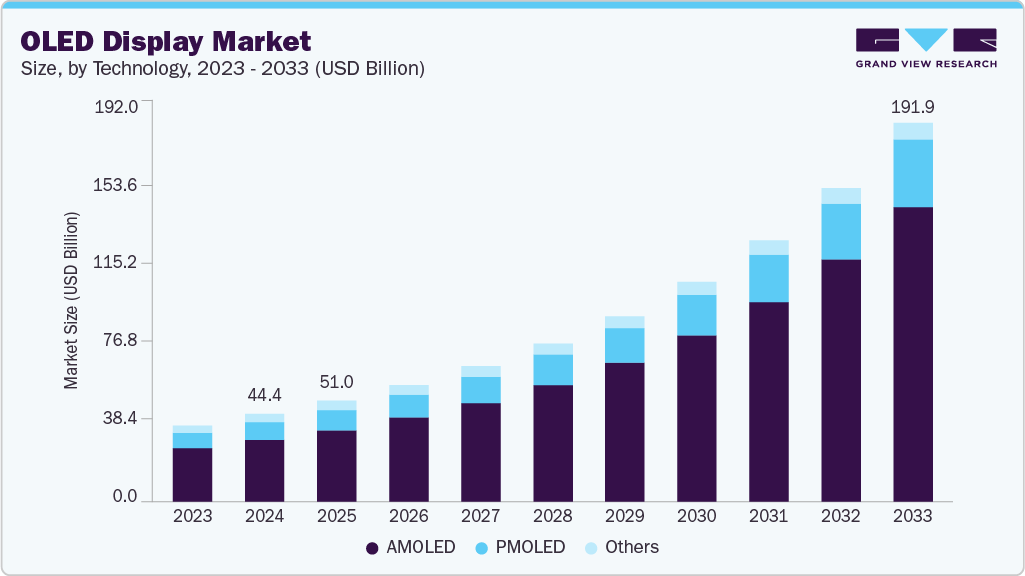
OLED technologies include Active Matrix OLED and Passive Matrix OLED. While PMOLEDs were used initially for MP3 players, AMOLED is the preferred technology being used presently for mobile phones and other displays. They are also used in portable gaming machines and have no size or resolution constraints. The average selling prices of OLEDs are inversely proportional to volume; therefore, cost decreases with increasing manufacturing. OLEDs consume less power and are used in a variety of electronics as well as in signage. Mobile phones were the biggest end use segment of OLEDs. Usage in television sets is also gaining traction since technological advances have aided in the development of large-sized displays. OLEDs are used for numerous purposes in high-end automobiles in components including rear-view mirrors, back-window alerts, and dashboard displays.
Furthermore, significant initiatives by key players are augmenting the growth of the OLED display industry. For instance, in June 2025, LG Display announced an investment plan of USD 925 million to develop advanced OLED technologies over the next two years, until June 30, 2027. This significant funding aims to enhance OLED production capabilities, focusing on small and medium-sized displays such as those for smartphones and IT devices, along with improving WOLED technology for TV panels. The investment will support R&D efforts to increase the production of higher-end OLED panels and integrate new foundational technologies. This move underlines LG Display’s commitment to leading innovation and expanding the application of OLED technology across various devices.
Technology Insights
The AMOLED segment led the OLED display market in 2024, accounting for 70.74% of global revenue. This surge is powered by strong demand from smartphones, TVs, automotive, wearables, and innovations like flexible, foldable, transparent, and curved form factors. Key firms such as Samsung Display, LG Display, BOE, AU Optronics, and LAVA are heavily investing in R&D to improve durability, cost-efficiency, and explore new applications. For instance, in August 2025, Lava launched the Blaze AMOLED 2, a sleek and powerful smartphone. It features a 6.67-inch Full HD+ AMOLED display with a smooth 120Hz refresh rate and is powered by the MediaTek Dimensity 7060 chipset paired with 6GB LPDDR5 RAM. The device boasts a 50MP Sony rear camera, an 8MP front camera, a 5,000mAh battery with 33W fast charging, and runs on a clean Android 15 OS.
The PMOLED segment is expected to grow at the fastest CAGR during the forecast period. The PMOLED segment is witnessing steady growth, particularly in specialized markets that prioritize ultra-low power consumption, compact and thin form factors, and straightforward user interfaces. Key applications include wearables, medical devices, industrial human–machine interfaces (HMIs), and smart home appliances, where long lifespan and high readability are valued more than advanced video performance. These displays are particularly well-suited for small, low-resolution screens used in devices like wearables, medical instruments, and industrial equipment.
The growing demand for wearable technology, such as fitness trackers and smartwatches, significantly boosted the PMOLED market. In addition, advancements in PMOLED technology have improved their performance and extended their lifespan, making them more viable for diverse uses. The increasing trend of compact, efficient display solutions in various industries further accelerated their adoption. Thus, the combination of affordability, improved capabilities, and expanding application areas has driven the segment growth.
Display Size Insights
The below 6 Inches segment accounted for the largest revenue share of the OLED display industry in 2024, due to the sheer scale of smartphone and smartwatch production, with flagship and mid-tier phones increasingly adopting AMOLED and LTPO OLED panels for higher refresh rates and power efficiency. Wearables, especially fitness bands and smartwatches, fuel additional demand for compact displays with deep contrast and outdoor visibility. Flexible and foldable OLED innovations in sub-6-inch formats are enabling sleeker, curved designs in both phones and consumer gadgets. The push toward always-on displays in mobile devices is also driving OEMs to prioritize OLED’s low power draw over LCD alternatives. Additionally, component miniaturization in automotive clusters and portable medical devices is expanding the use of sub-6-inch OLEDs beyond consumer electronics, further reinforcing its market lead.
The 6 to 20 Inches segment is expected to grow at the fastest CAGR over the forecast period, driven by the surge in demand for tablets, foldable devices, automotive infotainment systems, and professional-grade monitors. This size range strikes an optimal balance between portability and immersive viewing, making it attractive for both consumer electronics and industrial applications. Increasing adoption in electric vehicles, especially for dashboard and center console displays, will further accelerate growth. Advancements in AMOLED technology, higher refresh rates, and flexible form factors are also expanding the addressable market. Additionally, rising demand from gaming monitors and portable medical devices will sustain its leadership throughout the forecast period.
Application Insights
The smartphones and tablets segment accounted for the largest revenue share of the OLED display market in 2024, driven by the surge in 5G-enabled devices and higher refresh rate displays is further pushing manufacturers to integrate OLED panels for improved performance. Key players are significantly taking the initiative in this market. For instance, in September 2024, Samsung Electronics unveiled the Galaxy Tab S10 Ultra and Galaxy Tab S10+, its first tablets purpose-built for AI, featuring 14.6-inch and 12.4-inch Dynamic AMOLED 2X displays. These AI-ready tablets offer significant performance upgrades, including enhanced CPU, GPU, and NPU power, enabling faster and more responsive AI capabilities like Note Assist, Drawing Assist, and the Galaxy AI Key for customizable AI assistants. The tablets also serve as intelligent home devices with 3D Map View for smart device management across the SmartThings ecosystem. The Galaxy Tab S10 series delivers robust security with Samsung Knox, long battery life with super-fast charging, and premium build quality with IP68 durability.
The television sets segment is anticipated to grow at the fastest CAGR during the forecast period, driven by the premium TV brands increasingly expanding their OLED lineups, leveraging innovations like 8K resolution, larger screen sizes, and ultra-thin designs to attract high-end buyers. The shift towards home entertainment upgrades, fueled by streaming services and immersive gaming, is further boosting OLED TV demand. Moreover, recent developments in this market are fueling growth.
For instance, in December 2024, LG Electronics launched the world's first 77-inch transparent and true wireless 4K OLED TV, the LG SIGNATURE OLED T. This innovative TV features a self-lit screen that switches between transparent and opaque modes, blending on-screen visuals with the surrounding space. It offers wireless video and audio transmission via LG's Zero Connect Box for a seamless, cable-free viewing experience. Enhanced by the α11 AI processor and advanced gaming compatibility, it promises outstanding picture and sound quality with unprecedented spatial flexibility. The OLED T is set to debut in the U.S. in December 2024, with other markets to follow.
Regional Insights
North America held a significant revenue share of the OLED Display industry with 28.17% in 2024. Leading technology players, including Apple and Google, have incorporated OLED displays into their flagship product lines, elevating consumer awareness and accelerating demand. The regional automotive sector is increasingly leveraging OLED solutions for advanced infotainment systems and digital instrument clusters, further contributing to market expansion. Additionally, the rising deployment of OLED displays in digital signage and lighting applications across commercial and residential environments is reinforcing market momentum. Technological advancements, such as foldable and rollable form factors, are enhancing product innovation and consumer engagement. The presence of prominent industry stakeholders, including Universal Display Corporation, continues to strengthen North America’s position as a key hub for OLED development and commercialization.
U.S. OLED Display Market Trends
The U.S. OLED display industry is expected to grow significantly in 2024, driven by the significant expansion of major players in this region. For instance, in September 2024, Panasonic announced its return to the US market with a new lineup of cutting-edge OLED and Mini-LED TVs, ranging from 55 to 85 inches. These models feature Panasonic's renowned picture and sound quality, designed and developed primarily in Japan. Aligned with a global collaboration with Amazon, all TVs come with Fire TV built in, providing a seamless, personalized streaming experience and voice control via Alexa. Panasonic’s new TVs combine premium visuals, advanced gaming capabilities, and smart home integration with the immersive Fire TV Ambient Experience. This marks a significant comeback for Panasonic, aiming to meet the growing demand for high-quality, smart entertainment in the US market.
Europe OLED Display Market Trends
The Europe OLED display industry is expected to witness steady growth over the forecast period,due to the region’s support by rising adoption in consumer electronics, automotive, and signage applications. Demand for high-end smartphones, premium televisions, and advanced infotainment systems is driving the integration of OLED technology, particularly in markets such as Germany, the UK, and France. The region’s strong automotive manufacturing base is increasingly utilizing OLED panels for curved dashboards, digital clusters, and ambient lighting. Growing investments in smart retail displays and energy-efficient lighting solutions are further expanding adoption. Additionally, European focus on sustainability and energy efficiency aligns with OLED’s low power consumption, reinforcing its long-term market potential.
Asia Pacific OLED Display Market Trends
Asia Pacific dominated the global OLED Display market with the largest revenue share of 34.59% in 2024. The OLED display industry in Asia Pacific is anticipated to register the fastest CAGR over the forecast period. The region hosts leading OLED manufacturers, including Samsung Electronics and LG Electronics, driving large-scale production and continuous technological innovation. Strong demand for consumer electronics, particularly smartphones and televisions, in key markets such as India, China, South Korea, and Japan, is a major growth catalyst.
Expanding adoption of OLED technology across diverse applications, including automotive displays and wearable devices, further accelerates market expansion. Significant investments in R&D and manufacturing infrastructure are enhancing the region’s production capacity and innovation capabilities. Rising disposable incomes among the growing middle-class population are fueling the uptake of advanced electronic products.
Key OLED Display Company Insights
Some key companies in the OLED Display industry are Samsung Electronics and LG Electronics.
-
LG Display is a global leader in OLED technology, renowned for its cutting-edge display solutions that cater to TVs, monitors, wearables, automotive, and more. Their 4th-generation OLED panels deliver exceptional picture quality with brightness of up to 4,000 nits, vivid and accurate colors, and low power consumption. The company pioneers innovative OLED products such as flexible AMOLEDs for smartphones and tablets, transparent OLEDs for signage and commercial uses, and advanced automotive OLED displays optimized for next-generation vehicles. LG Display’s next-gen OLEDs also include ultra-high resolution microdisplays for VR and gaming, delivering lifelike visuals with industry-leading brightness and color fidelity. With advanced technologies like META Technology 2.0 and Tandem OLED, LG continues to elevate visual experiences across multiple sectors.
-
AUO Corporation is an innovator in display technologies, showcasing advanced OLED capabilities among its product portfolio. The company develops high-resolution AMOLED displays, such as a 4.8-inch 2k resolution dual MIPI OLED module, reflecting its expertise in premium screen technology. While AUO prominently advances Micro LED and other advanced display formats, it continues to leverage OLED’s benefits for high-quality, energy-efficient, and visually vibrant applications. This positions AUO as a key player in delivering cutting-edge OLED solutions for diverse industries, including mobility, retail, and smart devices. Their focus on integrating OLED with AI and smart technologies further enhances user experience and application versatility.
Key OLED Display Companies:
The following are the leading companies in the OLED display market. These companies collectively hold the largest market share and dictate industry trends.
- AUO Corporation
- BOE Display
- eMagin Corporation
- IPG Automotive
- LG Electronics
- Rit Display
- Samsung Electronics
- Sony Corporation
- Universal Display Corporation
- Visionox
Recent Developments
-
In May 2025, Samsung Display unveiled its cutting-edge IT-oriented OLED portfolio under the banner of “UT One” and other low-power solutions tailored for laptops, tablets, and monitors. Their globally debuting UT One ultra-thin OLED panel delivers ~30% lower power consumption and is 30% lighter due to its innovative architecture. The exhibition also featured QD-OLED prototypes reaching up to 220 PPI resolution and record-breaking 500 Hz refresh rates, aimed at professional monitors. Additionally, attendees experienced Synchroma for consistent color across multiple device types, along with immersive showcase rooms and robotic demos highlighting OLED’s thinness and lightness.
-
In June 2025, Sony India launched the all-new BRAVIA 8 II series, featuring cutting-edge QD-OLED technology and the advanced AI-powered XR Processor for breathtaking picture quality and immersive sound. The BRAVIA 8 II delivers perfect blacks, superior contrast, and brilliant colors, enhanced by Dolby Vision, Dolby Atmos, and Acoustic Surface Audio+ for a true cinematic experience at home. It includes Studio Calibrated Mode for authentic content viewing and is optimized for responsive, ultra-smooth gaming performance. Available in 55- and 65-inch models, the series combines elegant design with eco-conscious innovations, making it a premium choice for modern entertainment enthusiasts.
OLED Display Market Report Scope
Report Attribute
Details
Market size in 2025
USD 51.03 billion
Revenue forecast in 2033
USD 191.86 billion
Growth rate
CAGR of 18.0% from 2025 to 2033
Base year for estimation
2024
Actual data
2021 - 2023
Forecast period
2025 - 2033
Quantitative units
Market revenue in USD billion and CAGR from 2025 to 2033
Report coverage
Revenue forecast, company ranking, competitive landscape, growth factors, and trends
Segments covered
Technology, display size, application, region
Regional scope
North America; Europe; Asia Pacific; Latin America; MEA
Country scope
U.S.; Canada; Mexico; UK; Germany; France; China; India; Japan; South Korea; Australia; Brazil; KSA; UAE; South Africa
Key companies profiled
AUO Corporation; BOE Display; eMagin Corporation; IPG Automotive; LG Electronics; Rit Display; Samsung Electronics; Sony Corporation; Universal Display Corporation; Visionox
Customization scope
Free report customization (equivalent up to 8 analysts working days) with purchase. Addition or alteration to country, regional, and segment scope.
Pricing and purchase options
Avail customized purchase options to meet your exact research needs. Explore purchase options
Global OLED Display Market Report Segmentation
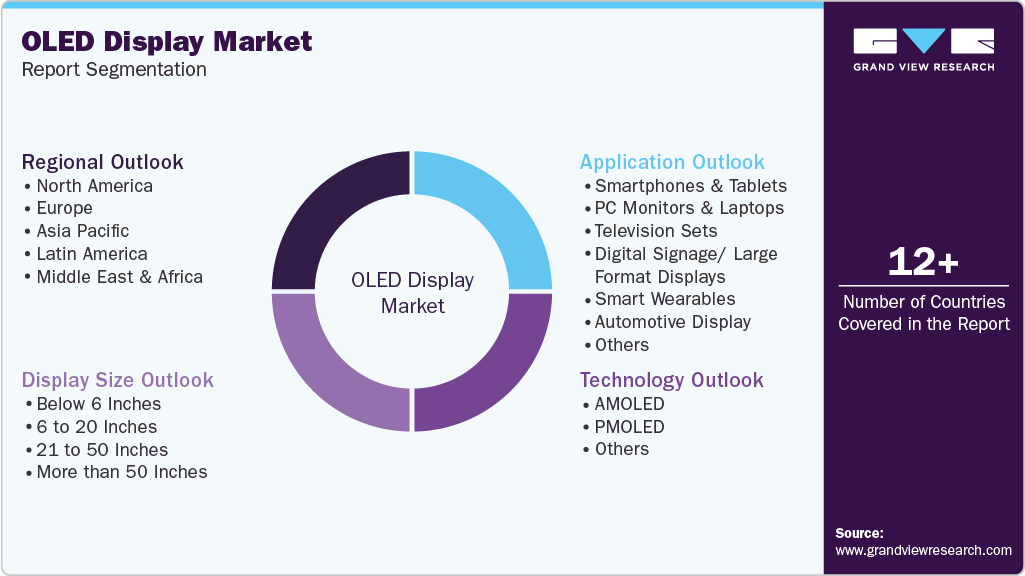
This report forecasts revenue growth on the global, regional, and country levels and provides an analysis of the industry trends in each of the sub-segments from 2021 to 2033. For this study, Grand View Research has segmented the global OLED Display market report based on technology, display size, application, and region:
-
Technology Outlook (Revenue, USD Billion, 2021 - 2033)
-
AMOLED
-
PMOLED
-
Others
-
-
Display Size Outlook (Revenue, USD Billion, 2021 - 2033)
-
Below 6 Inches
-
6 to 20 Inches
-
21 to 50 Inches
-
More than 50 Inches
-
-
Application Outlook (Revenue, USD Billion, 2021 - 2033)
-
Smartphones and Tablets
-
PC Monitors and Laptops
-
Television Sets
-
Digital Signage/ Large Format Displays
-
Smart Wearables
-
Automotive Display
-
Others
-
-
Regional Outlook (Revenue, USD Billion, 2021 - 2033)
-
North America
-
U.S.
-
Canada
-
Mexico
-
-
Europe
-
UK
-
Germany
-
France
-
-
Asia Pacific
-
China
-
India
-
Japan
-
South Korea
-
Australia
-
-
Latin America
-
Brazil
-
-
Middle East and Africa
-
KSA
-
UAE
-
South Africa
-
-
Frequently Asked Questions About This Report
b. The global OLED display market size was estimated at USD 44.39 billion in 2024 and is expected to reach USD 51.03 billion in 2025.
b. The global OLED display market is expected to grow at a compound annual growth rate of 18.0% from 2025 to 2033 to reach USD 191.86 billion by 2033.
b. North America dominated the OLED display market with a share of 28.2% in 2024. Leading technology players, including Apple and Google, have incorporated OLED displays into their flagship product lines, elevating consumer awareness and accelerating demand.
b. Some key players operating in the OLED display market include Teladoc; Doctor on Demand; iCliniq; IBM; Intel Corporation; Philips Healthcare; McKesson Corporation; AMD Telemedicine; GE Healthcare; CardioNet Inc.; 3m Health Information Systems; Medic4all; CirrusMD Inc.; Cisco; and American Telecare Inc.
b. OLED technologies include Active Matrix OLED and Passive Matrix OLED. While PMOLEDs were used initially for MP3 players, AMOLED is the preferred technology being used presently for mobile phones and other displays


Share this report with your colleague or friend.
Need a Tailored Report?
Customize this report to your needs — add regions, segments, or data points, with 20% free customization.


ISO 9001:2015 & 27001:2022 Certified
We are GDPR and CCPA compliant! Your transaction & personal information is safe and secure. For more details, please read our privacy policy.
Trusted market insights - try a free sample
See how our reports are structured and why industry leaders rely on Grand View Research. Get a free sample or ask us to tailor this report to your needs.