- Home
- »
- Petrochemicals
- »
-
Oilfields Chemicals Market Size, Share, Industry Report 2033GVR Report cover
![Oilfields Chemicals Market Size, Share & Trends Report]()
Oilfields Chemicals Market (2026 - 2033) Size, Share & Trends Analysis Report By Product (Inhibitors, Demulsifiers, Friction Reducers, Biocides, Surfactants), By Application (Drilling, Production, Cementing), By Location (Onshore, Offshore), By Region, And Segment Forecasts
- Report ID: GVR-1-68038-683-7
- Number of Report Pages: 80
- Format: PDF
- Historical Range: 2018 - 2024
- Forecast Period: 2026 - 2033
- Industry: Bulk Chemicals
- Report Summary
- Table of Contents
- Segmentation
- Methodology
- Download FREE Sample
-
 Download Sample Report
Oilfields Chemicals Market Summary
The global oilfields chemicals market size was estimated at USD 29,861.3 million in 2025 and is projected to reach USD 38,370.40 million by 2033, growing at a CAGR of 3.2% from 2026 to 2033. The growing focus on enhancing oil and gas production efficiency, particularly from mature and declining fields.
Key Market Trends & Insights
- Asia Pacific dominated the oilfields chemicals market with a significant revenue share of 30.04% in 2025.
- The market in China is expected to grow at the fastest CAGR of 4.2% from 2026 to 2033.
- By product, rheology modifiers segment is expected to grow at the fastest CAGR of 4.6% from 2026 to 2033 in terms of revenue.
- By location, the onshore segment held the largest revenue share of 69.06% in 2025 in terms of value.
- By application, the drilling segment held the largest revenue share of 33.31% in 2025 in terms of value.
Market Size & Forecast
- 2025 Market Size: USD 29,861.3 Million
- 2033 Projected Market Size: USD 38,370.40 Million
- CAGR (2026-2033): 3.2%
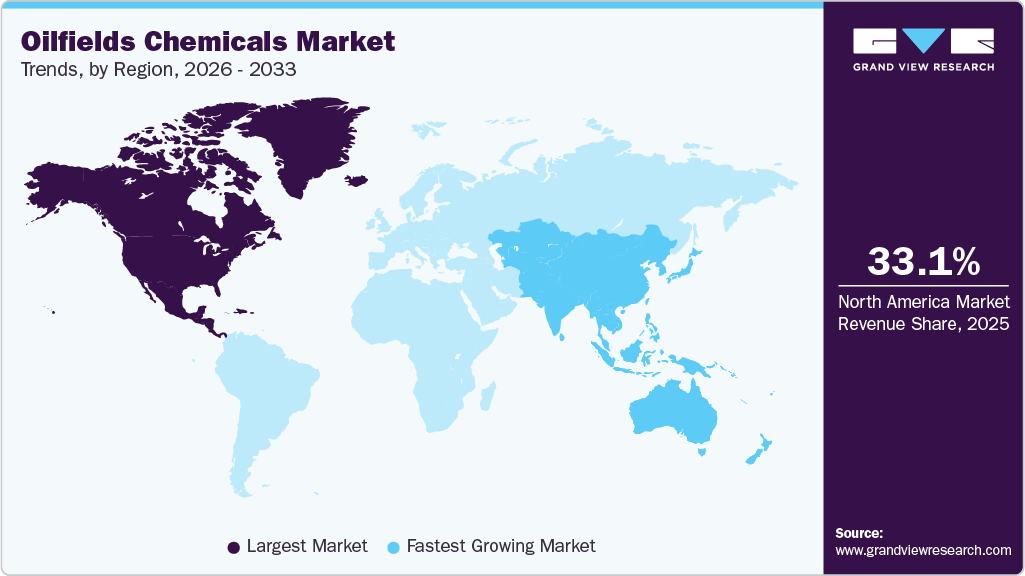
- North America: Largest market in 2025
- Asia Pacific: Fastest growing market
As conventional reservoirs age, operators increasingly rely on specialized oilfield chemicals, such as corrosion inhibitors, scale inhibitors, demulsifiers, and enhanced oil recovery (EOR) chemicals, to maintain production rates and extend field life. These chemicals improve flow assurance, reduce operational disruptions, and optimize asset performance, making them essential to sustaining output in existing fields. Another important aspect of this driver is the rising complexity of extraction environments, including high-pressure, high-temperature (HPHT) reservoirs, deepwater fields, and unconventional shale formations. Such conditions increase the risk of corrosion, scaling, emulsion formation, and microbial activity, all of which require advanced chemical solutions. As exploration and production activities move toward more technically challenging reserves, demand for high-performance and customized oilfield chemicals continues to rise.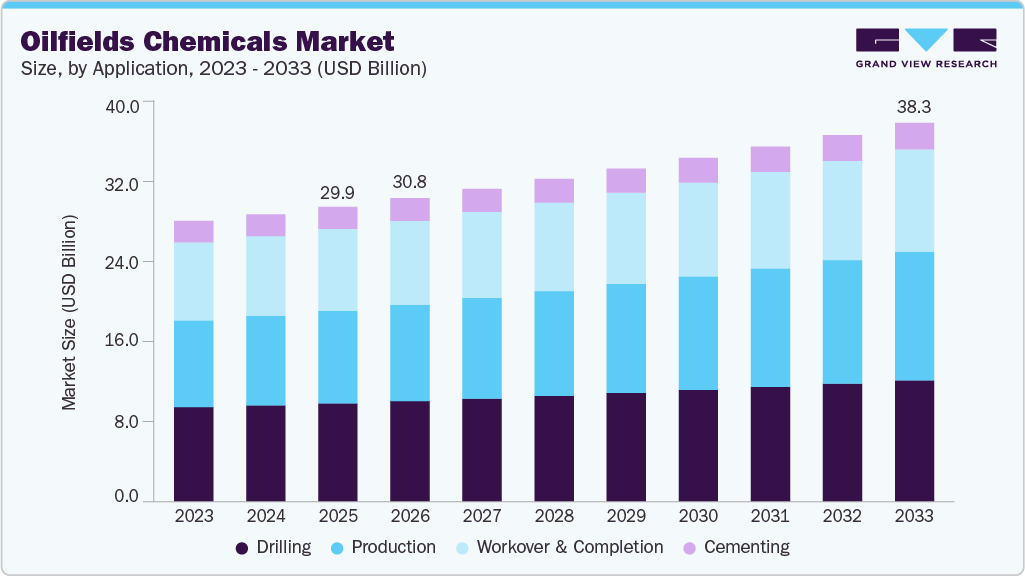
In addition, oil and gas operators are under increasing pressure to reduce operating costs and maximize recovery factors amid volatile crude oil prices. Oilfield chemicals play a cost-effective role in achieving these objectives by minimizing downtime, reducing equipment wear, and improving recovery efficiency without major capital investments. As a result, the emphasis on operational optimization and cost control is expected to remain a long-term driver supporting steady growth of the oilfield chemicals market.
Market Concentration & Characteristics
The oilfield chemicals market is moderately to highly concentrated, with a small group of large multinational service providers and specialty chemical companies accounting for a significant share of global revenues. These players benefit from integrated portfolios, strong R&D capabilities, global manufacturing footprints, and long-term contracts with major oil & gas operators. Their ability to provide customized chemical solutions across drilling, production, and enhanced oil recovery (EOR) stages creates high switching costs for customers, reinforcing market concentration at the upper tier.
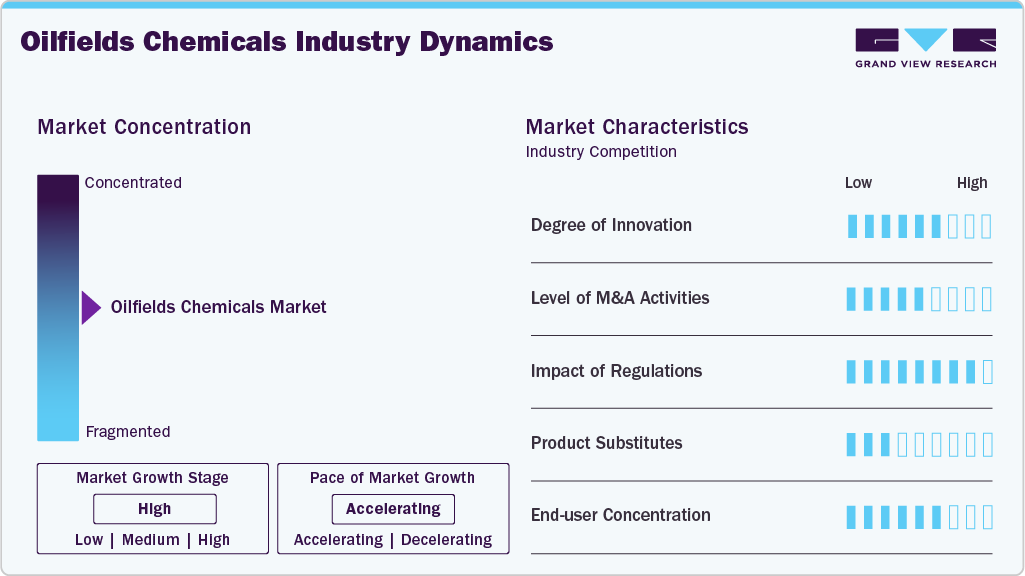
Meanwhile, the market also includes a large number of regional and niche suppliers, particularly in commoditized product segments such as basic inhibitors, demulsifiers, and biocides. This creates competitive pressure in price-sensitive applications and prevents full consolidation. However, in high-performance, offshore, and technically complex applications, concentration remains higher due to stringent qualification requirements, regulatory compliance, and the need for field-level technical support. Overall, the market structure reflects concentration in value-added segments and fragmentation in commodity products, resulting in a balanced but competitive landscape.
Product Insights
The rheology modifiers segment dominated the global oilfields chemicals market with the largest revenue share of 23.4% in 2025. The segment is expected to grow as they are essential in controlling the viscosity, flow behavior, and suspension stability of drilling and completion fluids. These chemicals enable efficient cuttings transport, wellbore stability, and pressure management across both conventional and unconventional wells. Their widespread use in drilling, hydraulic fracturing, and workover operations drives high consumption volumes. Increasing drilling complexity, including horizontal and extended-reach wells, continues to support strong demand for rheology modifiers.
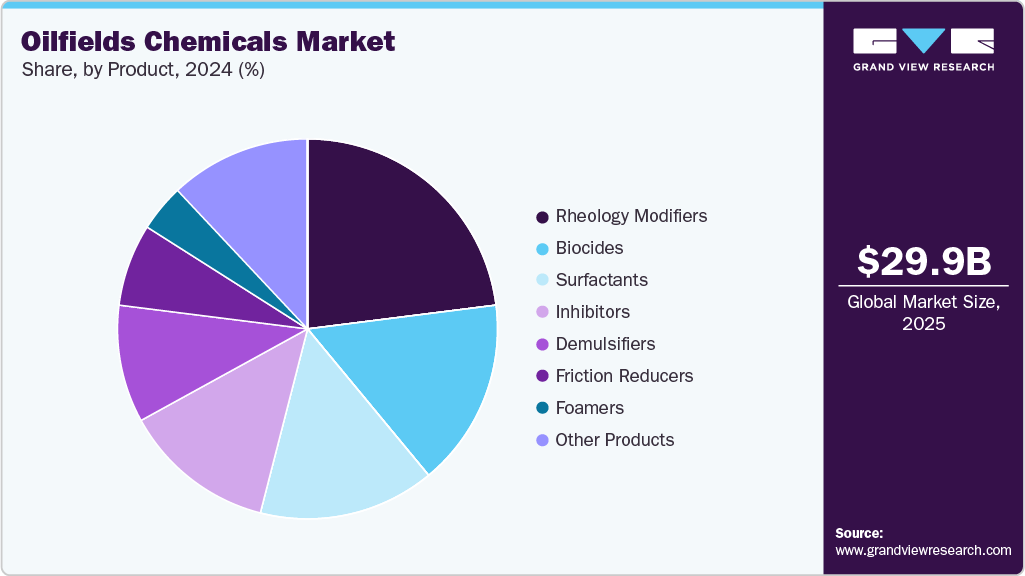
This inhibitors segment is the fastest-growing product category with a CAGR of 4.2% from 2026 to 2033. Inhibitors represent a critical product segment in the oilfield chemicals market, used to prevent corrosion, scaling, and formation damage throughout production and transportation systems. Corrosion and scale inhibitors are widely applied in production wells, pipelines, and processing facilities to protect equipment and extend asset life. Growing focus on maintaining aging infrastructure and reducing downtime has strengthened inhibitor demand. Their recurring usage across the production lifecycle ensures steady and resilient market growth.
Location Insights
The onshore segment held the largest revenue share of 69.1% in 2025, driven by the high volume of drilling and production activities across shale and conventional fields. Lower operational and development costs compared to offshore projects have encouraged operators to prioritize onshore investments. Extensive use of oilfield chemicals in drilling fluids, hydraulic fracturing, and production optimization further supports demand. Additionally, the shorter project timelines and faster return on investment associated with onshore fields continue to reinforce their market dominance.
The offshore applications segment is the fastest growing with a CAGR of 3.7% in the forecast period, due to renewed investments in deepwater and ultra-deepwater projects. Increasing exploration in offshore basins and the development of technically complex reservoirs require high-performance oilfield chemicals for flow assurance, corrosion control, and high-pressure, high-temperature conditions. Advancements in offshore drilling technology and rising focus on long-term production stability are further accelerating chemical demand in offshore operations.
Application Insights
The drilling segment held the largest revenue share of 33.31% in 2025, driven by continuous drilling activities across both conventional and unconventional oilfields. High consumption of oilfield chemicals such as rheology modifiers, lubricants, and fluid-loss control agents is essential to maintain wellbore stability, control pressure, and ensure efficient cuttings transport. Increasing complexity of wells, including horizontal and extended-reach drilling, further elevates chemical usage. Frequent drilling cycles and large chemical volumes per well support the segment’s leading revenue position.
The production segment is the fastest growing with a CAGR of 4.2% over the forecast period, due to rising emphasis on flow assurance, corrosion prevention, and enhanced oil recovery (EOR) in mature fields. Operators are increasingly investing in production chemicals to maximize recovery rates, extend asset life, and reduce operational downtime. Growing offshore production and aging infrastructure further boost demand for inhibitors, demulsifiers, and biocides. This sustained, recurring chemical consumption throughout the production lifecycle underpins strong growth prospects.
Regional Insights
North America oilfields chemicals market dominated the global industry with a revenue share of 33.1% in 2025, supported by extensive onshore drilling and shale production activities. High chemical consumption in drilling fluids, hydraulic fracturing, and production optimization underpins market strength. The region benefits from advanced oilfield service infrastructure and rapid adoption of performance-enhancing chemicals. Mature fields further drive demand for production and EOR chemicals.
U.S. Oilfields Chemicals Market Trends
U.S. accounted for 82.6% of the North America oilfields chemicals market in 2025. The U.S. is the largest single-country market, driven by extensive shale drilling and production activities. High usage of chemicals in hydraulic fracturing, drilling fluids, and production optimization supports strong demand. Continuous well drilling and refracturing activities ensure recurring chemical consumption. Technological innovation further strengthens market leadership.
Asia Pacific Oilfields Chemicals Market Trends
Asia Pacific is a fast-growing regional market with a CAGR of 4.4% during the forecast period, driven by increasing energy demand and upstream investments in countries such as China, India, and Southeast Asia. Rising offshore exploration, national oil company investments, and enhanced recovery initiatives are boosting chemical consumption. Demand is strong for drilling, production, and EOR chemicals, particularly in developing basins. The region’s growth outpaces mature markets over the forecast period.
China oilfields chemicals market in China is accounted for 44.3% of the Asia Pacific market in 2025, China’s oilfield chemicals market is driven by rising domestic energy demand and government-backed upstream investments. Focus on enhancing recovery from mature fields and expanding offshore production increases chemical usage. Demand is strong for drilling and production chemicals, particularly inhibitors and EOR formulations. State-owned operators play a central role in market development.
Europe Oilfields Chemicals Market Trends
Europerepresents a mature and relatively stable market, with demand concentrated in offshore fields in the North Sea and select onshore assets. Stringent environmental regulations shape chemical formulations, favoring low-toxicity and biodegradable oilfield chemicals. Investment in new exploration is limited, but sustained production activities support steady demand. Chemical usage is largely focused on flow assurance and corrosion management
Oilfields chemicals market in Germany represents a small but regulated market, with limited upstream oil and gas activity. Demand is primarily associated with chemical supply, technology development, and formulation expertise rather than large-scale production. Strict environmental regulations influence product selection and innovation. Germany plays a strategic role in R&D and specialty chemical supply within Europe
Middle East & Africa Oilfields Chemicals Market Trends
The Middle East & Africa market is supported by large conventional reserves, sustained production levels, and EOR deployment. National oil companies invest heavily in production chemicals to maximize recovery and manage aging reservoirs. Demand is particularly strong for corrosion inhibitors, scale inhibitors, and demulsifiers. Africa contributes through offshore developments and emerging exploration activities.
Latin America Oilfields Chemicals Market Trends
Oilfield chemicals market in Latin America is driven by offshore deepwater developments, particularly in Brazil, along with onshore production in Mexico and Argentina. High chemical intensity in deepwater projects supports demand for specialty and high-performance formulations. While market growth is project-dependent, long-term offshore investments provide structural support. Production-stage chemicals account for a significant share of consumption
Key Oilfields Chemicals Company Insights
Key players, such as BASF SE, Nouryon , SMC Global, Baker Hughes , Halliburton , and The Lubrizol Corporation are dominating the market.
BASF SE
-
BASF SE is a chemical manufacturing company with a presence across Asia Pacific, North America, Central & South America, Europe, and the Middle East & Africa. The company operates through six business segments, namely chemical, material, industrial solutions, surface technologies, agricultural solutions, and nutrition & care. The chemical segment includes petrochemicals and intermediaries. Material segment comprises performance polymers and monomers. The Industrial solutions segment includes performance chemicals and dispersions & pigments. Agricultural solution segment includes products for farming, landscape management, and pest control. Nutrition & care segment is further sub-segmented into nutrition & health and care. The company provides a wide range of surfactants for textile, paint & coatings, homecare, and food processing industries.
Key Oilfields Chemical Companies:
The following are the leading companies in the oilfields chemical market. These companies collectively hold the largest market share and dictate industry trends.
- BASF SE
- Nouryon
- SMC Global
- Baker Hughes
- Halliburton
- The Lubrizol Corporation
- Aquapharm Chemical Pvt. Ltd.
- Clariant AG
- Solvay S.A.
- Thermax Chemical Division
Oilfields Chemicals Market Report Scope
Report Attribute
Details
Market size value in 2026
USD 30,733.22 million
Revenue forecast in 2033
USD 38,370.40 million
Growth rate
CAGR of 3.2% from 2026 to 2033
Base year for estimation
2025
Historical data
2018 - 2024
Forecast period
2026 - 2033
Quantitative units
Revenue in USD million/billion, Volume in Kilotons, and CAGR from 2026 to 2033
Report coverage
Revenue forecast, company ranking, competitive landscape, growth factors, and trends
Segments covered
Product, application, location, region
Regional scope
North America; Europe; Asia Pacific; Middle East & Africa; Latin America
Country scope
U.S.; Canada; Mexico; Germany; UK; France; Italy; Spain; China; India; Japan; South Korea; Brazil; Argentina; South Africa; Saudi Arabia
Key companies profiled
BASF SE; Nouryon; SMC Global; Baker Hughes; Halliburton; The Lubrizol Corporation; Aquapharm Chemical Pvt. Ltd.; Clariant AG; Solvay S.A.; Thermax Chemical Division
Customization scope
Free report customization (equivalent up to 8 analysts’ working days) with purchase. Addition or alteration to country, regional & segment scope.
Pricing and purchase options
Avail customized purchase options to meet your exact research needs. Explore purchase options
Global Oilfields Chemicals Market Report Segmentation
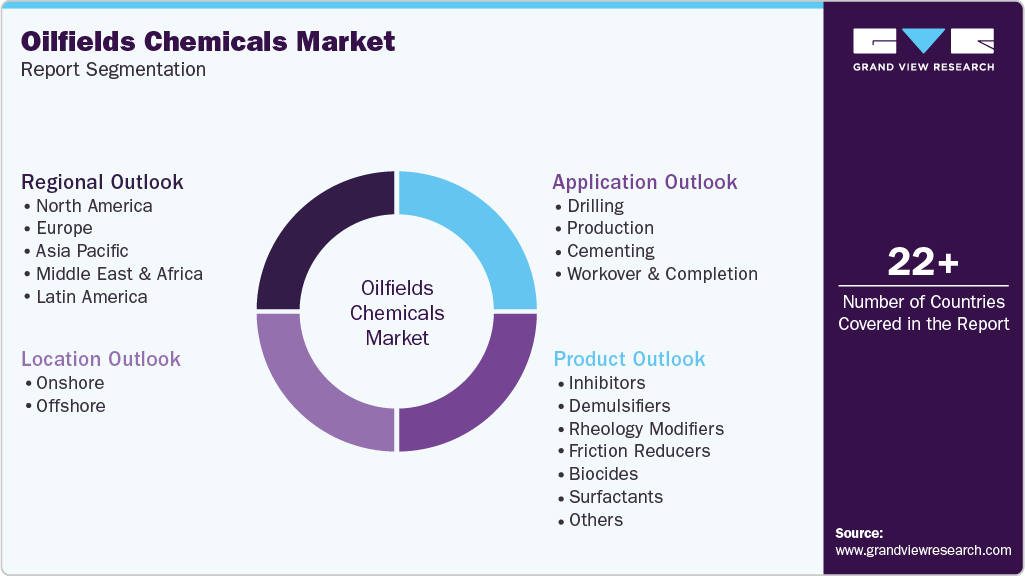
This report forecasts revenue growth at global, regional, and country levels and provides an analysis of the latest industry trends in each of the sub-segments from 2018 to 2033. For this study, Grand View Research has segmented the global oilfields chemicals market report based on product, application, location, and region.
-
Product Outlook (Volume, Kilotons; Revenue, USD Million, 2018 - 2033)
-
Inhibitors
-
Demulsifiers
-
Rheology Modifiers
-
Friction Reducers
-
Biocides
-
Surfactants
-
Foamers
-
Other Products
-
-
Application Outlook (Volume, Kilotons; Revenue, USD Million, 2018 - 2033)
-
Drilling
-
Production
-
Cementing
-
Workover & Completion
-
-
Location Outlook (Volume, Kilotons; Revenue, USD Million, 2018 - 2033)
-
Onshore
-
Offshore
-
-
Regional Outlook (Volume, Kilotons; Revenue, USD Million, 2018 - 2033)
-
North America
-
U.S.
-
Canada
-
Mexico
-
-
Europe
-
Germany
-
UK
-
France
-
Italy
-
Spain
-
-
Asia Pacific
-
China
-
India
-
Japan
-
South Korea
-
-
Latin America
-
Brazil
-
Argentina
-
-
Middle East & Africa
-
Saudi Arabia
-
South Africa
-
-
Frequently Asked Questions About This Report
b. The global oilfields chemicals market size was estimated at USD 29,861.3 million in 2025 and is expected to reach USD 30,733.22 million in 2026.
b. The global oilfields chemicals market is expected to grow at a compound annual growth rate of 3.2% from 2026 to 2033 to reach USD 38,370.40 million by 2033.
b. North America dominated the global oilfields chemicals market with a 33.1% revenue share in 2025, supported by extensive onshore drilling and shale production activities. High chemical consumption in drilling fluids, hydraulic fracturing, and production optimization underpins market strength
b. Some key players operating in the oilfield chemicals market include Nouryon, BASF SE, SMC Global, Baker Hughes, Halliburton, The Lubrizol Corporation, Aquapharm Chemical Pvt. Ltd., Clariant, Solvay S.A., Thermax Chemical Division.
b. Key factors that are driving the market growth include the renewed robustness in oil exploration & production activities due to the shale gas revolution and technological developments to explore oil & gas from mature and aged wells.


Share this report with your colleague or friend.
Need a Tailored Report?
Customize this report to your needs — add regions, segments, or data points, with 20% free customization.


ISO 9001:2015 & 27001:2022 Certified
We are GDPR and CCPA compliant! Your transaction & personal information is safe and secure. For more details, please read our privacy policy.
Trusted market insights - try a free sample
See how our reports are structured and why industry leaders rely on Grand View Research. Get a free sample or ask us to tailor this report to your needs.