- Home
- »
- Animal Feed and Feed Additives
- »
-
North America Aquaculture Market Size & Share Report, 2033GVR Report cover
![North America Aquaculture Market Size, Share & Trends Report]()
North America Aquaculture Market (2025 - 2033) Size, Share & Trends Analysis Report By Environment (Marine Water, Fresh Water, Brackish Water), By Fish Species (Carps, Barbels, And Other Cyprinids, Brown Seaweeds), By Country, And Segment Forecasts
- Report ID: GVR-4-68040-698-9
- Number of Report Pages: 80
- Format: PDF
- Historical Range: 2018 - 2023
- Forecast Period: 2025 - 2033
- Industry: Specialty & Chemicals
- Report Summary
- Table of Contents
- Segmentation
- Methodology
- Download FREE Sample
-
 Download Sample Report
North America Aquaculture Market Summary
The North America aquaculture market size was estimated at USD 35,975.5 million in 2024 and is projected to reach USD 50,463.0 million by 2033, growing at a CAGR of 4.0% from 2025 to 2033. The market is driven by a growing consumer focus on high-quality, protein-rich diets, particularly seafood known for its nutritional and sustainability benefits.
Key Market Trends & Insights
- U.S. dominated the North America aquaculture market with the largest revenue share of 86.1% in 2024.
- The North America aquaculture market is projected to grow at a CAGR of 4.0% from 2025 to 2033.
- By Environment, marine water segment is expected to witness the fastest growth of 4.0% from 2025 to 2033.
- By Fish Species, catfishes segment dominated the North America aquaculture market with a revenue share of 24.6% in 2024.
Market Size & Forecasts
- 2024 Market Size: USD 35,975.5 Million
- 2033 Projected Market Size: USD 50,463.0 Million
- CAGR (2025-2033): 4.0%
Rising health consciousness and shifting toward omega-3-rich species like salmon and trout significantly boosted regional demand. As wild capture fisheries face stagnation due to overfishing and tightening environmental regulations, aquaculture has become a key solution to meet growing seafood demand. Innovations such as recirculating aquaculture systems (RAS), automated feeding technologies, and genetic advancements in broodstock have significantly boosted production efficiency, allowing for consistent, year-round farming in controlled settings.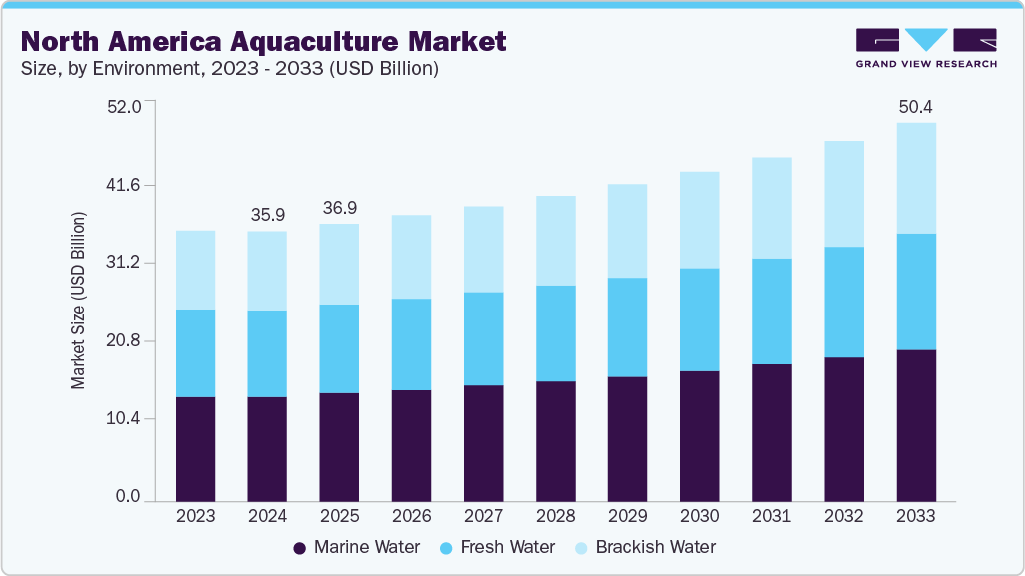
According to the FAO’s State of World Fisheries and Aquaculture 2024, global per capita seafood consumption more than doubled between 1961 and 2022, reaching 20.7 kg, outpacing population growth. In North America, this figure stands even higher at 23.4 kg/year, reflecting strong consumer preference. Moreover, sustainability is a major demand driver, with aquaculture now accounting for 51% of global aquatic animal production. This marks a fundamental shift in protein sourcing, creating a strategic opportunity for North American producers to meet market expectations for responsibly farmed, traceable, and nutrient-dense seafood.
The rise of land-based and offshore farming systems enables scalable production with reduced environmental impact, drawing strong interest from private investors and public institutions. Opportunities abound in cultivating high-value species such as Atlantic salmon, sea bass, and shellfish, as well as in expanding into seaweed farming and integrated multi-trophic aquaculture (IMTA), offering avenues for product diversification and market differentiation. These aquaculture-derived ingredients are widely used in supplements and fortified foods due to their proven benefits for heart, brain, and immune health. Growing interest in clean-label, sustainable marine products, such as enriched fillets and marine collagen, along with support from initiatives like NOAA’s Sea Grant, is fueling expansion in this space.
Technological advancements, including RAS, smart feeding solutions, and AI-powered monitoring tools, are transforming farm operations by enhancing efficiency, sustainability, and profitability. The growing shift toward sustainable feed alternatives, such as insect- and algae-based formulations, also supports eco-friendly practices and premium product positioning. Increasing consumer demand for responsibly sourced, high-quality seafood reinforces trends in organic production and eco-certification, further boosting market appeal and investor confidence. In addition, algae farming is gaining momentum due to its broad applications across food, pharmaceuticals, cosmetics, and bioenergy, adding another promising dimension to the sector's growth potential.
However, despite its strong growth potential, the market faces several restraints that could impede its expansion. Complex and stringent regulatory requirements, particularly environmental impact assessments, water usage, and effluent discharge, add to operational costs and administrative burdens. Disease outbreaks and biosecurity threats remain critical, especially in intensive farming systems, posing risks to stock health and farm viability. Moreover, the scarcity of affordable and suitable coastal or inland sites, along with local opposition (NIMBYism), often creates barriers to establishing new aquaculture facilities.
Market Concentration & Characteristics
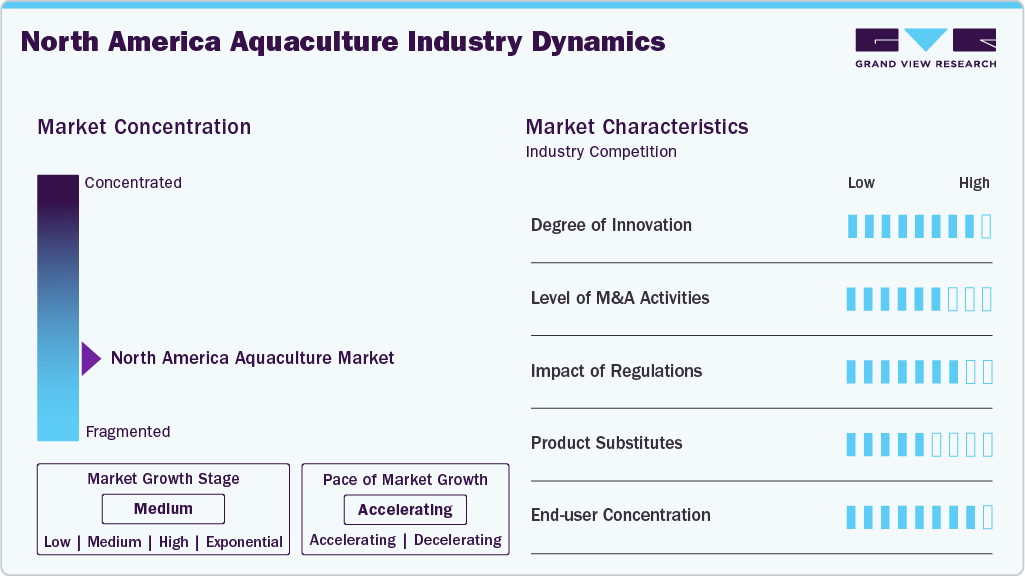
The North America aquaculture industry is moderately fragmented, with a few dominant players holding significant market share due to their vertical integration and scale of operations. These leading companies benefit from control over the entire value chain, from hatchery and feed production to growth and processing, which enables cost efficiencies, consistent product quality, and reliable supply. Their integrated operations, strong distribution networks, and advanced technologies allow them to effectively serve key end-use sectors such as retail, foodservice, and export markets. This strategic positioning also supports compliance with stringent regulatory standards and enhances their ability to meet growing consumer demand for sustainable and traceable seafood.
At the same time, emerging aquaculture players in regions such as the U.S. and Canada are steadily increasing their market presence by capitalizing on abundant natural resources, favorable climate conditions, and rising domestic seafood demand. These regional producers are supported by strategic investments in modern hatcheries, feed mills, and land-based or offshore farming systems, often located in coastal and inland aquaculture zones. They focus on cost-effective production and high-demand species such as salmon, trout, tilapia, and shrimp, aimed at local consumption and export markets. This shifting landscape, marked by consolidation among well-established players and regional expansion driven by localized advantages, continues to redefine the competitive structure.
However, the North American aquaculture industry faces several challenges, with one major challenge being rising temperatures, ocean acidification, hypoxia, and extreme weather events that disrupt production, increase mortality, and damage infrastructure. Climate-driven phenomena such as harmful algal blooms, invasive species, and declining oxygen levels reduce yields. At the same time, regulatory shifts, like Canada's planned ban on open-net pens, highlight the industry's urgent need to adapt to escalating environmental risks.
Environment Insights
Marine Water segment dominated the market and accounted for the largest revenue share of 39.0% in 2024, driven by its advantages such as a lower carbon footprint and minimal freshwater use. As wild fish stocks decline due to overfishing, marine aquaculture presents a sustainable solution to meet rising seafood demand. Technological innovations, including RAS, enhance operational efficiency and environmental performance. Growing consumer interest in a variety of seafood, along with increased demand for premium species like salmon, shrimp, and oysters, is fueling the expansion of offshore and coastal aquaculture in North America. Supported by advances in sustainable farming practices and strong certification standards, marine aquaculture is becoming a crucial driver of high-value seafood production in the region.
Whereas, the brackish water segment is expected to grow at a healthy CAGR of 4.0% from 2025 to 2033 during the forecast period, due to aquaculture, practiced in semi-saline environments like estuaries and mangroves, supports the cultivation of high-value species such as shrimp, oysters, and clams, particularly in southern U.S. states like Texas, Louisiana, and Florida, as well as select coastal areas in eastern Canada. Key drivers include strong domestic demand for shrimp, favorable geographic conditions, and the ability to farm in controlled environments that enhance biosecurity and reduce environmental impact. For instance, NaturalShrimp Inc., a U.S.-based aquaculture technology company operating in Texas and Iowa, focuses on land-based shrimp farming using proprietary electrocoagulation technology in brackish water systems. The company has received attention for producing antibiotic-free shrimp in indoor, brackish environments, targeting premium retail and foodservice markets.
Fish Species Insights
The catfish segment by fish species dominated with a market share of 24.6% in 2024, due to an established processing infrastructure and evolving consumer preferences. Most producers sell directly to processors, who handle large volumes and offer year-round market access. Consumer demand is a key driver, shifting preferences toward value-added and convenient formats such as fillets, nuggets, and frozen products. Frozen catfish products, particularly fillets, are grown the most, driven by sales to distributors, restaurants, and retail. Market trends include technological innovation, evolving production systems, and economic adaptation. The industry has continuously adapted to changing market conditions, rising input costs, and international competition by adopting more intensive systems such as split ponds and aerated ponds, which enhance productivity and reduce costs. Hybrid catfish have gained popularity due to their better growth performance and feed efficiency.
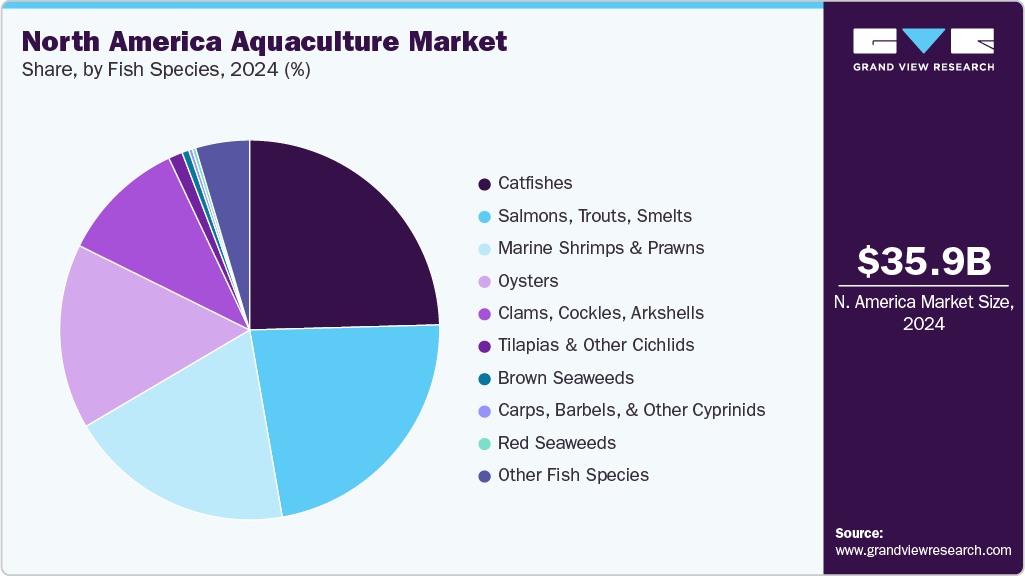
Brown seaweeds segment is expected to grow fastest with a CAGR of 6.6% from 2025 to 2033 during the forecast period due to due to their rich bioactive composition and rising demand for sustainable, multifunctional aquafeed ingredients and nutraceuticals. Their high content of polysaccharides like alginate and fucoidan, as well as compounds such as fucoxanthin, fucosterol, mannitol, and omega-3 fatty acids, contributes to a wide range of functional benefits, including antioxidant, anti-inflammatory, immune-boosting, and growth-promoting effects in aquatic species. As the industry shifts toward more eco-friendly and health-oriented aquaculture practices, brown seaweeds are being increasingly incorporated into feed formulations to enhance fish health and reduce antibiotic use. For instance, in the U.S., companies like Maine Coast Sea Vegetables and Ocean Rainforest are cultivating kelp (Laminaria and Alaria) for commercial applications, while startups in Canada’s Atlantic provinces are investing in Sargassum and Ascophyllum-based feed solutions. Regulatory support for alternative feedstocks and consumer demand for clean-label seafood further accelerate adoption, positioning brown seaweed as a key driver of innovation and sustainability in North American aquaculture.
Country Insights
U.S. Aquaculture Market Trends
The U.S. aquaculture market held a substantial share of the North American market in 2024, driven by efforts to reduce reliance on seafood imports and address the rising domestic demand for sustainable protein sources. The industry encompasses farming finfish, shellfish, and aquatic plants across both freshwater and marine settings. With wild fish populations under growing strain due to overfishing and climate change, aquaculture is becoming an essential strategy for securing the nation’s seafood supply while supporting economic growth in both coastal and inland areas. This growth is further fueled by increasing consumer preference for healthy, rich diets and a shift toward locally produced, eco-friendly seafood. As consumption rises and wild fisheries face environmental and regulatory constraints, aquaculture offers a dependable and sustainable solution to meet the country’s long-term seafood needs. For instance, in April 2025, NOAA highlighted its aquaculture program’s role in advancing sustainable seafood production through science-backed strategies and funding. Between 2018 and 2022, federal investments generated an average annual economic impact of USD 69.6 million, supporting over 1,100 jobs. A further USD 20 million invested in 2024 across 86 projects is expected to accelerate growth in the U.S. aquaculture sector.
Canada Aquaculture Market Trends
The aquaculture market in Canada held 13.9% of the North American market revenue share in 2024, driven by strong demand for sustainably sourced seafood and the need to diversify protein sources amid pressure on wild fisheries. The sector primarily produces Atlantic salmon, along with mussels, oysters, and emerging species like seaweed, leveraging Canada’s extensive coastal and freshwater resources. Increasing focus on innovation and sustainability, supported by strict regulations, is enhancing operational efficiency and environmental stewardship. For instance, in May 2025, Canadian aquaculture leaders issued an open letter urging government action to revitalize the stagnant sector, calling for science-based policymaking, reversal of the planned open-net pen salmon ban in British Columbia, and stronger federal leadership through Agriculture and Agri-Food Canada. These proposed changes aim to boost industry growth, create jobs, strengthen food security, and reduce import reliance.
Key North America Aquaculture Company Insights
Some key players operating in the North American market include Cooke Aquaculture Inc. and Mowi (RoyMarine Harvest ASA).
-
Cooke Aquaculture Inc., headquartered in New Brunswick, Canada, is a dominant and mature market player. As a vertically integrated global seafood company, Cooke has a strong foothold across the aquaculture value chain-from breeding, hatching, and farming to processing and distribution. The company specializes in a diverse range of species, including Atlantic salmon, sea bass, sea bream, and steelhead trout, farmed in marine, freshwater, and brackish water environments. Cooke’s operations span multiple North American regions, particularly the Atlantic coast, with significant investments in hatcheries, feed mills, and state-of-the-art processing facilities. Cooke's robust infrastructure enables them to maintain consistent product quality, ensure biosecurity, and meet stringent sustainability and traceability standards demanded by retailers and regulators. The company is also a pioneer in sustainable aquaculture practices, actively investing in R&D, environmental monitoring, and innovations such as integrated multi-trophic aquaculture (IMTA) and selective breeding programs. Cooke continues to expand its market presence through acquisitions and partnerships, further strengthening its leadership in supplying high-quality, responsibly farmed seafood to North American and global markets.
Blue Ridge Aquaculture and Riverence (Clear Springs Foods, Inc.) are emerging market participants.
-
Blue Ridge Aquaculture, based in Martinsville, Virginia, is an emerging and innovative market player, strongly focusing on sustainable, land-based fish farming. Recognized as one of the world’s largest indoor recirculating aquaculture system (RAS) facilities for tilapia production, the company is steadily expanding its influence within the U.S. market by promoting environmentally responsible and biosecure aquaculture practices. Blue Ridge Aquaculture leverages advanced RAS technology to maintain year-round production under controlled conditions, eliminating the risks associated with open-water farming such as disease transmission, environmental pollution, and weather disruptions. The company’s vertically integrated operations-from hatchery and grow-out to harvest and distribution-ensure consistent quality, traceability, and supply chain efficiency. Blue Ridge also invests in automation, water recycling technologies, and feed optimization to enhance operational sustainability and fish health. Its commitment to innovation and eco-efficiency positions it as a forward-looking partner for retailers and distributors seeking clean-label, domestically sourced, and responsibly farmed seafood. With increasing consumer demand for locally produced, sustainable protein sources, Blue Ridge Aquaculture is well-positioned for accelerated growth and broader market adoption in the North American aquaculture landscape.
Key North America Aquaculture Companies:
- Cooke Aquaculture Inc.
- Eastern Fish Company
- Mowi (RoyMarine Harvest ASA)
- Blue Ridge Aquaculture
- Riverence (Clear Springs Foods, Inc.)
- Taylor Shellfish Farms
- Pacific Seafood
- Blue Circle Foods
- American Seafoods Company
- Atlantic Sapphire
Recent Developments
-
In January 2025, Mowi ASA, a global leader in aquaculture with a significant presence in North America, announced it would increase its ownership of Nova Sea AS by acquiring Vigner Olaisen’s This strategic move strengthens Mowi’s position in Northern Norway, a region renowned for salmon farming. While the acquisition is focused on Norwegian operations, it has broader implications for the North American market by bolstering Mowi’s global supply capabilities, improving efficiency, and potentially increasing high-quality, sustainably farmed salmon exports to North America. This aligns with the growing demand for traceable and premium aquaculture products in the U.S. and Canada.
-
In October 2024, Eastern Fish, a leading seafood company in North America, introduced its Golden Harvest Dim Sum Line, set to launch in retail stores. This new offer reflects the region’s growing demand for value-added aquaculture products that combine convenience, quality, and authentic flavors. The line features four shrimp-based items Shrimp Wontons, Shrimp Dumpling Trio, Shrimp Shumai, and Shrimp Spring Rolls, crafted for quick preparation through air frying, steaming, or microwaving.
North America Aquaculture Market Report Scope
Report Attribute
Details
Market size value in 2025
USD 36,948.2 million
Revenue forecast in 2033
USD 50,463.0 million
Growth rate
CAGR of 4.0% from 2025 to 2033
Base year for estimation
2024
Historical data
2018 - 2023
Forecast period
2025 - 2033
Quantitative units
Volume in kilotons, revenue in USD million/billion, and CAGR from 2025 to 2033
Report coverage
Revenue forecast, company ranking, competitive landscape, growth factors, and trends
Segments covered
Environment, fish species, country
Regional scope
North America
Country scope
U.S.; Canada
Key companies profiled
Blue Ridge Aquaculture; Cooke Aquaculture Inc.; Eastern Fish Company; Mowi (RoyMarine Harvest ASA); Riverence (Clear Springs Foods, Inc.); Taylor Shellfish Farms; Pacific Seafood; Blue Circle Foods; American Seafoods Company; Atlantic Sapphire
Customization scope
Free report customization (equivalent to up to 8 analysts’ working days) with purchase. Addition or alteration to country, regional & segment scope.
Pricing and purchase options
Avail customized purchase options to meet your exact research needs. Explore purchase options
North America Aquaculture Market Report Segmentation
This report forecasts volume & revenue growth at regional and country levels and provides an analysis of the latest industry trends in each of the sub-segments from 2018 to 2033. For this study, Grand View Research has segmented the North America aquaculture market report based on environment, fish species, and country:
-
Environment Outlook (Volume, Kilotons; Revenue, USD Million, 2018 - 2033)
-
Marine Water
-
Fresh Water
-
Brackish Water
-
-
Fish Species Outlook (Volume, Kilotons; Revenue, USD Million, 2018 - 2033)
-
Carps, barbels, and other cyprinids
-
Brown seaweeds
-
Red seaweeds
-
Marine shrimps and prawns
-
Oysters
-
Tilapias and other cichlids
-
Catfishes
-
Clams, cockles, arkshells
-
Salmons, trouts, smelts
-
Freshwater fishes nei
-
Other Fish Species
-
-
Country Outlook (Volume, Kilotons; Revenue, USD Million, 2018 - 2033)
-
North America
-
U.S.
-
Canada
-
-
Frequently Asked Questions About This Report
b. The North America aquaculture market size was estimated at USD 35,975.5 million in 2024 and is expected to reach USD 36,948.2 million in 2025.
b. The North America aquaculture market is expected to grow at a compound annual growth rate of 4.0% from 2025 to 2033 to reach USD 50,463.0 million by 2033.
b. The marine water North America aquaculture segment led the market and accounted for the largest revenue share of 39.0% in 2024, driven by its advantages such as a lower carbon footprint and minimal freshwater use.
b. Some of the key players operating in the North America Aquaculture Market include Blue Ridge Aquaculture, Cooke Aquaculture Inc., Eastern Fish Company, Mowi (RoyMarine Harvest ASA), Riverence (Clear Springs Foods, Inc.), Taylor Shellfish Farms, Pacific Seafood, Blue Circle Foods, American Seafoods Company, Atlantic Sapphire.
b. The growth in North America’s aquaculture market is driven by a growing consumer focus on high-quality, protein-rich diets, particularly seafood known for its nutritional and sustainability benefits. Rising health consciousness and a shift toward omega-3-rich species like salmon and trout significantly boosted regional demand.


Share this report with your colleague or friend.
Need a Tailored Report?
Customize this report to your needs — add regions, segments, or data points, with 20% free customization.


ISO 9001:2015 & 27001:2022 Certified
We are GDPR and CCPA compliant! Your transaction & personal information is safe and secure. For more details, please read our privacy policy.
Trusted market insights - try a free sample
See how our reports are structured and why industry leaders rely on Grand View Research. Get a free sample or ask us to tailor this report to your needs.