- Home
- »
- Agrochemicals & Fertilizers
- »
-
Nitrogenous Fertilizer Market Size, Industry Report, 2033GVR Report cover
![Nitrogenous Fertilizer Market Size, Share & Trends Report]()
Nitrogenous Fertilizer Market (2026 - 2033) Size, Share & Trends Analysis Report By Product (Urea, Ammonium Sulfate), By Application (Cereals & Grains, Oilseeds & Pulses, Fruits & Vegetables), By Region, And Segment Forecasts
- Report ID: GVR-3-68038-752-0
- Number of Report Pages: 86
- Format: PDF
- Historical Range: 2021 - 2024
- Forecast Period: 2026 - 2033
- Industry: Bulk Chemicals
- Report Summary
- Table of Contents
- Segmentation
- Methodology
- Download FREE Sample
-
 Download Sample Report
Nitrogenous Fertilizer Market Summary
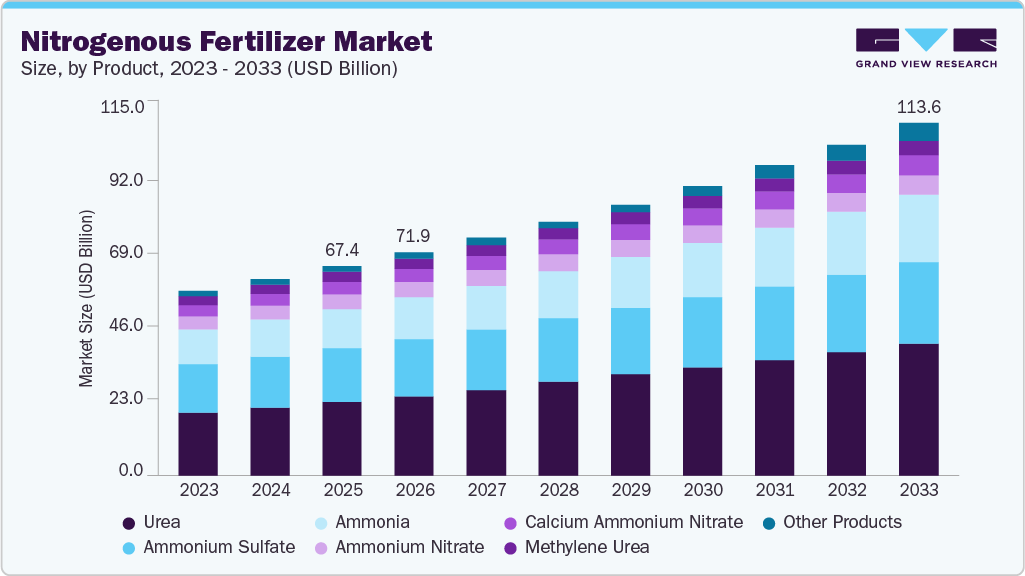
The global nitrogenous fertilizer market size was estimated at USD 67.4 billion in 2025 and is projected to reach USD 113.6 billion by 2033, growing at a CAGR of 6.8% from 2026 to 2033. The growth is primarily driven by rising global food demand and the need to enhance agricultural productivity across cereals, grains, fruits, and vegetable cultivation, where nitrogen plays a critical role in improving crop yield and soil fertility.
Key Market Trends & Insights
- By product, the urea segment led the market with a revenue share of 35.0% in 2025.
- By application, the cereals & grains segment dominated the market with a revenue share of 44.5% in 2025.
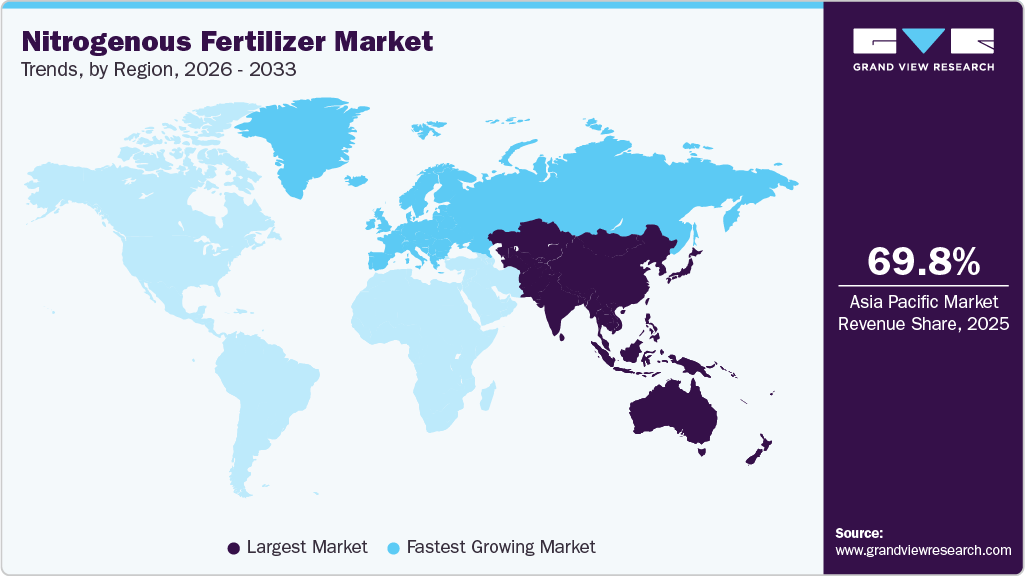
- Asia Pacific held the largest global revenue share of 69.8% in 2025.
- China nitrogenous fertilizer market dominated the Asia Pacific region.
Market Size & Forecast
- 2025 Market Size: USD 67.4 Billion
- 2033 Projected Market Size: USD 113.6 Billion
- CAGR (2026-2033): 6.8%
- Asia Pacific: Largest market in 2025
- Europe: Fastest growing market
Increasing emphasis on balanced nutrient management, higher fertilizer efficiency, and the adoption of advanced nitrogen application techniques, coupled with ongoing capacity expansions in ammonia and urea production, is further supporting the growth of the nitrogenous fertilizer industry.A key factor driving the growth of the global nitrogenous fertilizer market is its extensive use across large-scale agricultural operations, particularly in the cultivation of cereals, grains, fruits, and vegetables, where nitrogen is essential for plant growth, chlorophyll formation, and yield enhancement. These applications require efficient, high-nutrient formulations to ensure optimal crop productivity, improved soil fertility, and consistent output across varying climatic conditions. With increasing pressure to maximize agricultural output from limited arable land, manufacturers are focusing on improving the efficiency of urea- and ammonia-based fertilizers through enhanced nutrient-delivery systems and controlled application practices to support sustainable farming outcomes.
The growing emphasis on balanced fertilization, improved nitrogen use efficiency, and environmentally responsible nutrient management, coupled with evolving regulatory frameworks aimed at reducing nitrogen runoff and greenhouse gas emissions, is driving the development of advanced, sustainable nitrogen fertilizer solutions. However, volatility in natural gas prices, stringent environmental regulations, and increasing competition from bio-based and alternative soil nutrient solutions continue to influence overall market dynamics.
Market Concentration & Characteristics
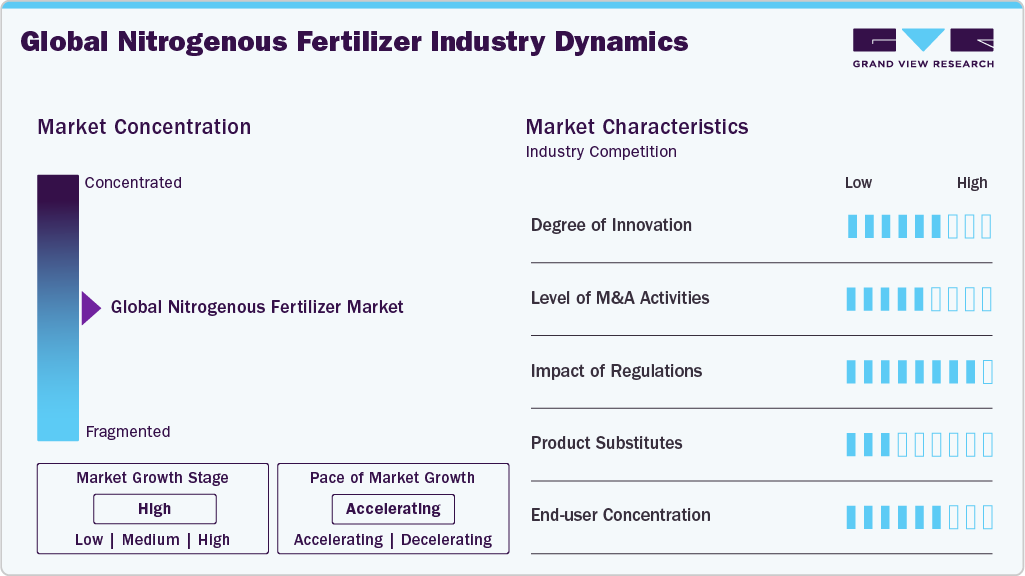
The global nitrogenous fertilizer market is moderately consolidated, with leadership held by several established manufacturers, including Nutrien Ltd., Yara International ASA, and Sasol, alongside regional producers and state-backed enterprises. These key players benefit from large-scale ammonia and urea production capacities, strong backward integration into feedstock supply, advanced agronomic expertise, and extensive global distribution networks, enabling them to maintain a competitive edge in the market.
At the same time, emerging players in Asia Pacific, Latin America, and the Middle East & Africa are steadily expanding their presence in the global nitrogenous fertilizer industry by leveraging cost-efficient manufacturing capabilities, improved access to natural gas feedstock, and rising domestic demand for crop nutrients driven by expanding agricultural activities. These regional manufacturers are supported by strategic investments in large-scale ammonia and urea production facilities, the modernization of existing plants to enhance energy efficiency, and the development of localized distribution networks positioned close to key farming regions and export terminals, thereby strengthening their competitiveness in both domestic and international markets.
Product Insights
The urea segment dominated the global nitrogenous fertilizer industry in 2025, accounting for a revenue share of 35.0%, driven by its high nitrogen content, cost-effectiveness, and widespread adoption across key crops. Its strong penetration in large-scale cereal and grain cultivation, along with established global production and distribution infrastructure, continues to support its leadership position in the market. Urea remains the most preferred nitrogen fertilizer due to its efficiency in improving crop yield and adaptability across diverse soil and climatic conditions.
The ammonia segment is projected to grow at a CAGR of 7.0% during 2026-2033, supported by its critical role as a primary feedstock in nitrogen fertilizer production. Increasing investments in ammonia capacity expansion, coupled with advancements in energy-efficient, low-carbon production technologies, are expected to drive faster growth in this segment over the forecast period.
Application Insights
The cereals & grains segment held the dominant position in the nitrogenous fertilizer market in 2025, accounting for a revenue share of 44.5%. This can be attributed to the extensive global cultivation of staple crops such as wheat, rice, and corn. The continuous need to enhance crop productivity and ensure food security remains a key factor sustaining high nitrogen fertilizer consumption in this segment.
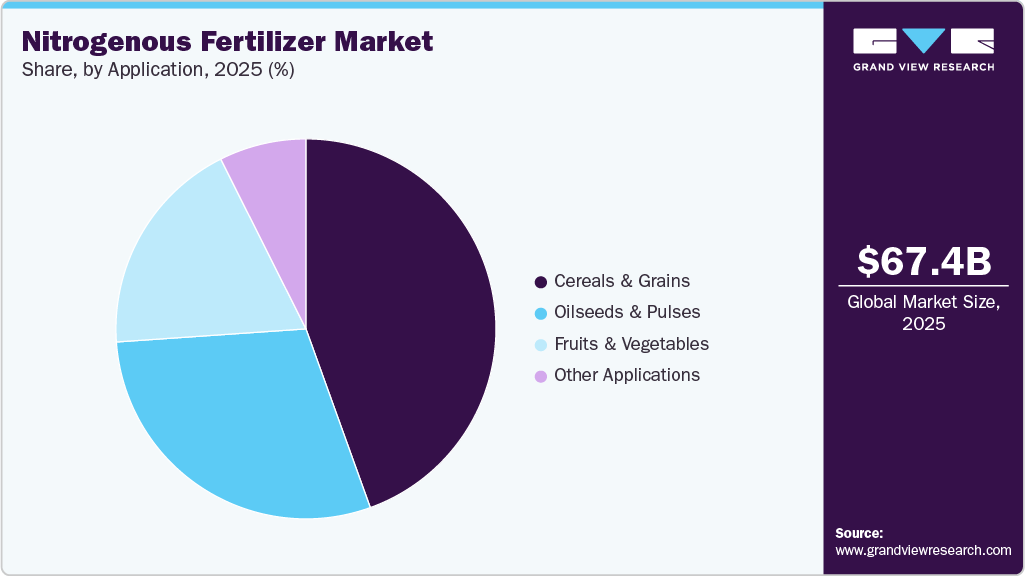
The fruits & vegetables segment is anticipated to grow at a CAGR of 6.9% during 2026-2033, driven by rising consumer demand for high-quality produce and the expansion of commercial horticulture practices. Increasing adoption of precision nutrient management techniques is further supporting growth in this application category.
Regional Insights
The Asia Pacific nitrogenous fertilizer market accounted for the largest revenue share of 69.8%, driven by strong demand from large agricultural economies and high fertilizer consumption across cereals, grains, fruits, and vegetable cultivation, along with cost-competitive production across major countries such as China and India. The region benefits from extensive crop cultivation and expanding agricultural intensification, which support substantial consumption of urea- and ammonia-based nitrogen fertilizers. China remains a key contributor within the region, supported by large-scale domestic production capacity and strong demand from staple crop production and fertilizer manufacturing hubs.
China’s nitrogenous fertilizer market dominated Asia Pacific, accounting for a regional revenue share of 69.7% in 2025, supported by extensive ammonia and urea production infrastructure, strong availability of natural gas and coal-based feedstock, and cost-competitive large-scale manufacturing of nitrogenous fertilizers. The country’s well-established domestic distribution network, long-standing expertise in fertilizer production technologies, and dominant presence in global agricultural supply chains continue to reinforce its leadership position in the region.
North America Nitrogenous Fertilizer Market Trends
North America is witnessing increased emphasis on sustainable nutrient management practices, regulatory compliance regarding nitrogen emissions and runoff control, and the adoption of enhanced-efficiency fertilizer products. These factors are supporting consistent market expansion and contributing to demand growth, reinforcing the long-term development of the regional market.
U.S. Nitrogenous Fertilizer Market Trends
The U.S. represents a key market within North America, accounting for 70.5% of the regional market in 2025. Demand is driven by extensive cultivation of cereals, grains, oilseeds, and specialty crops, supported by large-scale commercial farming operations and advanced agricultural practices. The country relies on a combination of domestic nitrogen production and imports to meet requirements for urea- and ammonia-based fertilizers. Strong downstream consumption across row crops and high-value agricultural segments continues to sustain steady market demand in the U.S. market.
Europe Nitrogenous Fertilizer Market Trends
Europe’s nitrogenous fertilizer industry is projected to grow at a CAGR of 7.4% over 2026-2033, supported by strong agricultural infrastructure and advanced fertilizer manufacturing capabilities. The presence of leading nitrogen producers and an integrated raw material and distribution network further strengthens regional demand dynamics. Consumption is driven by cereals, grains, and diversified crop cultivation, which require reliable, efficient nitrogen-based nutrient solutions. Additionally, stricter environmental regulations and the shift toward sustainable, high-efficiency fertilizer products are encouraging the adoption of advanced nutrient management practices across the region, supporting steady market expansion.
The Germany nitrogenous fertilizer market is expected to grow during the forecast period. Germany serves as a major agricultural and industrial hub within Europe, supported by a strong fertilizer manufacturing base and advanced nutrient management capabilities for nitrogen-based products. The demand for urea- and ammonia-based fertilizers in the country is driven by applications across cereals, grains, oilseeds, and specialty crop cultivation. Germany’s emphasis on high-quality production standards, technological innovation, and sustainable farming practices supports steady adoption of enhanced-efficiency and environmentally compliant nitrogen fertilizer solutions.
Latin America Nitrogenous Fertilizer Market Trends
Latin America is projected to grow steadily during the forecast period, supported by expanding agricultural activities, increasing cultivation of cash crops, and improving fertilizer production and distribution infrastructure across key countries. Nations witnessing strong agribusiness development and advancing nutrient management practices are creating opportunities for higher nitrogen fertilizer consumption across large-scale farming operations.
Middle East and Africa Nitrogenous Fertilizer Market Trends
The Middle East & Africa region is expected to see moderate growth in the global industry, driven by expanding agricultural activities, rising food security initiatives, and gradual improvements in farming infrastructure across key economies. Growth in cereal cultivation, horticulture, and government-supported agricultural development programs continues to generate steady requirements for nitrogen-based fertilizers across the region.
Key Nitrogenous Fertilizer Company Insights
The global nitrogenous fertilizer market is characterized by the presence of several leading players, including Nutrien Ltd., Yara International ASA, CF Industries Holdings, Inc., and Sasol. These companies actively focus on research and development, product innovation, capacity expansion, and strategic partnerships, while increasingly prioritizing sustainability, energy efficiency, and regulatory compliance in nitrogen fertilizer production.
Company Overview
Nutrien Ltd. is a global crop input and fertilizer company headquartered in Saskatoon, Canada. The company supplies nitrogen, phosphate, and potash fertilizers to agricultural markets worldwide, supporting large-scale crop production across cereals, grains, oilseeds, and specialty crops. With extensive nitrogen production capacity and integrated distribution operations, Nutrien focuses on operational efficiency, sustainable nutrient management, and innovation-driven solutions to enhance agricultural productivity while meeting evolving environmental and regulatory standards.
Key Nitrogenous Fertilizer Companies:
The following key companies have been profiled for this study on the nitrogenous fertilizer market.
- Nutrien Ltd.
- Yara International
- Omnia Holdings Limited
- Sasol
- OCI Nitrogen
- ICL Fertilizers
- Eurochem Group AG
- Koch Fertilizer, LLC
- Coromandel International Limited
- Haifa Group
Recent Developments
-
In December 2025, Indorama Corporation expanded its presence in the fertilizer sector through the strategic acquisition of a major nitrogen fertilizer producer in China, strengthening its ammonia and urea production capacity in one of the world’s largest agricultural markets. This move enhances regional supply capabilities, improves integration across the value chain, and supports rising domestic and export demand. Such expansions drive market growth by increasing production efficiency, intensifying competition, and ensuring stable fertilizer availability to meet growing global food security requirements.
Nitrogenous Fertilizer Market Report Scope
Report Attribute
Details
Market size value in 2026
USD 71.9 billion
Revenue forecast in 2033
USD 113.6 billion
Growth rate
CAGR of 6.8% from 2026 to 2033
Base year for estimation
2025
Historical data
2021 - 2024
Forecast period
2026 - 2033
Quantitative units
Revenue in USD million/billion, volume in kilotons, and CAGR from 2026 to 2033
Report coverage
Revenue forecast, volume forecast, company ranking, competitive landscape, growth factors, and trends
Segments covered
Product, application, region
Regional scope
North America; Europe; Asia Pacific; Middle East & Africa; Latin America
Country scope
U.S.; Canada; Mexico; Germany; France; UK; Italy; Spain; Netherlands; China; India; Japan; South Korea; Brazil; Argentina; Saudi Arabia; Qatar; Egypt
Key companies profiled
Nutrien Ltd.; Yara International; Omnia Holdings Limited; Sasol; OCI Nitrogen; ICL Fertilizers; EuroChem Group AG; Koch Fertilizer, LLC; Coromandel International Limited; Haifa Group
Customization scope
Free report customization (equivalent up to 8 analysts’ working days) with purchase. Addition or alteration to country, regional & segment scope.
Pricing and purchase options
Avail customized purchase options to meet your exact research needs. Explore purchase options
Global Nitrogenous Fertilizer Market Report Segmentation
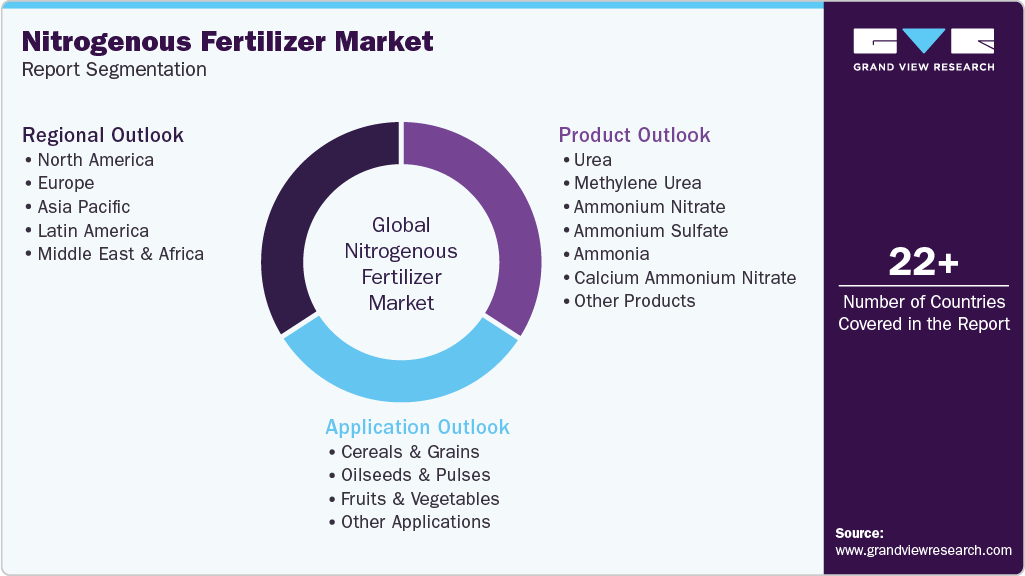
This report forecasts volume & revenue growth at the global, regional, and country levels and provides an analysis of the latest industry trends in each of the sub-segments from 2021 to 2033. For this study, Grand View Research has segmented the global nitrogenous fertilizer market report based on technology, product, application, and region:
-
Product Outlook (Volume, Kilotons; Revenue, USD Million, 2021 - 2033)
-
Urea
-
Methylene Urea
-
Ammonium Nitrate
-
Ammonium Sulfate
-
Ammonia
-
Calcium Ammonium Nitrate
-
Other Products
-
-
Application Outlook (Volume, Kilotons; Revenue, USD Million, 2021 - 2033)
-
Cereals & Grains
-
Oilseeds & Pulses
-
Fruits & Vegetables
-
Other Applications
-
-
Regional Outlook (Volume, Kilotons; Revenue, USD Million, 2021 - 2033)
-
North America
-
U.S.
-
Canada
-
Mexico
-
-
Europe
-
Germany
-
France
-
UK
-
Italy
-
Spain
-
Netherlands
-
-
Asia Pacific
-
China
-
India
-
Japan
-
South Korea
-
-
Latin America
-
Brazil
-
Argentina
-
-
Middle East & Africa
-
South Africa
-
Qatar
-
Egypt
-
-
Frequently Asked Questions About This Report
b. Some key players operating in the nitrogenous fertilizer market include Nutrien, Koch Industries, Yara International, OCI Nitrogen, and CF Industries Holdings, Inc. The other manufacturers of nitrogenous fertilizers in the market are ICL Fertilizers, EuroChem Group AG, Sinofert Holdings Limited, and Coromandel International Ltd.
b. Key factors that are driving the nitrogenous fertilizer market growth include technological innovations in the fertilizer industry and growth in commercial agriculture.
b. The global nitrogenous fertilizers market size was estimated at USD 67.4 billion in 2025 and is expected to reach USD 71.9 billion in 2026.
b. The global nitrogenous fertilizer market is expected to grow at a compound annual growth rate of 6.8% from 2026 to 2033 to reach USD 113.6 billion by 2033.
b. Asia Pacific accounted for the largest revenue share of 69.8%, driven by strong demand from large agricultural economies and high fertilizer consumption across cereals, grains, fruits, and vegetable cultivation, along with cost-competitive production across major countries such as China and India.


Share this report with your colleague or friend.
Need a Tailored Report?
Customize this report to your needs — add regions, segments, or data points, with 20% free customization.


ISO 9001:2015 & 27001:2022 Certified
We are GDPR and CCPA compliant! Your transaction & personal information is safe and secure. For more details, please read our privacy policy.
Trusted market insights - try a free sample
See how our reports are structured and why industry leaders rely on Grand View Research. Get a free sample or ask us to tailor this report to your needs.