- Home
- »
- Agrochemicals & Fertilizers
- »
-
Multiple Cropping Market Size, Share, Industry Report, 2033GVR Report cover
![Multiple Cropping Market Size, Share & Trends Report]()
Multiple Cropping Market (2026 - 2033) Size, Share & Trends Analysis Report By System Type (Sequential Cropping, Intercropping, Mixed Cropping), By Crop Type (Cereal & Grains, Oilseeds & Pulses, Other Crop Types), By Region, And Segment Forecasts
- Report ID: GVR-4-68040-871-6
- Number of Report Pages: 80
- Format: PDF
- Historical Range: 2021 - 2024
- Forecast Period: 2026 - 2033
- Industry: Bulk Chemicals
- Report Summary
- Table of Contents
- Segmentation
- Methodology
- Download FREE Sample
-
 Download Sample Report
Multiple Cropping Market Summary
The global multiple cropping market size was estimated at USD 25.7 billion in 2025 and is projected to reach USD 34.3 billion by 2033, growing at a CAGR of 3.8% from 2026 to 2033. Multiple cropping is gaining structural importance as farmers seek to increase output per hectare without expanding cultivated land. By harvesting two or more crops within a year, producers improve land productivity, stabilize income streams, and optimize fixed asset utilization.
Key Market Trends & Insights
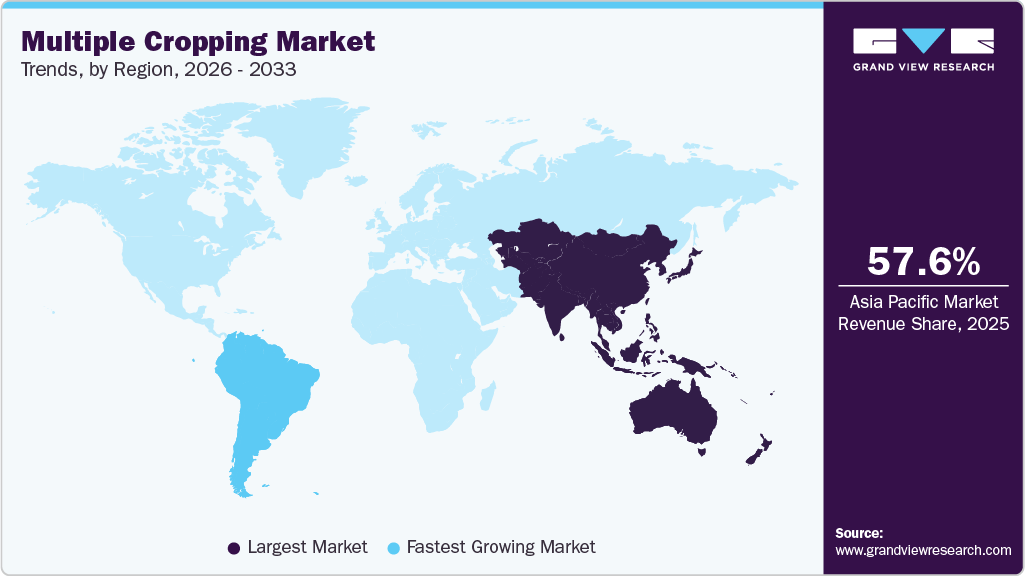
- The Asia Pacific multiple cropping market held the largest revenue share of 57.6% in 2025.
- The China multiple cropping industry led Asia Pacific, with a revenue share of 41.3% in 2025.
- By system type, the intercropping segment is projected to grow at the fastest CAGR of 4.4% from 2026 to 2033.
- By crop type, the cereal & grains segment led the market, accounting for a revenue share of 58.1% in 2025.
Market Size & Forecast
- 2025 Market Size: USD 25.7 Billion
- 2033 Projected Market Size: USD 34.3 Billion
- CAGR (2026-2033): 3.8%
- Asia Pacific: Largest market in 2025
- Latin America: Fastest growing market
The multiple cropping industry is expanding as agronomic planning becomes more precise and crop varieties are better suited for shorter growing windows. Early maturing hybrids and improved planting practices enable tighter crop sequencing while preserving primary season yields. Nutrient management programs are increasingly calibrated for consecutive harvests, ensuring soil fertility recovery between cycles. These adjustments reduce operational uncertainty and make double and triple cropping economically viable across a wider base of farms, reinforcing sustained input consumption across seasons.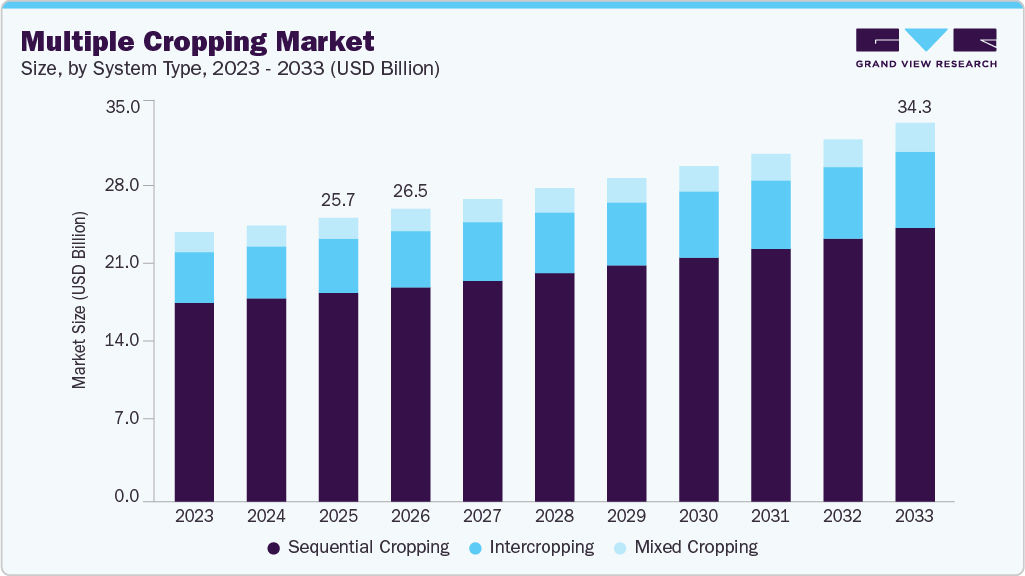
Economic considerations further strengthen adoption. Multiple cropping spreads revenue across different harvest periods, improving cash flow stability and reducing exposure to single commodity price swings. Diversified crop rotations can enhance soil structure and nutrient balance, particularly when legumes are integrated into cereal systems. Improved land use efficiency also supports higher overall production without proportional increases in land costs, making intensification financially attractive in environments where arable land expansion is limited or capital intensive.
Market Concentration & Characteristics
The multiple cropping market is moderately fragmented, with participation distributed across seed producers, crop nutrition companies, protection manufacturers, irrigation providers, and advisory service firms. This structure exists because multiple cropping is not a standalone product category but a farming practice that draws demand from several established agricultural input industries.
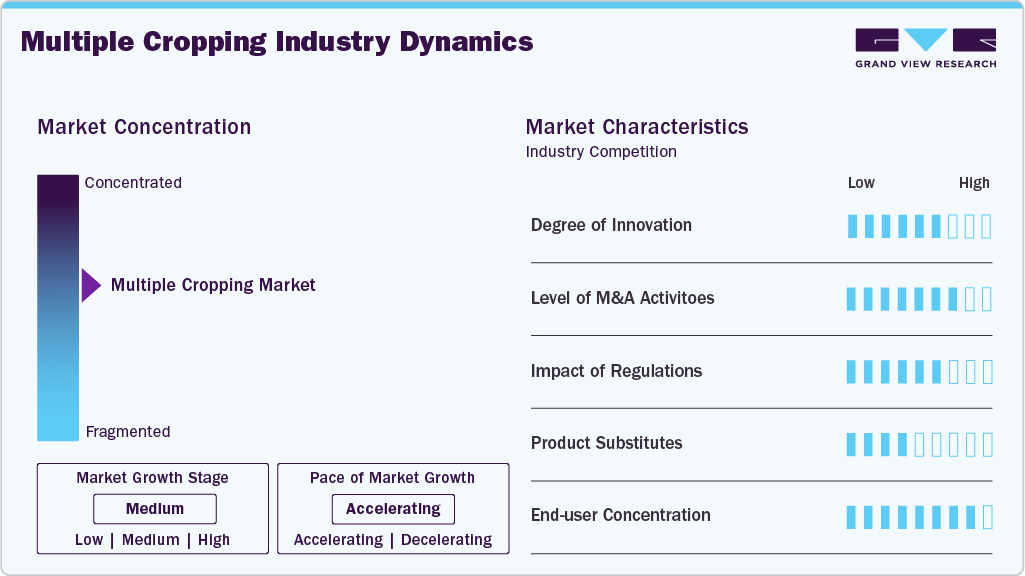
The market is characterized by seasonal demand cycles, agronomic dependency, and integration with farm management practices. These characteristics arise because planting schedules, soil conditions, and water availability determine whether additional crop cycles are feasible. Participants compete through yield optimization support, input efficiency, and reliability of supply, as farmers prioritize performance stability and risk reduction when intensifying production across consecutive growing seasons.
System Type Insights
Sequential cropping led the multiple cropping industry, accounting for a revenue share of 73.4% in 2025, reflecting its widespread adoption in systems where two or three crops are grown in succession within a year. The dominance is closely linked to established double cropping patterns in cereals and oilseeds, which require full input cycles for each planting season. Because every additional harvest involves renewed seed purchase, fertilizer application, and crop protection use, revenue intensity remains high. Its structured planting schedule and compatibility with mechanized farming also make it easier to scale, reinforcing its leading contribution to overall market demand.
Intercropping is expected to grow at a CAGR of 4.4% between 2026 and 2033, driven by increasing interest in resource efficiency and risk diversification. By cultivating two crops simultaneously on the same field, farmers can optimize sunlight use, reduce pest pressure, and improve nutrient cycling. Although its current revenue base is smaller than sequential systems, adoption is expanding as agronomic advisory services and precision planting techniques improve. The ability to stabilize yields and enhance soil health is encouraging gradual integration into commercial farming models, supporting steady expansion over the forecast period.
Crop Type Insights
The cereal and grains segment dominated the multiple cropping market, accounting for a revenue share of 58.1% in 2025, reflecting the dominance of crops such as rice, wheat, and maize in multiple cropping systems. These staples are commonly grown in sequential patterns, particularly double cropping arrangements, which require complete input cycles for each harvest. High acreage allocation and consistent demand for food and feed ensure steady seed, fertilizer, and crop protection consumption. Because cereals form the backbone of global harvested area, their integration into intensive cropping schedules significantly elevates revenue contribution compared to other crop categories.
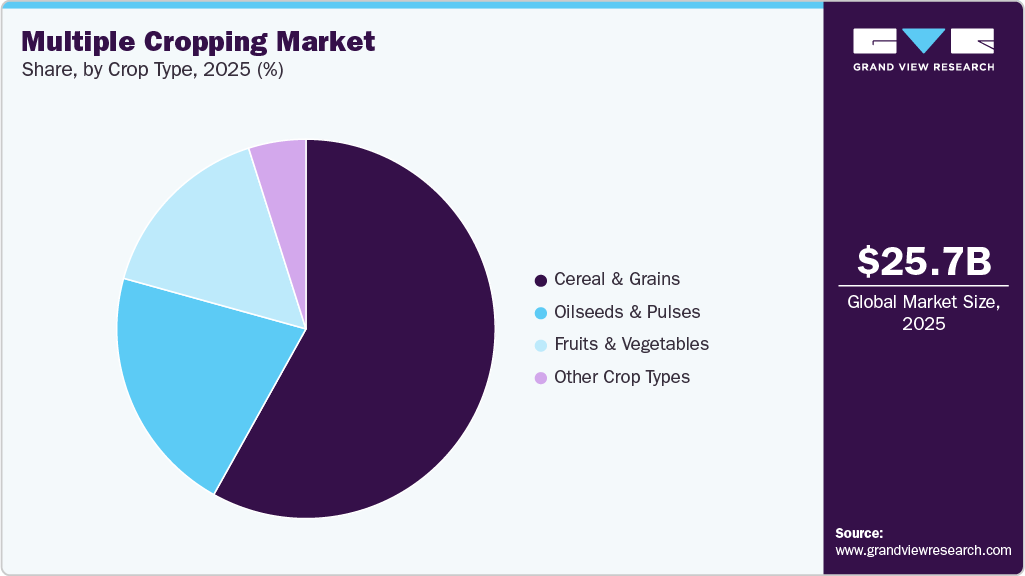
The fruits and vegetables segment is projected to grow at a CAGR of 4.3% through 2033, driven by rising preference for diversified and higher value crop rotations. These crops often generate greater revenue per hectare and benefit from short growing cycles that fit well within multiple cropping schedules. Increasing focus on nutritional diversity and controlled cultivation practices supports the adoption of sequential and intercropping systems for horticultural produce. As farmers seek to enhance income stability and optimize land productivity, fruits and vegetables are increasingly incorporated into intensive production plans.
Regional Insights
Asia Pacific accounted for a revenue share of 57.6% in 2025, attributed to its high cropping intensity and extensive adoption of double and triple cropping systems. Large areas under irrigated cereal cultivation enable multiple harvests within a single year, generating repeated input demand. Strong integration between seed usage, fertilizer application, and crop protection practices further elevates revenue per hectare. The region’s emphasis on maximizing food production from limited arable land sustains consistent participation in intensive cropping models.
China Multiple Cropping Market Trends
The China multiple cropping market plays a central role in multiple cropping due to intensive rice wheat and maize rotations supported by widespread irrigation. High cropping intensity in fertile river basins enables two or more harvests annually, generating recurring input demand. Government backed agricultural modernization programs promote efficient seed varieties and improved nutrient management across seasons. Strong domestic consumption of staple grains reinforces the need for continuous production cycles, sustaining structural reliance on multi season cultivation practices.
North America Multiple Cropping Market Trends
The North America multiple cropping industry is characterized by structured double-cropping systems in maize, soybean, and wheat rotations, supported by high mechanization levels. Farmers in this region use advanced planting and harvesting equipment that enable timely transitions between seasons. Strong integration of crop insurance, input financing, and forward contracting reduces financial risk associated with additional planting cycles. Adoption is concentrated where climate conditions permit sequential cropping, and demand is influenced by productivity optimization rather than land expansion.
The U.S. multiple cropping industry is driven by established corn soybean rotations and by increasing adoption of winter wheat and cover crop integration in certain states. High per-hectare input intensity results in strong revenue contribution from each additional crop cycle. Precision agriculture tools help optimize planting windows and input dosing, supporting efficient multi-season cultivation. Farm scale operations and structured supply contracts encourage farmers to intensify production while maintaining yield stability and operational control.
Europe Multiple Cropping Market Trends
Europe’s market is shaped by regulated agricultural frameworks and an emphasis on sustainable land management. Sequential cereal rotations and integration of legumes are common where climate permits, though environmental compliance requirements influence cropping patterns. Farmers prioritize soil health, nutrient balance, and efficient water use when adopting additional crop cycles. Input usage is carefully managed to meet regulatory thresholds, resulting in steady yet measured growth in demand for multiple cropping rather than aggressive expansion.
Germany's multiple cropping market reflects advanced agronomic planning and astrong emphasis on crop rotation for soil fertility management. Double cropping occurs in selected regions where climatic conditions allow winter and spring crop combinations. High standards in fertilizer efficiency and environmental monitoring guide input application across successive plantings. Industrial demand for cereals and oilseeds supports structured production cycles, while farm management systems ensure that additional crop intensity aligns with yield consistency and sustainability objectives.
Latin America Multiple Cropping Market Trends
Latin America is expected to grow at the fastest CAGR of 4.5% from 2026 to 2033, supported by expanding double-cropping in soybean and maize systems. Improved mechanization and efficient planting schedules allow farmers to harvest sequential crops with minimal turnaround time. The rising focus on export-oriented agricultural output encourages higher land productivity, thereby reinforcing the adoption of multi-cycle cultivation. As farm management practices become more structured, demand for inputs associated with additional crop cycles continues to strengthen.
Middle East & Africa Multiple Cropping Market Trends
The Middle East and Africa market is influenced by irrigation availability and efforts to enhance food security under water-constrained conditions. Multiple cropping adoption is concentrated in irrigated zones where controlled water supply allows sequential planting. Investment in protected cultivation and improved seed varieties supports limited but increasing intensity. Expansion remains gradual due to climatic variability and infrastructure gaps, yet demand for higher land productivity is encouraging targeted implementation of multi-cycle farming systems.
Key Multiple Cropping Company Insights
The two dominant manufacturers in the multiple cropping market are Bayer Crop Science and Corteva Agriscience, both recognized for their strong agricultural innovation capabilities and integrated crop-solution portfolios.
-
Bayer Crop Science is a global agricultural technology company focused on seed genetics, crop protection, and digital farming solutions. The company develops high-performance hybrid seeds and advanced trait technologies that enable farmers to optimize productivity across multiple planting cycles.
-
Corteva Agriscience specializes in seed innovation and crop protection chemistry designed to improve farm productivity and sustainability. The company invests in trait development, biological solutions, and precision agronomy tools that support efficient nutrient use and pest management across consecutive crop cycles.
Key Multiple Cropping Companies:
The following key companies have been profiled for this study on the multiple cropping market.
- Bayer Crop Science
- Corteva Agriscience
- Syngenta AG
- BASF SE
- John Deere
- Dole plc
- Olam Agri
- SLC Agrícola
- Bunge Global
- Cargill, Incorporated
Recent Developments
-
In February 2026, Bayer launched newgold, a multi-crop seed brand tailored for low-carbon intensity crops, enabling farmers to access the expanding biofuels market. The initiative supports sustainable aviation fuel and renewable diesel production while improving farm profitability without disrupting food production systems.
-
In September 2025, U.S. agricultural cooperatives, led by Land O’Lakes, launched AgRogue Growth Partners to fast-track ag technology adoption by investing in early-stage companies focused on crop inputs, ag data, and supply chain innovation to support farmers.
Multiple Cropping Market Report Scope
Report Attribute
Details
Market size value in 2026
USD 26.5 billion
Revenue forecast in 2033
USD 34.3 billion
Growth rate
CAGR of 3.8% from 2026 to 2033
Base year for estimation
2025
Historical data
2021 - 2024
Forecast period
2026 - 2033
Quantitative units
Revenue in USD billion, volume in kilotons, and CAGR from 2026 to 2033
Report coverage
Revenue forecast, volume forecast, company ranking, competitive landscape, growth factors, and trends
Segments covered
System type, crop type, region
Regional scope
North America; Europe; Asia Pacific; Latin America; Middle East & Africa
Country scope
U.S.; Canada; Mexico; Brazil; Argentina; Germany; UK; Italy; Spain; France; China; Japan; South Korea; Saudi Arabia; South Africa
Key companies profiled
Bayer Crop Science; Corteva Agriscience; Syngenta AG; BASF SE; John Deere; Dole plc; Olam Agri; SLC Agrícola; Bunge Global; Cargill, Incorporated
Customization scope
Free report customization (equivalent to up to 8 analysts’ working days) with purchase. Addition or alteration to country, regional & segment scope.
Pricing and purchase options
Avail customized purchase options to meet your exact research needs. Explore purchase options
Global Multiple Cropping Market Report Segmentation
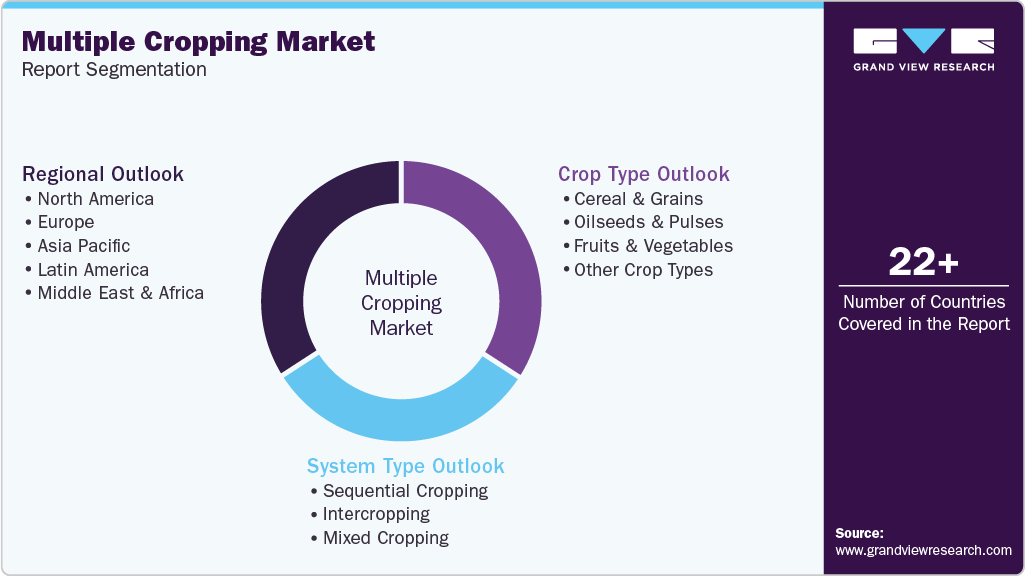
This report forecasts revenue & volume growth at global, regional, and country levels and provides an analysis of the latest industry trends in each of the sub-segments from 2021 to 2033. For this study, Grand View Research has segmented the global multiple cropping market report based on system type, crop type, and region:
-
System Type Outlook (Volume, Kilotons; Revenue, USD Billion, 2021 - 2033)
-
Sequential Cropping
-
Double Cropping
-
Triple Cropping
-
Others
-
-
Intercropping
-
Row Intercropping
-
Strip Intercropping
-
Relay Intercropping
-
-
Mixed Cropping
-
-
Crop Type Outlook (Volume, Kilotons; Revenue, USD Billion, 2021 - 2033)
-
Cereal & Grains
-
Oilseeds & Pulses
-
Fruits & Vegetables
-
Other Crop Types
-
-
Regional Outlook (Volume, Kilotons; Revenue, USD Billion, 2021 - 2033)
-
North America
-
U.S.
-
Canada
-
Mexico
-
-
Europe
-
Germany
-
UK
-
Italy
-
Spain
-
France
-
-
Asia Pacific
-
China
-
India
-
Japan
-
South Korea
-
-
Latin America
-
Brazil
-
Argentina
-
-
Middle East & Africa
-
Saudi Arabia
-
South Africa
-
-
Frequently Asked Questions About This Report
b. The global multiple cropping market size was estimated at USD 25.7 billion in 2025 and is expected to reach USD 26.5 billion in 2026.
b. Sequential cropping represented 73.4% of total revenue in 2025 due to its extensive use in farming systems where two or more crops are cultivated one after another within the same year. Its leading position is supported by prevalent double cropping practices in cereals and oilseeds, each demanding complete seed, fertilizer, and crop protection inputs for every planting cycle.
b. Some of the key players operating in the multiple cropping market include Bayer Crop Science, Corteva Agriscience, Syngenta AG, BASF SE, John Deere, Dole plc, Olam Agri, SLC Agrícola, Bunge Global, Cargill, Incorporated.
b. Multiple cropping is becoming increasingly significant as farmers aim to raise production per hectare without bringing additional land under cultivation. Harvesting two or more crops within a single year enhances overall land efficiency, supports more consistent income generation across seasons, and improves utilization of machinery, irrigation systems, and other fixed farm assets.
b. The global multiple cropping market is expected to grow at a compound annual growth rate of 3.8% from 2026 to 2033, reaching USD 34.3 billion by 2033.


Share this report with your colleague or friend.
Need a Tailored Report?
Customize this report to your needs — add regions, segments, or data points, with 20% free customization.


ISO 9001:2015 & 27001:2022 Certified
We are GDPR and CCPA compliant! Your transaction & personal information is safe and secure. For more details, please read our privacy policy.
Trusted market insights - try a free sample
See how our reports are structured and why industry leaders rely on Grand View Research. Get a free sample or ask us to tailor this report to your needs.