- Home
- »
- Communication Services
- »
-
Mobile Virtual Network Operator Market Size Report, 2033GVR Report cover
![Mobile Virtual Network Operator Market Size, Share & Trends Report]()
Mobile Virtual Network Operator Market (2026 - 2033) Size, Share & Trends Analysis Report By Type (Business, Discount, M2M, Media, Migrant, Retail, Roaming, Telecom), By Operational Model, By Service Type, By Contract Type, By End Use, By Region, And Segment Forecasts
- Report ID: 978-1-68038-360-7
- Number of Report Pages: 130
- Format: PDF
- Historical Range: 2021 - 2024
- Forecast Period: 2026 - 2033
- Industry: Technology
- Report Summary
- Table of Contents
- Interactive Charts
- Methodology
- Download FREE Sample
-
 Download Sample Report
Mobile Virtual Network Operator Market Summary
The global mobile virtual network operator (MVNO) market size was valued at USD 94.8 billion in 2025 and is projected to reach USD 171.61 billion by 2033, growing at a CAGR of 7.7% from 2026 to 2033. A major factor expected to drive the global MVNO market is the growing consumer demand for affordable and flexible mobile service plans.
Key Market Trends & Insights
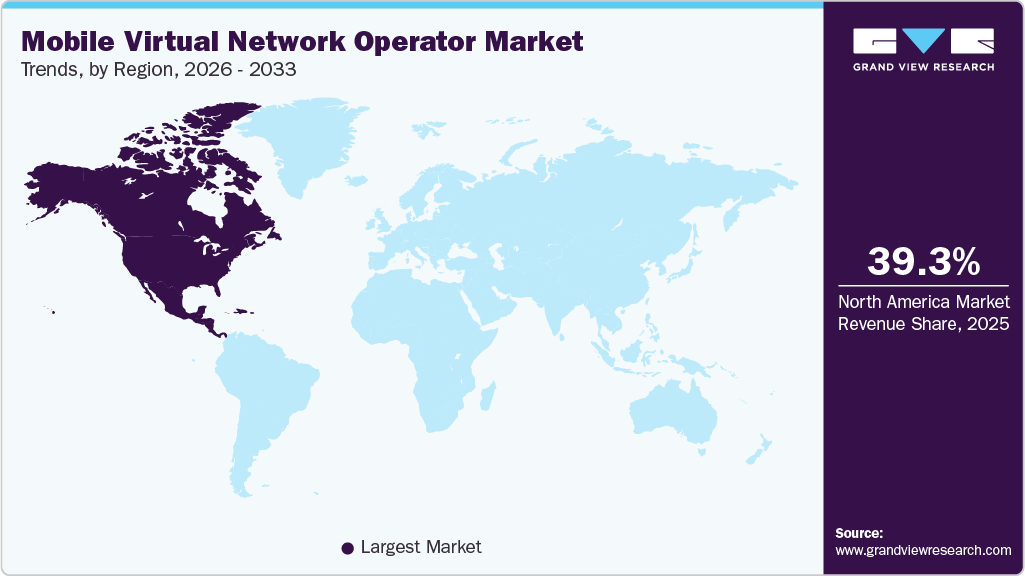
- North America mobile virtual network operator market accounted for a 39.32% share of the overall market in 2025.
- The MVNO industry in U.S. held a substantial market share in 2025.
- By type, the discount segment accounted for the largest share of 24.14% in 2025.
- By operational model, the Full MVNO segment held the largest market share in 2025.
- By service type, the 5G MVNO segment is projected to grow at the fastest CAGR over the forecast period.
Market Size & Forecast
- 2025 Market Size: USD 94.80 Billion
- 2033 Projected Market Size: USD 171.61 Billion
- CAGR (2026-2033): 7.7%
- North America: Largest market in 2025
MVNOs typically operate with lower infrastructure costs because they lease network capacity from mobile network operators rather than building and maintaining their own networks. This cost advantage enables MVNOs to offer competitively priced prepaid and no-contract plans that appeal to price-sensitive consumers.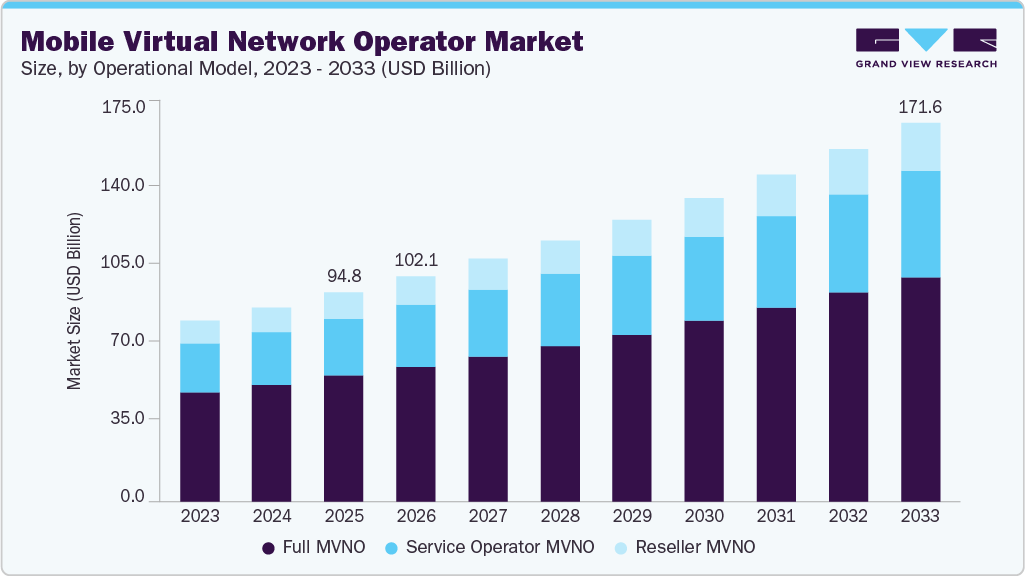
Structural shift in telecom operator strategies toward wholesale network monetization is another factor expected to support the growth of the MVNO industry. Mobile network operators invest heavily in spectrum acquisition, radio access networks, and core network infrastructure, resulting in substantial fixed capital expenditures. However, subscriber growth in many developed telecom markets has slowed due to high mobile penetration levels. As a result, operators increasingly use MVNO partnerships to improve network utilization and generate additional revenue from existing infrastructure. This wholesale model enables operators such as Vodafone Group, Telefónica, and AT&T to convert excess network capacity into recurring revenue streams without incurring additional customer-acquisition costs. MVNOs typically operate in niche market segments that the host operators may not prioritize directly, such as low-income consumers, migrant populations, or specialized enterprise users. By enabling MVNO access, MNOs can address these segments indirectly while maintaining their primary premium customer base. This wholesale access model has therefore become an integral component of telecom operator revenue diversification strategies.
The emergence of digital telecom platforms has significantly reduced entry barriers for MVNO providers. Launching a telecom service required extensive infrastructure investments in billing systems, subscriber management platforms, and physical retail distribution networks. However, the development of Mobile Virtual Network Enabler (MVNE) platforms has enabled telecom services to be deployed using cloud-based operational infrastructure. These platforms provide essential telecom functions, including subscriber management, billing systems, provisioning, and regulatory compliance. As a result, companies across various industries, including retail, fintech, and technology, can launch telecom services with minimal infrastructure investment.
Moreover, the rapid expansion of enterprise connectivity and Internet of Things (IoT) deployments represents another structural driver for the MVNO market. Industrial sectors such as logistics, automotive, manufacturing, and utilities increasingly rely on connected devices for operational monitoring, asset tracking, and automation. These applications require scalable, flexible connectivity solutions that can support large numbers of distributed devices. Traditional telecom operators primarily focus on consumer mobile services, whereas MVNOs are increasingly specializing in enterprise connectivity solutions. MVNOs often provide value-added capabilities including global SIM provisioning, multi-network roaming, device lifecycle management, and connectivity analytics. This specialization enables MVNOs to address the complex connectivity requirements of industrial IoT deployments. As global IoT device installations continue to increase across multiple industries, demand for specialized connectivity platforms provided by MVNO operators is expected to grow significantly.
Type Insights
The discount segment accounted for the largest share, 24.1%, in 2025. This segment primarily targets individuals and families who prioritize affordability over premium features, making it especially appealing to low-income users, students, and prepaid customers. Operators in this category typically offer no-frills voice, text, and data plans at highly competitive prices by minimizing operational overhead and avoiding extensive infrastructure investments. The popularity of online-only service models and simplified customer acquisition strategies has further fueled growth in this segment. As economic uncertainty and inflation pressures persist, the demand for discount mobile services is expected to rise, encouraging MVNOs in this space to continue innovating with flexible billing, device financing, and digital support services to maintain customer loyalty and expand their user base.
The M2M segment is projected to grow at the fastest CAGR over the forecast period, driven by the rapid expansion of the Internet of Things (IoT) across industries such as logistics, healthcare, smart cities, and agriculture. M2M MVNOs provide connectivity solutions that enable devices to communicate and exchange data autonomously, without human intervention. These operators typically offer highly reliable, low-latency data services with wide geographic coverage, supporting critical applications such as fleet tracking, remote monitoring, asset management, and smart metering. The increasing demand for real-time data exchange, combined with advancements in 5G and LPWAN (Low-Power Wide-Area Network) technologies, has positioned M2M MVNOs as essential enablers of digital transformation.
Operational Model Insights
The Full MVNO segment held the largest market share in 2025. Implementing a full MVNO network infrastructure involves minimal capital investment and provides complete call control, allowing customers to call internationally at highly discounted rates. The emergence of MVNOs results from regulatory interventions that lower the barriers to entry, thereby increasing competition, and from strategic decisions undertaken by MNOs.
The Reseller MVNO segment is expected to grow at a significant CAGR during the forecast period, due to its low barrier to entry and cost-effective operational model. Unlike other MVNO types, Reseller MVNOs do not own infrastructure or manage network elements. Instead, they purchase network access in bulk from Mobile Network Operators (MNOs) and resell it under their own brand. This enables them to focus on marketing, customer service, and targeting specific user demographics without the heavy capital investment required for infrastructure. The rise in digital-savvy consumers and demand for tailored, budget-friendly plans has made the Reseller MVNO model particularly attractive. These operators often cater to underserved or niche markets by offering competitive pricing, multilingual support, and flexible plan structures. As the telecom landscape becomes more customer-centric and data-driven, Reseller MVNOs that emphasize personalization, loyalty programs, and seamless digital experiences are positioned to thrive in a highly competitive environment.
Service Type Insights
The 4G MVNO segment dominated the market in 2025. The growth of the 4G MVNO segment can be attributed to the increasing demand for high-speed mobile data and improved connectivity. Since 4G enables seamless video streaming, improved browsing experiences, and app downloads, consumers are opting for it, which has been a major contributor to the growth of the 4G MVNO segment over the forecast period. Moreover, the 4G MVNO had capitalized on the increasing demand for smartphones and data-savvy devices to cater to a wide range of users, businesses, and IoT devices. The combination of affordable data plans and flexible pricing options has paved the way for the 4G MVNO segment growth in the mobile virtual network operator market by service type from 2026 to 2033.
The 5G MVNO segment is projected to grow at the fastest CAGR over the forecast period. With the rollout of 5G technology globally, 5G MVNOs have been leveraging the capabilities of 5G technology, including high data speed, low latency, and increased network capacity, enabling improved user experience. The increasing demand for data-intensive Contract Types has resulted in the growth of 5G MVNOs, and the growth of this segment is expected to continue to grow stronger over the period 2026 to 2033.
Contract Type Insights
The prepaid MVNO segment dominated the market in 2025. The growth of the prepaid MVNO can be attributed to the benefits offered to the customer, which include flexible and cost-effective alternatives compared to traditional postpaid plans. Moreover, the companies in the mobile virtual network operator industry have been coming up with various initiatives such as new product launches, mergers, and acquisitions, among others, which have helped drive the growth of the prepaid MVNO.
The postpaid MVNO segment is projected to grow at a significant CAGR over the forecast period. The postpaid MVNO majorly caters to a section of the customers who opt for monthly billing and are going for long-term contracts, for which, in return, additional benefits are offered to customers. The postpaid MVNOs offer competitive pricing, unlimited data, and truly international calling, among other features, which have driven the growth of the postpaid MVNO segment of the mobile virtual network operator market from 2026 to 2033.
End Use Insights
The consumer segment dominated the market in 2025 and is projected to grow at a significant CAGR over the forecast period. Increasing network speed and using advanced devices enable the growth of data applications such as internet browsing and video streaming. Increasing investments are being made to improve network coverage and expand Mobile Broadband (MBB) connections. The MVNO model offers benefits such as time efficiency and cost-effectiveness, which are expected to lure more consumers, accelerating the growth of the consumer segment.
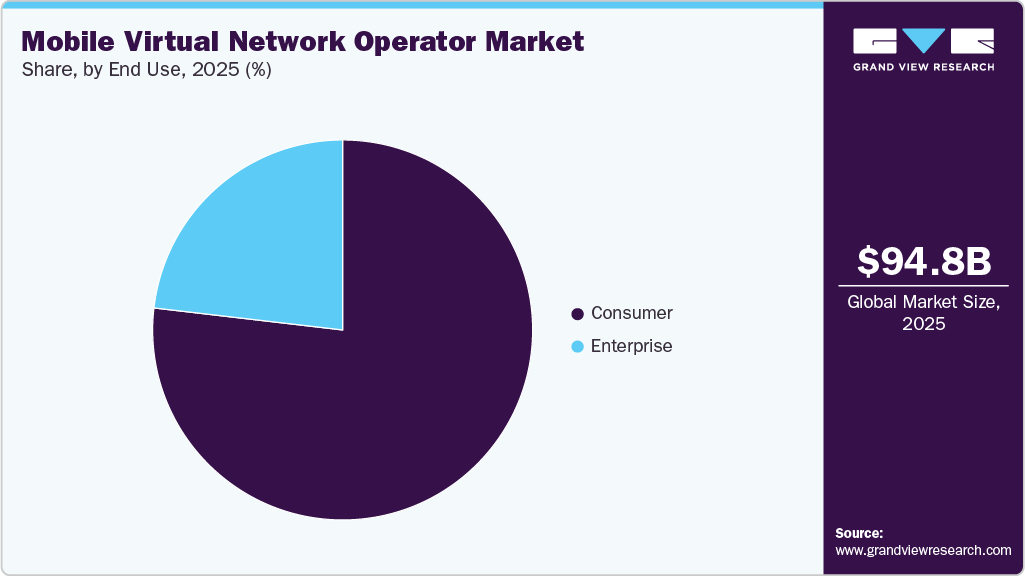
The Enterprise segment is projected to grow at the fastest CAGR over the forecast period. Managing connected living, personal data, and rising e-commerce activities are also anticipated to provide significant growth opportunities for key players operating in the market, along with increasing consumer benefits. Intelligent networks connecting a wide range of devices enable increased productivity of enterprises. The partnership between MNOs and MVNOs depends on brand reputation, distribution network, promotional strategies, and access to segments. The MVNO model is turning from voice to a more data-centric experience. MVNOs worldwide are opting for data-capable smartphones to expand their business.
Regional Insights
The North America mobile virtual network operator market accounted for 39.32% share of the overall market in 2025. The growth of the MVNO market in North America can be attributed to the strategic initiatives happening in the region aimed at improving the MVNO offerings.
U.S. Mobile Virtual Network Operator Market Trends
The U.S. mobile virtual network operator industry held a substantial market share in 2025. The U.S. MVNO market is primarily driven by the strong wholesale network ecosystem established by major operators such as Verizon Communications, AT&T, and T-Mobile US. These operators actively lease network capacity to MVNOs to monetize excess infrastructure while expanding coverage to price-sensitive and niche consumer segments. In addition, the large prepaid subscriber base and demand for low-cost wireless plans have enabled MVNO brands to gain significant traction. The growth of digital-first telecom providers and eSIM-based connectivity services is further accelerating MVNO adoption across the country.
Europe Mobile Virtual Network Operator Market Trends
The Europe MVNO industry was identified as a lucrative region in 2025, and the growth can be attributed to the favorable regulatory framework, which is expected to play a crucial role in developing the MVNO. Countries such as the UK, Germany, and France are projected to positively impact regional growth from 2026 to 2033.
The Germany mobile virtual network operator industry held a substantial market share in 2025. The Germany MVNO market growth is supported by regulatory policies promoting competition and infrastructure sharing within the telecom sector. Wholesale access agreements with major operators such as Deutsche Telekom and Telefónica enable MVNO providers to offer competitively priced mobile services without significant infrastructure investment. The country’s large base of cost-sensitive prepaid users and increasing demand for flexible mobile contracts further support MVNO expansion.
The UK mobile virtual network operator industry is expected to grow rapidly in the coming years. The UK MVNO market is driven by a highly competitive telecom environment and strong wholesale network access agreements with major operators such as Vodafone Group, BT Group, and Telefónica. The presence of well-established MVNO brands and a large prepaid subscriber base has accelerated adoption of low-cost and flexible mobile plans. In addition, the mature digital telecom ecosystem and growing adoption of eSIM-based connectivity services are enabling digital-first MVNO providers to scale rapidly.
Asia Pacific Mobile Virtual Network Operator Market Trends
Asia Pacific is projected to experience significant growth from 2026 to 2033. The growth in this region can be attributed to the phenomenal expansion of the telecom services industry. Emerging economies in the region, such as India, Vietnam, and Myanmar, are making efforts to expand and modernize their telecommunication services. Southeast Asian countries such as Singapore, Thailand, and the Philippines are also estimated to contribute substantially to the regional market expansion from 2026 to 2033.
Countries with advanced cellular networks, such as Singapore, Japan, and Australia, are expected to expand the Asia Pacific regional market significantly. For instance, in Japan, MVNOs provide services such as online gaming, remote management of vending machines, M2M, and surveillance. In the healthcare sector, they also offer voice-controlled services for patient monitoring and security applications.
The China mobile virtual network operator industry held a substantial market share in 2025. The China MVNO market is primarily driven by government-led telecom sector reforms aimed at increasing competition and improving service innovation. The Ministry of Industry and Information Technology introduced policies allowing private companies to operate MVNO services using the infrastructure of major telecom operators such as China Mobile, China Unicom, and China Telecom. These initiatives have enabled technology firms and digital service providers to enter the telecom sector without investing in network infrastructure.
The India mobile virtual network operator industry held a substantial market share in 2025. The India MVNO market is driven by regulatory frameworks introduced by the Telecom Regulatory Authority of India to promote competition and improve telecom service accessibility. The large and price-sensitive mobile subscriber base creates significant opportunities for MVNO operators to offer differentiated and low-cost service plans. Partnerships with major telecom operators such as Bharti Airtel and Reliance Jio enable MVNO providers to enter the market with limited infrastructure investments. Additionally, the increasing penetration of smartphones and rising mobile data consumption are expanding the potential customer base for MVNO service providers. These factors collectively support the gradual expansion of MVNO services in the Indian telecom ecosystem.
Key Mobile Virtual Network Operator Company Insights
Some of the key players operating in the mobile virtual network operator market include TracFone Wireless, Inc., Boost Mobile, Virgin Plus, Lyca Mobile, and FRiENDi, among others, due to a combination of strategic partnerships with established mobile network operators, extensive customer bases, competitive pricing models, and strong brand recognition. These companies often leverage innovative marketing strategies and flexible service offerings to cater to niche market segments such as budget-conscious consumers, ethnic communities, or travelers. Their ability to operate without owning physical network infrastructure allows them to minimize capital expenditure while focusing on customer acquisition and service differentiation. Furthermore, their agility in adopting emerging technologies and expanding into new geographic markets contributes to their sustained competitiveness in the dynamic telecommunications landscape.
-
TracFone Wireless, Inc., offers a variety of plans, which include calls, text, and data. The company also offers a variety of phones from popular manufacturers such as Apple, Motorola, Samsung, and Alcatel. TracFone Wireless leases network access from the three largest wireless network operators in the United States: T-Mobile US, AT&T Mobility, and Verizon.
-
Boost Mobile offers a variety of prepaid plans, which range from one month to a year. The company also offers access to T-Mobile and AT&T’s 4G/LTE and 5G networks. Boost Mobile offers phone plans that range from 1GB to 30 GB of high-speed internet data per month, with its unlimited data plan offering. Boost Mobile also offers a variety of features that are not available on traditional wireless carriers, which include the ability to be your own phone and the ability to switch plans without penalty.
Key Mobile Virtual Network Operator Companies:
The following key companies have been profiled for this study on the mobile virtual network operator market.
- Boost Mobile
- Consumer Cellular
- Cricket Wireless LLC.
- DISH Wireless L.L.C.
- FreedomPop
- Locus Telecommunications, LLC.
- Lyca Mobile
- Mint Mobile, LLC.
- Red Pocket Mobile
- Tello
- Tesco Mobile Ltd
- TracFone Wireless, Inc.
- T‑Mobile USA, Inc.
- UVNV, Inc
- Virgin Plus
- FRiENDi
Recent Developments
-
In November 2025, Hansen Technologies Limited announced the acquisition of Digitalk Group Holdings Ltd, a provider of mobile virtual network and carrier-grade platforms for the global communications industry. The acquisition is expected to help the company strengthen its position in the MVNO market by attracting new customers.
-
In October 2025, Vitel Wireless announced the introduction of the 0712 Network, Nigeria’s first-ever Mobile Virtual Network. Vitel Wireless will provide nationwide voice, SMS, and data services under its own brand. Its model emphasizes affordability, flexibility, and innovation, allowing the company to focus on enhancing customer experience rather than building costly network infrastructure.
Mobile Virtual Network Operator Market Report Scope
Report Attribute
Details
Market size value in 2026
USD 102.07 billion
Revenue forecast in 2033
USD 171.61 billion
Growth rate
CAGR of 7.7% from 2026 to 2033
Base year for estimation
2025
Historical data
2021 - 2024
Forecast period
2026 - 2033
Quantitative units
Revenue in USD billion and CAGR from 2026 to 2033
Report coverage
Revenue forecast, company ranking, competitive landscape, growth factors, and trends
Segments covered
Type, operational model, service type, contract type, end use, region
Regional scope
North America; Europe; Asia Pacific; Latin America; MEA
Country scope
U.S.; Canada; Mexico; UK; Germany; France; Italy; China; Singapore; Japan; Australia; South Korea; Brazil; Oman; South Africa
Key companies profiled
Boost Mobile; Consumer Cellular; Cricket Wireless LLC.; DISH Wireless L.L.C.; FreedomPop; Locus Telecommunications, LLC.; Lyca Mobile; Mint Mobile, LLC.; Red Pocket Mobile; Tello; Tesco Mobile Ltd; TracFone Wireless, Inc.; T‑Mobile USA, Inc.; UVNV, Inc; Virgin Plus; FRiENDi
Customization scope
Free report customization (equivalent up to 8 analysts working days) with purchase. Addition or alteration to country, regional & segment scope.
Pricing and purchase options
Avail customized purchase options to meet your exact research needs. Explore purchase options
Global Mobile Virtual Network Operator Market Report Segmentation
This report forecasts revenue growth at the global, regional, and country levels and provides an analysis of the latest industry trends in each of the sub-segments from 2021 to 2033. For this study, Grand View Research has segmented the global mobile virtual network operator (MVNO) market report based on type, operational model, service type, contract type, end use, and region:
-
Type Outlook (Revenue, USD Billion, 2021 - 2033)
-
Business
-
Discount
-
M2M
-
Media
-
Migrant
-
Retail
-
Roaming
-
Telecom
-
-
Operational Model Outlook (Revenue, USD Billion, 2021 - 2033)
-
Full MVNO
-
Reseller MVNO
-
Service Operator MVNO
-
-
Service Type Outlook (Revenue, USD Billion, 2021 - 2033)
-
4G MVNO
-
5G MVNO
-
Others
-
-
Contract Type Outlook (Revenue, USD Billion, 2021 - 2033)
-
Prepaid MVNO
-
Postpaid MVNO
-
-
End Use Outlook (Revenue, USD Billion, 2021 - 2033)
-
Consumer
-
Enterprise
-
-
Regional Outlook (Revenue, USD Billion, 2021 - 2033)
-
North America
-
U.S.
-
Canada
-
Mexico
-
-
Europe
-
UK
-
Germany
-
France
-
Italy
-
-
Asia Pacific
-
China
-
Singapore
-
Japan
-
Australia
-
South Korea
-
-
Latin America
-
Brazil
-
-
Middle East and Africa (MEA)
-
Oman
-
South Africa
-
-
Frequently Asked Questions About This Report
b. The global mobile virtual network operator market size was estimated at USD 88.06 billion in 2024 and is expected to reach USD 94.80 billion in 2025.
b. The global mobile virtual network operator market size is expected to grow at a significant CAGR of 7.7% to reach USD 137.31 billion in 2030.
b. Europe held the largest market share of 47.4% in 2024. This is due to the favorable regulatory framework, which is expected to play a crucial role in developing the MVNO. Countries such as the U.K., Germany, and France are projected to positively impact regional growth from 2025 to 2030.
b. Some of the players in the mobile virtual network operator market include Boost Mobile, Consumer Cellular, Cricket Wireless LLC., DISH Wireless L.L.C., FreedomPop, Locus Telecommunications, LLC., Lyca Mobile, Mint Mobile, LLC., Red Pocket Mobile, Tello, Tesco Mobile Ltd, TracFone Wireless, Inc., T‑Mobile USA, Inc., UVNV, Inc, Virgin Plus, FRiENDi.
b. The growing use of data and value-added services such as live streaming and M-commerce based services are expected to drive the mobile virtual network operator market for mobile virtual network operators over the forecast period.


Share this report with your colleague or friend.
Need a Tailored Report?
Customize this report to your needs — add regions, segments, or data points, with 20% free customization.


ISO 9001:2015 & 27001:2022 Certified
We are GDPR and CCPA compliant! Your transaction & personal information is safe and secure. For more details, please read our privacy policy.
Trusted market insights - try a free sample
See how our reports are structured and why industry leaders rely on Grand View Research. Get a free sample or ask us to tailor this report to your needs.