- Home
- »
- HVAC & Construction
- »
-
Mobile Cranes Market Size, Share, Industry Report, 2033GVR Report cover
![Mobile Cranes Market Size, Share & Trends Report]()
Mobile Cranes Market (2026 - 2033) Size, Share & Trends Analysis Report By Product (Truck Mounted Crane, Trailer Mounted Crane, Crawler Crane), By Application (Construction, Industrial, Utility), By Region (North America, Europe, Asia Pacific, MEA), And Segment Forecasts
- Report ID: GVR-3-68038-407-9
- Number of Report Pages: 105
- Format: PDF
- Historical Range: 2021 - 2025
- Forecast Period: 2026 - 2033
- Industry: Technology
- Report Summary
- Table of Contents
- Segmentation
- Methodology
- Download FREE Sample
-
 Download Sample Report
Mobile Cranes Market Summary
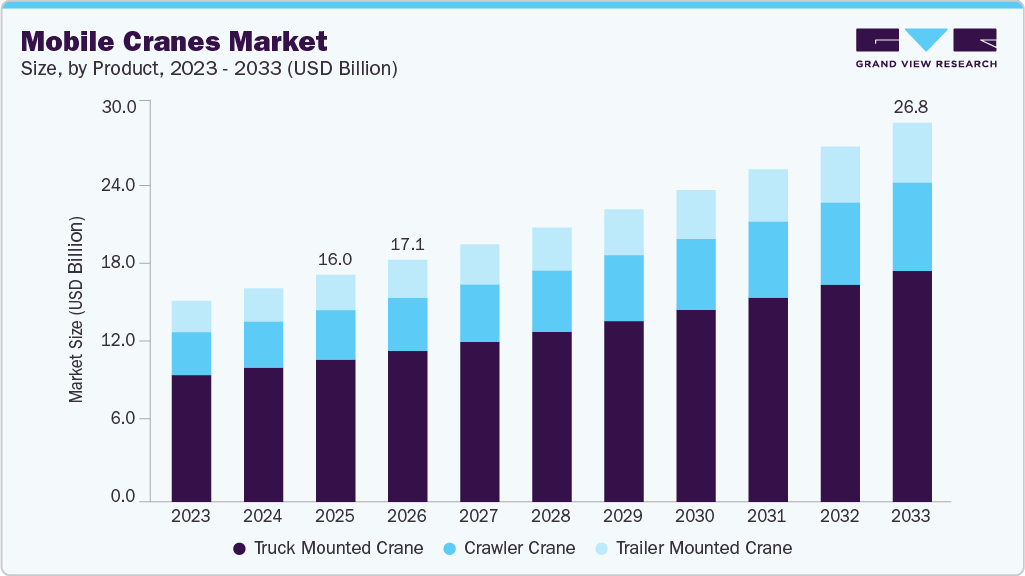
The global mobile cranes market size was valued at USD 16.0 billion in 2025 and is anticipated to reach USD 26.8 billion by 2033, growing at a CAGR of 6.6% from 2026 to 2033. A major factor driving the industry is the increasingly large-scale infrastructure development projects across transportation and commercial sectors.
Key Market Trends & Insights
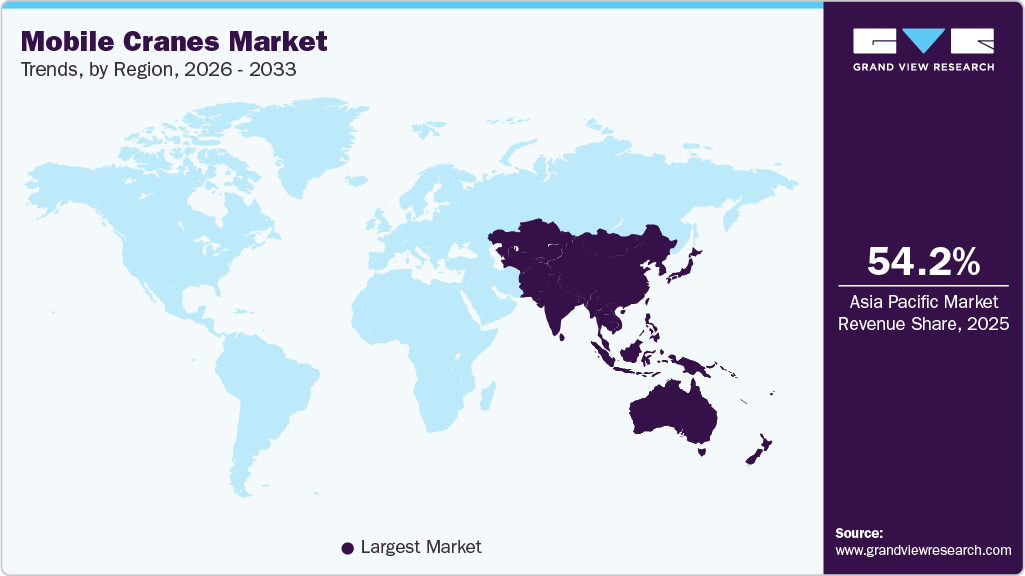
- Asia Pacific mobile cranes market accounted for a 54.2% largest share of the overall market in 2025.
- By product, the truck mounted crane segment accounted for the largest share of 62.6% in 2025.
- By application, the construction segment held the largest market share in 2025.
Market Size & Forecast
- 2025 Market Size: USD 16.0 Billion
- 2033 Projected Market Size: USD 26.8 Billion
- CAGR (2026-2033): 6.6%
- Asia Pacific: Largest market in 2025
Governments across the globe are focused on strengthening the cross-border and intra-border connectivity to support economic development. This approach resulted in increasing investment in projects such as highways, bridges, rail networks, airports, and urban transit systems, which call for advanced cranes. Mobile cranes tend to be a more essential part of these projects, as their ability to transport heavy structural components, install bridge segments, and handle construction materials at large heights. Increasing government inclination toward the use of renewable energy has emerged as a major growth catalyst for mobile cranes. Economies such as the U.S., China, the U.K., Germany, etc. are focused on wind farm construction in order to pursue carbon reduction targets and expand renewable energy capacity. The installation of wind turbines involves lifting heavy components weighing several hundred tons, making mobile cranes indispensable for project execution. These cranes find applicability in wind energy installation locations for activities such as installing extremely large turbine components, including towers, nacelles, and rotor blades. Likewise, offshore wind projects require large crawler cranes and specialized heavy-lift equipment for turbine assembly and installation. Governments across multiple regions are implementing policies and incentives to accelerate renewable energy deployment, further increasing crane utilization.The growth of the market is also anticipated to create significant growth opportunities for OEMs. Customers prefer renting as it allows them to save on the costs associated with the procurement and maintenance of new equipment. Renting equipment also reduces overall project costs. The growing preference for renting equipment is opening opportunities for manufacturers to collaborate with rental equipment companies as part of the efforts to augment their sales. On the other hand, rental companies are focusing on procuring new equipment and expanding their fleet size to cater to the rising demand for rentals. The growing demand for new equipment from rental equipment companies is expected to drive the demand for mobile cranes over the forecast period.
However, the high procurement and operating costs associated with mobile cranes, changing requirements of customers, and varying compliance and specification requirements from region to region are some of the factors that are expected to restrain the growth of the market. As the application portfolio of mobile cranes continues to widen, the product specifications for mobile cranes are also changing rapidly. As such, a standard mobile crane can no longer cater to diverse customer needs. Product specifications can also change according to the region. For instance, a mobile crane that suits the European market may not be suitable for the North American market.
Cranes are crucial for construction projects as they help in moving components and materials within the construction site as well as between off-site facilities and the construction site. Construction companies prefer prefabricating different construction blocks off-site and transporting the readymade blocks to the construction site for onsite assembly as part of the efforts to save time and avoid traffic congestion and onsite accidents. Mobile cranes boast high weight-lifting capacities and facilitate convenient material handling, and are hence used to transfer prefabricated construction blocks from off-site facilities to construction sites. As a result, most of the production equipment on construction sites is being gradually replaced by transportation equipment, such as mobile cranes. Construction projects underway in different parts of the world are driving the demand for mobile cranes.
Initiatives being pursued for upgrading the existing infrastructure are also driving the demand for mobile cranes. Several projects involving the refurbishment of the existing infrastructure are underway across the globe. For instance, China is upgrading the existing infrastructure of the Beijing International Airport. The expansion of the international airport is scheduled for completion by 2025.
Product Insights
The truck-mounted crane segment accounted for the largest revenue share of 62.6% in 2025. The rising demand for mobile machinery in power and utilities, construction, and other industries and industry verticals is expected to boost the growth of the segment. Truck-mounted equipment offers a high loading capacity and can help in transporting goods easily from one place to another. These products are typically used in construction projects, such as bridge construction, railway projects, and hydropower projects.
The crawler crane segment is expected to grow at the fastest CAGR of 7.6% during the forecast period. Crawler cranes are compact and offer the ease of accessibility required in small construction sites, especially in urban areas. Crawler cranes are considered the most powerful cranes for use in different projects involving heavy industrial materials and other large-scale construction activities. Nevertheless, crawler cranes and trailer-mounted cranes accounted for a smaller share of the market compared to truck-mounted cranes owing to their limited operational capabilities.
Application Insights
The construction segment held the largest revenue share of 51.9% in 2025. Continued residential and commercial infrastructure projects across the globe are expected to support the growth of the segment. Tower cranes, once installed, can only be moved once the project is completed. Hence, builders working on numerous projects usually prefer mobile cranes as they are easy to move. Deployment of mobile cranes can also reduce the idle time of the equipment and subsequently enhance productivity.
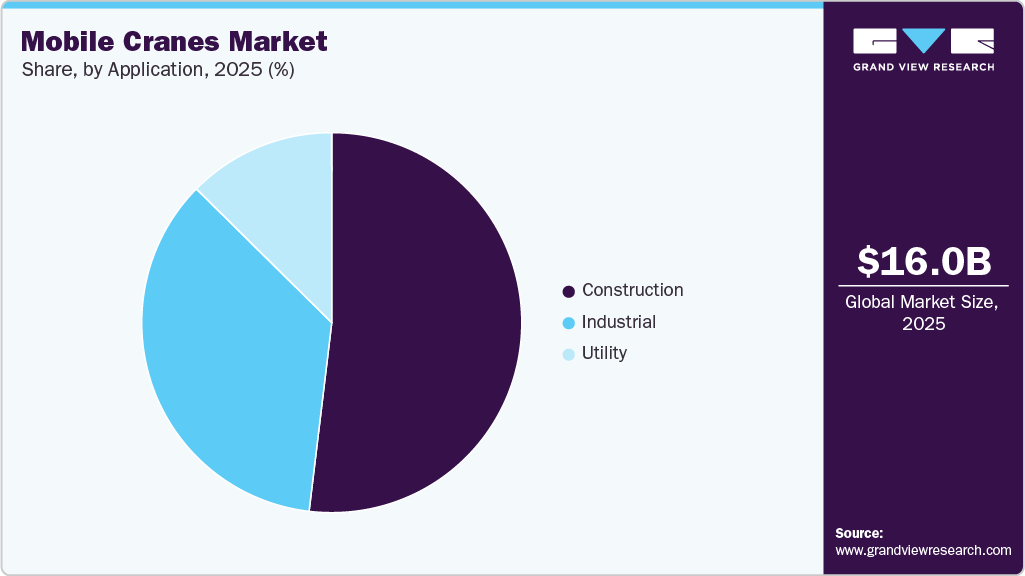
The utility segment is expected to grow at the fastest CAGR of 7.3% over the forecast period. The growth can be attributed to the extensive use in oil & gas projects, power projects, and utility projects, among other projects involving critical applications, such as underground construction. Utility companies require these products at the construction sites as well as their respective yards.
Regional Insights
The North America mobile cranes market held a significant share in 2025, supported by large-scale infrastructure modernization and strong construction projects/activity. Additionally, the rapid growth of renewable energy infrastructure is increasing crane utilization for wind turbine installation and power grid projects. Wind energy infrastructure alone represents about 15% of global heavy-lift crane demand, highlighting its importance as a demand generator.
U.S. Mobile Cranes Market Trends
The mobile cranes market in the U.S. held a dominant position in 2025. Increasing government projects specifically for transportation infrastructure, including roads and bridges, require heavy lifting equipment during construction and maintenance, which calls for the mobile cranes market. In addition, increasing housing shortage in the country is increasing construction activities, ultimately increasing demand for mobiles cranes for structural installation and prefabricated building assembly.
Europe Mobile Cranes Market Trends
The mobile cranes market in Europe was identified as a lucrative region in 2025. Increasing wind energy infrastructure is a major factor expected to support market growth. The region is focused on deploying energy transition policies, which are increasing infrastructure investments in renewable power generation and transmission networks. These projects require cranes for turbine installation, grid construction, and power plant maintenance.
The UK mobile cranes industry is expected to grow rapidly in the coming years. The U.K. mobile cranes market is primarily driven by large-scale infrastructure development and offshore wind energy expansion. The country is one of the largest offshore wind markets globally, requiring heavy-lift cranes for turbine installation, tower assembly, and maintenance operations.
The mobile cranes industry in Germany held a substantial market share in 2025. Germany represents one of the most important mobile crane markets in Europe due to its strong construction, manufacturing, and engineering industries. The country also serves as a major hub for crane manufacturing, with several global equipment manufacturers headquartered in Germany.
Asia Pacific Mobile Cranes Market Trends
Asia Pacific mobile cranes market accounted for a 54.2% largest share of the overall market in 2025.The mobile cranes industry in Asia Pacific is anticipated to grow at a CAGR of 7.0% during the forecast period. Rapid urbanization in emerging economies is another major demand catalyst for mobile cranes. The region is experiencing strong population growth in urban centers, requiring large-scale residential and commercial construction projects. In addition, manufacturing expansion across China, India, and Southeast Asia also drives demand for cranes used in industrial plant construction and equipment installation
China mobile cranes industry held a substantial market share in 2025. Urbanization also plays a critical role. China’s urban population reached around 920 million people, driving the need for residential buildings, commercial complexes, and transportation infrastructure. In addition, China also benefits from strong domestic manufacturing capacity, with companies producing large volumes of heavy lifting equipment for both domestic consumption and exports.
Key Mobile Cranes Companies Insights
Some of the key companies in the mobile cranes market include Bauer AG, KATO WORKS CO., LTD., KOBELCO Construction Machinery Co., Ltd., Liebherr-International AG, LiuGong Machinery Co., Ltd., Manitex International, PALFINGER AG and others. Organizations are focusing on increasing their customer base to gain a competitive edge in the industry. Therefore, key players are taking several strategic initiatives, such as mergers and acquisitions, and partnerships with other major companies.
-
BAUER AG is a Germany-based engineering and construction services company headquartered in Schrobenhausen, Germany. The company operates through three major segments: Construction, Equipment, and Resources. Within the construction equipment segment, BAUER develops and manufactures a wide range of specialized foundation engineering machinery, including rotary drilling rigs, diaphragm wall equipment, anchor drilling rigs, and related auxiliary machinery used in deep foundation construction. The company supports global infrastructure development through engineering solutions and equipment supply, serving contractors involved in geotechnical engineering and large construction projects. BAUER operates manufacturing facilities and subsidiaries across Europe, Asia, and the Americas, enabling global distribution and project support.
-
Kobelco Construction Machinery Co., Ltd. is a construction equipment manufacturer headquartered in Tokyo, Japan, and is part of the broader Kobe Steel, Ltd. group. The company develops and manufactures a range of heavy construction machinery, including crawler cranes, hydraulic excavators, and demolition equipment. In the mobile cranes market, Kobelco is particularly recognized for its crawler crane portfolio, which includes medium- and high-capacity lifting equipment used in infrastructure development, power plant construction, petrochemical facilities, and renewable energy projects. Kobelco distributes its equipment through a global network of dealers and subsidiaries across North America, Europe, and Asia-Pacific.
Key Mobile Cranes Companies:
The following key companies have been profiled for this study on the mobile cranes market.
- Bauer AG
- KATO WORKS CO., LTD.
- KOBELCO Construction Machinery Co., Ltd.
- Liebherr-International AG
- LiuGong Machinery Co., Ltd.
- Manitex International
- PALFINGER AG
- SANY HEAVY INDUSTRY INDIA PRIVATE LIMITED
- Sarens NV
- Sumitomo Heavy Industries, Ltd.
- Tadano Ltd.
- Terex Corporation
- XCMG GROUP
- Zoomlion Heavy Industry Science & Technology Co., Ltd.
Recent Developments
-
In January 2026, PALFINGER AG announced the launch of the PK 480 TEC truck-mounted articulated boom crane to meet the rising demand for material handling for waste treatment and also for urban infrastructure construction and maintenance, and related tasks. This new product launch is expected to help the company attract new customers and increase its revenue share.
-
In March 2026, XCMG presented three new crane models specifically for North America region. The new products are engineered to meet the rigorous demands of local municipal, energy, and infrastructure projects, advancing from traditional equipment sales to comprehensive, tailored lifting solutions.
-
In December 2025, TIL Limited announced the launch of TMS-885, an 85-tonne truck-mounted crane. The crane features a 5-section boom ranging from 12.1 to 43.8 metres and is powered by a Cummins engine with 260 horsepower. The introduction of a new product is expected to help the company strengthen its product portfolio.
Mobile Cranes Market Report Scope
Report Attribute
Details
Market size value in 2026
USD 17.1 billion
Revenue forecast in 2033
USD 26.8 billion
Growth rate
CAGR of 6.6% from 2026 to 2033
Base year for estimation
2025
Historical data
2021 - 2025
Forecast period
2026 - 2033
Quantitative units
Volume in thousand units; revenue in USD million/billion, and CAGR from 2026 to 2033
Report industry
Volume & revenue forecast, company ranking, competitive landscape, growth factors, and trends
Segments covered
Product, application, region
Regional scope
North America; Europe; Asia Pacific; Latin America; MEA
Country scope
U.S.; Canada; Mexico; Germany; UK; France; China; Japan; India; South Korea; Australia; Brazil; KSA; UAE; South Africa
Key companies profiled
Bauer AG; KATO WORKS CO., LTD.; KOBELCO Construction Machinery Co., Ltd.; Liebherr-International AG; LiuGong Machinery Co., Ltd.; Manitex International; PALFINGER AG; SANY HEAVY INDUSTRY INDIA PRIVATE LIMITED; Sarens NV; Sumitomo Heavy Industries, Ltd.; Tadano Ltd.; Terex Corporation; XCMG GROUP; Zoomlion Heavy Industry Science & Technology Co., Ltd.
Customization scope
Free report customization (equivalent up to 8 analysts working days) with purchase. Addition or alteration to country, regional & segment scope.
Pricing and purchase options
Avail customized purchase options to meet your exact research needs. Explore purchase options
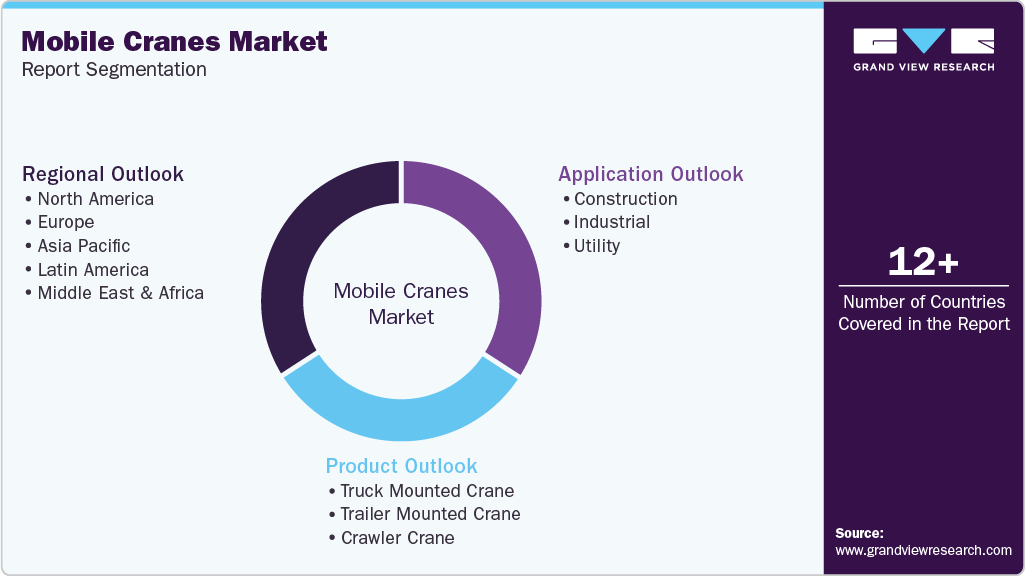
Global Mobile Cranes Market Report Segmentation
This report forecasts volume & revenue growth at global, regional, and country levels and provides an analysis of the latest industry trends in each of the sub-segments from 2021 to 2033. For this study, Grand View Research has segmented the global mobile cranes market report based on product, application, and region:
-
Product Outlook (Volume, Thousand Units; Revenue in USD Million, 2021 - 2033)
-
Truck Mounted Crane
-
Trailer Mounted Crane
-
Crawler Crane
-
-
Application Outlook (Volume, Thousand Units; Revenue in USD Million, 2021 - 2033)
-
Construction
-
Industrial
-
Utility
-
-
Regional Outlook (Volume, Thousand Units; Revenue in USD Million, 2021 - 2033)
-
North America
-
U.S.
-
Canada
-
Mexico
-
-
Europe
-
UK
-
Germany
-
France
-
-
Asia Pacific
-
China
-
Japan
-
India
-
Australia
-
South Korea
-
-
Latin America
-
Brazil
-
-
Middle East and Africa
-
Saudi Arabia
-
South Africa
-
UAE
-
-
Frequently Asked Questions About This Report
b. Some key players operating in the mobile crane market include Liebherr International AG, Manitowoc, XCMG Group, Kobelco Constriction Machinery Co. Ltd., and Mammoet Holding BV.
b. Key factors that are driving the mobile crane market growth include rising government investments on infrastructure development, and growing construction equipment rental market.
b. The global mobile cranes market size was estimated at USD 16.0 billion in 2025 and is expected to reach USD 17.1 billion in 2026.
b. The global mobile cranes market is expected to grow at a compound annual growth rate of 6.6% from 2026 to 2033 to reach USD 26.8 billion by 2033.
b. Asia Pacific dominated the mobile crane market with a share of 54% in 2025. This is attributable to the high growth of the construction market in the region owing to the rising urbanization.


Share this report with your colleague or friend.
Need a Tailored Report?
Customize this report to your needs — add regions, segments, or data points, with 20% free customization.


ISO 9001:2015 & 27001:2022 Certified
We are GDPR and CCPA compliant! Your transaction & personal information is safe and secure. For more details, please read our privacy policy.
Trusted market insights - try a free sample
See how our reports are structured and why industry leaders rely on Grand View Research. Get a free sample or ask us to tailor this report to your needs.