- Home
- »
- Water & Sludge Treatment
- »
-
Middle East Water Treatment Systems Market Report, 2033GVR Report cover
![Middle East Water Treatment Systems Market Size, Share & Trends Report]()
Middle East Water Treatment Systems Market (2025 - 2033) Size, Share & Trends Analysis Report By Installation (Point-of-Use, Point-of-Entry), By Technology (Reverse Osmosis Systems, Distillation Systems, Filtration Methods), By Application, By Country, And Segment Forecasts
- Report ID: GVR-4-68040-722-0
- Number of Report Pages: 100
- Format: PDF
- Historical Range: 2021 - 2024
- Forecast Period: 2025 - 2033
- Industry: Bulk Chemicals
- Report Summary
- Table of Contents
- Segmentation
- Methodology
- Download FREE Sample
-
 Download Sample Report
Middle East Water Treatment Systems Market Summary
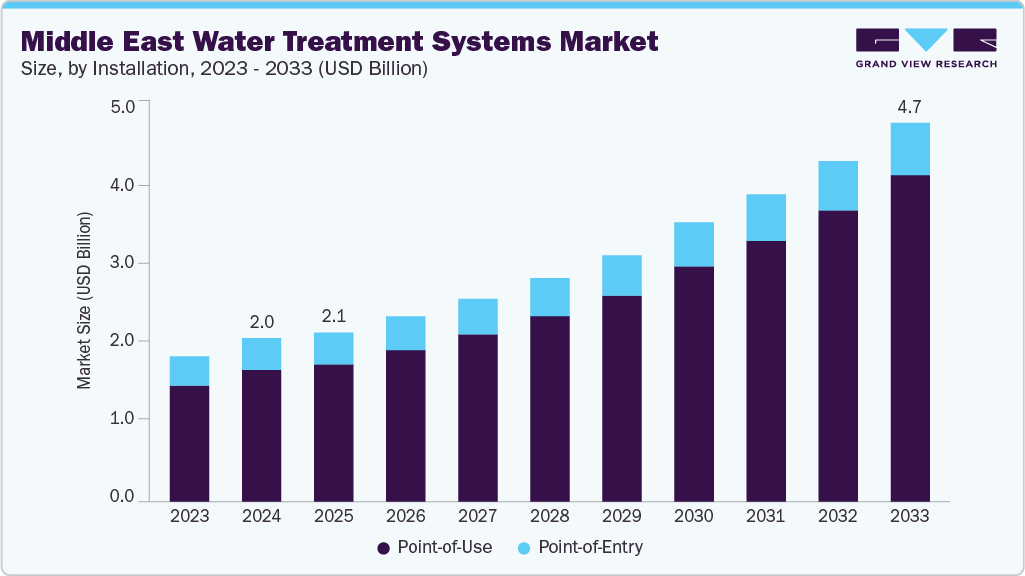
The Middle East water treatment systems market size was estimated at USD 2.04 billion in 2024 and is projected to reach USD 4.72 billion by 2033, growing at a CAGR of 10.6% from 2025 to 2033. The market growth is driven by increasing water scarcity due to arid climatic conditions and rapid population growth, prompting governments to invest heavily in advanced purification and desalination technologies.
Key Market Trends & Insights
- Saudi Arabia dominates the Middle East water treatment systems market and accounted for a 32.6% share in 2024.
- By installation, the point-of-use segment dominated the Middle East water treatment systems market with an 80.6% share in 2024.
- By technology, the filtration methods segment is expected to grow at a considerable CAGR of 11.3% from 2025 to 2033 in terms of revenue.
- By application, the commercial segment is expected to grow at a considerable CAGR of 11.1% from 2025 to 2033 in terms of revenue.
Market Size & Forecast
- 2024 Market Size: USD 2.04 Billion
- 2033 Projected Market Size: USD 4.72 Billion
- CAGR (2025-2033): 10.6%
Expanding industrial and commercial sectors are also boosting demand for efficient water recycling and reuse solutions. Another key driver for the Middle East water treatment systems industry’s growth is the rising focus on sustainable urban development projects such as NEOM and smart city initiatives, which require advanced water management solutions. The region’s heavy reliance on desalination plants is fostering innovation in energy-efficient treatment methods. Increasing investments from both public and private sectors are enhancing the availability of cutting-edge technologies. Moreover, climate change impacts and frequent droughts are pushing for long-term solutions in water security.Market Concentration & Characteristics
The Middle East water treatment systems market is moderately concentrated, with a few major players dominating large-scale projects, particularly in desalination and municipal treatment. Global companies collaborate with regional firms to deliver advanced technologies tailored to the region’s arid climate. However, the presence of numerous small and mid-sized local providers adds competitive diversity in niche applications. This mix of large-scale dominance and local competition shapes a balanced yet competitive market landscape.
The Middle East water treatment systems industry showcases a high degree of innovation, driven by the need for energy-efficient desalination and advanced wastewater recycling technologies. Companies are investing in membrane filtration, smart monitoring, and AI-based water management to address scarcity challenges. Pilot projects in renewable-powered desalination are gaining momentum in Gulf countries. Innovation is also encouraged through government-backed research and sustainability programs.
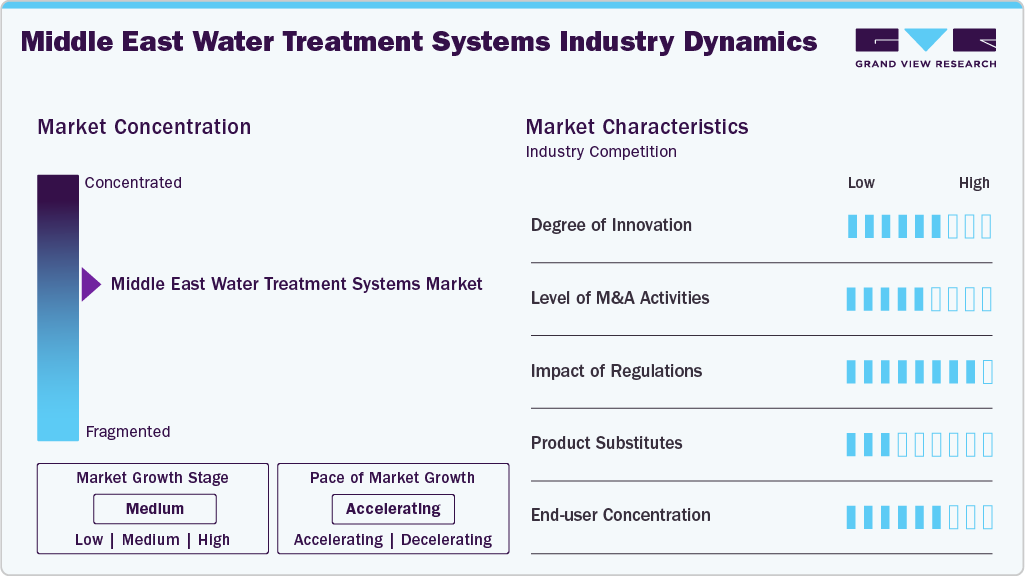
Mergers and acquisitions are moderately active in the region, with global leaders acquiring stakes in local companies to expand their footprint and access government contracts. Strategic partnerships are common in large-scale desalination and wastewater projects. M&A activity is often aimed at combining advanced technology with regional operational expertise. This trend is expected to continue as demand for integrated water solutions grows.
Government regulations play a significant role in shaping the Middle East water treatment systems market, with strict standards for wastewater discharge and drinking water quality. Policies promoting water reuse, conservation, and sustainable resource management are pushing industries to upgrade treatment facilities. Many countries are aligning their regulations with global environmental standards to attract foreign investment. Compliance requirements also create opportunities for technology providers offering innovative and efficient solutions.
Drivers, Opportunities & Restraints
The Middle East water treatment systems market growth is driven by severe water scarcity, prompting heavy investments in desalination and wastewater recycling. Rapid urbanization and industrial expansion are driving the demand for reliable water infrastructure. Government initiatives, such as Saudi Vision 2030 and the UAE’s water security strategy, are accelerating adoption. Rising awareness of sustainable water use is further boosting market growth.
There is strong growth potential in renewable-powered desalination plants and smart water management systems tailored for arid environments. Expanding public-private partnerships creates new investment avenues in large-scale projects. Emerging smart city developments, including NEOM, require advanced and integrated water solutions. Technological advancements in energy-efficient treatment processes open doors for cost-effective operations.
High capital and operational costs of advanced water treatment technologies pose challenges for smaller municipalities and private operators. Dependence on energy-intensive desalination processes increases vulnerability to energy price fluctuations. Limited local manufacturing of specialized equipment leads to reliance on imports. Additionally, varying regulatory frameworks across countries can slow project execution and investment decisions.
Installation Insights
Point-of-use water treatment systems dominate the Middle East water treatment systems market with an 80.6% share in 2024, due to rising concerns over drinking water quality and contamination in municipal supplies. These systems, including filters and purifiers, are widely adopted in households and commercial spaces for direct consumption. Affordability, ease of installation, and minimal maintenance make PoU solutions highly attractive. Growing urban populations and health awareness continue to drive demand in this segment.
Point-of-entry systems are witnessing moderate growth as residential complexes, hotels, and industrial facilities seek whole-building water purification. These systems ensure clean water for multiple uses, from cooking to bathing, improving overall water safety. Increasing adoption in new construction projects and luxury developments supports market expansion. However, higher installation and operational costs slow widespread adoption compared to PoU systems.
Technology Insights
Reverse osmosis systems dominated the Middle East water treatment industry with a 27.6% share in 2024, due to their effectiveness in desalination and removing dissolved salts from seawater. Their ability to produce high-quality potable water makes them essential in arid regions with limited freshwater sources. Widespread government investments in large-scale RO desalination plants further strengthen their market share. Continuous improvements in membrane efficiency and energy recovery systems are also boosting adoption.
Filtration methods are projected to be the fastest-growing technology segment in the Middle East water treatment systems industry. The rapid rise in demand is driven by the region’s increasing reliance on advanced purification solutions to address water scarcity and salinity challenges. Growing investments in desalination projects and municipal water treatment plants are further propelling the adoption of membrane and multimedia filtration systems.
Application Insights
The industrial sector dominated the Middle East water treatment systems market with a 43.5% share in 2024, due to high water consumption in oil & gas, power generation, and manufacturing. Industries require advanced treatment solutions for process water, cooling systems, and wastewater recycling. Stringent environmental regulations push companies to adopt efficient and sustainable water management practices. Large-scale industrial projects and expansions continue to drive significant demand in this segment.
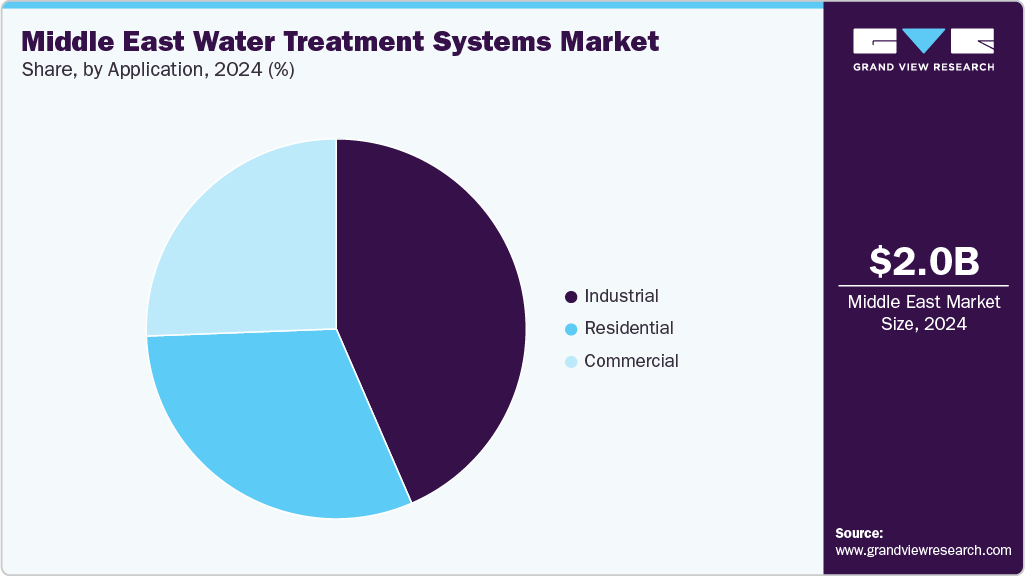
The commercial sector is the fastest-growing application segment, driven by the rapid expansion of hospitality, healthcare, and retail infrastructure. Hotels, resorts, and malls increasingly invest in high-quality water treatment to meet guest expectations and comply with health standards. Growth in the tourism sector, especially in the UAE and Saudi Arabia, is fueling installations in commercial facilities. Rising emphasis on safe drinking water and sustainability practices further accelerates adoption.
Country Insights
Saudi Arabia Water Treatment Systems Market Trends
Saudi Arabia dominates the Middle East water treatment systems market and accounted for a 32.6% share in 2024, due to its heavy reliance on desalination to meet water needs in its arid climate. The government invests significantly in large-scale desalination plants, wastewater recycling, and water security projects under Vision 2030. Industrial and urban expansion further drives demand for advanced treatment solutions. Strong public-private partnerships enhance technology adoption and infrastructure development.
UAE Water Treatment Systems Market Trends
The UAE is witnessing strong growth in the water treatment systems market, supported by rapid urbanization and large-scale infrastructure projects. Government initiatives focus on sustainable water management, including renewable-powered desalination. The tourism and hospitality sectors are major consumers of advanced water purification systems. Increasing investments in smart city developments further fuel market expansion.
Key Middle East Water Treatment Systems Company Insights
Some of the key players operating in the market include Veolia, Honeywell International Inc., and ACWA POWER.
-
Veolia is a global leader in environmental solutions with a strong operational presence in the Middle East’s water treatment sector. The company is involved in large-scale desalination projects, including the energy-efficient Hassyan RO plant in Dubai and the Az-Zour project in Kuwait. In the region, Veolia focuses on advanced membrane technologies, wastewater reuse, and smart water network management. It also partners with local governments to integrate renewable energy into water infrastructure. Veolia’s Middle East projects are often designed to address extreme water scarcity while reducing operational energy costs.
-
Honeywell International Inc. plays a key role in the Middle East water treatment market through its advanced automation, control, and monitoring systems. The company provides real-time water quality analytics, process optimization tools, and IoT-enabled solutions for desalination and wastewater facilities. Its technologies help improve efficiency, reduce energy consumption, and ensure compliance with regulatory standards. Honeywell collaborates with regional utilities and industrial players to implement smart water management frameworks. In the Middle East, its solutions are widely used in oil & gas, municipal, and industrial water operations.
Key Middle East Water Treatment Systems Companies:
- Veolia
- Honeywell International Inc.
- ACWA POWER
- DuPont
- Pentair plc
- Pure Aqua, Inc.
- Xylem Inc.
- Doosan Corporation.
- ACCIONA
- Panasonic
Recent Developments
-
In May 2025, ACWA Power has partnered with Malaysia’s Investment Development Authority and other local entities to explore renewable energy and water projects worth up to USD 10 billion. The plan includes developing up to 12.5 GW of clean energy by 2040, supporting Malaysia’s goal of 70% renewable power by 2050. This move marks ACWA Power’s expansion into Southeast Asia while aiding the country’s energy transition.
-
In March 2025, DuPont Water Solutions has launched WAVE PRO, a web-based tool for designing and modeling ultrafiltration systems in water treatment applications. The platform allows users to simulate performance, optimize costs, and manage water balance efficiently. It supports cross-platform access, collaboration, and future integration with reverse osmosis and nanofiltration technologies. WAVE PRO aims to enhance sustainable water management by reducing chemical use and improving operational efficiency.
-
In February 2025, ACWA Power has agreed to acquire power and desalination assets in Bahrain and Kuwait from Engie for $693 million. The deal covers stakes in major facilities, including Az Zour North in Kuwait and several plants in Bahrain, along with related O&M firms. This move strengthens ACWA Power’s Gulf presence and supports its goal of tripling assets by 2030, pending regulatory approval.
Middle East Water Treatment Systems Market Report Scope
Report Attribute
Details
Market size value in 2025
USD 2.11 billion
Revenue forecast in 2033
USD 4.72 billion
Growth Rate
CAGR of 10.6% from 2025 to 2033
Historical data
2021 - 2024
Forecast period
2025 - 2033
Quantitative units
Revenue in USD million and CAGR from 2025 to 2033
Report coverage
Revenue forecast, company ranking, competitive landscape, growth factors, and trends
Segments covered
Installation, technology, application, country
Regional scope
Middle East
Country scope
Saudi Arabia; Oman; UAE; Qatar; Israel; Kuwait
Key companies profiled
Veolia; Honeywell International Inc.; ACWA POWER; DuPont; Pentair plc; Pure Aqua, Inc.; Xylem Inc..; Doosan Corporation.; ACCIONA; Panasonic
Customization scope
Free report customization (equivalent up to 8 analysts working days) with purchase. Addition or alteration to country, regional & segment scope.
Pricing and purchase options
Avail customized purchase options to meet your exact research needs. Explore purchase options
Middle East Water Treatment Systems Market Report Segmentation
This report forecasts revenue growth at the regional and country levels and provides an analysis of the latest industry trends in each of the sub-segments from 2021 to 2033. For this study, Grand View Research has segmented the Middle East water treatment systems market report based on installation,technology, application, and country:
-
Installation Outlook (Revenue, USD Million, 2021 - 2033)
-
Point-of-Use (PoU)
-
Point-of-Entry (PoE)
-
-
Technology Outlook (Revenue, USD Million, 2021 - 2033)
-
Reverse Osmosis Systems
-
Distillation Systems
-
Disinfection Methods
-
Filtration Methods
-
Water Softeners
-
Other
-
-
Application Outlook (Revenue, USD Million, 2021 - 2033)
-
Residential
-
Commercial
-
Offices
-
Hotels
-
Restaurants
-
Café
-
Hospitals
-
Schools
-
Other
-
-
Industrial
-
-
Country Outlook (Revenue, USD Million, 2021 - 2033)
-
Saudi Arabia
-
UAE
-
Oman
-
Qatar
-
Israel
-
Kuwait
-
Frequently Asked Questions About This Report
b. The Middle East water treatment systems market size was estimated at USD 2.04 billion in 2024 and is expected to be USD 2.11 billion in 2025.
b. The Middle East water treatment systems market, in terms of revenue, is expected to grow at a compound annual growth rate of 10.6% from 2025 to 2033 to reach USD 4.72 billion by 2033.
b. Point-of-Use water treatment systems dominate the Middle East market and accounted for 80.6% share in 2024, due to rising concerns over drinking water quality and contamination in municipal supplies. These systems, including filters and purifiers, are widely adopted in households and commercial spaces for direct consumption.
b. Point-of-Use water treatment systems dominate the Middle East market and accounted for 80.6% share in 2024, due to rising concerns over drinking water quality and contamination in municipal supplies. These systems, including filters and purifiers, are widely adopted in households and commercial spaces for direct consumption.
b. The Middle East water treatment systems market is driven by severe water scarcity and rising dependence on desalination and wastewater reuse. Rapid urbanization and industrial growth are boosting the need for advanced treatment technologies to ensure reliable supply. In addition, strict government regulations on water quality and sustainability targets are accelerating market expansion.


Share this report with your colleague or friend.
Need a Tailored Report?
Customize this report to your needs — add regions, segments, or data points, with 20% free customization.


ISO 9001:2015 & 27001:2022 Certified
We are GDPR and CCPA compliant! Your transaction & personal information is safe and secure. For more details, please read our privacy policy.
Trusted market insights - try a free sample
See how our reports are structured and why industry leaders rely on Grand View Research. Get a free sample or ask us to tailor this report to your needs.