Middle East Nanocatalysts Market Summary
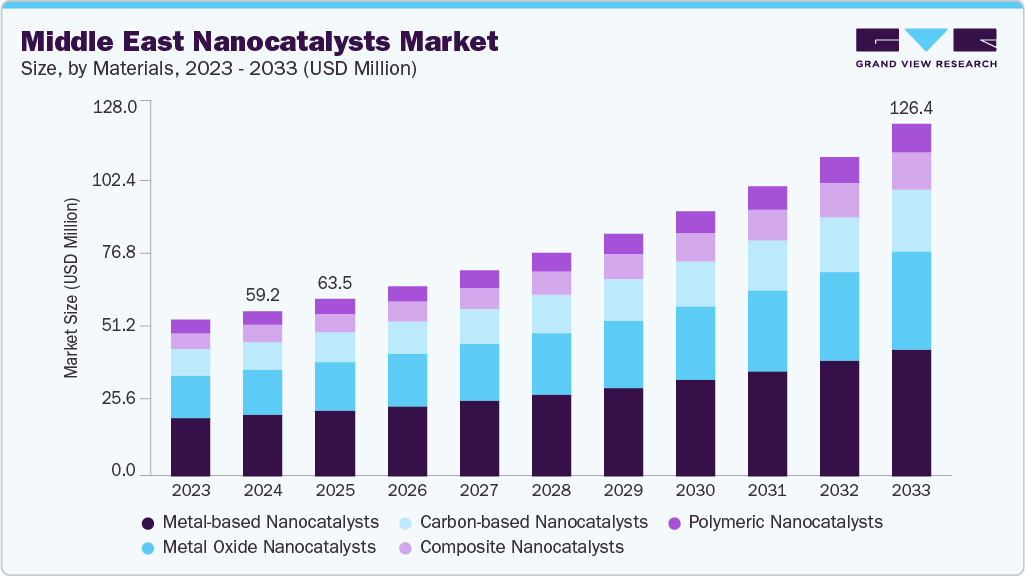
The Middle East nanocatalysts market size was estimated at USD 59.16 million in 2024 and is projected to reach USD 126.41 million by 2033, growing at a CAGR of 9.0% from 2025 to 2033. The market is driven by increasing investments in clean energy technologies and refinery modernization projects.
Key Market Trends & Insights
- Saudi Arabia dominated the Middle East nanocatalysts market with the largest revenue share of 51.20% in 2024.
- The market in UAE is expected to grow at a significant CAGR of 9.4% from 2025 to 2033.
- By material, the composite nanocatalysts segment is expected to grow at the highest CAGR of 9.5% from 2025 to 2033 in terms of revenue.
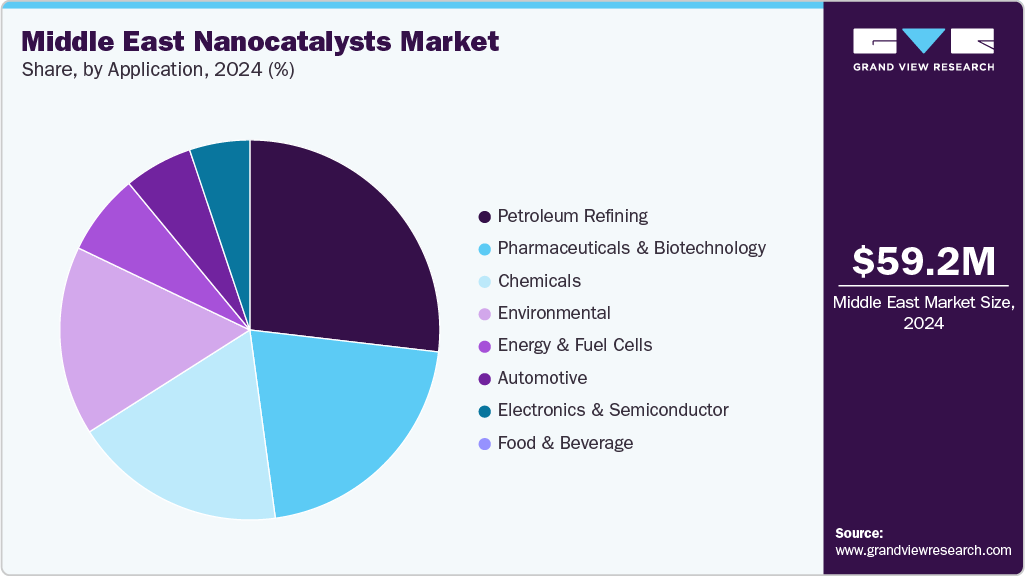
- By application, the petroleum refining segment held the largest revenue share of 31.2% in 2024 in terms of value.
Market Size & Forecast
- 2024 Market Size: USD 59.16 Million
- 2033 Projected Market Size: USD 126.41 Million
- CAGR (2025-2033): 9.0%
The region’s focus on enhancing catalytic efficiency in oil & gas downstream processes is accelerating demand. Additionally, the growing interest in hydrogen production and environmental remediation is further supporting the adoption of nanocatalyst solutions. The nanocatalyst market in the Middle East is emerging as a niche yet strategically significant segment, primarily aligned with the region’s dominant oil & gas and petrochemical sectors. Nanocatalysts, which operate at the nanoscale to accelerate chemical reactions, are gaining attention for their ability to improve conversion efficiency, lower energy consumption, and enhance selectivity in catalytic processes. Governments across the Middle East are increasingly investing in advanced materials and clean technologies as part of their broader economic diversification and sustainability goals, creating favorable conditions for nanocatalyst adoption across industrial applications.
A key driver propelling the Middle East nanocatalyst market is the ongoing modernization of oil refineries and the push for cleaner fuel production. As countries like Saudi Arabia and the UAE aim to align with international environmental standards and reduce sulfur emissions, there is growing demand for high-performance catalysts that can deliver greater efficiency and lower by-product formation. Nanocatalysts offer improved activity and durability under extreme operating conditions, making them ideal for desulfurization and reforming processes. These capabilities are crucial for meeting both regulatory requirements and economic goals within the region’s energy transformation agenda.
Market Concentration & Characteristics
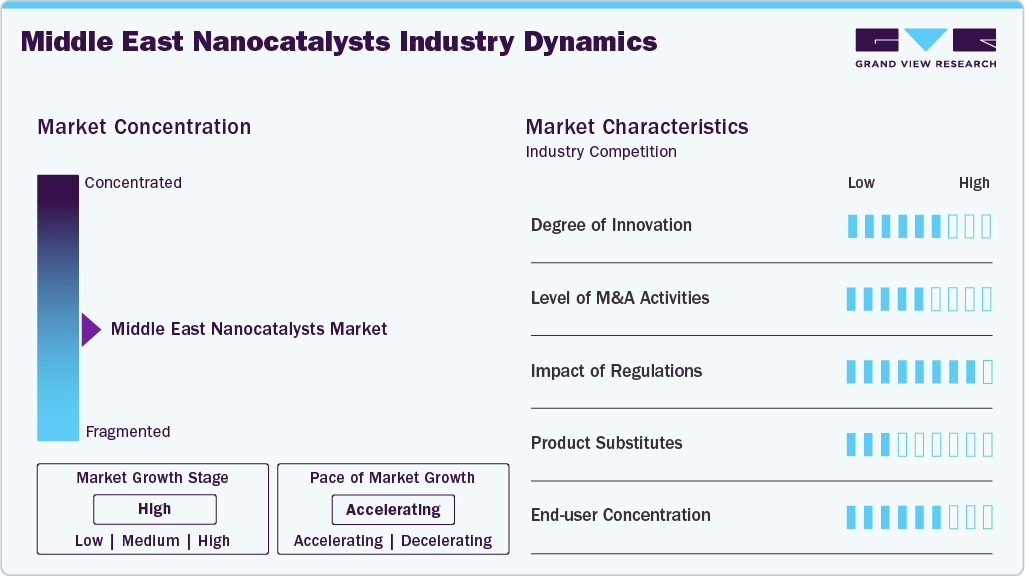
The market is moderately fragmented, with a few global players, such as Solvay The Solvay; Evonik Industries AG, and AkzoNobel N.V., dominating the competitive landscape. These companies benefit from their scale of operations, competitive pricing, and diversified product offerings. They are actively investing in research and development, expanding production capacities, and focusing on sustainable practices to strengthen their positions in the competitive market.
Leading players in the Middle East nanocatalysts market are adopting a combination of capacity expansion, product innovation, strategic partnerships, and sustainability initiatives to strengthen their market position. Companies such as Givaudan, DSM, The Lubrizol Corporation, and Croda International plc are investing in advanced refining technologies to enhance product purity and performance for high-end applications like cosmetics and phase change materials. To cater to rising demand in Asia Pacific and the Middle East, several players are expanding their production and distribution networks in these regions.
Materials Insights
The metal-based nanocatalysts segment dominated the market with a revenue share of 37.23% in 2024. The market is driven by their superior catalytic activity, thermal stability, and surface-to-volume ratio. Precious and transition metals such as platinum, palladium, nickel, and cobalt are widely used in refining, petrochemical, and hydrogen production applications due to their effectiveness in facilitating complex reactions like hydrocracking and reforming. The region’s strong dependence on oil & gas and its increasing investment in clean fuel technologies have reinforced demand for metal-based nanocatalysts, particularly in upgrading heavy crude and reducing sulfur content.
Composite nanocatalysts is expected to grow fastest with a CAGR of 9.5% during the forecast period. The material segment market is a versatile segment combining the advantages of multiple catalytic components, such as metals, metal oxides, and carbon-based materials. These hybrid catalysts offer enhanced activity, stability, and selectivity, making them suitable for a range of applications including water treatment, CO₂ conversion, and advanced petrochemical processes.
Applications Insights
The petroleum refining segment dominated the market with a revenue share of 31.2% in 2024. Nanocatalysts are being increasingly integrated into key refining processes such as hydrocracking, catalytic reforming, and desulfurization due to their superior surface area, activity, and resistance to deactivation. These catalysts enhance fuel quality, improve conversion efficiency, and help meet stringent environmental regulations related to emissions and fuel sulfur content. As Middle Eastern countries invest in refinery upgrades and expansion projects to align with global clean fuel standards, the demand for advanced nanocatalyst technologies in petroleum refining is expected to rise steadily.
Nanocatalysts are being adopted in various chemical synthesis and transformation processes, such as oxidation, hydrogenation, and polymerization, where enhanced reaction rates, selectivity, and energy efficiency are critical. Their ability to facilitate cleaner and more efficient chemical production aligns with the region’s push toward industrial diversification and sustainable practices. As nations like Saudi Arabia and the UAE increase investments in specialty and performance chemicals, the use of nanocatalysts is expected to play a crucial role in improving process economics and environmental compliance across the chemical sector.
Country Insights
The Middle East nanocatalyst market is experiencing steady growth, supported by advancements in energy, petrochemicals, and environmental technologies. The market is driven by regions’ strategic focus on upgrading oil refineries and producing cleaner fuels, where nanocatalysts enable higher efficiency and reduced emissions in critical processes like hydrocracking and desulfurization. Their superior surface properties and catalytic activity make them essential for meeting stricter global environmental standards. Additionally, rising investments in hydrogen production and sustainable chemical synthesis are further propelling demand for advanced nanocatalyst solutions across the region.
Saudi Arabia Nanocatalysts Market Trends
Saudi Arabia nanocatalyst market dominated the MEA market with a revenue share of 51.2% in 2024. The market is driven by the country's commitment to industrial modernization and sustainability under Vision 2030. A key growth driver is the ongoing investment in upgrading refinery and petrochemical infrastructure to improve fuel quality and reduce environmental impact. Nanocatalysts play a vital role in enhancing reaction efficiency and enabling cleaner processes in hydrocarbon conversion. Moreover, Saudi Arabia’s growing interest in green hydrogen and advanced chemical manufacturing is fostering further adoption of nanocatalyst technologies across strategic sectors.
Key Middle East Nanocatalysts Company Insights
Key players such as BASF SE, Solvay, Clariant, Evonik Industries AG, and DuPont, are dominating the market.
-
BASF SE is a chemical production company based in Germany and offers products to several end-use industries, including agriculture, chemicals, construction, electronic & electric, energy & resources, pharmaceuticals, and automotive & transportation. It operates through five business segments, namely performance products, chemicals, agricultural solutions, functional materials & solutions, and oil & gas. The chemicals segment specializes in the manufacturing of products such as petrochemicals, catalysts, intermediates, and monomers. It also provides surface disinfectants for applications, including home care and industrial & institutional, comprising sub-applications such as laundry, dishwashing, food & beverage processing, and industrial cleaning, among others. The company operates through its various subsidiaries and joint ventures in over 80 countries, with more than 353 production sites spread across the globe. It also has 13 operating divisions and around 84 sub-business units worldwide. The company operates in various locations, including Germany, the U.S., Belgium, Brazil, Canada, Chile, the Netherlands, Norway, Poland, Portugal, Korea, Japan, India, Malaysia, the UAE, South Africa, and China.
Key Middle East Nanocatalysts Companies:
- Solvay
- Evonik Industries AG
- Clariant
- BASF SE
- AkzoNobel N.V.
- Kemira
- Huntsman International LLC
- DuPont
- LANXESS
- Croda International Plc
- Givaudan
- Novozymes
- DSM
- The Lubrizol Corporation
- Albemarle Corporation
Recent Developments
-
In December 2023, Arkema finalized the acquisition of 54% shares of PI Advanced Materials (PIAM), a South Korean listed company held by Glenwood Private Equity, for an enterprise value of USD 793.30 million
-
In December 2023, Croda International Plc inaugurated a new production facility, Pastillator 4 (PSO4), located in Jurong Island, Singapore. The facility is expected to help the company meet the growing demand for esters and pastille format alkoxylates. It is investing a total sum of USD 16.4 million to increase the site’s total capacity to 15,000 metric tons.
Middle East Nanocatalysts Market Report Scope
|
Report Attribute
|
Details
|
|
Market size value in 2025
|
USD 63.51 million
|
|
Revenue forecast in 2033
|
USD 126.41 million
|
|
Growth rate
|
CAGR of 9.0% from 2025 to 2033
|
|
Base year for estimation
|
2024
|
|
Historical data
|
2021 - 2023
|
|
Forecast period
|
2025 - 2033
|
|
Quantitative units
|
Revenue in USD million/billion and CAGR from 2025 to 2033
|
|
Report coverage
|
Revenue forecast, company ranking, competitive landscape, growth factors, and trends
|
|
Segments covered
|
Materials, application, country
|
|
Regional scope
|
Middle East
|
|
Country scope
|
Oman; Kuwait; Saudi Arabia; UAE; Qatar; Bahrain; Israel
|
|
Key companies profiled
|
Solvay; Evonik Industries AG; Clariant; AkzoNobel N.V.; Kemira; BASF SE; DuPont; LANXESS; Croda International Plc; Huntsman International LLC; Givaudan; Novozymes; DSM; The Lubrizol Corporation; Albemarle Corporation.
|
|
Customization scope
|
Free report customization (equivalent up to 8 analysts’ working days) with purchase. Addition or alteration to country, regional & segment scope.
|
|
Pricing and purchase options
|
Avail customized purchase options to meet your exact research needs. Explore purchase options
|
Middle East Nanocatalysts Market Report Segmentation
This report forecasts revenue growth at regional and country levels and provides an analysis of the latest industry trends in each of the sub-segments from 2021 to 2033. For this study, Grand View Research has segmented the Middle East nanocatalysts market report based on material, application and region:
-
Material Outlook (Revenue, USD Million, 2021 - 2033)
-
Metal-based Nanocatalysts
-
Metal Oxide Nanocatalysts
-
Carbon-based Nanocatalysts
-
Polymeric Nanocatalysts
-
Composite Nanocatalysts
-
Application Outlook (Revenue, USD Million, 2021 - 2033)
-
Regional Outlook (Revenue, USD Million, 2021 - 2033)
-
Middle East
-
Oman
-
Kuwait
-
Saudi Arabia
-
UAE
-
Qatar
-
Bahrain
-
Israel
Frequently Asked Questions About This Report
b. The Middle East nanocatalysts market size was established at USD 59.16 million in 2024 and is expected to reach USD 63.51 million in 2025.
b. The Middle East nanocatalysts market is expected to grow at a compound annual growth rate of 9.0% from 2025 to 2033 to reach USD 126.41 million by 2033.
b. In Saudi Arabia, this country dominated the market with a revenue share of 51.2% in 2024. The market is driven by the country's commitment to industrial modernization and sustainability under Vision 2030. A key growth driver is the ongoing investment in upgrading refinery and petrochemical infrastructure to improve fuel quality and reduce environmental impact.
b. Some key players operating in the Middle East nanocatalysts market include Solvay, Evonik Industries AG, Clariant, AkzoNobel N.V., Kemira, BASF SE, DuPont, LANXESS, Croda International Plc, Huntsman International LLC, Givaudan, Novozymes, DSM, The Lubrizol Corporation, and Albemarle Corporation.
b. The market is driven by increasing investments in clean energy technologies and refinery modernization projects. The region’s focus on enhancing catalytic efficiency in oil & gas downstream processes is accelerating demand. Additionally, the growing interest in hydrogen production and environmental remediation is further supporting the adoption of nanocatalyst solutions
 Download Sample Report