- Home
- »
- Healthcare IT
- »
-
Middle East Healthcare Digital Twins Market Size Report 2033GVR Report cover
![Middle East Healthcare Digital Twins Market Size, Share & Trends Report]()
Middle East Healthcare Digital Twins Market (2026 - 2033) Size, Share & Trends Analysis Report By Component (Software, Services), By Application (Personalized Medicine, Drug Discovery & Development, Medical Device Design & Testing), By End Use, By Region, And Segment Forecasts
- Report ID: GVR-4-68040-846-6
- Number of Report Pages: 100
- Format: PDF
- Historical Range: 2021 - 2025
- Forecast Period: 2026 - 2033
- Industry: Healthcare
- Report Summary
- Table of Contents
- Segmentation
- Methodology
- Download FREE Sample
-
 Download Sample Report
Middle East Healthcare Digital Twins Market Summary
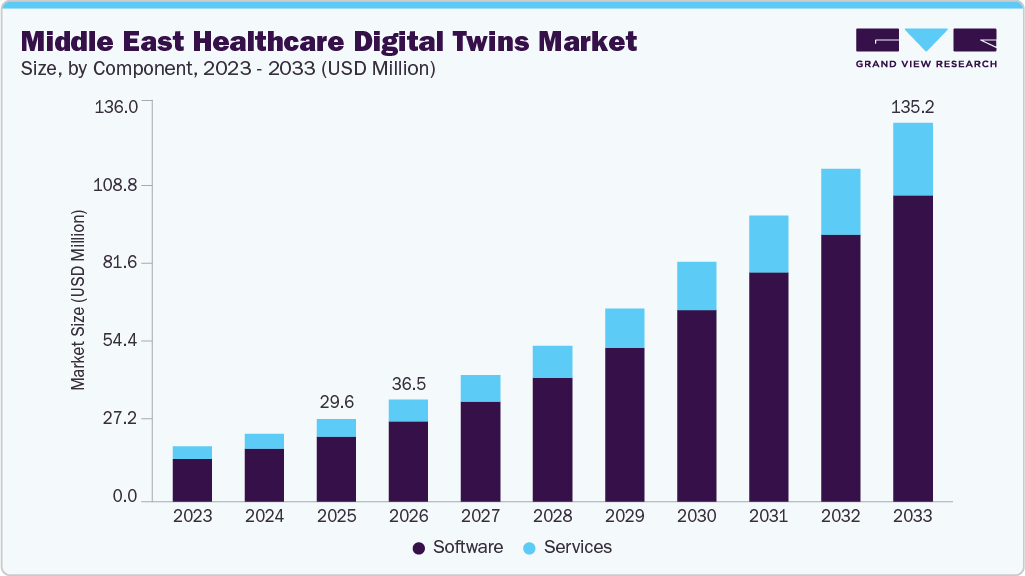
The Middle East healthcare digital twins market size was estimated at USD 29.56 million in 2025 and is projected to reach USD 135.20 million by 2033, growing at a CAGR of 20.58% from 2026 to 2033. Government-led digital health initiatives, the expansion of smart hospitals, and the demand for data-driven clinical and operational decisions drive the adoption of digital twins in the Middle East healthcare sector.
Key Market Trends & Insights
- The Saudi Arabia healthcare digital twins market dominated Middle East in 2025 with a revenue share of 27.57%.
- Based on component, the software segment held the largest share in 2025.
- Based on application, the personalized medicine segment held the largest share in 2025.
- Based on end use, the providers segment held the largest share in 2025.
Market Size & Forecast
- 2025 Market Size: USD 29.56 Million
- 2033 Projected Market Size: USD 135.20 Million
- CAGR (2026-2033): 20.58%
- Saudi Arabia: Largest market in 2025
- Oman: Fastest growing market
Enabled by AI, IoT, cloud platforms, and connected devices, digital twins support capacity optimization, predictive care, and personalized medicine. Rising healthcare spending and a post-pandemic focus on resilience and efficiency are further driving the growth of the Middle East healthcare digital twins industry.In healthcare, digital twins are used to generate digital replicas or models that mirror various aspects of healthcare data, including the hospital setting, human biological functions, and laboratory outcomes. The representations help to improve efficiency, anticipate future demand, and optimize costs. These factors are expected to drive demand for this technology over the forecast period.
Across the Middle East, digital twin adoption is growing as healthcare providers transition toward real-time, data-driven care models. Digital twins are increasingly used to represent patients, health systems, and clinical environments, enabling predictive care, personalized treatment, and operational optimization. For instance, in May 2025, American Hospital Dubai’s launch of the region’s first GenetiQ Digital Twin platform, introduced at Arab Health 2025, that integrates an individual’s genomic, microbiome, proteomic, clinical, and wearable data to deliver predictive diagnostics, personalized treatment plans, and continuous health monitoring under a framework referred to as Medicine 3.0. This initiative enables clinicians to anticipate health risks and tailor therapies more accurately than traditional approaches.
"American Hospital Dubai's integration of Prepaire Labs' cutting-edge GenetiQ Digital Twin platform with its advanced treatment solutions reimagines patient care. This partnership allows us to anticipate health risks, optimize treatments, and set a new standard for preventative care and longevity-focused solutions. American Hospital Dubai is committed to staying ahead of the curve, making Medicine 3.0 a reality."
-Dr. Tarek Dufan, Chief Medical Director at American Hospital Dubai,
The growing adoption of digital twins enables smart hospitals to improve operational efficiency, and sustainability is driving market growth. For instance, in January 2023, Emirates Health Services (EHS) in the UAE implemented digital twin solutions in partnership with technology leaders such as Microsoft and Schneider Electric. Key deployment is the digital twin established for Al Qassimi Hospital in Sharjah, which creates a real-time virtual replica of the facility to monitor complex systems, including energy usage, infrastructure performance, and maintenance needs. This project aims to improve sustainability, reducing energy consumption and maintenance disruptions while informing better decision-making across clinical and non-clinical domains.
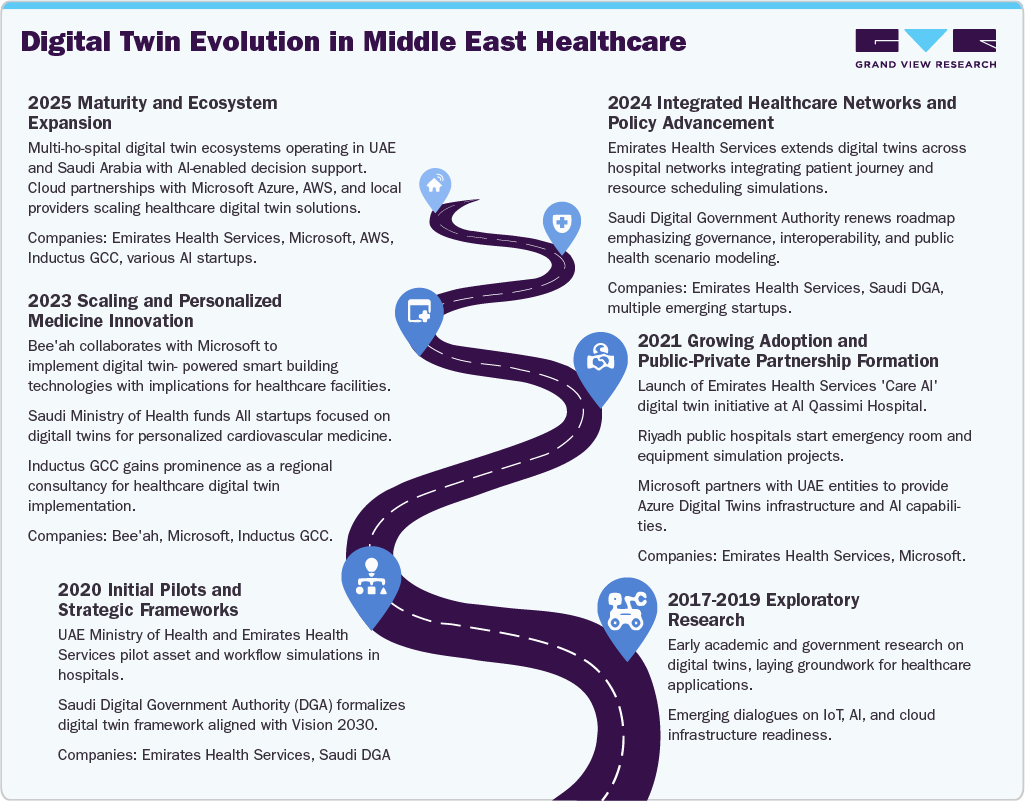
The evolution of digital twin technology in healthcare reflects a progression from static digital models to dynamic, real-time systems that integrate clinical, operational, and biological data. Early applications focused on basic visualization and retrospective analysis, while current deployments leverage AI, IoT, and cloud platforms to enable continuous monitoring, predictive analytics, and simulation across patient, hospital, and system levels. This evolution has transformed digital twins from experimental tools into core enablers of predictive, personalized, and operationally optimized healthcare delivery.
Digital twins offer capabilities that closely align with national healthcare priorities across the Middle East, particularly in efficiency, resilience, and data-driven planning. These platforms enable real-time visibility across patient, hospital, and system operations; predictive identification of clinical risks and care-pathway bottlenecks; simulation of capacity requirements and resource allocation; and integration of clinical, operational, and energy-management systems. At a system level, digital twins also support scenario-based modeling for national health planning and emergency preparedness.
The region’s investment in AI, 5G connectivity, national health interoperability platforms, and cloud infrastructure has created favorable conditions for digital twins to scale beyond pilot deployments into routine operations. As a result, healthcare providers are increasingly deploying digital twin solutions to support ICU capacity forecasting, surgical scheduling optimization, patient-flow modeling, AI-assisted diagnostics, and hospital energy optimization, with the most advanced implementations observed in Saudi Arabia and the UAE.
Digital twin adoption in the Middle East is occurring across multiple layers of the healthcare ecosystem, including patient-level, hospital-level, network-level, and national-scale implementations, as outlined below.
Digital Twin Deployment across the Middle East Healthcare Ecosystem
Category
Country
Example
Description
Patient-Level Digital Twins
Saudi Arabia
Sehhaty Digital Health Twin
Launched October 2024; world’s largest health twin platform (>30M users). Creates virtual versions of individuals using clinical + wearable + lifestyle data to predict NCD risks and simulate health trajectories.
UAE
Dr. Mansoor’s Digital Twin Doctor
A digital twin of Dr. Mansoor Al-Zaabi. Uses voice cloning + AI for preventive wellness guidance in 30+ languages; 24/7 health awareness support.
Network-Level Digital Twins
Saudi Arabia
Seha Virtual Hospital Network
Connects 170+ hospitals. Uses AI-driven diagnostics, remote monitoring, and resource-optimization algorithms. Strongest network-level twin in Middle East.
Hospital & Facility-Level Twins
Kuwait
Jaber Hospital - AI Surgical & ICU Integration
Uses advanced AI imaging, 3D organ visualization, and intra-operative decision tools—considered a stepping stone toward full hospital-level twins.
Qatar
Hamad & Sidra Medical Centers - Operational Twin Pilots
Running pilots for ICU bed-capacity forecasting, surgical scheduling optimization, and hospital-operation simulations.
National/System-Level Digital Twins
Saudi Arabia (NEOM)
City-Scale Digital Twin Ecosystem
NEOM is building a real-time, city-wide digital twin integrating health, environment, mobility, and infrastructure—most advanced transformation-stage model in ME. Healthcare will run predictive, autonomous workflows.
Market Concentration & Characteristics
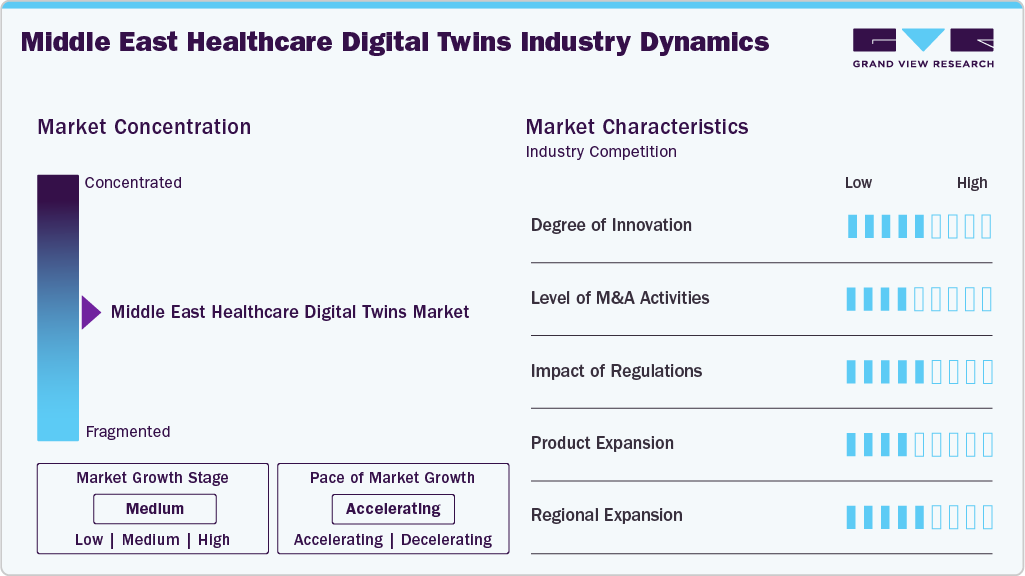
The Middle East healthcare digital twins market is experiencing significant innovation, fueled by rapid advancements in artificial intelligence (AI), machine learning (ML), the Internet of Things (IoT), and cloud computing. For instance, in October 2024, the Sehhaty Digital Health Twin was launched in Saudi Arabia, integrating personal health, wearable, and lifestyle data for over 30 million users to simulate health trajectories and enable early risk prediction and preventive care, reflecting a significant step toward personalized, predictive healthcare at a national scale.
The Middle East healthcare digital twin landscape is characterized by moderate levels of strategic partnerships and ecosystem collaborations, which operate similarly to mergers and acquisitions by enabling access to advanced technologies and accelerating adoption across clinical and research environments. For instance, in January 2025, BioTwin, a Canadian digital health startup within the Hub71 ecosystem, partnered with Cleveland Clinic Abu Dhabi to pilot virtual human twin technology for breast cancer screening. This collaboration combines BioTwin’s advanced virtual twin data analytics with Cleveland Clinic Abu Dhabi’s clinical expertise to validate and integrate next‑generation digital twin models into early-disease detection workflows, marking a significant step toward embedding digital twin innovation into regional healthcare practice.
Healthcare digital twin solutions in the Middle East must comply with strict data privacy and security laws to protect patient information. For example, the UAE’s Personal Data Protection Law (PDPL) and the federal Health Data Law require consent, anonymization, and secure storage of health data, ensuring that virtual models of patients are created responsibly and ethically. Similarly, Saudi Arabia’s PDPL imposes safeguards for clinical data, outlining how digital twin technologies access and use sensitive health information.
Several organizations in the Middle East are actively broadening their digital twin offerings to strengthen their healthcare technology portfolios. For instance, in July 2025, 9verse AI FZCO announced the launch of the first physician AI digital twin for the Middle East and Africa, developed for Emirati physician Dr. Mansoor Anwar Habib. This new solution, powered by the Convrz AI platform, offers 24/7 multilingual health guidance through a digital replica of the physician, allowing people to access preventive health advice and wellness information in Arabic, English, and over 30 other languages. This innovative deployment demonstrates how digital twin technology is rising beyond traditional clinical settings to support broader health education and community engagement in the region.
Healthcare digital twin initiatives are rising across the Middle East as technology partners and health systems broaden deployment beyond single facilities to wider regional applications. For instance, in October 2025, Abu Dhabi Health Data Services (ADHDS), in collaboration with G42’s Presight and Jordan’s Ministry of Health, launched the first national virtual hospital network in Jordan, connecting five remote hospitals through a central command center. This virtual hospital serves as a digital extension of physical care delivery, offering integrated tele-ICU, tele-dialysis, and tele-radiology services that reduce diagnostic turnaround times and improve access to specialist care across geographic boundaries, highlighting how digital twin-enabled networks are extending healthcare reach and digital infrastructure across the region.
Component Insights
The software segment dominated the Middle East healthcare digital twins industry, accounting for the largest revenue share of over 78.58% in 2025, and is anticipated to register the fastest CAGR over the forecast period. Increasing launches of digital twin software platforms are strengthening the healthcare ecosystem in the Middle East by enabling advanced simulations, predictive analytics, and system optimization. For instance, in January 2023, Emirates Health Services (EHS) partnered with Microsoft and Schneider Electric to deploy the EcoStruxure for Healthcare digital twin platform across UAE hospitals, a software solution that creates real‑time virtual models of clinical spaces and equipment to monitor performance, improve patient comfort, and optimize operations such as energy use and maintenance planning demonstrating how tailored software is being used to drive efficiency and sustainability in regional healthcare facilities.
The services segment is anticipated to grow significantly over the forecast period. The rising demand for consulting, implementation, and integration services that help ensure the smooth deployment and long‑term support of virtual modelling systems within existing IT environments is driving market growth. For instance, in April 2025, the Dubai Health Authority (DHA) engaged external digital health and systems integration firms to help build and integrate hospital operational digital twin services, ensuring that these models connect seamlessly with hospital information systems (HIS), electronic health records (EHRs), and Internetconnected medical devices to support real‑time resource management and predictive planning across multiple facilities. This reflects a growing trend in the region where digital twin service providers are required not only for initial system setup but also for ongoing maintenance, interoperability solutions, and consultancy to align digital twin capabilities with complex healthcare workflows and strategic goals.
Application Insights
The personalized medicine segment dominated the Middle East healthcare digital twins market, accounting for a revenue share of 27.40% in 2025. The growing emphasis on precision healthcare is accelerating the use of digital twin technology in the Middle East by enabling highly individualized disease prediction and treatment planning. For example, in October 2025, the Department of Health Abu Dhabi (DoH) unveiled the AI‑powered Population Health Intelligence (PHI) platform; it integrates clinical, environmental, lifestyle, and demographic data to forecast health risks, simulate interventions, and tailor evidence-based strategies that support personalized prevention and care at the population level. This initiative reflects a shift toward proactive, data‑driven medicine where virtual models help clinicians predict disease progression, optimize treatment plans, and identify potential risks before they manifest, moving healthcare away from one-size-fits-all approaches.
The medical device design and testing segment is anticipated to witness the fastest CAGR over the forecast period. Advancements in digital twin technology are enabling more efficient real-time simulation and virtual testing of healthcare devices in the Middle East, helping innovators identify design issues early and tailor devices to clinical needs. For instance, in October 2025 at GITEX Global, the Emirates Health Services (EHS) “Smart Twin” project was introduced, where a digital twin platform is being implemented at Khorfakkan Hospital to create a virtual replica of the hospital’s infrastructure, resources, and operations. This software-driven model enables healthcare teams to simulate and assess equipment usage, workflow performance, resource allocation, and facility needs before physical deployment, effectively supporting device testing, predictive planning, and the optimization of medical systems in a real-world clinical setting.
End Use Insights
The providers segment dominated the Middle East healthcare digital twins industry, accounting for a revenue share of 36.27% in 2025. Healthcare providers in the Middle East are increasingly using digital twin technology to optimize clinical operations, improve resource allocation, and enhance patient care delivery. For instance, Saudi Arabia’s Seha Virtual Hospital, which connects over 224 hospitals nationwide through digital platforms that combine telemedicine, AI‑driven workflows, and real‑time clinical data to deliver remote specialist services, reduce strain on physical facilities, and improve access to care across the Kingdom. This virtual hospital model helps providers manage patient flows, alleviate capacity constraints, and extend expertise to underserved areas, demonstrating how digital health solutions can enhance operational efficiency and decision-making in large healthcare networks.
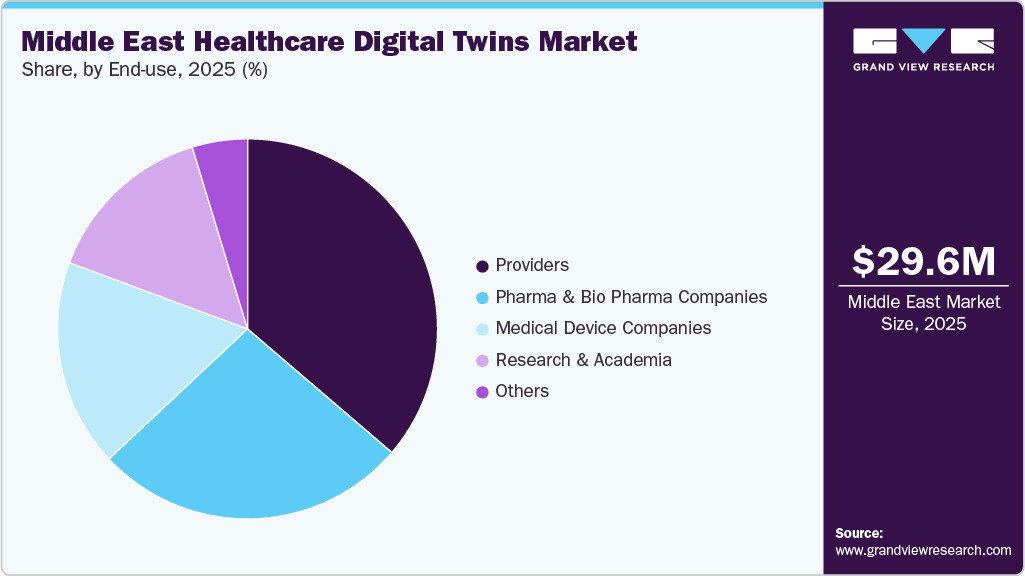
The pharma & bio pharma companies segment is anticipated to grow at the fastest CAGR over the forecast period. The growing demand for faster, more cost-effective drug development and personalized therapies is accelerating the adoption of digital twin technologies among pharmaceutical and biopharma players in the Middle East. For instance, DeepCARES, a Saudi Arabian biotech and AI startup that is developing explainable digital twin platforms based on multi-omics data to support disease prediction and personalized health management, is laying the foundation for future applications in drug response simulation and precision therapeutics in the region. Integrating real-time biological and clinical datasets, such digital twin models help researchers and developers predict how different patient groups respond to treatments, optimize dosage levels, and reduce reliance on lengthy empirical trials, ultimately backing more efficient and targeted drug discovery and development processes.
Country Insights
Saudi Arabia Healthcare Digital Twins Market Trends
Saudi Arabia dominated the Middle East healthcare digital twins market, accounting for a revenue share of 27.57% in 2025. The high adoption of digital and automation solutions in healthcare facilities across the country is a key driver of market growth in the region. Moreover, in Saudi Arabia, digital twin technologies are being progressively embedded into national healthcare transformation efforts to enhance planning, preventive care, and system-wide efficiency. For instance, in November 2025, Lean Business Services partnered with the Ministry of Health to introduce one of the Kingdom’s first scalable healthcare digital twin systems that integrates AI and real‑time clinical data to model individual health profiles and support predictive care planning, chronic disease management, and personalized intervention strategies strengthening the country’s Vision 2030 agenda of proactive, datadriven health services.
UAE Healthcare Digital Twins Market Trends
The UAE held the largest share of the Middle East healthcare digital twins industry in 2025, owing to the combination of advanced technological infrastructure, strong healthcare innovation, and substantial investment in healthcare research and development. Moreover, in the UAE, digital twin initiatives are not limited to hospital operations but are also forming healthcare delivery strategies and clinical planning tools. For instance, Aster DM Healthcare, which operates a large network of hospitals and clinics across the GCC, including the UAE, has been advancing an AI- and data-driven system incorporating digital twin-like models to forecast patient outcomes, optimize treatment plans, and support clinical decision-making.
Kuwait Healthcare Digital Twins Market Trends
Kuwait's healthcare digital twins market is anticipated to grow significantly over the forecast period, driven by increased emphasis on healthcare innovation, digital transformation, and government-backed modernization initiatives. Kuwait’s long-term national development agenda, including investments in smart hospitals, health IT infrastructure, and data-driven care delivery, is creating a favorable environment for the adoption of advanced technologies such as digital twins. These solutions enable real-time simulation of healthcare systems, patient pathways, and medical assets, strengthening improved clinical outcomes, operational efficiency, and preventive care planning.
Key Middle East Healthcare Digital Twins Company Insights
Key participants in the Middle East healthcare digital twins market are focusing on developing innovative business growth strategies in the form of product portfolio expansions, partnerships & collaborations, mergers & acquisitions, and business footprint expansions.
Key Middle East Healthcare Digital Twins Companies:
- Atos
- Microsoft
- Philips Healthcare
- Siemens Healthineers
- GE Healthcare
- QiO Technologies
- Verto Healthcare
- Dassault Systems (3DS System)
- Cerner (Oracle Health)
- Faststream Technologies
- Twin Health
Recent Developments
-
In March 2025, Medcare Hospitals & Medical Centres in the UAE launched a virtual digital twin hospital environment in the metaverse to allow patients to explore health services, interact with clinicians in immersive settings, and access virtual consultations before visiting the physical facility, illustrating the application of digital twin concepts for patient engagement and service innovation in the region.
-
In February 2025, a Qatari AI-healthtech startup, Lillia, secured a USD 1.7 million grant from the Qatar Research, Development & Innovation Council to develop a digital twin solution for chronic disease management, leveraging real-time data and AI-driven models to improve precision care within Qatar and the broader MENA region.
-
In November 2024, ZainTECH partnered with Tencent Cloud to introduce advanced Digital Twin applications across the Middle East and North Africa (MENA), enabling enhanced digital transformation and real-time simulation capabilities across sectors, including smart healthcare infrastructure and analytics.
Middle East Healthcare Digital Twins Market Report Scope
Report Attribute
Details
Market size value in 2026
USD 36.49 million
Revenue forecast in 2033
USD 135.20 million
Growth rate
CAGR of 20.58% from 2026 to 2033
Actual data
2021 - 2025
Forecast data
2026 - 2033
Quantitative units
Revenue in USD million and CAGR from 2026 to 2033
Report coverage
Revenue forecast, company ranking, competitive landscape, growth factors, and trends
Segments covered
Component, application, end use, country
Regional scope
MEA
Country scope
Saudi Arabia; UAE; Kuwait; Oman; Qatar
Key companies profiled
Atos; Microsoft; Philips Healthcare; Siemens Healthineers; GE Healthcare; QiO Technologies; Verto Healthcare; Dassault Systems (3DS System); Cerner (Oracle Health); Faststream Technologies; Twin Health
Customization scope
Free report customization (equivalent up to 8 analyst working days) with purchase. Addition or alteration to country, regional & segment scope.
Pricing and purchase options
Avail customized purchase options to meet your exact research needs. Explore purchase options
Middle East Healthcare Digital Twins Market Report Segmentation
This report forecasts revenue growth at the regional and country level and provides an analysis of the latest industry trends in each of the sub segments from 2021 to 2033. For this study, Grand View Research, Inc. has segmented the Middle East healthcare digital twins market report based on component, application, end use, and region:
-
Component Outlook (Revenue, USD Million, 2021 - 2033)
-
Software
-
Services
-
-
Application Outlook (Revenue, USD Million, 2021 - 2033)
-
Personalized medicine
-
Healthcare workflow optimization & Asset Management
-
Medical Device Design and Testing
-
Drug Discovery & development
-
Surgical planning and medical education
-
Others
-
-
End Use Outlook (Revenue, USD Million, 2021 - 2033)
-
Providers
-
Pharma & Bio Pharma Companies
-
Medical Device Companies
-
Research & Academia
-
Others
-
-
Country Outlook (Revenue, USD Million, 2021 - 2033)
-
Saudi Arabia
-
UAE
-
Kuwait
-
Oman
-
Qatar
-
Frequently Asked Questions About This Report
b. The Middle East healthcare digital twins market size was estimated at USD 29.56 million in 2025 and is expected to reach USD 36.49 million in 2026.
b. The Middle East healthcare digital twins market is expected to grow at a compound annual growth rate of 20.58% from 2026 to 2033 to reach USD 135.20 million by 2033.
b. Saudi Arabia dominated the Middle East healthcare digital twins market with a share of 27.57% in 2025. The high adoption of digital and automation solutions in healthcare facilities across the country is a key driver of market growth in the region.
b. Some key players operating in the Middle East healthcare digital twins market include Atos, Microsoft, Philips Healthcare, Siemens Healthineers, GE Healthcare, QiO Technologies, Verto Healthcare, Dassault Systems (3DS System), Cerner (Oracle Health), Faststream Technologies, Twin Health.
b. Digital twin adoption in Middle East healthcare is driven by government-led digital health initiatives, expansion of smart hospitals, and demand for data-driven clinical and operational decisions.Enabled by AI, IoT, cloud platforms, and connected devices, digital twins support capacity optimization, predictive care, and personalized medicine.


Share this report with your colleague or friend.
Need a Tailored Report?
Customize this report to your needs — add regions, segments, or data points, with 20% free customization.


ISO 9001:2015 & 27001:2022 Certified
We are GDPR and CCPA compliant! Your transaction & personal information is safe and secure. For more details, please read our privacy policy.
Trusted market insights - try a free sample
See how our reports are structured and why industry leaders rely on Grand View Research. Get a free sample or ask us to tailor this report to your needs.