Middle East Animal Feed Market Summary
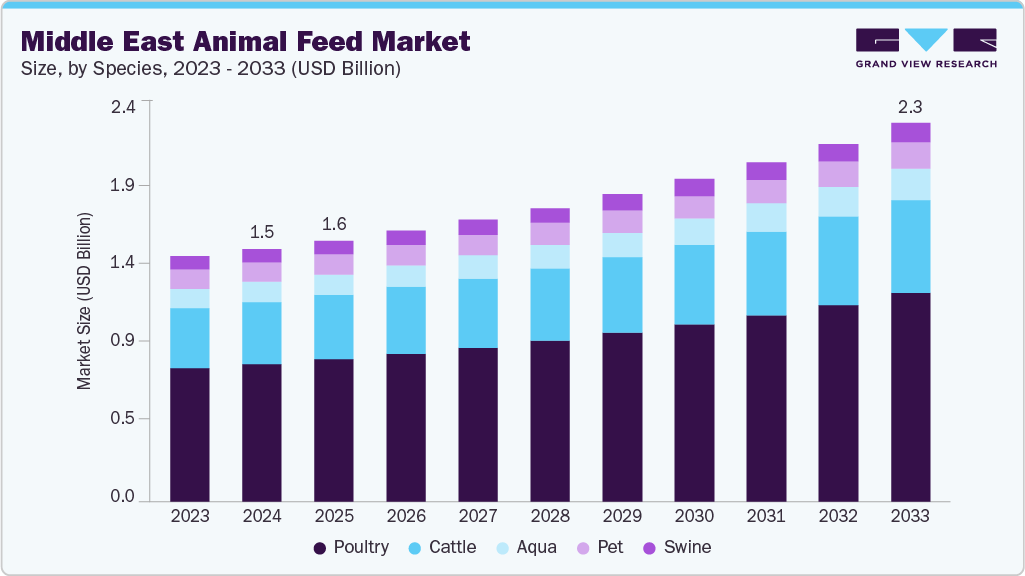
The Middle East animal feed market size was estimated at USD 1,509.5 million in 2024 and is projected to reach USD 2,260.0 million by 2033, growing at a CAGR of 4.7% from 2025 to 2033. The market is primarily driven by the region’s growing emphasis on food security, rising demand for high-quality protein sources, and government-backed initiatives to boost domestic livestock, aquaculture, and poultry production.
Key Market Trends & Insights
- The animal feed market in Bahrain is expected to grow at a significant CAGR of 5.6% from 2025 to 2033 in terms of revenue.
- By species, the aqua segment is expected to grow at the fastest CAGR of 5.3% from 2025 to 2033 in terms of revenue.
- By species, the poultry segment dominated the market with the largest revenue share of 54.6% in 2024.
- By additives, the feed enzymes segment is expected to grow at the fastest CAGR of 5.8% from 2025 to 2033 in terms of revenue.
- By additives, the amino acids segment captured the largest revenue share of 19.3% in 2024.
Market Size & Forecast
- 2024 Market Size: USD 1,509.5 Million
- 2033 Projected Market Size: USD 2,260.0 Million
- CAGR (2025-2033): 4.7%
Rapid population growth, coupled with increasing urbanization and changing dietary preferences, has fueled higher consumption of poultry and dairy, thereby stimulating feed demand. The integration of modern feed additives such as amino acids, enzymes, and acidifiers enhances feed efficiency and animal productivity, supporting sustainable sectoral growth. The market presents significant opportunities through aquaculture expansion, premiumization of pet nutrition, and the shift towards value-added feed additives that support animal health and performance. Advancements in feed formulation technologies, along with the rising adoption of precision nutrition, are opening avenues for players to differentiate their offerings. Furthermore, government investments in aquaculture projects, dairy self-sufficiency programs, and sustainable livestock practices provide fertile ground for feed producers and additive manufacturers to expand their presence. Rising consumer inclination toward antibiotic-free and organic animal products also creates opportunities for specialized feed solutions.
Despite strong growth potential, the market faces notable challenges such as high dependency on imported raw materials, which exposes feed producers to price volatility and supply chain disruptions. Limited water and arable land resources constrain livestock and aquaculture scalability, while stringent regulations regarding the use of antibiotics and certain feed additives increase compliance costs. In addition, fragmented market structures in some countries, coupled with cultural and regulatory restrictions on specific species like swine, restrict growth opportunities. Environmental concerns and the need for sustainable practices further add to operational complexities for stakeholders across the value chain.
Market Concentration & Characteristics
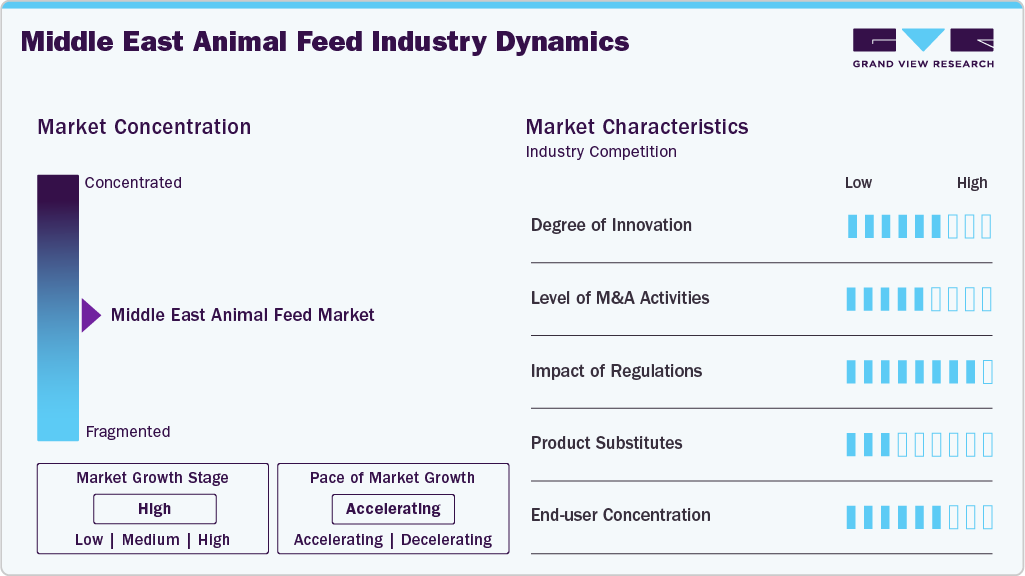
The Middle East animal feed industry is moderately fragmented. The market is influenced by a blend of regional leaders and international majors. Almarai Company, National Feed and Flour Production & Marketing (NFFPM), Tanmiah Food Company, and ARASCO are among the key domestic players, with strong vertical integration across feed, poultry, and dairy operations that ensure consistent demand and market resilience. Global players such as Cargill, ADM, Nutreco, Charoen Pokphand Foods PCL, Perdue Agribusiness, and Evonik Industries AG complement the landscape through advanced feed formulations, distribution networks, and specialized feed additives. This mix allows the region to balance local self-sufficiency goals with access to international expertise in animal nutrition and feed technologies.
To solidify their market presence, these companies have adopted a combination of localization, product innovation, and strategic partnerships. Regional leaders like Almarai and ARASCO emphasize vertical integration and government-backed food security initiatives, while NFFPM and Tanmiah focus on expansion of feed milling capacity and diversification into value-added feed products. Global multinationals such as Cargill, ADM, and Nutreco invest in R&D for sustainable and antibiotic-free feed solutions, while Evonik leverages its strength in amino acids and specialty additives to meet rising demand for feed efficiency. Charoen Pokphand Foods and Perdue are extending their footprint through strategic alliances and supply chain modernization to cater to poultry and aquaculture demand. Collectively, these strategies enhance operational resilience, align with shifting regulatory and consumer trends, and position these companies for long-term growth in a market increasingly shaped by food security, sustainability, and premium nutrition.
Species Insights
The poultry segment dominated the market, capturing the largest revenue share of 54.6% in 2024, primarily due to the region’s high demand for poultry meat and eggs as affordable sources of protein. Rapid urbanization, rising population, and increasing consumer awareness regarding protein-rich diets have further bolstered poultry consumption. In addition, advancements in poultry farming practices, including modern housing, nutrition optimization, and disease management, have led to higher productivity, driving consistent demand for high-quality feed. Leading feed manufacturers are also focusing on specialized poultry feed formulations, including nutrient-rich, additive-enhanced diets, to support growth, egg production, and disease resistance, thereby reinforcing the segment’s dominance.
The cattle segment holds a significant position, driven by strong dairy production in countries such as Saudi Arabia, UAE, and Egypt, where milk and dairy product consumption is increasing. Meanwhile, swine feed remains limited to select markets due to cultural and religious factors but shows growth in specific areas like Egypt and North Africa. The aqua feed segment is witnessing rapid expansion, reflecting the growth of aquaculture and rising fish consumption in coastal regions. Lastly, the pet feed segment is a niche but emerging market, fueled by increasing pet ownership, urban lifestyles, and demand for premium and specialized pet nutrition. Overall, these species-driven dynamics are shaping the Middle East feed market, with poultry leading in scale and revenue while other segments present targeted growth opportunities.
Additives Insights
The amino acids segment captured the largest revenue share of 19.3% in 2024, driven by their critical role in improving feed efficiency, supporting protein synthesis, and enhancing overall animal growth and health. With increasing demand for high-quality meat, milk, and egg production, feed manufacturers are incorporating tailored amino acid formulations to optimize animal performance while reducing feed costs. Countries in the Middle East are also emphasizing sustainable livestock production, where precise amino acid supplementation allows producers to minimize protein overuse and mitigate environmental impacts, further solidifying the segment’s revenue leadership.
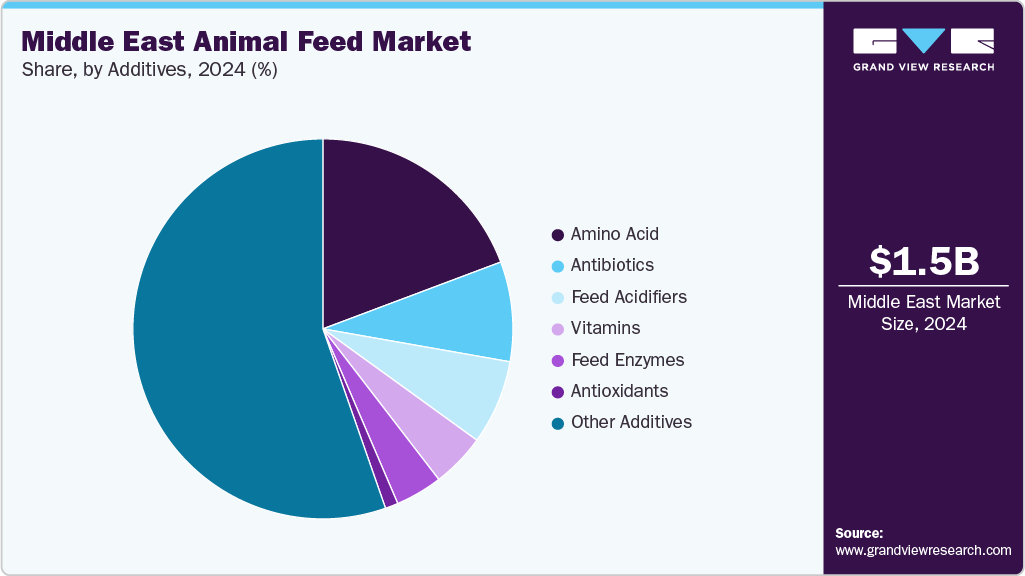
Other additives are witnessing notable adoption as well. Vitamins are essential for metabolic function and immunity, while antioxidants extend feed shelf life and reduce oxidative stress in animals. Feed enzymes enhance nutrient absorption and improve digestibility, supporting cost-effective feed utilization. Feed acidifiers promote gut health and reduce disease incidence, and antibiotics-though under increasing regulatory scrutiny-remain important for growth promotion and disease control in certain regions. The other additives category, including prebiotics, probiotics, and organic acids, is gaining traction as producers seek alternatives to antibiotics and aim to meet evolving consumer preferences for safe, sustainable animal products. Collectively, these additives are shaping the Middle East feed industry’s innovation landscape, driving both growth and efficiency.
Country Insights
Middle East Animal Feed Market Trends
The Middle East animal feed industry is experiencing steady growth, driven by rising protein consumption, urbanization, and increased awareness of animal nutrition. Poultry feed dominates the region, while cattle, aqua, and pet feed segments are expanding in line with dairy, aquaculture, and pet ownership trends. Feed additives such as amino acids, vitamins, and enzymes are increasingly adopted to improve animal health, productivity, and feed efficiency. Regional growth is also supported by government initiatives promoting livestock development, investments in modern farming practices, and an emphasis on sustainable feed solutions to meet the demands of a growing population.
Saudi Arabia Animal Feed Market Trends
Saudi Arabia animal feed industry represents the largest and most mature animal feed market in the Middle East, with poultry and cattle feed accounting for the majority of demand. Strong dairy and poultry industries, coupled with high per capita protein consumption, are driving feed consumption and adoption of advanced feed additives. The market is characterized by significant investments in feed production infrastructure, strategic partnerships with global feed suppliers, and increasing focus on locally produced high-quality feed. The regulatory support for food security and sustainable livestock production has encouraged innovation in feed formulations, positioning Saudi Arabia as a key growth hub in the regional animal feed landscape.
Key Middle East Animal Feed Company Insights
Some of the key players operating in the Middle East animal feed industry include Almarai Company, National Feed and Flour Production and Marketing (NFFPM), Tanmiah Food Company, Cargill, ADM, and Charoen Pokphand Foods PCL.
-
Tanmiah Food Company, established in 1962 and headquartered in Riyadh, Saudi Arabia, is a leading vertically integrated food producer specializing in fresh and processed poultry products. Operating under the brand name Tanmiah, the company offers a range of ready-to-cook, ready-to-eat, and bespoke poultry, turkey, and beef products. A key subsidiary, Desert Hills for Veterinary Services Co. Ltd. (DHV), focuses on animal feed production, day-old broiler chicks, hatching broiler eggs, and provides animal health products, livestock equipment, and technology across Saudi Arabia. . Tanmiah's commitment to quality is evident in its achievement of the highest AA+ BRCGS International Certification for food safety, setting it apart as a distinguished food provider in the industry. The company is also expanding its footprint through strategic partnerships, such as its collaboration with Griffith Foods to develop a dedicated production and R&D facility in Saudi Arabia for 100% halal-certified ingredients.
Key Middle East Animal Feed Companies:
- Almarai Company
- National Feed and Flour Production and Marketing (NFFPM)
- Tanmiah Food Company
- Cargill
- ADM
- Charoen Pokphand Foods PCL
- ARASCO
- Evonik Industries AG
- NUTRECO
- Perdue Agribusiness
Middle East Animal Feed Market Report Scope
|
Report Attribute
|
Details
|
|
Market size value in 2025
|
USD 1,559.4 million
|
|
Revenue forecast in 2033
|
USD 2,260.0 million
|
|
Growth rate
|
CAGR of 4.7% from 2025 to 2033
|
|
Base year for estimation
|
2024
|
|
Historical data
|
2018 - 2023
|
|
Forecast period
|
2025 - 2033
|
|
Quantitative units
|
Revenue in USD million/billion, volume in kilotons, and CAGR from 2025 to 2033
|
|
Report coverage
|
Revenue & volume forecast, company ranking, competitive landscape, growth factors, and trends
|
|
Segments covered
|
Species, additives, country
|
|
Country scope
|
Oman; Kuwait; Saudi Arabia; UAE; Qatar; Bahrain; Israel; Rest of Middle East
|
|
Key companies profiled
|
Almarai Company; National Feed and Flour Production and Marketing (NFFPM); Tanmiah Food Company; Cargill; ADM; Charoen Pokphand Foods PCL; ARASCO; Evonik Industries AG; NUTRECO; Perdue Agribusiness
|
|
Customization scope
|
Free report customization (equivalent to up to 8 analysts’ working days) with purchase. Addition or alteration to country, regional & segment scope.
|
|
Pricing and purchase options
|
Avail customized purchase options to meet your exact research needs. Explore purchase options
|
Middle East Animal Feed Market Report Segmentation
This report forecasts revenue & volume growth at global, regional, and country levels and provides an analysis of the latest industry trends in each of the sub-segments from 2018 to 2033. For this study, Grand View Research has segmented the Middle East animal feed market report based on species, additives, and country.
-
Species Outlook (Volume, Kilotons; Revenue, USD Billion, 2018 - 2033)
-
Poultry
-
Cattle
-
Swine
-
Aqua
-
Pet
-
Additives Outlook (Volume, Kilotons; Revenue, USD Billion, 2018 - 2033)
-
Antibiotics
-
Vitamins
-
Antioxidants
-
Amino Acid
-
Feed Enzymes
-
Feed Acidifiers
-
Other Additives
-
Country Outlook (Volume, Kilotons; Revenue, USD Billion, 2018 - 2033)
-
Oman
-
Kuwait
-
Saudi Arabia
-
UAE
-
Qatar
-
Bahrain
-
Israel
-
Rest of Middle East
Frequently Asked Questions About This Report
b. The Middle East animal feed market size was estimated at USD 1,509.5 million in 2024 and is expected to reach USD 1,559.4 million in 2025.
b. The Middle East animal feed market is expected to grow at a compound annual growth rate of 4.7% from 2025 to 2033 to reach USD 2,892.2 million by 2033.
b. The poultry segment dominated the Middle East animal feed market with a 54.6% revenue share in 2024 due to high consumer demand for affordable protein, rapid urbanization, and widespread adoption of modern poultry farming practices that enhance productivity and feed efficiency.
b. Some of the key players operating in the Middle East Potash market include Almarai Company, National Feed and Flour Production and Marketing (NFFPM), Tanmiah Food Company, Cargill, ADM, Charoen Pokphand Foods PCL, ARASCO, Evonik Industries AG, NUTRECO, and Perdue Agribusiness.
b. The Middle East animal feed market is driven by rising protein consumption, increasing urbanization, and growing awareness of animal nutrition, alongside government initiatives promoting sustainable livestock production and investments in modern feed technologies.

 Download Sample Report