- Home
- »
- Animal Feed and Feed Additives
- »
-
Middle East Animal Feed Additives Market Size Report, 2033GVR Report cover
![Middle East Animal Feed Additives Market Size, Share & Trends Report]()
Middle East Animal Feed Additives Market (2025 - 2033) Size, Share & Trends Analysis Report By Product (Antibiotics, Vitamins, Antioxidants), By Source (Natural, Synthetic), By Form (Dry, Liquid), By Livestock (Pig/Swine, Poultry, Cattle), By Country, And Segment Forecasts
- Report ID: GVR-4-68040-754-6
- Number of Report Pages: 80
- Format: PDF
- Historical Range: 2018 - 2023
- Forecast Period: 2025 - 2033
- Industry: Specialty & Chemicals
- Report Summary
- Table of Contents
- Segmentation
- Methodology
- Download FREE Sample
-
 Download Sample Report
Middle East Animal Feed Additives Market Summary
The Middle East animal feed additives market size was estimated at USD 1,886.9 million in 2024 and is projected to reach USD 2,825.0 million by 2033, growing at a CAGR of 4.7% from 2025 to 2033. The market is driven by rising demand for high-quality animal protein, expanding poultry and aquaculture production, and government-led food security initiatives that encourage industrial-scale farming.
Key Market Trends & Insights
- The animal feed additives industry in Bahrain is expected to grow at a significant CAGR of 5.6% from 2025 to 2033 in terms of revenue.
- By product, the amino acids segment dominated the market with the largest revenue share of 19.3% in 2024.
- By source, the synthetic segment captured the largest revenue share of 70.8% in 2024.
- By livestock, the poultry segment dominated the market with the largest revenue share of 61.0% in 2024.
- By form, the dry segment held the largest revenue share of 80.3% in 2024.
Market Size & Forecast
- 2024 Market Size: USD 1,886.9 Million
- 2033 Projected Market Size: USD 2,825.0 Million
- CAGR (2025-2033): 4.7%
Increasing adoption of compound feed, coupled with a shift toward precision nutrition and efficiency-enhancing additives such as amino acids, enzymes, and probiotics, is further accelerating market growth. Significant opportunities exist in the growing preference for natural and sustainable solutions, including phytogenics, probiotics, and mycotoxin detoxifiers tailored to the region’s climatic conditions. Rising investments in local feed manufacturing capacity, coupled with increasing partnerships between global additive suppliers and regional integrators, open avenues for product innovation, localized production, and value-added service offerings that can strengthen market penetration.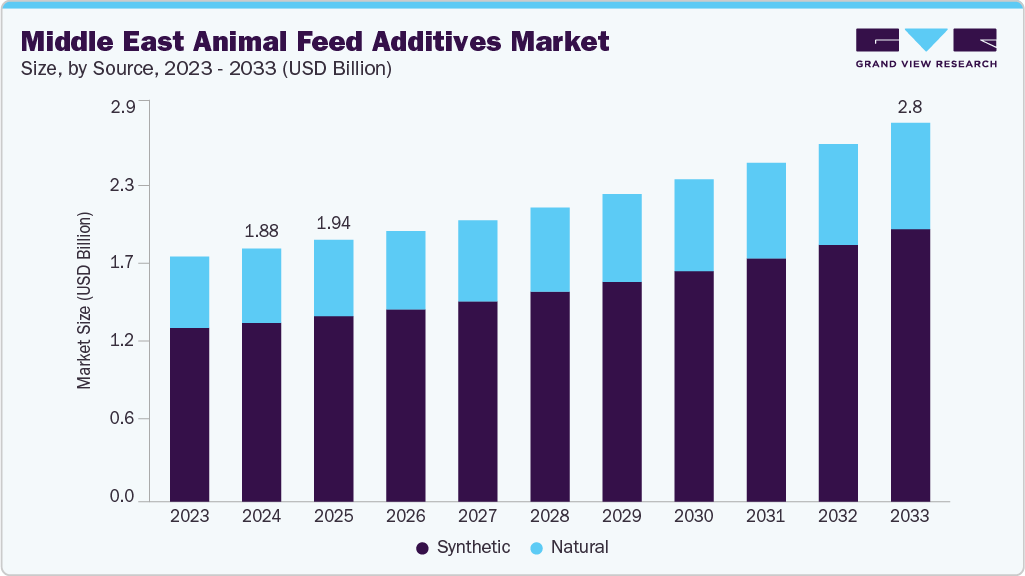
The market faces challenges such as heavy reliance on imports for specialty additives, exposure to volatile raw material prices, and fragmented distribution networks that limit consistent supply across smaller markets. In addition, regulatory uncertainty surrounding the use of antibiotics and the high cost of premium additives create barriers for wider adoption, particularly among small-scale producers.
Market Concentration & Characteristics
The market for animal feed additives market in the Middle East is moderately consolidated. Companies such as BASF SE, Evonik Industries AG, dsm-firmenich, Adisseo, and Alltech are leveraging their extensive product portfolios in amino acids, vitamins, enzymes, and probiotics to address the region’s growing demand for efficiency-enhancing and sustainable feed solutions. Strategic moves include expanding distribution partnerships with local integrators, establishing technical support hubs, and tailoring product offerings to the specific nutritional and climatic requirements of Middle Eastern livestock systems. Firms like ADM and Cargill, Incorporated are further strengthening their footprint through integrated supply chains, offering both feed ingredients and formulated additives, which enhance their ability to provide end-to-end nutrition solutions and capture a broader share of value creation.
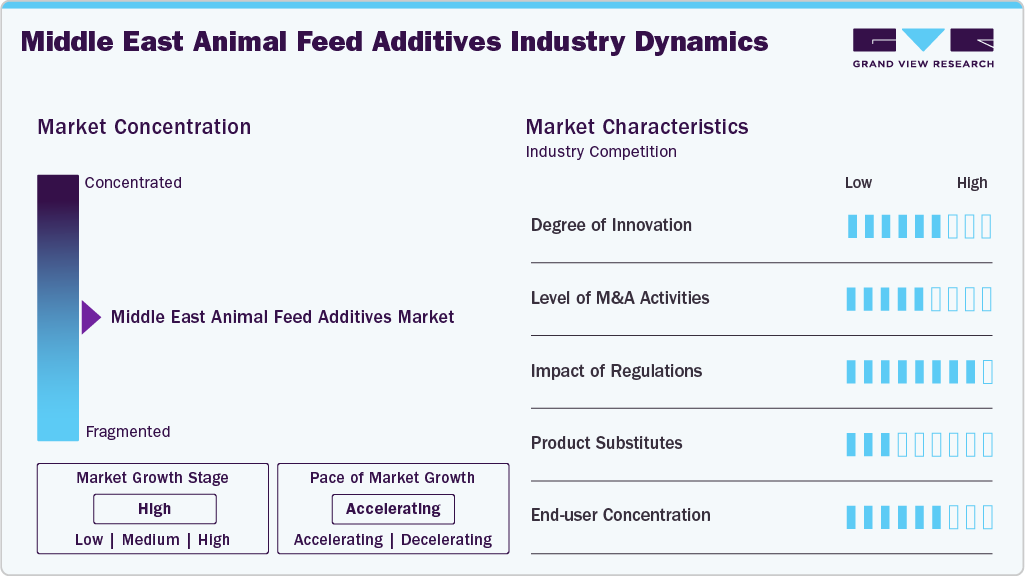
Key players are pursuing a mix of innovation, localization, and partnerships to consolidate their market position. Kemin Industries and Berg+Schmidt Animal Nutrition GmbH & Co. KG focus on specialty solutions such as lipid nutrition, probiotics, and functional additives, supported by strong R&D pipelines to address antibiotic reduction trends. Koudijs emphasizes collaboration with regional feed mills and distributors to deliver tailored additive blends, ensuring competitive positioning in niche livestock segments. Meanwhile, leading companies are investing in sustainable and natural additive lines-such as phytogenics, enzymes, and detoxifiers-aligning with the industry’s shift toward antibiotic alternatives. Mergers, acquisitions, and joint ventures, along with digital advisory services for precision feeding, are further enabling these firms to enhance customer engagement, strengthen regional networks, and secure long-term growth in the Middle East market.
Product Insights
Amino acids dominated the market with the largest share of 19.3% in 2024, primarily due to their critical role in enhancing feed conversion efficiency and supporting rapid growth in poultry and aquaculture production. Producers increasingly rely on essential amino acids such as lysine, methionine, and threonine to balance protein levels, reduce overall feed costs, and improve animal performance, making them indispensable in commercial feed formulations. The dominance of amino acids is further reinforced by the region’s emphasis on large-scale poultry integration, where optimizing nutritional inputs directly translates into higher profitability and improved sustainability.
Beyond amino acids, the other additive categories also play significant roles in shaping the market. Vitamins and minerals remain foundational across all livestock segments to ensure health, immunity, and productivity, while feed enzymes such as phytase and NSP enzymes are gaining traction for their ability to improve nutrient bioavailability and reduce environmental phosphorus emissions. Probiotics, phytogenics, and mycotoxin detoxifiers are witnessing rapid uptake as producers pivot toward antibiotic alternatives in line with evolving regulations and consumer preferences for natural solutions. Meanwhile, antioxidants, carotenoids, preservatives, flavors & sweeteners, and non-protein nitrogen serve more specialized functions-ranging from oxidative stability and pigment enhancement to shelf-life extension and nitrogen supplementation-creating a diversified yet complementary product landscape that supports both performance and value addition in Middle Eastern feed formulations.
Source Insights
The synthetic segment captured the largest revenue share of 70.8% in 2024, driven by its cost-effectiveness, consistent quality, and scalability in meeting the region’s growing demand for feed additives. Synthetic variants of amino acids, vitamins, and antioxidants are widely adopted in Middle Eastern livestock production systems due to their standardized formulation, reliable supply chains, and compatibility with precision nutrition programs. Large poultry and aquaculture producers prefer synthetic additives as they offer predictable performance outcomes, longer shelf life, and greater availability at competitive prices compared to natural alternatives. This strong preference underscores the reliance of the region’s feed industry on synthetic solutions to sustain high-volume commercial operations.
Conversely, the natural segment is emerging as a high-potential growth area, supported by rising regulatory scrutiny on antibiotics and a growing shift in consumer preferences toward sustainable and organic animal products. Natural additives such as phytogenics, probiotics, essential oils, and plant-derived enzymes are gaining traction as viable alternatives, particularly in premium poultry and aquaculture markets where differentiation through “clean-label” and environmentally friendly production practices is valued. Although the natural segment currently accounts for a smaller revenue share, continuous innovation, strategic collaborations between global suppliers and regional feed manufacturers, and the introduction of cost-competitive formulations are expected to accelerate its adoption, gradually reshaping the competitive landscape in the Middle East.
Livestock Insights
The poultry segment dominated the market with the largest revenue share of 61.0% in 2024, driven by the region’s strong reliance on poultry meat and eggs as affordable sources of protein and the rapid expansion of industrial-scale poultry farms. Poultry production benefits from shorter growth cycles and high feed conversion efficiency, making it particularly responsive to the use of amino acids, enzymes, probiotics, and vitamins that optimize growth rates and improve overall flock health. Government-backed food security programs, coupled with private sector investments in integrated poultry operations across Saudi Arabia, the UAE, and Israel, have further cemented poultry as the leading consumer of feed additives in the region.
Beyond poultry, cattle, and aquaculture represent important and expanding segments of the market. The cattle segment is supported by rising dairy consumption and government initiatives aimed at boosting local milk production, driving demand for additives such as vitamins, minerals, and rumen-protected amino acids. Aquaculture is witnessing rapid growth as countries diversify protein sources and invest in sustainable fish farming projects, creating opportunities for specialty additives such as probiotics, acidifiers, and mycotoxin detoxifiers. The swine and others segments remain smaller due to cultural and religious constraints on pork consumption and limited production of alternative livestock; however, niche demand persists in certain markets, sustaining a modest but stable requirement for additives.
Form Insights
The dry segment held the largest revenue share of 80.3% in 2024, owing to its superior stability, ease of handling, and cost-efficiency in bulk transportation and storage. Dry formulations of amino acids, vitamins, minerals, and enzymes are widely preferred by feed manufacturers across the Middle East, as they offer longer shelf life, simplified dosing, and compatibility with automated feed milling systems. Large-scale poultry and cattle producers rely on dry additives to ensure consistency and efficiency in feed production, making this form the backbone of commercial operations in the region.
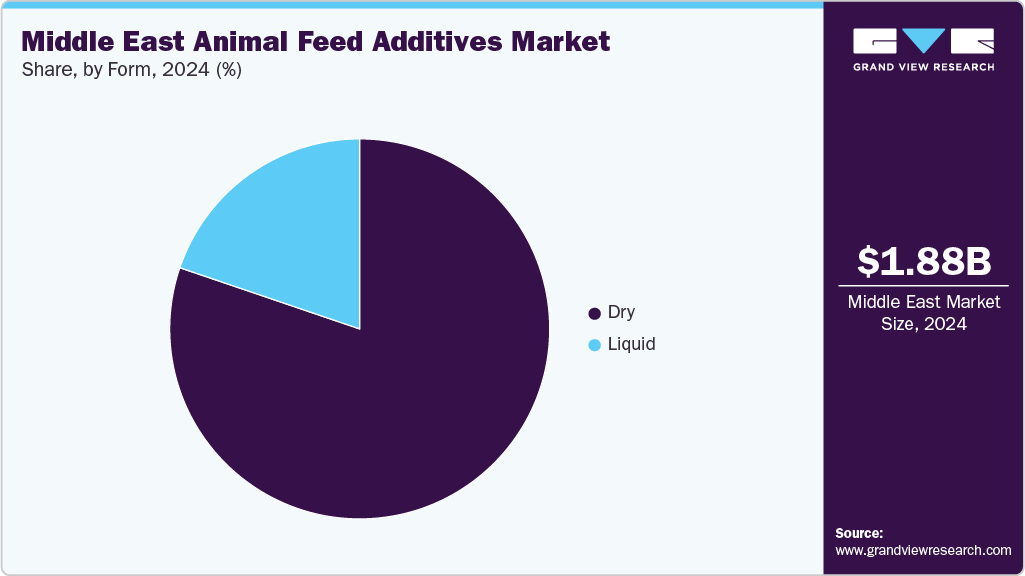
On the other hand, the liquid segment, though smaller in size, is gaining momentum due to its precision application and suitability for niche markets such as aquaculture and poultry nutrition enhancement. Liquid formulations allow for uniform mixing, rapid absorption, and flexibility in on-farm supplementation, making them increasingly attractive in intensive livestock systems. Rising adoption of liquid probiotics, acidifiers, and specialty enzyme blends, often delivered through water-soluble solutions, points to a gradual diversification of the market. As regional producers move toward more sophisticated feeding practices, the liquid segment is expected to witness faster growth, complementing the dominance of dry forms in core feed additive categories.
Country Insights
Middle East Animal Feed Additives Market Trends
The Middle East animal feed additives industry is expanding steadily, underpinned by rising meat and dairy consumption, increasing investments in food security, and the industrialization of livestock farming. Poultry and aquaculture are the primary growth engines, supported by large-scale feed mill expansions and strategic collaborations between global additive suppliers and regional integrators. While the market remains import-dependent for specialty additives, growing awareness of precision nutrition and a shift toward antibiotic alternatives such as enzymes, probiotics, and phytogenics are reshaping demand dynamics across the region.
Saudi Arabia Animal Feed Additives Market Trends
Saudi Arabia dominated the market with the largest revenue share of 56.0% in 2024, driven by its dominant poultry industry, government-backed initiatives to enhance local dairy production, and strong private-sector investments in integrated feed-to-food operations. The Kingdom’s Vision 2030 agenda, which prioritizes food self-sufficiency, has accelerated the adoption of advanced feed formulations and high-performance additives to improve productivity and sustainability. With poultry accounting for the bulk of protein consumption, and ongoing investments in aquaculture projects, Saudi Arabia continues to be a focal point for global suppliers seeking to expand their footprint in the Middle East feed additives industry.
Key Middle East Animal Feed Additives Company Insights
Some of the key players operating in the Middle East animal feed additives industry include BASF SE, Kemin Industries, Inc., ADM, Cargill, Incorporated, among others.
- dsm-firmenich is a global leader in nutrition, health, and sustainable living solutions, with a strong presence in the animal feed additives market through its extensive portfolio of vitamins, carotenoids, enzymes, probiotics, and specialty nutrition products. Following the merger of DSM and Firmenich in 2023, the company has reinforced its innovation capabilities by integrating science-based nutrition expertise with advanced biotechnology and flavor solutions, enabling it to deliver holistic animal health and performance products tailored to evolving market needs. In the Middle East, dsm-firmenich leverages its global R&D strength, sustainability-driven product pipeline, and strategic partnerships with regional feed integrators to support the transition toward antibiotic-free production systems and precision nutrition, positioning itself as a preferred partner in enhancing both productivity and sustainability within the livestock and aquaculture sectors.
Key Middle East Animal Feed Additives Companies:
- BASF SE
- Kemin Industries, Inc.
- ADM
- Cargill, Incorporated
- dsm-firmenich
- Alltech
- Evonik Industries AG
- Adisseo
- Koudijs
- Berg+Schmidt Animal Nutrition GmbH & Co. KG
Recent Developments
-
In September 2024, dsm-firmenich inaugurated a new Animal Nutrition & Health premix and additives manufacturing plant in Sadat City, Egypt, with an annual capacity of 10,000 tons. The facility is equipped with modern technology (including Bühler infrastructure & integrated plant-control/bar-coding systems) to serve Egypt as well as export markets spanning the Middle East, Southern Europe, and Africa, enhancing supply reliability, production efficiency, and the company’s ability to meet rising demand for high-quality feed additives and premixes.
-
In August 2023, Berg + Schmidt Animal Nutrition established a new subsidiary, Berg and Schmidt Middle East Trading LLC, in Dubai to better serve GCC markets. By opening a UAE warehouse and local company presence, the firm aims to accelerate distribution of its specialty additives, such as functional lipids, trace minerals, amino acids, emulsifiers, and rumen-protected ingredients, while improving customer service and supply chain responsiveness in the region.
Middle East Animal Feed Additives Market Report Scope
Report Attribute
Details
Market size value in 2025
USD 1,949.2 million
Revenue forecast in 2033
USD 2,825.0 million
Growth rate
CAGR of 4.7% from 2025 to 2033
Base year for estimation
2024
Historical data
2018 - 2023
Forecast period
2025 - 2033
Quantitative units
Revenue in USD million/billion, volume in kilotons, and CAGR from 2025 to 2033
Report coverage
Revenue & volume forecast, company ranking, competitive landscape, growth factors, and trends
Segments covered
Product, source, form, livestock, country
Country scope
Oman; Kuwait; Saudi Arabia; UAE; Qatar; Bahrain; Israel; Rest of Middle East
Key companies profiled
BASF SE; Kemin Industries, Inc.; ADM; Cargill, Incorporated; dsm-firmenich; Alltech; Evonik Industries AG; Adisseo; Koudijs; Berg+Schmidt Animal Nutrition GmbH & Co. KG
Customization scope
Free report customization (equivalent to up to 8 analysts’ working days) with purchase. Addition or alteration to country, regional & segment scope.
Pricing and purchase options
Avail customized purchase options to meet your exact research needs. Explore purchase options
Middle East Animal Feed Additives Market Report Segmentation
This report forecasts revenue growth at country levels and provides an analysis of the latest industry trends in each of the sub-segments from 2018 to 2033. For this study, Grand View Research has segmented the Middle East animal feed additives market report based on product, source, form, livestock, and country.
-
Product Outlook (Volume, Kilotons; Revenue, USD Billion, 2018 - 2033)
-
Antibiotics
-
Vitamins
-
Vitamin A
-
Vitamin E
-
Vitamin B
-
Vitamin C
-
Others
-
-
Antioxidants
-
Amino Acids
-
Tryptophan
-
Lysine
-
Methionine
-
Threonine
-
Others
-
-
Feed Enzymes
-
Phytase
-
Non-Starch Polysaccharides & Others
-
-
Feed Acidifiers
-
Phosphates
-
Carotenoids
-
Mycotoxin Detoxifiers
-
Flavors & Sweeteners
-
Minerals
-
Non-Protein Nitrogen
-
Phytogenics
-
Preservatives
-
Probiotics
-
Others
-
-
Source Outlook (Volume, Kilotons; Revenue, USD Billion, 2018 - 2033)
-
Natural
-
Synthetic
-
-
Form Outlook (Volume, Kilotons; Revenue, USD Billion, 2018 - 2033)
-
Dry
-
Liquid
-
-
Livestock Outlook (Volume, Kilotons; Revenue, USD Billion, 2018 - 2033)
-
Pig/Swine
-
Poultry
-
Cattle
-
Aquaculture
-
Others
-
-
Country Outlook (Volume, Kilotons; Revenue, USD Billion, 2018 - 2033)
-
Oman
-
Kuwait
-
Saudi Arabia
-
UAE
-
Qatar
-
Bahrain
-
Israel
-
Rest of Middle East
-
Frequently Asked Questions About This Report
b. The Middle East animal feed additives market size was estimated at USD 1,886.9 million in 2024 and is expected to reach USD 1,949.2 million in 2025.
b. The Middle East animal feed additives market is expected to grow at a compound annual growth rate of 4.7% from 2025 to 2033 to reach USD 2,825.0 million by 2033.
b. The amino acids segment dominated the market with the largest revenue share of 19.3% in 2024, as livestock producers increasingly adopted lysine, methionine, and threonine to optimize feed conversion, reduce protein costs, and enhance growth efficiency in poultry and aquaculture. Its indispensable role in precision nutrition and large-scale commercial farming cemented its leadership position in the Middle East market.
b. Some of the key players operating in the Middle East animal feed additives market include BASF SE, Kemin Industries, Inc., ADM, Cargill, Incorporated, dsm-firmenich, Alltech, Evonik Industries AG, Adisseo, Koudijs, and Berg+Schmidt Animal Nutrition GmbH & Co. KG.
b. The Middle East animal feed additives market is driven by rising demand for protein-rich diets, government-backed food security initiatives, and the rapid industrialization of poultry and aquaculture farming, which together fuel the adoption of efficiency-enhancing and sustainable feed solutions.


Share this report with your colleague or friend.
Need a Tailored Report?
Customize this report to your needs — add regions, segments, or data points, with 20% free customization.


ISO 9001:2015 & 27001:2022 Certified
We are GDPR and CCPA compliant! Your transaction & personal information is safe and secure. For more details, please read our privacy policy.
Trusted market insights - try a free sample
See how our reports are structured and why industry leaders rely on Grand View Research. Get a free sample or ask us to tailor this report to your needs.