Metal Injection Molding Market Summary
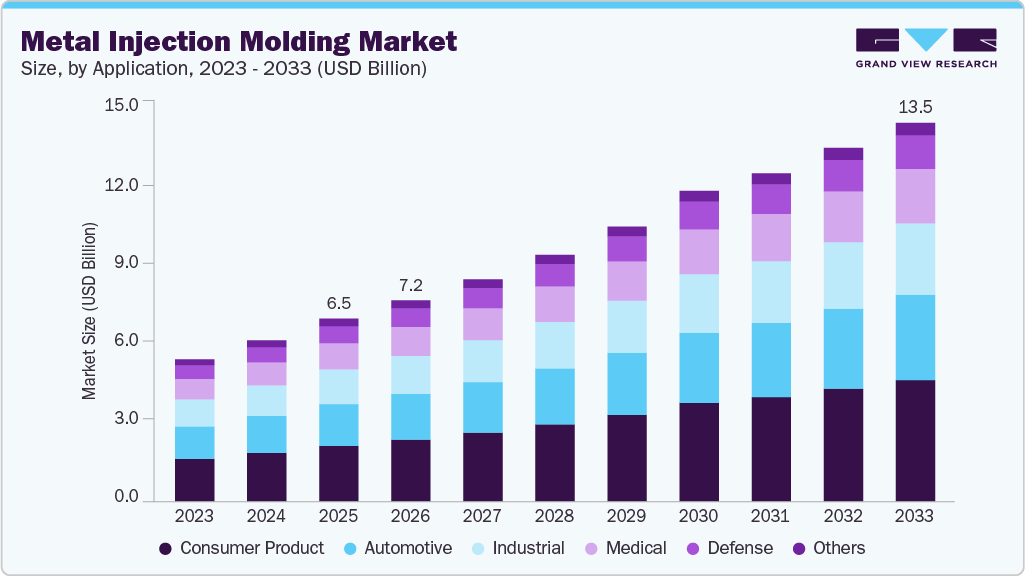
The global metal injection molding market size was estimated at USD 6.5 billion in 2025 and is expected to reach USD 13.5 billion by 2033, growing at a CAGR of 9.5% from 2026 to 2033. MIM is an advanced manufacturing process that combines powder metallurgy with plastic injection molding to produce small, complex metal parts.
Key Market Trends & Insights
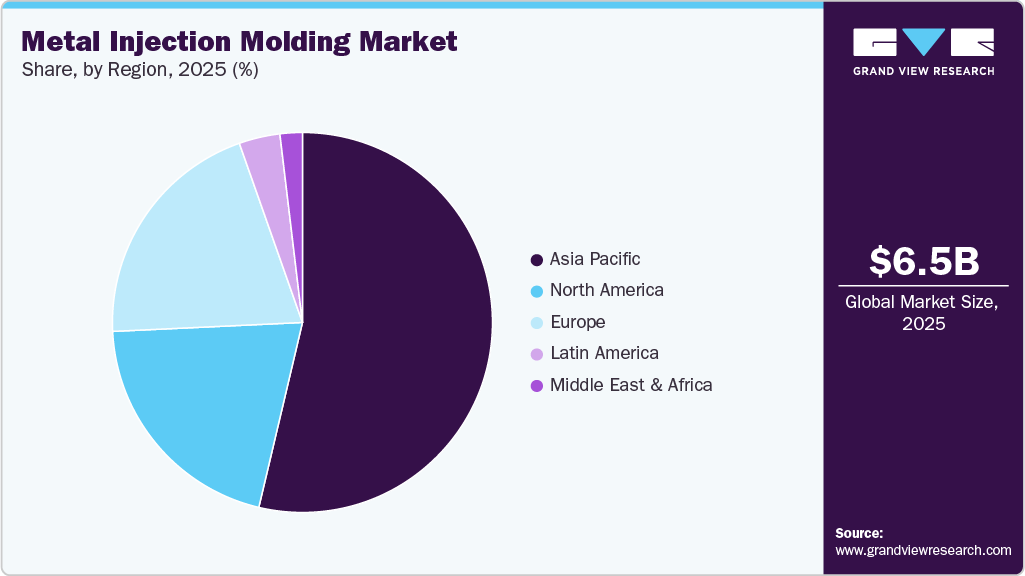
- Asia Pacific dominated the market with the largest market revenue share of over 53.0% in 2025.
- North America is anticipated to grow at a CAGR of 9.2% over the forecast period.
- By application, consumer product segment registered the largest revenue of over 30% in 2025.
Market Size & Forecast
- 2025 Market Size: USD 6.5 Billion
- 2033 Projected Market Size: USD 13.5 Billion
- CAGR (2026-2033): 9.5%
- Asia Pacific: Largest market in 2025
It involves mixing fine metal powders with a binder material to create a feedstock, which is then injected into molds, followed by debinding and sintering to achieve the final density and strength. It is widely used for high-volume production of precision components with intricate geometries that are difficult to manufacture using conventional techniques.
The transition from internal combustion engines to electric powertrains is a primary driver. EVs require a high volume of small, high-precision metal parts for battery management systems and power electronics. For instance, Indo-MIM produces intricate locking mechanisms, sensor housings, and battery connectors that must withstand high vibration and thermal stress. MIM's ability to use magnetic materials like Fe-Si alloys also makes it essential for producing high-efficiency rotors and stators for the smaller auxiliary motors found in modern EVs.
As consumer devices like smartwatches and AR/VR headsets become smaller and more feature-rich, the need for "Micro-MIM" has intensified. High-end brands like Apple and Samsung utilize MIM for components such as watch cases, camera ring brackets, and ultra-thin laptop hinges. For instance, the production of USB-C connector shells and internal chassis parts for foldable phones, where MIM provides the necessary structural integrity in a footprint too small for traditional CNC machining to be cost-effective.
The healthcare sector's shift toward robotic and laparoscopic surgery has created a massive market for disposable and reusable surgical instruments. MIM is the "gold standard" for manufacturing endoscopic graspers, staplers, and biopsy forceps. For example, companies like Advanced Powder Products have developed MIM titanium spinal fusion cages and screw chucks that feature internal channels and porous structures to promote bone ingrowth, features that are nearly impossible to achieve via conventional casting.
Aerospace manufacturers are increasingly adopting MIM to reduce aircraft weight and improve fuel efficiency. By using superalloys like Inconel 718 and Titanium Ti-6Al-4V, MIM can produce lightweight turbine vanes, fuel nozzles, and seatbelt adjustment levers. In the defense sector, the technology is used for high-durability parts in firearms and missile guidance systems, where the "near-net-shape" process significantly reduces the waste of expensive aerospace-grade metals compared to subtractive manufacturing.
Drivers, Opportunities & Restraints
The industry is driven by the growing demand for complex, high-precision components across industries such as automotive, aerospace, medical devices, and consumer electronics. The ability of MIM to produce intricate geometries with tight tolerances makes it highly suitable for miniaturized components, particularly in electronics and healthcare applications. Additionally, the rising need for lightweight yet high-strength materials to improve fuel efficiency and reduce emissions in the automotive and aerospace sectors is accelerating the adoption of MIM. Cost advantages, including minimal material wastage and reduced need for secondary machining, further strengthen its appeal for large-scale production.
The industry presents significant opportunities with the expansion of advanced manufacturing technologies and increasing adoption in emerging applications. Growth in electric vehicles, medical implants, and wearable devices is creating new demand for precision-engineered metal parts. Continuous advancements in powder metallurgy, binder systems, and sintering processes are enhancing product quality and enabling the use of a wider range of materials, including stainless steel, titanium, and specialty alloys. Moreover, rapid industrialization in the Asia Pacific and increasing investments in manufacturing infrastructure are opening new avenues for market players to expand their production capabilities and geographic presence.
Despite its advantages, the MIM industry faces certain restraints that may hinder growth. High initial tooling and setup costs can be a barrier, especially for low-volume production, making the process less attractive compared to traditional manufacturing methods in some cases.
Application Insights
Consumer product segment held the revenue share of over 30% in 2025. As consumer electronics continue to evolve toward slimmer designs and multifunctional features, manufacturers are increasingly adopting MIM to achieve design flexibility while maintaining mechanical strength and durability. Worldwide foldable smartphone shipments are forecast to grow by 10% year-on-year in 2025, reaching 20.6 million units, according to the International Data Corporation (IDC) Worldwide Quarterly Mobile Phone Tracker. The anticipated launch of Apple’s foldable iPhone and Samsung’s Galaxy Z Trifold from Q1 2026 is expected to accelerate consumer adoption further. These devices rely heavily on precision-engineered components such as hinges and micro-mechanical parts, where MIM plays a critical role due to its ability to deliver high strength, durability, and intricate design capabilities at scale.
The medical segment is one of the fastest-growing application areas, driven largely by the global shift toward minimally invasive surgery (MIS) and robotic-assisted procedures. These techniques require highly miniaturized, complex instruments that must maintain extreme structural integrity. As of 2026, the rollout of advanced platforms like the Intuitive Surgical da Vinci 5 has intensified the demand for MIM-produced robotic articulators, surgical grippers, and needle drivers. The process is uniquely suited for these applications because it can produce the intricate "internal-link" geometries required for robotic wrist movement, features that would be prohibitively expensive or physically impossible to achieve through traditional CNC machining at high volumes.
Regional Insights
The Asia Pacific metal injection molding market dominated and held over 53% revenue share of the global market. Asia Pacific market is primarily driven by the region’s strong manufacturing ecosystem, particularly in countries such as China, Japan, South Korea, and India. Rapid industrialization and the presence of large-scale automotive and consumer electronics industries have significantly increased the demand for small, complex, and high-precision metal components, which are ideally produced using MIM technology. The expansion of electric vehicle production, especially in China, along with rising smartphone and wearable device manufacturing, continues to accelerate the adoption of MIM for lightweight, intricate parts.
North America Metal Injection Molding Market Trends
The metal injection molding market in North America is experiencing a significant surge, primarily driven by the region's leadership in the medical and healthcare sectors. As surgical procedures shift toward minimally invasive techniques, there is an escalating demand for extremely small, complex, and high-precision stainless steel components. In the U.S. specifically, robust R&D investment and a streamlined FDA approval process for new medical technologies are further accelerating the adoption of MIM-produced parts, positioning healthcare as a dominant revenue contributor to the regional market.
U.S. Metal Injection Molding Market Trends
The metal injection molding market in the U.S. is being propelled by an aggressive shift toward industrial reshoring and supply chain security. Following the disruptions of the early 2020s, U.S. manufacturers are increasingly moving production back to North America to reduce lead times and reliance on overseas logistics. This "Made in USA" momentum is heavily supported by government initiatives like the CHIPS and Science Act, which, while focused on semiconductors, has created a halo effect for the precision engineering sector.
Europe Metal Injection Molding Market Trends
The metal injection molding market in Europe is primarily driven by the region's aggressive transition toward EVs and the miniaturization of high-precision components. In the automotive sector, European OEMs are increasingly adopting MIM to produce complex, lightweight parts, such as turbochargers, fuel injectors, and sensor housings, to meet stringent Euro 7 emission standards and improve battery efficiency in EVs. The process's ability to create near-net-shape components with minimal material waste aligns perfectly with Europe's "Green Deal" initiatives, making it a preferred alternative to traditional machining for high-volume, high-strength applications.
Latin America Metal Injection Molding Market Trends
The metal injection molding market in Latin America is gaining momentum, with Brazil leading due to its strong automotive and consumer goods manufacturing base, where increasing vehicle production and localization of components are driving demand for complex, high-volume metal parts. The country’s expanding electronics and healthcare sectors are further supporting the adoption of MIM for precision components. Meanwhile, Argentina is witnessing gradual growth supported by improving industrial activity and rising investments in manufacturing, particularly in automotive and industrial equipment.
Key Metal Injection Molding Company Insights
Key players operating in the metal injection molding market are undertaking various initiatives to strengthen their presence and increase the reach of their products and services. Strategies such as expansion activities and partnerships are key in propelling the market growth. Some of the key players operating in the market include INDO-MIM, Dynacast, among others.
-
INDO-MIM is a global company in precision engineering components headquartered in Bengaluru, India, specializing in metal injection molding as its core technology. The company has established a strong global footprint across the Americas, Europe, and Asia, serving industries such as automotive, aerospace, medical, defense, and consumer products. The company offers comprehensive metal injection molding solutions, including design, tooling, feedstock development, molding, debinding, sintering, and secondary operations such as machining, surface finishing, and assembly.
-
Dynacast is a global manufacturer of precision metal components and a leader in die casting, operating as part of Form Technologies with a strong international manufacturing footprint. While die casting remains its core competency, Dynacast has expanded into metal injection molding to enhance its capability in producing small, complex, and high-precision parts. Its MIM offerings include production of intricate components using materials such as steel, copper, and titanium alloys, supported by integrated services like tooling, prototyping, machining, finishing, and assembly, enabling customers to achieve cost-efficient, high-volume manufacturing of complex geometries.
Key Metal Injection Molding Companies:
The following key companies have been profiled for this study on the metal injection molding market.
- CMG Technologies
- Dean Group International
- Dynacast
- GKN Automotive Limited
- Greene Group Industries, Inc. (Britt Manufacturing)
- INDO-MIM
- Optimim
- Robert Bosch GmbH
- Rockleigh Industries
- Schunk Mobility
- Sintex
Recent Developments
-
In March 2026, Robert Bosch GmbH celebrated reaching the production milestone of one billion Metal Injection Moulding (MIM) parts at its Immenstadt facility in Germany, spanning from 2006 to 2025.
-
In October 2024, Biomerics, a vertically integrated medical device contract manufacturer, launched its new Metal Injection Molding (MIM) Center of Excellence in Salt Lake City, Utah, to enhance its micro metals processing capabilities for complex interventional devices.
Metal Injection Molding Market Report Scope
|
Report Attribute
|
Details
|
|
Market definition
|
The market represents the total consumption of metal injection molding components in various applications.
|
|
Market size value in 2026
|
USD 7.2 billion
|
|
Revenue forecast in 2033
|
USD 13.5 billion
|
|
Growth rate
|
CAGR of 9.5% from 2026 to 2030
|
|
Base year for estimation
|
2025
|
|
Historical data
|
2021 - 2024
|
|
Forecast period
|
2026 - 2033
|
|
Quantitative units
|
Revenue in USD million/billion and CAGR from 2026 to 2033
|
|
Report coverage
|
Revenue forecast, company ranking, competitive landscape, growth factors, and trends
|
|
Segments covered
|
Application, region
|
|
Regional scope
|
North America; Europe; Asia Pacific; Latin America; Middle East & Africa
|
|
Country scope
|
U.S.; Canada; Mexico; Germany; U.K.; Russia; France; Italy; Spain; China; India; Japan; South Korea; Australia; Brazil; Argentina; Saudi Arabia; South Africa
|
|
Key companies profiled
|
Dynacast; GKN Automotive Limited; Greene Group Industries, Inc. (Britt Manufacturing); Optimim; Dean Group International; Sintex; CMG Technologies; INDO-MIM; Schunk Mobility; Rockleigh Industries; Robert Bosch GmbH
|
|
Customization scope
|
Free report customization (equivalent to up to 8 analysts working days) with purchase. Addition or alteration to country, regional & segment scope.
|
|
Pricing and purchase options
|
Avail customized purchase options to meet your exact research needs. Explore purchase options
|
Global Metal Injection Molding Market Report Segmentation
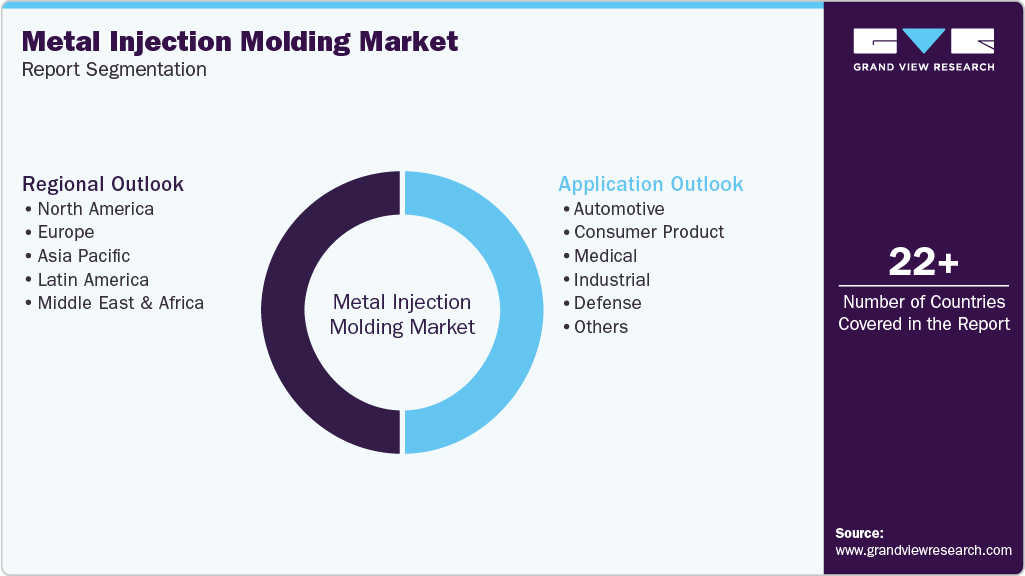
This report forecasts revenue growth at global, regional, and country levels and provides an analysis of the latest industry trends in each of the sub-segments from 2021 to 2033. For this study, Grand View Research has segmented the global metal injection molding market report on the basis of application and region:
-
Application Outlook (Revenue, USD Million, 2021 - 2033)
-
Automotive
-
Consumer Product
-
Medical
-
Industrial
-
Defense
-
Others
-
Regional Outlook (Revenue, USD Million, 2021 - 2033)
-
North America
-
Europe
-
Germany
-
UK
-
Russia
-
France
-
Italy
-
Spain
-
Asia Pacific
-
China
-
India
-
Japan
-
South Korea
-
Australia
-
Latin America
-
Middle East & Africa
-
Saudi Arabia
-
South Africa

 Download Sample Report