- Home
- »
- Sensors & Controls
- »
-
Lighting Market Size, Share & Growth, Industry Report, 2033GVR Report cover
![Lighting Market Size, Share & Trends Report]()
Lighting Market (2026 - 2033) Size, Share & Trends Analysis Report By Type (CFL, Fluorescent Lighting), By Application, By Distribution Channel (Online, Offline), By End-use, By Region, And Segment Forecasts
- Report ID: GVR-4-68040-521-3
- Number of Report Pages: 120
- Format: PDF
- Historical Range: 2021 - 2025
- Forecast Period: 2026 - 2033
- Industry: Semiconductors & Electronics
- Report Summary
- Table of Contents
- Interactive Charts
- Methodology
- Download FREE Sample
-
 Download Sample Report
Lighting Market Summary
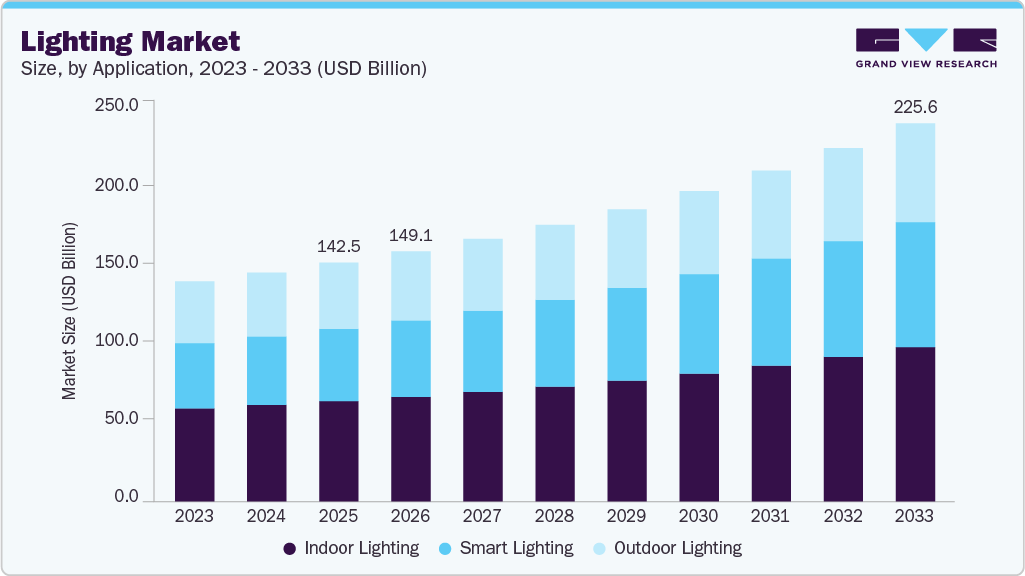
The global lighting market size was valued at USD 142.49 billion in 2025 and is projected to reach USD 225.56 billion by 2033, growing at a CAGR of 6.1% from 2026 to 2033. The industry is experiencing steady growth, driven by increasing demand for energy-efficient solutions, urbanization, and smart lighting technologies.
Key Market Trends & Insights
- North America accounted for 21.6% revenue share of the lighting market in 2025.
- The U.S. lighting market held the largest share of North America in 2025.
- By type, the LED lighting segment held the largest revenue share of 75.0% in 2025.
- By application, the indoor lighting segment held the largest revenue share in 2025.
- By distribution channel, the offline segment held the largest revenue share in 2025.
Market Size & Forecast
- 2025 Market Size: USD 142.49 Billion
- 2033 Projected Market Size: USD 225.56 Billion
- CAGR (2026-2033): 6.1%
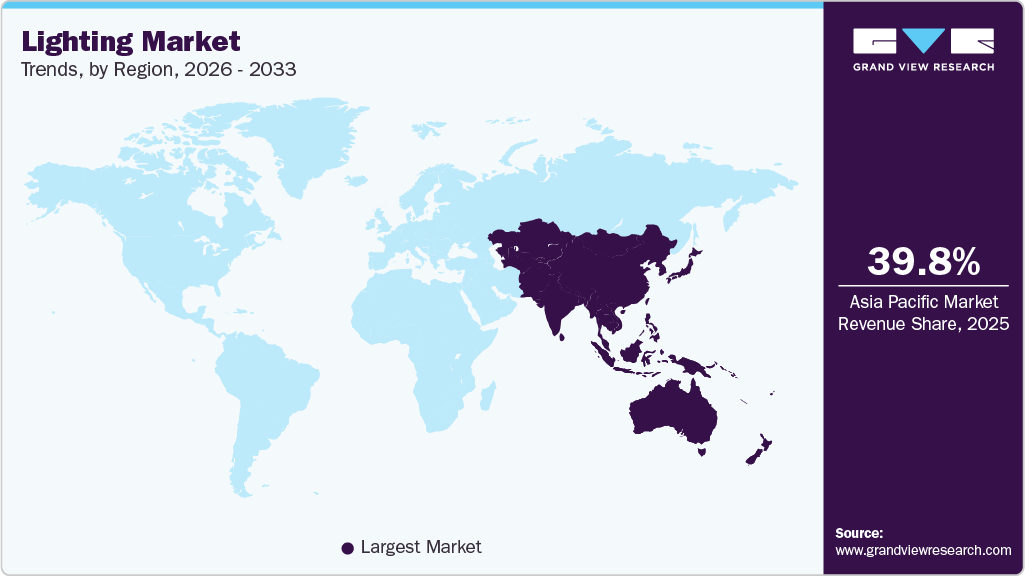
- Asia Pacific: Largest Market in 2025
Traditional lighting solutions, such as incandescent and halogen bulbs, are being phased out in favor of LED lighting, which dominates the market due to its superior energy efficiency, longer lifespan, and cost-effectiveness. Government regulations promoting energy conservation and sustainability are also accelerating the adoption of LEDs and smart lighting systems in residential, commercial, and industrial spaces. The rise of smart cities, infrastructure development, and Internet of Things (IoT)-enabled lighting solutions is shaping the future of market growth.
Smart lighting systems integrated with IoT, AI, and automation are revolutionizing the lighting industry by enabling remote control, adaptive lighting, and energy optimization. These systems allow users to adjust brightness, color temperature, and schedules via mobile apps or voice assistants, improving convenience and efficiency. AI-driven automation helps optimize energy use by adjusting lighting based on occupancy and daylight availability. In addition, the fast expansion of commercial and residential construction projects, particularly in urban areas, is driving demand for modern lighting solutions. Smart lighting is becoming a key feature in smart homes, offices, and cities, enhancing energy savings, security, and user experience while supporting global sustainability initiatives and energy efficiency goals.
The proliferation of low-quality and counterfeit LED products undermines market reliability and consumer trust, as these products often fail to meet safety and efficiency standards. In addition, environmental concerns regarding the disposal and recycling of lighting products, particularly CFLs and fluorescent halogen-containing mercury, pose significant regulatory challenges. Governments and industry players are focusing on stringent quality control measures and eco-friendly disposal regulations to mitigate risks, ensure sustainable lighting solutions, and reduce the environmental impacts of hazardous waste.
The future of the lighting industry is expected to be shaped by technological advancements, energy-efficiency regulations, and the adoption of smart lighting. Smart and connected lighting solutions, integrated with AI and IoT, will drive innovation, allowing automated lighting control based on occupancy, daylight levels, and energy-saving preferences. Human-centric lighting (HCL), which adjusts color temperature and intensity to enhance productivity and well-being, is gaining popularity in workplaces, healthcare, and residential spaces.
Type Insights
The LED lighting segment dominated the lighting market and accounted for the largest revenue share in 2025. The growing adoption of smart homes, smart offices, and smart cities is significantly increasing demand for connected LED lighting systems. IoT-enabled LED lighting enables remote control, automation, and energy optimization, allowing seamless integration with mobile apps and voice assistants. In addition, the declining cost of LED bulbs and fixtures has made them more affordable for both consumers and businesses. Mass production, advancements in semiconductor technology, and economies of scale have driven prices down, accelerating LED adoption. As LED lighting becomes more accessible and cost-effective, its role in energy-efficient and smart lighting solutions continues to grow across residential, commercial, and industrial sectors.
The HID segment is anticipated to register a manageable growth during the forecast period. HID lighting is widely used in outdoor and industrial applications due to its high-intensity output and long lifespan. It is a preferred choice for streetlights, parking lots, stadium floodlights, and airports, ensuring consistent illumination. In industrial settings, including warehouses and manufacturing plants, HID lighting provides large-scale illumination, enhancing safety, visibility, and operational efficiency, especially in harsh, demanding environments.
Application Insights
The indoor lighting segment accounted for the largest revenue share in 2025. As urban populations continue to grow, there is a significant increase in the construction of residential, commercial, and office buildings, all of which require modern indoor lighting solutions. This trend is particularly pronounced in emerging economies, where rapid urbanization is driving the demand for high-quality, energy-efficient indoor lighting. The need for enhanced lighting in new developments, combined with the growing focus on sustainability and smart technologies, is accelerating the adoption of innovative indoor lighting solutions in these regions.
The smart lighting segment is expected to grow at the fastest CAGR during the forecast period. The growing popularity of home automation systems and voice-controlled devices is significantly supporting the demand for smart lighting. These systems can easily integrate with smart thermostats, security systems, and other devices, providing a unified, customizable, and energy-efficient environment. The ability to control lighting alongside other home functions enhances convenience and energy savings, making it a key feature in modern smart homes. This growing trend is driving greater adoption of smart lighting solutions across residential spaces.
Distribution Channel Insights
The offline segment accounted for the largest revenue share in 2025. Leading lighting brands are increasing their presence in retail outlets and specialty stores, making their products more accessible to consumers. The availability of lighting in home improvement stores, lighting showrooms, and electronics outlets has significantly contributed to the growth of the offline segment. In addition, many consumers prefer purchasing from established offline retailers because they trust the product quality, reliability, and customer service these stores offer. Offline stores are often seen as providing superior after-sales support, including warranty services and return policies, which consumers value. This consumer trust and the convenience of in-person shopping continue to fuel the demand for lighting purchases.
The online segment is anticipated to grow at the fastest CAGR during the forecast period. The online channel offers consumers a wider product selection than physical stores, including designer Halogen, niche eco-friendly options, and smart lighting solutions. This expanded variety allows consumers to find exactly what they are looking for. In addition, price comparison tools and the ability to read reviews help consumers make informed decisions. With discounts, seasonal offers, and flash sales, online shoppers are often attracted to better pricing and promotions, further supporting demand for lighting products.
End-use Insights
The residential segment accounted for the largest revenue share in 2025. The demand for smart lighting in smart homes is growing rapidly as homeowners seek IoT-enabled lighting systems that provide remote control, automation, and energy optimization. Integration with voice assistants such as Alexa and Google Assistant makes these systems more customizable, user-friendly, and efficient. At the same time, there is a growing focus on aesthetic lighting, with homeowners using it to enhance the design and ambiance of their living spaces. This trend has driven demand for decorative fixtures, color-changing LEDs, and human-centric lighting solutions that adjust to the time of day, promoting better mood, productivity, and well-being, while contributing to the overall aesthetic appeal of the home.
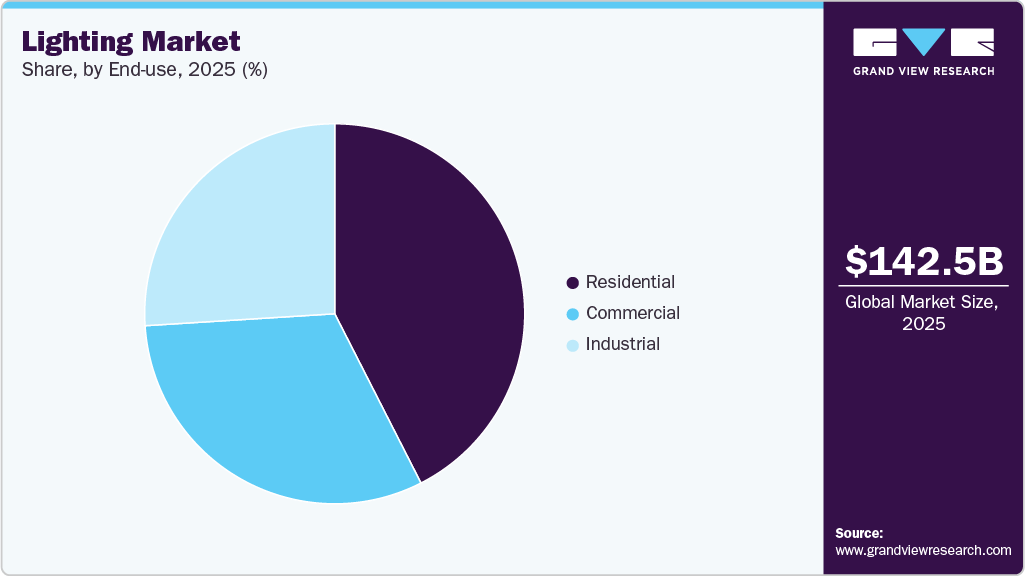
The commercial segment is expected to grow at the fastest CAGR during the forecast period. The development of smart cities is driving demand for intelligent lighting systems in commercial spaces. Public areas, retail, and municipal buildings are incorporating smart streetlights, connected lighting networks, and energy-efficient solutions, making the commercial segment a key area for innovation and adoption. Similarly, commercial spaces are increasingly using lighting not only for functional purposes but also as a design element. Decorative fixtures, ambient lighting, and accent lighting are in demand in retail stores, hotels, restaurants, and entertainment venues, enhancing the customer experience while meeting lighting needs.
Regional Insights
The North America lighting market accounted for a revenue share of over 21.0% of the global industry in 2025, supported by strong adoption of smart and energy-efficient lighting solutions. The growing use of smart lighting, which allows remote control, automation, and energy monitoring through mobile apps and connected devices, has contributed to the expansion of the LED lighting market in the region. In addition, the increasing integration of Internet of Things (IoT) technologies with LED lighting has enabled greater system customization and improved energy efficiency.
U.S. Lighting Market Trends
The lighting industry in the U.S. is expected to grow significantly from 2026 to 2033, driven by the increasing adoption of smart lighting in residential, commercial, and urban infrastructure applications. Growing demand for smart homes and smart city projects, along with the integration of IoT platforms, voice assistants such as Alexa and Google Assistant, and energy-efficient technologies, is driving the need for advanced, connected lighting solutions across the country. For instance, in 2025, the U.S. Department of Energy announced selections for Solid-State Lighting core technology and product development to advance LED and connected lighting innovations, supporting broader adoption of efficient lighting systems. This DOE initiative highlights government support for LED and connected lighting technologies that drive smart lighting adoption.
Asia Pacific Lighting Market Trends
The lighting industry in the Asia Pacific is growing steadily at a significant CAGR from 2026 to 2033, supported by rapid urbanization and the development of new cities across the region. Increasing migration to urban areas is increasing the need for modern lighting solutions in homes, commercial buildings, and public infrastructure. In addition, the adoption of smart street lighting, energy-efficient systems, and smart city projects is accelerating demand for advanced lighting technologies.
The China lighting industry accounted for a significant share of the regional market in 2025. The country is among the world’s largest manufacturers and exporters of lighting products, especially LED solutions. Strong manufacturing capabilities and a well-established supply chain enable cost-efficient production, allowing Chinese companies to serve both domestic and global markets, thereby supporting market growth.
The lighting industry in Japan held a notable revenue share in 2025. Market growth is driven by the launch of innovative and cost-effective LED lighting solutions by domestic companies. For example, Japanese manufacturers are introducing multifunctional LED products designed for both residential and commercial applications, helping reduce overall lighting costs and encourage wider adoption.
The India lighting industry is expanding rapidly due to fast-paced urbanization and growing construction activity across residential, commercial, and industrial sectors. The development of new infrastructure, including smart city projects, is increasing demand for modern lighting solutions such as smart lighting systems and energy-efficient LED products. For instance, in 2025, the Delhi Public Works Department announced the replacement of around 45,000 conventional streetlights with app-controlled smart LED lights, highlighting the government's adoption of connected, energy-efficient lighting solutions.
Europe Lighting Market Trends
The lighting industry in Europe is anticipated to register a significant CAGR from 2026 to 2033. This growth is mainly driven by strict energy-efficiency regulations across the region, with the European Union actively promoting sustainable lighting solutions. Regulations such as the EU Ecodesign Directive and the Energy Performance of Buildings Directive are encouraging the shift toward LED and other energy-efficient lighting technologies across residential, commercial, and industrial applications.
The UK lighting industry is expected to grow rapidly in the coming years, supported by the increasing adoption of smart lighting systems. The growing demand for smart homes and smart city projects is accelerating the adoption of connected lighting solutions. Integration with IoT, AI, and automation enables remote operation, adaptive lighting, and better energy management, particularly in urban areas undergoing infrastructure upgrades.
The lighting industry in Germany held a substantial market share in 2025, driven by widespread upgrades to energy-efficient lighting systems. Businesses across industrial, warehouse, and commercial sectors are increasingly replacing traditional lighting with LED solutions due to their energy savings, high performance, and longer lifespan. These upgrades help reduce operational costs while ensuring compliance with environmental regulations.
Key Lighting Company Insights
Some of the key companies operating in the market include Acuity Brands, Inc., Cree Lighting, Eaton Corporation, and Signify Holding, among others.
-
Acuity Brands is a global provider of lighting and building management solutions, designing and manufacturing innovative indoor and outdoor lighting products and controls for commercial, industrial, residential, and infrastructure applications. Headquartered in Atlanta, Georgia, the company operates across North America, Europe, and Asia and markets lighting solutions under brands such as Lithonia Lighting, Holophane, Gotham, and Winona.
-
Signify Holding is a global lighting company that delivers innovative, sustainable lighting products, systems, and services for homes, businesses, and cities. Formerly part of Philips, the company operates in more than 70 countries and focuses on energy-efficient, connected lighting solutions, including LED lighting and smart controls. Signify’s portfolio includes Philips Hue, Interact IoT platforms, and professional lighting systems that enhance user experience and sustainability.
Key Lighting Companies:
The following key companies have been profiled for this study on the lighting market.
- Acuity Brands, Inc.
- Cree Lighting
- Eaton Corporation
- Everlight Electronics Co., Ltd.
- GE Lighting
- Havells India Ltd
- Hubbell Incorporated
- Nichia Corporation
- OSRAM GmbH
- Panasonic Holdings Corporation
- Seoul Semiconductor Co., Ltd.
- Signify Holding
- Siteco GmbH
- Toshiba Lighting.
- Zumtobel Group
Recent Developments
-
In December 2025, Cree LED, a Penguin Solutions brand, partnered with SANlight GmbH to integrate Cree LED’s J Series products into SANlight’s new STIXX‑Series horticulture luminaires. These modular, space‑saving lights deliver high efficiency and durability for vertical farming and other controlled‑environment agriculture applications, optimizing plant yield and energy use.
-
In January 2025, LEDVANCE, a global lighting solutions company, acquired loblicht, a German specialist renowned for premium design lighting. This acquisition broadens LEDVANCE’s brand portfolio and enhances its expertise in project-based lighting, enabling the company to offer innovative, high-quality, and design-focused lighting solutions across key international markets.
Lighting Market Report Scope
Report Attribute
Details
Market size value in 2026
USD 149.14 billion
Revenue forecast in 2033
USD 225.56 billion
Growth rate
CAGR of 6.1% from 2026 to 2033
Actual data
2021 - 2025
Forecast period
2026 - 2033
Quantitative units
Revenue in USD million/billion, and CAGR from 2026 to 2033
Report coverage
Revenue forecast, company share, competitive landscape, growth factors, and trends
Segments covered
Type, application, distribution channel, end-use, region
Regional scope
North America; Europe; Asia Pacific; Latin America; Middle East and Africa
Country scope
U.S.; Canada; Mexico; UK; Germany; France; China; India; Japan; Australia; South Korea; Brazil; UAE; Saudi Arabia; South Africa
Key companies profiled
Acuity Brands, Inc.; Cree Lighting; Eaton Corporation; Everlight Electronics Co., Ltd.; GE Lighting; Havells India Ltd; Hubbell Incorporated; Nichia Corporation; OSRAM GmbH; Panasonic Holdings Corporation; Seoul Semiconductor Co., Ltd.; Signify Holding; Siteco GmbH; Toshiba Lighting.; Zumtobel Group
Customization scope
Free report customization (equivalent to 8 analysts working days) with purchase. Addition or alteration to country, regional & segment scope.
Pricing and purchase options
Avail customized purchase options to meet your exact research needs. Explore purchase options
Global Lighting Market Report Segmentation
This report forecasts revenue growth at global, regional, and country levels and provides an analysis of the latest industry trends in each of the sub-segments from 2021 to 2033. For this study, Grand View Research has segmented the global lighting market report based on type, application, distribution channel, end-use, and region.
-
Type Outlook (Revenue, USD Million, 2021 - 2033)
-
CFL
-
Fluorescent Lighting
-
Halogen
-
HID
-
Incandescent
-
LED Lighting
-
-
Application Outlook (Revenue, USD Million, 2021 - 2033)
-
Indoor Lighting
-
Outdoor Lighting
-
Smart Lighting
-
-
Distribution Channel Outlook (Revenue, USD Million, 2021 - 2033)
-
Online
-
Offline
-
-
End-use Outlook (Revenue, USD Million, 2021 - 2033)
-
Commercial
-
Industrial
-
Residential
-
-
Regional Outlook (Revenue, USD Million, 2021 - 2033)
-
North America
-
U.S.
-
Canada
-
Mexico
-
-
Europe
-
Germany
-
UK
-
France
-
-
Asia Pacific
-
China
-
India
-
Japan
-
South Korea
-
Australia
-
-
Latin America
-
Brazil
-
-
Middle East & Africa
-
UAE
-
Saudi Arabia
-
South Africa
-
-
Frequently Asked Questions About This Report
b. The global lighting market is expected to grow at a compound annual growth rate of 6.1% from 2026 to 2033 to reach USD 225.56 billion by 2033.
b. The global lighting market size was estimated at USD 142.49 billion in 2025 and is expected to reach USD 149.14 billion in 2026.
b. The key market players in the global lighting market include Acuity Brands, Inc., Signify Holding, OSRAM GmbH, Eaton Corporation, Cree Lighting, Nichia Corporation, GE Lighting, Seoul Semiconductor Co., Ltd., Everlight Electronics Co., Ltd., Hubbell Incorporated, Zumtobel Group, Siteco GmbH, Panasonic Holdings Corporation, Havells India Ltd, and Toshiba Lighting.
b. The global lighting market is experiencing steady growth, driven by increasing demand for energy-efficient solutions, urbanization, and smart lighting technologies. Traditional lighting solutions, such as incandescent and halogen bulbs, are being phased out in favor of LED lighting, which dominates the market due to its superior energy efficiency, longer lifespan, and cost-effectiveness.
b. The offline segment accounted for the largest market share of over 64% in 2025. Leading lighting brands are increasing their presence in retail outlets and specialty stores, making their products more accessible to consumers. The availability of lighting in home improvement stores, lighting showrooms, and electronics outlets has significantly contributed to the growth of the offline segment.


Share this report with your colleague or friend.
Need a Tailored Report?
Customize this report to your needs — add regions, segments, or data points, with 20% free customization.


ISO 9001:2015 & 27001:2022 Certified
We are GDPR and CCPA compliant! Your transaction & personal information is safe and secure. For more details, please read our privacy policy.
Trusted market insights - try a free sample
See how our reports are structured and why industry leaders rely on Grand View Research. Get a free sample or ask us to tailor this report to your needs.