- Home
- »
- Personal Care & Cosmetics
- »
-
Jojoba Oil Market Size And Share, Industry Report, 2033GVR Report cover
![Jojoba Oil Market Size, Share & Trends Report]()
Jojoba Oil Market (2026 - 2033) Size, Share & Trends Analysis Report By Product (Cold Pressed, Refined), By Application (Cosmetics & Personal Care, Pharmaceutical, Industrial), By Region, And Segment Forecasts
- Report ID: GVR-1-68038-016-3
- Number of Report Pages: 80
- Format: PDF
- Historical Range: 2018 - 2024
- Forecast Period: 2026 - 2033
- Industry: Bulk Chemicals
- Report Summary
- Table of Contents
- Interactive Charts
- Methodology
- Download FREE Sample
-
 Download Sample Report
Jojoba Oil Market Summary
The global jojoba oil market size was estimated at USD 146.3 million in 2025 and is projected to reach USD 255.5 million by 2033, growing at a CAGR of 7.6% from 2026 to 2033. Jojoba oil demand is rising because consumers want simple, plant-based ingredients that perform across skin, hair, and cosmetics.
Key Market Trends & Insights
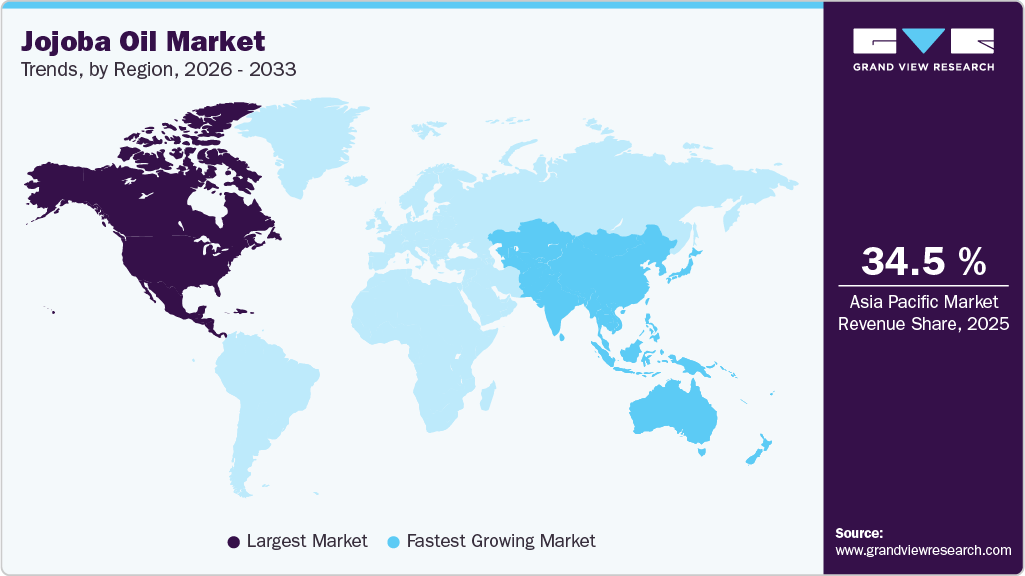
- North America held the largest share of the market in 2025, accounting for 34.5% of revenue.
- U.S. held over 80.9% revenue share of the North America jojoba oil market.
- By product, the cold pressed segment dominated the market in 2025, accounting for 64.6% of total revenue.
- By application, the cosmetics & personal care segment led the market in 2025, accounting for 72.5% of total revenue.
Market Size & Forecast
- 2025 Market Size: USD 146.3 Million
- 2033 Projected Market Size: USD 255.5 Million
- CAGR (2026-2033): 7.6%
- North America: Largest market in 2025
- Asia pacific: Fastest growing market
Its wax ester profile mimics natural sebum, so brands can promise comfort without heaviness. This functional fit lets jojoba anchor premium, everyday routines. It also offers shelf stability for finished products. This positioning aligns with the clean beauty shift that favors recognizable inputs and avoids heavy silicones and mineral oils. Formulators use jojoba as an emollient that can soften while supporting the skin barrier, which fits the rising demand for gentle care among people with sensitivity, acne concerns, and frequent cleansing. Because the material resists oxidation, brands can keep formulas minimalist with fewer stabilizers and less fragrance, strengthening trust under tighter labeling scrutiny.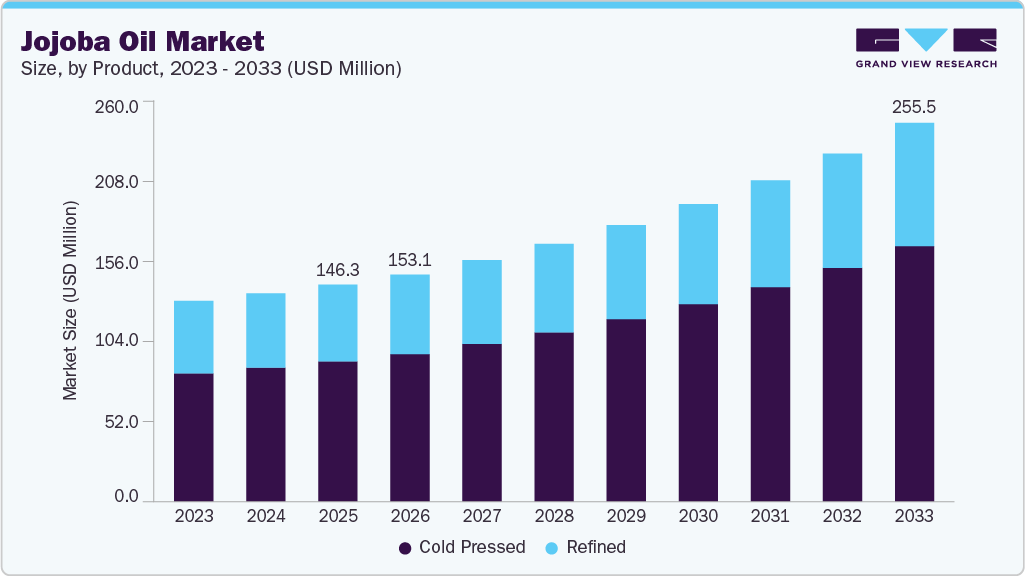
That consumer recognition translates into broader product adoption. Personal care companies integrate jojoba into facial oils, scalp serums, baby care, and color cosmetics because it improves spreadability and reduces tack. Blends with other botanical lipids create tailored textures, letting mid-range and luxury labels differentiate without changing their core story. Its plant origin suits vegan positioning, and long term supplier contracts help maintain consistent viscosity, odor, and color from batch to batch. This flexibility supports launches of hybrid products that replace multiple steps in routines.
Market Concentration & Characteristics
The jojoba oil market shows moderate concentration, with a mix of established ingredient processors and specialized agricultural producers. This structure exists because cultivation requires specific climatic conditions and long crop cycles, which limit rapid entry. Processing expertise and quality consistency also create barriers, as buyers expect stable composition, purity, and traceability for cosmetic and personal care formulations.
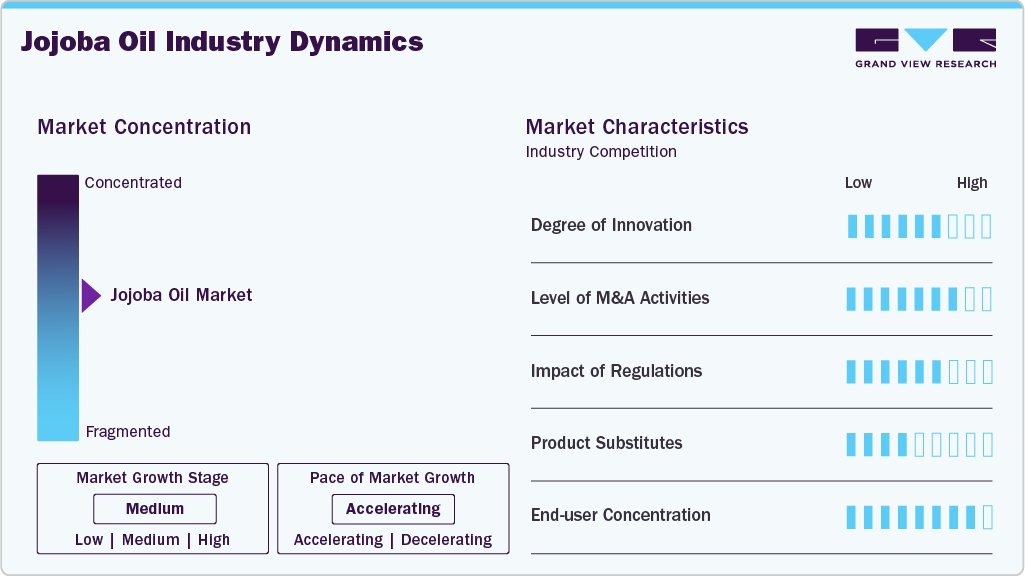
The market is characterized by long term supply relationships, quality differentiation, and growing emphasis on sustainability. These traits arise because personal care brands prioritize reliable sourcing and formulation stability to protect product performance and reputation. Buyers also value certified production and transparent supply chains, since consumer awareness around natural ingredients and ethical sourcing continues to influence purchasing decisions.
Product Insights
Cold pressed segment dominated the market in 2025, accounting for 64.6% of total revenue. This dominance is attributed to strong consumer preference for minimally processed and naturally extracted ingredients in personal care formulations. Cold pressed jojoba oil retains more of its natural nutrients, color, and mild aroma, which enhances its appeal in premium skincare and haircare products. Brands often highlight extraction methods as part of their clean label positioning, reinforcing product authenticity and perceived purity. The segment also benefits from demand in organic and natural cosmetic lines, where ingredient transparency and minimal chemical processing influence purchasing decisions.
Refined jojoba oil market is projected to record the fastest growth, with a CAGR of 6.4% from 2026 to 2033. Growth in the refined segment is driven by its wider applicability across large scale cosmetic and industrial formulations that require consistent color, odor, and stability. Refining improves uniformity and removes impurities, making the oil more suitable for mass market products where standardization is critical. It also enhances compatibility with fragrances and active ingredients, allowing formulators greater flexibility. As demand increases for multifunctional personal care products, refined jojoba oil is gaining traction due to its predictable performance and extended shelf stability.
Application Insights
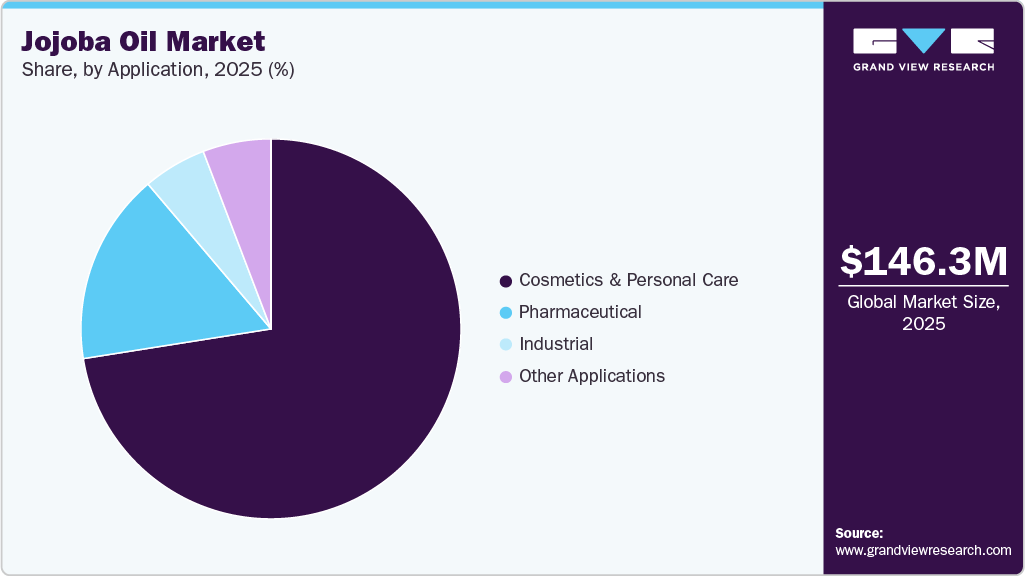
Cosmetics & personal care segment led the market in 2025, accounting for 72.5% of total revenue. This leadership is mainly supported by jojoba oil’s strong compatibility with skincare and haircare formulations, where it is widely used as an emollient, moisturizer, and texture enhancer. Its similarity to natural skin oils makes it suitable for products targeting dryness, sensitivity, and acne prone skin. Beauty brands also value jojoba oil for its stability, which helps maintain product shelf life without heavy reliance on preservatives. High demand for clean label and plant based cosmetics further strengthens consumption across creams, serums, conditioners, and makeup products.
The pharmaceutical segment is expected to grow at the fastest rate, with a CAGR of 6.4% from 2026 to 2033. Fast growth is expected as jojoba oil gains wider use in topical drug formulations, ointments, and medicated skincare products where stability and skin absorption are critical. Its non-irritating nature makes it useful for sensitive skin applications, supporting demand in dermatology focused products. The segment also benefits from increasing interest in natural excipients and carrier oils that improve delivery of active ingredients. Rising development of therapeutic creams and skin treatment products is likely to push refined and pharmaceutical grade jojoba oil adoption over the forecast period.
Regional Insights
North America held the largest share of the market in 2025, accounting for 34.5% of revenue. This dominance is largely tied to the region’s strong preference for premium skincare and haircare products that rely on high-performance natural ingredients. Jojoba oil fits well into formulations positioned around clean beauty and sensitive skin benefits, which remain highly influential purchase drivers. Mature cosmetic manufacturing networks also encourage steady bulk procurement, while strong brand competition pushes companies to use jojoba for texture improvement and product differentiation. Higher consumer spending on personal care further strengthens revenue contribution compared to other markets.
U.S. Jojoba Oil Market Trends
U.S. held over 80.9% revenue share of the North America jojoba oil market. U.S. jojoba oil market continues to expand due to strong consumer demand for clean label and plant based skincare products. Specialty retail chains and natural grocery outlets play a major role in influencing purchasing behavior, particularly through curated personal care selections. The growing visibility of jojoba oil sprouts market and jojoba oil whole foods market product placements reflects rising consumer trust in botanical oils sold through health focused retail environments. These channels strengthen brand credibility, encourage ingredient transparency, and support premium positioning.
Demand is further reinforced by increasing interest in dermatologically tested formulations and minimalist skincare routines. The rise of the high purity jojoba oil market in the U.S. is linked to growing consumer awareness regarding extraction methods, refinement standards, and product safety. Buyers actively seek oils with clear sourcing information and controlled processing, especially for facial applications. This focus on quality, combined with strong e-commerce penetration and subscription beauty models, continues to sustain market expansion across both mass and premium product categories.
Asia Pacific Jojoba Oil Market Trends
Asia Pacific is projected to grow at the fastest rate, with a CAGR of 8.9% from 2026 to 2033. Rapid growth is expected as rising disposable income and expanding beauty awareness increase spending on skincare, haircare, and wellness products. Consumers are increasingly drawn to natural and lightweight oils that suit daily routines, supporting wider adoption of jojoba-based formulations. The fast expansion of local cosmetic brands and contract manufacturers is also increasing ingredient demand at scale. E-commerce growth plays a major role by improving product availability and accelerating trend-driven purchases through influencer marketing and digital retail platforms.
China jojoba oil market is expanding due to fast growing demand for premium skincare and rising awareness of ingredient based beauty routines. Consumers increasingly prefer lightweight oils that support hydration without heaviness, which fits well with jojoba’s texture and absorption profile. Growth is strengthened by strong e commerce penetration and live commerce driven product discovery, which accelerates adoption of imported and premium formulations. The market also benefits from rising demand for scalp care and hair repair products, supported by urban lifestyle stress, frequent styling, and increasing consumer spending on personal grooming.
Europe Jojoba Oil Market Trends
Europe shows steady demand for jojoba oil due to strong preference for plant based cosmetics and strict ingredient scrutiny across beauty and personal care. Consumers are highly conscious about sustainability, product transparency, and certified sourcing, which supports jojoba adoption in natural formulations. The region’s established premium cosmetics industry also uses jojoba to improve product texture and stability in creams, lip care, and hair conditioners. Growth is supported by high demand for fragrance free and sensitive skin products, particularly in pharmacy linked cosmetic channels that influence consumer trust.
Germany jojoba oil market is shaped by the country’s strong natural cosmetics culture and high consumer trust in organic and certified personal care products. Demand is supported by the widespread presence of herbal and botanical skincare brands that prioritize ingredient purity and traceability. Jojoba oil is commonly used in facial care, baby care, and dry skin treatments, aligning with German preferences for functional, skin friendly formulations. The market also benefits from strong pharmacy and drugstore distribution networks, where consumers actively seek clean label alternatives backed by quality assurance standards.
Latin America Jojoba Oil Market Trends
Latin America is witnessing growing jojoba oil demand due to expanding beauty consumption and strong cultural emphasis on haircare and skin moisturization. Consumers frequently seek products for frizz control, dry scalp treatment, and sun related skin dryness, supporting jojoba use in conditioners, body lotions, and repair oils. Growth is also supported by the rising influence of salon driven product trends and increasing popularity of natural beauty solutions. Wider retail access through supermarkets and personal care chains is helping jojoba based blends reach middle income buyers seeking affordable premium alternatives.
Middle East & Africa Jojoba Oil Market Trends
The Middle East & Africa jojoba oil market is supported by strong demand for hydration focused skincare due to hot climates and dryness related skin concerns. Consumers in many areas prioritize rich moisturization, hair nourishment, and protective oils, which increases jojoba usage in body care, hair serums, and traditional wellness routines. Demand is also strengthened by premium beauty retail growth in key urban centers and rising preference for natural ingredients aligned with clean beauty trends. In addition, increasing grooming awareness among younger consumers is driving higher spending on specialized personal care products.
Key Jojoba Oil Company Insights
The two key dominant manufacturers in the market are Purcell Jojoba and Inca Oil SA.
-
Purcell Jojoba is a vertically integrated company engaged in cultivating jojoba plants and processing seeds into high quality oil and specialty derivatives. With operations rooted in desert agriculture, the company focuses on controlled farming practices, advanced extraction methods, and product consistency tailored for cosmetic and personal care formulations requiring purity and stability.
-
Inca Oil SA is known for its expertise in organic jojoba cultivation and cold pressed extraction techniques. The company emphasizes sustainable farming practices and careful processing to maintain oil integrity and natural characteristics. Its portfolio is widely incorporated into skincare and beauty applications that prioritize plant based ingredients and formulation performance.
Key Jojoba Oil Companies:
The following key companies have been profiled for this study on the jojoba oil market.
- Purcell Jojoba
- Inca Oil SA
- Ecooil
- ConnOils LLC
- Jojoba Naturals
- JD Jojoba Desert
- Hallstar
- Nutrix International LLC
- US Organic Group Corp
- OPW Ingredients GmbH
Recent Developments
-
January 2026: The Jojoba Company launched a new mix-and-match Jojoba Boost skincare range featuring targeted boosters powered by Wadi-Wadi jojoba that adapt to skin concerns like dullness, dehydration, and sensitivity, gaining strong attention from beauty enthusiasts.
-
December 2025: Jojoba Valley thanked clients and partners for a successful year and reaffirmed its commitment to producing high-quality jojoba oil and products, signaling continued focus on growth and industry engagement.
Jojoba Oil Market Report Scope
Report Attribute
Details
Market size value in 2026
USD 153.1 million
Revenue forecast in 2033
USD 255.5 million
Growth rate
CAGR of 7.6% from 2026 to 2033
Base year for estimation
2025
Historical data
2018 - 2024
Forecast period
2025 - 2033
Quantitative units
Revenue in USD million/billion, volume in kilotons, and CAGR from 2025 to 2033
Report coverage
Revenue forecast, company ranking, competitive landscape, growth factors, and trends
Segments covered
Product, application, region
Regional scope
North America; Europe; Asia Pacific; Latin America; Middle East & Africa
Country scope
U.S.; Canada; Mexico; Brazil; Argentina; Germany; UK; Italy; Spain; France; China; Japan; South Korea; Saudi Arabia; South Africa
Key companies profiled
Purcell Jojoba; Inca Oil SA; Ecooil; ConnOils LLC; Jojoba Naturals; JD Jojoba Desert; Hallstar; Nutrix International LLC; US Organic Group Corp; OPW Ingredients GmbH
Customization scope
Free report customization (equivalent to up to 8 analysts’ working days) with purchase. Addition or alteration to country, regional & segment scope.
Pricing and purchase options
Avail customized purchase options to meet your exact research needs. Explore purchase options
Global Jojoba Oil Market Report Segmentation
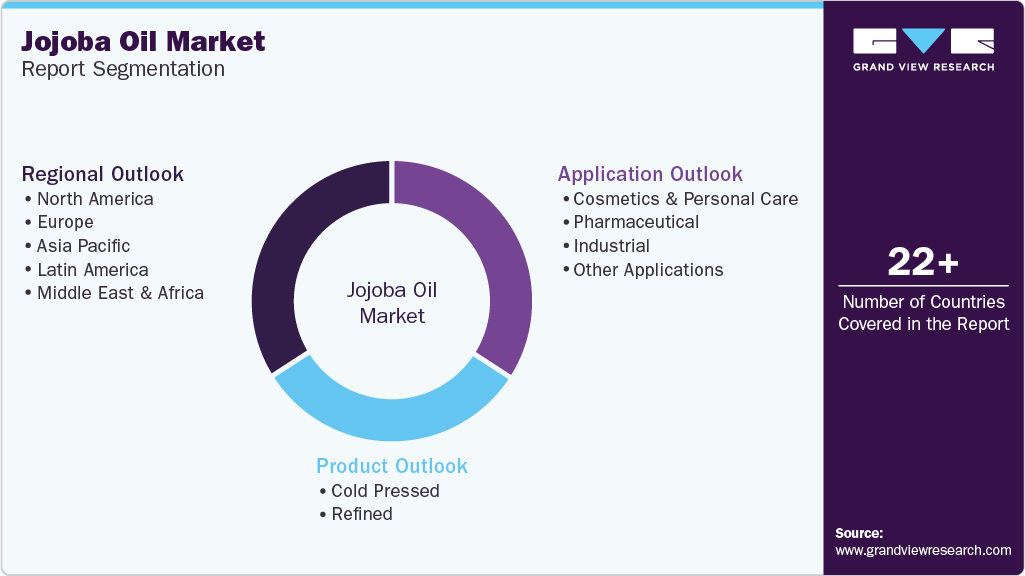
This report forecasts revenue growth at global, regional, and country levels and provides an analysis of the latest industry trends in each of the sub-segments from 2018 to 2033. For this study, Grand View Research has segmented the global jojoba oil market report based on product, application, and region:
-
Product Outlook (Volume, Kilotons; Revenue, USD Million, 2018 - 2033)
-
Cold Pressed
-
Refined
-
-
Application Outlook (Volume, Kilotons; Revenue, USD Million, 2018 - 2033)
-
Cosmetics & Personal Care
-
Pharmaceutical
-
Industrial
-
Other Applications
-
-
Regional Outlook (Volume, Kilotons; Revenue, USD Million, 2018 - 2033)
-
North America
-
U.S.
-
Canada
-
Mexico
-
-
Europe
-
Germany
-
UK
-
Italy
-
Spain
-
France
-
-
Asia Pacific
-
China
-
India
-
Japan
-
South Korea
-
-
Latin America
-
Brazil
-
Argentina
-
-
Middle East & Africa
-
Saudi Arabia
-
South Africa
-
-
Frequently Asked Questions About This Report
b. The global jojoba oil market size was estimated at USD 146.3 million in 2025 and is expected to reach USD 153.1 million in 2026.
b. The jojoba oil market is expected to grow at a compound annual growth rate of 7.6% from 2026 to 2033, reaching USD 255.5 million by 2033.
b. Cold Pressed segment dominated the market in 2025, accounting for 64.6% of total revenue. This dominance is attributed to strong consumer preference for minimally processed and naturally extracted ingredients in personal care formulations. Cold pressed jojoba oil retains more of its natural nutrients, color, and mild aroma, which enhances its appeal in premium skincare and haircare products.
b. Some of the key players operating in the jojoba oil market include Purcell Jojoba, Inca Oil SA, Ecooil, ConnOils LLC, Jojoba Naturals, JD Jojoba Desert, Hallstar, Nutrix International LLC, US Organic Group Corp, OPW Ingredients GmbH
b. Jojoba oil demand is rising because consumers want simple, plant-based ingredients that perform across skin, hair, and cosmetics. Its wax ester profile mimics natural sebum, so brands can promise comfort without heaviness. This functional fit lets jojoba anchor premium, everyday routines. It also offers shelf stability for finished products.


Share this report with your colleague or friend.
Need a Tailored Report?
Customize this report to your needs — add regions, segments, or data points, with 20% free customization.


ISO 9001:2015 & 27001:2022 Certified
We are GDPR and CCPA compliant! Your transaction & personal information is safe and secure. For more details, please read our privacy policy.
Trusted market insights - try a free sample
See how our reports are structured and why industry leaders rely on Grand View Research. Get a free sample or ask us to tailor this report to your needs.