- Home
- »
- Homecare & Decor
- »
-
Insect Repellent Market Size & Share, Industry Report, 2033GVR Report cover
![Insect Repellent Market Size, Share & Trends Report]()
Insect Repellent Market (2026 - 2033) Size, Share & Trends Analysis Report By Insect Type (Mosquito Repellent, Bug Repellent, Fly Repellent), By Product (Vaporisers, Spray, Cream), By Formulation (Synthetic, Natural/Organic), By Region, And Segment Forecasts
- Report ID: GVR-2-68038-993-7
- Number of Report Pages: 110
- Format: PDF
- Historical Range: 2021 - 2025
- Forecast Period: 2026 - 2033
- Industry: Consumer Goods
- Report Summary
- Table of Contents
- Interactive Charts
- Methodology
- Download FREE Sample
-
 Download Sample Report
Insect Repellent Market Summary
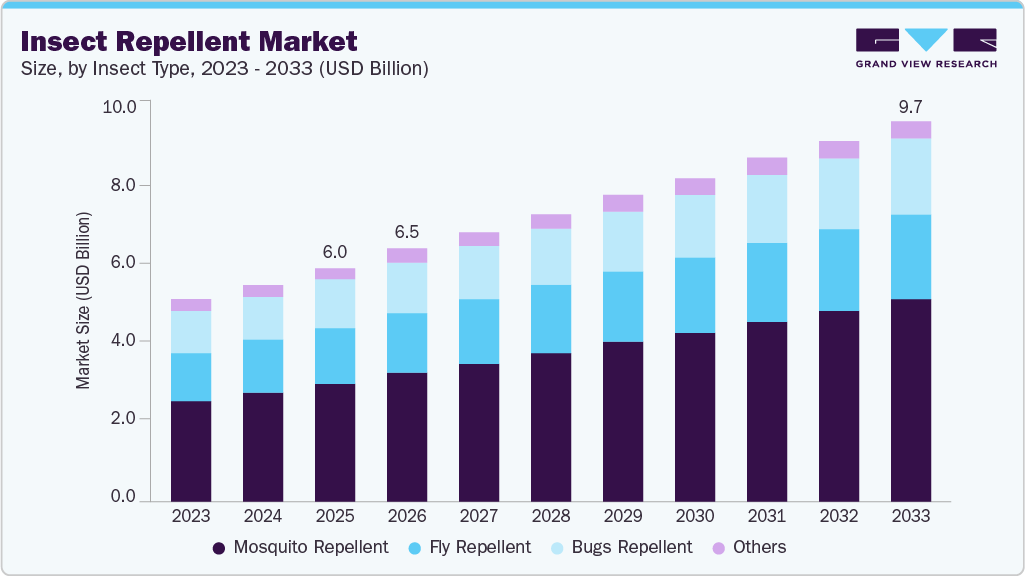
The global insect repellent market size was estimated at USD 6.00 billion in 2025 and is projected to reach USD 9.70 billion by 2033, growing at a CAGR of 6.0% from 2026 to 2033. The growing prevalence of vector-borne diseases such as malaria, dengue fever, Zika virus, and Lyme disease fuels the demand for insect repellents across the broader market, including segments such as the body-worn and pet insect repellent industry.
Key Market Trends & Insights
- Asia Pacific insect repellent accounted for a market share of 41.15% in 2025.
- By insect type, mosquito repellent accounted for a market share of 50.93% in 2025.
- By product, vaporisers accounted for a market share of 35.01% in 2025.
- By formulation, synthetic insect repellent accounted for a market share of 69.82% in 2025.
Market Size & Forecast
- 2025 Market Size: USD 6.00 Billion
- 2033 Projected Market Size: USD 9.70 Billion
- CAGR (2026-2033): 6.0%
- Asia Pacific: Largest market in 2025
These illnesses, transmitted by insects like mosquitoes and ticks, pose significant health risks in many parts of the world. As awareness of these diseases rises, both in endemic regions and areas where these diseases are spreading due to changing climatic conditions, more individuals and communities are prioritizing preventive measures like insect repellents.The growing adoption of landscaping items like plants, water fountains, and gazebos is anticipated to propel the demand for different home and garden pesticides, indirectly supporting market expansion and related segments such as the insect repellent active ingredients market. In addition, the increasing trend of renovating commercial and residential outdoor spaces into attractive features like lawns, outdoor kitchens, and entertainment zones is fostering market expansion. Outdoor areas across various sectors are redesigned to integrate natural beauty into structures and enhance their value.
A growing number of insects across the globe has led to an increase in the number of diseases, further strengthening demand across the market, including the body-worn and pet insect repellent industry. Mosquitos are the major reason for diseases such as malaria, dengue, West Nile Virus, and yellow fever. They also transmit lymphatic filariasis and Japanese encephalitis. Also, other insects such as tsetse flies cause sleeping sickness, the leishmaniasis group of diseases caused by sandflies, Onchocerciasis, or river blindness by blackflies, and plague by fleas.
Furthermore, consumer trends and preferences in the market are continuously evolving due to changing lifestyles, environmental concerns, and health considerations. Consumers are increasingly seeking insect repellents that utilize natural ingredients, as they are perceived as safer for personal use and the environment. Ingredients like citronella, lavender, and eucalyptus are popular due to their natural origins and pleasant scents, driving growth in the natural ingredient market and influencing innovation within the insect repellent active ingredients market. This trend aligns with the broader movement towards cleaner, greener living and a desire to avoid potentially harmful chemicals.
Consumers are increasingly opting for insect repellents in the form of creams and lotions with skin-hydrating and nourishing properties, supporting innovation in the body-worn market. Avon is one of the leading manufacturers of cosmetic-based insect repellents. For instance, Avon offers Avon Skin So Soft Bug Guard Collection in spray and lotion formats. These products are DEET-free and water-resistant and provide SPF 30 protection, reflecting the convergence of skincare and protection within the broader market.
Brand Market Share Insights
The global market is highly competitive, supported by the presence of multinational consumer goods companies, regional manufacturers, and emerging brands specializing in herbal or plant-based formulations. Companies compete through product innovation, strong brand positioning, and wide retail distribution across supermarkets, pharmacies, and online platforms, with increasing expansion into adjacent segments such as the pet market, natural ingredient market, and insect repellent active ingredients market. Leading participants such as SC Johnson, Reckitt, Spectrum Brands, Godrej Consumer Products, and Dabur India offer a diverse portfolio of repellent formats, including sprays, creams, lotions, vaporizers, coils, and wearable devices designed for indoor and outdoor protection.
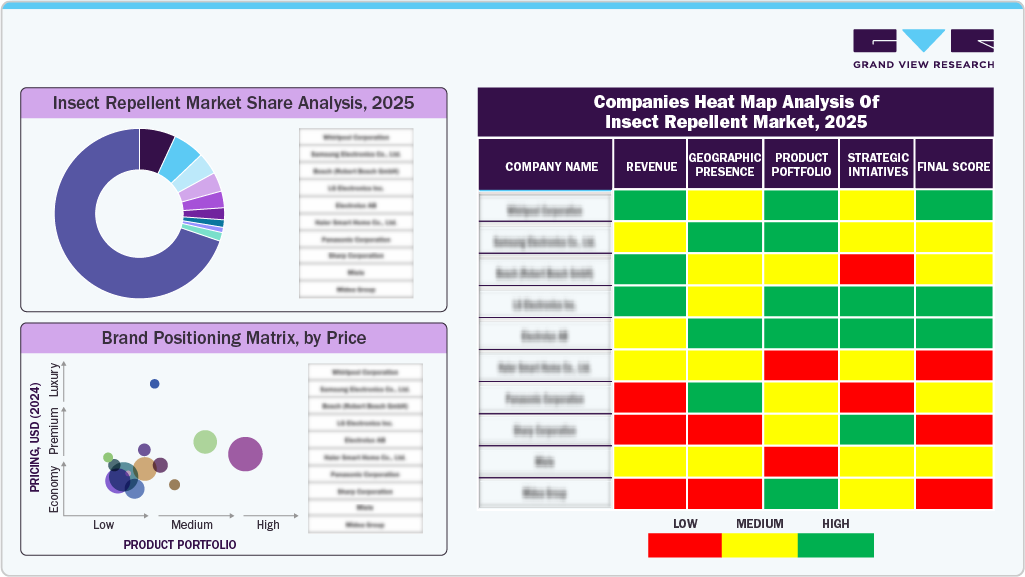
These companies frequently expand their product lines with long-lasting protection formulas, skin-friendly repellents for children, and natural ingredient-based products such as citronella or eucalyptus oil blends, contributing to the growth of the natural ingredient market and innovation within the insect repellent active ingredients market. Continuous investment in research and development, expansion into emerging markets, and increased consumer awareness regarding mosquito-borne diseases such as dengue and malaria are encouraging manufacturers to introduce more advanced and convenient insect repellent solutions. This also includes targeted offerings in categories such as the pet market, further strengthening competition across the global market.
Consumer Survey & Insights
Many households prefer easy-to-use formats such as electric vaporizers, aerosol sprays, and roll-on repellents that provide long-lasting protection with minimal effort. At the same time, consumers are increasingly seeking products that are safe for children and suitable for frequent use, encouraging demand for dermatologically tested and skin-friendly formulations. Travel activities, outdoor recreation, and tourism further contribute to product demand, as travelers often purchase portable repellents such as sprays, patches, and wearable devices for protection during outdoor trips and vacations.
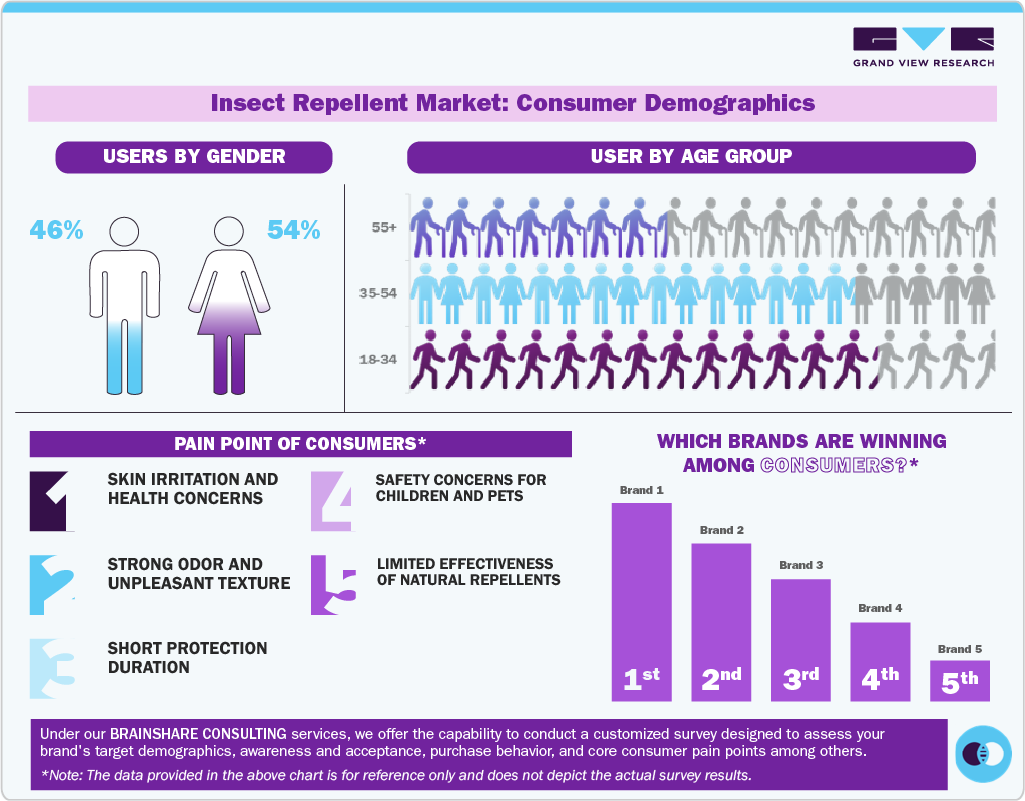
Product performance and comfort are also important purchase considerations for consumers. Repellents that offer extended protection, non-greasy textures, and mild fragrances are particularly favored, as consumers look for solutions that can be used regularly without causing skin irritation or discomfort. In response, manufacturers are introducing improved formulations that combine effective insect-repelling ingredients with skin-conditioning agents and pleasant fragrances. In addition, the growing interest in plant-based and herbal repellents made with ingredients such as citronella, eucalyptus oil, and lemongrass is encouraging product innovation, as consumers increasingly seek safer and more environmentally friendly alternatives within the global market.
Insect Type Insights
Mosquito repellents accounted for a share of over 50.93% in 2025, supported by the widespread use of household insect protection products in regions with high mosquito activity. Increasing urbanization and population density have contributed to environments that support mosquito breeding, particularly in areas with standing water and inadequate drainage systems. As a result, households are increasingly incorporating mosquito repellents such as vaporizers, sprays, creams, and coils into their daily routines to maintain a safer indoor environment. Seasonal increases in mosquito populations during warmer and rainy periods further encourage consumers to stock up on repellent products for continuous protection. In addition, growing participation in outdoor activities such as camping, hiking, and traveling to nature-based destinations has increased demand for portable repellent formats, including sprays, lotions, and wearable patches designed for convenient outdoor use.
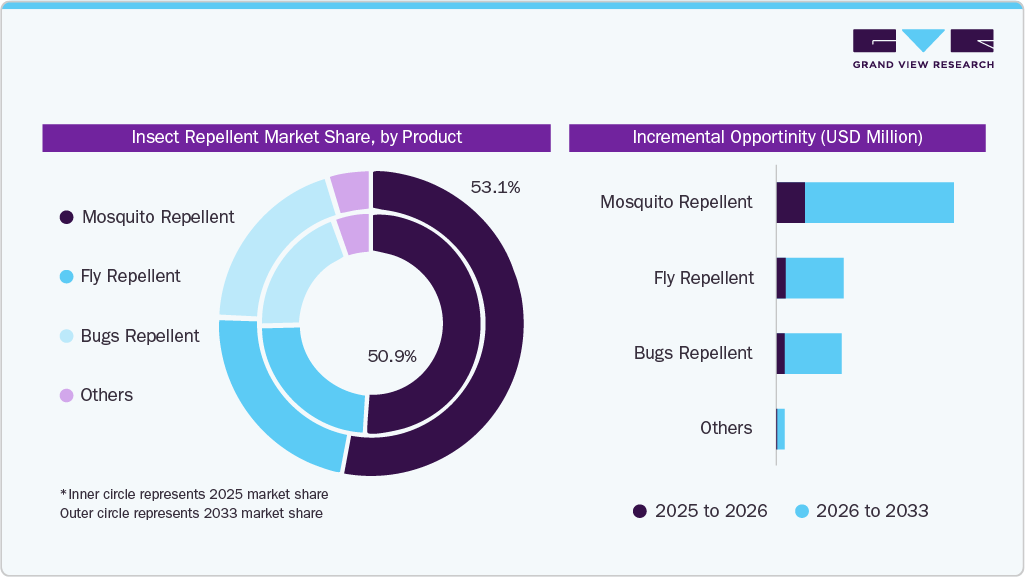
Bug repellents are projected to grow at a CAGR of 5.9% from 2026 to 2033. Beyond mosquitoes, various types of bugs, including ticks, fleas, ants, and bedbugs, are carriers of diseases like Lyme disease, plague, and allergies. As people become more concerned about these health threats, particularly in outdoor environments and during travel, the demand for effective bug repellents rises. As the market diversifies with natural and eco-friendly repellent options, consumer preference for safe, long-lasting, and multi-purpose products also contributes to the growing demand in this segment. In March 2023, Zevo, a leading pest control brand, introduced its new On-Body Mosquito + Tick Repellents, offering odorless and non-sticky protection against mosquitoes and ticks for up to 8 hours. It is available in aerosol, pump spray, and lotion forms. This new launch aligns with consumer preferences for non-sticky and odorless formulas.
Formulation Insights
Synthetic insect repellents accounted for a share of over 69.82% in 2025. Consumers widely prefer synthetic formulations because they provide reliable protection for extended periods, particularly in regions with high insect activity. Products containing active ingredients such as DEET, picaridin, and permethrin are commonly used in sprays, creams, lotions, and vaporizer liquids due to their proven ability to repel insects effectively. In addition, the widespread availability of these products across supermarkets, pharmacies, and convenience stores makes them easily accessible for household use. Many households incorporate synthetic repellents such as electric vaporizers, mosquito coils, and aerosol sprays into daily protection routines, especially during warmer seasons when insect activity increases.
Natural/organic insect repellents are projected to grow at a CAGR of 7.1% from 2026 to 2033, driven by increasing consumer preference for environmentally friendly and plant-based personal care products. Many consumers are becoming more conscious of the environmental impact associated with chemical-based repellents and are therefore shifting toward products formulated with botanical ingredients such as citronella, eucalyptus oil, neem oil, and lemongrass. The segment is also benefiting from wider availability across supermarkets, pharmacies, and online platforms, which has improved product accessibility and encouraged trial among new consumers.
Product Insights
Vaporisers accounted for a share of over 35.01% in 2025, driven by increasing consumer preference for convenient and low-maintenance household insect protection solutions. Many households favor vaporisers because they provide automatic and continuous protection for several hours, making them particularly suitable for overnight use in bedrooms and indoor living spaces. The segment is also supported by the widespread availability of electric vaporiser devices and refill packs across supermarkets, pharmacies, and convenience stores, which encourages regular product replenishment and repeat purchases. In addition, urban consumers increasingly prefer plug-in insect control devices that operate quietly and require minimal user effort compared with traditional options such as sprays or coils.
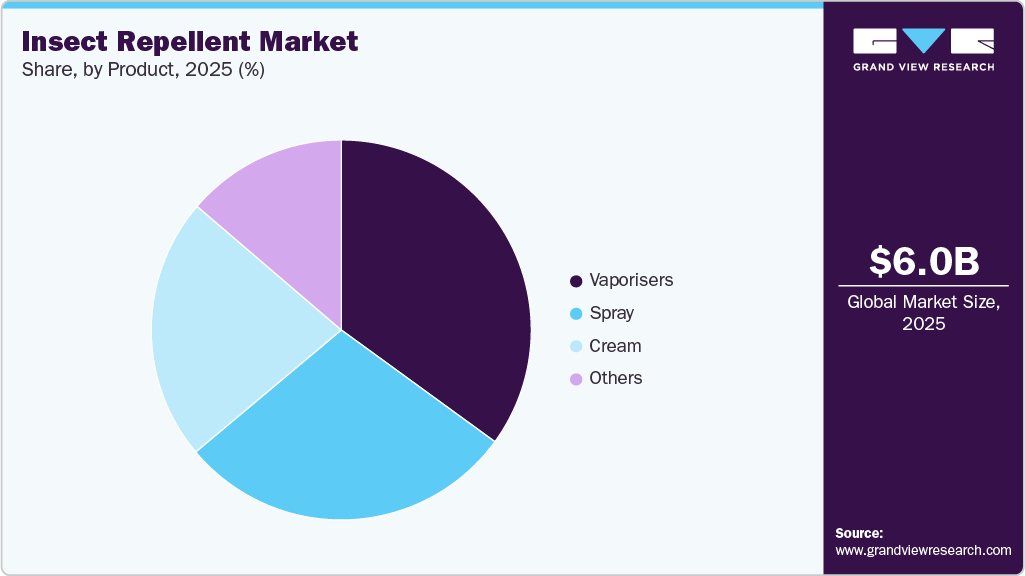
Insect repellent sprays are projected to grow at a CAGR of 6.9% from 2026 to 2033, supported by increasing consumer demand for flexible and multi-purpose insect protection products. Many consumers prefer spray formats because they can be applied quickly to both skin and clothing, making them suitable for short-term protection during outdoor exposure. The segment is also benefiting from rising urban travel and tourism activities, as travelers often carry compact repellent sprays to protect themselves from insect bites when visiting mosquito-prone destinations. In addition, the growing availability of repellent sprays across pharmacies, supermarkets, and convenience stores has improved accessibility, encouraging consumers to purchase these products for occasional or seasonal use.
Regional Insights
The North American insect repellent market accounted for a share of 9.45% of the global market in 2025. The market is driven by increasing consumer participation in outdoor leisure activities such as camping, hiking, fishing, and backyard recreation across the U.S. and Canada. These activities expose individuals to mosquitoes, ticks, and other biting insects, encouraging the regular use of insect repellent products for personal protection. The market is also supported by growing public awareness regarding insect-borne diseases such as Lyme disease and West Nile virus, which has prompted consumers to adopt preventive protection products during travel and outdoor exposure.
U.S. Insect Repellent Market Trends
The insect repellent market in the U.S. accounted for a revenue share of around 71.15% in North America in 2025. The U.S. market is driven by the country’s high participation in outdoor recreational activities such as camping, hiking, fishing, and backyard gatherings, where protection against mosquitoes and other insects is often required. Many households regularly purchase insect repellent products such as sprays, lotions, and electric vaporizers to ensure personal comfort during outdoor activities and warmer seasons when insect populations increase. The market is also supported by growing consumer awareness regarding mosquito- and tick-borne diseases, which encourages preventive use of repellent products during travel and outdoor exposure. In addition, the strong presence of large retail chains, pharmacies, and e-commerce platforms across the U.S. ensures wide product availability and convenient access to various insect repellent formats, further supporting market growth.
Canada insect repellent market is expected to grow at a CAGR of 5.9% from 2026 to 2033. The market is driven by the country’s vast forested landscapes and outdoor recreational culture, where activities such as camping, hiking, fishing, and wildlife tourism are widely practiced. These activities expose individuals to mosquitoes, ticks, and other insects, encouraging consumers to regularly use insect repellent products for personal protection. The market is also supported by seasonal increases in insect activity during warmer months, which leads households to purchase repellents such as sprays, creams, and vaporizer products for both indoor and outdoor use. In addition, the wide availability of insect repellent products through supermarkets, pharmacies, and outdoor equipment retailers across Canada continues to improve product accessibility and support market growth.
Europe Insect Repellent Market Trends
The insect repellent market in Europe accounted for a revenue share of 16.75% of the global market in 2025. The market is driven by the increasing expansion of travel and tourism activities across the region, which encourages consumers to purchase personal insect protection products during vacations, outdoor excursions, and nature-based travel. Many travelers carry portable repellents such as sprays, lotions, and patches to prevent insect bites when visiting forested areas, lakesides, and rural destinations. The market is also supported by rising consumer interest in comfortable home environments, prompting households to adopt indoor insect protection solutions such as electric vaporizers and mosquito control devices.
The UK insect repellent market accounted for a revenue share of around 16.91% in 2025. The market is driven by increasing consumer demand for personal protection products during the summer months when mosquito and insect activity rises. Many households regularly purchase insect repellents such as sprays, creams, and plug-in vaporizers to maintain comfortable indoor environments and prevent insect bites. The market is also supported by the growing popularity of outdoor leisure activities such as camping, gardening, and countryside travel, where portable repellent solutions are commonly used.
The insect repellent market in France is expected to grow at a CAGR of 7.5% from 2026 to 2033. The market is driven by increasing consumer awareness regarding mosquito-borne diseases and the growing use of household insect protection products during warmer seasons. Many households regularly adopt repellents such as sprays, vaporizers, creams, and mosquito coils to protect against insect bites, particularly in regions with higher mosquito activity during summer months. The market is also supported by the rising popularity of outdoor recreational activities such as camping, hiking, and countryside tourism, which encourages consumers to carry portable insect protection products.
Asia Pacific Insect Repellent Market Trends
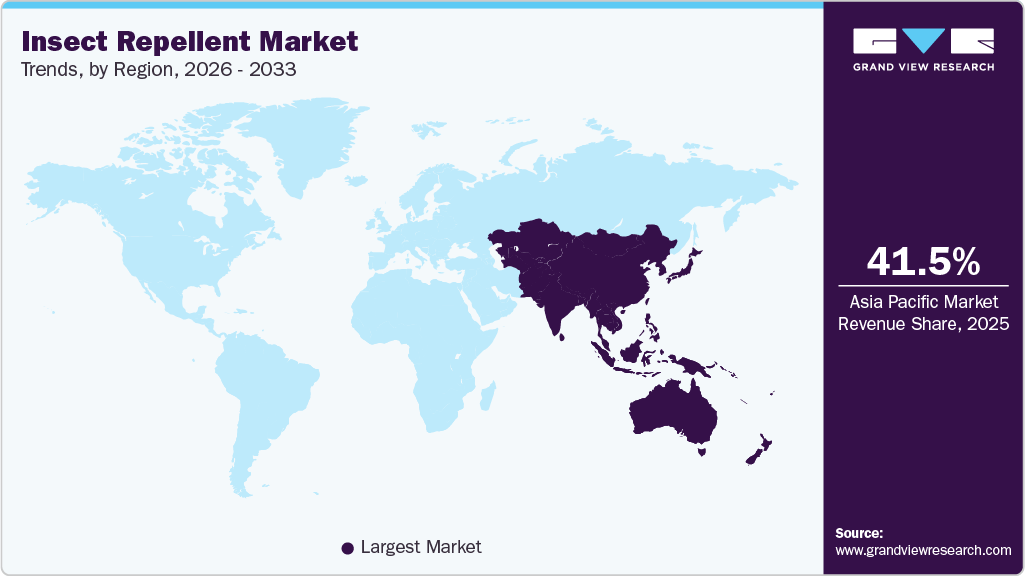
The insect repellent market in the Asia Pacific accounted for a revenue share of 41.15% in 2025. The market is driven by the region’s warm and humid climate conditions, which create favorable environments for mosquito breeding and increase the need for regular insect protection. Countries across South and Southeast Asia frequently experience seasonal outbreaks of mosquito-borne diseases such as dengue and malaria, encouraging households to adopt insect repellent products, including vaporizers, sprays, coils, and creams as part of everyday protection routines. The market is also supported by the region’s large population base and high household usage of mosquito control solutions, particularly in densely populated urban areas where mosquito exposure can be significant. In addition, the strong presence of regional manufacturers and the widespread availability of affordable repellent products across supermarkets, convenience stores, and local retail outlets continue to support market growth.
China insect repellent market accounted for a revenue share of around 21.83% on the Asia Pacific market in 2025. The market is driven by the country’s large population and increasing demand for household insect protection products, particularly during warmer months when mosquito activity is higher. Many households regularly use insect repellent solutions such as electric vaporizers, sprays, coils, and creams to maintain comfortable indoor living environments. The market is also supported by rising urbanization and the expansion of residential housing in major cities, which has increased the demand for convenient household pest control solutions. In addition, the strong presence of domestic manufacturers and the growing availability of insect repellent products through supermarkets, pharmacies, and e-commerce platforms are improving product accessibility.
The insect repellent market in India is expected to grow at a CAGR of 8.0% from 2026 to 2033. The market in India is driven by the country’s tropical climate and the high prevalence of mosquitoes, particularly during monsoon seasons when mosquito breeding increases significantly. As a result, households widely adopt insect repellent products such as electric vaporizers, mosquito coils, creams, and sprays as part of daily protection routines. The market is also supported by increasing public awareness regarding mosquito-borne diseases such as dengue, malaria, and chikungunya, which has encouraged consumers to use repellent products more consistently for personal and household protection.
Central & South America Insect Repellent Market Trends
The insect repellent market in CSA is expected to grow at a CAGR of 5.3% from 2026 to 2033. The market is driven by the increasing expansion of urban and suburban residential areas, which has contributed to greater demand for household insect control products. As cities expand and housing developments grow near forested and water-rich environments, mosquito and insect exposure in residential neighborhoods has increased, encouraging households to adopt repellents such as vaporizers, coils, sprays, and creams for daily protection. The market is also supported by improving consumer purchasing power in several countries across the region, allowing more households to regularly purchase insect repellent products as part of their home care routines.
Middle East & Africa Insect Repellent Market Trends
The insect repellent market in the MEA is expected to grow at a CAGR of 6.2% from 2026 to 2033. The market is driven by the region’s warm climate conditions and the growing need for effective household protection against insects. Many countries experience prolonged periods of high temperatures and seasonal rainfall, creating favorable environments for mosquito breeding and increasing the demand for repellent products used in homes and outdoor settings. The market is also supported by the rising adoption of household pest control solutions such as vaporizers, sprays, coils, and creams, which are widely used to maintain comfortable indoor living conditions.
Key Insect Repellent Companies:
The following key companies have been profiled for this study on the insect repellent market.
- Reckitt Benckiser Group PLC
- Godrej Consumer Products Ltd
- Dabur India Limited
- Coghlan's Ltd.
- S.C. Johnson & Sons Inc
- Johnson & Johnson
- Spectrum Brands, Inc.
- Sawyer Products
- Henkel AG & Co. KGaA
- Jyothy Laboratories Ltd.
Recent Developments
-
In April 2025, Mamaearth launched a new campaign for its mosquito repellent products featuring actress Shilpa Shetty Kundra. The campaign highlights the importance of protecting children from mosquito bites while promoting the brand’s repellents made with natural ingredients like citronella and eucalyptus oils. Through this initiative, the company aims to emphasize safe and plant-based protection for families.
-
In April 2025, Godrej Consumer Products launched an upgraded Kala HIT mosquito spray featuring Thunderbolt Technology to improve mosquito control. The new formulation is designed to act faster and deliver more effective results while using less spray. The product also comes with updated packaging and a refreshed fragrance to enhance the overall user experience.
Insect Repellent Market Report Scope
Report Attribute
Details
Market size value in 2026
USD 6.46 billion
Revenue forecast in 2033
USD 9.70 billion
Growth rate (revenue)
CAGR of 6.0% from 2026 to 2033
Actuals
2021 - 2025
Forecast period
2026 - 2033
Quantitative units
Revenue in USD million/billion, and CAGR from 2026 to 2033
Report coverage
Revenue forecast, company ranking, competitive landscape, growth factors, and trends
Segments covered
Insect type, product, formulation, region
Regional scope
North America; Europe; Asia Pacific; CSA; MEA
Country scope
U.S.; Canada; Mexico; Germany; UK; France; Italy; Spain; China; Japan; India; Australia; South Korea; Brazil; Saudi Arabia
Key companies profiled
Reckitt Benckiser Group PLC; Godrej Consumer Products Ltd; Dabur India Limited; Coghlan's Ltd.; S.C. Johnson & Sons Inc; Johnson & Johnson; Spectrum Brands, Inc.; Sawyer Products; Henkel AG & Co. KGaA; Jyothy Laboratories Ltd.
Customization
Free report customization (equivalent up to 8 analysts working days) with purchase. Addition or alteration to country, regional & segment scope
Pricing and purchase options
Avail customized purchase options to meet your exact research needs. Explore purchase options
Global Insect Repellent Market Report Segmentation
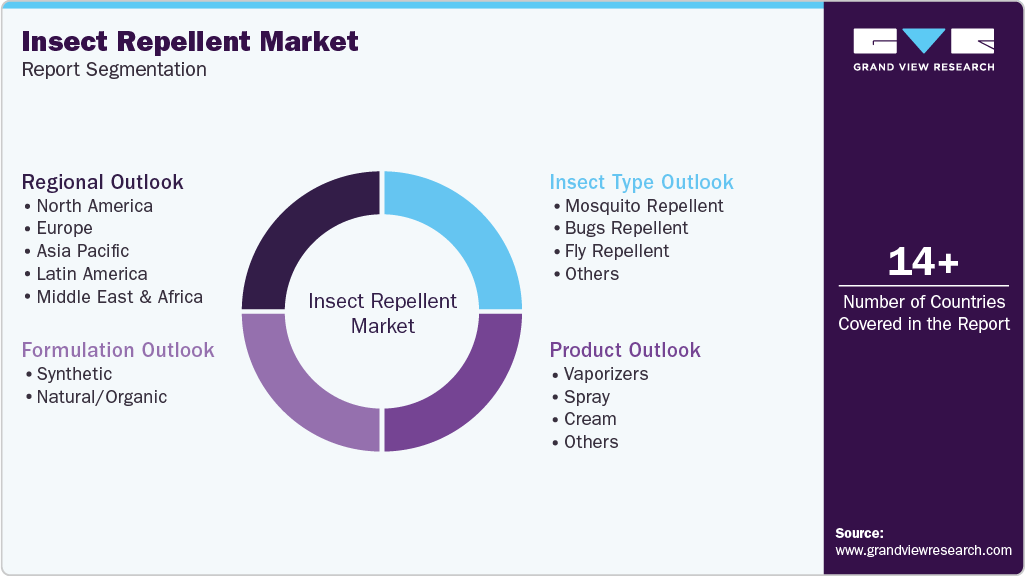
This report forecasts revenue growth at the global, regional, and country levels and provides an analysis of the latest industry trends and opportunities in each of the sub-segments from 2021 to 2033. For this study, Grand View Research has segmented the global insect repellent market based on insect type, product, formulation, and region:
-
Insect Type Outlook (Revenue, USD Billion, 2021 - 2033)
-
Mosquito Repellent
-
Bugs Repellent
-
Fly Repellent
-
Others
-
-
Product Outlook (Revenue, USD Billion, 2021 - 2033)
-
Vaporizers
-
Spray
-
Cream
-
Others
-
-
Formulation Outlook (Revenue, USD Billion, 2021 - 2033)
-
Synthetic
-
Natural/Organic
-
-
Regional Outlook (Revenue, USD Billion; 2021 - 2033)
-
North America
-
U.S.
-
Canada
-
Mexico
-
-
Europe
-
Germany
-
UK
-
France
-
Italy
-
Spain
-
-
Asia Pacific
-
China
-
India
-
Japan
-
Australia
-
South Korea
-
-
Central & South America
-
Brazil
-
-
Middle East & Africa
-
Saudi Arabia
-
-
Frequently Asked Questions About This Report
b. The global insect repellent market was estimated at USD 5.57 billion in 2024 and is expected to reach USD 6.00 billion in 2025.
b. The insect repellent market is expected to grow at a compound annual growth rate of 6.7% from 2025 to 2030 to reach USD 8.28 billion by 2030.
b. Asia Pacific dominated the insect repellent market with a share of around 40.98% in 2024. The technological advancements in the insect repellent industry contribute to growth.
b. Some of the key players operating in the insect repellent market include b " Reckitt Benckiser Group, The Godrej Company, Dabur International, Coghlans Ltd., S.C Jhonson & Son., Johnson and Johnson, Spectrum Brands, Sawyer Products, Inc., Himalaya Herbals, and Jyothy Labs.
b. Key factors that are driving the insect repellent market growth are due to an increase in vector-borne diseases are spreading across the globe especially in under-developed countries due to less sanitation awareness.


Share this report with your colleague or friend.
Need a Tailored Report?
Customize this report to your needs — add regions, segments, or data points, with 20% free customization.


ISO 9001:2015 & 27001:2022 Certified
We are GDPR and CCPA compliant! Your transaction & personal information is safe and secure. For more details, please read our privacy policy.
Trusted market insights - try a free sample
See how our reports are structured and why industry leaders rely on Grand View Research. Get a free sample or ask us to tailor this report to your needs.