- Home
- »
- Disinfectants & Preservatives
- »
-
Industrial And Institutional Cleaning Chemicals Market Report, 2033GVR Report cover
![Industrial And Institutional Cleaning Chemicals Market Size, Share & Trends Report]()
Industrial And Institutional Cleaning Chemicals Market (2026 - 2033) Size, Share & Trends Analysis Report By Raw Material (Chlor-alkali, Surfactant, Biocides), By Product (General Purpose Cleaners, Vehicle Wash Products), By End-use, By Region, And Segment Forecasts
- Report ID: GVR-4-68038-649-3
- Number of Report Pages: 80
- Format: PDF
- Historical Range: 2021 - 2024
- Forecast Period: 2026 - 2033
- Industry: Bulk Chemicals
- Report Summary
- Table of Contents
- Segmentation
- Methodology
- Download FREE Sample
-
 Download Sample Report
Industrial And Institutional Cleaning Chemicals Market Summary
The global industrial and institutional cleaning chemicals marketsize was estimated at USD 86.46 billion in 2025 and is projected to reach USD 156.99 billion by 2033, growing at a CAGR of 8.0% from 2026 to 2033. The market's growth is driven by rising hygiene standards, stringent health and safety regulations, increased demand from the healthcare and food service sectors, growing awareness of sustainable cleaning solutions, and technological advancements enabling more effective, eco-friendly, and specialized cleaning chemical formulations worldwide.
Key Market Trends & Insights
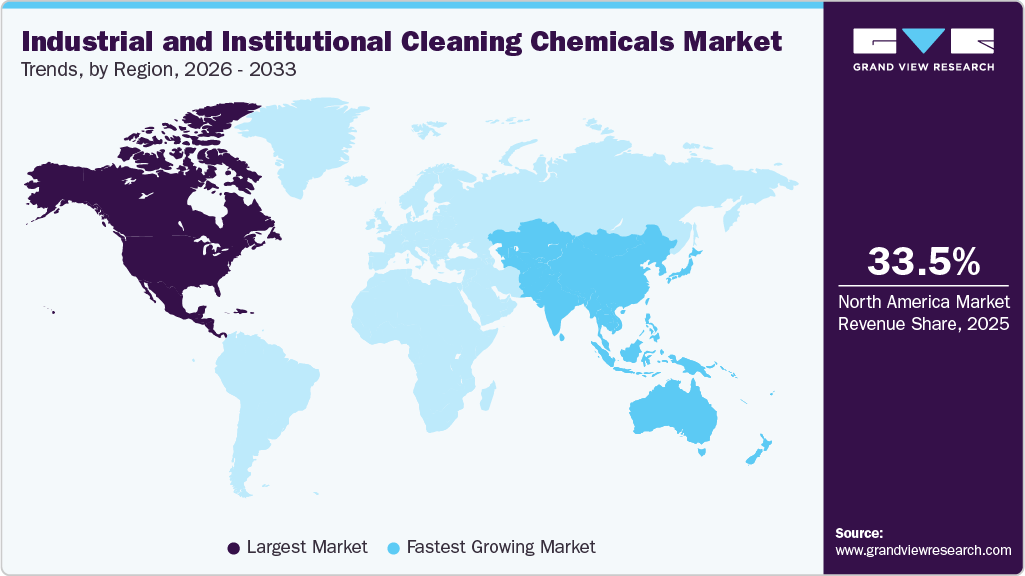
- North America dominated the globalindustrial and institutional cleaning chemicals market with the largest revenue share of 33.55% in 2025.
- The industrial and institutional cleaning chemicals market in the U.S. is expected to grow at a substantial CAGR of 7.9% from 2026 to 2033.
- By raw material, the surfactants segment held the highest market share of 29.3% in 2025 in terms of revenue.
- By product, the general purpose cleaners segment led the market and accounted for the largest revenue share of 34.3% in 2025.
- By end-use, the manufacturing segment accounted for the largest revenue share of 69.8% in 2025.
Market Size & Forecast
- 2025 Market Size: USD 86.46 Billion
- 2033 Projected Market Size: USD 156.99 Billion
- CAGR (2026-2033): 8.0%
- North America: Largest market in 2025
- Asia Pacific: Fastest growing market
Heightened hygiene and safety concerns following the pandemic have significantly boosted global consumption of industrial and institutional cleaning chemicals. Strict health regulations in sectors like healthcare and food processing further drive demand for effective cleaners, disinfectants, and sanitizers. In countries like the U.S., a large industrial base and widespread maintenance of public spaces contribute to consistent market growth. Manufacturers are prioritizing R&D to diversify product portfolios with advanced and more efficient cleaning solutions.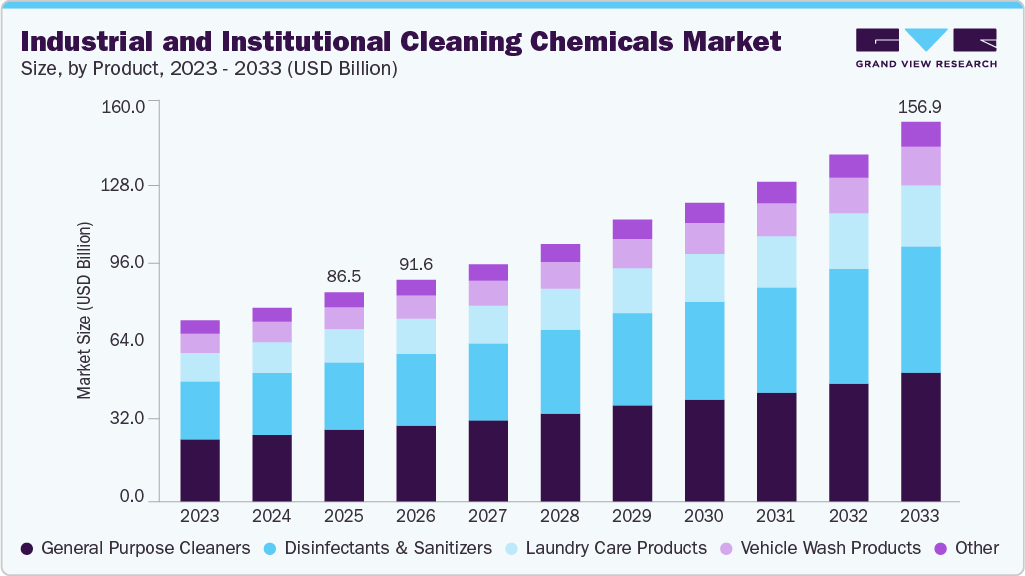
There is immense potential for sustainable and eco-friendly cleaning products as consumers increasingly seek ways to lower their carbon footprint. Growing demand for plant-based, non-toxic, and biodegradable chemicals, particularly in developed markets like the U.S., presents lucrative opportunities for manufacturers. Companies investing in green innovation and transparent labeling can strengthen their market presence while supporting sustainability goals.
Despite robust growth, the market faces challenges such as the high cost of developing sustainable cleaning solutions and the complex regulatory approvals required for new chemical formulations. Overuse or misuse of harsh chemical cleaners can pose environmental risks, creating pressure on manufacturers to balance efficacy with safety and sustainability without compromising performance standards.
Market Concentration & Characteristics
The global industrial and institutional cleaning chemicals market is moderately consolidated, dominated by a mix of large multinational corporations and regional specialists. Major players such as Ecolab Inc., Diversey Holdings Ltd., BASF SE, Procter & Gamble Professional, Clorox Professional Products Company, and 3M Company hold significant market shares through extensive product lines, established distribution networks, and substantial investments in research and development. These leaders maintain their competitive edge by continuously innovating, expanding sustainable product portfolios, and leveraging global supply chains to achieve economies of scale.
The industry is marked by high regulatory compliance requirements, as manufacturers must adhere to strict health, safety, and environmental standards, especially for products used in healthcare, food service, and industrial facilities. Demand spans a wide array of applications-ranging from janitorial services and institutional kitchens to industrial processing plants and public infrastructure-driving the need for both broad-use and specialized cleaning formulations.
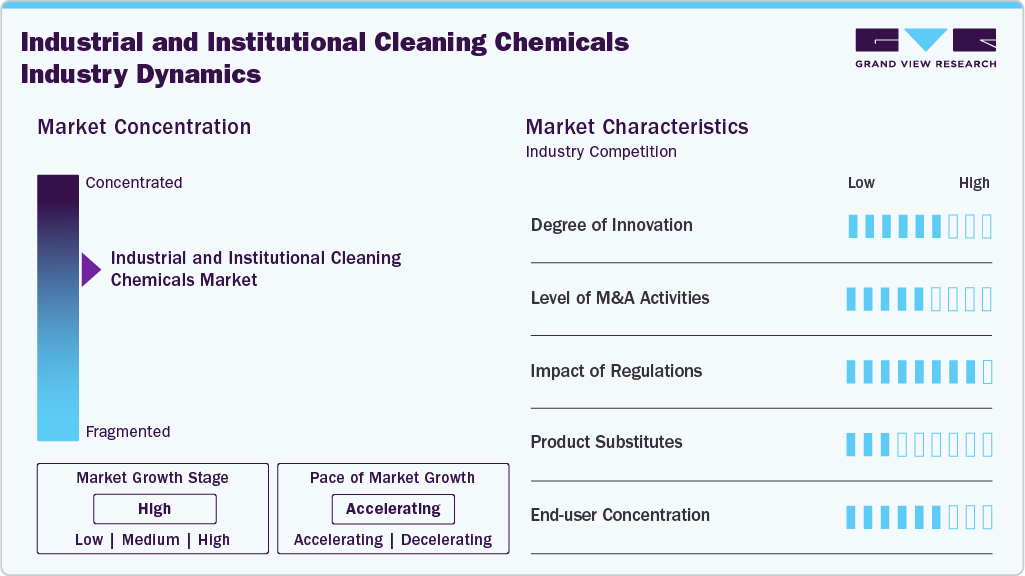
Despite the presence of large players, the market remains competitive due to the contribution of smaller, niche companies that focus on region-specific needs, green cleaning solutions, and customized service contracts. Barriers to entry include significant capital requirements for production facilities, complex regulatory approvals, and the need for robust distribution partnerships. Leading companies differentiate themselves through product performance, sustainable innovation, value-added services, and integrated hygiene management solutions, ensuring customer loyalty and compliance with evolving standards worldwide.
Raw material Insights
Surfactants segment dominated the market and accounted for the largest revenue share of 29.3% in 2025. This growth is driven by the wide use of surfactants as essential agents that reduce surface tension, allowing dirt, oil, and contaminants to be lifted and rinsed away efficiently. Surfactants are widely incorporated in disinfectants, detergents, degreasers, and specialized institutional cleaners for industries like healthcare, food processing, and hospitality. The increasing shift toward bio-based and biodegradable surfactants, prompted by stringent environmental standards and consumer demand for safer alternatives, further strengthens this segment’s position. Ongoing product innovation and performance enhancements ensure surfactants remain central to sustainable and high-performance cleaning solutions.
The solvent segment is expected to grow fastest with a CAGR of 8.5% from 2026 to 2033 during the forecast period. This growth is supported by the rising demand for specialty cleaners capable of dissolving tough greases, oils, and industrial residues. Growth is propelled by the need for highly effective degreasing and precision cleaning agents in sectors like manufacturing, automotive, and heavy equipment maintenance. Solvents enable efficient removal of stubborn contaminants, extending equipment life and ensuring hygiene compliance in regulated environments. The segment’s expansion is further fueled by technological advancements that focus on safer, low-VOC (volatile organic compounds) and environmentally friendly formulations. As industries balance performance with sustainability, demand for innovative, greener solvent systems continues to accelerate globally.
Product Insights
The general purpose cleaners segment led the market and accounted for the largest revenue share of 34.3% in 2025. This growth is driven by their versatility and widespread use across commercial buildings, schools, offices, healthcare facilities, and industrial sites. These cleaners are formulated to handle a broad range of dirt, grime, and stains on multiple surfaces, making them indispensable for daily maintenance and hygiene protocols. Rising awareness about workplace cleanliness, combined with strict facility management standards, continues to fuel demand. Additionally, the market is witnessing a shift toward low-toxicity, eco-friendly formulations as organizations aim to reduce their environmental impact while maintaining high cleaning efficiency, boosting the general purpose cleaners segment’s dominance further.
Disinfectants and sanitizers segment is anticipated to grow fastest with a CAGR of 8.4% from 2026 to 2033 during the forecast period. This segment is propelled by heightened awareness of infection prevention following recent global health crises. This segment’s expansion is propelled by strict sanitation requirements in critical sectors like hospitals, food processing plants, and hospitality, where surface hygiene is paramount. Increasing regulatory standards and certification requirements for high-level disinfection fuel ongoing product innovation, including the use of bio-based active ingredients and safer chemical blends. As businesses adopt rigorous cleaning protocols to ensure health and safety, demand for advanced, broad-spectrum disinfectants and sanitizers continues to rise worldwide.
End-use Insights
The manufacturing segment accounted for the largest revenue share of 69.8% in 2025. This growth is driven by stringent cleanliness protocols, rising awareness of health and safety, and the increasing emphasis on creating sanitized, welcoming environments for staff and visitors alike. The surge in commercial construction and facility management services worldwide further fuels product demand. Additionally, sustainability trends are influencing commercial end-users to adopt environmentally responsible cleaning products, boosting demand for biodegradable chemicals and green certifications. As businesses prioritize hygiene to protect occupants and brand reputation, the commercial segment continues to anchor the market’s steady expansion.
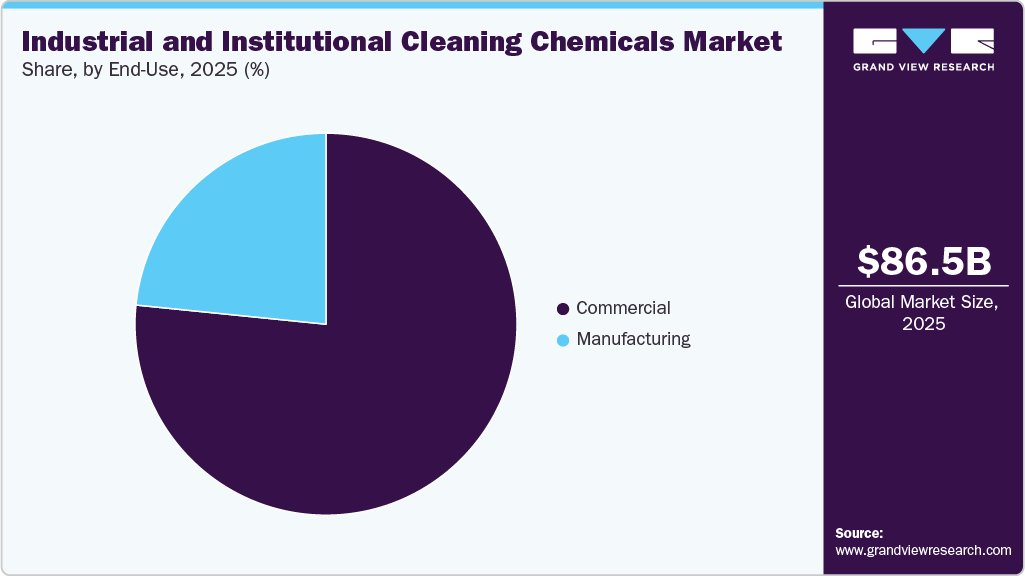
Manufacturing segment is expected to grow with a CAGR of 8.2% from 2026 to 2033 during the forecast period. This expansion is driven by the sector’s ongoing need for specialized cleaning agents to maintain equipment efficiency, ensure worker safety, and meet strict regulatory standards. Industries such as automotive, electronics, food processing, and heavy machinery rely on advanced cleaning chemicals for degreasing, precision cleaning, and sanitization of production areas. Growing industrial output in emerging economies, coupled with rising investment in automated and high-performance manufacturing lines, amplifies demand for effective, eco-friendly cleaning solutions. Innovations in low-VOC and biodegradable formulations further support this segment’s robust growth trajectory as sustainability becomes a key focus.
Regional Insights
The North America market accounted for the largest revenue share of 33.55% in 2025. It holds a strong share driven by strict health and sanitation protocols across healthcare, food processing, hospitality, and institutional spaces. Widespread investment in infrastructure and sustained hygiene awareness, bolstered by pandemic experiences, reinforced the demand for disinfectants, sanitizers, and eco‑friendly formulations. Regional growth is also stimulated by manufacturers developing enzyme‑based, biodegradable, and automation‑compatible solutions, alongside government-led sanitation initiatives. Market players continue to expand through collaborations, acquisitions, and new product launches, strengthening distribution channels and R&D capacities. While environmental regulations and competitive pricing present challenges, the region remains the benchmark for innovation and regulatory compliance in cleaning chemistry.
The industrial and institutional cleaning chemicals market in the U.S. is expected to grow at a substantial CAGR of 7.9% from 2026 to 2033. U.S. industrial and institutional cleaning chemicalsmarket growth is driven by heightened hygiene measures in healthcare settings and food industries. The pandemic heightened demand for institutional-grade sanitizers and disinfectants, prompting the mainstreaming of plant-based, non-toxic formulas. Manufacturers have responded through product innovation, elevating sustainable supply chains and acute infection control compliance. With extensive commercialization in hospitality, education, and public infrastructure, the U.S. market also benefits from strong R&D investments. Leading firms are leveraging digital distribution methods and strategic partnerships to roll out ozone‑safe alternatives and enzyme-driven detergents, aligning with evolving regulatory and end-user expectations without compromising efficacy.
Asia Pacific Industrial And Institutional Cleaning Chemicals Market Trends
Asia Pacific is expected to grow fastest, with a CAGR of 8.6% from 2026 to 2033 during the forecast period. It is primarily attributed robust industrial expansion in healthcare, food processing, automotive, and electronics manufacturing. Rising urbanization and infrastructure modernization have elevated hygiene standards, especially in institutional and public facilities. Post-pandemic shifts have catalyzed demand for enzyme‑based and eco-friendly products, with institutional buyers seeking sustainable and health-compliant formulations. Regional growth is supported by competitive production costs and regional manufacturing zones that encourage local innovation. Public health investments and international partnerships are expanding R&D capacity, accelerating uptake of chemical dosing technologies. Despite regulatory challenges and fragmented markets, sustained investment in cleaner manufacturing and managed hygiene services positions Asia Pacific as a key emerging player.
China’s industrial and institutional cleaning chemicals market is distinguished by the country’s anchored by large-scale healthcare and food processing development and government-led sanitation initiatives. Rising public health awareness and regulatory tightening have increased adoption of advanced cleaning agents, including enzyme-enhanced and solvent-based formulations. Local manufacturers are investing heavily in sustainable chemistry to support national carbon‑neutral goals and environmental mandates. The industrial sector remains a primary driver, as manufacturers require high cleanability standards. China’s market is also benefiting from government subsidies and the strategic prioritization of green chemicals.
Europe Industrial And Institutional Cleaning Chemicals Market Trends
Europe's market is also rapidly growing at a CAGR of 8.0% during the forecast period. The market is propelled by comprehensive health, food safety, and environmental regulations, particularly in Western Europe. Rising hygiene awareness, accelerated by public health campaigns, drives demand across healthcare, hospitality, and industrial manufacturing sectors. The regulatory emphasis on eco‑sustainable ingredients fosters adoption of biodegradable surfactants and enzyme-based cleaners. Innovation is channeled through public-private R&D efforts, supporting advances in automated dispensing and dose-optimized formulations. Despite environmental compliance and cost pressures, European players are differentiating via green credentials and tailored service models. Ongoing investment in sustainable chemistry, especially in institutional-grade solutions, reinforces Europe’s position as a mature yet evolving market.
Germany’s industrial and institutional cleaning chemicals market is experiencing consistent growth, driven by its advanced industrial base and quality-focused regulations. Its automotive, manufacturing, and food processing sectors create consistent demand for high-performance cleaning agents. Rising interest in sustainable product lines prompts investment in green chemistry and R&D within local supply chains. Companies are increasingly focusing on enzyme‑enhanced detergents, biodegradable surfactants, and automated dispenser systems to align with strict environmental and occupational standards. German manufacturers often integrate services such as hygiene consulting and controlled dosing systems to maintain compliance and operational efficiency. Regulatory mandates, particularly in healthcare and food safety, drive further innovation, reinforcing Germany’s role as a technology-centric and compliance-driven market within Europe.
Latin America Industrial And Institutional Cleaning Chemicals Market Trends
Latin America is steadily growing due to expanding healthcare, food processing, retail, and tourism sectors, all demanding institutional-grade hygiene. Nations like Brazil and Mexico are heightening sanitation standards, prompting hospitals, schools, and public facilities to upgrade to enzyme‑based and biodegradable cleaning agents. Urbanization trends are increasing demand in both public and private infrastructure, while regulatory agencies are gradually enforcing higher compliance levels. Manufacturers are responding with localized product formulations and service-driven offerings, including dosing systems and hygiene training. Despite logistical challenges and regulatory inconsistencies, rising public health investments and expanding middle classes are creating sustained momentum in institutional cleaning chemical consumption.
Middle East and Africa Industrial And Institutional Cleaning Chemicals Market Trends
Middle East and Africa are emerging as high-growth markets, supported by industrial diversification across Gulf Cooperation Council countries and South Africa. Investments in healthcare infrastructure, food processing facilities, and hospitality driven by tourism and economic diversification are elevating hygiene demands. Regional regulatory frameworks are strengthening, mirroring global sanitation standards for disinfectants and detergents. Local producers are increasingly adopting enzyme-based and biodegradable solutions to meet environmental criteria. While reliance on imports remains significant, international partnerships and market-tailored product lines are enhancing local capabilities. With infrastructure development and public health modernization, the region is evolving from fragmented supply into an opportunity-rich market with substantial future potential.
Key Industrial And Institutional Cleaning Chemicals Company Insights
Some of the key players operating in the market include BASF SE, Procter & Gamble, Reckitt-Benckiser, Dow, 3M, and Henkel AG & Co. KGaA., and others
-
BASF SE, headquartered in Ludwigshafen, Germany, is one of the world’s largest diversified chemical companies, operating across segments such as chemicals, materials, industrial solutions, surface technologies, nutrition & care, and agricultural solutions. The company’s vast portfolio ranges from basic chemicals and intermediates to advanced performance products, battery materials, and specialty additives. BASF is renowned for its robust global R&D network, backward-integrated production sites, and commitment to sustainability and circular economy principles. With a focus on innovation, digitalization, and climate neutrality, BASF serves industries including automotive, construction, agriculture, mining, and electronics, maintaining leadership through strategic partnerships and technological advancements.
-
Clariant AG, based in Muttenz, Switzerland, is a leading specialty chemicals company known for its focus on sustainability, innovation, and high-value specialty solutions. Its core business units include Care Chemicals, Catalysts, and Adsorbents & Additives, supplying products and services for industries like personal care, oil & gas, mining, plastics, and agriculture. Clariant emphasizes eco-friendly formulations and resource-efficient technologies, backed by a strong global R&D and production footprint. Through targeted investments, portfolio optimization, and a clear sustainability strategy, Clariant drives value creation and supports customers in transitioning to safer, more efficient, and environmentally responsible chemical applications worldwide.
Key Industrial And Institutional Cleaning Chemicals Companies:
The following are the leading companies in the industrial and institutional cleaning chemicals market. These companies collectively hold the largest market share and dictate industry trends.
- Procter & Gamble
- BASF SE
- Clariant
- The Clorox Company, Inc.
- Henkel AG & Co. KGaA
- 3M
- Kimberly-Clark Corporation
- Reckitt Benckiser Group plc
- Croda International PLC
- Albemarle Corporation
- Eastman Chemical Corporation
- Huntsman International LLC
- STEPAN Company
- Westlake Chemicals Corporation
- SOLVAY
- Dow
- Sasol
Recent Development
-
In August 2024, Ecolab Inc. advanced its product sustainability mission by installing its Ultrasil membrane technology at customer facilities. The aim is to help food and beverage clients maintain hygiene standards while lowering environmental impact. This move strengthens the Industrial and Institutional Cleaning Chemicals Market by integrating enzyme-based cleaning agents that replace harsh chemicals, driving safer, more efficient, and eco-friendly cleaning solutions globally..
-
In June 2024, Solenis announced the acquisition of Aqua ChemPacs LLC to expand its specialty chemical portfolio for institutional cleaning and disinfection. The aim is to integrate pre-portioned, dissolvable cleaning pods that allow customers to produce cleaners and disinfectants on-site. This strengthens the Industrial and Institutional Cleaning Chemicals Market by advancing sustainable, low-waste packaging and precise chemical dosing for diverse commercial facilities.
Industrial And Institutional Cleaning Chemicals Market Report Scope
Report Attribute
Details
Market size value in 2026
USD 91.64 billion
Revenue forecast in 2033
USD 156.99 billion
Growth rate
CAGR of 8.0% from 2026 to 2033
Base year for estimation
2025
Historical data
2021 - 2024
Forecast period
2026 - 2033
Quantitative units
Revenue in USD million/billion and CAGR from 2026 to 2033
Report coverage
Revenue forecast, volume forecast, competitive landscape, growth factors, and trends
Segments covered
Raw material, product, end-use, region
Regional scope
North America; Europe; Asia Pacific; Latin America; Middle East & Africa
Country scope
U.S.; Canada; Mexico; Germany; UK; France; Italy; China; India; Japan; South Korea; Brazil; Argentina; Saudi Arabia; South Africa
Key companies profiled
Procter & Gamble; BASF SE; Clariant; The Clorox Company, Inc.; Henkel AG & Co. KGaA; 3M; Kimberly-Clark Corporation; Reckitt Benckiser Group plc; Croda International PLC; Albemarle Corporation; Eastman Chemical Corporation; Huntsman International LLC; Stepan Company; Westlake Chemicals Corporation; SOLVAY; Dow; Sasol
Customization scope
Free report customization (equivalent up to 8 analyst’s working days) with purchase. Addition or alteration to country, regional, and segment scope.
Pricing and purchase options
Avail customized purchase options to meet your exact research needs. Explore purchase options
Global Industrial And Institutional Cleaning Chemicals Market Report Segmentation
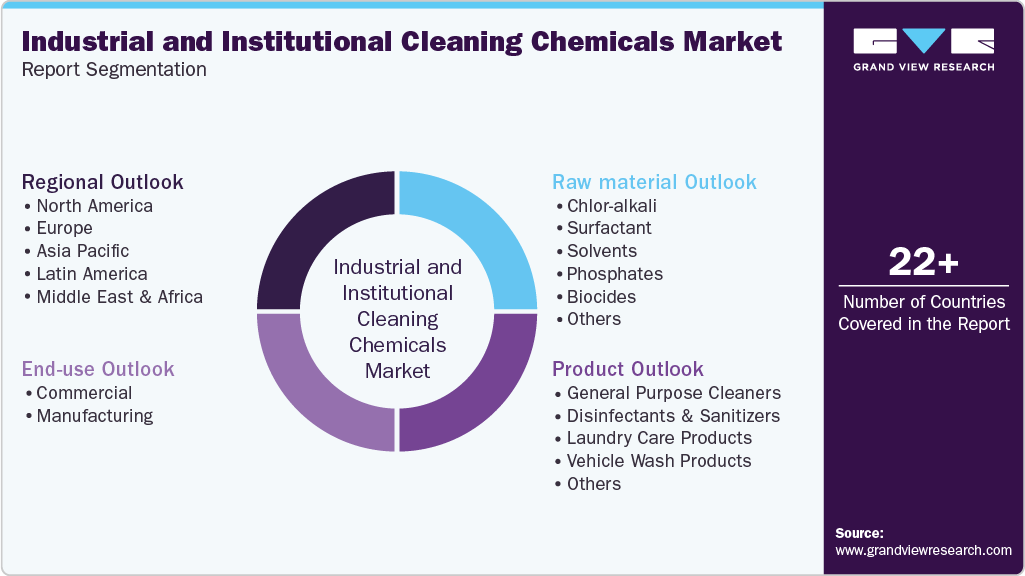
This report forecasts volume & revenue growth at a global level and provides an analysis of the latest industry trends in each of the sub-segments from 2021 to 2033. For this study, Grand View Research has segmented the global industrial and institutional cleaning chemicals market report based on raw material, product, end-use, and region:
-
Raw material Outlook (Revenue, USD Million, 2021 - 2033)
-
Chlor-alkali
-
Caustic Soda
-
Soda Ash
-
Chlorine
-
-
Surfactant
-
Nonionic
-
Anionic
-
Cationic
-
Amphoteric
-
-
Solvents
-
Alcohols
-
Hydrocarbons
-
Chlorinated
-
Ethers
-
Others
-
-
Phosphates
-
Biocides
-
Others
-
-
Product Outlook (Revenue, USD Million, 2021 - 2033)
-
General Purpose Cleaners
-
Disinfectants And Sanitizers
-
Laundry Care Products
-
Vehicle Wash Products
-
Others
-
-
End-use Outlook (Revenue, USD Million, 2021 - 2033)
-
Commercial
-
Food Service
-
Retail
-
Healthcare
-
Laundry Care
-
Institutional Buildings
-
Others
-
-
Manufacturing
-
Food & Beverage Processing
-
Metal Manufacturing & Fabrication
-
Electronic Components
-
Others
-
-
-
Region Outlook (Revenue, USD Million, 2021 - 2033)
-
North America
-
U.S.
-
Canada
-
Mexico
-
-
Europe
-
Germany
-
UK
-
France
-
Italy
-
-
Asia Pacific
-
China
-
India
-
Japan
-
South Korea
-
-
Latin America
-
Brazil
-
Argentina
-
-
Middle East & Africa
-
Saudi Arabia
-
South Africa
-
-
Frequently Asked Questions About This Report
b. The global industrial and institutional cleaning chemicals market size was estimated at USD 86.46 billion in 2025 and is expected to reach USD 91.64 billion in 2025.
b. The global industrial and institutional cleaning chemicals market is expected to grow at a compound annual growth rate of 8.0% from 2026 to 2033 to reach USD 156.99 billion in 2033
b. North America market accounted for the largest revenue share of 33.6% in 2025. This can be attributed to the rising usage driven by heightened hygiene needs during the ongoing pandemic and the increasing demand from diverse industries to maintain cleanliness in their production facilities. North America remains a mature and well-developed market, serving as a key manufacturing center for various sectors, which continues to fuel strong demand for industrial and institutional cleaning chemical products.
b. Some key players operating in the industrial and institutional cleaning chemicals market include Procter & Gamble; BASF SE; Clariant; The Clorox Company, Inc.; Henkel AG & Co. KGaA; 3M; Kimberly-Clark Corporation; Reckitt Benckiser Group plc; Croda International PLC; Albemarle Corporation; Eastman Chemical Corporation; Huntsman International LLC; Stepan Company; Westlake Chemicals Corporation; SOLVAY; Dow; Sasol.
b. The industrial and institutional cleaning chemicals market is driven by strict hygiene regulations, heightened sanitation awareness post-pandemic, rapid industrialization, and strong demand from healthcare, food processing, and commercial sectors. Growing adoption of eco-friendly, bio-based solutions and technological innovations in cleaning formulations further boost market expansion and sustainability initiatives.


Share this report with your colleague or friend.
Need a Tailored Report?
Customize this report to your needs — add regions, segments, or data points, with 20% free customization.


ISO 9001:2015 & 27001:2022 Certified
We are GDPR and CCPA compliant! Your transaction & personal information is safe and secure. For more details, please read our privacy policy.
Trusted market insights - try a free sample
See how our reports are structured and why industry leaders rely on Grand View Research. Get a free sample or ask us to tailor this report to your needs.