Industrial Hemp Market Summary
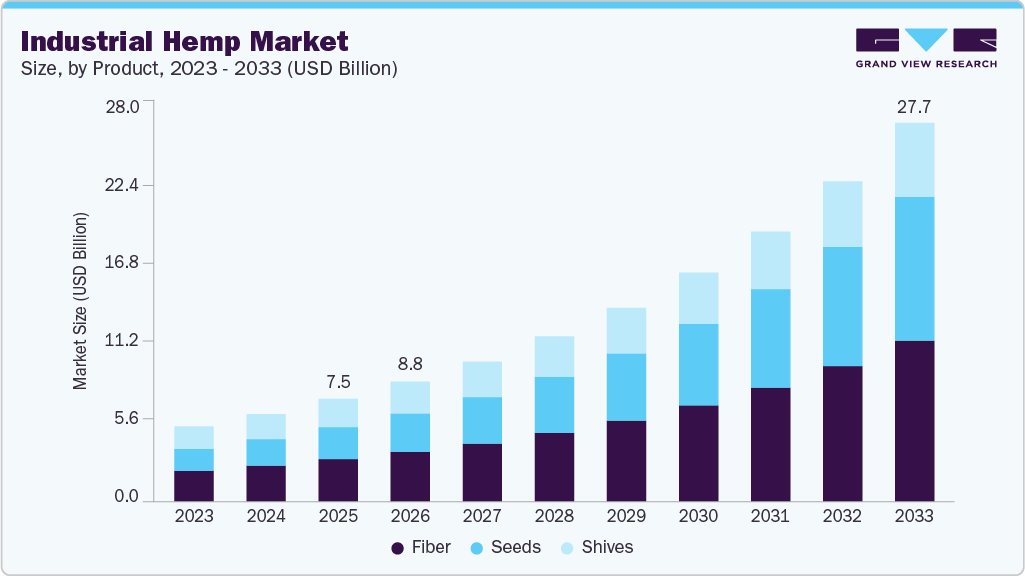
The global industrial hemp market size was estimated at USD 7.5 billion in 2025 and is projected to reach USD 27.7 billion by 2033, growing at a CAGR of 17.9% from 2026 to 2033. Rising demand for sustainable and eco-friendly materials across industries such as textiles, construction, and packaging is significantly driving the growth of the global market for industrial hemp.
Key Market Trends & Insights
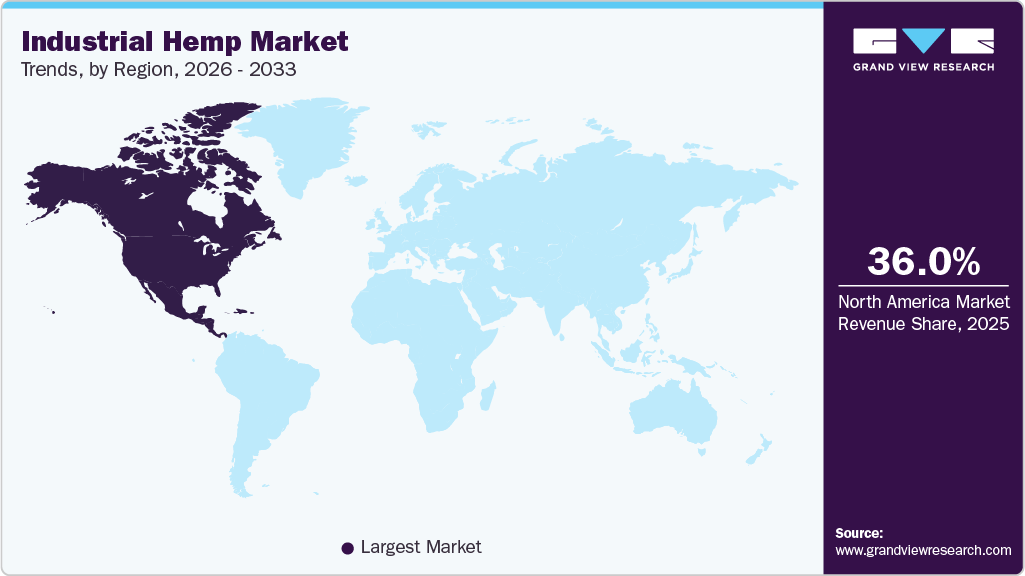
- North America was the largest market for industrial hemp consumption in 2025, with a revenue share of 36.0%.
- U.S. is expected to grow at a CAGR of 20.9% during the forecast period.
- By product, the seeds segment is projected to register a 20.6% CAGR in revenue from 2026 to 2033.
- By application, the textiles segment is forecast to witness the fastest growth at a 20.2% CAGR in revenue during 2026 to 2033.
Market Size & Forecast
- 2025 Market Size: USD 7.5 Billion
- 2033 Projected Market Size: USD 27.7 Billion
- CAGR (2026-2033): 17.9%
- North America: Largest market in 2025
In addition, increasing legalization and regulatory support for hemp cultivation, along with its expanding applications in food, personal care, and pharmaceuticals, are further accelerating market expansion. The global industrial hemp industry is being strongly driven by increasing demand for sustainable and eco-friendly raw materials across multiple industries. Hemp is a highly versatile crop that requires significantly less water, pesticides, and fertilizers compared to conventional crops such as cotton, making it an attractive alternative in the context of rising environmental concerns. Industries such as textiles, construction, packaging, and automotive are increasingly adopting hemp-based materials such as hemp fiber, hempcrete, and bioplastics to reduce their carbon footprint and align with circular economy principles. This shift toward sustainability, supported by tightening environmental regulations and corporate ESG commitments, is accelerating the adoption of industrial hemp globally.
The expanding application of hemp-derived products in the food, beverage, and personal care industries, is also boosting the market growth. Hemp seeds and oil are rich in essential fatty acids, protein, and nutrients, positioning them as a popular ingredient in health-conscious consumer markets. In addition, the rising popularity of plant-based diets and functional foods is boosting demand for hemp-based products such as protein powders, snacks, and beverages. In the personal care sector, hemp-derived ingredients are increasingly used in skincare and cosmetics due to their moisturizing and anti-inflammatory properties, further widening the market scope and creating new revenue streams.
Moreover, regulatory liberalization across major economies is playing a crucial role in driving market growth. Governments in regions such as North America and Europe have relaxed restrictions on hemp cultivation and processing, distinguishing industrial hemp from psychoactive cannabis based on low THC content. This has encouraged large-scale farming, investment, and innovation in hemp-based product development. In addition, growing awareness among farmers regarding hemp’s high yield potential and profitability compared to traditional crops is supporting its cultivation. As regulatory frameworks continue to evolve and global acceptance increases, the industrial hemp industry is expected to witness sustained expansion across both developed and emerging economies.
Market Concentration & Characteristics
Evolving regulatory landscape and fragmented global framework is one of the defining characteristics of the industry. While many countries have legalized industrial hemp cultivation, regulations regarding THC limits, licensing, and processing differ widely across regions. This creates both opportunities and challenges for market participants, as companies must navigate compliance requirements while scaling operations. The industry is still in a semi-mature stage, with significant variations in policy clarity between developed regions like North America and Europe and emerging markets in Asia Pacific and Latin America.
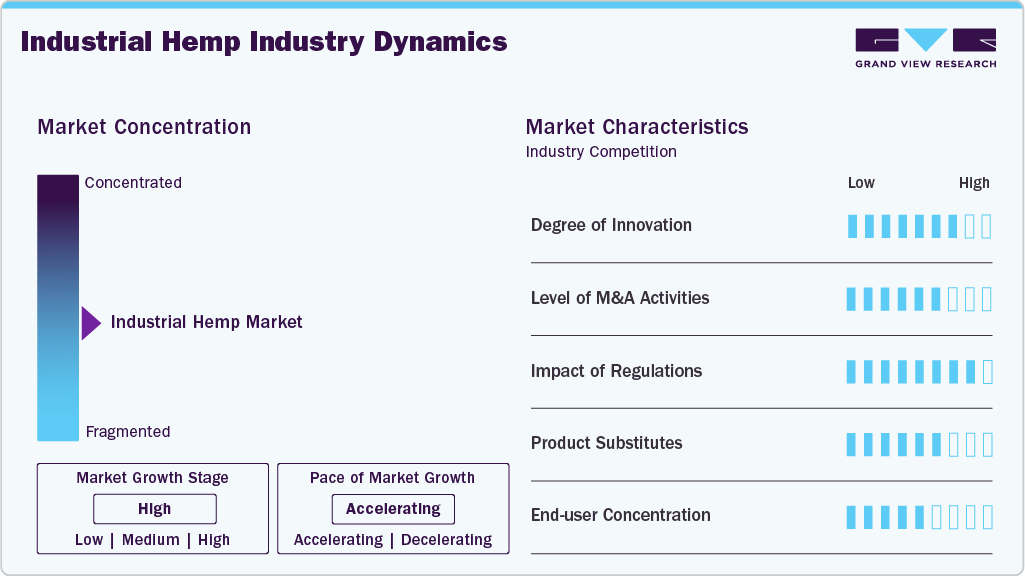
The market is also marked by a developing value chain and limited processing infrastructure in many regions. Unlike established agricultural commodities, industrial hemp requires dedicated decortication, fiber processing, and extraction facilities, which are still underdeveloped in several countries. This leads to supply-demand imbalances and cost inefficiencies, especially for high-quality processed materials. In addition, the industry is witnessing increasing investment, innovation, and vertical integration, as companies aim to control raw material sourcing, processing, and end-product manufacturing to improve margins and ensure consistent quality.
Product Insights
The fiber segment dominated the industrial hemp industry in 2025, accounting for 41.3% of the total revenue share. This dominance is due to its widespread use across high-demand industries such as textiles, construction (hempcrete), automotive composites, and sustainable packaging. Its strong mechanical properties, biodegradability, and alignment with sustainability trends made it a preferred alternative to synthetic fibers and conventional materials. In addition, growing investments in eco-friendly materials and infrastructure further accelerated demand for hemp fiber globally.
The seeds segment is anticipated to be the fastest-growing segment over the forecast period, due to rising demand for nutrient-rich, plant-based foods and functional ingredients. Hemp seeds are widely used in protein powders, snacks, and beverages owing to their high protein, omega fatty acids, and health benefits. In addition, increasing consumer preference for vegan and clean-label products is accelerating the adoption of hemp seed-based offerings.
Application Insights
The textiles segment accounted for the largest revenue share of 27.0% in 2025, due to rising demand for sustainable and durable fibers as alternatives to cotton and synthetic materials. Hemp fibers offer high strength, breathability, and lower environmental impact, making them increasingly preferred by eco-conscious apparel and fashion brands. In addition, growing regulations and industry shifts toward sustainable textiles have further supported segment dominance.
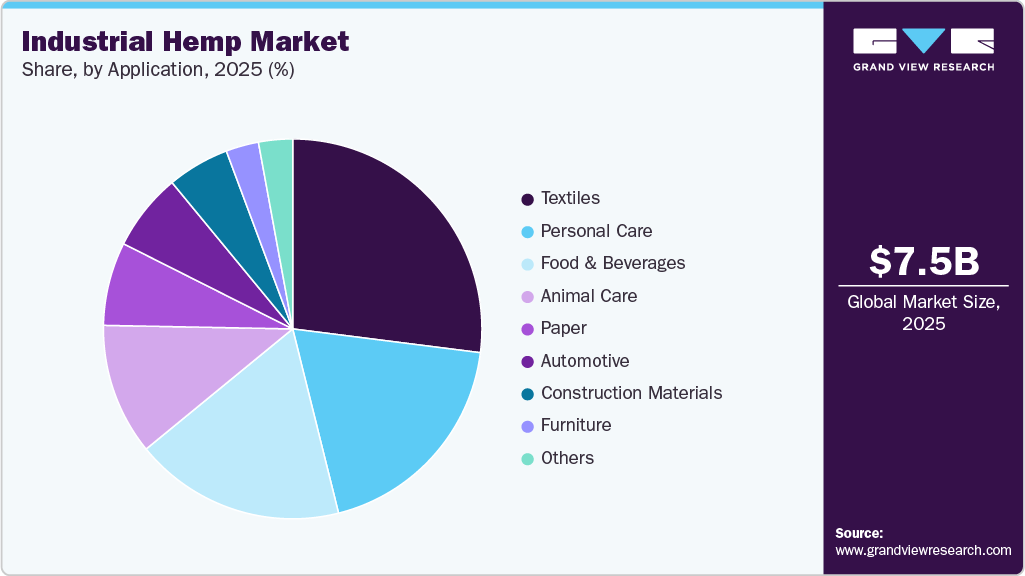
The personal care segment is witnessing strong growth in the market due to increasing demand for natural and organic ingredients in skincare and cosmetics. Hemp-derived oil is rich in essential fatty acids and antioxidants, making it highly effective for moisturizing, anti-inflammatory, and anti-aging formulations. In addition, rising consumer preference for clean-label, plant-based beauty products is accelerating its adoption across global personal care brands.
Regional Insights
North America industrial hemp industry dominated the global market with a revenue share of 36.0% in 2025, due to favorable regulatory frameworks, particularly the legalization of hemp cultivation and commercialization under policies such as the U.S. Farm Bill 2018. This has enabled large-scale production, increased investments, and rapid expansion of processing infrastructure across the region. In addition, strong demand from end-use industries such as food & beverages, personal care, textiles, and CBD-related products, along with the presence of established players and advanced supply chains, has further strengthened North America’s leading position in the global market.
U.S. Industrial Hemp Market Trends
U.S. industrial hemp industry remains a key market for industrial hemp due to its well-established agricultural ecosystem and large-scale farming capabilities, enabling consistent raw material supply. Strong demand from end-use industries such as textiles, construction, and nutraceuticals, coupled with increasing adoption of hemp-based alternatives in sustainable manufacturing, supports market expansion. Furthermore, the presence of a mature consumer market with high awareness of plant-based and eco-friendly products continues to strengthen the country’s position in the global industrial hemp industry.
Europe Industrial Hemp Market Trends
Europe industrial hemp industry is a leading region in the global market, driven by strong government support for sustainable agriculture and bio-based industries. The presence of organizations such as the European Industrial Hemp Association (EIHA) plays a crucial role in promoting hemp cultivation, standardization, and policy advocacy across the region. Europe also benefits from well-established cultivation practices, particularly in countries like France and Germany, along with advanced processing capabilities. In addition, stringent environmental regulations and increasing demand for eco-friendly materials in automotive, construction, and textiles are significantly boosting hemp adoption across the region.
Key Industrial Hemp Company Insights
The competitive environment of the industrial hemp industry is moderately fragmented, characterized by the presence of a mix of regional processors, agricultural producers, and vertically integrated companies competing across diverse application segments. Companies are focusing on strategies such as capacity expansion, product innovation, and vertical integration to strengthen control over raw material supply and improve margins.
The market is witnessing increasing partnerships and strategic collaborations, particularly to enhance processing capabilities and develop high-value applications in textiles, bioplastics, food, and personal care. In addition, competition is intensifying as new entrants and startups leverage sustainability trends, while established players invest in advanced processing technologies and branding to differentiate their offerings in a rapidly evolving and regulation-driven market.
-
In January 2026, New York State invested USD 1 million in a cutting-edge hemp manufacturing lab at Rensselaer Polytechnic Institute (RPI) to pioneer carbon-negative building materials from industrial hemp. This initiative will transform hemp fibers into structural blocks, natural-fiber rebar, insulated panels, and siding, addressing construction's high carbon emissions while building a local circular bioeconomy.
-
In November 2025, MariMed Inc., a leading cannabis consumer packaged goods company, announced plans to launch hemp-derived THC versions of its top-selling brands, Vibations and Betty’s Eddies, starting with a hydrating drink mix in Rhode Island by early Q1 2026. This move, part of its "Expand the Brand" strategy, taps into the booming hemp beverage market.
Key Industrial Hemp Companies:
The following key companies have been profiled for this study on the industrial hemp market.
- Parkland Industrial Hemp Growers Cooperative Ltd.
- CBD Biotechnology Co.
- Botanical Genetics, LLC
- Marijuana Company of America Inc.
- HempMeds Brasil
- Terra Tech Corp.
- American Cannabis Company, Inc.
- HempFlax B.V.
- Industrial Hemp Manufacturing, LLC
- American Hemp
- Hemp, Inc.
- Boring Hemp Company
- Plains Industrial Hemp Processing Ltd.
- Ecofiber Industries Operations
- Valley Bio Limited
Industrial Hemp Market Report Scope
|
Report Attribute
|
Details
|
|
Market size value in 2026
|
USD 8.8 billion
|
|
Revenue forecast in 2033
|
USD 27.7 billion
|
|
Growth rate
|
CAGR of 17.9% from 2026 to 2033
|
|
Base year for estimation
|
2025
|
|
Historical data
|
2021 - 2024
|
|
Forecast period
|
2026 - 2033
|
|
Quantitative units
|
Revenue in USD million, volume in tons, and CAGR from 2026 to 2033
|
|
Report coverage
|
Revenue forecast, volume forecast, company ranking, competitive landscape, growth factors, and trends
|
|
Segments covered
|
Product, application, region
|
|
Regional scope
|
North America; Europe; Asia Pacific; Latin America; Middle East & Africa
|
|
Country scope
|
U.S.; Canada; Mexico; Germany; UK; France; China; India; Japan; Brazil
|
|
Key companies profiled
|
Parkland Industrial Hemp Growers Cooperative Ltd.; CBD Biotechnology Co.; Botanical Genetics, LLC; Marijuana Company of America Inc.; HempMeds Brasil; Terra Tech Corp.; American Cannabis Company, Inc.; HempFlax B.V.; Industrial Hemp Manufacturing, LLC; American Hemp; Hemp, Inc.; Boring Hemp Company; Plains Industrial Hemp Processing Ltd.; Ecofiber; Industries Operations; Valley Bio Limited
|
|
Customization scope
|
Free report customization (equivalent up to 8 analysts’ working days) with purchase. Addition or alteration to country, regional, and segment scope.
|
|
Pricing and purchase options
|
Avail customized purchase options to meet your exact research needs. Explore purchase options
|
Global Industrial Hemp Market Report Segmentation
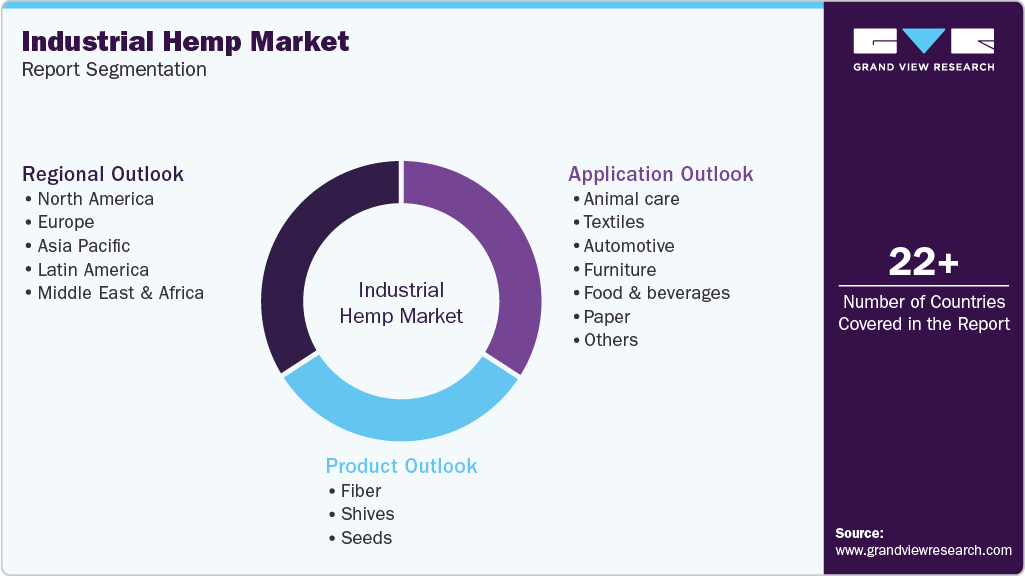
This report forecasts revenue & volume growth at the global, regional, and country levels and provides an analysis of the latest industry trends in each of the sub-segments from 2021 to 2033. For this study, Grand View Research has segmented the global industrial hemp market report based on product, application, and region:
-
Product Outlook (Volume, Tons; Revenue, USD Million, 2021 - 2033)
-
Application Outlook (Volume, Tons; Revenue, USD Million, 2021 - 2033)
-
Animal care
-
Textiles
-
Automotive
-
Furniture
-
Food & beverages
-
Paper
-
Construction materials
-
Personal care
-
Others
-
Regional Outlook (Volume, Tons; Revenue, USD Million, 2021 - 2033)
-
North America
-
Europe
-
Asia Pacific
-
Latin America
-
Middle East & Africa
Frequently Asked Questions About This Report
b. North America dominated the industrial hemp market with a share of 36.0% in 2025, owing to rising production and consumption of industrial hemp in the region coupled with the presence of well-established market players with robust supply chains.
b. Some key players operating in the industrial hemp market include Parkland Industrial Hemp Growers Cooperative Ltd., CBD Biotechnology Co., Botanical Genetics, LLC, Marijuana Company of America Inc., and HempMeds Brasil.
b. Key factors that are driving the market growth include rising demand from the application industries coupled with agricultural and environmental product benefits.
b. The global industrial hemp market size was estimated at USD 7.5 billion in 2025 and is expected to reach USD 8.8 billion in 2026.
b. The global industrial hemp market is expected to grow at a compound annual growth rate of 17.9% from 2026 to 2033 to reach USD 27.7 billion by 2033.

 Download Sample Report