- Home
- »
- Paints, Coatings & Printing Inks
- »
-
Hydrophilic Coatings Market Size, Industry Report, 2033GVR Report cover
![Hydrophilic Coatings Market Size, Share & Trends Report]()
Hydrophilic Coatings Market (2026 - 2033) Size, Share & Trends Analysis Report By Substrate (Polymers, Glass, Metal, Nanoparticles), By Application (Aerospace, Automotive, Marine, Medical devices & equipment, Optical), By Region, And Segment Forecasts
- Report ID: GVR-1-68038-222-8
- Number of Report Pages: 80
- Format: PDF
- Historical Range: 2021 - 2024
- Forecast Period: 2026 - 2033
- Industry: Bulk Chemicals
- Report Summary
- Table of Contents
- Segmentation
- Methodology
- Download FREE Sample
-
 Download Sample Report
Hydrophilic Coatings Market Summary
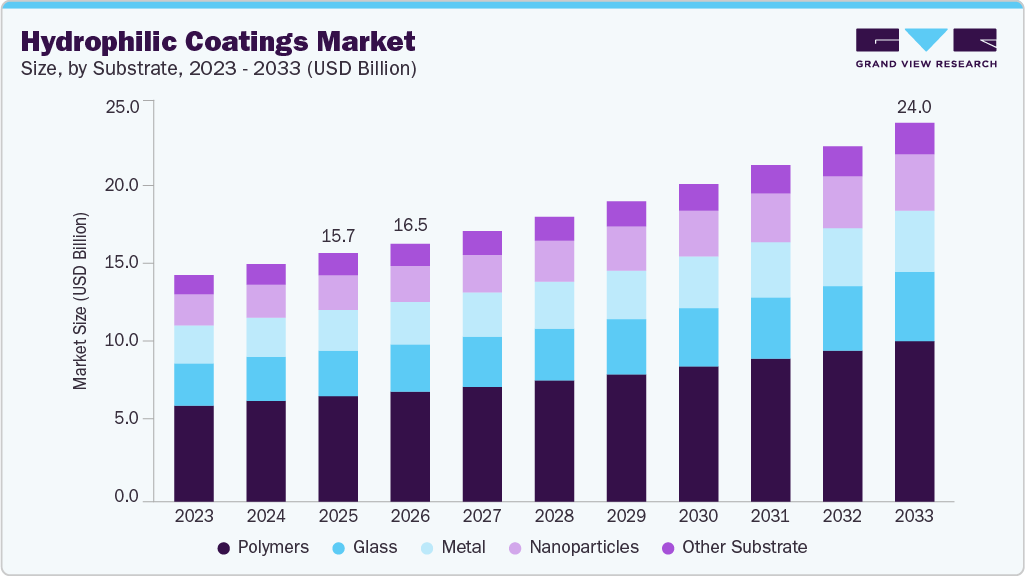
The global hydrophilic coatings market size was valued at USD 15.7 billion in 2025 and is projected to reach USD 24.0 billion by 2033, growing at a CAGR of 5.6% from 2026 to 2033. Demand rises because device makers and OEMs need reliable surface performance without redesigning core materials, and end users value smoother handling, clearer optics, and easier cleaning across healthcare, electronics, and manufacturing.
Key Market Trends & Insights
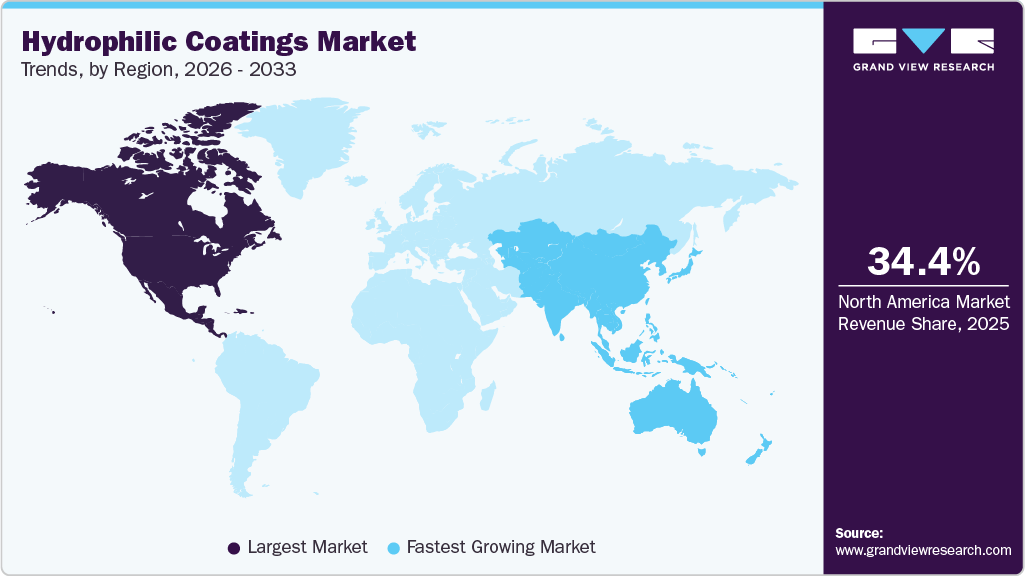
- North America held the largest share of the market in 2025, accounting for 34.4% of revenue.
- The China hydrophilic coatings industry led Asia Pacific, with a revenue share of 46.3% in 2025.
- By substrate, the nanoparticles segment is projected to record the fastest growth, with a CAGR of 6.5% from 2026 to 2033.
- By application, the medical devices & equipment segment led the market in 2025, accounting for 41.9% of total revenue.
Market Size & Forecast
- 2025 Market Size: USD 15.7 Billion
- 2033 Projected Market Size: USD 24.0 Billion
- CAGR (2026-2033): 5.6%
- North America: Largest market in 2025
- Asia Pacific: Fastest growing market
The largest pull comes from medical devices where hydrophilic, lubricious surfaces lower insertion force on catheters, guidewires, and sheath introducers and can reduce procedure time. Hospitals and clinicians prefer coatings that keep slipperiness after storage and during long procedures, so suppliers invest in chemistries that resist delamination and maintain wet performance. As minimally invasive treatments expand into smaller vessels, coating uniformity on complex geometries becomes a purchasing requirement, pushing higher value per device. This favors qualified vendors with validated processes and cleanroom-ready production.Outside healthcare, optical and sensor applications use hydrophilic layers to prevent fog and create self-wetting films that preserve image quality. Automotive camera modules, displays, and mirrors benefit when water sheets off uniformly, improving visibility for safety systems. Industrial users seek anti-soiling surfaces that reduce maintenance and chemical use, aligning with procurement targets for lower lifecycle costs. These needs shift buying criteria from raw coating price to durability, adhesion to diverse substrates, and repeatable line speed in high-volume manufacturing operations.
Suppliers are responding by offering UV-curable and water-based systems, tighter control over surface preparation, and coating packages delivered with application know-how. Partnerships between coating formulators and contract coaters help device firms qualify materials more quickly while meeting documentation and biocompatibility requirements. Competitive differentiation is moving toward longer-lasting lubricity, thinner films that do not change dimensions, and chemistries compatible with sterilization. Through 2033, growth should track procedure volumes, sensor proliferation, and rising quality requirements that reward proven, scalable coating platforms across industries.
Market Concentration & Characteristics
The hydrophilic coatings industry exhibits a moderately concentrated structure, with a limited number of specialized manufacturers possessing strong technological capabilities. This occurs because the coatings require advanced polymer chemistry, surface engineering expertise, and strict quality control. Many end users prefer suppliers with proven coating performance and regulatory compliance, particularly in sensitive applications such as medical devices.
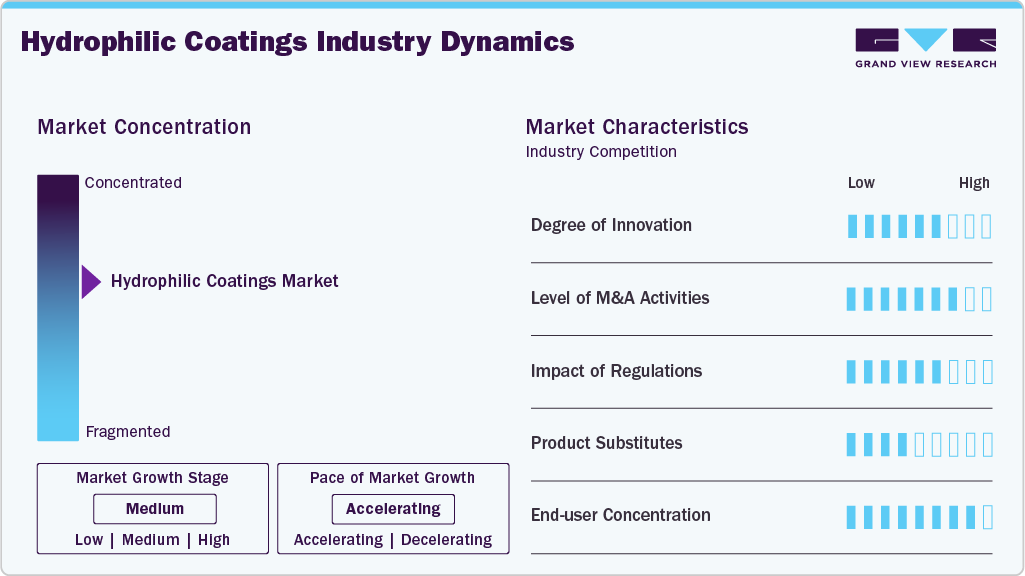
The market also shows characteristics of technology-driven competition and close collaboration between coating developers and device manufacturers. This happens because hydrophilic coatings must be customized for different substrates and performance conditions. Long qualification cycles, validation testing, and integration into manufacturing processes create strong supplier relationships, making switching suppliers less frequent and strengthening the position of established coating providers.
Substrate Insights
The polymers segment held the largest share of the hydrophilic coatings market in 2025 with 42.5% of total revenue, largely due to its extensive use across medical devices, optical products, and industrial components. Polymer substrates such as polyurethane, polyethylene, and polyamide are widely adopted because they provide flexibility, durability, and compatibility with hydrophilic coating chemistries. Medical devices, including catheters, guidewires, and vascular access tools, frequently use polymer surfaces where lubricious coatings reduce friction during insertion.
The nanoparticles segment is expected to grow at the fastest pace, registering a CAGR of 6.5% between 2026 and 2033. Nanoparticle-based coatings provide improved surface functionality, including enhanced wettability, antimicrobial performance, and greater durability compared with traditional coating materials. Industries such as medical technology, electronics, and advanced optics increasingly explore nano-engineered surfaces to achieve precise control over surface behavior. These coatings can form extremely thin and uniform layers that improve performance without altering substrate properties.
Application Insights
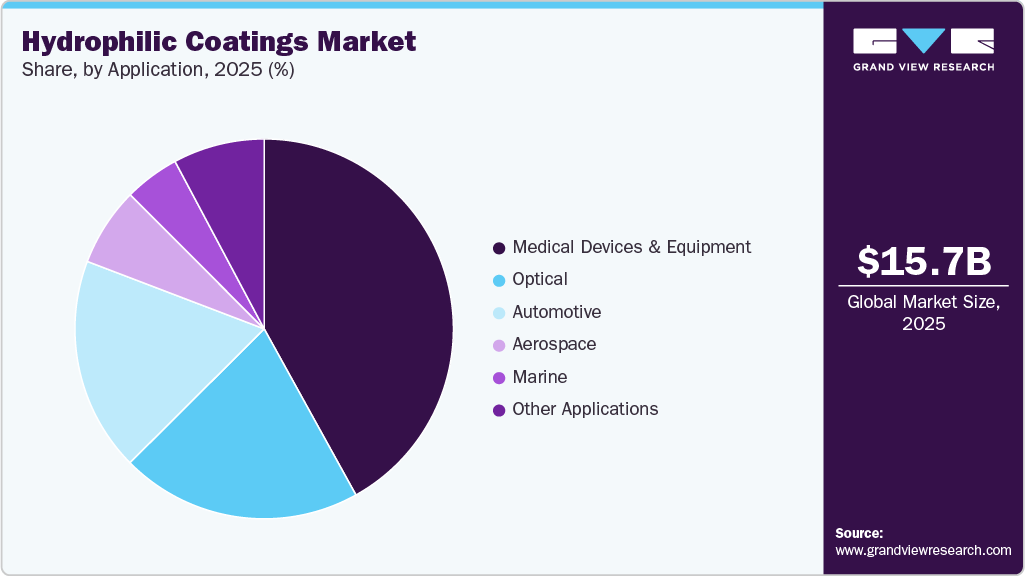
The medical devices and equipment segment accounted for 41.9% of total revenue in 2025, reflecting strong demand from minimally invasive medical procedures. Hydrophilic coatings are widely applied on catheters, guidewires, sheath introducers, and endoscopic devices to reduce friction during insertion and navigation within blood vessels. Hospitals and physicians increasingly prefer coated devices because smoother surface performance can improve procedural precision and patient comfort.
>
The aerospace segment is projected to register the fastest growth in the market, expanding at a CAGR of 6.8% between 2026 and 2033. Aerospace systems require advanced surface treatments that can manage moisture behavior, reduce contamination, and maintain optical clarity in sensors and cockpit displays. Hydrophilic coatings help prevent fog formation on transparent components and improve the performance of monitoring equipment used in aircraft systems. As aircraft manufacturers increase the use of sophisticated sensors and electronic monitoring devices, the need for reliable surface coatings continues to rise.
Regional Insights
The hydrophilic coatings industry in North America accounted for 34.4% of total revenue in 2025, supported by the presence of advanced medical technology manufacturers and well-established healthcare infrastructure. The region shows strong adoption of coated medical devices such as catheters, guidewires, and vascular access products, where hydrophilic surfaces improve device performance during minimally invasive procedures. Research institutions and specialized coating developers are actively engaged in developing new surface treatment technologies, which support steady innovation in the market. High regulatory standards also encourage manufacturers to adopt reliable coating solutions that enhance safety, durability, and consistent device functionality.
U.S. Hydrophilic Coatings Market Trends
The U.S. hydrophilic coatings industry is supported by a strong medical technology ecosystem and high adoption of minimally invasive procedures. Hospitals frequently use coated catheters, guidewires, and vascular access devices to improve procedural efficiency and patient safety. Device manufacturers in the country invest heavily in advanced surface technologies to maintain product differentiation and comply with strict regulatory requirements. The presence of specialized coating developers and contract coating service providers further strengthens the market. Continuous research in biomaterials and surface engineering across academic and industrial laboratories also drives steady innovation in hydrophilic coating formulations and applications.
Asia Pacific Hydrophilic Coatings Market Trends
The hydrophilic coatings industry in the Asia Pacific is expected to record the fastest expansion, with a CAGR of 6.2% from 2026 to 2033. Growth is influenced by increasing production of medical devices, electronics, and optical components across several emerging manufacturing hubs. Companies are investing in advanced surface engineering technologies to improve product quality and meet international manufacturing standards. Expanding healthcare services and rising demand for minimally invasive medical procedures also increase the use of coated devices in clinical settings. Continuous improvement in industrial capabilities and growing participation of regional manufacturers contribute to the accelerating demand for hydrophilic coating solutions.
The China hydrophilic coatings industry is expanding as domestic medical device production and healthcare infrastructure continue to develop. Manufacturers in the country are increasing production of vascular access devices, diagnostic tools, and minimally invasive surgical equipment, which often require lubricious surface coatings. Local companies are investing in advanced manufacturing techniques and material science research to meet international quality standards. Government initiatives encouraging the growth of the medical technology sector also support innovation in coating technologies. As domestic manufacturers move toward higher value medical products, demand for specialized surface treatments such as hydrophilic coatings continues to rise.
Europe Hydrophilic Coatings Market Trends
The hydrophilic coatings industry in Europe benefits from the region’s well-established medical device manufacturing sector and strong regulatory framework for healthcare products. Countries across the region are focusing on improving clinical outcomes and procedural safety, which is driving the use of coated devices in cardiology, urology, and interventional procedures. European manufacturers emphasize high-precision engineering and reliable surface performance, driving consistent demand for advanced coating technologies. Research collaborations among universities, biomedical institutes, and specialty chemical companies further support the development of new coating materials that enhance durability, wettability, and compatibility with various medical substrates.
The Germany hydrophilic coatings industry represents a significant contributor within the European market due to its strong engineering capabilities and leadership in medical device manufacturing. The country hosts numerous device producers specializing in cardiovascular and diagnostic equipment, which frequently incorporate hydrophilic coatings to enhance device performance. German manufacturers emphasize high-quality production standards and precision manufacturing processes, creating demand for reliable coating solutions that maintain consistent surface properties. Research institutions and technical universities actively explore advanced biomaterials and polymer technologies, supporting innovation in coating chemistry and strengthening the country’s position in specialized medical technologies.
Latin America Hydrophilic Coatings Market Trends
The hydrophilic coatings industry in Latin America is influenced by gradual expansion of healthcare services and growing adoption of minimally invasive treatment methods. Hospitals in several countries are increasing the use of coated catheters and guidewires to improve procedural efficiency and patient comfort. Medical device distributors and healthcare providers are also introducing advanced interventional technologies to meet the rising demand for cardiovascular and diagnostic procedures. Although manufacturing capacity in the region remains limited compared with developed markets, increased imports of coated medical devices and improved healthcare access are contributing to steady demand for hydrophilic coating applications.
Middle East & Africa Hydrophilic Coatings Market Trends
The hydrophilic coatings industry in the Middle East and Africa is developing alongside improvements in healthcare infrastructure and investment in modern medical technologies. Hospitals and specialized treatment centers are gradually adopting coated medical devices used in cardiology and diagnostic procedures. Government initiatives aimed at expanding healthcare capacity and improving clinical services are encouraging the introduction of advanced medical equipment. Medical device suppliers in the region often rely on imported technologies that incorporate hydrophilic coatings to enhance performance and safety. As healthcare systems modernize, the adoption of advanced surface-coated devices is expected to increase steadily.
Key Hydrophilic Coatings Company Insights
The two key dominant manufacturers in the hydrophilic coatings market are Surmodics Inc. and Hydromer Inc. Both companies are recognized for their expertise in advanced surface modification technologies and their focus on developing high-performance coating solutions for medical device applications.
-
Surmodics Inc. develops advanced surface technologies designed to improve the performance of medical devices used in minimally invasive procedures. The company focuses on hydrophilic and lubricious coating platforms that enhance device maneuverability and surface compatibility. Its technologies are widely integrated into cardiovascular, vascular, and diagnostic devices, supporting improved procedural efficiency and consistent surface performance across complex medical device applications.
-
Hydromer Inc. specializes in hydrophilic polymer coating technologies used to improve wettability and reduce friction on medical and industrial surfaces. The company develops coating formulations that enhance device functionality and durability while maintaining strong adhesion to polymer and metal substrates. Its solutions are commonly applied to medical instruments and healthcare technologies where reliable surface performance and controlled interaction with fluids are essential.
Key Hydrophilic Coatings Companies:
The following key companies have been profiled for this study on the hydrophilic coatings market.
- Surmodics Inc.
- Hydromer Inc.
- Biocoat Inc.
- AST Products Inc.
- Aculon Inc.
- Surface Solutions Group LLC
- DSM Biomedical (dsm-firmenich)
- Tokyo Ohka Kogyo Co., Ltd.
- BioInteractions Ltd.
- Covalon Technologies Ltd.
Recent Developments
-
In February 2026, Freudenberg Medical launched LUBRITEQ, a UV-curable, single-step hydrophilic coating solution for medical devices, alongside development and manufacturing services, aiming to improve lubricity, durability, and manufacturability while supporting customers throughout the product lifecycle from feasibility to commercial production.
-
In August 2025, Merit Medical launched the Prelude Wave Hydrophilic Sheath Introducer with SnapFix Securement Technology in the U.S., designed to improve radial access procedures by enhancing lubricity, reducing insertion force, and minimizing risks of arterial spasm and occlusion.
Hydrophilic Coatings Market Report Scope
Report Attribute
Details
Market size value in 2026
USD 16.5 billion
Revenue forecast in 2033
USD 24.0 billion
Growth rate
CAGR of 5.6% from 2026 to 2033
Base year for estimation
2025
Historical data
2021 - 2024
Forecast period
2026 - 2033
Quantitative units
Revenue in USD million/billion, Volume in Kilotons, and CAGR from 2026 to 2033
Report coverage
Revenue forecast, company ranking, competitive landscape, growth factors, and trends
Segments covered
Substrate, application, region
Regional scope
North America; Europe; Asia Pacific; Latin America; Middle East & Africa
Country scope
U.S.; Canada; Mexico; Brazil; Argentina; Germany; UK; Italy; Spain; France; China; Japan; South Korea; Saudi Arabia; South Africa
Key companies profiled
Surmodics Inc.; Hydromer Inc.; Biocoat Inc.; AST Products Inc.; Aculon Inc.; Surface Solutions Group LLC; DSM Biomedical (dsm-firmenich); Tokyo Ohka Kogyo Co., Ltd.; BioInteractions Ltd.; Covalon Technologies Ltd.
Customization scope
Free report customization (equivalent to up to 8 analysts’ working days) with purchase. Addition or alteration to country, regional & segment scope.
Pricing and purchase options
Avail customized purchase options to meet your exact research needs. Explore purchase options
Global Hydrophilic Coatings Market Report Segmentation
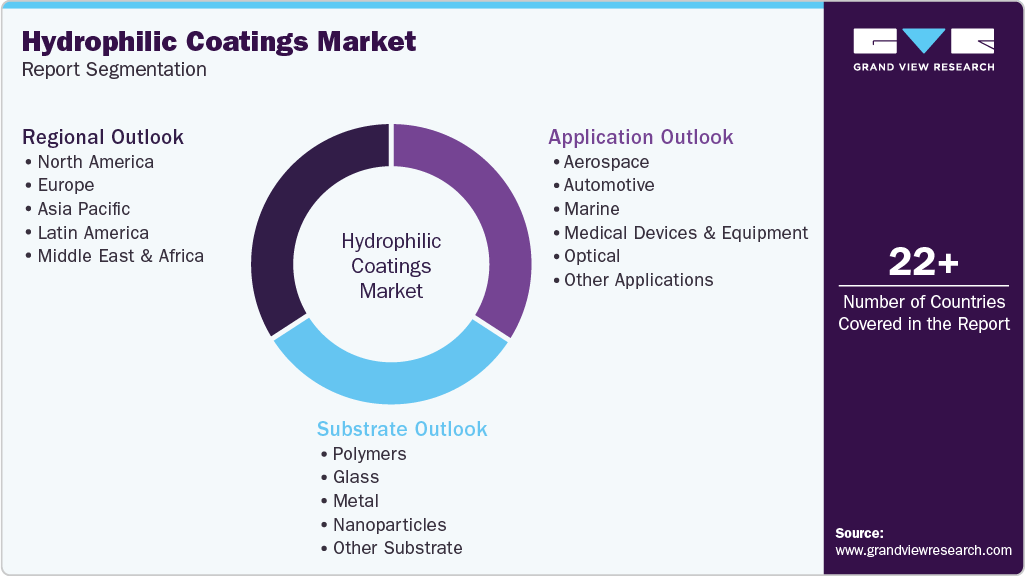
This report forecasts revenue growth at global, regional, and country levels and provides an analysis of the latest industry trends in each of the sub-segments from 2021 to 2033. For this study, Grand View Research has segmented the global hydrophilic coatings market report based on substrate, application, and region
-
Substrate Outlook (Volume, Kilotons; Revenue, USD Billion, 2021 - 2033)
-
Polymers
-
Glass
-
Metal
-
Nanoparticles
-
Other Substrate
-
-
Application Outlook (Volume, Kilotons; Revenue, USD Billion, 2021 - 2033)
-
Aerospace
-
Automotive
-
Marine
-
Medical devices & equipment
-
Optical
-
Other Applications
-
-
Regional Outlook (Volume, Kilotons; Revenue, USD Billion, 2021 - 2033)
-
North America
-
U.S.
-
Canada
-
Mexico
-
-
Europe
-
Germany
-
UK
-
Italy
-
Spain
-
France
-
-
Asia Pacific
-
China
-
Japan
-
South Korea
-
-
Latin America
-
Brazil
-
Argentina
-
-
Middle East & Africa
-
Saudi Arabia
-
South Africa
-
-
Frequently Asked Questions About This Report
b. Demand rises because device makers and OEMs need reliable surface performance without redesigning core materials, and end users value smoother handling, clearer optics, and easier cleaning across healthcare, electronics, and manufacturing.
b. The global hydrophilic coatings market size was estimated at USD 15.7 billion in 2025 and is expected to reach USD 16.5 billion in 2026.
b. The global hydrophilic coatings market is expected to grow at a compound annual growth rate of 5.6% from 2026 to 2033, reaching USD 24.0 billion by 2033.
b. Some of the key players operating in the hydrophilic coatings market include Surmodics Inc., Hydromer Inc., Biocoat Inc., AST Products Inc., Aculon Inc., Surface Solutions Group LLC, DSM Biomedical (dsm-firmenich), Tokyo Ohka Kogyo Co., Ltd., BioInteractions Ltd., Covalon Technologies Ltd.
b. The polymers segment held the largest share of the hydrophilic coatings market in 2025 with 42.5% of total revenue, largely due to its extensive use across medical devices, optical products, and industrial components. Polymer substrates such as polyurethane, polyethylene, and polyamide are widely adopted because they provide flexibility, durability, and compatibility with hydrophilic coating chemistries. Medical devices including catheters, guidewires, and vascular access tools frequently use polymer surfaces where lubricious coatings reduce friction during insertion.


Share this report with your colleague or friend.
Need a Tailored Report?
Customize this report to your needs — add regions, segments, or data points, with 20% free customization.


ISO 9001:2015 & 27001:2022 Certified
We are GDPR and CCPA compliant! Your transaction & personal information is safe and secure. For more details, please read our privacy policy.
Trusted market insights - try a free sample
See how our reports are structured and why industry leaders rely on Grand View Research. Get a free sample or ask us to tailor this report to your needs.