- Home
- »
- Advanced Interior Materials
- »
-
HVAC Refrigerant Recovery System Market Report, 2033GVR Report cover
![HVAC Refrigerant Recovery System Market Size, Share & Trends Report]()
HVAC Refrigerant Recovery System Market (2026 - 2033) Size, Share & Trends Analysis Report By Type (Portable, Stationary), By Technology (Liquid Refrigerant, Push-Pull), By End Use, By Region, And Segment Forecasts
- Report ID: GVR-4-68040-877-3
- Number of Report Pages: 150
- Format: PDF
- Historical Range: 2021 - 2025
- Forecast Period: 2026 - 2033
- Industry: Advanced Materials
- Report Summary
- Table of Contents
- Segmentation
- Methodology
- Download FREE Sample
-
 Download Sample Report
HVAC Refrigerant Recovery System Market Summary
The global HVAC refrigerant recovery system market size was estimated at USD 1,477.7 million in 2025 and is projected to reach USD 2,266.0 million by 2033, growing at a CAGR of 5.6% from 2026 to 2033. The market is primarily driven by tightening environmental regulations and compliance requirements around refrigerant handling.
Key Market Trends & Insights
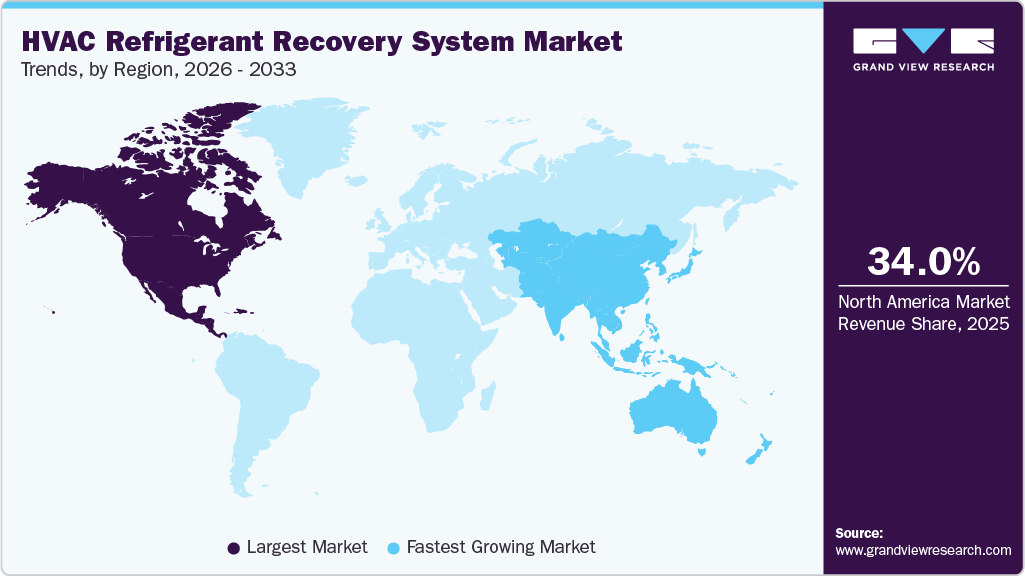
- North America accounted for a 34.0% share of the HVAC refrigerant recovery system market in 2025.
- The vapor refrigerant recovery segment is projected to grow at a CAGR of 5.8% from 2026 to 2033.
- The portable segment led the market in 2025, capturing a 61.2% share.
- By end use, the equipment manufacturers segment is anticipated to expand at a CAGR of 6.0% from 2026 to 2033.
Market Size & Forecast
- 2025 Market Size: USD 1,477.7 Million
- 2033 Projected Market Size: USD 2,266.0 Million
- CAGR (2026-2033): 5.6%
- North America: Largest market in 2025
- Asia Pacific: Fastest growing region
Governments across regions are enforcing stricter rules on the recovery, recycling, and disposal of refrigerants such as HFCs and HCFCs due to their high global warming potential. Another key driver is the rapid growth in installed HVAC systems and rising service demand across residential, commercial, and industrial sectors. Increasing urbanization, climate change-driven cooling needs, and expansion of commercial infrastructure are leading to a higher volume of air-conditioning and refrigeration units in operation. This directly increases the frequency of maintenance, repair, and replacement activities, all of which require refrigerant recovery.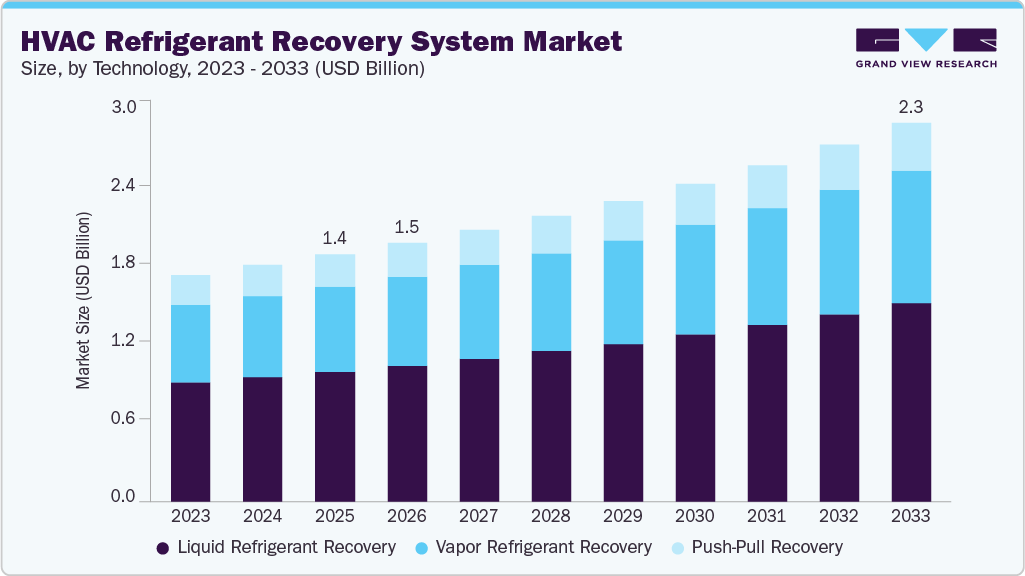
Market Concentration & Characteristics
The HVAC refrigerant recovery system industry is fragmented, with the presence of several global, regional, and local manufacturers competing across different product categories. While a few established players, such as INFICON, CPS Products, and Bosch Automotive Service Solutions, hold notable market positions due to strong distribution networks and product reliability, the overall market remains competitive with many mid-sized and niche companies offering cost-effective and application-specific solutions. The relatively low barriers to entry in terms of manufacturing and the wide customer base of HVAC contractors and service technicians further contribute to fragmentation.
The HVAC refrigerant recovery system industry shows a moderate but steadily evolving level of innovation, mainly focused on improving efficiency, portability, and compatibility with next-generation refrigerants. Manufacturers are developing faster recovery units with oil-less compressors, dual-cylinder designs, and automated controls to reduce recovery time and enhance ease of use for technicians. There is also growing emphasis on lightweight, compact portable systems and equipment capable of handling low-GWP refrigerants such as R32 and mildly flammable blends.
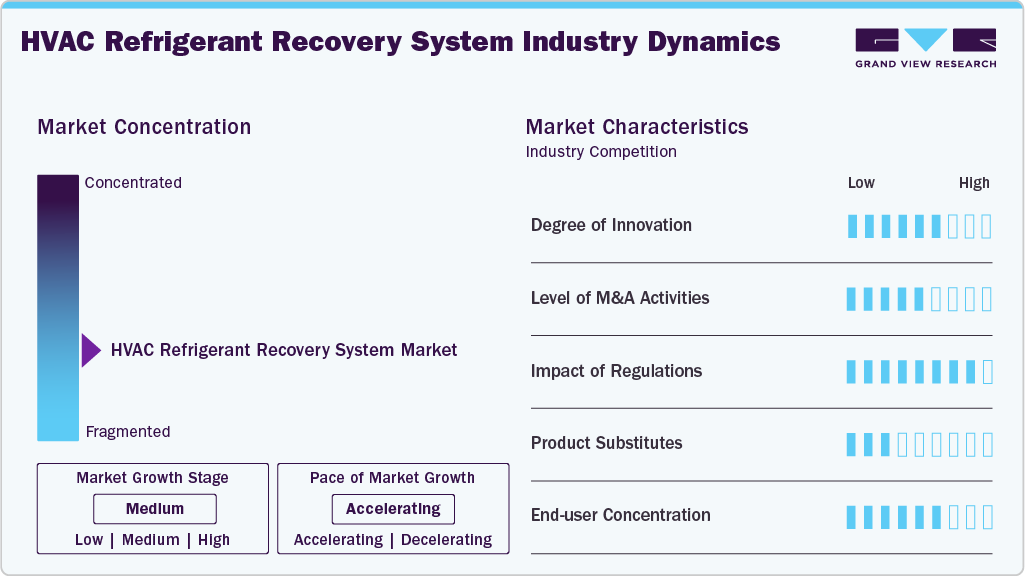
Regulations have a high and direct impact on this market, making them one of the strongest influencing factors. Strict environmental policies governing refrigerant emissions, recovery, and reuse, especially under global frameworks like the Kigali Amendment are compelling end users to adopt certified recovery systems. Compliance requirements for HVAC servicing, refrigerant handling certifications, and penalties for non-compliance are driving consistent demand across regions.
The market exhibits a moderate level of end-user concentration, with demand largely driven by HVAC contractors and service technicians who form the core customer base. These users are highly fragmented, ranging from small independent technicians to large service firms, leading to widespread but distributed demand. At the same time, a smaller share of demand comes from equipment manufacturers and large industrial service providers, which are more consolidated and purchase in bulk.
Drivers, Opportunities & Restraints
The market is primarily driven by strict environmental regulations and the global phase-down of high-GWP refrigerants, which make refrigerant recovery mandatory during servicing and decommissioning. Compliance with these regulations has significantly increased the adoption of certified recovery systems among HVAC contractors and technicians. In addition, the growing installed base of air-conditioning and refrigeration systems, supported by urbanization and rising cooling demand, is leading to frequent maintenance activities, further driving the need for efficient refrigerant recovery solutions.
The market presents strong opportunities through the transition to low GWP and next-generation refrigerants, which require advanced and compatible recovery equipment. This shift is encouraging manufacturers to innovate and develop systems capable of handling mildly flammable and environmentally friendly refrigerants. Moreover, rapid HVAC market expansion in emerging economies such as Asia-Pacific and the Middle East is creating new demand for servicing equipment, supported by infrastructure growth and increasing adoption of cooling systems.
However, the market faces restraints such as the high initial cost of advanced recovery systems, which can limit adoption among small-scale contractors and independent technicians. In addition, limited awareness and inconsistent enforcement of regulations in developing regions often result in improper refrigerant handling practices, reducing the demand for recovery equipment. The presence of low-cost or refurbished alternatives in the market also poses a challenge to the growth of high-quality and technologically advanced systems.
Type Insights
Portable refrigerant recovery systems dominated the market in 2025 and accounted for 61.2%, due to their flexibility, compact design, and ease of use in field operations. HVAC contractors and service technicians widely prefer portable units for on-site maintenance, repair, and servicing of residential and light commercial systems. Their lower cost, mobility, and suitability for routine service jobs make them the most practical choice for day-to-day operations.
Stationary refrigerant recovery systems are expected to be the fastest-growing segment at a CAGR of 5.8%, driven by increasing demand from large-scale commercial and industrial applications. These systems offer higher capacity, faster recovery rates, and continuous operation, making them ideal for centralized service facilities, HVAC manufacturers, and large refrigeration installations. The growing focus on refrigerant recycling, bulk recovery operations, and stricter compliance requirements in industrial settings is accelerating the adoption of stationary systems across developed and emerging markets.
Technology Insights
Liquid refrigerant recovery technology holds a significant market share with 52.6% in 2025, due to its high efficiency and faster recovery rates, especially when handling large volumes of refrigerant in commercial and industrial HVAC systems. This method allows direct removal of refrigerant in liquid form, significantly reducing recovery time and improving service productivity for technicians. Its effectiveness in large-capacity systems such as chillers and refrigeration units, along with reduced operational downtime, has made it the preferred choice among HVAC professionals, supporting its leading market share.
Vapor refrigerant recovery technology is expected to be the fastest-growing segment over the forecast period, driven by the need for complete refrigerant extraction and compliance with stringent environmental regulations. Vapor recovery plays a critical role in capturing residual refrigerant that remains after liquid recovery, ensuring minimal emissions. Increasing regulatory pressure for zero refrigerant release, along with rising adoption in smaller systems and final-stage recovery processes, is accelerating demand for vapor recovery solutions across both residential and commercial applications.
End Use Insights
HVAC contractors dominated the market and accounted for 41.3% share in 2025, due to their high involvement in installation, maintenance, and replacement activities across residential, commercial, and light industrial sectors. These contractors handle a large volume of service calls, each requiring proper refrigerant recovery to meet environmental regulations. The widespread presence of small and mid-sized contractors, along with the growing installed base of air-conditioning systems, continues to drive strong and consistent demand for portable and efficient recovery equipment in day-to-day operations.
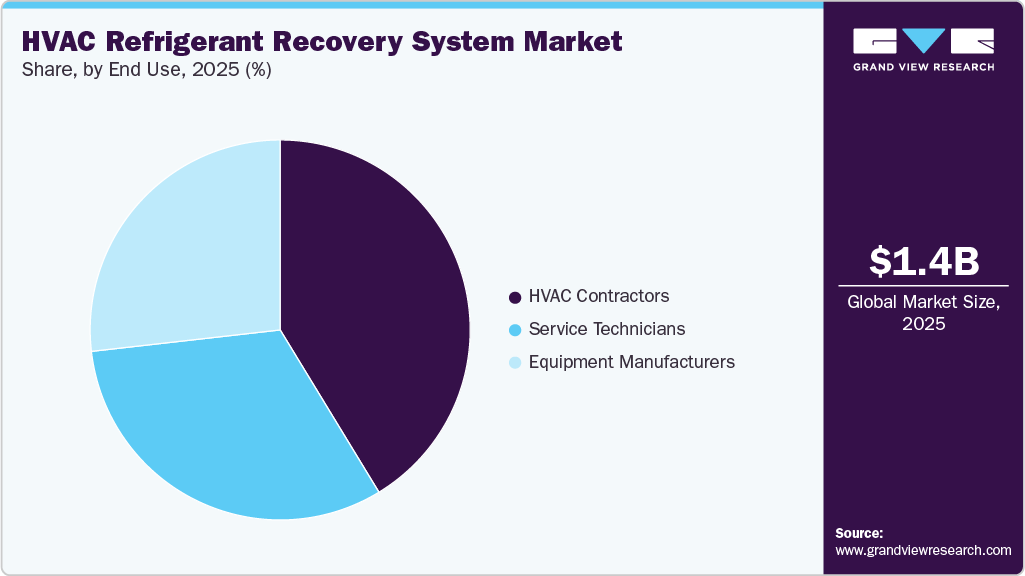
Equipment manufacturers are expected to be the fastest-growing segment at a CAGR of 6.0%, driven by increasing HVAC production, testing, and quality control requirements. Recovery systems are widely used in manufacturing facilities to capture and reuse refrigerants during system charging and performance testing, improving operational efficiency and reducing refrigerant losses. With the expansion of HVAC manufacturing, particularly in Asia-Pacific region, and rising focus on sustainable production practices, demand from equipment manufacturers is projected to grow at a faster pace over the forecast period.
Regional Insights
North America accounted for a 34.0% share of the HVAC refrigerant recovery system market, supported by well-established regulatory frameworks and high compliance standards for refrigerant handling and emissions. The region benefits from a mature HVAC service industry, widespread adoption of advanced service equipment, and a strong presence of key manufacturers. Regular system upgrades, retrofitting activities, and strict enforcement of refrigerant recovery practices across the U.S. and Canada continue to sustain market leadership.
U.S. HVAC Refrigerant Recovery System Market Trends
The HVAC refrigerant recovery system market in the U.S. dominates North America, driven by strict regulatory enforcement and a highly developed HVAC service sector. Under the Clean Air Act, EPA regulations (40 CFR Part 82, Subpart F) Section 608 require refrigerant recovery and recycling equipment to be tested and certified to meet EPA standards, making compliance mandatory for contractors and technicians. This regulatory framework, along with a large installed base of HVAC systems and frequent servicing activities, continues to drive strong demand for refrigerant recovery systems across the country.
Canada HVAC refrigerant recovery system market is experiencing steady growth, supported by increasing focus on environmental sustainability and evolving refrigerant management standards. Government initiatives promoting reduced emissions and responsible refrigerant handling are encouraging the adoption of recovery systems across service operations. The growing demand for HVAC systems in residential and commercial buildings, along with rising awareness among technicians regarding compliance practices, is contributing to market expansion.
Europe HVAC Refrigerant Recovery System Market Trends
The HVAC refrigerant recovery system market in Europe is experiencing steady growth due to its strong focus on sustainability and circular economy practices. Stringent environmental regulations, particularly around fluorinated gases (F-gas regulations), are encouraging the use of refrigerant recovery and recycling systems. The region’s emphasis on energy efficiency and environmentally responsible HVAC servicing is driving consistent demand for advanced recovery technologies.
Germany HVAC refrigerant recovery system market represents a leading market in Europe, supported by its strong industrial base and strict adherence to environmental regulations. The country’s well-established HVAC servicing sector, along with rigorous compliance under F-gas regulations, is driving consistent demand for refrigerant recovery equipment. Germany also benefits from advanced technical standards and a high level of awareness among contractors regarding sustainable refrigerant management practices.
The HVAC refrigerant recovery system market in France is witnessing steady growth, driven by its increasing focus on energy efficiency and environmentally responsible HVAC practices. Regulatory frameworks promoting reduced greenhouse gas emissions and proper refrigerant handling are encouraging the use of recovery systems across maintenance and service operations.
Asia Pacific HVAC Refrigerant Recovery System Market Trends
The HVAC refrigerant recovery system market in the Asia Pacific is the fastest-growing region at 6.5% CAGR over the forecast period, driven by rapid urbanization, expanding construction activities, and rising demand for cooling solutions across countries. The increasing penetration of air-conditioning systems, along with growing awareness around refrigerant management and gradual regulatory tightening, is accelerating the adoption of recovery systems.
China HVAC refrigerant recovery system market leads the Asia Pacific market, backed by its massive construction pipeline and strong HVAC production capacity. Large infrastructure and real estate developments continue to increase installation and servicing needs, supporting demand for refrigerant recovery systems. As per the China Belt and Road Initiative (BRI) Investment Report 2025, the average construction deal size reached USD 964 million in 2025, nearly doubling from USD 496 million in 2024, highlighting the scale of ongoing projects. This, along with stricter environmental oversight, is driving wider adoption of recovery equipment.
The HVAC refrigerant recovery system market in India is emerging as a key growth market, driven by rapid expansion in real estate and rising cooling demand. According to IBEF, the real estate sector in India is projected to reach USD 1 trillion by 2030, up from USD 200 billion in 2021, and contribute around 13% to GDP by 2025, highlighting strong infrastructure growth. This surge in construction activity is increasing HVAC installations and servicing needs. Alongside this, improving awareness of refrigerant management and a gradual regulatory push are encouraging wider use of refrigerant recovery systems across the country.
Latin America HVAC Refrigerant Recovery System Market Trends
The HVAC refrigerant recovery system market in Latin America is witnessing gradual market growth, supported by the increasing adoption of HVAC systems in commercial and residential sectors. Improving regulatory frameworks and rising awareness of proper refrigerant handling practices are contributing to the uptake of recovery systems. Growth in sectors such as retail, hospitality, and food storage is also creating additional demand for HVAC servicing equipment.
Brazil HVAC refrigerant recovery system market leads the market in Latin America, supported by its large installed base of HVAC and refrigeration systems and growing commercial infrastructure across sectors such as retail, hospitality, and food processing. Increasing service and maintenance activities are driving steady demand for recovery equipment. At the same time, rising environmental awareness and gradual improvements in refrigerant handling regulations are encouraging the adoption of proper recovery practices.
Middle East & Africa HVAC Refrigerant Recovery System Market Trends
The HVAC refrigerant recovery system market in the Middle East & Africa is emerging as a growing market, fueled by rising cooling demand due to extreme climatic conditions and infrastructure development. Expanding commercial construction, particularly in the Gulf countries, and increasing investments in HVAC systems are supporting market expansion. While regulatory enforcement varies across countries, gradual improvements in environmental policies and service standards are expected to drive future adoption of refrigerant recovery systems.
Saudi Arabia HVAC refrigerant recovery system market leads the Middle East & Africa market, driven by high cooling demand due to extreme climatic conditions and large-scale infrastructure development. Ongoing mega projects, commercial construction, and expansion of hospitality and retail sectors are significantly increasing HVAC installations, leading to higher servicing needs. This is supporting a steady demand for refrigerant recovery systems across the country.
Key HVAC Refrigerant Recovery System Company Insights
Some of the key players operating in the market include INFICON, Robinair (Bosch Automotive), and CPS Products, Inc.
-
INFICON develops measurement instruments, sensor systems, and software that help industries monitor processes and improve efficiency. Its core offerings include solutions for gas analysis, leak detection, and vacuum measurement, which are widely used in HVAC and refrigeration, automotive, and semiconductor manufacturing. The company’s technologies support accurate detection of refrigerant leaks and enhance system performance across various applications. Based in Switzerland, INFICON has a global footprint with operations and production facilities across Europe, the United States, and Asia, serving a broad range of industrial customers.
-
CPS Products, Inc. is a U.S. based manufacturer specializing in the design and production of tools, instruments, and service equipment for HVAC/R and automotive applications. The company offers a wide range of products, including refrigerant recovery machines, leak detectors, vacuum pumps, gauges, and diagnostic tools used by professional service technicians. Headquartered in Florida, CPS Products serves customers globally through its manufacturing and distribution network, focusing on developing practical, technician-oriented solutions that improve efficiency, accuracy, and overall service performance.
Key HVAC Refrigerant Recovery System Companies:
The following key companies have been profiled for this study on the HVAC refrigerant recovery system market.
- RefTec International Systems, LLC
- Appion
- Robinair (Bosch Automotive)
- INFICON
- CPS Products, Inc.
- Yellow Jacket (Ritchie Engineering)
- REFCO Manufacturing Ltd.
- Mastercool Inc.
- MSA
- Hudson Technologies
- Mellcon Engineers Pvt Ltd.
- JB Industries
- Mahle GmbH
- NAVAC Inc.
- TSI Supercool
Recent Developments
-
In January 2026, MSA Safety highlighted its connected HVAC-R solutions at the AHR Expo, focusing on integrating refrigerant leak detection, gas monitoring, and system connectivity into a single platform. The approach emphasizes real-time data visibility and improved safety across HVAC operations.
-
In September 2025, Hudson Technologies, in collaboration with DCSEU, launched a refrigerant recovery pilot program in Washington, D.C., to reduce emissions from HVAC systems. The initiative promotes proper recovery practices during servicing and supports contractors with training, logistics, and incentives. It also encourages the reuse and reclamation of refrigerants instead of releasing them into the environment.
HVAC Refrigerant Recovery System Market Report Scope
Report Attribute
Details
Market size value in 2026
USD 1,546.9 million
Revenue forecast in 2033
USD 2,266.0 million
Growth rate
CAGR of 5.6% from 2026 to 2033
Historical data
2021 - 2025
Forecast period
2026 - 2033
Quantitative units
Revenue in USD million/billion and CAGR from 2026 to 2033
Report coverage
Revenue forecast, company market position analysis, competitive landscape, growth factors, and trends
Segments covered
Type, technology, end use, region
Regional scope
North America; Europe; Asia Pacific; Latin America; MEA
Country Scope
U.S.; Canada; Mexico; Spain; France; Germany; Italy; UK; China; India; Japan; Australia; South Korea; Brazil; Argentina; Saudi Arabia; UAE; South Africa
Key companies profiled
RefTec International Systems, LLC; Appion; Robinair (Bosch Automotive); INFICON; CPS Products, Inc.; Yellow Jacket (Ritchie Engineering); REFCO Manufacturing Ltd.; Mastercool Inc.; MSA; Hudson Technologies; Mellcon Engineers Pvt. Ltd.; JB Industries; Mahle GmbH; NAVAC Inc.; TSI Supercool
Customization scope
Free report customization (equivalent up to 8 analysts working days) with purchase. Addition or alteration to country, regional & segment scope.
Pricing and purchase options
Avail customized purchase options to meet your exact research needs. Explore purchase options
Global HVAC Refrigerant Recovery System Market Report Segmentation
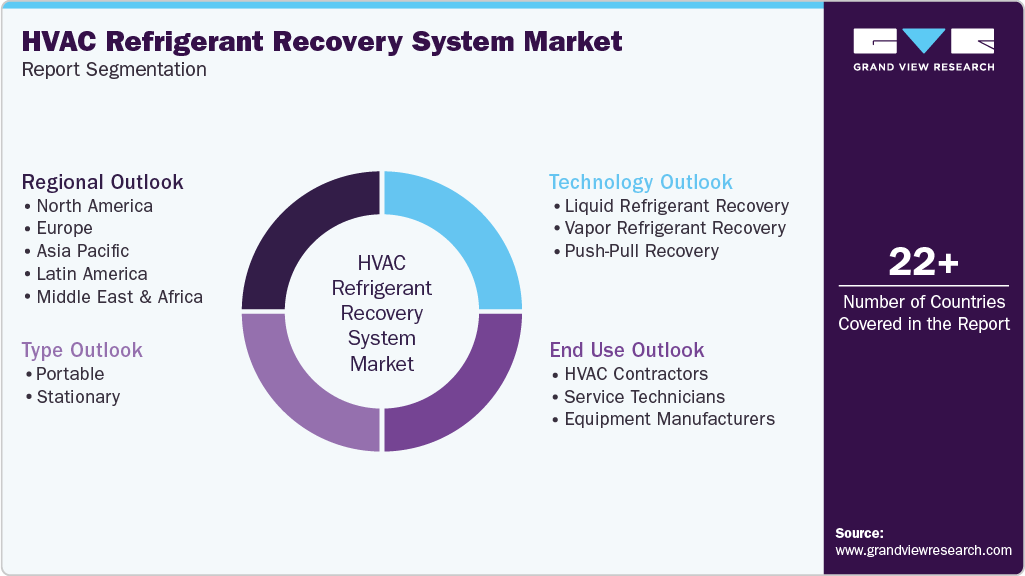
This report forecasts revenue growth at global, regional & country levels, and provides an analysis on the latest trends and opportunities in each of the sub-segments from 2021 to 2033. For this study, Grand View Research has segmented the global HVAC refrigerant recovery system market based on type, technology, end use, and region:
-
Type Outlook (Revenue, USD Million, 2021 - 2033)
-
Portable
-
Stationary
-
-
Technology Outlook (Revenue, USD Million, 2021 - 2033)
-
Liquid Refrigerant Recovery
-
Vapor Refrigerant Recovery
-
Push-Pull Recovery
-
-
End Use Outlook (Revenue, USD Million, 2021 - 2033)
-
HVAC Contractors
-
Service Technicians
-
Equipment Manufacturers
-
-
Regional Outlook (Revenue, USD Million, 2021 - 2033)
-
North America
-
U.S.
-
Canada
-
Mexico
-
-
Europe
-
Spain
-
Germany
-
Italy
-
France
-
UK
-
-
Asia Pacific
-
China
-
India
-
Japan
-
Australia
-
South Korea
-
-
Latin America
-
Brazil
-
Argentina
-
-
Middle East & Africa
-
Saudi Arabia
-
UAE
-
South Africa
-
-
Frequently Asked Questions About This Report
b. The global HVAC refrigerant recovery system market size was estimated at USD 1,477.7 million in 2025 and is expected to reach USD 1,546.9 million in 2026
b. The HVAC refrigerant recovery system market is expected to grow at a compound annual growth rate of 5.6% from 2026 to 2033 to reach USD 2,266.0 million by 2033.
b. North America dominates the HVAC refrigerant recovery system market, supported by well-established regulatory frameworks and high compliance standards for refrigerant handling and emissions. The region benefits from a mature HVAC service industry, widespread adoption of advanced service equipment, and strong presence of key manufacturers
b. Some of the key players operating in the HVAC refrigerant recovery system market include RefTec International Systems, LLC; Appion; Robinair (Bosch Automotive); INFICON; CPS Products, Inc.; Yellow Jacket (Ritchie Engineering); REFCO Manufacturing Ltd.; Mastercool Inc.; MSA; Hudson Technologies; Mellcon Engineers Pvt. Ltd.; JB Industries; Mahle GmbH; NAVAC Inc.; TSI Supercool.
b. The market is mainly driven by strict environmental regulations requiring proper refrigerant recovery and emission control, making recovery systems essential for HVAC servicing. Additionally, the growing number of air-conditioning and refrigeration systems is increasing maintenance activities, boosting demand for efficient recovery equipment.


Share this report with your colleague or friend.
Need a Tailored Report?
Customize this report to your needs — add regions, segments, or data points, with 20% free customization.


ISO 9001:2015 & 27001:2022 Certified
We are GDPR and CCPA compliant! Your transaction & personal information is safe and secure. For more details, please read our privacy policy.
Trusted market insights - try a free sample
See how our reports are structured and why industry leaders rely on Grand View Research. Get a free sample or ask us to tailor this report to your needs.