- Home
- »
- Plastics, Polymers & Resins
- »
-
Graphic Film Market Size And Share, Industry Report, 2033GVR Report cover
![Graphic Film Market Size, Share & Trends Report]()
Graphic Film Market (2026 - 2033) Size, Share & Trends Analysis Report By Product Type (Polyethylene, Polypropylene, Polyvinyl Chloride), By Film Type (Opaque, Transparent), By Manufacturing Process, By Printing Technology, By End Use Industry, By Region, And Segment Forecasts
- Report ID: GVR-4-68040-330-8
- Number of Report Pages: 180
- Format: PDF
- Historical Range: 2021 - 2024
- Forecast Period: 2026 - 2033
- Industry: Bulk Chemicals
- Report Summary
- Table of Contents
- Segmentation
- Methodology
- Download FREE Sample
-
 Download Sample Report
Graphic Film Market Summary
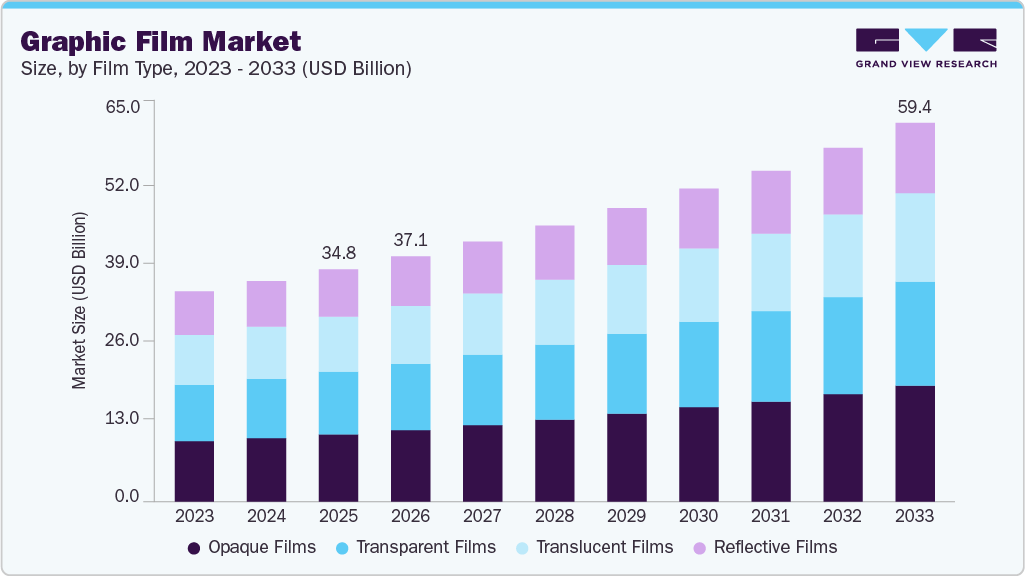
The global graphic film market size was estimated at USD 34.8 billion in 2025 and is projected to reach USD 59.4 billion by 2033, growing at a CAGR of 7.0% from 2026 to 2033. Graphic films offer versatility in applications, ranging from vehicle wraps and window graphics to safety signs and decorative elements.
Key Market Trends & Insights
- Asia Pacific dominated the global graphic film market with the largest revenue share of 46.3% in 2025.
- The graphic film industry in India accounted for the largest market revenue share in the Asia Pacific in 2025.
- By film type, the reflective films segment is expected to grow at the fastest CAGR of 7.7% from 2026 to 2033.
- By product type, the polyvinyl chloride segment accounted for the largest market revenue share in 2025.
- By manufacturing process, the calendered film segment accounted for the largest market revenue share in 2025.
Market Size & Forecast
- 2025 Market Size: USD 34.8 Billion
- 2033 Projected Market Size: USD 59.4 Billion
- CAGR (2026-2033): 7.0%
- Asia Pacific: Largest market in 2025
These films are preferred due to their durability, high-quality printability, and ability to enhance visual appeal. The growing trend of vehicle customization and the need for effective advertising solutions are major factors driving the market. In addition, advancements in printing technologies such as digital printing are enhancing the capabilities and applications of graphic films. The market is also seeing a shift towards environmentally friendly materials and processes, with increased adoption of recyclable and biodegradable films.Drivers, Opportunities & Restraints
The automotive industry is a significant driver of the graphic film industry, primarily due to the increasing trend of vehicle customization and branding. Graphic films are extensively used for vehicle wraps, decals, and window tinting, offering a cost-effective and versatile way to alter the appearance of vehicles. These films not only enhance aesthetic appeal but also provide protective benefits, such as shielding the vehicle's paint from damage and UV exposure.
The graphic film industry faces challenges due to fluctuations in raw material prices, particularly those of polymers like polyvinyl chloride (PVC), polyethylene (PE), and polypropylene (PP). These price variations can significantly impact the production costs and profit margins for manufacturers. In addition, the reliance on petroleum-based raw materials makes the market vulnerable to volatility in global oil prices.
The increasing focus on sustainability and environmental regulations presents significant opportunities for the graphic film industry. There is a growing demand for eco-friendly, biodegradable films as consumers and industries seek to reduce their environmental footprint. Manufacturers are investing in the development of recyclable materials and sustainable production processes to meet this demand.
Market Concentration & Characteristics
The graphic film industry shows moderate innovation, mainly driven by advances in printability, durability, and adhesive technology. Producers are launching PVC-free films, air-release adhesives, and UV-protective coatings to improve efficacy for vehicle wraps and outdoor signage. Mergers and acquisitions are also at a moderate level, with businesses engaging in acquisitions to broaden their product ranges, bolster regional distribution, and enhance their abilities in specialty films and digital printing applications.
Environmental regulations on plasticizers, VOC emissions, and PVC use are influencing product development in the graphic film sector. Producers are increasingly focusing on recyclable and low-VOC materials to meet evolving regulatory requirements, particularly in Europe and North America. Furthermore, the market faces competition from alternatives such as direct digital printing on hard boards, painted signage, and LED display technologies, even though films remain preferred for their affordability and adaptability.
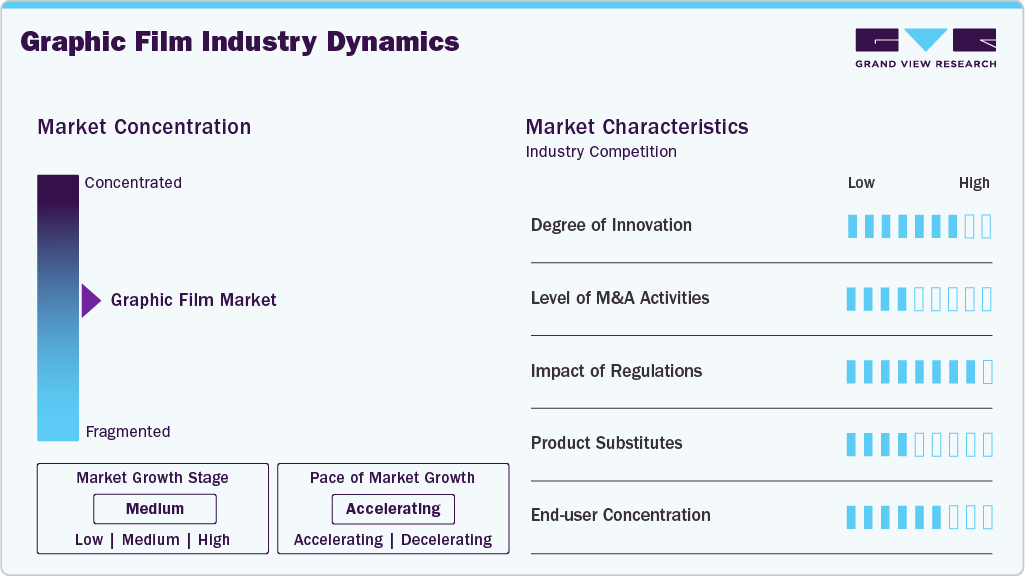
The graphic film industry serves a wide range of end users. The main demand comes from advertising and signage companies, commercial printing providers, automotive wrap installers, and retail branding agencies. The large number of small and medium-sized print service providers and signage firms reduces buyer concentration and prevents any single customer group from dominating the market.
Film Type Insights
The opaque films segment led the market with the largest revenue share of 48.2% in 2025. These films are highly favored for their ability to completely block light and view. This makes them ideal for a variety of applications, including vehicle wraps, promotional banners, and decorative purposes. These films provide privacy, protect underlying surfaces, and ensure vibrant, non-fading colors, which are crucial for both indoor and outdoor advertising.
Transparent films are also significant in the market due to their applications in window graphics, automotive window tinting, and packaging. These films allow visibility while providing UV protection and aesthetic appeal. Translucent films, which allow light to pass through but not detailed shapes, are commonly used in illuminated signage and backlit displays, ensuring uniform light diffusion. Reflective films, designed to reflect light, are essential for safety and security applications such as road signs, vehicle markings, and emergency exits, contributing to visibility and safety in low-light conditions.
Product Type Insights
The polyvinyl chloride (PVC) segment led the market with the largest revenue share of 48.3% in 2025. They are extensively used in various applications such as automotive wraps, signage, and decals. PVC films are preferred for their ease of installation and ability to conform to complex surfaces, making them suitable for a wide range of promotional and decorative uses.
Polyethylene films are known for their excellent resistance to chemicals and moisture, making them suitable for industrial applications and protective packaging. Polypropylene films, on the other hand, offer high clarity and strength, making them ideal for labeling, packaging, and graphic displays. The other category includes specialty films such as polyester and polycarbonate, which are used for their specific properties like high heat resistance and enhanced durability, catering to niche markets.
Manufacturing Process Insights
The calendered film segment led the market with the largest revenue share of 61.9% in 2025. Calendered films are produced by pressing the material through rollers, resulting in smooth and even films. This process is cost-effective and well-suited to high-volume production, making calendered films popular for signage, decals, and general graphic applications.
Casting, a more premium process, involves pouring the material onto a casting sheet and curing it. Cast films are generally of higher quality, offering better conformability and durability compared to calendered films. They are preferred for high-end applications such as vehicle wraps and premium advertisements due to their superior performance and longer lifespan.
Printing Technology Insights
The flexography segment led the market with the largest revenue share of 53.6% in 2025. Flexography is a widely used printing technology for printing large volumes of graphics on various substrates, including packaging films, labels, and promotional materials. It is favored for its high speed and cost-effectiveness.
Rotogravure printing is known for its high-quality output and ability to print fine details. This technology is often used for high-end packaging, decorative films, and applications where print quality is paramount. Offset printing offers excellent print quality and consistency, making it ideal for producing detailed graphics and images. It is commonly used in the production of labels, decals, and other printed materials requiring high-resolution output. Digital printing technology offers flexibility and quick turnaround times, making it suitable for short-run and customized printing.
End Use Insights
The promotional & advertising segment led the market with the largest revenue share of 50.5% in 2025. These films are widely used in creating eye-catching banners, posters, billboards, and point-of-sale displays. Their ability to deliver vibrant, high-resolution graphics makes them essential for effective marketing campaigns. In the industrial sector, graphic films are used for labeling, safety signage, and protective applications. Their durability and resistance to harsh environments make them suitable for industrial use. The "Others" category includes applications in home décor, DIY projects, and architectural films for decorative purposes, offering a cost-effective solution to enhance the visual appeal of interiors and exteriors.
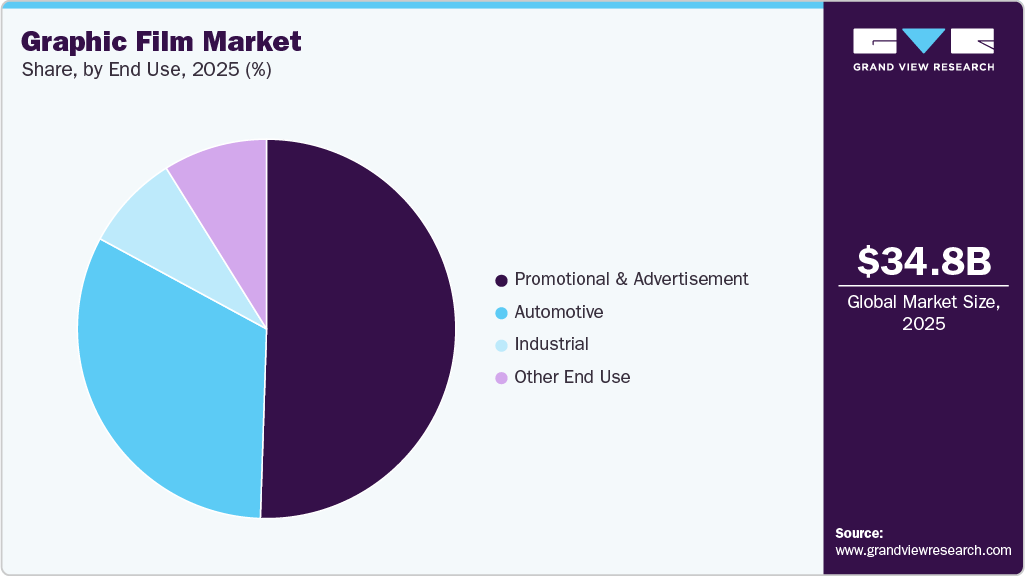
The automotive sector extensively uses graphic films for vehicle wraps, decals, and window tinting. These films enhance the aesthetic appeal of vehicles, provide protection against environmental elements, and serve advertising purposes. The growing trend of vehicle customization is boosting the demand for graphic films in this sector.
Regional Insights
The graphic film market in North America is driven by the high demand in the automotive and promotional sectors. The region's strong automotive industry, especially in the United States, is a major driver of market growth. In addition, the presence of leading market players and the increasing adoption of advanced printing technologies further bolster market growth. The promotional and advertising industry in North America also significantly drives demand for high-quality graphic films.
U.S. Graphic Film Market Trends
The graphic film market in the U.S. accounted for the largest market revenue share in North America in 2025. The U.S., as a major player in the North American market, is experiencing substantial growth driven by its robust automotive and advertising industries. The trend of vehicle customization and the high demand for visually appealing advertisements drive the market. In addition, stringent road-safety regulations boost the use of reflective, durable graphic films.
Asia Pacific Graphic Film Market Trends
Asia Pacific dominated the global graphic film market with the largest revenue share of 46.3% in 2025 and is projected to grow at the fastest CAGR during the forecast period. Advancements in printing technologies and the availability of cost-effective materials boost market growth in the region. The APAC market is characterized by significant investments in infrastructure and advertising, which further drive demand for graphic films.
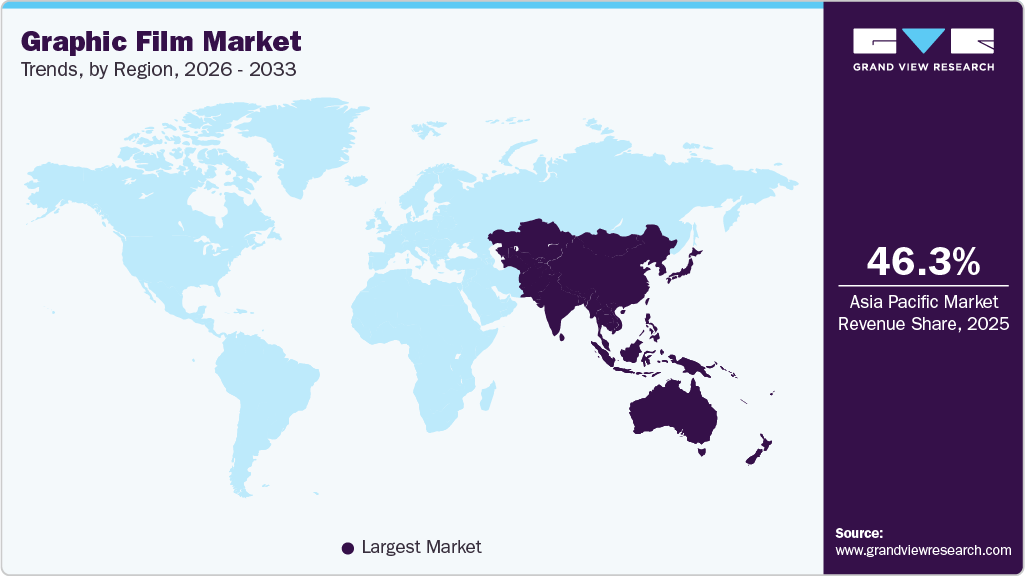
Rapid industrialization, urbanization, and the expanding automotive industry in countries like China, India, and Japan are key factors driving the market. The increasing popularity of vehicle wraps and promotional activities in emerging economies contributes to the demand for graphic films. In addition, advancements in printing technologies and the availability of cost-effective materials boost market growth in the region.
Europe Graphic Film Market Trends
The graphic film market in Europe represents a mature market with steady growth. The region's focus on sustainability and environmental regulations has led to the adoption of eco-friendly graphic films. Countries like Germany, France, and the UK are major contributors to the market, driven by their automotive industries and the need for high-quality promotional materials. The European market is also witnessing a growing demand for digitally printed films due to their customization capabilities and quick turnaround times.
Key Graphic Film Company Insights
The graphic film industry is highly competitive, with several key players operating globally. Prominent companies such as 3M, Avery Dennison Corporation, Hexis S.A.S., Orafol Group, and Arlon Graphics LLC play a crucial role in shaping the industry landscape through continuous innovation and strong global distribution networks. These companies are actively focusing on product advancements, strategic partnerships, and expansion into emerging markets to strengthen their competitive positioning and cater to the growing demand.
Key Graphic Film Companies:
The following key companies have been profiled for this study on the graphic film market.
- 3M
- Avery Dennison Corporation
- Hexis S.A.S.
- Orafol Group
- Arlon Graphics LLC
- Ritrama S.p.A.
- Mactac, LLC
- Dunmore
- The Griff Network
- Spandex AG
- FDC Graphic Films Inc.
Recent Developments
-
In February 2026, Avery Dennison introduced the MPI 1903 cast wrapping film, a premium digitally printable film designed for vehicle wraps and outdoor graphics. This latest product expands the company’s cast film offerings and boasts a high-gloss finish, improved print capabilities, and cost-effective solutions for installers and print shops. The launch of this film is intended to strengthen Avery Dennison's position in the growing vehicle wrap and commercial graphics sector while providing a range of performance options to meet diverse customer requirements.
-
In January 2025, Vision Graphics, LLC, backed by Banner Capital Management, revealed its acquisition of Queen of Wraps, a provider based in the U.S. that specializes in wraps for commercial vehicles and graphic installations. This acquisition is intended to enhance Vision Graphics' offerings in fleet branding, vehicle graphics, and large-format printing services, while also reinforcing its position in the commercial graphics and advertising sector.
Graphic Film Market Report Scope
Report Attribute
Details
Market size value in 2026
USD 37.1 billion
Revenue forecast in 2033
USD 59.4 billion
Growth rate
CAGR of 7.0% from 2026 to 2033
Base year for estimation
2025
Historical data
2021 - 2024
Forecast period
2026 - 2033
Quantitative units
Revenue in USD Million/billion, Volume in Million Square Meters, and CAGR from 2026 to 2033
Report coverage
Revenue forecast, volume forecast, competitive landscape, growth factors, and trends
Segments covered
Product type, film type, manufacturing process, printing technology, end use, region
Regional scope
North America; Europe; Asia Pacific; Latin America; Middle East & Africa
Country Scope
U.S.; Canada; Mexico; Germany; France; UK; Italy; Spain; China; India; Japan; South Korea; Australia; Brazil; Argentina; Saudi Arabia; South Africa
Key companies profiled
3M; Avery Dennison Corporation; Hexis S.A.S.; Orafol Group; Arlon Graphics LLC; Ritrama S.p.A.; Mactac, LLC; Dunmore; The Griff Network; Spandex AG; FDC Graphic Films Inc.
Customization scope
Free report customization (equivalent up to 8 analyst’s working days) with purchase. Addition or alteration to country, regional & segment scope
Pricing and purchase options
Avail customized purchase options to meet your exact research needs. Explore purchase options
Global Graphic Film Market Report Segmentation
This report forecasts revenue growth at the global, regional, and country levels and provides an analysis of the latest industry trends across sub-segments from 2021 to 2033. For this study, Grand View Research has segmented global graphic film market report based on the product type, film type, manufacturing process, printing technology, end use, and region:
-
Film Type Outlook (Volume, Million Square Meters; Revenue, USD Million, 2021 - 2033)
-
Opaque Films
-
Transparent Films
-
Translucent Films
-
Reflective Films
-
-
Product Type Outlook (Volume, Million Square Meters; Revenue, USD Million, 2021 - 2033)
-
Polyethylene
-
Polypropylene
-
Polyvinyl chloride
-
Others
-
-
Manufacturing Process Outlook (Volume, Million Square Meters; Revenue, USD Million, 2021 - 2033)
-
Calendered
-
Casting
-
Others
-
-
Printing Technology Outlook (Volume, Million Square Meters; Revenue, USD Million, 2021 - 2033)
-
Flexography
-
Rotogravure
-
Offset
-
Digital
-
-
End Use Outlook (Volume, Million Square Meters; Revenue, USD Million, 2021 - 2033)
-
Automotive
-
Promotional & Advertisement
-
Industrial
-
Others
-
-
Regional Outlook(Volume, Million Square Meters; Revenue, USD Million, 2021 - 2033)
-
North America
-
U.S.
-
Canada
-
Mexico
-
-
Europe
-
Germany
-
UK
-
Italy
-
Spain
-
France
-
-
Asia Pacific
-
China
-
India
-
Japan
-
South Korea
-
Australia
-
-
Latin America
-
Brazil
-
Argentina
-
-
Middle East & Africa
-
Saudi Arabia
-
South Africa
-
-
Frequently Asked Questions About This Report
b. Some of the major companies in the global graphic film market include 3M; Avery Dennison Corporation; Hexis S.A.S.; Orafol Group; Arlon Graphics LLC; Ritrama S.p.A.; Mactac, LLC; Dunmore; The Griff Network; Spandex AG; FDC Graphic Films Inc., among others.
b. The growing trend of vehicle customization and the need for effective advertising solutions are major factors driving the market. Additionally, advancements in printing technologies, such as digital printing, are enhancing the capabilities and applications of graphic films.
b. The global graphic film market size was estimated at USD 34.8 billion in 2025 and is expected to reach USD 37.1 billion in 2026.
b. The global graphic film market is expected to grow at a compound annual rate of 7.0% from 2026 to 2033, reaching USD 59.4 billion by 2033.
b. The opaque film segment led the global graphic film market, accounting for 48.2% of the global revenue in 2025.


Share this report with your colleague or friend.
Need a Tailored Report?
Customize this report to your needs — add regions, segments, or data points, with 20% free customization.


ISO 9001:2015 & 27001:2022 Certified
We are GDPR and CCPA compliant! Your transaction & personal information is safe and secure. For more details, please read our privacy policy.
Trusted market insights - try a free sample
See how our reports are structured and why industry leaders rely on Grand View Research. Get a free sample or ask us to tailor this report to your needs.