- Home
- »
- Communications Infrastructure
- »
-
GPU Server Market Size And Share, Industry Report, 2033GVR Report cover
![GPU Server Market Size, Share & Trends Report]()
GPU Server Market (2026 - 2033) Size, Share & Trends Analysis Report By GPU Type (Dedicated GPUs, Integrated GPUs, Hybrid GPUs), By Server Type (Rack Servers, Blade Servers), By Deployment, By Enterprise Size, By Application, By End Use, By Region, And Segment Forecasts
- Report ID: GVR-4-68040-851-8
- Number of Report Pages: 120
- Format: PDF
- Historical Range: 2021 - 2025
- Forecast Period: 2026 - 2033
- Industry: Technology
- Report Summary
- Table of Contents
- Segmentation
- Methodology
- Download FREE Sample
-
 Download Sample Report
GPU Server Market Summary
The global GPU server market size was estimated at USD 174.33 billion in 2025 and is projected to reach USD 1,545.23 billion by 2033, growing at a CAGR of 31.5% from 2026 to 2033. The global GPU server industry is witnessing robust growth as enterprises accelerate digital transformation efforts and embrace high-performance infrastructure for data-intensive applications.
Key Market Trends & Insights
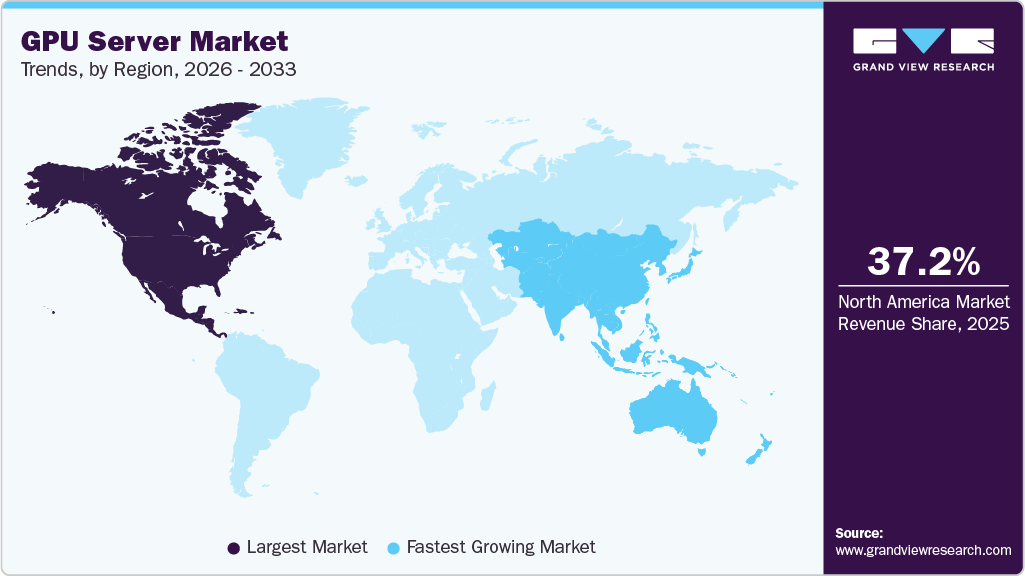
- North America held a 37.2% revenue share of the global GPU server market in 2025.
- In the U.S., the market is driven by large-scale investments in AI supercomputing infrastructure, government-backed semiconductor initiatives, and enterprise-wide AI adoption.
- By server type, the rack servers segment held the largest revenue share of 55.4% in 2025.
- By GPU type, the dedicated GPUs segment held the largest revenue share in 2025.
Market Size & Forecast
- 2025 Market Size: USD 174.33 Billion
- 2033 Projected Market Size: USD 1,545.23 Billion
- CAGR (2026-2033): 31.5%
- North America: Largest market in 2025
- Asia Pacific: Fastest growing market
GPU servers offer processing capabilities that make them ideal for emerging workloads such as AI/ML, deep learning, data analytics, and high-performance computing (HPC). Organizations across sectors, including healthcare, BFSI, manufacturing, and telecom, are increasingly deploying GPU-powered servers to meet the growing demand for inference and training models, real-time simulation, and intelligent automation. This trend is further amplified by the proliferation of large language models (LLMs), autonomous systems, and 3D content rendering, all of which require optimized compute density and scalability. As enterprises modernize their IT stacks, GPU servers are being integrated both on-premises and in cloud-based environments to support hybrid and multi-cloud strategies that balance performance, compliance, and latency.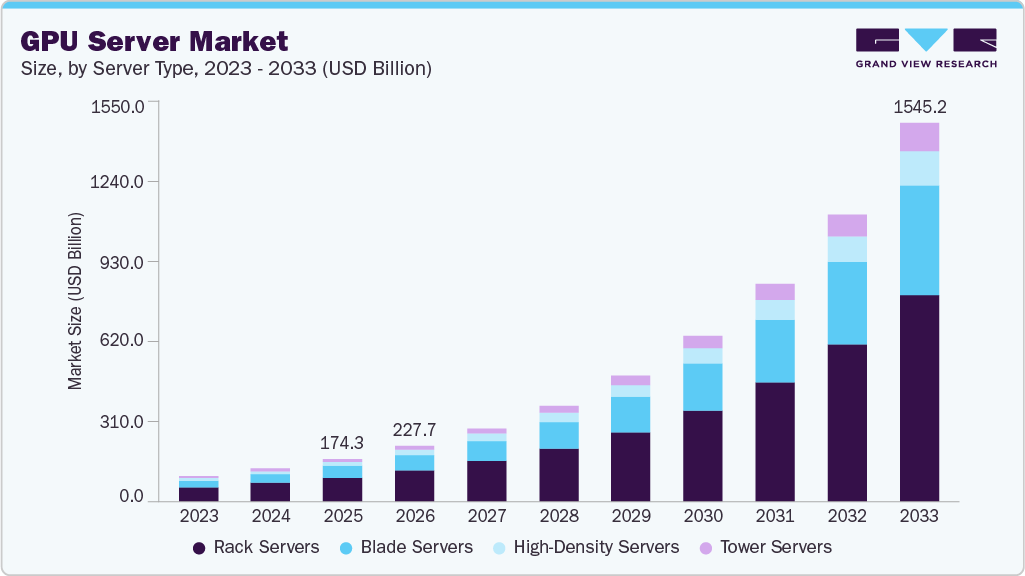
The rapid adoption of AI-native applications is also transforming how GPU servers are architected, deployed, and consumed. Cloud hyperscalers and data center providers are investing in dedicated GPU clusters and bare-metal GPU nodes to support large-scale AI training, while enterprises are deploying GPU servers at the edge to enable real-time inference closer to the data source. Containerization and orchestration tools such as Kubernetes, combined with GPU scheduling extensions like NVIDIA’s GPU Operator, are enabling seamless provisioning and management of GPU resources across distributed environments. This operational flexibility is critical for industries deploying mission-critical AI workloads, such as predictive diagnostics in healthcare, fraud detection in finance, and digital twin simulations in manufacturing. As demand grows for dynamic, workload-aware infrastructure, vendors are offering modular GPU servers with interchangeable components, enabling faster hardware upgrades and more efficient use of computational resources.
The GPU server market is increasingly intersecting with advancements in secure computing, AI observability, and green data center initiatives. Confidential computing technologies are being embedded into GPU-enabled infrastructure to ensure the protection of sensitive data during model training and inference, particularly in sectors bound by strict regulatory mandates. For instance, NVIDIA’s collaboration with leading cloud providers is bringing secure enclave support to GPU workloads, enabling confidential AI processing. Simultaneously, enterprises are leveraging AI-powered observability tools to monitor GPU performance, detect anomalies, and optimize energy consumption in real-time. Sustainability is becoming a core focus, with vendors designing liquid-cooled, energy-efficient GPU servers to reduce the total cost of ownership (TCO) and the carbon footprint. As a result, the market is evolving from a performance-driven compute backbone into a secure, intelligent, and sustainable infrastructure layer underpinning next-generation AI, analytics, and digital services.
GPU Type Insights
The dedicated GPUs segment accounted for the largest revenue share of the global GPU server industry in 2025, primarily driven by the escalating demand for high-performance computing acceleration across AI/ML, high-performance computing (HPC), and data analytics workloads. Unlike integrated or hybrid GPU configurations, dedicated GPUs offer superior computational throughput, memory bandwidth, and parallel processing efficiency, making them the preferred choice for training large-scale models, conducting scientific simulations, and rendering complex 3D graphics. Enterprises, hyperscalers, and research institutions are increasingly investing in GPU-accelerated servers equipped with discrete units such as NVIDIA’s A100/H100 or AMD’s Instinct series to address growing performance needs and workload-specific optimization. Additionally, dedicated GPUs provide greater architectural flexibility, enabling dynamic scaling, virtualization, and integration with container orchestration tools such as Kubernetes for GPU scheduling. For instance, in May 2024, Dell Technologies expanded its PowerEdge XE9680 portfolio with support for 8x NVIDIA H100 GPUs, enabling enterprises to deploy LLM training workloads with reduced latency and improved energy efficiency. Such targeted innovation reinforces the dominance of the dedicated GPU segment, as organizations prioritize raw performance, scalability, and workload isolation to power mission-critical and AI-centric operations.
The hybrid GPUs segment is expected to register a significant CAGR during the forecast period, due to its growing role in balancing performance and energy efficiency across emerging edge, embedded, and mobile data center environments. Hybrid GPUs are designed to integrate the benefits of both integrated and discrete GPU architectures, and are increasingly being adopted in scenarios where space, power, and thermal constraints limit the deployment of full-scale dedicated GPU solutions. This segment is gaining traction in AI inferencing at the edge, real-time data processing in IoT gateways, and automotive applications where compact, power-optimized compute is essential. Moreover, the proliferation of AI PCs, compact edge servers, and thin-client cloud deployments is driving demand for hybrid GPU configurations that offer dynamic workload offloading, cost-effective scalability, and improved battery or thermal performance without compromising on processing capabilities. For instance, Intel’s Meteor Lake processors with integrated NPU and hybrid GPU architecture are designed to support lightweight AI workloads and graphics tasks simultaneously, unlocking new possibilities in decentralized compute environments. As more enterprises shift toward distributed AI and real-time analytics, hybrid GPUs are emerging as a strategic enabler, driving accelerated adoption and a forecasted high growth rate.
Server Type Insights
The rack servers segment accounted for the largest revenue share of the global GPU server market in 2025, owing to its widespread adoption across hyperscale data centers, enterprise AI infrastructure, and high-performance computing environments that demand modular scalability and high-density GPU integration. Rack servers offer an optimal balance between compute performance, space efficiency, and cooling flexibility, making them the preferred deployment model for GPU-intensive workloads such as large language model training, real-time inference, 3D rendering, and simulation. These systems can be configured with multiple high-end GPUs, advanced cooling solutions, and high-bandwidth interconnects, enabling seamless scaling of AI and HPC workloads. Enterprises also favor rack-mounted GPU servers for their compatibility with standard 19-inch racks, which simplifies integration into existing data center ecosystems. For instance, in September 2022, Supermicro introduced its new 8U Universal GPU rack server, supporting up to 10 NVIDIA H100 GPUs and designed for AI factories and HPC clusters. Consequently, such innovations highlight the dominance of rack servers, as organizations seek to optimize performance per watt, footprint, and TCO while scaling their AI, analytics, and virtualization capabilities in a centralized infrastructure.
The blade servers segment is expected to register a significant CAGR during the forecast period, due to increasing demand for high-density, modular compute infrastructure capable of supporting GPU-accelerated workloads in space-constrained data center environments. Blade servers offer a compact, scalable architecture that enables enterprises to deploy multiple GPU-powered nodes within a single chassis, optimizing power, cooling, and rack space utilization. This makes them particularly attractive for AI inference, virtualization, and edge deployments where physical footprint and energy efficiency are critical. Additionally, advancements in interconnect technologies and liquid cooling have enabled modern blade servers to support powerful GPUs like the NVIDIA H100 or AMD Instinct MI300, previously limited to larger rack systems. For example, in February 2025, HPE launched its ProLiant Gen12 blade servers featuring integrated support for dual-slot GPUs, targeting AI and HPC workloads in modular environments. As enterprises embrace hybrid IT strategies and move toward more agile, software-defined infrastructure, blade servers are emerging as a key enabler of GPU scalability in private clouds and enterprise AI clusters, driving rapid growth over the coming years.
Deployment Insights
The on-premise segment accounted for the largest share of the global GPU server industry in 2025, driven by enterprise demand for data sovereignty, low-latency processing, and full-stack control over AI and high-performance computing workloads. Industries operating in highly regulated environments, such as healthcare, government, and BFSI, prefer on-premises GPU servers to ensure compliance with data localization laws, maintain operational autonomy, and manage sensitive information without third-party exposure. Additionally, on-premise deployments provide greater flexibility for hardware customization, thermal management, and GPU-intensive applications such as real-time simulation, LLM training, and visual rendering, which benefit from direct infrastructure access. Enterprises also continue to invest in on-premise GPU clusters to reduce long-term operational costs, avoid cloud egress charges, and enable tighter integration with legacy IT systems. For instance, in October 2023, NVIDIA and Lenovo collaborated to deliver a turnkey on-premise AI infrastructure tailored for enterprises deploying GenAI models and edge inferencing in private environments. These capabilities reinforce the preference for on-premise GPU server deployments among organizations seeking performance, compliance, and cost predictability, driving their leading market position.
The cloud-based segment is expected to grow at the fastest CAGR over the forecast period, fueled by the rising adoption of AI-as-a-Service, elastic training infrastructure, and GPU-accelerated workloads in public and hybrid cloud environments. As organizations prioritize agility, scalability, and cost-efficiency, cloud-based GPU servers are emerging as a preferred choice for running deep learning models, high-performance simulations, 3D rendering, and real-time analytics, without the capital expenditure and maintenance overhead of on-premises infrastructure. Leading cloud providers such as AWS, Microsoft Azure, and Google Cloud are continuously expanding their GPU instance portfolios with next-generation GPUs like the NVIDIA H100 and AMD MI300X, offering specialized configurations optimized for model training, inference, and AI pipelines. For example, in May 2023, Google Cloud introduced A3 Mega VMs with 8 H100 GPUs and 3.6 TB of system RAM to support the training of trillion-parameter models. Additionally, advancements in GPU virtualization, serverless containers, and confidential computing are further driving the shift toward cloud-native AI compute environments. As enterprises embrace AI-first architectures and multi-cloud strategies, the demand for flexible, on-demand access to GPU power is accelerating, positioning the cloud-based segment for the highest growth trajectory.
Enterprise Size Insights
The large enterprise segment accounted for the largest share of the global GPU server market in 2025, primarily due to its substantial budgets, advanced digital transformation initiatives, and complex workload requirements that demand high-performance, scalable GPU infrastructure. Large organizations across sectors such as BFSI, telecom, manufacturing, and healthcare are leading adopters of GPU servers for applications including large-scale AI training, predictive analytics, real-time fraud detection, and scientific simulations-all of which require significant parallel processing power and memory throughput. These enterprises typically operate expansive on-premises data centers or hybrid cloud environments and have the technical expertise to deploy and manage GPU clusters optimized for LLMs, HPC, and rendering. Moreover, large enterprises are increasingly investing in AI factories and private GPU clouds to support in-house R&D, IP protection, and cost optimization. For instance, Meta announced a USD 1.2 billion investment in its in-house GPU supercomputing infrastructure to accelerate the training of GenAI models. Such initiatives reflect the scale and performance needs of large enterprises, reinforcing their dominant market share.
The Small and Medium-Sized Enterprise (SMEs) segment is expected to grow at the fastest CAGR during the forecast period, driven by the democratization of AI, increased access to cloud-based GPU resources, and the growing adoption of AI/ML applications among smaller businesses. As cloud hyperscalers and GPU-as-a-Service providers offer flexible, pay-as-you-go models, SMEs are increasingly leveraging GPU power without the capital burden of owning dedicated infrastructure. These organizations are deploying GPU servers to enable capabilities such as intelligent automation, real-time customer analytics, and computer vision across fields such as retail, logistics, and healthcare tech. Furthermore, advancements in pre-trained AI models, containerized GPU deployment, and managed ML platforms are lowering the technical barriers for SMEs to adopt GPU-accelerated computing. For example, in December 2024, AWS expanded its SageMaker JumpStart offering with optimized GPU inference instances targeted at startups and mid-sized firms with limited ML expertise. As a result, SMEs are poised to emerge as a high-growth segment, capitalizing on GPU-driven innovation to enhance competitiveness, agility, and operational intelligence.
Application Insights
The artificial intelligence & machine learning (AI/ML) segment accounted for the largest share of the global GPU server market in 2025, owing to the rapidly growing demand for accelerated computing in model training, inferencing, and real-time data processing across industries. GPUs are essential for handling the highly parallel workloads required by deep learning algorithms, natural language processing (NLP), computer vision, and large language models (LLMs), making them the preferred infrastructure for AI development. Enterprises across sectors such as healthcare, finance, automotive, and retail are investing in GPU-accelerated servers to support use cases such as predictive diagnostics, fraud detection, autonomous driving, and recommendation engines. Additionally, the emergence of generative AI and foundation models has dramatically increased the need for high-throughput GPU clusters capable of handling trillion-parameter models and continuous fine-tuning. For example, in August 2023, Google Cloud and NVIDIA expanded their strategic collaboration to accelerate AI development by introducing new AI-optimized infrastructure and tools. Google Cloud launched A3 instances powered by NVIDIA H100 GPUs, delivering up to 3× faster AI training performance. At the same time, NVIDIA’s DGX Cloud and AI Enterprise suite were integrated into Google Cloud’s ecosystem, offering enterprises direct access to AI supercomputing capabilities.
The cloud gaming segment is expected to grow at the fastest CAGR during the forecast period, driven by the surging demand for immersive, low-latency gaming experiences without the need for high-end consumer hardware. As gaming platforms shift toward streaming-based delivery models, GPU servers are becoming essential for rendering high-fidelity graphics, real-time physics, and AI-driven gameplay at scale. The proliferation of 5G networks, edge data centers, and GPU virtualization technologies is further enabling scalable cloud gaming infrastructure that supports massive concurrent user bases with minimal lag. Moreover, leading tech companies are investing heavily in GPU-accelerated cloud gaming platforms. For instance, in January 2023, NVIDIA announced updates to its GeForce NOW platform, leveraging RTX 4080 SuperPODs to deliver ultra-low latency gameplay at up to 240 FPS, powered by GPU server clusters across global regions. As game developers increasingly adopt cloud-native tools and real-time rendering engines, the need for flexible, high-performance GPU infrastructure is accelerating, positioning the cloud gaming segment for the fastest growth trajectory.
End Use Insights
The IT & Telecom segment accounted for the largest share of the global GPU server industry in 2025, driven by the sector’s foundational role in enabling AI workloads, cloud infrastructure, and high-throughput data services. Telecom operators and IT service providers are deploying GPU servers to support diverse applications, including 5G core network optimization, AI-powered customer support, real-time video processing, and network function virtualization (NFV). The rising adoption of edge computing and software-defined infrastructure further amplifies demand for GPU-accelerated compute to handle latency-sensitive, bandwidth-intensive tasks. Moreover, hyperscalers and tech giants within the IT & Telecom space are investing in large-scale GPU clusters to power AI-as-a-Service, LLM development, and cloud-native DevOps pipelines. Therefore, the aforementioned factors are contributing significantly to driving the segment share.
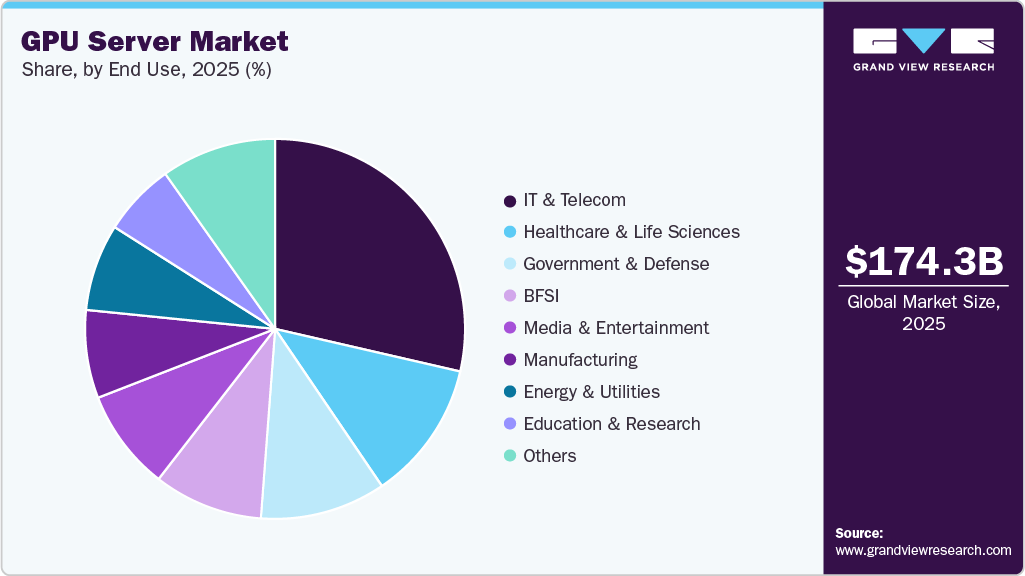
The healthcare & life sciences segment is expected to register the fastest CAGR during the forecast period, driven by the growing adoption of AI-powered diagnostics, genomics, medical imaging, and drug discovery that require accelerated computing. GPU servers are becoming indispensable in healthcare for training deep learning models used in radiology, pathology, and predictive analytics, enabling faster and more accurate disease detection. Additionally, the rise of precision medicine and next-generation sequencing (NGS) is driving demand for GPU-accelerated data processing to analyze massive genomic datasets in real time. Cloud-based GPU platforms are further enabling smaller research labs and hospitals to access scalable AI infrastructure without heavy upfront investment. For instance, startups and institutions are increasingly using GPU-powered frameworks like NVIDIA Clara and MONAI to develop AI models for medical imaging and clinical workflows. The sector’s growing reliance on real-time AI insights, coupled with the need for high-performance, secure, and regulatory-compliant infrastructure, positions healthcare & life sciences as the fastest-growing market vertical.
Regional Insights
North America accounted for the largest market share in 2025, drivenby the rapid buildout of hyperscale AI infrastructure as companies such as Microsoft, Meta, and Amazon invest heavily in GPU-powered data centers to support large language models and generative AI applications. Google Cloud has launched A3 supercomputing instances equipped with NVIDIA H100 GPUs and integrated DGX Cloud capabilities to enable scalable training and inference for enterprise AI workloads. The CHIPS and Science Act is further accelerating demand by boosting domestic semiconductor manufacturing and AI R&D, leading to increased GPU server deployments across research institutions, national labs, and government-backed initiatives. Telecom operators like Verizon and AT&T are adopting GPU servers at the network edge to support AI-native 5G functions, Open RAN platforms, and real-time analytics. These region-specific developments are positioning North America at the forefront of GPU infrastructure adoption for cloud AI, national computing resilience, and next-generation telecom innovation.
U.S. GPU Server Market Trends
The U.S. GPU server industry is experiencing accelerated growth driven by large-scale investments in AI supercomputing infrastructure, government-backed semiconductor initiatives, and enterprise-wide AI adoption. Leading cloud providers such as Microsoft Azure, Google Cloud, and Amazon Web Services are scaling their GPU server capacity with high-density deployments of NVIDIA H100-powered clusters to support foundation model training, generative AI workloads, and AI-as-a-Service platforms. The U.S. Department of Energy and national laboratories are also expanding their use of GPU-based HPC systems for climate modeling, molecular research, and advanced simulations, supported by funding from the CHIPS and Science Act. Additionally, GPU server adoption is rising at the network edge as telecom operators integrate AI into 5G core networks, Open RAN architectures, and real-time service delivery. The U.S. is also seeing strong activity in healthcare and life sciences, with GPU-accelerated servers powering AI imaging, genomics, and drug-discovery platforms across hospitals, research institutions, and startups. This convergence of public-private investment, technological leadership, and cross-sector AI deployment is making the U.S. the most dominant and dynamic market for GPU server infrastructure globally.
Europe GPU Server Market Trends
The GPU server industry in Europe is anticipated to register significant growth from 2026 to 2033, driven by rising investments in sovereign AI infrastructure, energy-efficient data centers, and high-performance computing that meets regulatory requirements across industries. Countries such as Germany, France, and the Netherlands are spearheading GPU server adoption through initiatives like the European High-Performance Computing Joint Undertaking (EuroHPC JU), which funds GPU-accelerated supercomputers for scientific research and climate modeling. European cloud providers, including OVHcloud and Deutsche Telekom, are integrating NVIDIA GPUs into their AI cloud services to support regional enterprises seeking GDPR-compliant AI compute. There is also growing demand from the automotive sector, particularly in Germany and Sweden, where companies are using GPU servers for autonomous vehicle simulations and digital twin development. Additionally, Europe’s focus on sustainable infrastructure has led to the deployment of liquid-cooled and carbon-neutral GPU data centers, such as those operated by Equinix and Atos. These region-specific trends reflect Europe’s strategic push to develop high-performance, sovereign, and green AI infrastructure tailored to its regulatory and industrial landscape.
The GPU server market in the UK is gaining strong momentum, fueled by the country's strategic focus on becoming a global leader in artificial intelligence and advanced computing. The UK government’s £900 million investment in a national AI Research Resource, which includes the construction of a massive GPU-powered supercomputer, is significantly boosting domestic demand for high-performance GPU infrastructure. Leading academic institutions such as the University of Cambridge and AI research hubs in London and Edinburgh are deploying GPU clusters to support cutting-edge research in language modeling, biomedical computing, and climate science. Additionally, UK-based cloud and telecom providers like BT and Gcore are expanding their AI compute offerings with NVIDIA GPU-enabled services to meet enterprise demand for generative AI, data analytics, and 5G applications. The financial services sector, particularly in London, is also adopting GPU servers to power real-time risk modeling, fraud detection, and AI-enhanced trading algorithms. These targeted investments across public, academic, and private sectors are positioning the UK as a key European hub for GPU server infrastructure growth and AI innovation.
The Germany GPU server market is expanding rapidly, driven by the country's strong industrial base, advanced automotive sector, and national initiatives focused on AI sovereignty and high-performance computing. Germany is a key participant in the EuroHPC Joint Undertaking, with supercomputing centers such as LRZ and Jülich deploying GPU-powered systems for scientific research, climate modeling, and quantum simulation. The automotive industry, led by companies such as BMW and Mercedes-Benz, is leveraging GPU servers for autonomous driving simulations, digital twin development, and AI-based quality control across manufacturing processes. German cloud providers and data center operators, including IONOS and T-Systems, are integrating NVIDIA GPUs into their offerings to support GDPR-compliant AI workloads for enterprise clients. Additionally, Germany’s commitment to energy-efficient infrastructure is driving the deployment of liquid-cooled GPU server racks to support the country’s sustainability and emissions goals. These factors collectively position Germany as a leading European market for GPU server adoption, supported by a convergence of industrial innovation, scientific computing, and secure AI infrastructure development.
Asia Pacific GPU Server Market Trends
Asia Pacific is expected to register the fastest CAGR from 2026 to 2033, driven by national AI strategies, rapid hyperscaler expansion, and surging demand for AI infrastructure across key economies such as China, India, Japan, and South Korea. In China, domestic cloud giants like Alibaba Cloud, Tencent, and Baidu are investing heavily in large-scale GPU clusters for generative AI development and foundation model training, with growing demand for domestically produced alternatives to NVIDIA GPUs due to export restrictions. India is emerging as a regional AI compute hub, with investments from AWS and NVIDIA into GPU data centers to support AI startups, digital governance, and academic research. Japan’s RIKEN and Fujitsu continue to expand their high-performance computing capabilities by integrating GPU acceleration into national supercomputing projects, while South Korea’s tech majors, such as Samsung and Naver, are deploying GPU servers for AI-powered semiconductor design, language models, and robotics. Additionally, governments across the region are promoting sovereign cloud and edge AI initiatives that require GPU-optimized infrastructure. These trends, combined with rising 5G penetration, industrial automation, and AI-driven consumer applications, are positioning the Asia Pacific as the fastest-growing region in the global market.
The GPU Server market in Japan is poised for robust growth from 2026 to 2033, driven by the country’s focus on scientific research, robotics, and AI-enhanced industrial automation. Japan is integrating GPU servers into national supercomputing initiatives, such as the RIKEN Fugaku project and the ongoing development of next-generation AI supercomputers that blend GPU and CPU architectures for scalable performance. Leading tech firms like Fujitsu, NEC, and SoftBank are deploying GPU infrastructure to support applications in natural language processing, robotics, autonomous systems, and drug discovery. Additionally, Japanese automotive and electronics manufacturers are leveraging GPU servers for AI-based quality inspection, simulation, and digital twin development. The government’s AI strategy emphasizes collaboration between academia and industry, prompting GPU server installations at universities and research centers to accelerate machine learning and quantum computing research. Japan's growing emphasis on energy-efficient data centers and high-reliability infrastructure is also encouraging investments in liquid-cooled GPU deployments and advanced thermal management systems, reinforcing the country's position as a regional leader in high-performance and AI-focused GPU server adoption.
The India GPU Server market is poised for rapid expansion from 2026 to 2033, propelled by the government's digital initiatives, surging AI startup ecosystem, and increasing demand for compute infrastructure across sectors such as healthcare, fintech, and education. India's National Program on Artificial Intelligence and the establishment of AI research hubs under the Digital India framework have catalyzed investments in GPU-powered data centers for public-sector projects, language model training, and smart governance applications. Major cloud providers like AWS and Google Cloud are expanding their GPU instance offerings within Indian regions to support growing enterprise adoption of AI/ML workloads. At the same time, NVIDIA has partnered with Indian firms and academic institutions to deploy GPU clusters for research and skill development. Additionally, Indian startups in edtech, agritech, and medtech are utilizing cloud-based GPU servers to enable real-time analytics, computer vision, and language translation across regional dialects. With increasing adoption of 5G, IoT, and AI-driven automation, and a strong focus on building sovereign digital infrastructure, India is emerging as a key growth market for GPU servers in the Asia Pacific region.
Key GPU Server Company Insights
Key players in the GPU Server industry include AMD (Advanced Micro Devices, Inc.), ASRock Rack Inc., ASUS (ASUSTeK Computer Inc.), Cisco Systems, Inc., and others. Companies are focusing on various strategic initiatives, including new product development, partnerships & collaborations, and agreements to gain a competitive advantage over their rivals. The following are some instances of such initiatives.
-
In August 2025, NVIDIA launched its RTX PRO 6000 Blackwell Server Edition GPUs in a compact 2U rackmount form factor. These powerful systems, offered through Dell, HPE, Lenovo, Cisco, and Supermicro, deliver up to 45× better performance and 18× greater energy efficiency than CPU-only solutions.
-
In May 2025, Intel launched new Xeon 6 processors designed to maximize GPU-accelerated AI performance, featuring Priority Core Turbo (PCT) technology that dynamically prioritizes CPU cores to run at higher turbo frequencies, efficiently feeding data to GPUs.
-
In May 2024, Dell Technologies expanded its Dell AI Factory with NVIDIA by introducing new GPU server solutions like the PowerEdge XE9680L server, which supports up to eight NVIDIA Blackwell Tensor Core GPUs with direct liquid cooling for high performance and efficiency in compact form factors.
Key GPU Server Companies:
The following key companies have been profiled for this study on the GPU server market.
- AMD (Advanced Micro Devices, Inc.)
- ASRock Rack Inc.
- ASUS (ASUSTeK Computer Inc.)
- Cisco Systems, Inc.
- Dell Technologies Inc.
- Fujitsu Limited
- GIGABYTE Technology Co., Ltd.
- Hewlett Packard Enterprise (HPE)
- Huawei Technologies Co., Ltd.
- IBM Corporation
- Inspur Group
- Intel Corporation
- Lenovo Group Limited
- NVIDIA Corporation
- Super Micro Computer, Inc.
GPU Server Market Report Scope
Report Attribute
Details
Market size in 2026
USD 227.65 billion
Revenue forecast in 2033
USD 1,545.23 billion
Growth rate
CAGR of 31.5% from 2026 to 2033
Actual data
2021 - 2025
Forecast period
2026 - 2033
Quantitative units
Revenue in USD billion and CAGR from 2026 to 2033
Report Coverage
Revenue forecast, company share, competitive landscape, growth factors, and trends
Segments covered
GPU type, server type, deployment, enterprise size, application, end use, region
Regional scope
North America; Europe; Asia Pacific; Latin America; MEA
Country scope
U.S.; Canada; Mexico; UK; Germany; France; China; India; Japan; Australia; South Korea; Brazil; UAE; Kingdom of Saudi Arabia; South Africa
Key companies profiled
AMD (Advanced Micro Devices, Inc.); ASRock Rack Inc.; ASUS (ASUSTeK Computer Inc.); Cisco Systems, Inc.; Dell Technologies Inc.; Fujitsu Limited; GIGABYTE Technology Co., Ltd.; Hewlett Packard Enterprise (HPE); Huawei Technologies Co., Ltd.; IBM Corporation; Inspur Group; Intel Corporation; Lenovo Group Limited; NVIDIA Corporation; Super Micro Computer, Inc.
Customization scope
Free report customization (equivalent to 8 analysts working days) with purchase. Addition or alteration to country, regional & segment scope.
Pricing and purchase options
Avail customized purchase options to meet your exact research needs. Explore purchase options
Global GPU Server Market Report Segmentation
This report forecasts revenue growth at the global, regional, and country levels and provides an analysis of the latest industry trends in each of the sub-segments from 2021 to 2033. For this study, Grand View Research has segmented the GPU Server market report based on GPU type, server type, deployment, enterprise size, application, end use, and region:
-
GPU Type Outlook (Revenue, USD Billion, 2021 - 2033)
-
Dedicated GPUs
-
Integrated GPUs
-
Hybrid GPUs
-
-
Server Type Outlook (Revenue, USD Billion, 2021 - 2033)
-
Rack Servers
-
Blade Servers
-
Tower Servers
-
High-Density Servers
-
-
Deployment Outlook (Revenue, USD Billion, 2021 - 2033)
-
On-Premise
-
Cloud-Based
-
-
Enterprise Size Outlook (Revenue, USD Billion, 2021 - 2033)
-
Large Size Enterprise
-
Small and Medium Sized Enterprise (SMEs)
-
-
Application Outlook (Revenue, USD Billion, 2021 - 2033)
-
Artificial Intelligence & Machine Learning
-
High-Performance Computing (HPC)
-
Graphics Rendering
-
Data Analytics
-
Virtualization
-
Cloud Gaming
-
Others
-
-
End Use Outlook (Revenue, USD Billion, 2021 - 2033)
-
IT & Telecom
-
Healthcare & Life Sciences
-
BFSI
-
Government & Defense
-
Manufacturing
-
Media & Entertainment
-
Energy & Utilities
-
Education & Research
-
Others
-
-
Regional Outlook (Revenue, USD Billion, 2021 - 2033)
-
North America
-
U.S.
-
Canada
-
Mexico
-
-
Europe
-
UK
-
Germany
-
France
-
-
Asia Pacific
-
China
-
India
-
Japan
-
South Korea
-
Australia
-
-
Latin America
-
Brazil
-
-
Middle East & Africa
-
UAE
-
Saudi Arabia
-
South Africa
-
-
Frequently Asked Questions About This Report
b. The artificial intelligence & machine learning (AI/ML) segment dominated the GPU server market in 2025, owing to the rapidly growing demand for accelerated computing in model training, inferencing, and real-time data processing across industries.
b. Some key players operating in the market include AMD (Advanced Micro Devices, Inc.), ASRock Rack Inc., ASUS (ASUSTeK Computer Inc.), Cisco Systems, Inc., Dell Technologies Inc., Fujitsu Limited, GIGABYTE Technology Co., Ltd., Hewlett Packard Enterprise (HPE), Huawei Technologies Co., Ltd., IBM Corporation, Inspur Group, Intel Corporation, Lenovo Group Limited, NVIDIA Corporation, Super Micro Computer, Inc. and Others.
b. Factors such as the enterprises accelerating digital transformation efforts and embracing high-performance infrastructure for data-intensive applications play a key role in accelerating the GPU server market.
b. The global GPU server market size was estimated at USD 174.33 billion in 2025 and is expected to reach USD 227.65 billion in 2026.
b. The global GPU server market is expected to grow at a compound annual growth rate of 31.5% from 2026 to 2033 to reach USD 1,545.23 million by 2033.


Share this report with your colleague or friend.
Need a Tailored Report?
Customize this report to your needs — add regions, segments, or data points, with 20% free customization.


ISO 9001:2015 & 27001:2022 Certified
We are GDPR and CCPA compliant! Your transaction & personal information is safe and secure. For more details, please read our privacy policy.
Trusted market insights - try a free sample
See how our reports are structured and why industry leaders rely on Grand View Research. Get a free sample or ask us to tailor this report to your needs.