- Home
- »
- Food Safety & Processing
- »
-
Food Processing Equipment Market Size, Share Report, 2033GVR Report cover
![Food Processing Equipment Market Size, Share & Trends Report]()
Food Processing Equipment Market (2026 - 2033) Size, Share & Trends Analysis Report By Type (Processing, Pre-Processing), By Mode Of Operation (Semi-Automatic, Automatic), By Application (Bakery & Confectionaries, Meat, Poultry, & Seafood), By Region, And Segment Forecasts
- Report ID: GVR-2-68038-491-8
- Number of Report Pages: 100
- Format: PDF
- Historical Range: 2021 - 2025
- Forecast Period: 2026 - 2033
- Industry: Consumer Goods
- Report Summary
- Table of Contents
- Interactive Charts
- Methodology
- Download FREE Sample
-
 Download Sample Report
Food Processing Equipment Market Summary
The global food processing equipment market size was estimated at USD 56.79 billion in 2025 and is projected to reach USD 78.71 billion by 2033, growing at a CAGR of 4.2% from 2026 to 2033. Rising demand for processed and convenience foods is a major factor driving the food processing equipment market.
Key Market Trends & Insights
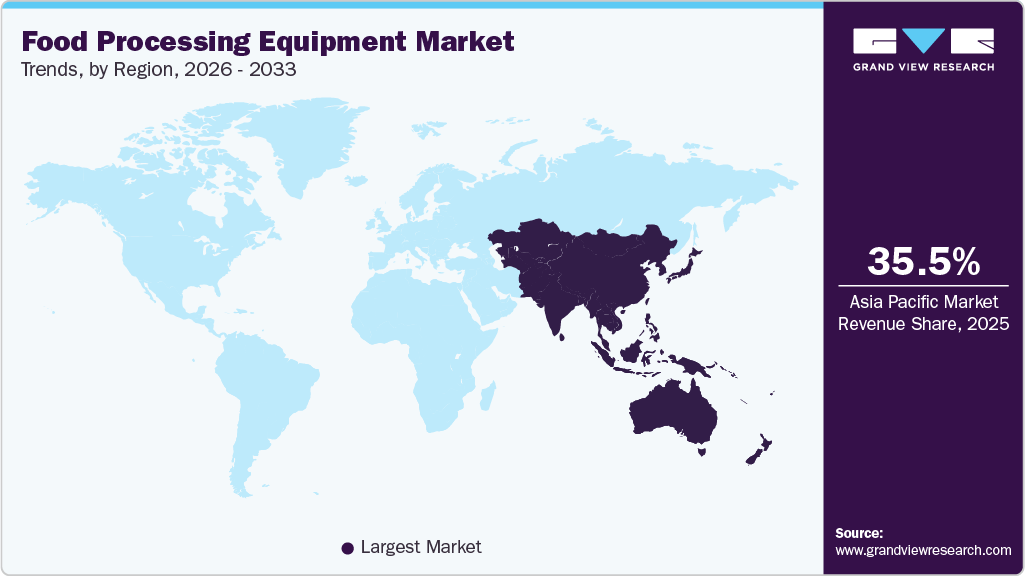
- Asia Pacific dominated the food processing equipment market with the largest revenue share of 35.5% in 2025.
- The food processing equipment market in the China is expected to grow at a substantial CAGR of 5.5% from 2026 to 2033.
- By application, meat, poultry, & seafood segment is expected to grow at a considerable CAGR of 5.1% from 2026 to 2033.
- By type, processing segment is expected to grow at a considerable CAGR of 4.5% from 2026 to 2033.
- By mode of operation, automatic segment is expected to grow at a considerable CAGR of 4.9% from 2026 to 2033.
Market Size & Forecast
- 2025 Market Size: USD 56.79 Billion
- 2033 Projected Market Size: USD 78.71 Billion
- CAGR (2026-2033): 4.2%
- Asia Pacific: Largest market in 2025
Changing lifestyles, urbanization, and increasing disposable income are encouraging consumers to choose ready-to-eat and packaged food products. Food manufacturers are investing in advanced processing solutions to improve efficiency, maintain consistent product quality, and scale production. Technological advancements and stricter food safety regulations are further accelerating market growth. Manufacturers are adopting automated and smart equipment integrated with digital monitoring, IoT, and energy-efficient systems to enhance productivity and reduce operational costs. Compliance with hygiene standards and traceability requirements is pushing companies to upgrade processing lines with modern equipment. Moreover, expansion of cold chain infrastructure and demand for sustainable processing solutions continue to support equipment adoption.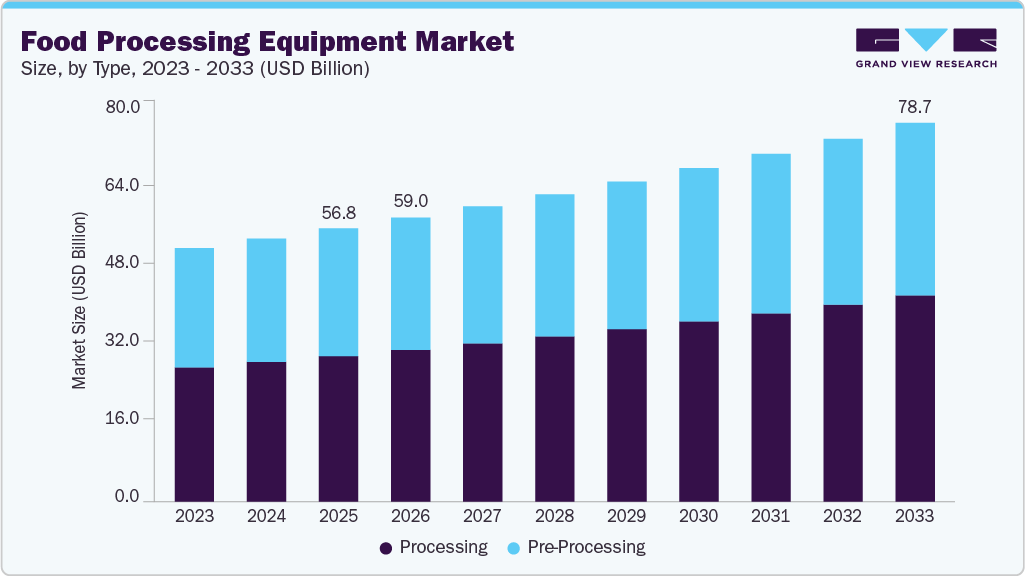
Market Concentration & Characteristics
The food processing equipment market is fragmented, supported by the presence of numerous global manufacturers alongside many regional and niche equipment suppliers. While leading companies hold strong positions in high-technology and automated processing solutions, smaller players remain competitive by offering specialized machines, flexible customization, and cost-effective alternatives. The wide range of applications across bakery, dairy, meat, beverage, and agricultural processing prevents dominance by a few firms. Continuous product innovation, regional manufacturing capabilities, and diverse end-user requirements contribute to a competitive and dynamic market structure rather than a highly concentrated one.
Innovation plays a central role in the food processing equipment market as manufacturers focus on automation, smart controls, and energy-efficient technologies to improve productivity. Integration of IoT, data monitoring, and advanced sensors enables predictive maintenance and better process optimization. Companies are also developing flexible systems that allow quick product changeovers to meet evolving consumer trends. Sustainability-driven innovation, including waste reduction and water-efficient designs, is becoming increasingly important.
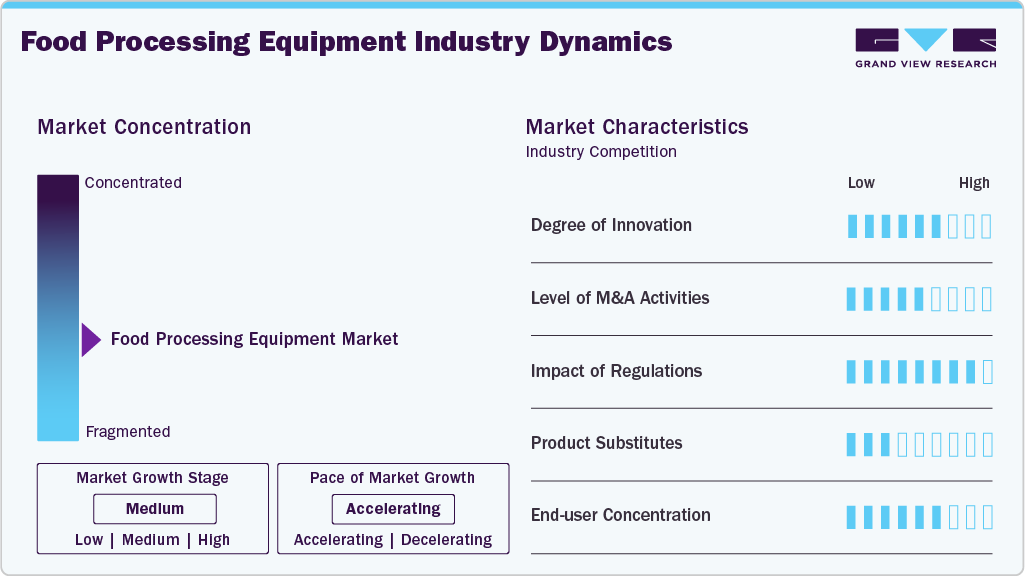
Regulatory standards strongly influence equipment design and adoption, especially regarding food safety, hygiene, and traceability requirements. Manufacturers must comply with strict guidelines related to sanitation, contamination prevention, and material safety across different regions. Compliance encourages investment in advanced processing solutions that support automated cleaning and monitoring systems. Changing environmental regulations are also pushing companies to adopt energy-efficient and low-emission equipment.
End users range from large multinational food producers to small and medium-sized processors, creating a diverse customer base. Major food corporations often invest in fully automated, high-capacity equipment to achieve large-scale production efficiency. Smaller processors typically prioritize cost-effective and modular systems that can scale gradually. This varied demand structure leads to broad product offerings and supports competition across multiple equipment segments.
Drivers, Opportunities & Restraints
Increasing global demand for processed and packaged food products is a key driver supporting adoption of advanced food processing equipment. Rising urbanization and changing dietary habits are pushing manufacturers to expand production capacity and improve efficiency. Automation reduces labor dependency while maintaining consistent quality and safety standards. Growth in cold chain logistics and expansion of organized retail also encourage investment in modern processing technologies.
Growing interest in plant-based foods, functional ingredients, and customized food products is creating opportunities for flexible and modular processing equipment. Emerging markets are witnessing rapid industrialization of food processing, opening new avenues for equipment suppliers. Digitalization, including smart manufacturing and data-driven process optimization, offers potential for improved operational performance. Demand for sustainable solutions such as energy-efficient machines and waste reduction technologies is also generating new growth prospects.
High initial investment costs and maintenance expenses can limit adoption, particularly among small and medium-sized food processors. Complex regulatory requirements across different regions may increase compliance costs and slow equipment upgrades. Integration challenges with existing processing lines can create operational disruptions during modernization. In addition, fluctuations in raw material prices and supply chain disruptions may impact equipment demand cycles.
Type Insights
Processing equipment segment held the largest share in the food processing equipment market and accounted for 53.3% share in 2025, due to its critical role in transforming raw ingredients into finished or ready-to-package products. High demand for extrusion, baking, drying, freezing, and coating systems supports strong adoption across multiple food segments. Large-scale food manufacturers prioritize advanced processing technologies to improve productivity, product consistency, and operational efficiency. Increasing automation and continuous processing systems further strengthen the dominance of this segment.
Pre-processing equipment is witnessing steady growth as food manufacturers focus on improving raw material handling and preparation efficiency. Equipment such as sorting, washing, cutting, and mixing systems reduce waste, enhance hygiene, and ensure uniform product quality before main processing stages. Rising demand for fresh-cut and minimally processed foods is encouraging investment in advanced pre-processing solutions. Automation and improved sanitation standards are also driving adoption across fruit, vegetable, and meat processing applications.
Mode of Operation Insights
Automatic equipment dominated the food processing equipment market in 2025 and accounted for 51.1% share due to its ability to enhance productivity, reduce labor costs, and maintain consistent product quality. Large food manufacturers preferred fully automated systems to support high-volume production and minimize human intervention. Integration with digital monitoring and smart control technologies helped improve process optimization and operational efficiency. Strong emphasis on hygiene standards and traceability further accelerated adoption of automated solutions.
Semi-automatic segment showed moderate growth in 2025 as small and medium-sized food processors sought cost-effective solutions with greater operational flexibility. These systems provided a balance between automation and manual control, making them suitable for customized or smaller batch production. Lower upfront investment compared to fully automated machinery supported adoption among emerging businesses. Increasing demand from regional manufacturers and developing markets contributed to steady segment expansion.
Application Insights
The bakery and confectionaries segment dominated the food processing equipment market in 2025 and accounted for 21.5% share due to strong consumer demand for packaged baked goods, snacks, and ready-to-eat products. High production volumes required advanced ovens, mixers, and forming equipment to ensure consistency and efficiency. Expansion of industrial bakeries and growing demand for premium and specialty baked items supported equipment investments. Automation in baking processes also improved product quality and reduced operational costs.
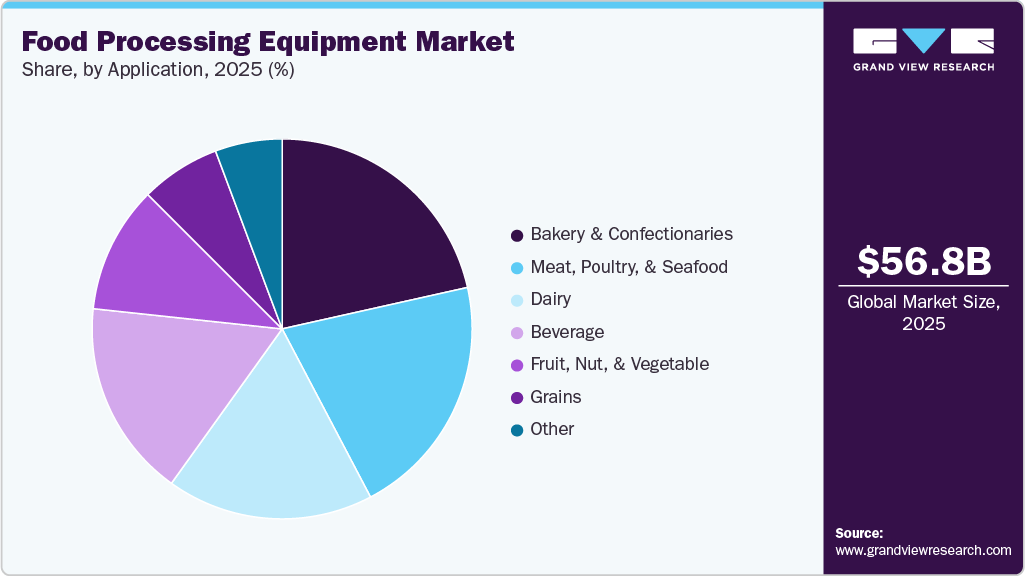
The meat, poultry, and seafood segment emerged as the fastest-growing application segment driven by rising protein consumption and increasing demand for processed meat products. Food safety regulations encouraged adoption of advanced cutting, freezing, and processing equipment to maintain hygiene and traceability. Growth of quick-service restaurants and ready-to-cook meat products supported higher processing capacity requirements. Technological advancements in preservation and cold chain infrastructure further accelerated equipment demand in this segment.
Regional Insights
Asia Pacific dominated the food processing equipment market in 2025 and accounted for 35.5% share, due to rapid industrialization of the food sector and rising demand for packaged and processed foods. Growing population, urbanization, and changing dietary preferences encouraged manufacturers to expand processing capacity. Strong growth in countries such as China, India, and Southeast Asia supported equipment adoption. Increasing investments in automation and modernization of food processing facilities further strengthened regional leadership.
China Food Processing Equipment Market Trends
Food processing equipment market in China dominated the APAC market in 2025 due to its large-scale food manufacturing industry and strong investments in automation and industrial modernization. Rising domestic consumption of processed and packaged foods supported continuous expansion of production facilities. Government initiatives encouraging advanced manufacturing technologies further boosted equipment adoption. The country’s strong export-oriented food sector also drove demand for high-capacity processing systems.
Food processing equipment market in India showed significant growth driven by rapid expansion of the food processing sector and increasing demand for packaged and ready-to-eat products. Government support through food processing initiatives and infrastructure development encouraged modernization of production lines. Rising urbanization and changing consumer lifestyles supported adoption of automated and semi-automated equipment. Growth of organized retail and cold chain logistics further strengthened market development.
North America Food Processing Equipment Market Trends
North America food processing equipment market is anticipated to experience steady growth at CAGR of 3.5% over the forecast period, supported by high adoption of advanced automation and smart processing technologies. Established food manufacturing industries focused on upgrading equipment to improve efficiency and comply with strict safety standards. Rising demand for convenience foods and ready-to-eat products encouraged continuous innovation. Investments in sustainable and energy-efficient processing solutions also supported market expansion.
The U.S. dominated the North American food processing equipment market in 2025 due to its highly developed food manufacturing sector and strong adoption of advanced automation technologies. Large-scale producers invested in modern processing systems to enhance efficiency, maintain quality standards, and reduce labor dependency. Strict food safety regulations encouraged continuous equipment upgrades and technological innovation. Growing demand for convenience foods and ready-to-eat products further supported market leadership.
Food processing equipment market in Mexico showed notable growth driven by expansion of its food processing industry and increasing foreign investments in manufacturing facilities. Rising export-oriented production, particularly in processed foods and beverages, supported demand for modern processing equipment. Competitive labor costs and improving industrial infrastructure attracted multinational food companies. Adoption of semi-automated and automated solutions increased as local manufacturers focused on improving productivity and meeting international quality standards.
Europe Food Processing Equipment Market Trends
Europe showed consistent growth driven by strict regulatory standards related to food safety, hygiene, and environmental sustainability. Food manufacturers invested in modern processing equipment to enhance traceability and reduce energy consumption. Increasing demand for premium, organic, and specialty food products supported technological upgrades. Strong presence of established equipment manufacturers also contributed to regional market development.
Food processing equipment market in Germany dominated the European market in 2025 due to its strong engineering expertise and presence of leading equipment manufacturers. The country’s advanced food manufacturing sector drove demand for highly automated and energy-efficient processing solutions. Strict regulatory standards encouraged continuous investment in hygienic design and precision processing technologies. Export-oriented machinery production also strengthened Germany’s position as a regional leader.
Food processing equipment market in the UK experienced steady growth supported by increasing investment in modernizing food processing facilities and improving production efficiency. Rising demand for packaged and convenience foods encouraged adoption of advanced processing and automation solutions. Food manufacturers focused on enhancing flexibility to meet changing consumer preferences and product innovation. Sustainability initiatives and energy-efficient equipment adoption further contributed to market expansion.
Middle East & Africa Food Processing Equipment Market Trends
The Middle East and Africa region experienced gradual growth driven by increasing food security initiatives and expansion of local food processing capabilities. Governments encouraged domestic production to reduce reliance on imports, supporting equipment adoption. Rising investments in cold chain infrastructure and packaged food manufacturing boosted demand for advanced machinery. Growth of hospitality and retail sectors also contributed to market expansion.
Food processing equipment market in South Africa experienced steady growth in the Middle East & Africa market in 2025, driven by increasing investments in local food manufacturing and processing capacity. Rising demand for packaged and processed foods encouraged companies to modernize production lines. Expansion of retail infrastructure and cold chain logistics supported adoption of advanced processing technologies. Government initiatives promoting food security and industrial development also contributed to market growth.
Latin America Food Processing Equipment Market Trends
Latin America witnessed growing demand for food processing equipment due to expansion of the packaged food industry and increasing exports of processed agricultural products. Rising urban populations and improving retail infrastructure encouraged food manufacturers to modernize production lines. Investment in meat and beverage processing sectors supported equipment demand. Regional manufacturers also adopted automation to improve productivity and quality standards.
Food processing equipment market in Brazil showed strong growth in the Latin America food processing equipment market in 2025 driven by expansion of its processed food and beverage industries. Increasing exports of meat, poultry, and agricultural products encouraged investment in advanced processing technologies. Food manufacturers focused on improving production efficiency and meeting international quality standards. Rising urbanization and growing demand for packaged foods further supported equipment adoption across the country.
Key Food Processing Equipment Company Insights
Some of the key players operating in the market include Bühler AG, GEA Group Aktiengesellschaft, and Tetra Laval.
-
GEA focuses on advanced processing and packaging technologies designed to improve efficiency, hygiene, and automation across dairy, beverage, meat, and prepared food applications. The company offers integrated solutions covering processing, separation, thermal treatment, and refrigeration systems, enabling end-to-end production optimization. Its equipment emphasizes energy efficiency and reduced resource consumption to support sustainable food manufacturing. GEA invests heavily in digitalization, including smart monitoring and predictive maintenance technologies. Strong global service capabilities help food manufacturers maintain operational continuity and optimize equipment performance.
-
Bühler AG specializes in processing solutions for grains, cereals, chocolate, and advanced food ingredients, supporting large-scale industrial production. The company develops high-precision milling, extrusion, and drying technologies that enhance product consistency and throughput. Innovation is centered on automation, data-driven process control, and sustainable processing methods that reduce waste and energy usage. Bühler’s equipment is widely used in staple food processing, contributing to improved productivity across milling and food production lines. Continuous investment in R&D enables the company to address emerging trends such as alternative proteins and functional food processing.
Key Food Processing Equipment Companies:
The following key companies have been profiled for this study on the food processing equipment market.
- BAADER Group
- JBT Marel
- Bühler AG
- GEA Group Aktiengesellschaft
- The Middleby Corporation
- Tetra Laval
- Alfa Laval
- Krones AG
- SPX Flow Inc.
- LEHUI
- Equipamientos Cárnicos, S.L. (MAINCA)
- FENCO Food Machinery s.r.l.
- Bigtem Makine A.S.
- TNA Australia Pty Limited.
- Foodmate
Recent Developments
-
In October 2025, JBT Marel introduced the Fresh’n Squeeze 1800 citrus juicer to improve extraction efficiency and juice quality. The system processes whole fruits while separating unwanted components to maintain freshness and taste. It offers higher yield and faster operation compared to traditional juicing equipment. The automated design supports improved productivity for retail and foodservice environments.
-
In May 2025, BAADER strengthened its regional footprint by launching a new production facility in Malaysia to support innovation and localized manufacturing. The site focuses on advanced processing technologies and digital solutions for protein processing applications. This expansion aims to meet rising demand across Southeast Asia and improve supply chain efficiency. The investment also supports sustainable production and regional market growth.
-
In January 2025, Bühler strengthened its processing capabilities by acquiring CEREX puffing technology for food, pet food, and feed production. The technology helps improve efficiency while reducing energy consumption and processing waste. It supports development of lightweight, textured products with enhanced quality. The move also expands Bühler’s ability to address growing demand for innovative and sustainable processing solutions.
Food Processing Equipment Market Report Scope
Report Attribute
Details
Market size value in 2026
USD 59.02 billion
Revenue forecast in 2033
USD 78.71 billion
Growth rate
CAGR of 4.2% from 2026 to 2033
Actual data
2021 - 2025
Forecast period
2026 - 2033
Quantitative units
Revenue in USD million/billion and CAGR from 2026 to 2033
Report coverage
Revenue forecast, company ranking, competitive landscape, growth factors, and trends
Segments covered
Application, type, mode of operation, and region.
Regional scope
North America; Europe; Asia Pacific; Latin America; Middle East & Africa
Country scope
U.S.; Canada; Mexico; UK; Germany; Russia; Italy; China; Japan; India; Australia; South Korea; Brazil; South Africa
Key companies profiled
BAADER Group; JBT Marel; Bühler AG; GEA Group Aktiengesellschaft; The Middleby Corporation; Tetra Laval; Alfa Laval; Krones AG; SPX Flow Inc.; LEHUI; Equipamientos Cárnicos, S.L. (MAINCA); FENCO Food Machinery s.r.l.; Bigtem Makine A.S.; TNA Australia Pty Limited; Foodmate.
Customization scope
Free report customization (equivalent up to 8 analysts working days) with purchase. Addition or alteration to country, regional & segment scope.
Pricing and purchase options
Avail customized purchase options to meet your exact research needs. Explore purchase options
Global Food Processing Equipment Market Report Segmentation
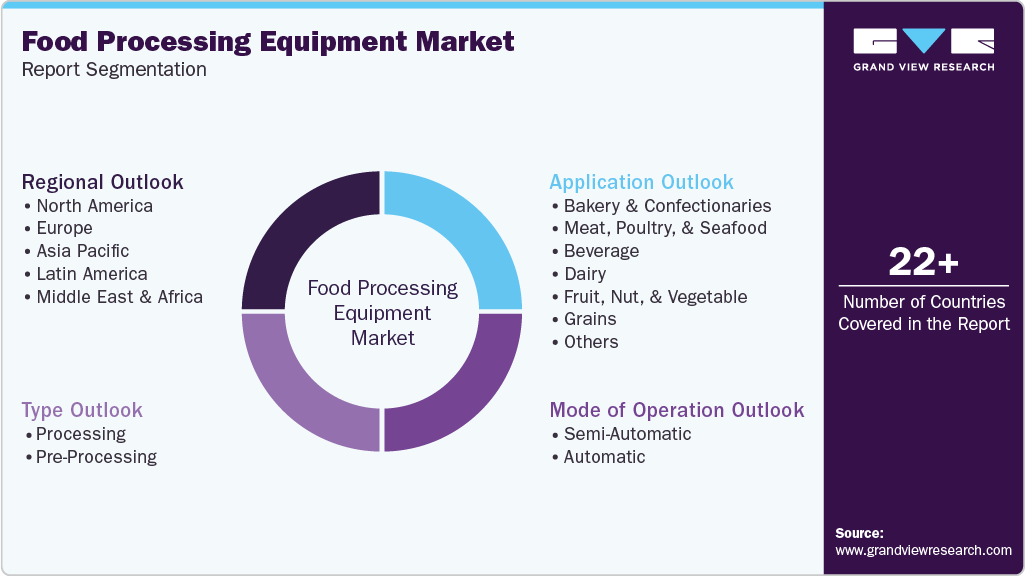
This report forecasts revenue growth at global, regional, and country levels and provides an analysis of the latest industry trends in each of the sub-segments from 2021 to 2033. For this study, Grand View Research has segmented the global food processing equipment market report based on application, type, mode of operation, and region:
-
Type Outlook (Revenue, USD Billion, 2021 - 2033)
-
Processing
-
Extruders and Forming Machines
-
Ovens and Dryers
-
Refrigeration and Freezing Equipment
-
Coating Equipment
-
Others
-
-
Pre-Processing
-
Sorting & Grading
-
Cutting and Peeling Equipment
-
Washing Equipment
-
Mixing and Blending Equipment
-
-
-
Mode of Operation Outlook (Revenue, USD Billion, 2021 - 2033)
-
Semi-Automatic
-
Automatic
-
-
Application Outlook (Revenue, USD Billion, 2021 - 2033)
-
Bakery & Confectionaries
-
Meat, Poultry, & Seafood
-
Beverage
-
Dairy
-
Fruit, Nut, & Vegetable
-
Grains
-
Others
-
-
Regional Outlook (Revenue, USD Billion, 2021 - 2033)
-
North America
-
U.S.
-
Canada
-
Mexico
-
-
Europe
-
Germany
-
Russia
-
Italy
-
UK
-
-
Asia Pacific
-
China
-
India
-
Japan
-
South Korea
-
Australia
-
-
Latin America
-
Brazil
-
-
Middle East and Africa
-
South Africa
-
-
Frequently Asked Questions About This Report
b. The global food processing equipment market size was estimated at USD 56.79 billion in 2025 and is expected to be USD 59.02 billion in 2026.
b. The global food processing equipment market, in terms of revenue, is expected to grow at a compound annual growth rate of 4.2% from 2026 to 2033 to reach USD 78.71 billion by 2033.
b. Asia Pacific dominated the food processing equipment market in 2025 and accounted for 35.5% share, due to rapid industrialization of the food sector and rising demand for packaged and processed foods. Growing population, urbanization, and changing dietary preferences encouraged manufacturers to expand processing capacity.
b. Some of the key players operating in the global food processing equipment market include BAADER Group; JBT Marel; Bühler AG; GEA Group Aktiengesellschaft; The Middleby Corporation; Tetra Laval; Alfa Laval; Krones AG; SPX Flow Inc.; LEHUI; Equipamientos Cárnicos, S.L. (MAINCA); FENCO Food Machinery s.r.l.; Bigtem Makine A.S.; TNA Australia Pty Limited; Foodmate.
b. Rising demand for processed and convenience foods, driven by urbanization and changing consumer lifestyles, is a major factor supporting market growth. Increasing adoption of automation and advanced technologies helps improve efficiency, food safety, and production capacity. Expansion of cold chain infrastructure and stricter hygiene regulations also encourage investment in modern food processing equipment.


Share this report with your colleague or friend.
Need a Tailored Report?
Customize this report to your needs — add regions, segments, or data points, with 20% free customization.


ISO 9001:2015 & 27001:2022 Certified
We are GDPR and CCPA compliant! Your transaction & personal information is safe and secure. For more details, please read our privacy policy.
Trusted market insights - try a free sample
See how our reports are structured and why industry leaders rely on Grand View Research. Get a free sample or ask us to tailor this report to your needs.