- Home
- »
- Organic Chemicals
- »
-
Flow Chemistry Market Size & Share, Industry Report, 2033GVR Report cover
![Flow Chemistry Market Size, Share & Trends Report]()
Flow Chemistry Market (2026 - 2033) Size, Share & Trends Analysis Report By Product (CSTR, Plug Flow Reactor, Microreactor, Microwave System), By Application (Pharmaceuticals, Chemicals, Academia & Research, Petrochemicals), By Region, And Segment Forecasts
- Report ID: GVR-1-68038-711-7
- Number of Report Pages: 100
- Format: PDF
- Historical Range: 2021 - 2024
- Forecast Period: 2026 - 2033
- Industry: Bulk Chemicals
- Report Summary
- Table of Contents
- Segmentation
- Methodology
- Download FREE Sample
-
 Download Sample Report
Flow Chemistry Market Summary
The global flow chemistry market size was estimated at USD 2,149.9 million in 2025 and is projected to reach USD 5,016.4 million by 2030, growing at a CAGR of 11.3% from 2026 to 2033. Market growth is primarily driven by rising demand for efficient, safe chemical manufacturing processes across the pharmaceutical, specialty chemicals, and petrochemical industries.
Key Market Trends & Insights
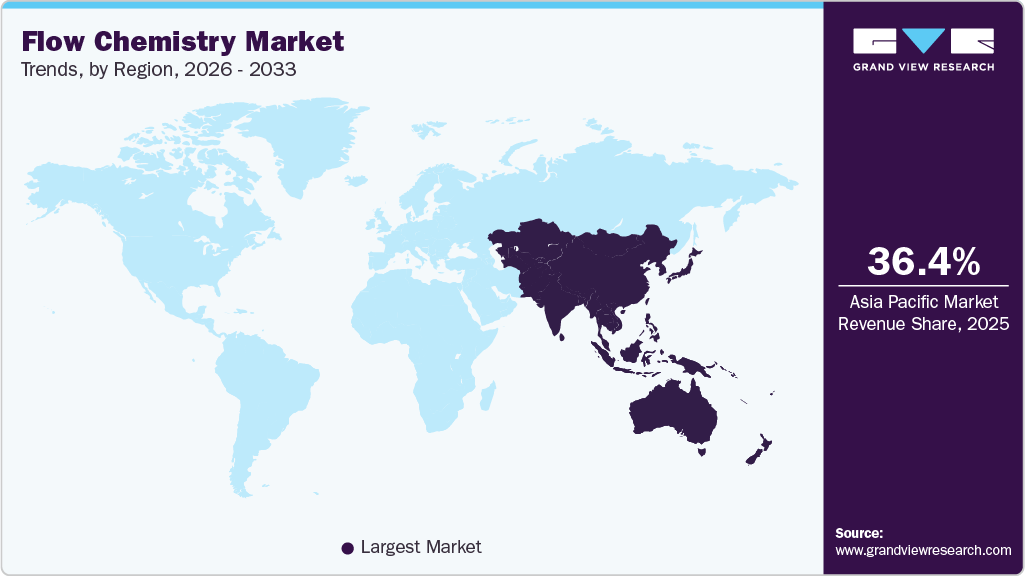
- Asia Pacific dominated the flow chemistry market with the largest revenue share of 36.4% in 2025.
- The flow chemistry industry in the U.S. is expected to grow at a substantial CAGR of 10.0% from 2026 to 2033.
- By product, the microreactor segment is expected to grow at a considerable CAGR of 16.1% from 2026 to 2033 in terms of revenue.
- By application, the pharmaceuticals segment is expected to grow at a considerable CAGR of 12.0% from 2026 to 2033 in terms of revenue.
Market Size & Forecast
- 2025 Market Size: USD 2,149.9 Million
- 2033 Projected Market Size: USD 5,016.4 Million
- CAGR (2026-2033): 11.3%
- Asia Pacific: Largest market in 2025
Continuous processing enables precise control over reaction parameters such as temperature, pressure, and residence time, resulting in improved product quality and reduced risk compared to batch processing. Another key driver is the rising focus on process intensification, sustainability, and cost reduction in industrial operations. Flow chemistry minimizes solvent usage, reduces waste generation, and improves energy efficiency, aligning with strict environmental regulations and green chemistry initiatives. Advancements in microreactor technology, automation, and real-time analytics are also accelerating adoption by simplifying scale-up from laboratory research to commercial manufacturing. Increasing investment in continuous manufacturing within the pharmaceutical sector further supports long-term market growth.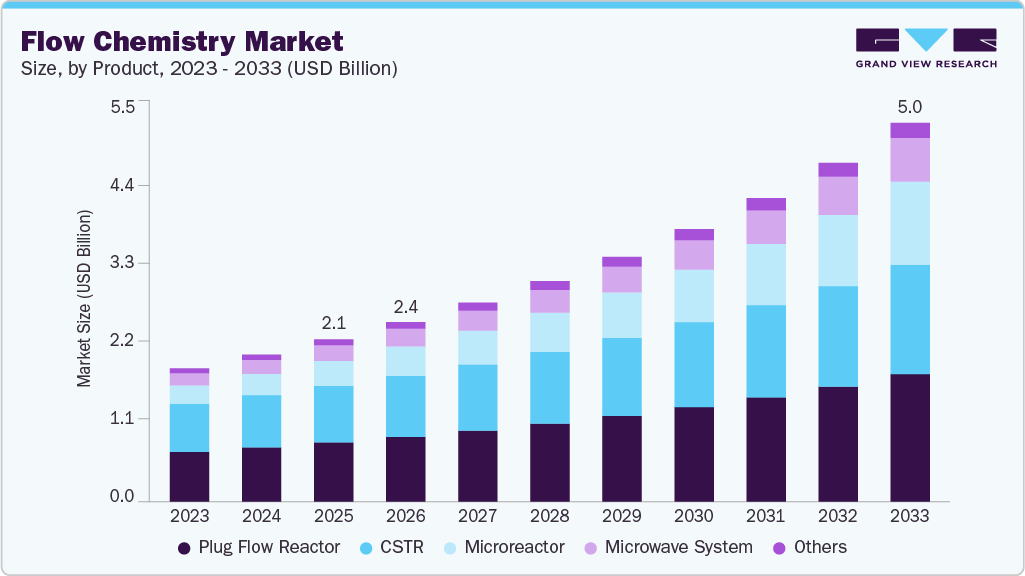
Market Concentration & Characteristics
The flow chemistry market is in a strong growth phase, driven by rapid expansion as continuous processing technologies are increasingly adopted across pharmaceuticals, chemicals, and research applications. The global market is highly fragmented due to the presence of numerous multinational players alongside specialized regional and niche technology providers. Competitive dynamics are shaped by continuous innovation in reactor design, automation, and process optimization solutions. Companies are actively investing in R&D and developing advanced instruments to enhance production efficiency, improve reaction yield, and support scalable continuous manufacturing.
The flow chemistry industry is highly innovation-driven, supported by continuous advancements in reactor design, automation, and process analytical technologies. Companies focus on developing compact microreactors, scalable systems, and integrated digital monitoring tools to improve reaction efficiency and precision. Research institutions and industry collaborations play a key role in accelerating new product development. The need for faster process optimization and flexible manufacturing solutions also drives innovation.
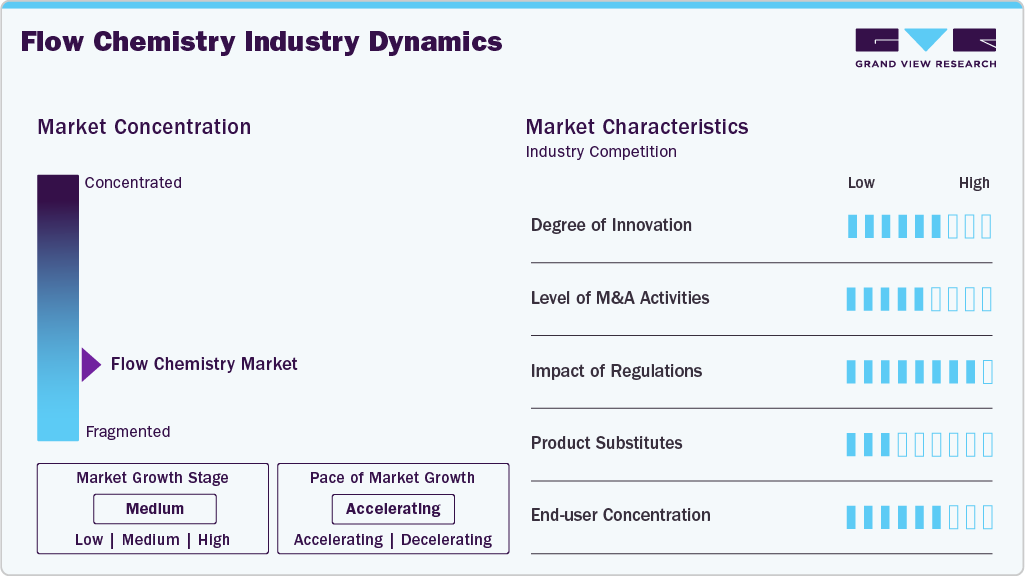
Regulatory requirements strongly influence the adoption of flow chemistry, especially in pharmaceutical and specialty chemical manufacturing. Strict safety, environmental, and quality standards encourage companies to shift toward continuous processes that offer better control and traceability. Compliance with green chemistry principles and emissions regulations further supports market growth. Regulatory approval pathways for continuous manufacturing are also becoming clearer, encouraging wider implementation.
The market has a high level of end-user concentration, with pharmaceuticals and fine chemicals representing the largest demand segments. Large pharmaceutical companies invest heavily in flow chemistry to enhance production efficiency and ensure consistent product quality. Academic institutions and research laboratories also contribute significantly through early-stage innovation and testing. The petrochemical and specialty chemical industries are gradually increasing adoption as the process benefits become more evident.
Drivers, Opportunities & Restraints
The growth of the flow chemistry market is driven by the growing need for continuous manufacturing processes that improve reaction control, safety, and production efficiency. Industries such as pharmaceuticals and specialty chemicals are adopting flow systems to reduce batch variability and accelerate scale-up from research to commercial production. Increased focus on green chemistry and reduced waste generation further supports adoption. Technological advancements in microreactors and automation are also making systems more accessible and efficient.
Expanding applications in pharmaceutical manufacturing, including API production and continuous synthesis, create strong growth opportunities for flow chemistry technologies. Increasing investment in process intensification and digitalized chemical manufacturing opens new avenues for integrated flow systems. Emerging markets and growing research activity in academia are driving additional demand for compact and modular reactors. Collaboration between equipment manufacturers and chemical companies is enabling the development of customized solutions for complex reactions.
High initial investment costs and the need for specialized technical expertise can limit adoption, especially among small-scale manufacturers. Transitioning from traditional batch processes to continuous flow systems may require redesigning existing production infrastructure. Limited awareness and a lack of skilled professionals in certain regions also slow market penetration. In addition, challenges related to scaling specific reactions and material compatibility may restrict broader implementation in some applications.
Product Insights
The plug flow reactor segment dominated the flow chemistry industry, accounting for a 36.4% share in 2025, due to its ability to deliver consistent reaction control and high conversion efficiency in continuous processing. These reactors enabled precise control of temperature and residence time, making them suitable for large-scale industrial applications. Their scalability and compatibility with various chemical processes increased adoption across the pharmaceutical and petrochemical industries. Industries preferred PFR systems for handling complex reactions while maintaining product quality and operational efficiency.
Microreactor segment is expected to grow at a fastest CAGR of 16.1% from 2026 to 2033 in terms of revenue. The microreactor segment emerged as the fastest-growing category, driven by rising demand for compact, highly efficient reaction systems. Microreactors enabled rapid heat and mass transfer, improving safety and reaction speed, particularly for hazardous or sensitive processes. Rising use in research laboratories, specialty chemical synthesis, and pharmaceutical development accelerated market expansion. Continuous advancements in miniaturization and automation further supported their adoption across emerging flow chemistry applications.
Application Insights
In 2025, the chemicals segment dominated the flow chemistry market, accounting for a 37.9% share, driven by widespread adoption of continuous processing for specialty chemicals and intermediate production. Flow systems improved reaction efficiency, reduced waste generation, and enabled better process control compared to traditional batch methods. Chemical manufacturers increasingly use these technologies to enhance productivity and meet sustainability targets. The ability to scale processes efficiently also supported strong demand across industrial chemical applications.
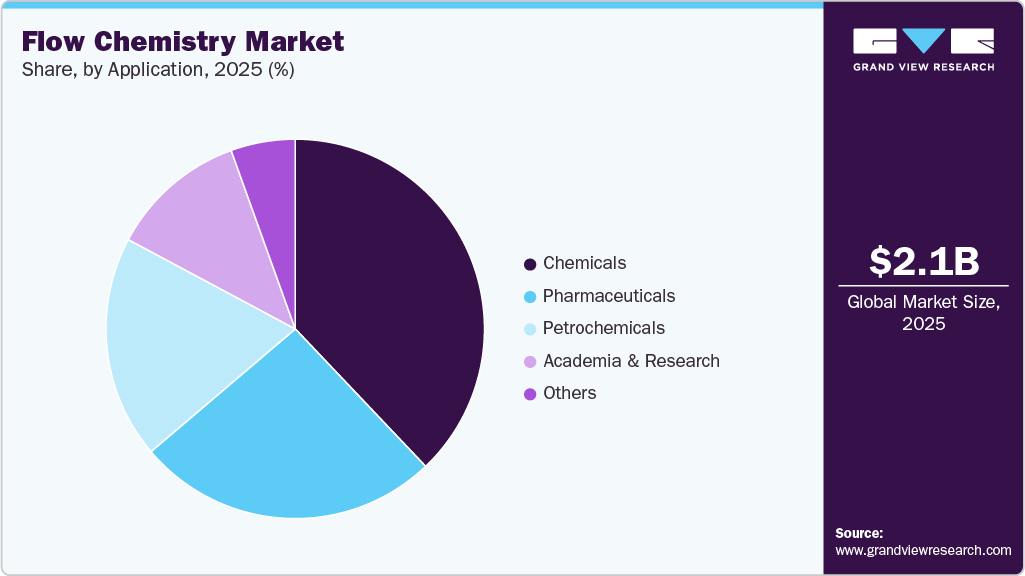
The pharmaceuticals segment is expected to grow at the fastest CAGR of 12.0% from 2026 to 2033 in terms of revenue. The pharmaceuticals segment is expected to grow at the fastest CAGR over the forecast period, driven by rising interest in continuous manufacturing and process optimization. Flow chemistry allowed precise control over reaction conditions, improving product consistency and reducing development timelines. The growing demand for active pharmaceutical ingredients (APIs) and personalized medicine has driven investment in advanced flow systems. Regulatory support for continuous manufacturing further accelerated adoption within pharmaceutical production and research.
Regional Insights
North America is expected to showcase strong growth at a CAGR of 10.4% over the forecast period, driven by technological innovation and increasing adoption of continuous manufacturing in the pharmaceutical and chemical industries. The presence of established research institutions and advanced automation capabilities supported the development of flow chemistry solutions. Companies focused on improving process safety and reducing production timelines through continuous flow systems. Regulatory support for advanced manufacturing technologies also encouraged wider adoption.
U.S. Flow Chemistry Market Trends
The U.S. led the North America flow chemistry industry, supported by strong innovation ecosystems and high adoption of continuous manufacturing in advanced pharmaceutical production. The country benefited from extensive R&D funding, strong collaboration between academia and industry, and early commercialization of microreactor technologies. The need for precision synthesis and rapid process optimization also influenced adoption. High demand for specialty chemicals and advanced materials further strengthened market dominance.
The flow chemistry market in Mexico is experiencing notable growth, as manufacturing companies have integrated modern processing technologies to improve production flexibility and export competitiveness. Expansion of contract manufacturing and nearshoring trends encouraged investment in efficient chemical processing solutions. Local industries increasingly explored flow chemistry to enhance scalability and reduce operational downtime.
Europe Flow Chemistry Market Trends
Europe experienced steady growth supported by strong regulatory emphasis on sustainability and green chemistry practices. Manufacturers increasingly adopted flow chemistry to reduce waste, improve energy efficiency, and comply with strict environmental standards. The region’s well-established pharmaceutical and specialty chemical sectors contributed to market expansion. Continuous investments in research and innovation further enhanced adoption across industrial and academic applications.
The Germany flow chemistry market dominates Europe, driven by its strong chemical manufacturing base and advanced engineering expertise. The country’s focus on precision processing, automation, and high-quality production standards helped drive the adoption of continuous-flow technologies. Leading research institutes and industrial collaborations encouraged innovation in reactor design and process optimization.
The flow chemistry market in the UK experiences notable growth, supported by expanding pharmaceutical research and increasing investment in continuous manufacturing technologies. Academic institutions and innovation hubs played a key role in advancing flow chemistry applications for drug development and fine chemical synthesis. The growing startup ecosystem and collaborations between industry and research organizations accelerated technology adoption.
Asia Pacific Flow Chemistry Market Trends
Asia Pacific dominated the flow chemistry industry, accounting for a 36.4% share in 2025, driven by strong growth in pharmaceutical manufacturing, specialty chemicals production, and expanding industrial infrastructure. Countries such as China, India, and Japan increased investments in continuous manufacturing technologies to improve efficiency and competitiveness. The presence of large-scale chemical manufacturing hubs supported higher adoption of advanced reactor systems. Rising research activities and cost-effective production capabilities further strengthened regional leadership.
The China flow chemistry market dominates Asia Pacific, supported by its large-scale chemical production capacity and the government's strong focus on industrial modernization. Manufacturers increasingly adopted continuous processing to improve efficiency, reduce waste, and enhance product consistency. Growing investments in specialty chemicals and pharmaceutical manufacturing strengthened demand for advanced reactor systems.
The flow chemistry market in India is growing, driven by expanding pharmaceutical manufacturing and increasing focus on process innovation. Companies adopted flow chemistry to enhance scalability, reduce production timelines, and improve reaction safety in complex synthesis. Rising investment in contract manufacturing and active pharmaceutical ingredient production supported technology adoption. Collaboration between academic institutions and industry players also contributed to increased awareness and implementation of continuous flow processes.
Latin America Flow Chemistry Market Trends
Latin America showed gradual growth as the chemical and pharmaceutical industries began exploring continuous processing to enhance operational efficiency. Increasing industrial modernization and the adoption of advanced manufacturing technologies supported market expansion. Growing research collaborations and investments in process optimization increased awareness of flow chemistry's benefits. Economic development and improving industrial infrastructure also created new opportunities for technology adoption.
The Brazil flow chemistry market shows steady growth, supported by expanding pharmaceutical and specialty chemical manufacturing activities. Companies explored continuous processing technologies to improve production efficiency and reduce operational costs. Increasing investment in research collaborations and the modernization of chemical facilities encouraged the adoption of advanced reactor systems. Growing focus on sustainable manufacturing and process optimization further contributed to market expansion.
Middle East & Africa Flow Chemistry Market Trends
The Middle East & Africa region demonstrated growing interest in flow chemistry, supported by the diversification of petrochemical industries and the increasing focus on advanced processing technologies. Investments in specialty chemicals and research initiatives encouraged the adoption of continuous flow systems. Companies aimed to improve production efficiency and reduce operational risks through modern reactor technologies. Expanding industrial development and innovation-driven strategies supported gradual market growth.
The flow chemistry market in Saudi Arabia is seeing growing adoption, driven by efforts to diversify its economy beyond traditional oil production and expand the specialty chemicals sector. Investments in advanced petrochemical processing and modern manufacturing technologies sparked interest in continuous-flow systems. The country’s focus on innovation, research partnerships, and industrial transformation helped drive technology adoption. Increasing emphasis on process efficiency and sustainable production methods further contributed to market growth.
Key Flow Chemistry Company Insights
Some of the key players operating in the market include METTLER TOLEDO, Corning Incorporated, and Vapourtec Ltd.
-
METTLER TOLEDO plays an important role in the flow chemistry ecosystem through advanced analytical and process monitoring solutions that enable precise control of continuous reactions. Its inline measurement technologies, including real-time spectroscopy and automated sampling systems, help optimize reaction parameters and improve reproducibility. The company supports flow chemistry by integrating analytical instruments with automated workflows, allowing better data-driven decision-making during synthesis. Its solutions are widely used for reaction monitoring, quality assurance, and process development in pharmaceutical and chemical manufacturing. By enhancing process visibility and control, METTLER TOLEDO improves efficiency and scalability in continuous flow applications.
-
Corning Incorporated is a key technology provider in the flow chemistry market through its advanced microreactor platforms designed for continuous processing. The company’s reactor systems focus on enhanced heat and mass transfer, enabling safer handling of complex or highly exothermic reactions. Corning supports scale-up from laboratory development to industrial production through modular, scalable reactor designs. Its flow reactor technologies are widely used in the manufacturing of pharmaceuticals, fine chemicals, and specialty materials. A strong emphasis on engineering precision and process intensification positions Corning as a leading provider of industrial continuous-flow solutions.
Key Flow Chemistry Companies:
The following key companies have been profiled for this study on the flow chemistry market.
- Am Technology
- Agi Glassplant
- METTLER TOLEDO
- Vapourtec Ltd.
- ThalesNano Inc.
- HEL Limited
- Uniqsis Ltd.
- Ehrfeld Mikrotechnik GmbH
- Future Chemistry Holding BV
- Corning Incorporated
- Parr Instrument Company
- Amar Equipment Pvt. Ltd.
- FABEX ENGINEERING PVT. LTD.
- Dalton Pharma Services
- buchiglasuster
Recent Developments
-
In October 2025, Evonik introduced the Noblyst F catalyst range to improve performance in continuous flow chemistry processes. The portfolio includes precious-metal catalysts designed to enable efficient reactions and better integration into flow systems. These catalysts help enhance selectivity, scalability, and operational safety, particularly in pharmaceutical and fine chemical applications. The launch highlights the industry's increasing focus on optimizing continuous manufacturing technologies.
-
In August 2025, Asymchem enhanced its flow chemistry capabilities at its UK Sandwich facility by adding advanced continuous processing technologies. The upgrade supports faster process development, improved scalability, and efficient handling of complex chemical reactions. New flow platforms help strengthen research-to-production transition and optimize manufacturing workflows. This move reflects increasing use of continuous flow systems in pharmaceutical development.
Flow Chemistry Market Report Scope
Report Attribute
Details
Market size value in 2026
USD 2,377.8 million
Revenue forecast in 2033
USD 5,016.4 million
Growth rate
CAGR of 11.3% from 2026 to 2033
Historical data
2021 - 2024
Forecast period
2026 - 2033
Quantitative units
Revenue in USD million and CAGR from 2026 to 2033
Report coverage
Revenue forecast, company ranking, competitive landscape, growth factors, and trends
Segments covered
Product, application, region
Country scope
U.S.; Canada; Mexico; Germany; France; Italy; Russia; UK; China; Japan; India; South Korea; Australia; Argentina; Brazil; Saudi Arabia; UAE
Key companies profiled
Am Technology; Agi Glassplant; METTLER TOLEDO; Vapourtec Ltd.; ThalesNano Inc.; HEL Limited; Uniqsis Ltd.; Ehrfeld Mikrotechnik GmbH; Future Chemistry Holding BV; Corning Incorporated; Parr Instrument Company; Amar Equipment Pvt. Ltd.; FABEX ENGINEERING PVT. LTD.; Dalton Pharma Services; buchiglasuster.
Customization scope
Free report customization (equivalent up to 8 analysts working days) with purchase. Addition or alteration to country, regional & segment scope.
Pricing and purchase options
Avail customized purchase options to meet your exact research needs. Explore purchase options
Global Flow Chemistry Market Report Segmentation
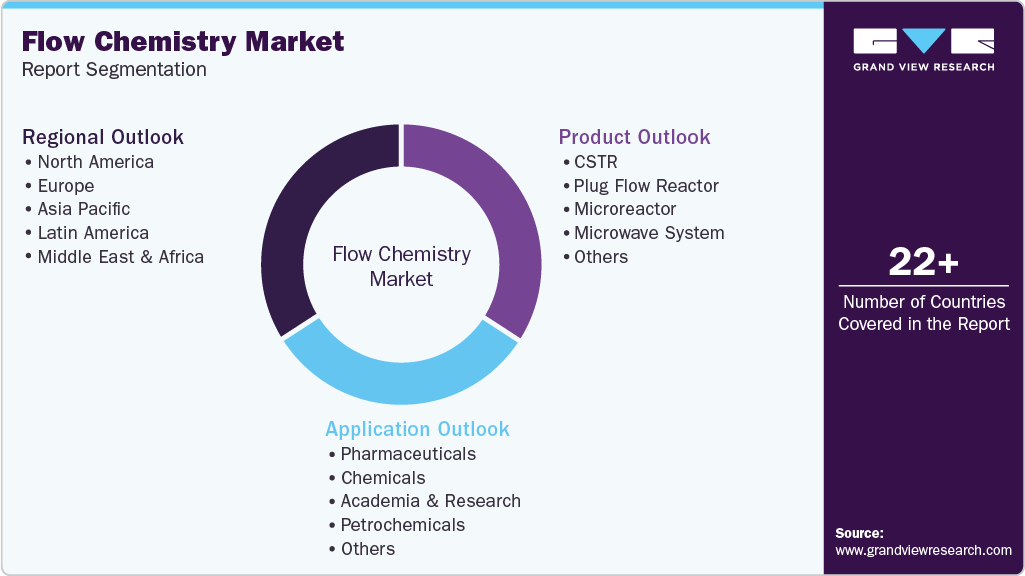
This report forecasts revenue growth at the global, regional, and country levels and provides an analysis of the latest industry trends in each of the sub-segments from 2021 to 2033. For this study, Grand View Research has segmented the flow chemistry market report based on product, application, and region:
-
Product Outlook (Revenue, USD Million; 2021 - 2033)
-
CSTR
-
Plug Flow Reactor
-
Microreactor
-
Microwave System
-
Others
-
-
Application Outlook (Revenue, USD Million; 2021 - 2033)
-
Pharmaceuticals
-
Chemicals
-
Academia & Research
-
Petrochemicals
-
Others
-
-
Regional Outlook (Revenue, USD Million; 2021 - 2033)
-
North America
-
U.S.
-
Canada
-
Mexico
-
-
Europe
-
France
-
Germany
-
Italy
-
Russia
-
UK
-
-
Asia Pacific
-
China
-
India
-
Japan
-
South Korea
-
Australia
-
-
Latin America
-
Brazil
-
Argentina
-
-
Middle East & Africa
-
Saudi Arabia
-
UAE
-
-
Frequently Asked Questions About This Report
b. The global flow chemistry market size was estimated at USD 2,149.9 million in 2025 and is expected to be USD 2,377.8 million in 2026.
b. The global flow chemistry market, in terms of revenue, is expected to grow at a compound annual growth rate of 11.3% from 2026 to 2033 to reach USD 5,016.4 million by 2033.
b. Asia Pacific dominated the flow chemistry market and accounted for 36.4% share in 2025, due to strong growth in pharmaceutical manufacturing, specialty chemicals production, and expanding industrial infrastructure. Countries such as China, India, and Japan increased investments in continuous manufacturing technologies to improve efficiency and competitiveness. The presence of large-scale chemical manufacturing hubs supported higher adoption of advanced reactor systems.
b. Some of the key players operating in the flow chemistry market include Am Technology; Agi Glassplant; METTLER TOLEDO; Vapourtec Ltd.; ThalesNano Inc.; HEL Limited; Uniqsis Ltd.; Ehrfeld Mikrotechnik GmbH; Future Chemistry Holding BV; Corning Incorporated; Parr Instrument Company; Amar Equipment Pvt. Ltd.; FABEX ENGINEERING PVT. LTD.; Dalton Pharma Services; buchiglasuster.
b. The flow chemistry market is driven by increasing demand for continuous manufacturing that improves reaction control, safety, and production efficiency. Growing adoption in pharmaceutical and specialty chemical industries supports faster scale-up and consistent product quality. Advancements in microreactor technology, automation, and sustainability-focused processes further accelerate market growth.


Share this report with your colleague or friend.
Need a Tailored Report?
Customize this report to your needs — add regions, segments, or data points, with 20% free customization.


ISO 9001:2015 & 27001:2022 Certified
We are GDPR and CCPA compliant! Your transaction & personal information is safe and secure. For more details, please read our privacy policy.
Trusted market insights - try a free sample
See how our reports are structured and why industry leaders rely on Grand View Research. Get a free sample or ask us to tailor this report to your needs.