- Home
- »
- Plastics, Polymers & Resins
- »
-
Flexitank Market Size & Share, Industry Report, 2033GVR Report cover
![Flexitank Market Size, Share & Trends Report]()
Flexitank Market (2026 - 2033) Size, Share & Trends Analysis Report By Layer (Single Layer, Multi-layer), By Application (Food Stuffs, Wine & Spirits, Chemicals, Oils, Industrial Products, Pharmaceutical Goods), By Region, And Segment Forecasts
- Report ID: 978-1-68038-745-2
- Number of Report Pages: 130
- Format: PDF
- Historical Range: 2021 - 2024
- Forecast Period: 2026 - 2033
- Industry: Bulk Chemicals
- Report Summary
- Table of Contents
- Interactive Charts
- Methodology
- Download FREE Sample
-
 Download Sample Report
Flexitank Market Summary
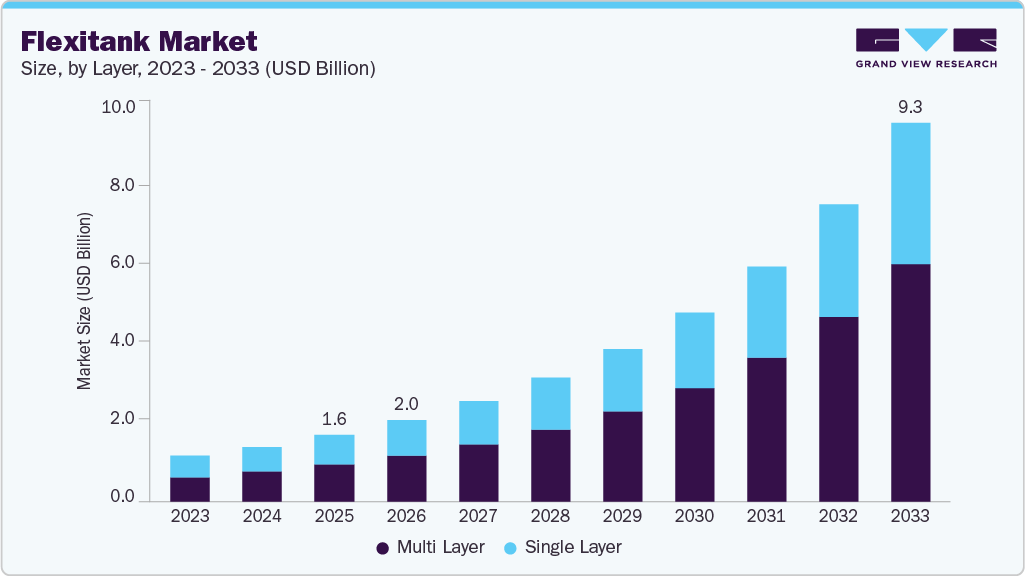
The global flexitank market size was estimated at USD 1.6 billion in 2025 and is projected to reach USD 9.3 billion by 2033, growing at a CAGR of 24.5% from 2026 to 2033. The market is growing on account of the increasing volume of commodity trade globally.
Key Market Trends & Insights
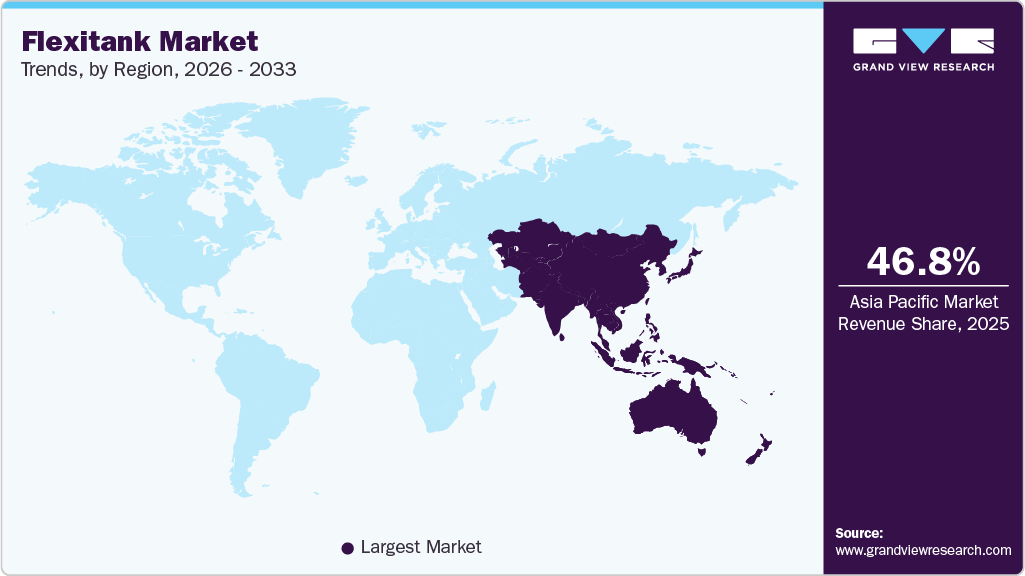
- By region, Asia Pacific dominated the regional market with a major revenue share of 46.8% in 2025.
- By layer, the multi-layer segment dominated the market with 55.7% of overall revenue share in 2025.
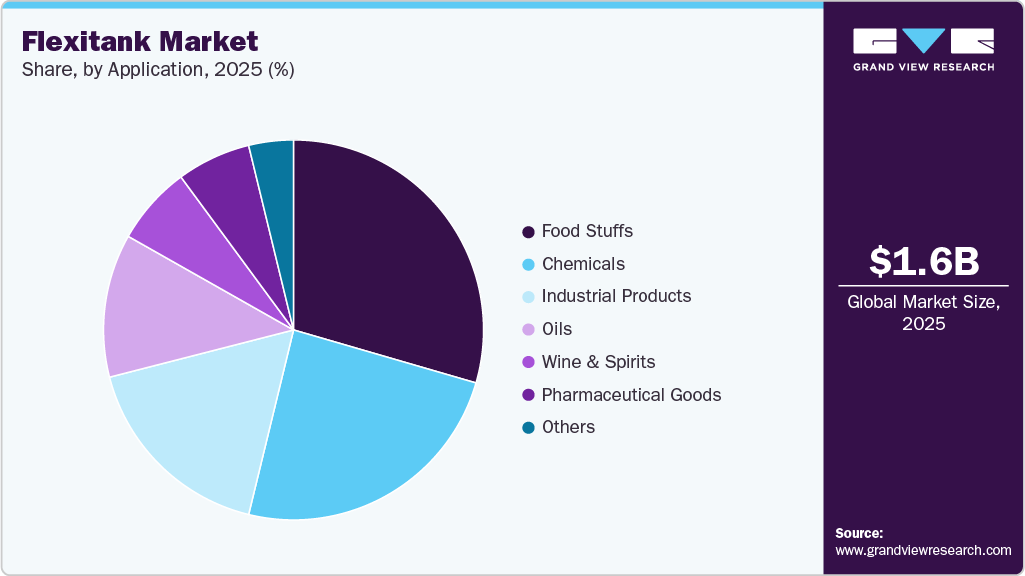
- The foodstuff application segment led the market with a revenue share of 29.5% in 2025.
Market Size & Forecast
- 2025 Market Size: USD 1.6 Billion
- 2033 Projected Market Size: USD 9.3 Billion
- CAGR (2026-2033): 24.5%
- Asia Pacific: Largest Market in 2025
As international trade expands, the demand for efficient transportation solutions for bulk liquids is rising, making flexitank a preferred choice. These innovative containers offer several advantages over traditional shipping methods, including cost-effectiveness, reduced logistical complexities, and enhanced loading efficiency. Flexitank allows for the transport of liquids in standard shipping containers, maximizing cargo space and minimizing freight costs. This flexibility is particularly appealing for industries such as food and beverage, chemicals, and agriculture, where bulk liquid transport is essential.The rise of emerging markets has further fueled the flexitank industry, particularly in Asia and Africa. Countries like China and India have significantly ramped up their import volumes of liquid commodities. For instance, China's imports of edible oils grew from 8.5 million metric tons in 2013 to nearly 12 million metric tons in 2023, while India's imports of liquid chemicals increased from around 10 million metric tons to approximately 14 million metric tons in the same period. Such growth in demand reflects the broader trends in commodity trade, where businesses are increasingly seeking reliable and flexible solutions to meet their shipping needs. The e-commerce boom and changing consumer preferences also underscore the importance of versatile packaging solutions, making flexitank an attractive option for exporters aiming to optimize their logistics.
Moreover, the rising global commodity prices have made efficient transportation methods increasingly critical. As prices for key commodities such as crude oil and agricultural products continue to rise, maximizing profit margins through efficient shipping is vital for exporters. The ability to transport larger volumes at lower costs not only benefits exporters but also ensures competitive pricing for consumers. The global market for flexitank is expected to continue expanding as companies recognize the benefits of this innovative shipping method in light of these dynamics.
In addition to market demand, evolving trade regulations and standards are shaping the flexitank industry. Regulatory frameworks that prioritize safety and environmental sustainability will likely bolster the adoption of flexitank, as manufacturers seek compliant shipping solutions. As the flexitank industry aligns with these trends, its integration into global trade logistics is anticipated to increase, solidifying its role as a preferred solution for transporting bulk liquids. Overall, the interplay of growing commodity trade, rising global demand, and regulatory advancements will significantly drive the market's growth in the years ahead.
Market Concentration & Characteristics
The impact of regulations, availability of product substitutes, and end-user concentration also play significant roles in shaping the flexitank industry. Regulatory standards governing food safety, chemical transport, and container shipping require manufacturers to meet strict quality and safety certifications, particularly for food-grade liquids and sensitive industrial products. At the same time, flexitanks face competition from alternative bulk liquid transport solutions such as ISO tanks, intermediate bulk containers (IBCs), and drums, which are often preferred for hazardous or reusable transport needs. The market also shows moderate end user concentration, with demand primarily driven by industries such as food & beverages, edible oils, wine, chemicals, and industrial liquids. Large exporters and global commodity traders represent key customers, making logistics efficiency and cost savings critical factors influencing purchasing decisions.
The degree of innovation in the flexitank industry is moderate but steadily increasing as manufacturers focus on improving product safety, durability, and efficiency in bulk liquid transportation. Companies are investing in advanced multilayer polyethylene films, improved barrier technologies, and reinforced outer polypropylene layers to reduce leakage risks and enhance load stability during long-distance shipping. Innovation is also being driven by the need to transport a wider range of liquids, including food-grade products, chemicals, and industrial oils.
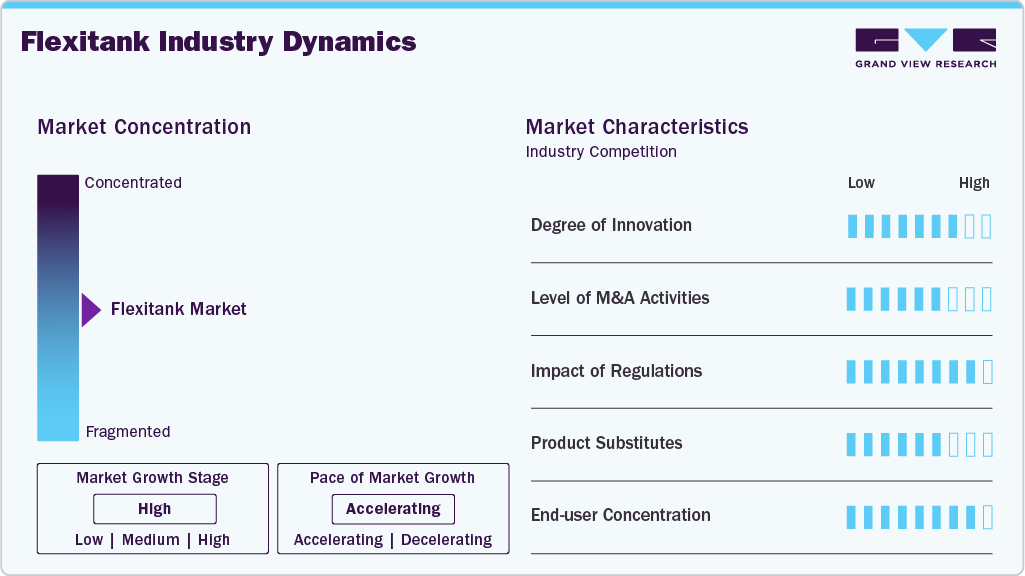
The level of mergers and acquisitions (M&A) activities in the flexitank industry is moderate and largely driven by the need for geographic expansion and technological capabilities. Leading flexitank manufacturers and logistics solution providers are pursuing strategic partnerships, acquisitions, and joint ventures to strengthen their global distribution networks and improve service offerings. These activities are particularly prominent in regions with strong trade volumes such as Asia-Pacific, Europe, and North America, where companies aim to enhance container logistics services and integrate value-added solutions such as installation support, monitoring systems, and supply chain management. Consolidation within the industry helps companies improve production scale, expand their client base, and strengthen their competitive position.
Layer Insights
Based on layer, the multi-layer segment dominated the market with the largest revenue share in 2025. The segment is further forecasted to grow at a CAGR of 26.4% from 2026 to 2033. This growth is attributed to multi-layer flexitanks providing superior strength, durability, and protection during the transportation of bulk liquids. Flexitanks are used to transport large volumes of liquids, often up to 24,000 liters, across long distances via sea freight, where containers are exposed to pressure, vibration, and temperature fluctuations.
Multi-layer flexitanks are constructed using several layers of polyethylene film combined with an outer polypropylene woven layer, which significantly improves puncture resistance and reduces the risk of leakage. This layered structure distributes internal liquid pressure more effectively and ensures the tank maintains structural integrity during loading, transit, and unloading. As a result, industries transporting sensitive or high-value liquids such as edible oils, wine, chemicals, and industrial liquids prefer multi-layer flexitanks due to their higher reliability and safety.
Furthermore, the dominance of multi-layer flexitanks is attributed to its ability to provide better contamination control and product protection, which is especially important for food-grade and pharmaceutical liquids. The multiple barrier layers help prevent oxygen ingress, moisture penetration, and external contamination, thereby preserving the quality and shelf life of the transported liquid. In addition, many manufacturers design multi-layer flexitanks with specialized inner layers tailored for specific cargo types, such as temperature-sensitive liquids or corrosive chemicals. This adaptability allows flexitanks to serve a wider range of applications compared to single-layer alternatives. Furthermore, international shipping regulations and quality standards increasingly emphasize cargo safety and risk reduction, encouraging exporters and logistics providers to adopt more robust multi-layer designs. Consequently, the combination of improved safety, product protection, and regulatory compliance has led to multi-layer flexitanks holding the largest share in the layer-type segment.
Application Insights
By application, the food stuff segment led the market with the largest revenue share and is estimated to grow at the fastest CAGR of 25.6% over the forecast period. The anticipated growth of the segment can be attributed to the rising consumption of grocery products coupled with the burgeoning growth of retail chains, especially hypermarket & supermarket chains, in emerging economies. The segment includes a wide range of products, including fruit juices, concentrates, vegetable oils, palm oils, fish oils, edible oils, sorbitol, fructose, coconut oils, egg liquid, malt extract, corn oil, sauces, purees, and bakery & confectionary products, among others.
Another factor attributed to the growth of this segment can be the rising consumption of cheese, most notably through the e-commerce platform. Thus, Turophiles across the globe are no longer relegated to retail aisles (dairy). However, packaging and shipping of cheese require special packaging needs. Thus, the need for efficient packaging solutions has been driving the demand for flexitanks across the globe.
The industry demand for flexitank in chemical applications is predicated to grow rapidly over the coming years. Flexitank have transformed the transport of non-hazardous chemicals in the chemical industry, offering a highly efficient, low-cost, and durable alternative to conventional packaging options like corrugated containers. Many companies are now opting for flexitanks due to their lightweight and sturdy structure, which significantly reduces shipping costs while providing reliable protection during transit. Unlike traditional packaging, these flexitanks are often crafted from recycled polypropylene, ethylene vinyl acetate (EVA), and polyethylene, thereby minimizing the reliance on 100% virgin polymers. This shift supports both cost reduction and sustainability initiatives, allowing chemical manufacturers to meet growing environmental standards.
Regional Insights
Asia Pacific accounted for the largest revenue share in 2025 and is forecasted to grow at the fastest CAGR of 25.8% from 2026 to 2033. This high growth is attributed to the presence of the two largest agricultural producing and consuming countries, namely China and India, in the region. Furthermore, several key companies in Europe and North America have been outsourcing production activities to India and China owing to the lower production cost in these countries. Therefore, the potential growth of food and pharmaceutical industries is anticipated to increase the demand for flexitank within the region over the forecast period.
China Flexitank Market Trends
China flexitank industry dominated the Asia Pacific region with a revenue share of 26.9% in 2025. The revenue share of China's market is bolstered by major players such as Qingdao BLT Packing Industrial Co., Ltd., Full-Pak, and Qingdao LAF Packaging Co., Ltd. The country’s extensive network of ports and favorable shipping facilities enhance its market value. Additionally, the escalating global demand for chemicals, foodstuffs, and industrial products significantly contributes to the increasing need for flexitank. Notably, the chemicals segment is expected to dominate the flexitank industry and experience the fastest growth from 2025 to 2030, driven by a rising need for transporting food-grade liquids and non-hazardous chemicals at low temperatures.
Europe Flexitank Market Trends
Europe flexitank industry is characterized by a large presence of the world’s largest pharmaceutical companies including Bayer AG, F. Hoffmann-La Roche Ltd., Novartis AG, Sanofi, and GlaxoSmithKline, among others. These companies mainly manufacture various temperature-sensitive pharmaceuticals in Europe and export them to the rest of the world. The presence of stringent regulations pertaining to the use of plastic materials for packaging are expected to pose a significant challenge for the manufacturers of flexitank in Europe. The European Union has been encouraging packaging manufacturers within the region to offer sustainable packaging solutions to clients. Such developments in Europe are expected to force manufacturers of flexitank to invest in sustainable packaging materials over the forecast period.
Flexitank industry in Germany accounted for the largest share of 19.8% in 2025. The Germany market is boosted by the presence of major players such as Büscherhoff Packaging Solutions GmbH and Trans Ocean Bulk Logistics Ltd., contributing to the market's growth and stability. Germany shows a strong preference for single-layer flexitank, which are expected to retain their dominance throughout the forecast period due to their efficiency and convenience. The high focus on recyclable material in order to meet the sustainable goals of the country is another major trend in the Germany market
North America Flexitank Market Trends
The flexitank industry in North America is anticipated to grow at a significant CAGR of 23.6% from 2026 to 2033. The demand for flexitanks is rising as industries increasingly look for efficient and scalable solutions for transporting bulk liquids across domestic and international markets. The region has a strong presence of food and beverage producers, chemical manufacturers, and agricultural exporters that frequently ship large volumes of liquid products such as edible oils, syrups, and industrial chemicals. Flexitanks enable companies to maximize the volume of liquid transported in a single container while reducing loading time and logistics costs. As supply chains in the region continue to expand and companies seek ways to improve operational efficiency, flexitanks are becoming an attractive alternative to conventional bulk liquid packaging and transportation methods.
The flexitank industry in the U.S is witnessing growing demand due to its large-scale production and export of liquid commodities. Industries such as chemicals, food processing, beverages, and agriculture generate significant volumes of non-hazardous liquids that need to be transported efficiently to global markets. Flexitanks allow exporters to ship high volumes of liquids in standard containers, improving freight efficiency and reducing overall transportation costs. The country’s extensive port network, advanced logistics infrastructure, and high level of international trade further support the adoption of flexitanks, as businesses seek flexible and cost-effective solutions to manage bulk liquid shipments.
Key Flexitank Company Insights
The flexitank industry is moderately consolidated, with a mix of global manufacturers and regional suppliers competing based on product quality, safety standards, and logistics support services. Leading companies focus heavily on developing durable multi-layer flexitank designs that minimize leakage risks and improve the safe transportation of bulk liquids over long distances. Since flexitanks are primarily used in international shipping, reliability and compliance with global safety standards are critical competitive factors. Companies therefore invest significantly in product testing, certification, and quality control to ensure their flexitanks can handle high pressure, temperature variations, and long transit times. In addition to manufacturing capabilities, many suppliers differentiate themselves by offering value-added services such as technical support, installation assistance, cargo monitoring, and customized solutions for specific liquid products.
Competition in the market is also shaped by geographic expansion and partnerships with logistics providers, shipping companies, and bulk liquid exporters. Manufacturers are increasingly strengthening their global distribution networks to support growing demand from major exporting regions such as Asia-Pacific, Europe, and North America. Strategic collaborations with freight forwarders and container shipping companies help flexitank providers integrate their products into broader supply chain solutions. At the same time, companies are investing in product innovation, including improved barrier films, recyclable materials, and enhanced loading and unloading systems to address sustainability and operational efficiency requirements. As global trade in food-grade liquids, chemicals, and agricultural products continues to grow, market participants are focusing on expanding production capacity, improving product performance, and strengthening customer relationships to maintain their competitive position.
-
In November 2023, ASF, Inc., a logistics service provider, announced the expansion of its flexitank portfolio, providing highly efficient and environmentally friendly forms of shipping for non-hazardous bulk liquid cargo.
-
In November 2022, The Anthente Special Food Grade Flexitank Project for Grease involved the development of a new type of flexitank called the Truck Flexitank (T-Flexitank). This innovative flexitank is designed for bulk liquid transportation of grease. The project provides a specialized solution for efficiently transporting grease in large quantities. T-Flexitank technology offers a flexible and cost-effective method for handling and transporting liquids such as grease.
Key Flexitank Companies:
The following key companies have been profiled for this study on the flexitank market.
- Qingdao BLT Packing Industrial Co., Ltd.
- Nelson Global
- Braid Logistics
- Bulk Liquid Solutions
- Büscherhoff Packaging Solutions GmbH
- Environmental Packaging Technologies Inc.
- Full-Pak Bulk Containers
- K Tank Supply Ltd
- Mak & Williams Flexitank Supply
- MYFLEXITANK
- KriCon Group
- Qingdao LAF Technology Co., Ltd.
- SIA FLEXITANKS
- Shanghai Yunjet Plastic Packaging Co., Ltd
- TRUST Flexitanks
- Techno Group USA
- Hillebrand Gori Group GmbH
- Neoflex
- FLUIDTAINER FLEXITANK SDN BHD
- Qingdao Hengxin Plastic Co. Ltd
- Philton Polythene Converters Ltd
- Anthente International
- LSM S.A. - FLEXPACK
- United Accredited Co.
- Transocean Forwarding & Commerce
- Rishi FIBC Solutions Pvt Ltd
- Hinrich Industries
- ONE Flexitank
- Infinity Bulk Logistics Sdn Bhd
Flexitank Market Report Scope
Report Attribute
Details
Market size value in 2026
USD 2.0 billion
Revenue forecast in 2033
USD 9.3 billion
Growth rate
CAGR of 24.5% from 2026 to 2033
Base year for estimation
2025
Historical data
2021 - 2024
Forecast period
2026 - 2033
Quantitative units
Revenue in USD million, Volume in units, and CAGR from 2026 to 2033
Report coverage
Revenue forecast, company ranking, competitive landscape, growth factors, and trends
Segments covered
Layer, application, region
Regional scope
North America; Europe; Asia Pacific; Latin America; Middle East & Africa
Country scope
U.S.; Canada; Mexico; Germany; UK; France; Spain; Italy; China; India; Japan; Australia; South Korea, Brazil; South Africa, UAE, Argentina, Saudi Arabia
Key companies profiled
Qingdao BLT Packing Industrial Co., Ltd. (BLT); Nelson Global; Braid Logistics; Bulk Liquid Solutions; Büscherhoff Packaging Solutions GmbH; Environmental Packaging Technologies Inc.; Full-Pak Bulk Containers; K Tank Supply Ltd; Mak & Williams Flexitank Supply; MYFLEXITANK; KriCon Group; Qingdao LAF Technology Co., Ltd.; SIA FLEXITANKS; Shanghai Yunjet Plastic Packaging Co., Ltd.; TRUST Flexitanks; Techno Group USA; Hillebrand Gori Group GmbH; Neoflex; FLUIDTAINER FLEXITANK SDN BHD; Qingdao Hengxin Plastic Co. Ltd; Philton Polythene Converters Ltd; Anthente International; LSM S.A. - FLEXPACK; United Accredited Co.; Transocean Forwarding & Commerce; Rishi FIBC Solutions Pvt Ltd; Hinrich Industries; ONE Flexitank; Infinity Bulk Logistics Sdn Bhd;
Customization scope
Free report customization (equivalent up to 8 analysts’ working days) with purchase. Addition or alteration to country, regional, and segment scope.
Pricing and purchase options
Avail customized purchase options to meet your exact research needs. Explore purchase options
Global Flexitank Market Report Segmentation
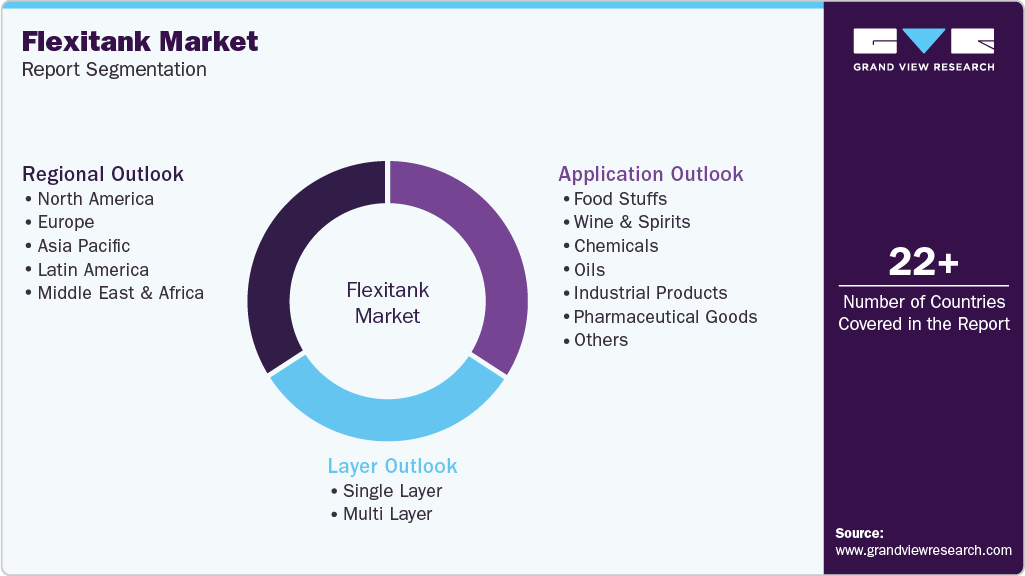
This report forecasts revenue growth at the global, regional, and country levels and provides an analysis of the latest industry trends in each of the sub-segments from 2021 to 2033. For this study, Grand View Research has segmented the global flexitank market report based on layer, application, and region:
-
Layer Outlook (Volume, Thousand Units; Revenue, USD Million, 2021 - 2033)
-
Single Layer
-
Multi Layer
-
-
Application Outlook (Volume, Thousand Units; Revenue, USD Million, 2021 - 2033)
-
Food Stuffs
-
Wine & Spirits
-
Chemicals
-
Oils
-
Industrial Products
-
Pharmaceutical Goods
-
Others
-
-
Regional Outlook (Volume, Thousand Units; Revenue, USD Million, 2021 - 2033)
-
North America
-
U.S.
-
Canada
-
Mexico
-
-
Europe
-
Germany
-
UK
-
France
-
Italy
-
Spain
-
-
Asia Pacific
-
China
-
India
-
Japan
-
Australia
-
South Korea
-
-
Latin America
-
Brazil
-
Argentina
-
-
Middle East & Africa
-
South Africa
-
Saudi Arabia
-
UAE
-
-
Frequently Asked Questions About This Report
b. The global flexitank market was estimated at USD 1.6 billion in the year 2025 and is expected to reach USD 2.0 billion in 2026.
b. The global flexitank market is expected to grow at a compound annual growth rate of 24.5% from 2026 to 2033 to reach USD 9.3 billion by 2033.
b. Based on layer type, the multi-layer segment led the market with the largest revenue share in 2025.
b. Qingdao BLT Packing Industrial Co., Ltd. (BLT); Braid Logistics UK Ltd.; Bulk Liquid Solutions Pvt. Ltd.; Büscherhoff Packaging Solutions GmbH; Environmental Packaging Technologies, Inc.; Full- Pak; K Tank Supply Ltd.; MY Flexitank; Kricon Group BV; Qingdao LAF Packaging Co., Ltd.; SIA FLEXITANKS; Yunjet Plastics Packaging; Trans Ocean Bulk Logistics Ltd.
b. The key factors that are driving the flexitank market include increasing trade across the countries and the competitive benefits of flexitanks over its traditional substitutes such as ISO containers, drums, barrels, and IBC’s.


Share this report with your colleague or friend.
Need a Tailored Report?
Customize this report to your needs — add regions, segments, or data points, with 20% free customization.


ISO 9001:2015 & 27001:2022 Certified
We are GDPR and CCPA compliant! Your transaction & personal information is safe and secure. For more details, please read our privacy policy.
Trusted market insights - try a free sample
See how our reports are structured and why industry leaders rely on Grand View Research. Get a free sample or ask us to tailor this report to your needs.