Fixed Broadband Services Market Summary
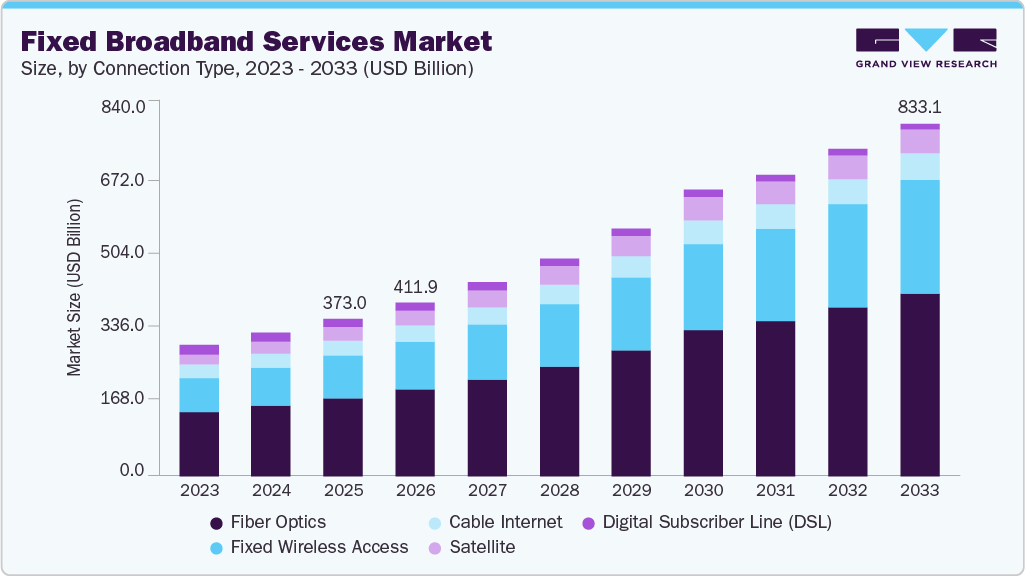
The global fixed broadband services market size was estimated at USD 373.04 billion in 2025 and is projected to reach USD 833.12 billion by 2033, growing at a CAGR of 10.6% from 2026 to 2033. Growth in the fixed broadband services industry is being driven by rising demand for high-speed connectivity, increasing digitalization across industries, and the rapid expansion of streaming, cloud computing, and remote work activities.
Key Market Trends & Insights
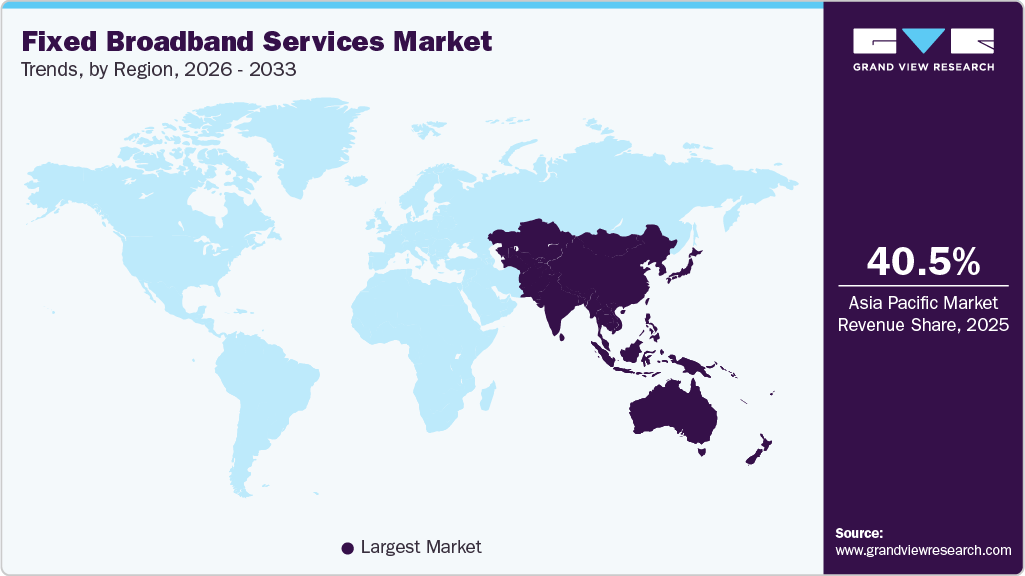
- Asia Pacific dominated the global fixed broadband services market with the largest revenue share of 40.5% in 2025.
- The fixed broadband services industry in India is expected to grow at the fastest CAGR during the forecast period.
- By connection type, the fiber optics segment led the market with the largest revenue share of 49.6% in 2025.
- By end use, the enterprise/business segment accounted for the largest market revenue share in 2025.
Market Size & Forecast
- 2025 Market Size: USD 373.04 Billion
- 2033 Projected Market Size: USD 833.12 Billion
- CAGR (2026-2033): 10.6%
- Asia Pacific: Largest market share in 2025
Significant technological advancements are being observed across the fixed broadband ecosystem, with fiber-to-the-home (FTTH), XGS-PON, and DOCSIS 4.0 upgrades being widely adopted to deliver gigabit-level speeds. Network virtualization and software-defined networking (SDN) are being implemented to enable more flexible and scalable infrastructure management. Moreover, Wi-Fi 6 and Wi-Fi 7 technologies are being deployed within households and enterprises to enhance indoor connectivity performance. These developments have been instrumental in improving service quality and increasing operator competitiveness.
The fixed broadband industry is witnessing an aggressive shift from legacy copper and DSL networks to fiber-to-the-home infrastructure. Demand for high-capacity, low-latency connectivity driven by 4K/8K streaming, cloud gaming, and remote collaboration is pushing operators to accelerate fiber rollouts. Governments in the U.S., Europe, and Asia are also offering subsidies and rural broadband funds, enabling operators to extend fiber into underserved regions. As a result, FTTH is becoming the dominant broadband technology, offering speeds of 1 Gbps and above while significantly reducing maintenance costs versus copper networks.
Telecom operators, private equity firms, and infrastructure funds are making large-scale investments to accelerate fiber rollouts and modernize network capabilities. Capital expenditure has been directed toward expanding last-mile connectivity, upgrading backbone networks, and deploying advanced access technologies. Public-private partnerships have also been encouraged in several regions, enabling broadband expansion into underserved rural areas. The market has been further supported by government subsidies, digital transformation grants, and long-term infrastructure financing.
Despite strong growth prospects, several restraints are being observed in the market. High deployment costs, particularly in rural and low-density areas, continue to limit the pace of infrastructure expansion. Regulatory delays, rights-of-way challenges, and complex permitting processes have slowed the rollout of fiber networks in certain regions. In addition, competition from emerging alternatives, such as wireless mobile broadband services, is putting pressure on pricing and profitability. Economic uncertainties and fluctuations in investment cycles are further contributing to uneven market development.
Connection Type Insights
The fiber optics segment led the market with the largest revenue share of 49.6% in 2025. The primary growth driver for the fiber optics segment is the increasing global emphasis on high-speed, high-capacity broadband connectivity, which serves as a critical foundation for digital transformation. Governments and telecom regulators are prioritizing large-scale fiber deployment to enable economic modernization, smart city initiatives, cloud adoption, and advanced consumer applications. National programs such as the EU’s Digital Decade 2030, China’s Broadband China initiative, and the U.S. BEAD program have collectively directed billions of dollars toward full-fiber infrastructure. These investments are accelerating deployment timelines and expanding fiber access across rural and previously underserved regions.
The fixed wireless access is expected to grow at the fastest CAGR over the forecast period. FWA, or fixed wireless internet, refers to a broadband solution designed for stationary locations such as homes, offices, retail sites, and remote facilities. It is particularly well suited for businesses operating outside established fiber coverage areas, as it delivers high-speed connectivity without the need for extensive cabling. In addition, enterprises within fiber-served regions increasingly adopt FWA as a dependable backup option to ensure business continuity during primary network outages. Supported by accelerating 5G deployments and growing spectrum liberalization, FWA has emerged as the fastest-growing segment of the global fixed broadband services industry.
End Use Insights
The enterprise / business segment accounted for the largest market revenue share in 2025. The segment is experiencing strong growth driven by rapid digital transformation and the rising adoption of cloud-based platforms, video conferencing, and remote collaboration tools. Organizations across sectors, particularly IT, finance, manufacturing, and healthcare are increasingly requiring high-bandwidth, low-latency connectivity to support mission-critical operations and data-intensive applications. In response, service providers are prioritizing the delivery of enterprise-grade fiber networks and dedicated leased-line broadband solutions to meet these stringent performance and reliability demands.
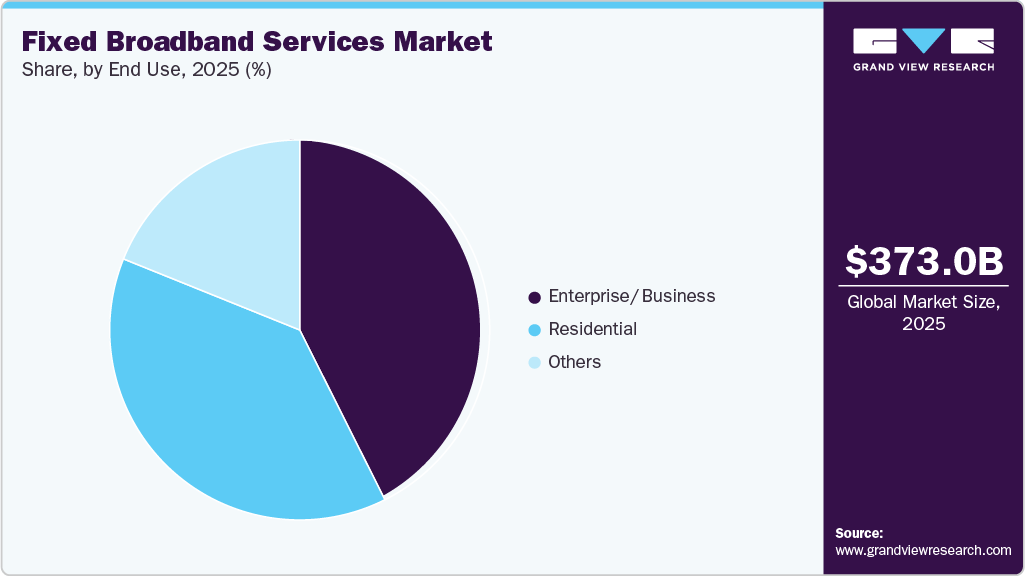
The residential segment is expected to witness at the fastest CAGR over the forecast period. Growth in this segment is primarily driven by rising household internet penetration and the increasing use of OTT platforms, online gaming, and smart home applications. The shift toward highly digital lifestyles are further accelerating demand for reliable, high-speed connectivity. Expanding fiber-to-the-home deployments are enhancing user experiences by delivering gigabit speeds and seamless performance across multiple devices.
Regional Insights
The fixed broadband services market in North America is expected to grow at a notable CAGR of 11.6% during the forecast period. The North American market is characterized by strong competition, high ARPU levels, and continuous investment in fiber and DOCSIS 4.0 upgrades. Demand for multi-gigabit services has increased significantly due to the rise of streaming, cloud computing, remote work, and connected home devices.
U.S. Fixed Broadband Services Market Trends
The fixed broadband services market in the U.S. held a dominant position in North America in 2025, driven by federal programs such as BEAD (Broadband Equity, Access, and Deployment) and RDOF (Rural Digital Opportunity Fund). Billions of dollars are being allocated to extend fiber networks into rural and remote areas, reducing longstanding connectivity gaps. Large telecom and cable operators are investing heavily in multi-gig fiber services and next-generation cable technologies to stay competitive, thereby driving the market’s growth.
Asia Pacific Fixed Broadband Services Market Trends
Asia Pacific dominated the global fixed broadband services market with the largest revenue share of 40.5% in 2025 and is expected to grow at the fastest CAGR during the forecast period. The region’s growth is driven by large-scale fiber investments, rapid urbanization, and increasing digital adoption across both consumer and enterprise segments.
The fixed broadband services market in India is expected to grow at the fastest CAGR during the forecast period. India’s market is expanding rapidly, supported by rising household broadband adoption and accelerating fiber deployments by major telecom operators.
The China fixed broadband services market held a substantial market share in Asia Pacific in 2025, driven by extensive fiber-to-the-home penetration and strong government support under national programs such as Broadband China and New Infrastructure.
Europe Fixed Broadband Services Market Trends
The fixed broadband services market in Europe is expected to register at a moderate CAGR from 2026 to 2033, driven by ambitious digital strategies aimed at achieving gigabit connectivity and full-fiber coverage across member states.
The UK fixed broadband services market is expected to grow at a significant CAGR from 2026 to 2033, driven by aggressive rollout plans from both established operators and new alternative network providers.Government initiatives such as Project Gigabit are playing a crucial role in expanding high-capacity broadband to rural and hard-to-reach areas. The market is highly competitive, with providers focusing on gigabit and multi-gigabit services to meet rising consumer and enterprise demand.
The fixed broadband services market in Germany held a substantial market share in Europe in 2025. Germany’s market is witnessing accelerated fiber deployment after years of relying heavily on copper and VDSL technologies. Significant investments from both domestic operators and international investors are being directed toward FTTH build-outs to achieve national gigabit targets.
Key Fixed Broadband Services Company Insights
Some of the key companies in the broadband services industry include AT&T Inc., Verizon Communications Inc., Deutsche Telekom AG and others. key players are taking several strategic initiatives, such as new service launches, mergers and acquisitions, and partnerships, among others.
-
AT&T is a major telecommunications company and a player in the global broadband services industry, offering high-speed internet solutions, fiber-optic connectivity, and innovative digital services. Its advanced network infrastructure and extensive customer base position it as a key driver of broadband expansion worldwide.
-
Verizon Communications Inc. is one of the major telecommunications providers in the globe, with a strong and expanding presence in the fixed broadband services market. The company’s broadband portfolio is primarily anchored by Verizon Fios, its fiber-to-the-home (FTTH) service, which delivers high-speed, low-latency internet across key metropolitan and suburban regions.
Key Fixed Broadband Services Companies:
The following key companies have been profiled for this study on the fixed broadband services market.
- Comcast Corporation
- AT&T Inc.
- Deutsche Telekom AG
- China Telecom Corporation Limited
- SoftBank Group Corp.
- Orange S.A.
- Bharti Airtel
- Verizon Communications Inc.
- Charter Communications, Inc.
- Vodafone Limited.
Recent Developments
-
In October 2025, Verizon announced a definitive agreement to acquire Starry, a fixed wireless broadband provider specializing in MDUs (multi-dwelling units) across major urban centers, including Los Angeles, Boston, Denver, New York, and Washington, D.C. The acquisition is designed to enhance Verizon’s fixed wireless access (FWA) capabilities, with plans to double its FWA subscriber base to between 8 and 9 million by 2028 and extend service availability to approximately 90 million households.
Fixed Broadband Services Market Report Scope
|
Report Attribute
|
Details
|
|
Market size value in 2026
|
USD 411.96 billion
|
|
Revenue forecast in 2033
|
USD 833.12 billion
|
|
Growth rate
|
CAGR of 10.6% from 2025 to 2033
|
|
Base year for estimation
|
2025
|
|
Historical data
|
2021 - 2024
|
|
Forecast period
|
2026 - 2033
|
|
Quantitative units
|
Revenue in USD million/billion, and CAGR from 2026 to 2033
|
|
Report coverage
|
Revenue forecast, company ranking, competitive landscape, growth factors, and trends
|
|
Segments covered
|
Connection type, end use, region
|
|
Regional scope
|
North America; Europe; Asia Pacific; Latin America; MEA
|
|
Country scope
|
U.S.; Canada; Mexico; Germany; UK; France; China; Japan; India; South Korea; Australia; Brazil; KSA; UAE; South Africa
|
|
Key companies profiled
|
Comcast Corporation; AT&T Inc.; Deutsche Telekom AG; China Telecom Corporation Limited; SoftBank Group Corp.; Orange S.A.; Bharti Airtel; Verizon Communications Inc.; Charter Communications, Inc.; Vodafone Limited.
|
|
Customization scope
|
Free report customization (equivalent up to 8 analysts working days) with purchase. Addition or alteration to country, regional & segment scope.
|
|
Pricing and purchase options
|
Avail customized purchase options to meet your exact research needs. Explore purchase options
|
Global Fixed Broadband Services Market Report Segmentation
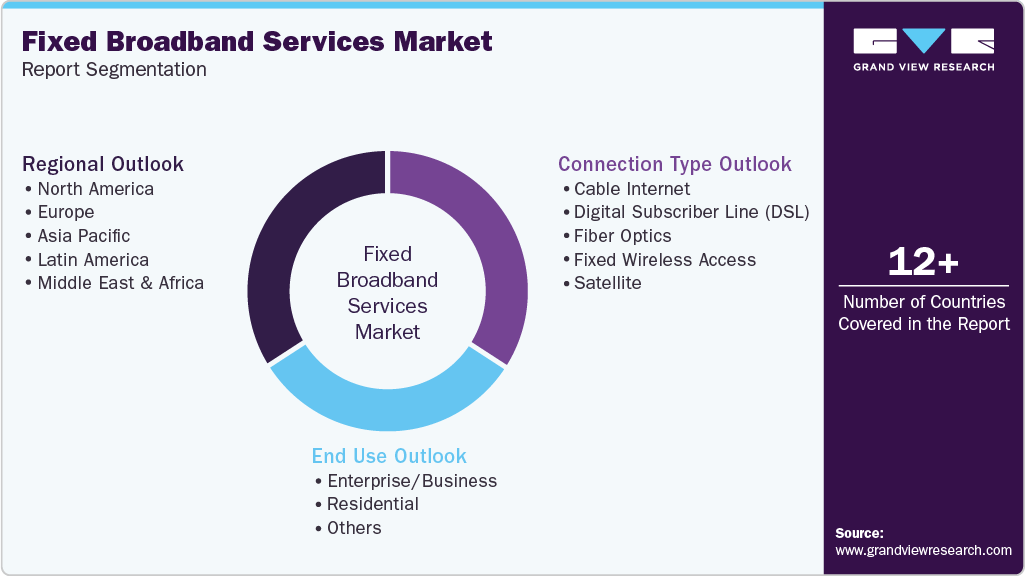
This report forecasts revenue growth at global, regional, and country levels and provides an analysis of the latest industry trends in each of the sub-segments from 2021 to 2033. For this study, Grand View Research has segmented the global fixed broadband services market report based on connection type, end use, and region:
-
Connection Type Outlook (Revenue, USD Million, 2021 - 2033)
-
End Use Outlook (Revenue, USD Million, 2021 - 2033)
-
Enterprise / Business
-
Residential
-
Others
-
Regional Outlook (Revenue, USD Million, 2021 - 2033)
Frequently Asked Questions About This Report
b. The global fixed broadband services market is expected to grow at a compound annual growth rate of 10.6% from 2025 to 2033 to reach USD 833.12 billion by 2033.
b. Some key players operating in the fixed broadband services market include Comcast Corporation, AT&T Inc., Deutsche Telekom AG, China Telecom Corporation Limited, SoftBank Group Corp., Orange S.A., Bharti Airtel, Verizon Communications Inc., Charter Communications, Inc., and Vodafone Limited.
b. Growth in the fixed broadband services market is being driven by rising demand for high-speed connectivity, increasing digitalization across industries, and the rapid expansion of streaming, cloud computing, and remote work activities.
b. The fiber optics segment dominated the market in 2025 and accounted for the largest share of 49.6%. The primary growth driver for the fiber optics segment is the increasing global emphasis on high-speed, high-capacity broadband connectivity, which serves as a critical foundation for digital transformation.
b. The global fixed broadband services market size was estimated at USD 373.04 billion in 2025 and is expected to reach USD 411.96 billion in 2026.

 Download Sample Report