- Home
- »
- Organic Chemicals
- »
-
Fermentation Chemicals Market Size, Industry Report, 2033GVR Report cover
![Fermentation Chemicals Market Size, Share & Trends Report]()
Fermentation Chemicals Market (2026 - 2033) Size, Share & Trends Analysis Report By Product (Alcohols, Enzymes, Organic Acids), By Application (Industrial, Food & Beverages, Nutritional And Pharmaceutical, Plastic & Fibers), By Region, And Segment Forecasts
- Report ID: 978-1-68038-336-2
- Number of Report Pages: 125
- Format: PDF
- Historical Range: 2021 - 2024
- Forecast Period: 2026 - 2033
- Industry: Bulk Chemicals
- Report Summary
- Table of Contents
- Interactive Charts
- Methodology
- Download FREE Sample
-
 Download Sample Report
Fermentation Chemicals Market Summary
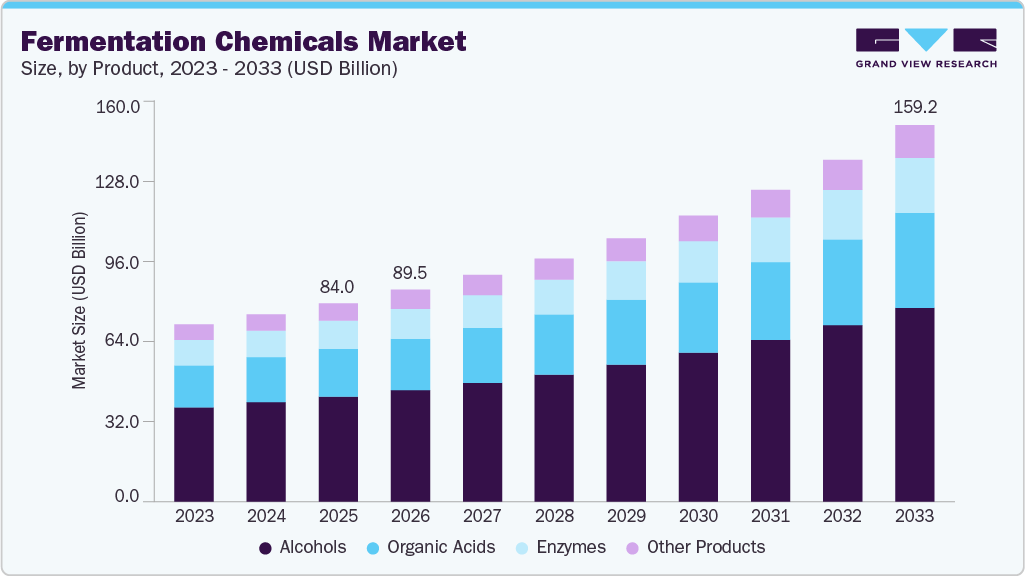
The global fermentation chemicals market size was estimated at USD 84.0 billion in 2025 and is projected to reach USD 159.2 billion by 2033, growing at a CAGR of 8.6% from 2026 to 2033. The market growth is primarily driven by the growing shift toward bio-based, sustainable chemical production across industries such as food & beverages, pharmaceuticals, and industrial manufacturing.
Key Market Trends & Insights
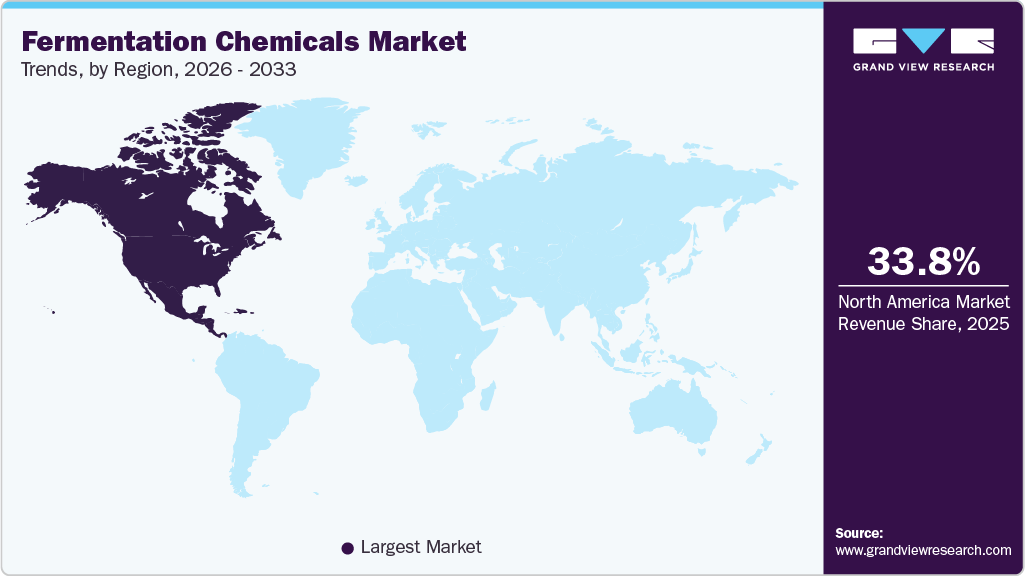
- North America dominated the fermentation chemicals market with the largest revenue share of 33.8% in 2025.
- The China fermentation chemicals industry is expected to grow at the fastest CAGR of 10.1% from 2026 to 2033 in terms of revenue.
- By product, the alcohols segment held the largest revenue share of 52.8% in 2025.
- By product, the organic acids segment is expected to grow at the fastest CAGR of 9.2% from 2026 to 2033 in terms of revenue.
- By application, the industrial segment captured the largest revenue share of 41.5% in 2025.
Market Size & Forecast
- 2025 Market Size: USD 84.0 Billion
- 2033 Projected Market Size: USD 159.2 Billion
- CAGR (2026-2033): 8.6%
- North America: Largest market in 2025
Growing demand for fermentation-derived products, including enzymes, organic acids, and bio-alcohols, coupled with advancements in industrial biotechnology and microbial fermentation technologies, is accelerating market adoption. The strategic investments and product innovations by key industry participants such as BASF SE, Novonesis, and Archer Daniels Midland are further supporting the market expansion.Significant growth opportunities are emerging from the increasing adoption of precision fermentation and synthetic biology to produce high-value bio-based chemicals, specialty ingredients, and pharmaceutical intermediates. Rising demand for biodegradable materials and sustainable industrial inputs is also creating new applications for fermentation-derived organic acids and biopolymers in sectors such as bioplastics, cosmetics, and nutraceuticals. Moreover, expanding biotechnology infrastructure and investments in biomanufacturing in emerging economies are expected to create new revenue streams for companies such as DSM and Evonik Industries AG.
Despite strong growth prospects, the fermentation chemicals market faces several challenges, including high production costs and complex bioprocessing requirements associated with large-scale fermentation operations. The need for specialized fermentation infrastructure, stringent quality control, and stable microbial strains can increase operational complexity and capital investment requirements. Furthermore, competition from petrochemical-based alternatives and volatility in the supply of feedstocks such as sugar and corn may constrain profitability for industry participants, including Cargill, Incorporated and Ajinomoto Co., Inc.
Market Concentration & Characteristics
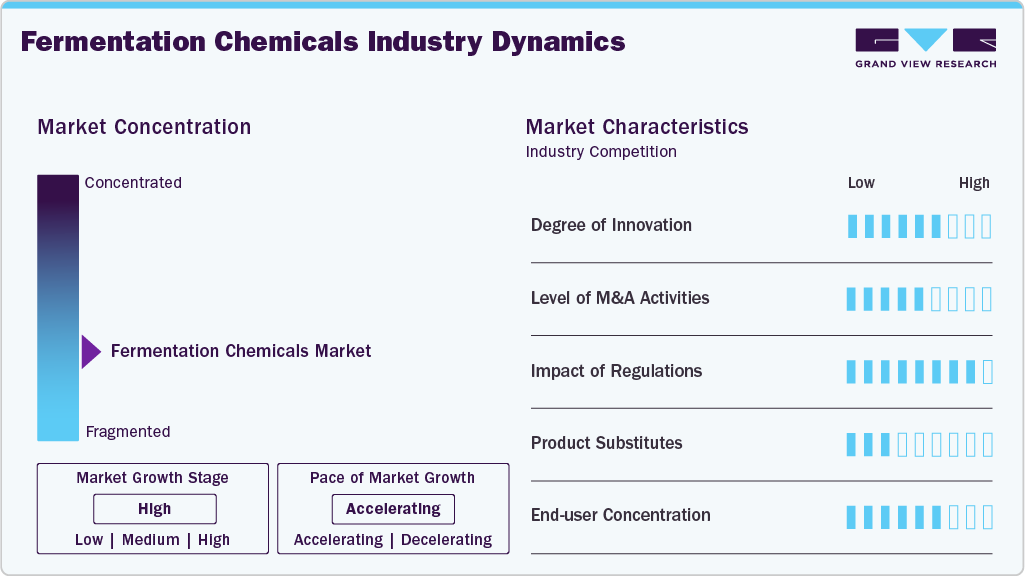
The competitive landscape of the global fermentation chemicals market is characterized by the presence of multinational chemical companies, biotechnology firms, and agro-processing corporations operating across diverse product categories such as enzymes, alcohols, and organic acids. Leading participants, including BASF SE, Novonesis, Archer Daniels Midland, and Cargill, Incorporated, maintain strong competitive positions through integrated production capabilities, robust global distribution networks, and continuous investments in biotechnology and fermentation process optimization. The market exhibits moderate fragmentation, with several regional manufacturers and specialized biotechnology firms contributing to product innovation and supply diversity.
Competition within the industry is primarily driven by advancements in microbial fermentation technologies, expansion of bio-based product portfolios, and strategic collaborations aimed at strengthening technological capabilities. Companies such as DSM, Chr. Hansen Holding A/S, Evonik Industries AG, and Ajinomoto Co., Inc. are increasingly focusing on high-value fermentation-derived ingredients and sustainable biomanufacturing solutions to enhance their competitive positioning. The capacity expansions, strategic partnerships, and innovation in enzyme and specialty chemical production remain key strategies adopted by market participants to address evolving demand across food & beverages, pharmaceuticals, and industrial applications.
Product Insights
The alcohols segment dominated the global fermentation chemicals industry, accounting for the largest revenue share of 52.8% in 2025, primarily due to the extensive use of fermentation-derived alcohols such as ethanol and butanol across fuel, industrial solvent, and chemical intermediate applications. Strong demand for bioethanol in fuel blending, particularly in major economies with renewable fuel mandates, along with its widespread use in pharmaceuticals, food processing, and personal care formulations, has significantly contributed to the segment’s leading market position. Major producers, including Archer Daniels Midland, Cargill Incorporated, and BASF SE, leverage large-scale fermentation infrastructure and feedstock integration to maintain strong production capabilities in this segment.
The enzymes and organic acids segments also represent important components of the market, driven by their expanding use in food processing, pharmaceuticals, detergents, and industrial biotechnology applications. Industrial enzymes, such as amylases, proteases, and cellulases, are widely used across sectors, including food & beverages, textiles, and biofuel production, with key technology providers such as Novonesis and DSM playing a significant role in innovation and product development. Meanwhile, organic acids such as citric acid, lactic acid, and acetic acid are increasingly used in food preservation, biodegradable plastics, and pharmaceutical formulations. The other products segment, which includes fermentation-derived amino acids, vitamins, and specialty bio-based compounds produced by companies such as Ajinomoto Co., Inc. and Evonik Industries AG, is also witnessing steady growth due to rising demand for nutritional and specialty chemical ingredients.
Application Insights
The industrial applications segment led the fermentation chemicals market, capturing the largest revenue share of 41.5% in 2025, driven by the extensive use of fermentation chemicals in the production of biofuels, industrial solvents, detergents, and bio-based chemical intermediates. Fermentation-derived products, such as alcohols, enzymes, and organic acids, are widely used across industries, including energy, chemicals, textiles, and wastewater treatment, due to their efficiency and sustainable production pathways. The growing emphasis on bio-based manufacturing and low-carbon industrial processes has further accelerated adoption, with major industry participants such as BASF SE, Evonik Industries AG, and Archer Daniels Midland expanding their fermentation-based product portfolios to meet increasing industrial demand.
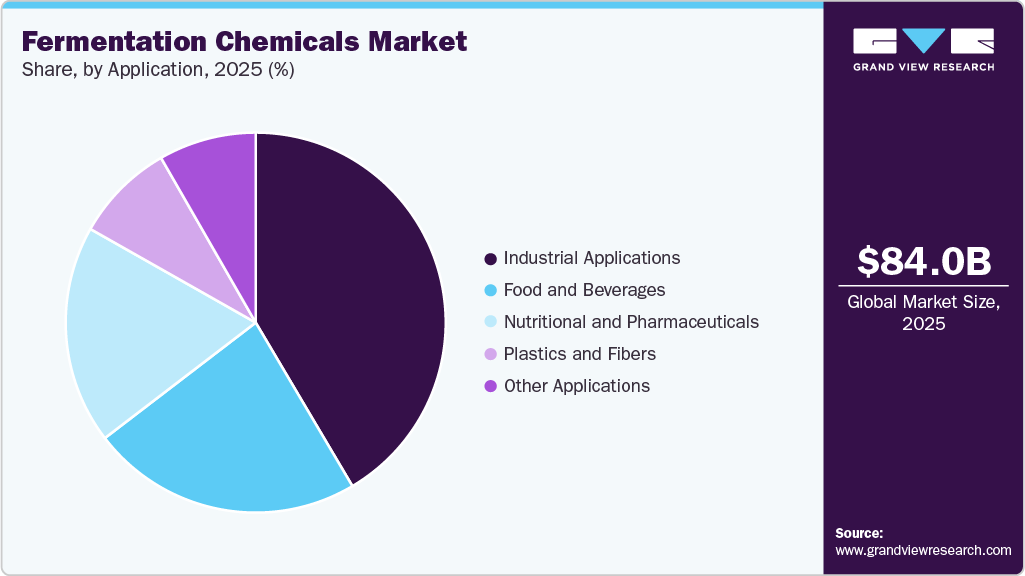
The food & beverages and nutritional & pharmaceutical segments also represent significant application areas, supported by the widespread use of fermentation-derived enzymes, organic acids, amino acids, and probiotics in food processing, preservation, and nutraceutical formulations. Companies such as Novonesis, DSM, and Chr. Hansen Holding A/S plays a key role in supplying specialized fermentation ingredients to these sectors. Meanwhile, the plastics & fibers segment is gaining traction due to the increasing adoption of fermentation-derived organic acids and bio-based monomers used in biodegradable polymers and sustainable textile materials. The other applications segment, which includes agriculture, cosmetics, and personal care products, is also witnessing gradual growth as industries increasingly incorporate fermentation-derived bioactive compounds and sustainable ingredients.
Regional Insights
North America accounted for 33.8% of the global fermentation chemicals market in 2025, driven by the region’s well-established biotechnology ecosystem, strong biofuel production capacity, and high demand for fermentation-derived ingredients across industrial, food, and pharmaceutical sectors. The presence of leading biotechnology and agricultural processing companies, including Archer Daniels Midland and Cargill, Incorporated, along with continuous investments in industrial biotechnology and bio-based chemical production, continues to support market expansion across the region.
U.S. Fermentation Chemicals Market Trends
The U.S. represented the largest market within North America, supported by its advanced biomanufacturing infrastructure, large-scale ethanol production, and strong research capabilities in microbial fermentation technologies. Increasing demand for fermentation-derived enzymes, organic acids, and bio-based intermediates across food processing, pharmaceuticals, and industrial applications, combined with strong participation from companies such as DuPont and Archer Daniels Midland, continues to drive market growth.
Asia Pacific Fermentation Chemicals Market Trends
The Asia Pacific fermentation chemicals industry held a significant 28.7% share in 2025, supported by the region’s large-scale fermentation production base, the expanding chemical manufacturing sector, and strong demand from the food processing and pharmaceutical industries. Rapid industrialization, growing biotechnology investments, and the increasing adoption of bio-based chemicals across countries such as China, Japan, and India are driving market expansion, with key industry participants, including Ajinomoto Co., Inc., playing an important role in regional production and innovation.
The China fermentation chemicals market led Asia Pacific with the largest share in 2025, driven by its extensive fermentation manufacturing capacity, abundant feedstock availability, and strong presence in amino acid, organic acid, and alcohol production. The country’s rapidly growing food processing, pharmaceutical, and chemical industries, along with increasing investments in biotechnology and sustainable chemical manufacturing, are further strengthening its position as a key global production hub for fermentation-based chemicals.
Europe Fermentation Chemicals Market Trends
Europe accounted for 25.1% of the global fermentation chemicals industry in 2025, supported by strong regulatory emphasis on sustainable chemical production and the widespread adoption of industrial biotechnology solutions. The region hosts several leading enzyme and biotechnology companies such as Novonesis, DSM, and Chr. Hansen Holding A/S continues to drive innovation in fermentation technologies and bio-based product development across food, pharmaceutical, and industrial sectors.
The fermentation chemicals market in Germany is expected to grow over the forecast period. Germany is one of the leading markets for fermentation chemicals in Europe, supported by its advanced chemical manufacturing base, strong biotechnology research infrastructure, and increasing adoption of sustainable industrial processes. The presence of major chemical and specialty ingredient producers such as BASF SE and Evonik Industries AG further strengthens the country’s position in the development and commercialization of fermentation-derived chemicals.
Middle East & Africa Fermentation Chemicals Market Trends
The Middle East & Africa fermentation chemicals industry is witnessing gradual growth, driven by increasing investments in the food processing, pharmaceutical, and industrial manufacturing sectors. Expanding demand for enzymes, organic acids, and fermentation-based ingredients in the food production and healthcare industries, coupled with growing initiatives to diversify industrial economies and develop biotechnology capabilities, is driving market growth across the region.
Central & South America Fermentation Chemicals Market Trends
The Central & South America fermentation chemicals industry’s growth is primarily driven by the region’s strong agricultural base and expanding bioethanol production industry. Countries such as Brazil are significant producers of fermentation-derived alcohols, supported by abundant sugarcane feedstock and well-established biofuel policies. The growing demand for fermentation chemicals in food processing, animal nutrition, and industrial applications is further driving regional market growth.
Key Fermentation Chemicals Company Insights
Key players, such as BASF SE, Novonesis, DSM, AB Enzymes, Evonik Industries AG, Cargill, Incorporated, and ADM, dominate the market.
-
BASF SE has a strong presence in the fermentation chemicals market through its diversified portfolio of bio-based intermediates, enzymes, and fermentation-derived ingredients. The company leverages advanced biotechnology capabilities and integrated chemical production infrastructure to develop sustainable solutions for applications across food & beverages, pharmaceuticals, agriculture, and industrial manufacturing. BASF continues to strengthen its market position through strategic investments in biotechnological research, partnerships, and the expansion of bio-based product lines to support the transition toward sustainable, low-carbon chemical production.
Key Fermentation Chemicals Companies:
The following key companies have been profiled for this study on the fermentation chemicals market.
- BASF SE
- Novonesis
- DuPont Danisco
- DSM
- Amano Enzymes USA Co., Ltd.
- AB Enzymes
- Chr. Hansen Holding A/S
- Dow
- Evonik Industries AG
- Cargill, Incorporated
- Ajinomoto Co., Inc.
- ADM
Recent Developments
-
In January 2024, Novozymes and Chr. Hansen completed its strategic merger to form Novonesis, creating a global biosolutions leader that combines expertise in enzymes and microbial technologies. The combined entity aims to accelerate innovation in industrial biotechnology and fermentation-based solutions across food, agriculture, and industrial applications.
Fermentation Chemicals Market Report Scope
Report Attribute
Details
Market size value in 2026
USD 89.5 billion
Revenue forecast in 2033
USD 159.2 billion
Growth rate
CAGR of 8.6% from 2026 to 2033
Base year for estimation
2025
Historical data
2021 - 2024
Forecast period
2026 - 2033
Quantitative units
Volume in kilotons, revenue in USD million/billion, and CAGR from 2026 to 2033
Report coverage
Volume and revenue forecast, company ranking, competitive landscape, growth factors, trends
Segments covered
Product, application, region
Regional scope
North America; Europe; Asia Pacific; Central & South America; Middle East Africa
Country scope
U.S.; Canada; Mexico; Germany; UK; France; Italy; Spain; China; India; Japan; South Korea; Australia; Brazil; Argentina; South Africa; Saudi Arabia
Key companies profiled
BASF SE; Novonesis; DuPont Danisco; DSM; Amano Enzymes USA Co., Ltd.; AB Enzymes; Chr. Hansen Holding A/S; Dow; Evonik Industries AG; Cargill; Incorporated; Ajinomoto Co., Inc.; ADM
Customization scope
Free report customization (equivalent up to 8 analysts working days) with purchase. Addition or alteration to country, regional & segment scope.
Pricing and purchase options
Avail customized purchase options to meet your exact research needs. Explore purchase options
Global Fermentation Chemicals Market Report Segmentation
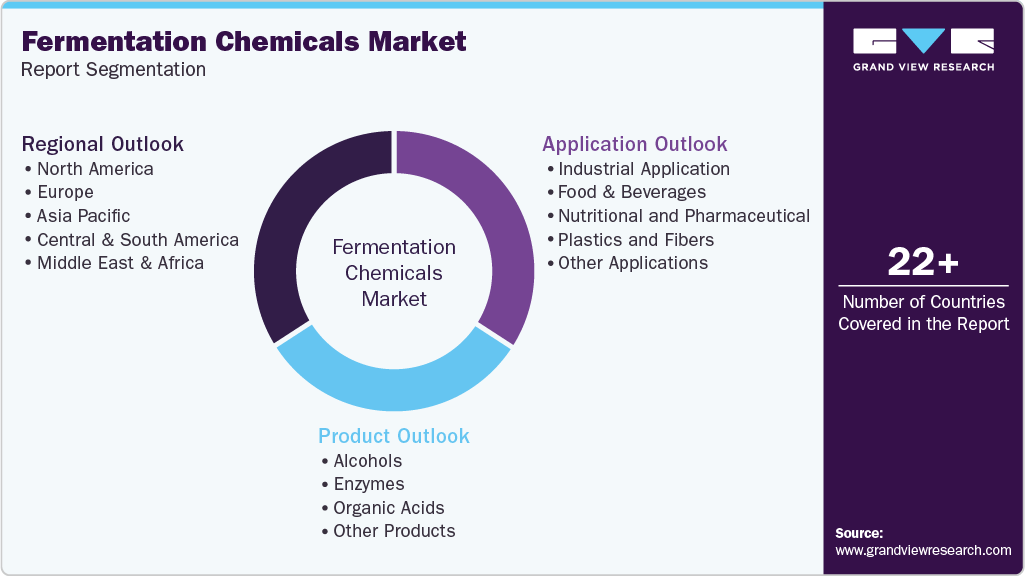
This report forecasts volume and revenue growth at the global, regional, and country levels and provides an analysis of the latest industry trends in each of the sub-segments from 2021 to 2033. For this study, Grand View Research has segmented the global fermentation chemicals market report based on product, application, and region:
-
Product Outlook (Volume, Kilotons; Revenue, USD Million, 2021 - 2033)
-
Alcohols
-
Enzymes
-
Organic Acids
-
Other Products
-
-
Application Outlook (Volume, Kilotons; Revenue, USD Million, 2021 - 2033)
-
Industrial Application
-
Food & Beverages
-
Nutritional and Pharmaceutical
-
Plastics and Fibers
-
Other Applications
-
-
Regional Outlook (Volume, Kilotons; Revenue, USD Million, 2021 - 2033)
-
North America
-
U.S.
-
Canada
-
Mexico
-
-
Europe
-
Germany
-
UK
-
France
-
Italy
-
Spain
-
-
Asia Pacific
-
China
-
Japan
-
India
-
South Korea
-
Australia
-
-
Central & South America
-
Brazil
-
Argentina
-
-
Middle East and Africa
-
Saudi Arabia
-
South Africa
-
-
Frequently Asked Questions About This Report
b. The global fermentation chemicals market size was estimated at USD 84.0 billion in 2025 and is expected to reach 89.5 billion in 2026.
b. The alcohols segment dominated the global fermentation chemicals market with a revenue share of 52.8% in 2025, primarily due to the large-scale production and consumption of fermentation-derived alcohols such as ethanol in fuel blending, industrial solvents, and chemical intermediates. Strong demand from biofuel, pharmaceutical, and food processing industries, supported by extensive production capacities of companies such as Archer Daniels Midland and Cargill, Incorporated, has significantly contributed to the segment’s leading market position.
b. The growth of the fermentation chemicals market is primarily driven by the rising demand for bio-based and sustainable chemicals across industries such as food & beverages, pharmaceuticals, and industrial manufacturing. The advancements in industrial biotechnology and fermentation technologies, supported by innovation from companies such as Novozymes and DSM, are accelerating the adoption of fermentation-derived products including enzymes, organic acids, and bio-alcohols.
b. Some of the key players operating in the fermentation chemicals market include BASF SE, Novonesis, DuPont Danisco, DSM, Amano Enzymes USA Co., Ltd., AB Enzymes, Chr. Hansen Holding A/S, Dow, Evonik Industries AG, Cargill, Incorporated, Ajinomoto Co., Inc., and ADM.
b. The global fermentation chemicals market is expected to grow at a compound annual growth rate of 8.6% from 2026 to 2033 to reach USD 159.2 billion by 2033.


Share this report with your colleague or friend.
Need a Tailored Report?
Customize this report to your needs — add regions, segments, or data points, with 20% free customization.


ISO 9001:2015 & 27001:2022 Certified
We are GDPR and CCPA compliant! Your transaction & personal information is safe and secure. For more details, please read our privacy policy.
Trusted market insights - try a free sample
See how our reports are structured and why industry leaders rely on Grand View Research. Get a free sample or ask us to tailor this report to your needs.