- Home
- »
- Nutraceuticals & Functional Foods
- »
-
Europe Dietary Supplements Market Size Report, 2033GVR Report cover
![Europe Dietary Supplements Market Size, Share & Trends Report]()
Europe Dietary Supplements Market (2026 - 2033) Size, Share & Trends Analysis Report By Ingredients (Vitamin, Botanicals, Minerals), By Type (OTC), By Form (Tablets, Capsules, Softgels, Powder), By Application, By End User, By Distribution Channel, By Country, And Segment Forecasts
- Report ID: GVR-4-68040-065-2
- Number of Report Pages: 110
- Format: PDF
- Historical Range: 2021 - 2025
- Forecast Period: 2026 - 2033
- Industry: Consumer Goods
- Report Summary
- Table of Contents
- Segmentation
- Methodology
- Download FREE Sample
-
 Download Sample Report
Europe Dietary Supplements Market Summary
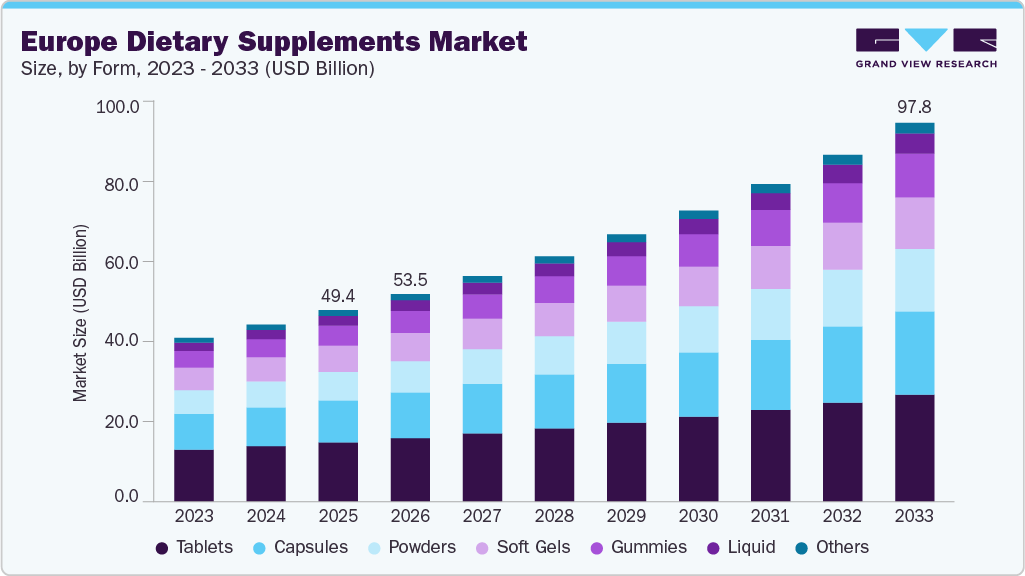
The Europe dietary supplements market size was estimated at USD 49.39 billion in 2025 and is projected to reach USD 97.76 billion by 2033, growing at a CAGR of 9.0% from 2026 to 2033. Growing technological innovation in the nutraceuticals sector offers new opportunities for the dietary supplements market in Europe.
Key Market Trends & Insights
- By ingredients, the vitamin supplements segment accounted for a share of 27.57% in 2025.
- By form, the tablet supplements segment accounted for a share of 30.97% in 2025.
- By type, OTC supplements accounted for a share of 62.46% in 2025.
- By application, dietary supplements for energy & weight management dominated the market, with a share of 18.81% in 2025.
- By distribution channel, the offline channel segment led the market with a share of 69.40% in 2025.
- By end user, dietary supplements for adults dominated the market, with a share of 62.52% in 2025.
Key Market Trends & Insights
- 2025 Market Size: USD 49.39 Billion
- 2033 Projected Market Size: USD 97.76 Billion
- CAGR (2026-2033): 9.0%
The Federation of European Nutrition Societies (FENS) funds and invests in various nutritional food and nutricosmetic businesses. The federation operates and nurtures the growth of such companies in 26 countries in the region.The European Society for Clinical Nutrition and Metabolism (ESPEN) governs and offers grants for businesses in the nutrition sector, and also honors the best-performing organizations in the industry. Such initiatives have encouraged participants to develop highly beneficial, innovative products, thereby boosting the growth of the European dietary supplements industry.
Probiotic food supplements continue to contribute significantly to the growth of the Europe food supplements market. Many medical professionals in Europe recommend probiotic supplements for their various health benefits, including increased immunity.
The prevalence of lactose intolerance and obesity in Europe has further increased the demand for probiotic health supplements. Probiotic supplements are increasingly consumed in the region by consumers with lactose intolerance, thereby contributing to the growth of the probiotics segment across other applications.
Across the European Union, a rapidly aging population is becoming a key structural driver of dietary supplement demand, as a growing proportion of consumers are over 60 and increasingly focused on maintaining mobility, immunity, and overall quality of life. Age-related physiological changes, along with behavioral and social factors, raise vulnerability to chronic conditions such as osteoporosis, cardiovascular diseases, joint problems, and cognitive decline, prompting greater reliance on preventive nutrition. As a result, supplements such as calcium, vitamin D, omega-3s, magnesium, and targeted formulations for heart, bone, and brain health are becoming part of daily health routines rather than occasional purchases.
This trend is clearly reflected in Germany, where around one in five adults is aged 65 or older, and the share of seniors is expected to keep rising. According to figures from the Max Rubner Institute National Nutrition Survey II and the KPRA Age Study, women aged 65–80 are the most active supplement users, with 54% of women and 34% of men in this age group regularly taking food supplements. Such high adoption among older adults highlights how demographic ageing directly expands the core consumer base and supports sustained, long-term growth in the European dietary supplements market.
In August 2025, IBSA Group launched orodispersible film food supplements containing iron, vitamin D3, and vitamin B12 using its patented FilmTec technology across new European markets, expanding its international presence with easy-to-take, precisely dosed formats.
Consumer Insights for Europe Dietary Supplements
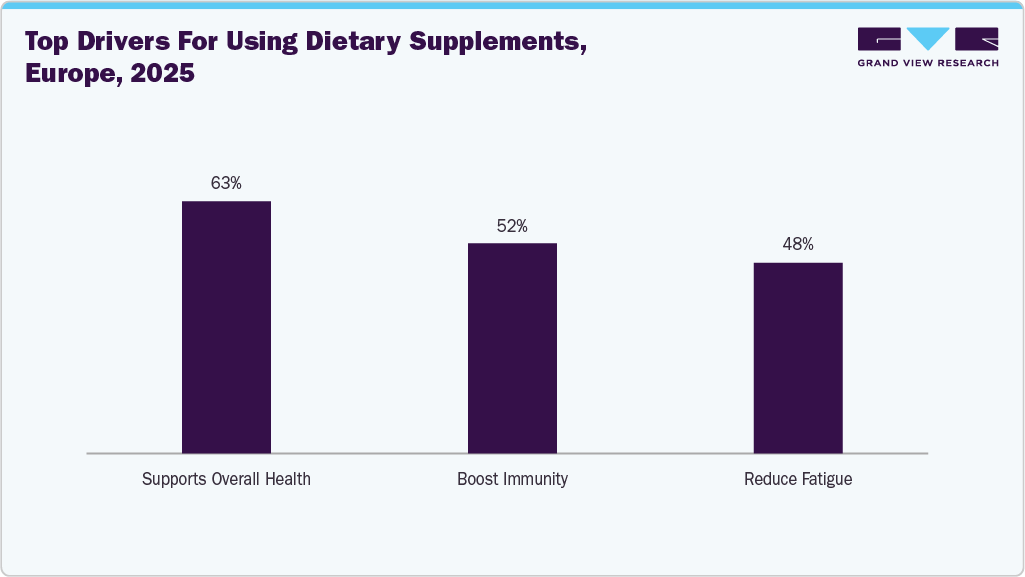
Beyond demographic influences, evolving consumer attitudes toward preventive healthcare and self-care are further strengthening the dietary supplements market across the European Union. Europeans are increasingly taking a proactive approach to managing their health, using supplements to support immunity, energy, stress management, and overall wellness rather than waiting to address deficiencies or illnesses. This shift toward routine, lifestyle-based consumption has normalized supplements as part of daily nutrition, encouraging repeat purchases and building long-term trust in these products. This behavioral change is reflected in the following consumer usage and confidence data.
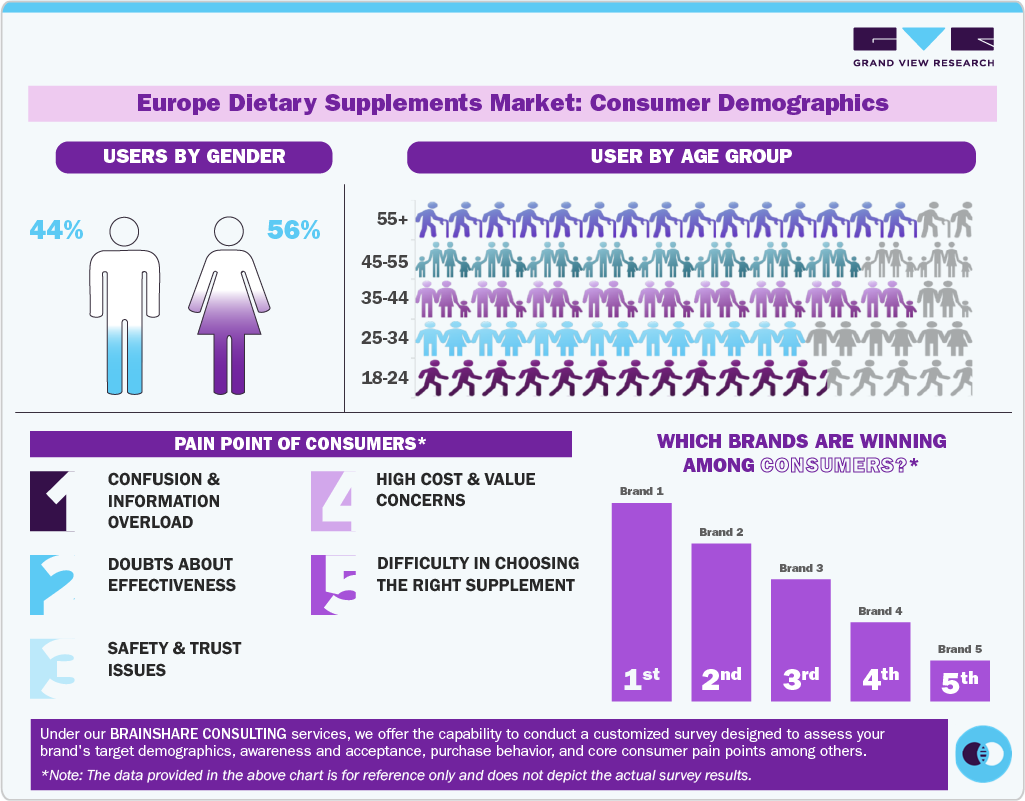
2025 Survey findings from the AESGP show that over half of consumers (55%) purchase food supplements, and among users, 62% take them daily, indicating that supplements are increasingly integrated into everyday health routines rather than used occasionally. Confidence levels are also high: 82% of consumers consider supplements essential for maintaining their health, and 78% express trust in their safety and quality, reflecting strong consumer acceptance. Together, these figures highlight how growing trust, regular usage habits, and preventive health awareness are reinforcing consistent, long-term demand for dietary supplements across Europe.
Ingredients Insights
The vitamin supplements market segment accounted for a revenue share of 27.57% in 2025. Vitamins address common nutrient deficiencies, everyday immune needs, and preventive health goals in a simple, affordable way. Many Europeans have inadequate intake of key micronutrients, such as vitamin D, vitamin C, and B-complex vitamins, making vitamin supplements an easy way to maintain energy, bone strength, and immune function.
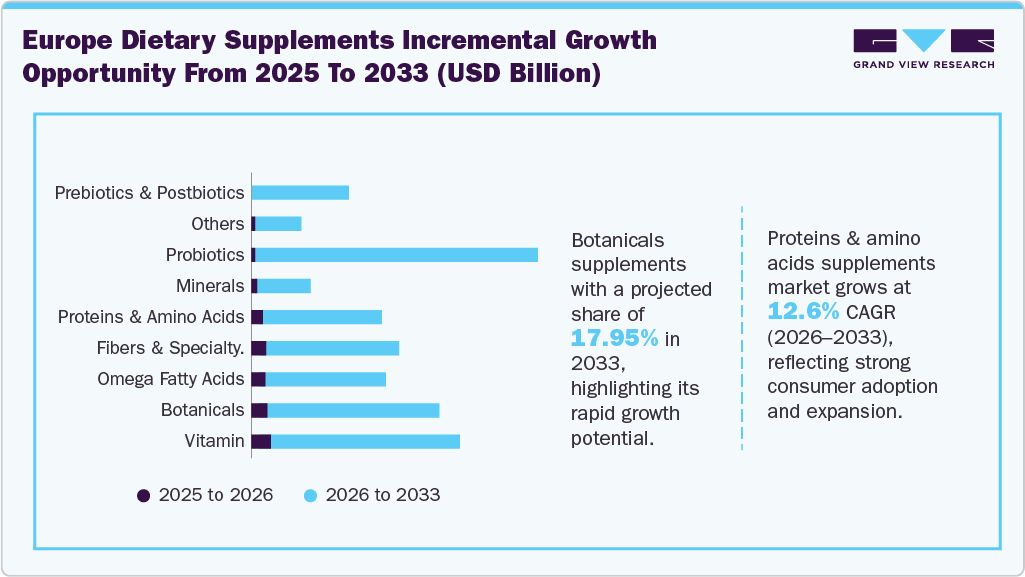
The protein & amino acids supplements segment of the Europe dietary supplements market is expected to grow at a CAGR of 12.6% from 2026 to 2033. Health-conscious consumers are increasingly seeking high-protein foods, supplements, and functional products to support muscle maintenance, weight management, active lifestyles, and ageing populations, which fuels growth in protein-rich dietary and wellness products. At the same time, amino acids are essential in animal feed to improve livestock growth, feed efficiency, and sustainability goals, particularly as Europe’s livestock sector modernizes and adopts precision nutrition strategies. Additional applications in personal care, pharmaceuticals, and functional foods, combined with shifting diets toward plant and alternative proteins, also support broader market expansion.
Type Insights
Over the counter (OTC) dietary supplements led the Europe dietary supplements industry, accounting for the largest revenue share of 62.46% in 2025. Consumers strongly associate supplements with medical credibility, safety, and professional guidance, which makes pharmacies & and drug stores their preferred purchase channels over supermarkets or purely online platforms. In many European countries, strict regulations and health claim oversight by authorities such as the European Food Safety Authority (EFSA) increase consumer trust in products sold through pharmacy networks, where pharmacists can recommend vitamins, minerals, protein supplements, and amino acids for specific needs like immunity, ageing, bone health, and clinical nutrition.
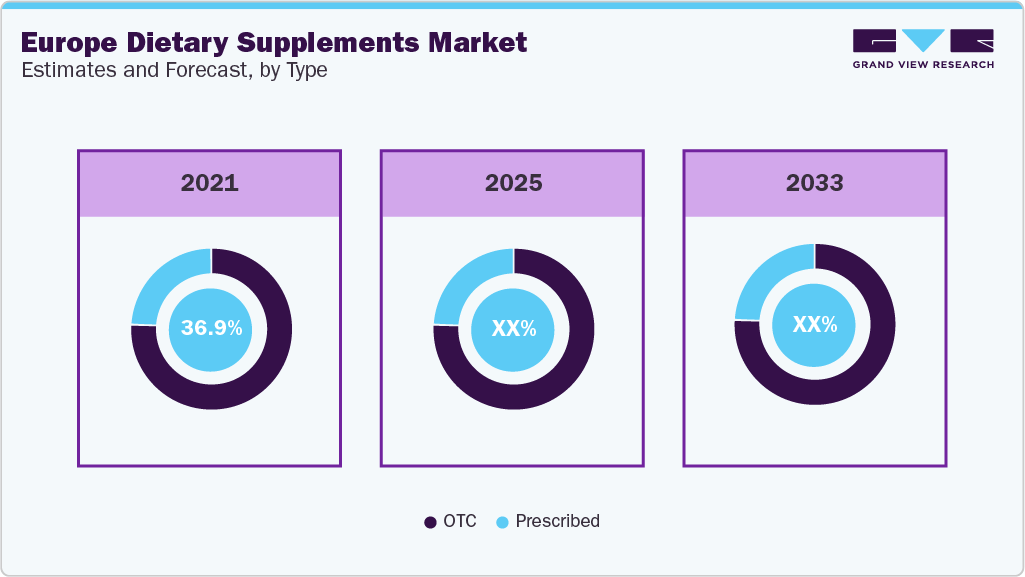
The demand for prescribed dietary supplements is projected to grow at a CAGR of 8.7% from 2026 to 2033. Doctors are recommending or prescribing targeted nutrients such as vitamin D, iron, omega-3s, protein powders, and amino-acid formulas to manage specific deficiencies, chronic conditions, and recovery needs, especially among the elderly, pregnant women, and patients with metabolic or digestive disorders. With Europe’s ageing population and rising cases of lifestyle diseases like osteoporosis, diabetes, and cardiovascular issues, medically guided supplementation has become a routine extension of treatment plans.
Form Insights
The tablet dietary supplements market accounted for the largest revenue share of 30.97% in 2025. Tablets are easy to store, transport, and dose, making them suitable for daily-use products such as multivitamins, minerals, protein blends, and amino acids. Healthcare professionals frequently recommend tablet-based supplements for the management of deficiencies and preventive care. They are cheaper to manufacture and package than capsules, gummies, or liquids, allowing brands to offer affordable prices while maintaining long shelf life and stability without refrigeration.
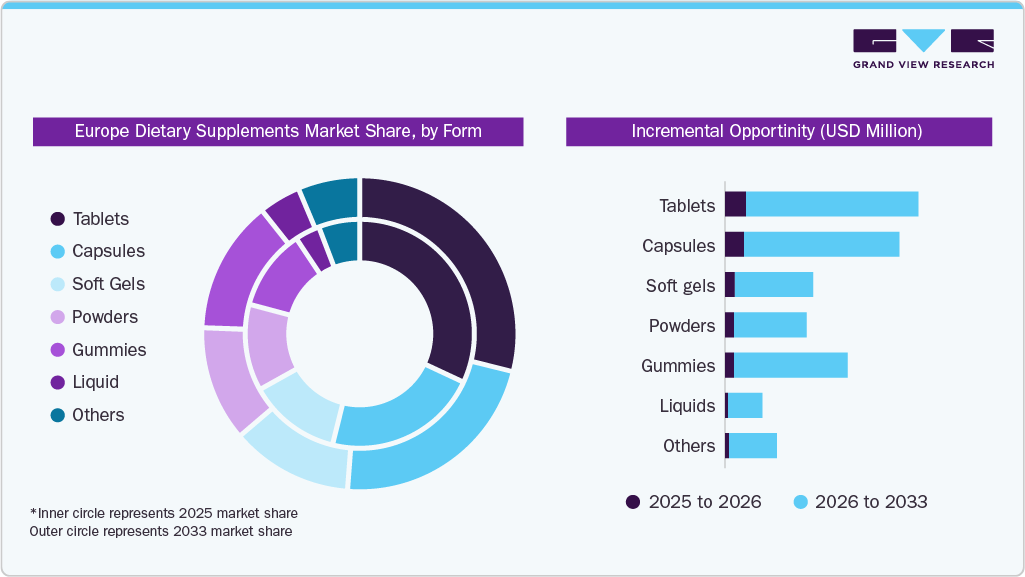
The liquid supplements market is projected to grow at a CAGR of 9.5% from 2026 to 2033. Consumers are prioritizing faster absorption, ease of consumption, and personalized dosing. Liquids are often perceived as having higher bioavailability than tablets or capsules, making them popular for nutrients that require quick uptake, such as vitamin D, iron, magnesium, amino acids, and herbal extracts. Additionally, Children, elderly consumers, and people with swallowing difficulties prefer syrups, drops, or ready-to-drink formats over tablets, supporting growth in pediatric and geriatric nutrition.
Application Insights
The energy & weight management supplements market accounted for a revenue share of 18.81% in 2025. Consumers increasingly juggle long work hours, commuting, and fitness goals, which often results in low daily energy levels. Instead of relying only on caffeine or sugary drinks, many prefer vitamin B-complex, iron, magnesium, ginseng, and adaptogenic supplements that promise sustained energy and reduced fatigue. These options are viewed as cleaner and healthier alternatives to energy drinks. Additionally, the rise of active lifestyles, gym culture, cycling, running, and wellness apps drives demand for performance and stamina boosters, making energy supplements part of daily routines rather than occasional purchases.
Prenatal health supplements are projected to grow at a CAGR of 13.4% from 2026 to 2033. Women are focusing on planned pregnancies, preventive care, and maternal–infant nutrition. Modern healthcare guidance, later-age pregnancies, and stronger awareness about fetal development have made prenatal supplementation a routine part of pregnancy rather than an optional add-on. Consumers increasingly understand that nutrition during pregnancy directly affects baby growth, brain development, and immunity. Supplements such as folic acid, iron, calcium, iodine, and DHA are now widely recommended to prevent deficiencies and birth complications.
End User Insights
The dietary supplements for adults market accounted for a revenue share of 62.52% in 2025. Working adults often experience long hours, stress, irregular meals, and lack of sleep, leading to fatigue and reduced immunity. Supplements such as multivitamins, B-complex, vitamin C, magnesium, and adaptogens are used to maintain daily energy levels, improve focus, and help prevent frequent illness.
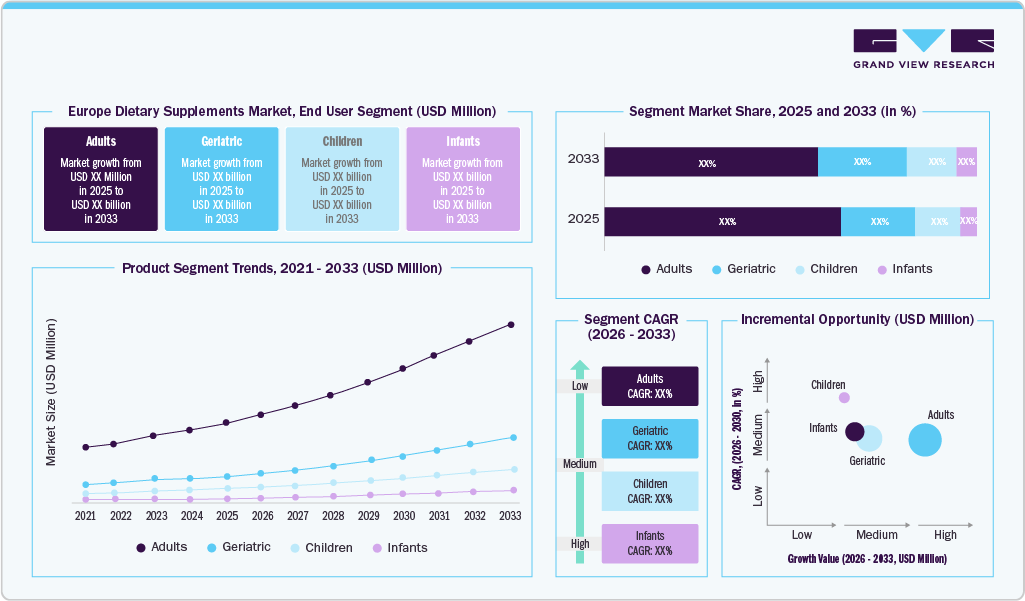
Dietary supplements for infants is projected to grow at a CAGR of 10.4% from 2025 to 2033. Parents are increasingly prioritizing their babies’ nutrition and preventive healthcare, recognizing that the first 1,000 days are crucial for brain development, immunity, and long-term well-being. Greater awareness of the importance of nutrients such as vitamin D, iron, DHA, probiotics, and calcium has encouraged families to use supplements to support bone strength, cognitive growth, and overall health. Since infants may not always obtain adequate nutrients from breast milk or regular diets alone, supplements are commonly viewed as a safe and reliable way to bridge nutritional gaps during the first year.
Distribution Channel Insights
The sales of dietary supplements through offline channels accounted for a share of around 69.40% of the revenue in 2025. Consumers often seek guidance on dosage, ingredients, side effects, and suitability, especially for prenatal, infant, or medical supplements. Pharmacies & Drug Stores and health stores provide face-to-face consultation with pharmacists or staff, which builds credibility and encourages immediate purchase. This reassurance is challenging to replicate online, making offline stores the preferred channel for first-time or sensitive purchases. For instance, the Edeka Group and the REWE Group are some of the largest supermarket chains in Germany. While the former operates through more than 4,000 stores, the latter owns more than 3,300 stores nationwide.
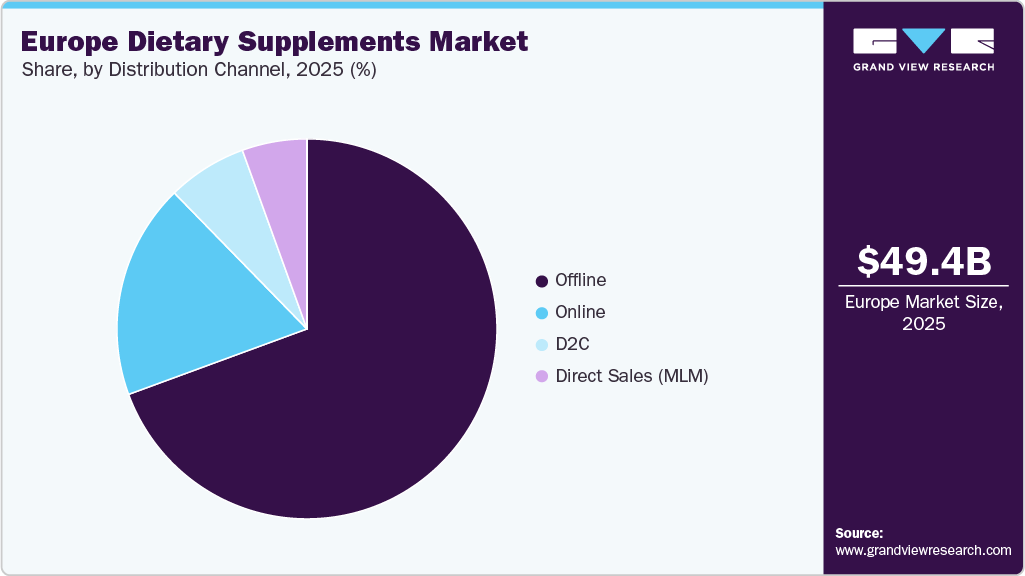
The sales of dietary supplements through online channels are projected to grow at a CAGR of 8.4% from 2026 to 2033. As lifestyles become busier and e-commerce adoption rises, buying supplements online fits easily into everyday routines without the need to visit physical stores. Consumers can order supplements anytime, compare options, and receive products at home, saving travel time. This is especially useful for busy professionals, parents, and elderly consumers who prefer hassle-free purchasing. Subscription models and auto-refill services further encourage repeat online buying.
Country Insights
UK Dietary Supplements Market Trends
Dietary supplements manufacturers are focusing on innovating their product offerings to cater to a varied set of consumers in the UK For instance, Yakult Honsha, a Japan-based supplement manufacturing company, has been developing strains (patented) of microorganisms to stay ahead of the competition in the UK dietary supplements market. Such efforts are likely to contribute to the growth of the dietary supplements industry in the foreseeable future.
The rising home healthcare expenditure has been contributing significantly to the demand for dietary supplements, most notably digestive capsules and tablets, among baby boomers in the UK In addition to the prevalence of chronic diseases in the country, the presence of a geriatric population has been driving the sale of dietary supplement capsules and tablets in the country.
Germany Dietary Supplements Market Trends
Germany has a large population base that is quickly realizing the benefits of digestive foods and ingredients in their regular diets, as food becomes the medium to obtain necessary vitamins, minerals, and other essentials. The food & beverage industry in the country is also highly developed, with major multinational companies introducing new products & technologies to cater to the rising country-wide demand. Recent years have witnessed an increasing demand for dietary supplements, as is the case in most countries in Europe. The demand for dietary supplements in Germany is likely to grow steadily over the next decade, owing to the increasing availability of innovative products within the country.
According to the data, there is a growing trend among German consumers, with a majority leaning towards organic vitamin supplements. Nearly two-thirds of supplement users believe that organic supplements are more beneficial for their health compared to non-organic alternatives.
France Dietary Supplements Market Trends
The consumption trend of dietary supplements in France is similar to that of most other countries in Europe. In this regard, French consumers have principally preferred the consumption of the product in the form of capsules and tablets. Increase in prescriptions by medical practitioners for these product forms is driving the segment growth.
Furthermore, French consumers continue to favor supermarkets/ hypermarkets/ food stores and Pharmacies & Drug Stores for the purchase of dietary supplements. Furthermore, the proliferation of organic retail chains across the country has been contributing favorably to the growth of the OTC segment.
Italy Dietary Supplements Market Trends
Growing consumer proactiveness toward health problems has boosted the demand for dietary supplements in Italy. Consumers in Italy prefer these supplements owing to their perceived health benefits and familiar taste. The increasing instance of product innovation in the production of dietary supplements by employing a variety of flavors is expected to attract new customers during the period 2026 to 2033. There has been an increasing trend of consuming dietary supplements among younger consumers in Italy, which, in turn, has been boosting the demand for products such as vitamins, minerals, and omega-3.
Key Europe Dietary Supplements Company Insights
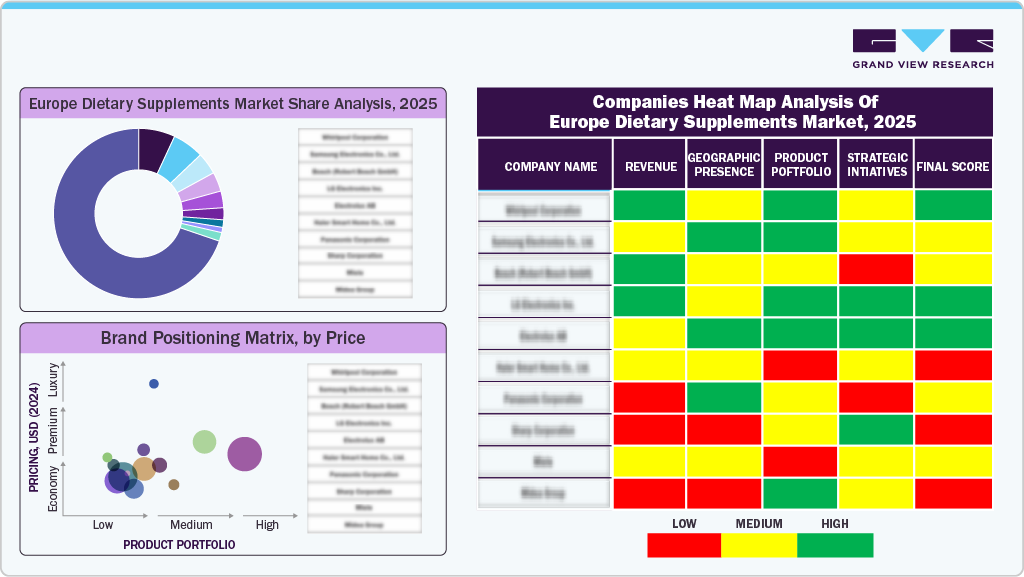
Established companies and emerging players in the Europe dietary supplements market are creating a competitive environment by emphasizing product innovation, quality, and strategic pricing. Growing awareness of chronic health issues such as diabetes, obesity, and nutrient deficiencies is encouraging consumers to seek targeted and preventive nutrition through dietary supplements. This shift in consumer behavior is fueling the demand for specialized formulations, including plant-based supplements, allergen-free options, and condition-specific blends, creating significant opportunities for manufacturers and suppliers who can meet these evolving health-conscious needs.
Key Europe Dietary Supplements Companies:
- Bayer AG
- Nestlé Health Science
- Reckitt Benckiser Group plc
- Sanofi
- GSK plc
- Holland & Barrett
- Glanbia plc
- Orkla Health
- Pharmavite LLC
- Bioglan
Recent Developments
-
In September 2025, NextPlat Corp officially rolled out its Florida Sunshine line of premium, made-in-USA vitamins and supplements across Europe and North America and has secured initial approval to sell these products in China via Tmall Global.
-
In April 2025, PharmaLinea presented its new liposomal supplement innovations at Vitafoods Europe, introducing two products: Your Lipo-Mag Orosticks and Your Lipo-C Orosticks. These supplements used liposomal technology to improve nutrient absorption and came in convenient orodispersible stick packs that dissolved easily without water.
Europe Dietary Supplements Market Report Scope
Report Attribute
Details
Market size value in 2026
USD 53.54 billion
Revenue forecast in 2033
USD 97.76 billion
Growth rate
CAGR of 9.0% from 2026 to 2033
Actuals
2021 - 2025
Forecast period
2026 - 2033
Quantitative units
Revenue in USD billion and CAGR from 2026 to 2033
Report coverage
Revenue forecast, company ranking, competitive landscape, growth factors, and trends
Segments covered
Ingredient, type, form, application, end user, distribution channel, product-form, form-end user, form-application
Country scope
UK; Germany; France; Italy; Spain; Poland; Russia
Key companies profiled
Bayer AG; Nestlé Health Science; Reckitt Benckiser Group plc; Sanofi; GSK plc; Holland & Barrett; Glanbia plc; Orkla Health; Pharmavite LLC; Bioglan.
Customization scope
Free report customization (equivalent up to 8 analysts’ working days) with purchase. Addition or alteration to country, regional & segment scope.
Pricing and purchase options
Avail customized purchase options to meet your exact research needs. Explore purchase options
Europe Dietary Supplements Market Report Segmentation
This report forecasts revenue growth at the regional & country levels and provides an analysis of the latest trends and opportunities in each of the sub-segments from 2021 to 2033. For this study, Grand View Research has segmented the Europe dietary supplements market report based on ingredient, type, form, application, end user, distribution channel, product-form, form-end user, form-application, and region:
-
Ingredients Outlook (Revenue, USD Billion, 2021 - 2033)
-
Vitamins
-
Multivitamin
-
Vitamin A
-
Vitamin B
-
Vitamin C
-
Vitamin D
-
Vitamin K
-
Vitamin E
-
-
Botanicals
-
Minerals
-
Calcium
-
Potassium
-
Magnesium
-
Iron
-
Zinc
-
Others
-
-
Protein & Amino Acids
-
Collagen
-
Others
-
-
Fibers & Specialty Carbohydrates
-
Omega Fatty Acids
-
Probiotics
-
Prebiotics & Postbiotics
-
Others
-
-
Type Outlook (Revenue, USD Billion, 2021 - 2033)
-
OTC
-
Prescribed
-
-
Form Outlook (Revenue, USD Billion, 2021 - 2033)
-
Tablets
-
Capsules
-
Softgels
-
Powder
-
Gummies
-
Liquid
-
Others
-
-
Application Outlook (Revenue, USD Billion, 2021 - 2033)
-
Energy & Weight Management
-
General Health
-
Bone & Joint Health
-
Gastrointestinal Health
-
Immunity
-
Cardiac Health
-
Diabetes
-
Anti-cancer
-
Lungs Detox/Cleanse
-
Skin/ Hair/ Nails
-
Sexual Health
-
Brain/Mental Health
-
Insomnia
-
Menopause
-
Anti-aging
-
Prenatal Health
-
Others
-
-
End User Outlook (Revenue, USD Billion, 2021 - 2033)
-
Adults
-
Millennials
-
Male
-
Female
-
Pregnant Women
-
Non-pregnant Women
-
-
-
Gen X
-
Male
-
Female
-
Pregnant Women
-
Non-pregnant Women
-
-
-
Gen Z
-
Male
-
Female
-
Pregnant Women
-
Non-pregnant Women
-
-
-
Boomers
-
Male
-
Female
-
-
Geriatric
-
Children
-
Infants
-
-
Distribution Channel Outlook (Revenue, USD Billion, 2021 - 2033)
-
Offline
-
Hypermarkets/Supermarkets
-
Pharmacies & Drug Stores
-
Specialty Stores
-
Practitioner
-
Others
-
-
Direct Sales (MLM)
-
D2C
-
Online
-
Amazon
-
Others
-
-
-
Product-Form Outlook (Revenue, USD Billion, 2021 - 2033)
-
Vitamin
-
Tablets
-
Capsules
-
Soft Gels
-
Powders
-
Gummies
-
Liquid
-
Others
-
Multivitamin
-
Tablets
-
Capsules
-
Soft Gels
-
Powders
-
Gummies
-
Liquid
-
Others
-
-
Vitamin A
-
Tablets
-
Capsules
-
Soft Gels
-
Powders
-
Gummies
-
Liquid
-
Others
-
-
Vitamin B
-
Tablets
-
Capsules
-
Soft Gels
-
Powders
-
Gummies
-
Liquid
-
Others
-
-
Vitamin C
-
Tablets
-
Capsules
-
Soft Gels
-
Powders
-
Gummies
-
Liquid
-
Others
-
-
Vitamin D
-
Tablets
-
Capsules
-
Soft Gels
-
Powders
-
Gummies
-
Liquid
-
Others
-
-
Vitamin K
-
Tablets
-
Capsules
-
Soft Gels
-
Powders
-
Gummies
-
Liquid
-
Others
-
-
Vitamin E
-
Tablets
-
Capsules
-
Soft Gels
-
Powders
-
Gummies
-
Liquid
-
Others
-
-
-
-
Mineral
-
Tablets
-
Capsules
-
Soft Gels
-
Powders
-
Gummies
-
Liquid
-
Others
-
Calcium
-
Tablets
-
Capsules
-
Soft Gels
-
Powders
-
Gummies
-
Liquid
-
Others
-
-
Potassium
-
Tablets
-
Capsules
-
Soft Gels
-
Powders
-
Gummies
-
Liquid
-
Others
-
-
Magnesium
-
Tablets
-
Capsules
-
Soft Gels
-
Powders
-
Gummies
-
Liquid
-
Others
-
-
Iron
-
Tablets
-
Capsules
-
Soft Gels
-
Powders
-
Gummies
-
Liquid
-
Others
-
-
Zinc
-
Tablets
-
Capsules
-
Soft Gels
-
Powders
-
Gummies
-
Liquid
-
Others
-
-
Others (selenium, chromium, copper)
-
Tablets
-
Capsules
-
Soft Gels
-
Powders
-
Gummies
-
Liquid
-
Others
-
-
-
-
Botanicals
-
Tablets
-
Capsules
-
Soft Gels
-
Powders
-
Gummies
-
Liquid
-
Others
-
-
Protein & amino acids
-
Tablets
-
Capsules
-
Soft Gels
-
Powders
-
Gummies
-
Liquid
-
Others
-
Collagen
-
Tablets
-
Capsules
-
Soft Gels
-
Powders
-
Gummies
-
Liquid
-
-
Others
-
Others
-
Tablets
-
Capsules
-
Soft Gels
-
Powders
-
Gummies
-
Liquid
-
Others
-
-
-
Fibers & Specialty Carbohydrates
-
Tablets
-
Capsules
-
Soft Gels
-
Powders
-
Gummies
-
Liquid
-
Others
-
-
Omega Fatty Acids
-
Tablets
-
Capsules
-
Soft Gels
-
Powders
-
Gummies
-
Liquid
-
Others
-
-
Probiotics
-
Tablets
-
Capsules
-
Soft Gels
-
Powders
-
Gummies
-
Liquid
-
Others
-
-
Prebiotics & Postbiotics
-
Tablets
-
Capsules
-
Soft Gels
-
Powders
-
Gummies
-
Liquid
-
Others
-
-
Others
-
Tablets
-
Capsules
-
Soft Gels
-
Powders
-
Gummies
-
Liquid
-
Others
-
-
-
Form-End User Outlook (Revenue, USD Billion, 2021 - 2033)
-
Tablets
-
Adults
-
Millennials
-
Male
-
Female
-
Pregnant Women
-
Non-pregnant Women
-
-
-
Gen X
-
Male
-
Female
-
Pregnant Women
-
Non-pregnant Women
-
-
-
Gen Z
-
Male
-
Female
-
Pregnant Women
-
Non-pregnant Women
-
-
-
Boomers
-
Male
-
Female
-
Pregnant Women
-
Non-pregnant Women
-
-
-
-
Geriatric
-
Children
-
Infants
-
-
Capsules
-
Adults
-
Millennials
-
Male
-
Female
-
Pregnant Women
-
Non-pregnant Women
-
-
-
Gen X
-
Male
-
Female
-
Pregnant Women
-
Non-pregnant Women
-
-
-
Gen Z
-
Male
-
Female
-
Pregnant Women
-
Non-pregnant Women
-
-
-
Boomers
-
Male
-
Female
-
Pregnant Women
-
Non-pregnant Women
-
-
-
-
Geriatric
-
Children
-
Infants
-
-
Softgels
-
Adults
-
Millennials
-
Male
-
Female
-
Pregnant Women
-
Non-pregnant Women
-
-
-
Gen X
-
Male
-
Female
-
Pregnant Women
-
Non-pregnant Women
-
-
-
Gen Z
-
Male
-
Female
-
Pregnant Women
-
Non-pregnant Women
-
-
-
Boomers
-
Male
-
Female
-
Pregnant Women
-
Non-pregnant Women
-
-
-
-
Geriatric
-
Children
-
Infants
-
-
Powders
-
Adults
-
Millennials
-
Male
-
Female
-
Pregnant Women
-
Non-pregnant Women
-
-
-
Gen X
-
Male
-
Female
-
Pregnant Women
-
Non-pregnant Women
-
-
-
Gen Z
-
Male
-
Female
-
Pregnant Women
-
Non-pregnant Women
-
-
-
Boomers
-
Male
-
Female
-
Pregnant Women
-
Non-pregnant Women
-
-
-
-
Geriatric
-
Children
-
Infants
-
-
Gummies
-
Adults
-
Millennials
-
Male
-
Female
-
Pregnant Women
-
Non-pregnant Women
-
-
-
Gen X
-
Male
-
Female
-
Pregnant Women
-
Non-pregnant Women
-
-
-
Gen Z
-
Male
-
Female
-
Pregnant Women
-
Non-pregnant Women
-
-
-
Boomers
-
Male
-
Female
-
Pregnant Women
-
Non-pregnant Women
-
-
-
-
Geriatric
-
Children
-
Infants
-
-
Liquid
-
Adults
-
Millennials
-
Male
-
Female
-
Pregnant Women
-
Non-pregnant Women
-
-
-
Gen X
-
Male
-
Female
-
Pregnant Women
-
Non-pregnant Women
-
-
-
Gen Z
-
Male
-
Female
-
Pregnant Women
-
Non-pregnant Women
-
-
-
Boomers
-
Male
-
Female
-
Pregnant Women
-
Non-pregnant Women
-
-
-
-
Geriatric
-
Children
-
Infants
-
-
Others
-
Adults
-
Millennials
-
Male
-
Female
-
Pregnant Women
-
Non-pregnant Women
-
-
-
Gen X
-
Male
-
Female
-
Pregnant Women
-
Non-pregnant Women
-
-
-
Gen Z
-
Male
-
Female
-
Pregnant Women
-
Non-pregnant Women
-
-
-
Boomers
-
Male
-
Female
-
Pregnant Women
-
Non-pregnant Women
-
-
-
-
Geriatric
-
Children
-
Infants
-
-
-
Form-Application Outlook (Revenue, USD Billion, 2021 - 2033)
-
Tablets
-
Energy & Weight Management
-
General Health
-
Bone & Joint Health
-
Gastrointestinal Health
-
Immunity
-
Cardiac Health
-
Diabetes
-
Anti-cancer
-
Lungs Detox/Cleanse
-
Skin/ Hair/ Nails
-
Sexual Health
-
Brain/Mental Health
-
Insomnia
-
Menopause
-
Anti-aging
-
Prenatal Health
-
Others
-
-
Capsules
-
Energy & Weight Management
-
General Health
-
Bone & Joint Health
-
Gastrointestinal Health
-
Immunity
-
Cardiac Health
-
Diabetes
-
Anti-cancer
-
Lungs Detox/Cleanse
-
Skin/ Hair/ Nails
-
Sexual Health
-
Brain/Mental Health
-
Insomnia
-
Menopause
-
Anti-aging
-
Prenatal Health
-
Others
-
-
Softgels
-
Energy & Weight Management
-
General Health
-
Bone & Joint Health
-
Gastrointestinal Health
-
Immunity
-
Cardiac Health
-
Diabetes
-
Anti-cancer
-
Lungs Detox/Cleanse
-
Skin/ Hair/ Nails
-
Sexual Health
-
Brain/Mental Health
-
Insomnia
-
Menopause
-
Anti-aging
-
Prenatal Health
-
Others
-
-
Powders
-
Energy & Weight Management
-
General Health
-
Bone & Joint Health
-
Gastrointestinal Health
-
Immunity
-
Cardiac Health
-
Diabetes
-
Anti-cancer
-
Lungs Detox/Cleanse
-
Skin/ Hair/ Nails
-
Sexual Health
-
Brain/Mental Health
-
Insomnia
-
Menopause
-
Anti-aging
-
Prenatal Health
-
Others
-
-
Gummies
-
Energy & Weight Management
-
General Health
-
Bone & Joint Health
-
Gastrointestinal Health
-
Immunity
-
Cardiac Health
-
Diabetes
-
Anti-cancer
-
Lungs Detox/Cleanse
-
Skin/ Hair/ Nails
-
Sexual Health
-
Brain/Mental Health
-
Insomnia
-
Menopause
-
Anti-aging
-
Prenatal Health
-
Others
-
-
Liquid
-
Energy & Weight Management
-
General Health
-
Bone & Joint Health
-
Gastrointestinal Health
-
Immunity
-
Cardiac Health
-
Diabetes
-
Anti-cancer
-
Lungs Detox/Cleanse
-
Skin/ Hair/ Nails
-
Sexual Health
-
Brain/Mental Health
-
Insomnia
-
Menopause
-
Anti-aging
-
Prenatal Health
-
Others
-
Others
-
-
Energy & Weight Management
-
General Health
-
Bone & Joint Health
-
Gastrointestinal Health
-
Immunity
-
Cardiac Health
-
Diabetes
-
Anti-cancer
-
Lungs Detox/Cleanse
-
Skin/ Hair/ Nails
-
Sexual Health
-
Brain/Mental Health
-
Insomnia
-
Menopause
-
Anti-aging
-
Prenatal Health
-
Others
-
-
-
Country Outlook (Revenue, USD Billion, 2021 - 2033)
-
Europe
-
Germany
-
UK
-
Spain
-
Italy
-
France
-
Poland
-
Russia
-
-
Frequently Asked Questions About This Report
b. The Europe dietary supplements market size was estimated at USD 49.39 billion in 2025 and is expected to reach USD 53.54 billion in 2026.
b. The Europe dietary supplements market is expected to grow at a compound annual growth rate (CAGR) of 9.0% from 2026 to 2033 to reach USD 97.76 billion by 2033.
b. Italy accounted for the largest share of 18.0% of the Europe dietary supplements market revenue in 2025, driven by an expanding consumer base and increasing adoption of preventive healthcare practices.
b. Some key players operating in the Europe dietary supplements market include Bayer AG, Nestlé Health Science, Reckitt Benckiser Group plc, Sanofi, GSK plc, Holland & Barrett, and Glanbia plc.
b. Key factors driving growth in the Europe dietary supplements market include increasing health awareness, rising demand for natural and clean-label products, and a growing aging population seeking preventive healthcare. Additionally, supportive government regulations, advances in nutraceutical research, and expanding distribution channels further boost market expansion.


Share this report with your colleague or friend.
Need a Tailored Report?
Customize this report to your needs — add regions, segments, or data points, with 20% free customization.


ISO 9001:2015 & 27001:2022 Certified
We are GDPR and CCPA compliant! Your transaction & personal information is safe and secure. For more details, please read our privacy policy.
Trusted market insights - try a free sample
See how our reports are structured and why industry leaders rely on Grand View Research. Get a free sample or ask us to tailor this report to your needs.