- Home
- »
- Renewable Chemicals
- »
-
Energy Storage Chemicals Market Size, Share Report, 2033GVR Report cover
![Energy Storage Chemicals Market Size, Share & Trends Report]()
Energy Storage Chemicals Market (2025 - 2033) Size, Share & Trends Analysis Report By Product (Lithium-Ion Battery, Flow Battery), By Technology (Battery Storage, Flywheel Energy Storage), By End Use (Utilities, Automotive), By Region, And Segment Forecasts
- Report ID: GVR-4-68040-803-7
- Number of Report Pages: 80
- Format: PDF
- Historical Range: 2018 - 2023
- Forecast Period: 2025 - 2033
- Industry: Specialty & Chemicals
- Report Summary
- Table of Contents
- Segmentation
- Methodology
- Download FREE Sample
-
 Download Sample Report
Energy Storage Chemicals Market Summary
The global energy storage chemicals market size was estimated at USD 130.0 million in 2024 and is projected to reach USD 500.3 million by 2033, growing at a CAGR of 16.3% from 2025 to 2033. The market growth is driven by the rapid expansion of battery-based energy storage systems (ESS) across electric vehicles (EVs), renewable energy integration, and grid stabilization applications.
Key Market Trends & Insights
- The Asia Pacific dominated the global energy storage chemical market, accounting for a 46.2% revenue share in 2024.
- China energy storage chemicals market is expected to grow over the forecast period.
- Based on technology, the battery storage segment dominated the energy storage chemicals industry, with a revenue share of 74.6% in 2024.
- Based on product, the lithium-ion battery segment dominated the energy storage chemicals market, with a revenue share of 65.6% in 2024.
- Based on end use, the automotive segment dominated the market, accounting for a 43.7% revenue share in 2024.
Market Size & Forecast
- 2024 Market Size: USD 130.0 Million
- 2033 Projected Market Size: USD 500.3 Million
- CAGR (2025-2033): 16.3%
- Asia Pacific: Largest market in 2024
The rising adoption of solar and wind power has increased the need for efficient storage solutions to manage energy intermittency, thereby boosting demand for high-performance battery chemicals, including lithium salts, electrolytes, and binders. Additionally, growing government incentives and clean energy policies worldwide are accelerating the deployment of advanced batteries, directly supporting market growth.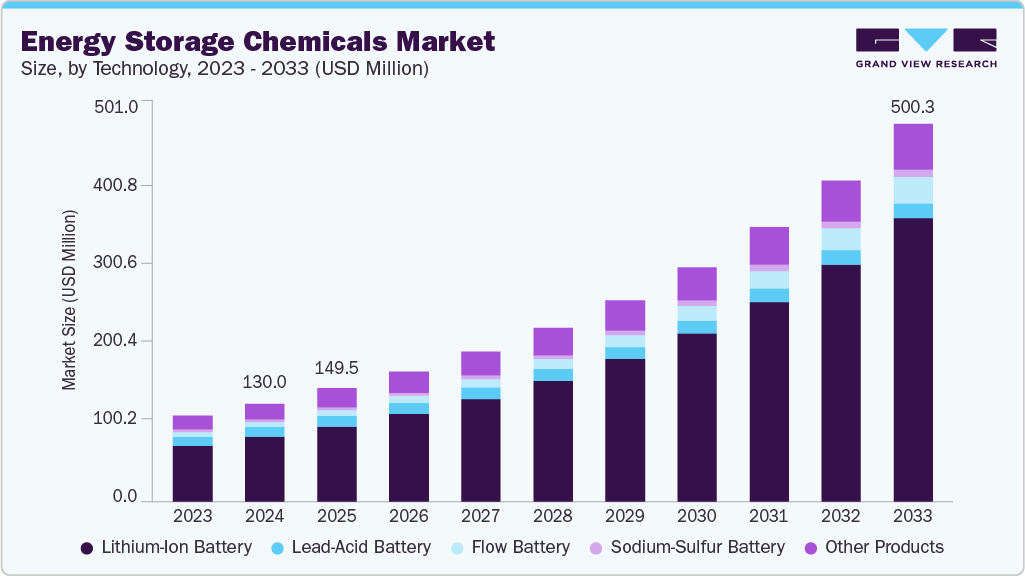
Another key driver is the technological advancement in battery chemistry, which has created opportunities for specialty chemicals tailored to enhance performance, energy density, and the lifecycle of storage systems. Developments in lithium-ion, sodium-sulfur, and flow battery technologies are driving the adoption of innovative materials, including solid-state electrolytes, conductive polymers, and redox-active compounds. These innovations not only enhance safety and efficiency but also expand the applicability of storage systems across various sectors, including electric mobility, industrial manufacturing, and grid infrastructure.
Furthermore, the energy storage chemicals industry is benefiting from the global shift toward localized and sustainable supply chains for critical energy materials. Governments and private players are investing heavily in domestic production of battery chemicals to reduce dependency on imports, especially for lithium, nickel, and cobalt derivatives. The emergence of recycling technologies for spent batteries and the recovery of valuable elements is further strengthening the circular economy model within the energy storage ecosystem. Collectively, these factors are shaping a robust growth trajectory for the energy storage chemicals market over the coming decade.
Market Concentration & Characteristics
The energy storage chemicals market exhibits a moderate to high level of concentration, particularly in the advanced battery materials segment, where a limited number of global players dominate the supply of critical inputs such as lithium salts, electrolytes, and cathode-active materials. Companies with established expertise in electrochemical materials, such as those producing LiPF₆, LiFSI, and high-purity solvents, maintain significant market share due to stringent quality requirements and lengthy qualification cycles by battery manufacturers. These barriers to entry make the market highly competitive and favor established chemical producers with integrated production capabilities and long-term supply contracts with battery OEMs.
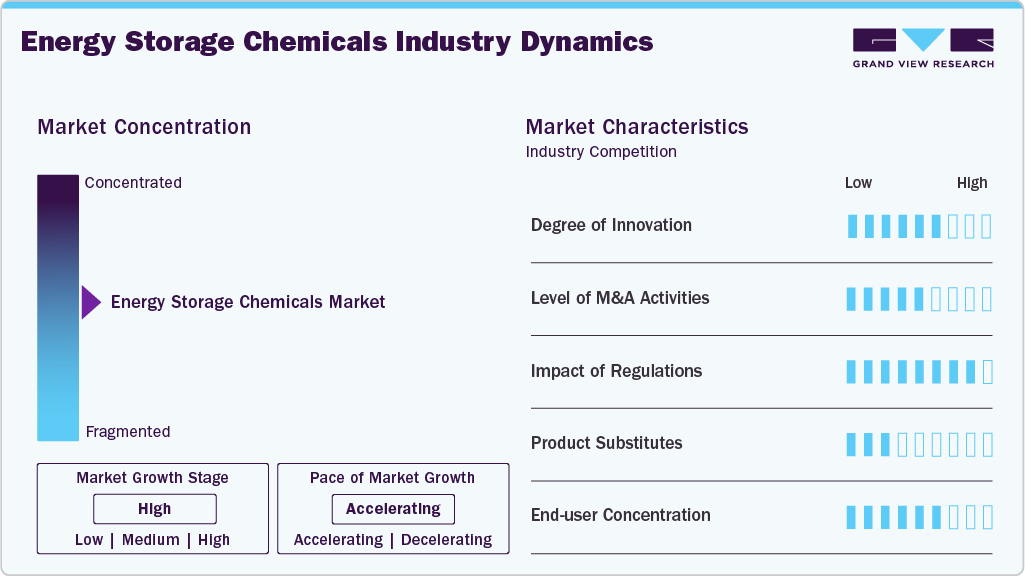
At the same time, the market is witnessing increasing consolidation through mergers, joint ventures, and vertical integration between chemical producers, battery manufacturers, and energy companies. This integration is designed to secure raw material supply, enhance cost efficiency, and ensure consistent quality for large-scale energy storage deployments. Emerging participants, particularly in the Asia Pacific, are rapidly expanding their capacity to meet growing local demand; yet, the technological edge remains concentrated among a few multinational firms with strong R&D portfolios. As a result, while the broader market is expanding, the high-performance segment remains dominated by a concentrated group of suppliers controlling key chemical formulations and intellectual property.
Technology Insights
The battery storage segment dominated the energy storage chemicals industry, with a revenue share of 74.6% in 2024, attributed to their versatility and scalability across automotive, grid, and industrial applications. It relies on advanced chemical systems, such as lithium-ion, sodium-sulfur, and flow batteries, which utilize electrolytes, salts, and active materials to store electrical energy efficiently. Continuous innovation aimed at improving energy density, charging rates, and lifecycle performance is reinforcing its dominance as the preferred energy storage solution globally.
The flywheel energy storage segment uses kinetic energy principles, where electrical energy is converted into rotational energy and stored in a high-speed rotor. While it involves less direct chemical consumption than battery systems, it often incorporates chemical-based lubricants, composite materials, and advanced coatings to enhance performance and durability. The technology is gaining adoption for grid frequency regulation and short-term energy balancing, driven by its high power density, rapid response time, and long operational lifespan.
Product Insights
The lithium-ion battery segment dominated the energy storage chemicals market, with a revenue share of 65.6% in 2024, driven by its widespread use in electric vehicles, consumer electronics, and grid-scale energy storage systems. Demand for high-purity lithium salts, electrolytes, and cathode materials is surging as manufacturers focus on improving energy density, charging efficiency, and safety.
The flow battery segment is gaining traction as an emerging solution for long-duration and stationary energy storage applications, particularly in renewable energy integration and utility-scale systems. It utilizes liquid electrolytes containing vanadium, zinc-bromine, or other redox-active chemicals that enable scalable energy capacity and flexible operation. Increasing adoption of vanadium redox flow batteries (VRFBs) and advancements in electrolyte formulations are enhancing performance, making flow batteries a promising alternative for grid and industrial energy storage.
End Use Insights
The automotive segment dominated the market, accounting for a 43.7% revenue share in 2024. The segment growth is primarily driven by the rapid adoption of electric vehicles (EVs) and hybrid models. Demand for high-performance electrolytes, lithium salts, and binders is rising as manufacturers focus on improving battery range, charging efficiency, and safety. Growing investments in EV production capacity and government incentives promoting clean mobility are further accelerating chemical consumption within this segment.
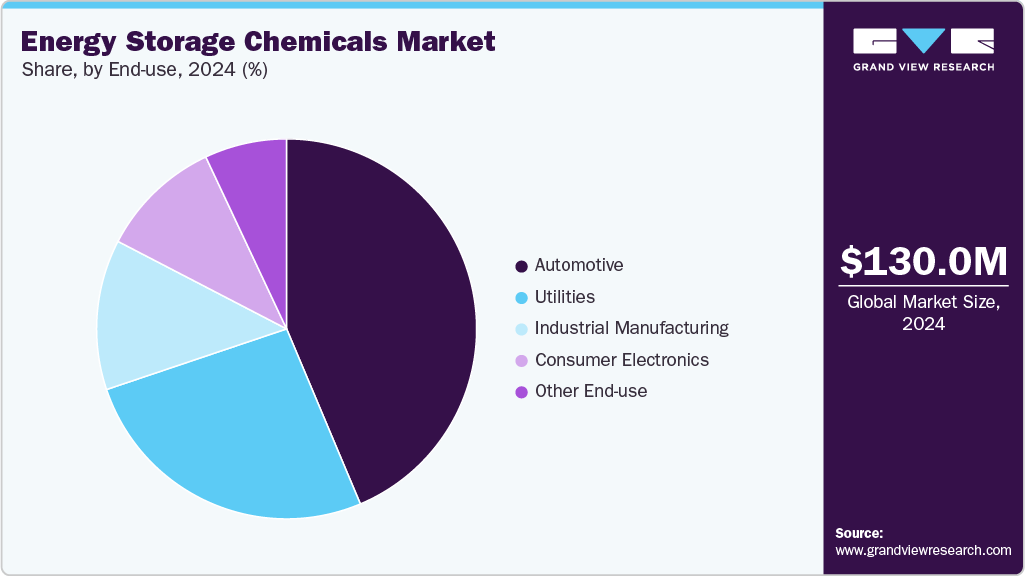
The utilities segment is emerging as a key end-user in the energy storage chemicals industry, supported by the expansion of grid-scale storage projects for renewable energy integration and load balancing. Chemical-based storage technologies, particularly lithium-ion and flow batteries, are being deployed to stabilize power supply, manage peak demand, and enhance grid resilience. Increasing renewable energy penetration and decarbonization targets are driving utilities to invest heavily in large-capacity energy storage systems, boosting demand for specialized battery and electrolyte chemicals.
Regional Insights
The Asia Pacific dominated the global energy storage chemical market, accounting for a 46.2% revenue share in 2024, driven by large-scale battery manufacturing in China, Japan, and South Korea. The expansion of electric vehicle (EV) production, integration of renewable energy, and government-backed investments in gigafactories are driving demand for lithium salts, electrolytes, and cathode materials. Rapid industrialization and the growth of domestic supply chains for critical minerals further strengthen the region’s leadership position.
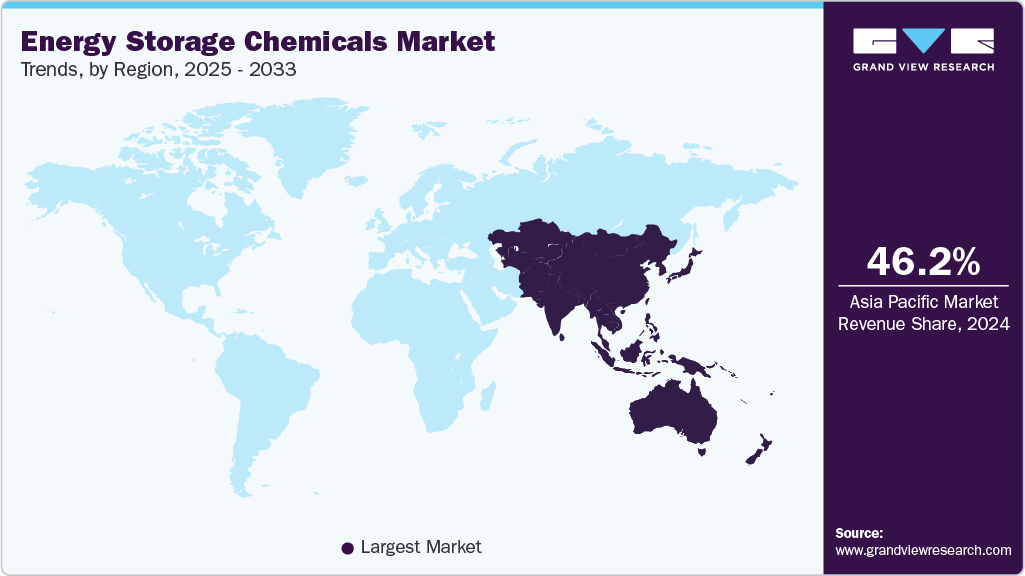
China energy storage chemicals market is expected to grow over the forecast period. China leads the global space, accounting for the majority of lithium-ion battery material production and consumption. The country’s integrated supply chain, from mining to cathode and electrolyte manufacturing, provides cost and scale advantages. Strong government support for EV adoption and renewable energy projects continues to solidify its dominant position.
North America Energy Storage Chemicals Market Trends
North America is experiencing robust growth in the energy storage chemicals industry, driven by increasing investments in electric vehicle EV) battery production and grid-scale storage projects. The U.S. Inflation Reduction Act and other clean energy policies are incentivizing domestic production and recycling of battery materials. Increasing collaboration between chemical producers and battery OEMs is helping build a resilient regional supply chain.
U.S. Energy Storage Chemicals Market Trends
The U.S.energy storage chemicals industry is expanding rapidly, supported by federal funding for domestic battery production, energy storage infrastructure, and material recycling. Rising demand from the electric vehicle EV) sector and the integration of renewable energy are driving the consumption of advanced electrolytes and lithium-based compounds. Strategic initiatives to localize supply chains are strengthening the U.S. position in the global market.
Europe Energy Storage Chemicals Market Trends
Europeis emerging as a key hub for sustainable and circular battery material production, driven by stringent EU regulations on carbon neutrality and recycling mandates. The region’s growing network of gigafactories and strong R&D ecosystem is fostering innovation in advanced electrolytes and solid-state battery materials. Countries such as Germany and France are leading initiatives to localize the supply of battery chemicals and reduce their reliance on imports.
Germany energy storage chemicals market is expected to grow over the forecast period. Germany serves as Europe’s center for advanced battery research and development, as well as chemical innovation, driven by its strong automotive and industrial base. Investments in solid-state battery development and electrolyte manufacturing are accelerating as part of the EU’s clean energy transition. The country’s commitment to sustainability and technology leadership continues to attract major industry partnerships and funding in energy storage chemistry.
Latin America Energy Storage Chemicals Market Trends
Latin America has significant potential due to its abundant reserves of lithium and other critical minerals, particularly in countries such as Chile, Argentina, and Bolivia. Investments in refining capacity and partnerships with international battery manufacturers are helping the region transition from raw material export to value-added chemical processing. The market is expected to expand as local governments promote downstream integration.
Middle East & Africa Energy Storage Chemicals Market Trends
The MEA region is in the early stages of developing its energy storage chemicals market, with increasing focus on renewable energy and grid stabilization projects. Countries such as Saudi Arabia and South Africa are investing in pilot projects for battery production and recycling to diversify their energy portfolios. Rising solar power deployment and government-led sustainability programs are expected to create demand for energy storage materials gradually.
Key Energy Storage Chemicals Company Insights
Some of the key players operating in the market include Henkel & Cie. AG, H.B. Fuller, Arkema, Moresco Corporation, and Beardow Adams Ltd.
-
LG Chem is a leading player in the global energy storage chemicals market, leveraging its well-established LOCTITE and TECHNOMELT product lines to cater to hygiene end uses such as baby diapers, feminine care, and industrial manufacturing products. The company focuses on delivering high-performance battery storage adhesives that offer superior bonding, skin compatibility, and process efficiency, tailored for high-speed manufacturing environments.
-
Henkel places strong emphasis on sustainability, offering bio-based and low-VOC adhesive solutions to align with evolving regulatory standards and consumer preferences. With a robust global footprint and continuous investments in R&D, Henkel remains at the forefront of innovation in the hygiene adhesives segment.
Key Energy Storage Chemicals Companies:
The following are the leading companies in the energy storage chemicals market. These companies collectively hold the largest market share and dictate industry trends.
- BASF SE
- Albermarle Corporation
- LG Chem
- Samsung SDI
- Panasonic
- 3M
- Cuberg
- Siemens
- Solid Power
- BioSolar
- Vestas
Energy Storage Chemicals Market Report Scope
Report Attribute
Details
Market size value in 2025
USD 149.5 million
Revenue forecast in 2033
USD 500.3 million
Growth rate
CAGR of 16.3% from 2025 to 2033
Base year for estimation
2024
Historical data
2018 - 2023
Forecast period
2025 - 2033
Quantitative units
Revenue in USD million, volume in kilotons, and CAGR from 2025 to 2033
Report coverage
Revenue forecast, company ranking, competitive landscape, growth factors, and trends
Segments covered
Technology, product, end use, region
Regional scope
North America; Europe; Asia Pacific; Middle East; Africa, Latin America
Country scope
U.S.; Canada; Mexico; Germany; UK; Italy; Spain; France; China; Japan; South Korea; Saudi Arabia; South Africa; Brazil; Argentina
Key companies profiled
BASF SE; Ablemarle Corporation; LG Chem; Samsung SDI; Panasonic; 3M; Cuberg; Siemens; Solid Power; BioSolar; Vestas
Customization scope
Free report customization (equivalent up to 8 analysts’ working days) with purchase. Addition or alteration to country, regional & segment scope.
Pricing and purchase options
Avail customized purchase options to meet your exact research needs. Explore purchase options
Global Energy Storage Chemicals Market Report Segmentation
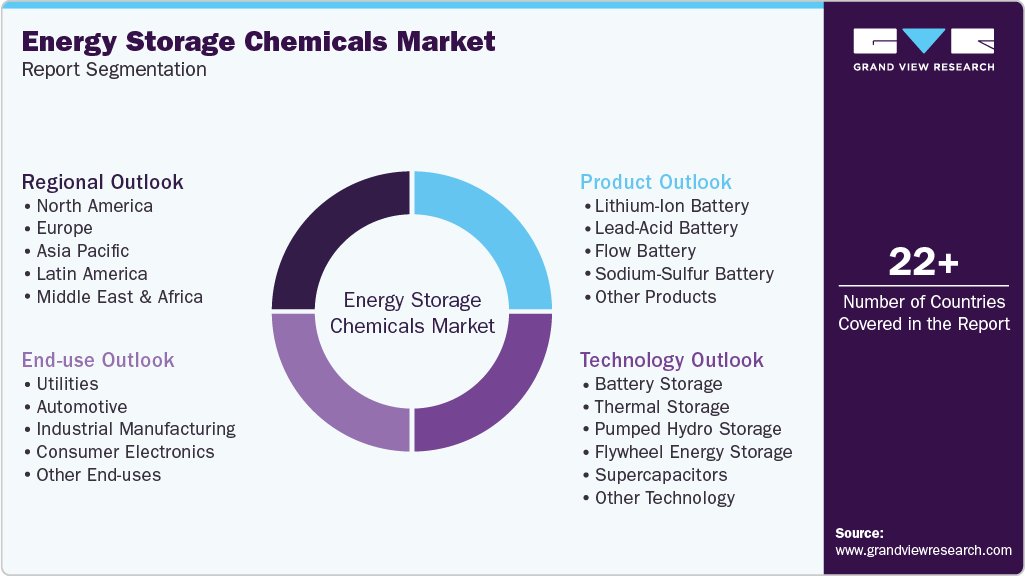
This report forecasts volume & revenue growth at the global, regional, and country levels and provides an analysis of the latest industry trends in each of the sub-segments from 2018 to 2033. For this study, Grand View Research has segmented the global energy storage chemicals market report based on product, technology, end use, and region:
-
Product Outlook (Volume, Kilotons; Revenue, USD Million, 2018 - 2033)
-
Lithium-Ion Battery
-
Lead-Acid Battery
-
Flow Battery
-
Sodium-Sulfur Battery
-
Other Products
-
-
Technology Outlook (Volume, Kilotons; Revenue, USD Million, 2018 - 2033)
-
Battery Storage
-
Thermal Storage
-
Pumped Hydro Storage
-
Flywheel Energy Storage
-
Supercapacitors
-
Other Technology
-
-
End Use Outlook (Volume, Kilotons; Revenue, USD Million, 2018 - 2033)
-
Utilities
-
Automotive
-
Industrial Manufacturing
-
Consumer Electronics
-
Other End Uses
-
-
Regional Outlook (Volume, Kilotons; Revenue, USD Million, 2018 - 2033)
-
North America
-
U.S.
-
Canada
-
Mexico
-
-
Europe
-
Germany
-
UK
-
Italy
-
Spain
-
France
-
-
Asia Pacific
-
China
-
Japan
-
India
-
South Korea
-
-
Middle East & Africa
-
Saudi Arabia
-
South Africa
-
-
Latin America
-
Brazil
-
Argentina
-
-
Frequently Asked Questions About This Report
b. The global energy storage chemicals market size was estimated at USD 130 million in 2024 and is expected to reach USD 149.5 million in 2025.
b. The global energy storage chemicals market is expected to grow at a compound annual growth rate of 16.3% from 2025 to 2033 to reach USD 500.3 million by 2033.
b. The Asia Pacific dominated the global energy chemical storage market, accounting for a 46.2% revenue share in 2024, driven by large-scale battery manufacturing in China, Japan, and South Korea. The expansion of electric vehicle (EV) production, integration of renewable energy, and government-backed investments in gigafactories are driving demand for lithium salts, electrolytes, and cathode materials
b. Some key players operating in the energy storage chemicals market include BASF SE, Ablemarle Corporation, LG Chem, Samsung SDI, Panasonic, 3M, Cuberg, Siemens, Solid Power, BioSolar, and Vestas
b. The market growth is driven by the rapid expansion of battery-based energy storage systems (ESS) across electric vehicles (EVs), renewable energy integration, and grid stabilization applications. The rising adoption of solar and wind power has increased the need for efficient storage solutions to manage energy intermittency, thereby boosting demand for high-performance battery chemicals, including lithium salts, electrolytes, and binders


Share this report with your colleague or friend.
Need a Tailored Report?
Customize this report to your needs — add regions, segments, or data points, with 20% free customization.


ISO 9001:2015 & 27001:2022 Certified
We are GDPR and CCPA compliant! Your transaction & personal information is safe and secure. For more details, please read our privacy policy.
Trusted market insights - try a free sample
See how our reports are structured and why industry leaders rely on Grand View Research. Get a free sample or ask us to tailor this report to your needs.