- Home
- »
- Next Generation Technologies
- »
-
Energy Management Systems Market, Industry Report, 2033GVR Report cover
![Energy Management Systems Market Size, Share & Trends Report]()
Energy Management Systems Market (2026 - 2033) Size, Share & Trends Analysis Report By System (IEMS, BEMS, HEMS), By Component (Hardware, Software), By Deployment, By Vertical (Residential, Energy & Power, Telecom & IT, Manufacturing, Retail), By Region, And Segment Forecasts
- Report ID: 978-1-68038-666-0
- Number of Report Pages: 100
- Format: PDF
- Historical Range: 2021 - 2025
- Forecast Period: 2026 - 2033
- Industry: Technology
- Report Summary
- Table of Contents
- Interactive Charts
- Methodology
- Download FREE Sample
-
 Download Sample Report
Energy Management Systems Market Summary
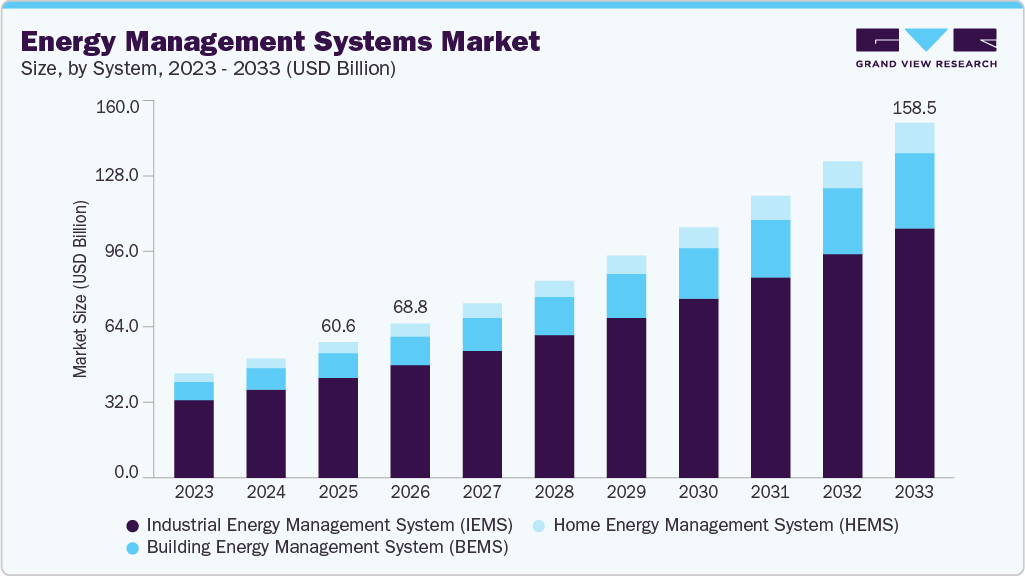
The global energy management systems market size was valued at USD 60.61 billion in 2025 and is projected to reach USD 158.55 billion by 2033, growing at a CAGR of 12.7% from 2026 to 2033. The increasing integration of renewable energy sources is significantly driving the adoption of energy management systems, as organizations seek intelligent solutions to manage the variability of power generation and demand.
Key Market Trends & Insights
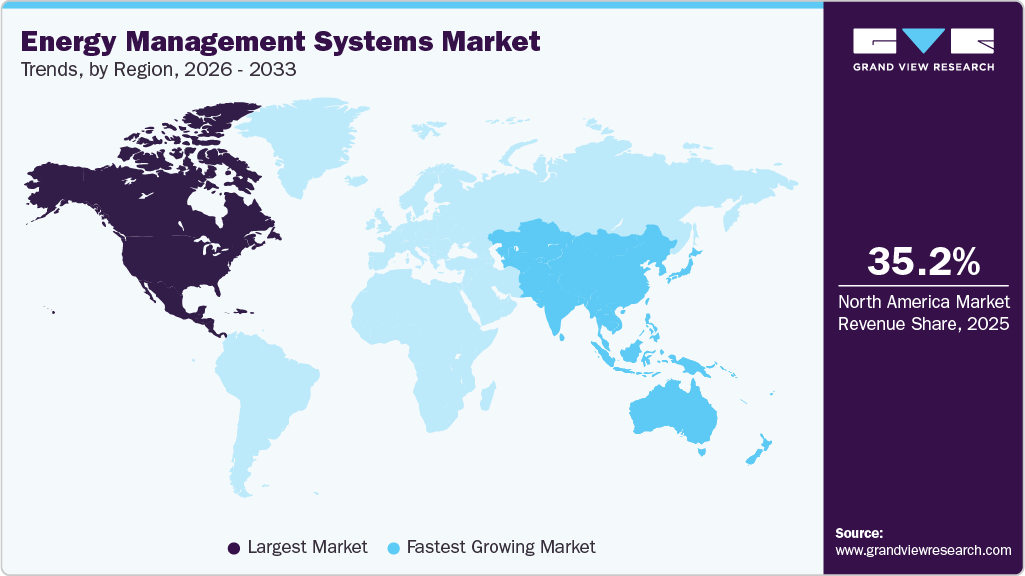
- North America dominated the global energy management systems (EMS) market with the largest revenue share of 35.2% in 2025.
- The energy management systems market in the U.S. led the North America market and held the largest revenue share in 2025.
- By system, the industrial energy management system (IEMS) segment led the market and held the largest revenue share of 73.6% in 2025.
- By component, the hardware segment held the dominant position in the market and accounted for the largest revenue share of 64.1% in 2025.
- By deployment, the cloud segment held the leading position in the market and accounted for the largest revenue share of 57.8% in 2025.
Market Size & Forecast
- 2025 Market Size: USD 60.61 Billion
- 2033 Projected Market Size: USD 158.55 Billion
- CAGR (2026-2033): 12.7%
- North America: Largest market in 2025
- Asia Pacific: Fastest growing market
Energy management platforms enable real-time monitoring and optimization of energy produced from sources such as solar and wind, ensuring efficient utilization and grid stability. By leveraging advanced analytics and predictive algorithms, EMS solutions help organizations forecast energy demand, optimize load distribution, and reduce operational costs.The rising emphasis on efficient energy utilization across public, industrial, and commercial sectors is significantly accelerating the adoption of energy management systems. Organizations are increasingly prioritizing energy monitoring and optimization as part of broader cost-reduction and sustainability strategies. At the same time, the rapid digitalization of the energy ecosystem and the growing shift toward electrification are reshaping how energy is generated, distributed, and consumed, thereby increasing the need for advanced energy management platforms. EMS solutions provide integrated, IT-enabled analytical capabilities that enable organizations to monitor, control, and optimize energy usage across multiple operational systems. By leveraging real-time data analytics and intelligent monitoring, these platforms support improved energy efficiency through the optimization of individual processes and assets. Furthermore, continuous technological advancements and the commercialization of innovative energy management solutions are expected to drive further investments in this space. As industrial sectors, manufacturing facilities, and power and energy enterprises increasingly require real-time visibility into energy consumption patterns, EMS platforms are emerging as a critical tool for enabling operational efficiency, sustainability compliance, and long-term energy cost optimization.
EMS is experiencing significant growth due to increasing demand for energy efficiency and sustainability. Rising electricity costs are pushing industries, commercial sectors, and households to adopt EMS for better control over energy consumption. Government regulations and policies, such as carbon-reduction targets and green building standards, further fuel adoption, mainly in the U.S. and Europe. The integration of smart meters, IoT devices, and real-time data analytics within EMS is enhancing operational efficiency. Additionally, growing investments in renewable energy sources, such as solar and wind, are driving the need for advanced EMS to optimize energy storage and distribution.
Increasing awareness of environmental, social, and governance (ESG) practices is encouraging businesses to adopt EMS to enhance their sustainability profiles. Technological advancements, such as cloud-based platforms and AI-powered energy forecasting, are enabling better scalability and decision-making for EMS users. Utility companies are also promoting EMS adoption through demand response programs, incentivizing consumers to optimize energy use during peak hours. Additionally, the push toward electric vehicles (EVs) and the need for efficient energy management in charging infrastructure are contributing to the market’s expansion.
System Insights
The industrial energy management system (IEMS) segment led the market in 2025, accounting for over 73.6% share of the global revenue. Rising awareness about energy consumption, efficiency, and demand control is driving the growth of the IEMS market. With the increasing emphasis on reducing carbon emissions and improving sustainability, companies across various industries are adopting energy management solutions to optimize their energy usage and reduce operating costs. Integrating industrial energy consumption systems helps energy-intensive industries increase profits by lowering energy costs. As a result, the industrial energy management systems market is expanding rapidly, driven by the need for energy efficiency and the adoption of energy management solutions in various industries.
The Building Energy Management System (BEMS) segment is expected to grow significantly over the forecast period, driven by the increasing emphasis on smart, sustainable, and energy-efficient building infrastructure. As governments and regulatory bodies introduce stricter building efficiency standards and sustainability frameworks such as LEED and ENERGY STAR, organizations are increasingly adopting BEMS solutions to monitor and optimize building energy performance. In addition, the growing deployment of IoT-enabled sensors, smart meters, and automated control systems is significantly enhancing the ability of BEMS platforms to provide real-time energy monitoring and intelligent optimization of building operations.
Component Insights
The hardware segment accounted for the largest market revenue share in 2025 due to the increasing deployment of advanced sensors, controllers, and smart meters, which are essential for energy monitoring and automation. The adoption of HVAC controllers, lighting control systems, and energy metering devices is rising across commercial, industrial, and residential buildings to enhance energy efficiency. Growing investments in infrastructure and retrofitting projects are driving the demand for hardware components, especially in developed regions such as the U.S. and Europe. Additionally, the shift toward IoT-enabled devices and edge computing solutions is further boosting the need for robust hardware for real-time data collection and processing.
The software segment is expected to showcase significant growth over the forecast period due to the increasing demand for data analytics and predictive tools that help optimize energy usage. Cloud-based energy management platforms are gaining traction, enabling remote monitoring and control, which is vital for large facilities and distributed assets. Integration with AI and machine learning allows software solutions to provide actionable insights, such as forecasting energy demand and automating systems based on real-time conditions. As companies aim to meet sustainability goals and regulatory compliance, energy management software plays a key role in tracking carbon footprints and generating reports.
Deployment Insights
The cloud segment accounted for the largest market revenue share in 2025 due to the growing preference for scalable, flexible, and cost-efficient energy management solutions. Cloud-based platforms allow organizations to monitor and control energy systems remotely, which is especially beneficial for enterprises managing multiple locations or distributed energy assets. The seamless integration of IoT devices with cloud infrastructure enhances real-time data processing, predictive analytics, and automation capabilities. Businesses are increasingly adopting cloud solutions to meet regulatory requirements and sustainability goals while reducing operational expenses by minimizing the need for on-site infrastructure.
The on-premises segment remains favored by organizations that require full control over their energy data and system infrastructure. Companies adopt on-premises solutions to meet strict internal security policies and ensure sensitive operational information remains within their facilities. These deployments enable real-time monitoring and management of energy consumption without reliance on external networks. Industries with complex operational environments prefer on-premises systems due to their high customization potential and seamless integration with existing equipment. This approach supports consistent performance, even in locations with limited cloud connectivity.
Vertical Insights
The manufacturing segment accounted for the largest market revenue share in 2025 due to its high energy consumption and the growing need to optimize operational efficiency. Manufacturers are increasingly adopting EMS to monitor and reduce energy consumption across production lines, HVAC systems, and lighting, thereby directly impacting profitability. The rising focus on sustainability and carbon footprint reduction is pushing industries to implement EMS solutions that support compliance with environmental regulations. Additionally, the growing adoption of Industry 4.0 technologies has accelerated EMS deployment in manufacturing plants, as these systems integrate with digital manufacturing platforms to provide real-time energy insights. Trending technologies such as Industrial Internet of Things (IIoT) sensors, artificial intelligence (AI)-based energy analytics, digital twins, cloud-based energy management platforms, and smart grid integration are further enhancing the capabilities of EMS in manufacturing environments.
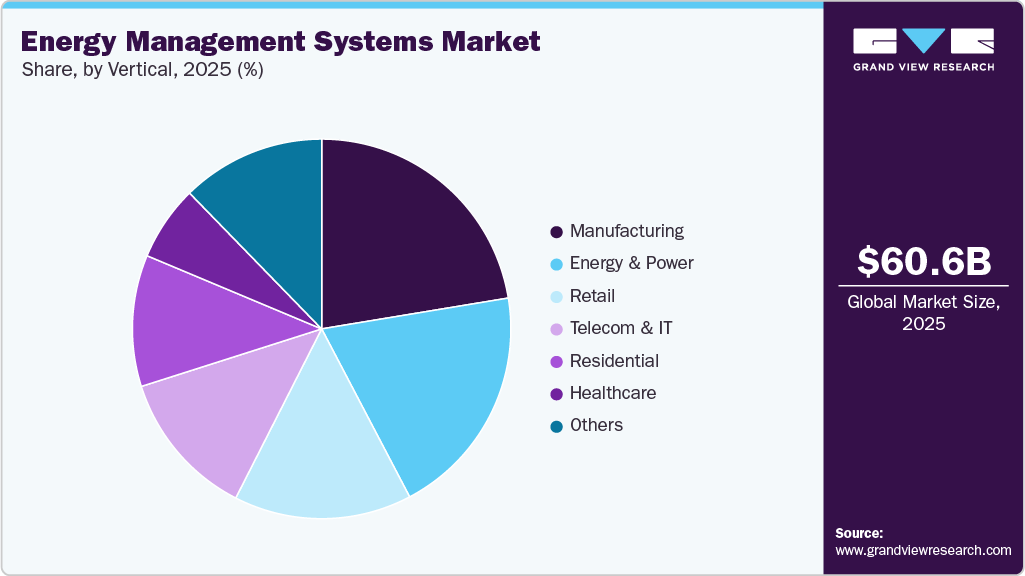
The residential segment is projected to experience significant growth in the coming years due to the increasing adoption of smart home technologies and energy-efficient solutions. Rising energy costs are prompting homeowners to invest in EMS that optimizes the use of HVAC systems, lighting, and appliances. Governments and utility companies are offering incentives and rebates to encourage the adoption of energy-saving technologies, further driving demand in the residential sector. The integration of solar panels, battery storage, and electric vehicle (EV) chargers is also boosting the need for advanced EMS to manage energy consumption effectively.
Regional Insights
The energy management systems industry in North America dominated with a revenue share of over 35.2% in 2025, driven by the early adoption of smart EMS in the U.S. and Canada. The region's advanced infrastructure and strong focus on energy-efficiency initiatives have positioned it as a leader in EMS deployment. Government regulations, such as energy efficiency standards and carbon-emission targets, along with incentives to adopt smart technologies, have further accelerated market growth. Furthermore, the high adoption of smart grids, advanced metering infrastructure, and digital industrial systems across the U.S and Canada strengthens North America’s leadership in the global EMS market.
U.S. Energy Management Systems Market Trends
The U.S. energy management systems industry is expected to grow in 2025 due to increasing regulatory pressure to improve energy efficiency and reduce carbon emissions. Federal and state governments are implementing stricter energy-efficiency standards, incentivizing businesses and homeowners to adopt advanced energy management solutions. The rising costs of electricity are prompting organizations to seek effective ways to monitor and control their energy consumption, driving demand for EMS technologies. Additionally, the growing integration of renewable energy sources, such as solar and wind, into the energy mix necessitates advanced energy management systems to optimize their use.
Europe Energy Management Systems Market Trends
The energy management systems industry in the Europe region is expected to witness significant growth over the forecast period. Stricter regulations regarding energy efficiency and carbon emissions, driven by the European Union's Green Deal and various national initiatives, are compelling businesses and residential sectors to adopt energy management solutions. The increasing integration of renewable energy sources into the grid, alongside investments in smart grid technologies, necessitates advanced EMS to ensure efficient energy distribution and usage. Additionally, the rise in energy prices across Europe is pushing consumers and businesses to seek cost-effective solutions to manage their energy consumption.
Asia Pacific Energy Management Systems Market Trends
The energy management systems industry in the Asia Pacific region is anticipated to register the fastest CAGR over the forecast period, due to rapid urbanization and industrialization, leading to increased energy demand. Countries such as China and India are investing heavily in infrastructure development and smart city initiatives, which are driving the need for advanced energy management solutions. The growing focus on sustainability and renewable energy adoption is prompting both governments and businesses to implement EMS to optimize energy consumption and reduce greenhouse gas emissions. Additionally, supportive government policies and incentives to enhance energy efficiency are encouraging the adoption of EMS technologies across sectors.
Key Energy Management Systems Company Insights
Some key players in the EMS market, such as Schneider Electric SE, Honeywell International Inc., Siemens AG, and ABB, are actively expanding their customer bases and seeking to gain a competitive advantage. To achieve this, they are pursuing strategic initiatives such as partnerships, mergers and acquisitions, collaborations, and the development of new products and technologies. This proactive approach allows them to enhance their market presence and innovate in response to evolving security needs.
-
Schneider Electric SE is a global leader in energy management and automation solutions, specializing in optimizing energy use across various sectors, including industrial, commercial, and residential markets. The company offers a wide range of EMS that integrate IoT technology, software, and services to enhance energy efficiency and sustainability. With a strong commitment to innovation, Schneider Electric SE develops smart solutions that enable businesses to monitor, control, and reduce energy consumption effectively.
-
ABB is a technology company that focuses on electrification and automation, providing solutions to enhance energy efficiency across various sectors. Known for its extensive portfolio, ABB offers advanced EMS that integrates seamlessly with its automation and control technologies, enabling real-time monitoring and management of energy consumption. The company emphasizes sustainability, helping clients reduce their carbon footprints and meet regulatory requirements through smart energy solutions.
Key Energy Management Systems Companies:
The following key companies have been profiled for this study on the energy management systems market.
- ABB
- C3.ai, Inc
- Cisco Systems, Inc.
- GridPoint
- General Electric
- Honeywell International Inc.
- IBM Corporation
- Johnson Controls, Inc.
- Schneider Electric SE
- Siemens AG
Recent Developments
-
In September 2025, Honeywell International Inc. introduced the Ionic Modular All-in-One, a compact battery energy storage system for commercial and industrial use that combines flexible storage with advanced control and analytics to optimize energy costs and ensure grid stability. The system supports scalable power options from 250 kWh to 5 MWh, integrates cybersecurity protections, and can be managed onsite or remotely through Honeywell’s Energy Management platform.
-
In January 2025, ABB partnered with Edgecom Energy, a Toronto-based energy management startup, to integrate generative AI-driven capabilities into energy management solutions. This partnership enables industrial and commercial users to optimize power usage and reduce demand peaks. This partnership strengthens ABB’s digital energy portfolio by combining its Smart Power expertise with Edgecom’s AI Energy Copilot, enabling more efficient, sustainable energy operations.
-
In September 2024, Larsen & Toubro Limited's Power Transmission & Distribution (PT&D) business, through its Digital Energy Solutions (DES) division, secured a project to develop advanced energy management systems at Southern India's multiple state and regional load dispatch centers. This initiative enhances Larsen & Toubro Limited's DES's growing portfolio in intelligent grid modernization and digital solutions. The EMS will be installed in 12 control rooms at the Southern Regional Load Dispatch Centre and various State Load Dispatch Centers across Puducherry, Tamil Nadu, Andhra Pradesh, Kerala, and Telangana.
-
In June 2024, ABB launched ABB Ability OPTIMAX 6.4, the latest version of its digital energy management and optimization system designed to enhance the coordinated control of multiple industrial assets and processes. This upgrade aims to improve energy efficiency, reduce emissions, and support decarbonization efforts. Key enhancements include an AI module that forecasts load demand, energy generation, and pricing automatically, eliminating the need for manual input. These improvements significantly minimize day-ahead and intra-day nomination errors when supplying energy to the grid, helping operators avoid costly penalty payments.
-
In May 2024, Capgemini, an information technology services and consulting company, collaborated with Schneider Electric SE to enhance energy optimization through the Energy Command Center. This solution aims to accelerate organizations' efforts toward smarter and greener facility management and energy efficiency. The Energy Command Center is an integrated platform that enables centralized monitoring, control, and optimization of all energy-consuming assets, including data centers and critical environment rooms. Powered by advanced AI, ML, and IoT technologies, the platform measures and predicts key metrics such as energy intensity, asset health, renewable energy generation, and overall performance across all energy assets.
Energy Management Systems Market Report Scope
Report Attribute
Details
Market size value in 2026
USD 68.79 billion
Revenue forecast in 2033
USD 158.55 billion
Growth rate
CAGR of 12.7% from 2026 to 2033
Actual data
2021 - 2025
Forecast period
2026 - 2033
Quantitative units
Revenue in USD million/billion and CAGR from 2026 to 2033
Report coverage
Revenue forecast, company ranking, competitive landscape, growth factors, and trends
Segments covered
System, component, deployment, vertical, region
Regional scope
North America; Europe; Asia Pacific; Latin America; Middle East and Africa
Country scope
U.S.; Canada; Mexico; Germany; UK; France; China; India; Japan; Australia; South Korea; Brazil; UAE; South Africa; KSA
Key companies profiled
Schneider Electric SE; Honeywell International Inc.; Siemens AG; Johnson Controls, Inc.; C3.ai; Inc.; GridPoint; General Electric; ABB; IBM Corporation; Cisco Systems, Inc.
Customization scope
Free report customization (equivalent up to 8 analysts working days) with purchase. Addition or alteration to country, regional & segment scope.
Pricing and purchase options
Avail customized purchase options to meet your exact research needs. Explore purchase options
Global Energy Management Systems Market Report Segmentation
This report forecasts revenue growth at global, regional, and country levels and provides an analysis of the latest industry trends in each of the sub-segments from 2021 to 2033. For this study, Grand View Research has segmented the global energy management systems market report based on system, component, deployment, vertical, and region.
-
System Outlook (Revenue, USD Million, 2021 - 2033)
-
Industrial energy management system (IEMS)
-
Building energy management system (BEMS)
-
Home energy management system (HEMS)
-
-
Component Outlook (Revenue, USD Million, 2021 - 2033)
-
Hardware
-
Software
-
Services
-
-
Deployment Outlook (Revenue, USD Million, 2021 - 2033)
-
On Premises
-
Cloud
-
-
Vertical Outlook (Revenue, USD Million, 2021 - 2033)
-
Residential
-
Energy & Power
-
Telecom & IT
-
Manufacturing
-
Retail
-
Healthcare
-
Others
-
-
Regional Outlook (Revenue, USD Million, 2021 - 2033)
-
North America
-
U.S.
-
Canada
-
Mexico
-
-
Europe
-
UK
-
Germany
-
France
-
-
Asia Pacific
-
China
-
India
-
Japan
-
Australia
-
South Korea
-
-
Latin America
-
Brazil
-
-
MEA
-
UAE
-
South Africa
-
KSA
-
-
Frequently Asked Questions About This Report
b. Some key players operating in the energy management systems market include Honeywell Inc., Schneider Electric, Siemens AG, C3 Energy, General Electric Company, Emerson Process Management, Daikin Industries, Daintree Networks, Jones Sang LaSalle, Gridpoint Inc., Schneider Electric, Siemens AG, Honeywell International Inc., Elster Group GmbH, ABB, IBM, Toshiba Corporation, and Johnson’s Control International.
b. Key factors that are driving the market growth include improving energy efficiency, energy price volatility, and regulatory mandate and incentive program.
b. The global energy management systems market size was estimated at USD 60.61 billion in 2025 and is expected to reach USD 68.79 billion in 2026.
b. The global energy management systems market is expected to grow at a compound annual growth rate of 12.7% from 2026 to 2033 to reach USD 158.55 billion by 2033.
b. North America dominated the energy management systems market with a share of 35.2% in 2025. This is attributable to early adoption of smart grid technologies, strong regulatory support for energy efficiency, and high investments in advanced energy infrastructure.


Share this report with your colleague or friend.
Need a Tailored Report?
Customize this report to your needs — add regions, segments, or data points, with 20% free customization.


ISO 9001:2015 & 27001:2022 Certified
We are GDPR and CCPA compliant! Your transaction & personal information is safe and secure. For more details, please read our privacy policy.
Trusted market insights - try a free sample
See how our reports are structured and why industry leaders rely on Grand View Research. Get a free sample or ask us to tailor this report to your needs.