- Home
- »
- Plastics, Polymers & Resins
- »
-
Electric Vehicle Plastics Market Size, Industry Report, 2033GVR Report cover
![Electric Vehicle Plastics Market Size, Share & Trends Report]()
Electric Vehicle Plastics Market (2026 - 2033) Size, Share & Trends Analysis Report By Resin (PP, PU), By Application (Interior, Exterior, Lighting & Electric Wiring), By Type (BEV, HEV/PHEV), By Components (Battery, Bumper, Car Upholstery), By Region, And Segment Forecasts
- Report ID: GVR-4-68039-975-9
- Number of Report Pages: 120
- Format: PDF
- Historical Range: 2021 - 2024
- Forecast Period: 2026 - 2033
- Industry: Bulk Chemicals
- Report Summary
- Table of Contents
- Segmentation
- Methodology
- Download FREE Sample
-
 Download Sample Report
Electric Vehicle Plastics Market Summary
The global electric vehicle plastics market size was estimated at USD 3.7 billion in 2025 and is projected to reach USD 30.6 billion by 2033, growing at a CAGR of 30.5% from 2026 to 2033. Increasing integration of advanced electronics in electric vehicles is expanding the use of specialized plastics.
Key Market Trends & Insights
- Asia Pacific dominated the global electric vehicle plastics industry with the largest revenue share of 59.2% in 2025.
- The electric vehicle plastics industry in India is expected to grow at a CAGR of 42.6% from 2026 to 2033.
- The polypropylene (PP) segment is expected to grow at a 35.6% CAGR in revenue from 2026 to 2033 in the resin segment.
- By application, the interior segment is expected to grow at a CAGR of 35.9% from 2026 to 2033 in terms of revenue.
- Revenue in the battery components segment is expected to expand at a compound annual growth rate of 39.0% from 2026 to 2033.
- The battery electric vehicle (BEV) segment (by type) is projected to register a revenue CAGR of 31.4% from 2026 through 2033.
Market Size & Forecast
- 2025 Market Size: USD 3.7 Billion
- 2033 Projected Market Size: USD 30.6 Billion
- CAGR (2026-2033): 30.5%
- Asia Pacific: Largest market in 2025
Components such as battery connectors, sensor housings, and charging systems require polymers that offer electrical insulation, heat resistance, and design flexibility, thereby strengthening demand for engineering plastics across EV architectures.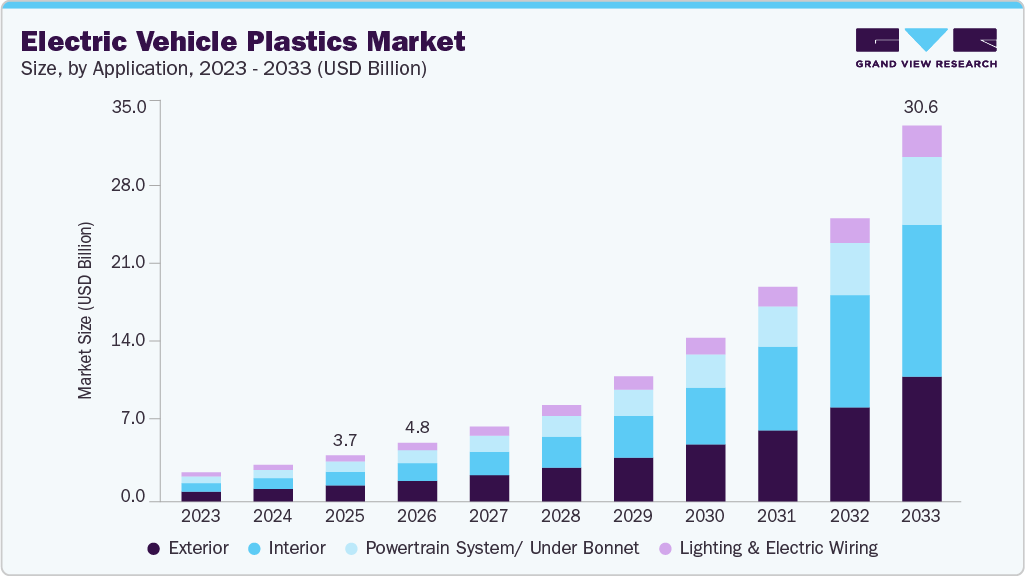
Rapid material substitution and integration of high-performance polymers are reshaping the market. Accelerating EV sales reported by the International Energy Agency drive higher plastics content per vehicle as battery packs, power electronics, and e-motors demand engineered thermoplastics for insulation, structural support, and thermal management. Suppliers are scaling flame-retardant and glass-filled resins to meet OEM safety and weight targets. This structural shift is narrowing the performance gap with metallic solutions.
Drivers, Opportunities & Restraints
Vehicle lightweighting and manufacturability are primary commercial drivers for plastics adoption in EVs. Policy and engineering imperatives to extend range increase the value of low-density, high-strength polymer solutions. Thermal-management and electrical-insulation requirements in battery systems further push demand for specialized resins that combine flame retardance, mechanical stiffness, and processability. Public programs and technical guidance on lightweight materials also accelerate adoption by reducing technological uncertainty for OEMs and tier-1 suppliers.
There is a clear commercialization opportunity in thermoplastic battery enclosures, integrated e-motor housings, and modular, multi-material assemblies. Manufacturers that offer validated, mass-producible resin systems can capture content gains from chassis to powertrain. Collaborative prototypes and platform demonstrations led by material suppliers highlight weight, cost, and assembly advantages and create near-term adoption pathways for OEMs. Capturing aftermarket and recycling feedstock value via design-for-recyclability adds long-term revenue potential for vertically integrated suppliers.
Regulatory pressure for recycled content and end-of-life vehicle rules raises compliance and technical barriers for polymers in EVs. Meeting minimum recycled content targets is challenging for safety-critical components where validated recyclates remain limited. Complex multi-material assemblies increase sorting and reprocessing costs. Regional policy divergence and periodic downturns in polymer production capacity also create feedstock price volatility. These factors constrain near-term substitution of virgin engineering plastics in structural and battery-adjacent applications.
Market Concentration & Characteristics
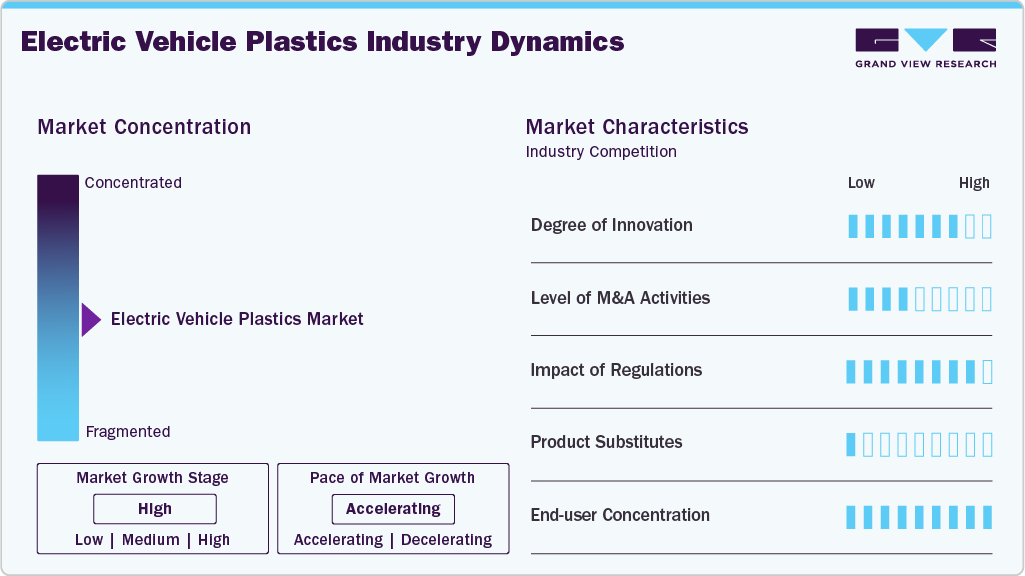
The market growth stage is exponential, and growth is accelerating. The market exhibits fragmentation, with key players dominating the industry landscape. Major companies such as BASF SE, SABIC, LyondellBasell Industries Holdings B.V., Evonik Industries, Covestro AG, and others play a significant role in shaping the market dynamics. These leading players often drive innovation in the market by introducing new products, technologies, and materials to meet the industry's evolving demands.
The electric vehicle plastics industry shows rapid, application-led innovation driven by battery scale and thermal constraints. Suppliers deliver multifunctional polymer systems that combine structural bonding, thermal conductivity, and flame resistance to replace metal parts and simplify assembly. Novel approaches such as injectable thermally conductive adhesives and debonding-on-demand chemistries enable lighter, safer battery packs and easier end-of-life handling. Validation at gigafactory scale and direct OEM qualification shorten adoption cycles and raise per-vehicle plastics content.
Substitution dynamics vary by function and cost sensitivity. Metals such as aluminum and steel remain preferred for high-load structural parts where stiffness and predictable crash performance are essential. Ceramics and metal-matrix solutions compete in high-temperature or EMI-sensitive components. Policy pressure on recyclability and lightweighting tilts choices toward mono-material plastics and engineered thermoplastics that meet circularity targets while delivering comparable weight and cost advantages. Material selection increasingly balances lifecycle compliance, manufacturability, and total cost of ownership.
Resin Insights
The polyurethane (PU) segment dominated the market across resin segmentation in terms of revenue, accounting for 31.4% market share in 2025, and is forecast to grow at a 33.7% CAGR from 2026 to 2033. Polyurethane systems are becoming indispensable where battery safety and multifunctional bonding converge. BASF’s expanded PU portfolio for adhesives, potting, and fire-protective coatings enables cell-to-pack designs that reduce parts count while improving thermal runaway resistance. OEMs select PU formulations to meet stringent battery safety protocols and automated dispensing processes. Suppliers with validated PU chemistries therefore win faster integration into production lines and higher per-vehicle content in battery modules.
The polypropylene (PP) segment is expected to expand at a 35.6% CAGR over the forecast period. Automakers are adopting advanced polypropylene grades to balance cost, weight, and recyclability targets. SABIC’s new PP foam and flame-retardant PP grades allow thinner, lighter structural parts and meet vehicle emissions rules without large cost premiums. These materials replace heavier alternatives in non-load-bearing structures and exterior inlets, delivering measurable range improvements for electric vehicles. The result is clear demand growth for automotive-spec PP across high-volume platforms.
Application Insights
The exterior segment dominated the market across application segmentation in terms of revenue, accounting for 34.5% market share in 2025, and is forecast to grow at a 29.6% CAGR from 2026 to 2033. Exterior applications now prioritize multi-material plastic architectures that deliver styling, safety, and weight reduction in one package. Plastic Omnium has scaled complex body modules and integrated energy-storage housings using engineered polymers that reduce mass and simplify assembly. OEMs favor these plastic exterior systems because they shorten stamping lines and enable mix-and-match electrified platforms. Adoption accelerates when suppliers demonstrate production readiness and validated cycle-time benefits.
The interior segment is expected to expand at a 35.9% CAGR over the forecast period. Interior plastics are driven by the need for sustainable, high-value tactile surfaces that also meet recycled content mandates. FORVIA focuses on mono-material instrument panels and recyclable foams that lower lifecycle emissions and simplify end-of-life processing. OEMs prefer interior modules that combine low weight, a premium feel, and clear documentation of recycled content. Suppliers that deliver tested, compliant interior compounds capture larger module contracts and lock in multi-year supply agreements.
Components Insights
The battery segment dominated the market across components segmentation in terms of revenue, accounting for 20.4% market share in 2025, and is forecast to grow at a 39.0% CAGR from 2026 to 2033. Thermally conductive and structural polymer adhesives are shifting battery pack design from mechanical fastening to bonded, lighter assemblies. Henkel’s injectable, thermally conductive adhesives enable cell-to-pack integration and reduce the need for secondary structural parts. This consolidation lowers part counts and assembly time while improving heat extraction. Battery manufacturers award material content to suppliers who can prove process stability, thermal performance, and scalable dispensing at gigafactory volumes.
The exterior trim segment is expected to expand at a 32.6% CAGR over the forecast period. Exterior trim demand is driven by recyclable mono-material cladding that preserves styling while simplifying recycling workflows. Magna International is developing trim solutions that use mono-material PET and recyclable foams to halve the scope-1 carbon footprint versus conventional PU systems. OEM programs increasingly require trim components that align with circularity targets and permit closed-loop recovery. Suppliers with validated mono-material trim systems secure tier-1 status on EV platforms.
Type Insights
The battery electric vehicle (BEV) segment led the market by type, accounting for 76.5% of revenue in 2025, and is forecast to grow at a 31.4% CAGR from 2026 to 2033, due to its versatility across rigid and flexible formats. Rising BEV production volumes create scale economics that favor polymer substitution across chassis, battery enclosures, and power-electronics housings. IEA data show rapid growth in battery demand, prompting OEMs to redesign modules for mass production and weight efficiency. Plastics suppliers that certify flame-retardant, high-temperature resins for high-volume BEV platforms capture outsized content gains as OEMs prioritize range and cost per kilometer.
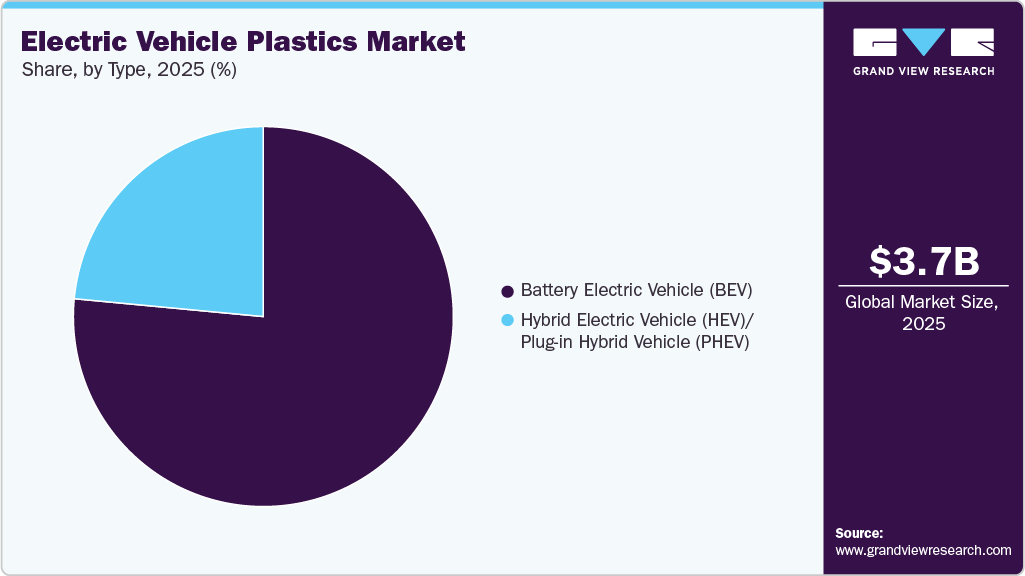
The hybrid electric vehicle (HEV)/plug-in hybrid vehicle (PHEV) segment is expected to expand at a 27.0% CAGR over the forecast period. Hybrid and plug-in hybrid platforms favor cost-efficient, high-throughput polymer solutions because battery size and packaging are constrained. NREL research into integrated e-machine components and compact thermal systems shows an opportunity for thermoplastics that enable tight packaging and combined structural-insulation roles. Suppliers offering low-cost, high-cycle materials win content on hybrid powertrains where incremental weight savings and thermal resilience directly improve fuel-electric performance.
Regional Insights
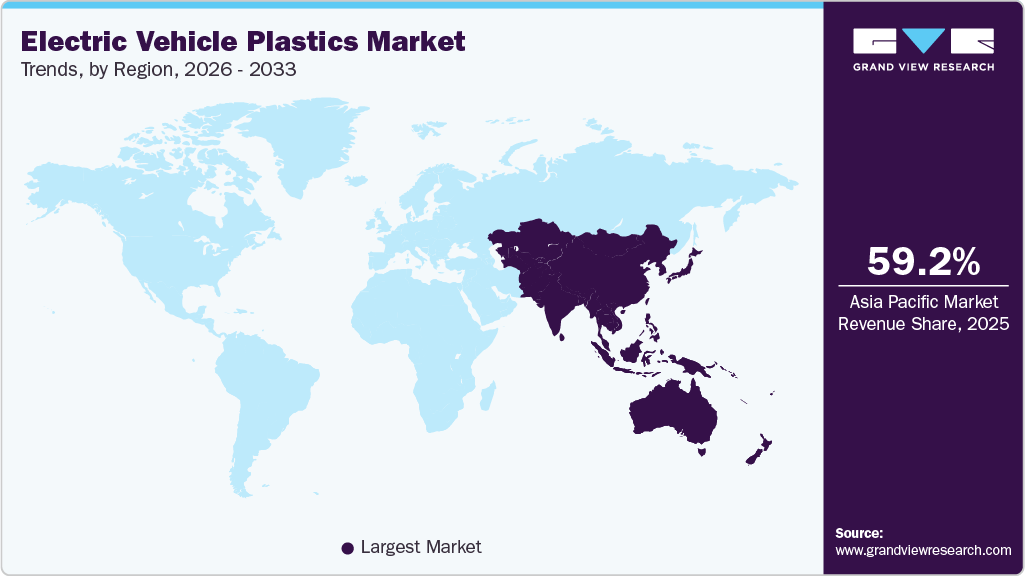
The Asia Pacific electric vehicle plastics industry held the largest revenue share of 59.2% in 2025. The region is expected to grow at a CAGR of 33.5% over the forecast period. Rapid market expansion and infrastructure financing are driving the adoption of plastics in regional EVs. Governments and multilateral lenders fund charging networks and gigafactories, thereby improving the total cost economics of polymer-rich assemblies. Localization of supply chains raises demand for automotive-grade resins that meet regional recyclability and performance standards. Suppliers that partner with vehicle makers and infrastructure investors capture platform wins as volumes shift toward Asia Pacific manufacturing hubs.
China Electric Vehicle Plastics Market Trends
The electric vehicle plastics market in China is growing significantly due to the exceptionally large NEV production and strong export growth. High volumes enable trial and rapid scale of multi-functional plastics for battery housings, motor casings, and lightweight exterior modules. Domestic OEMs and battery makers accelerate materials qualification to meet cost and thermal-management targets, creating dense demand for automotive-grade engineering resins. Local supply concentration also shortens feedback loops between material developers and manufacturers.
North America Electric Vehicle Plastics Market Trends
The electric vehicle plastics market in North America is driven by demand for engineered automotive plastics, which is driven by intensive lightweighting and nearshoring of EV supply chains. OEMs are redesigning platforms to capture range gains and reduce assembly complexity, which raises content for structural thermoplastics and thermal-management polymers. Federal R&D and manufacturing incentives support material qualification and gigafactory scale-up, improving supplier economics for high-performance resins. This combination strengthens the adoption of polymer solutions across chassis, battery enclosures, and power-electronics housings.
Domestic policy and tax credits have reshaped procurement and local content requirements, accelerating the uptake of polymers in EV programs. Tighter supply-chain rules incentivize OEMs to source validated, recyclable engineering plastics that meet battery safety and performance standards. The resultant scale reduces unit costs for flame-retardant and thermally conductive resins. Programmatic support for lightweight materials shortens OEM qualification cycles and favours suppliers that can demonstrate manufacturing readiness at high volumes.
Europe Electric Vehicle Plastics Market Trends
The electric vehicle plastics market in Europe is controlled by the regulatory emphasis on lifecycle performance, and circularity drives plastics selection toward recyclable mono-materials and validated recyclates. OEMs and suppliers prioritize compounds that meet EU battery and end-of-life requirements while reducing vehicle mass. Public funding for battery recycling and industrial decarbonization accelerates investment in recyclable polymer solutions for interiors, trim, and battery systems. Suppliers with certified recycled-content resins gain preferential consideration in platform sourcing.
Key Electric Vehicle Plastics Company Insights
The electric vehicle plastics industry is highly competitive, with several key players dominating the landscape. Major companies include BASF SE, SABIC, LyondellBasell Industries Holdings B.V., Evonik Industries, Covestro AG, DuPont, Sumitomo Chemicals Co. Ltd., LG Chem, Asahi Kasei, LANXESS, INEOS Group, Celanese Corp., AGC Chemicals, EMS-Chemie Holding, and Mitsubishi Engineering Plastics Corp. The industry is characterized by a competitive landscape with several key players driving innovation and market growth. Major companies in this sector are investing heavily in research and development to enhance the performance, cost-effectiveness, and sustainability of their products.
Key Electric Vehicle Plastics Companies:
The following key companies have been profiled for this study on the electric vehicle plastics market.
- BASF SE
- SABIC
- LyondellBasell Industries Holdings B.V.
- Evonik Industries
- Covestro AG
- DuPont
- Sumitomo Chemicals Co., Ltd.
- LG Chem
- Asahi Kasei
- LANXESS
- INEOS Group
- Celanese Corp.
- AGC Chemicals
- EMS-Chemie Holding
- Mitsubishi Engineering Plastics Corp.
Recent Developments
-
In November 2024, Covestro and Ausell launched a collaboration to accelerate the recycling of end-of-life automotive plastics in China, converting waste into feedstock for new components and improving circularity in EV supply chains.
-
In June 2024, SABIC showcased an illuminated EV front grille molded from its LNP SLX1271D copolymer resin, demonstrating paint-free, weatherable exterior styling that reduces VOCs and expands polymer use in visible EV body components.
Electric Vehicle Plastics Market Report Scope
Report Attribute
Details
Market size value in 2026
USD 4.8 billion
Revenue forecast in 2033
USD 30.6 billion
Growth rate
CAGR of 30.5% from 2026 to 2033
Historical data
2021 - 2024
Forecast period
2026 - 2033
Quantitative units
Revenue in USD billion/million, volume in kilotons, and CAGR from 2026 to 2033
Report coverage
Revenue forecast, competitive landscape, growth factors, and trends
Report Segmentation
Resin, application, components, type, region
Regional scope
North America; Europe; Asia Pacific
Country Scope
U.S.; Canada; Norway; Germany; UK; France; Sweden; Netherlands; China; India; Japan; South Korea; Southeast Asia
Key companies profiled
BASF SE; SABIC; LyondellBasell Industries Holdings B.V.; Evonik Industries; Covestro AG; DuPont; Sumitomo Chemicals Co. Ltd.; LG Chem; Asahi Kasei; LANXESS; INEOS Group; Celanese Corp.; AGC Chemicals; EMS-Chemie Holding; Mitsubishi Engineering Plastics Corp.
Customization scope
Free report customization (equivalent to up to 8 analyst working days) with purchase. Addition or alteration to country, regional & segment scope
Pricing and purchase options
Avail customized purchase options to meet your exact research needs. Explore purchase options
Global Electric Vehicle Plastics Market Report Segmentation
This report forecasts revenue growth at the global, regional, and country levels and provides an analysis of the latest industry trends across sub-segments from 2021 to 2033. For this study, Grand View Research has segmented the global electric vehicle plastics market report based on resin, application, components, type, and region:
-
Resin Outlook (Volume, Kilotons, Revenue, USD Billion, 2021 - 2033)
-
Polypropylene (PP)
-
Polyamide (PA)
-
Polycarbonate (PC)
-
Polyethylene (PE)
-
Polyurethane (PU)
-
Polyvinyl Chloride (PVC)
-
Polyvinyl Butyral (PVB)
-
Polybutylene Terephthalate (PBT)
-
Acrylonitrile Butadiene Styrene (ABS)
-
Polyethylene Terephthalate (PET)
-
Others
-
-
Application Outlook (Volume, Kilotons, Revenue, USD Billion, 2021 - 2033)
-
Interior
-
Exterior
-
Powertrain System/ Under Bonnet
-
Lighting & Electric Wiring
-
-
Components Outlook (Volume, Kilotons, Revenue, USD Billion, 2021 - 2033)
-
Steering & Dashboards
-
Car Upholstery
-
Bumper
-
Door Assembly
-
Exterior Trim
-
Interior Trim
-
Connector and Cables
-
Battery
-
Lighting
-
Electric wiring
-
Others
-
-
Type Outlook (Volume, Kilotons, Revenue, USD Billion, 2021 - 2033)
-
Battery Electric Vehicle (BEV)
-
Hybrid Electric Vehicle (HEV)/Plug-in Hybrid Vehicle (PHEV)
-
-
Regional Outlook (Volume, Kilotons, Revenue, USD Billion, 2021 - 2033)
-
North America
-
U.S.
-
Canada
-
-
Europe
-
Norway
-
Germany
-
UK
-
France
-
Sweden
-
Netherlands
-
-
Asia Pacific
-
China
-
India
-
Japan
-
South Korea
-
Southeast Asia
-
-
Frequently Asked Questions About This Report
b. The global electric vehicle plastics market size was estimated at USD 3.7 billion in 2025 and is expected to reach USD 4.8 billion in 2026.
b. The global electric vehicle plastics market is expected to grow at a compound annual growth rate of 30.5% from 2026 to 2033 to reach USD 30.6 billion by 2033.
b. The polyurethane (PU) segment dominated the market across resin segmentation in terms of revenue, accounting for 31.4% market share in 2025, and is forecast to grow at a 33.7% CAGR from 2026 to 2033.
b. Some key players operating in the electric vehicle plastics market include BASF SE, SABIC, LyondellBasell Industries Holdings B.V., Evonik Industries, Covestro AG, Dupont, Sumitomo Chemicals Co. Ltd., LG Chem, Asahi Kasei, LANXESS, INEOS Group, Celanese Corp., AGC Chemicals, EMS-Chemie Holding, and Mitsubishi Engineering Plastics Corp.
b. Increasing integration of advanced electronics in electric vehicles is expanding the use of specialized plastics. Components such as battery connectors, sensor housings, and charging systems require polymers that offer electrical insulation, heat resistance, and design flexibility, thereby strengthening demand for engineering plastics across EV architectures.


Share this report with your colleague or friend.
Need a Tailored Report?
Customize this report to your needs — add regions, segments, or data points, with 20% free customization.


ISO 9001:2015 & 27001:2022 Certified
We are GDPR and CCPA compliant! Your transaction & personal information is safe and secure. For more details, please read our privacy policy.
Trusted market insights - try a free sample
See how our reports are structured and why industry leaders rely on Grand View Research. Get a free sample or ask us to tailor this report to your needs.