- Home
- »
- Electronic Security
- »
-
Digital Advertising Display Market Size, Industry Report, 2033GVR Report cover
![Digital Advertising Display Market Size, Share & Trends Report]()
Digital Advertising Display Market (2025 - 2033) Size, Share & Trends Analysis Report By Component, By Product Type, By Technology, By Resolution, By Application, By End Use, By Region, And Segment Forecasts
- Report ID: GVR-4-68040-782-7
- Number of Report Pages: 120
- Format: PDF
- Historical Range: 2021 - 2024
- Forecast Period: 2025 - 2033
- Industry: Semiconductors & Electronics
- Report Summary
- Table of Contents
- Segmentation
- Methodology
- Download FREE Sample
-
 Download Sample Report
Digital Advertising Display Market Summary
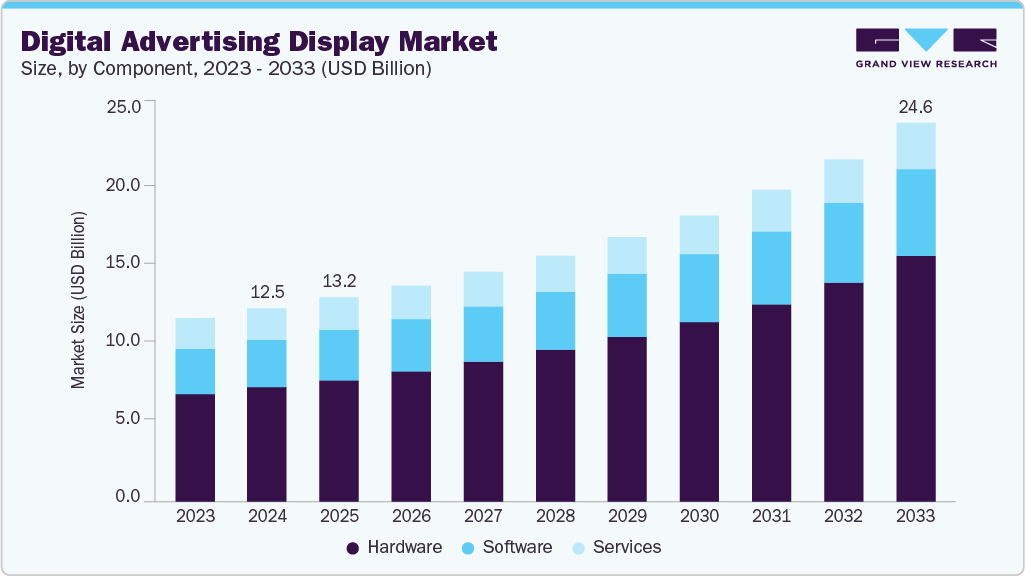
The global digital advertising display market size was estimated at USD 12.54 billion in 2024 and is projected to reach USD 24.60 billion by 2033, growing at a CAGR of 8.1% from 2025 to 2033. The rise of smart cities and the proliferation of connected infrastructure are driving the market growth.
Key Market Trends & Insights
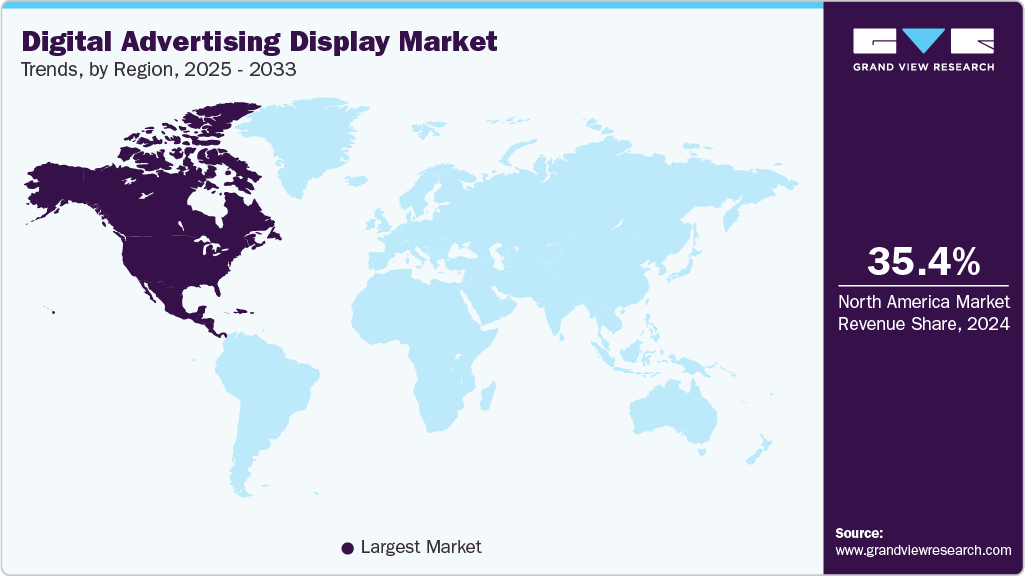
- North America held a 35.4% revenue share of the global digital advertising display market in 2024.
- In the U.S., advancements in display technologies, such as LED, OLED, and high-definition LCD panels, are accelerating the demand for digital advertising display systems.
- By component, the hardware segment held the largest revenue share of 59.2% in 2024.
- By product type, the digital billboards segment held the largest revenue share in 2024.
- By technology, the LED segment held the largest revenue share in 2024.
Market Size & Forecast
- 2024 Market Size: USD 12.54 Billion
- 2033 Projected Market Size: USD 24.60 Billion
- CAGR (2025-2033): 8.1%
- North America: Largest market in 2024
- Asia Pacific: Fastest growing market
The digital advertising display industry represents a dynamic and evolving space within the broader advertising ecosystem. It encompasses a wide range of display solutions that deliver promotional content in visually engaging formats, often integrating interactivity, motion graphics, and real-time updates to capture audience attention. These displays are used across various environments, from bustling urban centers and transport hubs to retail spaces and corporate settings, serving as a direct channel for brands to connect with their target audiences in high-visibility locations.The growth of the digital advertising display market is fueled by the rapid expansion of omnichannel marketing strategies, where brands seek to create seamless and consistent messaging across multiple touchpoints. Digital displays play a central role in this approach by acting as highly visible, adaptable mediums that can be synchronized with online campaigns, mobile applications, and social media content. This integration allows advertisers to create cohesive narratives that guide consumers from digital engagement to physical interaction, such as visiting a store or scanning a QR code for promotions. The ability to instantly adapt messaging based on campaign performance metrics or external conditions, such as weather or traffic flow, makes digital advertising displays far more responsive than static signage, amplifying their demand for time-sensitive marketing efforts.
Increasing use of in-store digital displays to influence purchasing decisions at the point of sale is driving the market growth. Retailers are deploying these displays to showcase product demonstrations, run limited-time offers, and promote cross-selling opportunities, leveraging the medium’s ability to capture shoppers’ attention during critical decision-making moments. In hospitality and quick-service restaurants, digital menu boards and promotional displays are enhancing customer experience by offering dynamic, visual content that can be updated instantly. Similarly, in transportation hubs such as airports and metro stations, advertisers are using digital displays to target large, diverse audiences with location-relevant messages, increasing campaign impact.
Event-based marketing is another factor boosting the demand for the digital advertising display market. Live events, such as sports tournaments, music festivals, and trade shows, are increasingly using these displays to deliver dynamic advertisements, sponsor branding, and real-time updates. This capability enhances audience engagement by providing contextually relevant content, such as instant replays, score updates, or promotional offers triggered by in-game events. The combination of high visual impact and the ability to integrate with live data feeds makes digital displays an ideal medium for capturing audience attention in fast-paced environments. In many cases, this approach also drives higher advertising revenue for event organizers, as brands are willing to pay a premium for placements that can be updated instantly in response to live moments.
Component Insights
The hardware segment dominated the digital advertising display industry with a revenue share of 59.2% in 2024. The hardware segment is also benefiting from the growing demand for weather-resistant, vandal-proof, and energy-efficient outdoor displays. These robust units are essential for high-traffic public spaces and have expanded the use of digital advertising into areas where traditional displays were once impractical. For instance, transportation authorities and smart city initiatives are installing durable digital advertising displays in bus shelters, train stations, and along highways to display both commercial and public service messages. Such installations require hardware capable of withstanding extreme weather conditions while operating continuously, making advancements in display durability a critical market driver.
The software segment is projected to grow significantly during the forecast period. The rise of interactive and experiential advertising is further boosting segment growth in the digital advertising display market. Modern display software often supports integration with touchscreens, gesture recognition, QR code scanning, and augmented reality experiences, allowing advertisers to engage audiences in more immersive ways. This shift toward interactivity not only increases viewer engagement but also generates valuable behavioral data that can inform future campaigns. As digital displays become more connected and intelligent, the role of software in managing, optimizing, and personalizing advertising content will grow.
Product Type Insights
The digital billboards segment dominated the digital advertising display market in 2024. The rise of programmatic advertising is driving the growth of the digital billboard segment, enabling automated ad buying and real-time campaign adjustments based on audience data, time of day, or environmental triggers. This approach maximizes inventory utilization by allowing multiple advertisers to share a single billboard space in timed rotations, which increases revenue potential for operators while providing affordable options for smaller advertisers. Moreover, the integration of sensors, cameras, and geolocation technology is making it possible to deliver contextually relevant content, such as targeted promotions triggered by passing traffic demographics or weather conditions.
Digital posters is projected to be the fastest-growing segment from 2025 to 2033. Retail and hospitality sectors are particularly significant adopters of digital posters, using them for promotions, product showcases, and interactive customer experiences. Restaurants employ them for digital menu boards and upselling opportunities, while retailers use them for flash sales and personalized offers. As advertisers increasingly seek to combine creativity, flexibility, and cost-effectiveness, digital posters are emerging as a preferred medium for targeted marketing in both small-scale and networked campaigns. With the continued development of high-quality display technology and intelligent content delivery systems, the digital posters segment is set to play a key role in the future market growth.
Technology Insights
The LED segment dominated the digital advertising display industry in 2024. Technological advancements in LED manufacturing have significantly improved resolution and pixel density, enabling the creation of high-definition and even ultra-high-definition displays. This has opened up new opportunities for indoor applications, such as retail store displays, shopping malls, airports, and corporate environments, where sharp visuals and premium image quality are essential for audience engagement. The availability of fine-pitch LED screens allows advertisers to deliver detailed, dynamic content at close viewing distances, blurring the line between LED and LCD usage in certain contexts. Furthermore, the development of energy-efficient LEDs has helped reduce power consumption, aligning with sustainability goals and lowering the environmental impact of advertising campaigns.
The OLED segment is projected to grow at the fastest CAGR from 2025 to 2033. The growth of high-end retail and luxury goods sectors is driving OLED adoption in the market. Brands in these categories place a strong emphasis on visual aesthetics and customer experience, making OLED’s superior display quality a natural fit for in-store promotions, product showcases, and brand installations. Airports, hotels, and entertainment venues are also increasingly using OLED displays to convey a modern, upscale image while delivering dynamic, high-resolution content. In addition, the technology’s ability to maintain high performance in ambient indoor lighting makes it ideal for locations where controlling light levels is not always possible.
Resolution Insights
The FHD segment dominated the digital advertising display market in 2024. The FHD segment is also being propelled by the global expansion of mid-range commercial advertising networks, where scalability and cost control are essential. For operators deploying hundreds or even thousands of displays, FHD offers a resolution that is visually impressive to the average viewer without demanding the higher bandwidth, storage, and processing resources required for 4K or 8K content. This efficiency not only reduces infrastructure costs but also allows for faster content uploads and smoother playback, which is particularly important for campaigns that require frequent updates or real-time adjustments. The ability to run high-quality video and imagery without taxing network performance is a key factor in the segment’s continued popularity among large-scale advertisers.
The 8K segment is projected to grow at a significant CAGR from 2025 to 2033. The adoption of 8K displays is also being fueled by industries where visual precision is critical to conveying brand value. Luxury automotive showrooms, high-end fashion retailers, and premium real estate developments are using 8K screens to showcase products with lifelike accuracy, highlighting textures, finishes, and intricate details that lower-resolution displays cannot fully capture. Similarly, in sectors such as tourism, hospitality, and entertainment, 8K technology is being deployed to deliver breathtaking scenic visuals, cinematic experiences, and interactive storytelling that create strong emotional connections with viewers. These high-quality visuals not only enhance brand perception but also increase dwell time and engagement in physical locations.
Application Insights
The indoor segment dominated the digital advertising display industry in 2024. The rising trend of interactive advertising is a major factor driving segment growth. Indoor displays are often paired with technologies such as augmented reality, QR codes, gesture control, and mobile integration to create engaging, personalized brand experiences. This interactivity captures attention and encourages direct consumer participation, deepening brand engagement. As businesses continue to prioritize immersive, targeted, and adaptable marketing strategies, the indoor segment is expected to remain one of the most vibrant and fast-evolving areas of the market.
The outdoor segment is projected to grow at the fastest CAGR from 2025 to 2033. The rising popularity of programmatic digital out-of-home (DOOH) advertising is driving the segment growth. With the growing availability of 5G connectivity, outdoor displays receive and update content instantly, enabling advertisers to run time-sensitive campaigns, react to live events, or personalize messages for different times of day. Combined with the sheer scale and visibility of outdoor formats, this agility offers advertisers a powerful way to maximize campaign relevance and impact. As display costs continue to decrease and data-driven targeting capabilities advance, the outdoor segment is expected to grow in the forthcoming years.
End Use Insights
The retail segment dominated the market in 2024. The shift toward experiential shopping environments is driving the adoption of the retail segment’s growth. Brick-and-mortar stores are embracing technology to compete with e-commerce by offering interactive and sensory-rich experiences that cannot be replicated online. Video walls, touch-enabled kiosks, and LED shelf-edge displays are being deployed to engage shoppers, tell brand stories, and create emotional connections with products. The integration of augmented reality and artificial intelligence into digital displays allows for personalized product recommendations, virtual try-ons, and targeted promotions based on customer demographics or purchasing history, further enhancing the customer journey and boosting sales conversion rates.
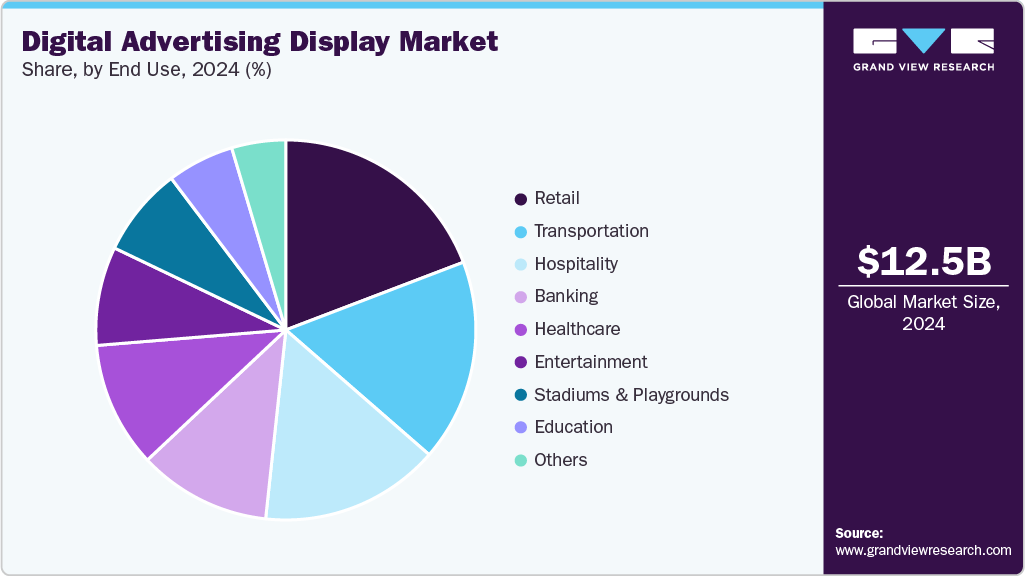
The transportation segment is projected to grow the fastest from 2025 to 2033. The transportation segment of the digital advertising display market is growing rapidly, fueled by the high visibility and captive audience opportunities found in airports, train stations, bus terminals, subways, and other transit hubs. These locations experience consistent, high-volume foot traffic, making them ideal for delivering impactful advertising messages to diverse audiences. Passengers often spend considerable waiting times in these environments, providing advertisers with extended exposure periods and increasing the likelihood of engagement. Digital displays in transportation settings can showcase vibrant, motion-rich content that captures attention even in busy, distraction-filled spaces, giving brands a powerful platform for both mass awareness and targeted messaging.
Regional Insights
North America dominated the digital advertising display market with a revenue share of 35.4% in 2024. A combination of advanced technology adoption, high advertising spending, and out-of-home media infrastructure drives the strong regional growth. The region is home to some of the world’s largest advertising and media companies, as well as leading technology providers, which accelerate innovation and resolution of high-quality digital displays across both urban and suburban areas. The presence of major metropolitan hubs such as New York, Los Angeles, and Toronto, where competition for consumer attention is intense, has pushed advertisers to adopt dynamic, visually striking displays that can stand out in crowded environments. With consumers in North America accustomed to high production values and engaging content, the demand for advanced formats such as 4K, 8K, OLED, and interactive displays is growing rapidly.
U.S. Digital Advertising Display Market Trends
The U.S. digital advertising display industry is projected to grow during the forecast period. The widespread availability of high-speed internet, advanced content management systems, and 5G networks enables seamless delivery of high-quality, real-time content to digital displays across the country. Additionally, many states and municipalities have updated zoning laws to accommodate the installation of digital billboards, fostering a favorable regulatory environment for advertisers. The ongoing decline in display hardware costs, combined with improvements in energy efficiency, is making advanced digital signage solutions accessible to a broader range of businesses. These factors, combined with the U.S.’s fast-paced and highly competitive advertising culture, are positioning digital advertising displays as an increasingly essential component of modern marketing strategies.
Asia Pacific Digital Advertising Display Market Trends
The Asia Pacific digital advertising display industry is expected to grow at the fastest CAGR of 10.4% over the forecast period. The entertainment and sports industries are also major adopters in Asia Pacific, using these technologies to enhance audience engagement in stadiums, cinemas, theme parks, and concert venues. Large-format LED displays, interactive ticketing kiosks, and dynamic advertising boards create immersive experiences for attendees and open new monetization opportunities through targeted advertising. In countries like China and India, where sports and live events draw massive audiences, the scalability and impact of digital advertising display help brands connect with consumers on a large scale. According to Grand View Research, 77% of sports viewers notice brands during sporting events, and exposure to sports-related DOOH ads leads to a 33% increase in brand favorability, highlighting the substantial advertising potential in this space.
The digital advertising display market in China is projected to grow during the forecast period. The increasing affordability of advanced display technologies such as LED and OLED has made digital advertising displays more accessible in China. Local manufacturers, including global giants like Leyard and Unilumin, are producing high-quality digital displays at competitive prices, fueling wider adoption across second- and third-tier cities. The domestic production capability reduces costs and accelerates innovation, with Chinese companies pioneering advancements in flexible displays, ultra-high-definition screens, and energy-efficient systems. These technological developments support greater customization and scalability of digital advertising display resolutions across different environments and use cases.
Europe Digital Advertising Display Market Trends
The digital advertising display industry in Europe is expected to grow during the forecast period. The market benefits from adopting interactive kiosks as part of broader efforts to enhance customer service and streamline business operations. These kiosks can be integrated with loyalty programs, enabling businesses to offer targeted promotions and personalized discounts that appeal to individual customers. The 2023 Square Future of Restaurants Report reveals that 79% of consumers believe kiosks simplify ordering. This ability to tailor marketing efforts to specific audiences ensures higher engagement rates and encourages repeat business. Moreover, in the hospitality industry, interactive kiosks facilitate seamless check-in and check-out processes, improving customer experiences and reducing waiting times.
The UK digital advertising display market is expected to grow during the forecast period. The UK’s sports and entertainment industry is driving market growth by adopting advanced displays to enhance fan and visitor experiences. PREMIER LEAGUE stadiums, music venues, and theaters are using dynamic signage for live updates, interactive content, and targeted advertising, creating new revenue streams. These installations improve audience engagement and provide sponsors with high-impact advertising opportunities. As the sector continues to invest in modernizing facilities, the demand for innovative and immersive digital advertising display solutions is steadily increasing.
Key Digital Advertising Display Company Insights
Some of the key companies operating in the market include Samsung Electronics Co., Ltd., and LG Electronics.
-
Samsung Electronics Co., Ltd. is a multinational electronics company engaged in providing consumer electronic products and solutions and Information Technology (IT) solutions, and mobile communication worldwide. The company offers various products, including phones, tablets, wearables, computing & SSD, digital signage and video walls, TVs, printers & copiers, networking & voice, medical devices, and air conditioning. The company distributes its products online and through dedicated franchise stores. The company’s services include Samsung ProCare and Samsung business services. The company has a geographical presence spanning Europe, Asia Pacific, the Middle East, and Africa, among other regions.
-
LG Electronics provides electronic products and technology solutions. LG Electronics offers various products, such as OLED displays, digital signage, video walls, outdoor displays, display TVs, display monitors, and IT products. The company provides accessories like wall mounts, monitor stands, and other TV accessories. The company has a global presence and operates through more than 70 subsidiaries. It has corporate offices, sales offices, and dealers across North America, South America, Central America, Europe, Asia Pacific, Russia & CIS, and the Middle East & Africa.
Scala and Barco are some of the emerging participants in the digital advertising display market.
-
Scala is a digital signage software solution. The company serves government agencies, corporate enterprises, and the incumbents of various industries and industry verticals. It also provides solutions for various applications, such as digital menu boards, kiosks, wayfinding, emergency messaging, assistive selling tools, vending, point-of-sale, advertising networks, financial terminals, and mobile and social networking in both public and private environments.
-
Barco is a Belgian technology company, and it operates across three primary sectors: Entertainment, Enterprise, and Healthcare, offering cutting-edge products such as projectors, display monitors, video walls, connectivity platforms, image processing tools, and interactive software. Its V-series indoor LED displays, which include V4i and V6i models with 4 mm and 6 mm pixel pitches, combine the company’s signature image quality with excellent contrast, reliability for 24/7 operation, and cost-effectiveness for environments like fashion stores, automotive showrooms, banks, and transit hubs.
Key Digital Advertising Display Companies:
The following are the leading companies in the digital advertising display market. These companies collectively hold the largest market share and dictate industry trends.
- Daktronics Dr.
- BrightSign, LLC
- LG Electronics
- Panasonic Corporation
- Samsung Electronics Co., Ltd.
- Scala
- Barco
- Lamar Advertising Company
- Leyard Group
- Adonmo-Acumen
- Armagard Ltd.
- Allsee Technologies Limited
- STRATACACHE
- Shining International Co., Ltd.
- COX MEDIA, LLC
Recent Developments
-
In May 2025, Daktronics partnered with the University of Delaware to design, manufacture, and install a cutting-edge LED video display at the university's stadium. Engineered with advanced environmental protection, the display is built to perform reliably in the outdoor conditions of Newark. In addition, Daktronics provided a comprehensive Show Control system. This solution integrates display control software, high-quality video processing, data integration, and playback hardware into a powerful yet intuitive production platform.
-
In February 2025, NoviSign partnered with BrightSign, LLC, to enhance the flexibility and scalability of its digital signage solutions. This collaboration allows businesses to combine NoviSign’s robust software with the trusted reliability and security of BrightSign’s media players. The partnership ensures complete compatibility across BrightSign’s entire product line, enabling smooth integration and high-performance functionality. Designed with user experience in mind, NoviSign’s platform offers interactive features, including touchscreen capabilities, real-time data feeds, and IoT integrations, all optimized for seamless operation with BrightSign hardware.
-
In February 2025, Daktronics Dr. launched the next generation of digital billboard technology for the out-of-home (OOH) advertising market with the launch of the DB-7000. Building on a legacy of proven reliability, the DB-7000 incorporates state-of-the-art, energy-efficient innovations designed to enhance return on investment (ROI) and reduce operational expenses. Developed in collaboration with vendors, the DB-7000 is engineered to lower site power demands and cut operational costs by up to 20%, minimizing environmental impact while ensuring long-lasting, high-quality image performance.
Digital Advertising Display Market Report Scope
Report Attribute
Details
Market size value in 2025
USD 13.24 billion
Revenue forecast in 2033
USD 24.60 billion
Growth rate
CAGR of 8.1% from 2025 to 2033
Actual data
2021 - 2024
Forecast period
2025 - 2033
Quantitative units
Revenue in USD million/billion and CAGR from 2025 to 2033
Report coverage
Revenue forecast, company share, competitive landscape, growth factors, and trends
Segments covered
Component, product type, technology, resolution, application, end use, region
Regional scope
North America; Europe; Asia Pacific; Latin America; MEA
Country scope
U.S.; Canada; Mexico; UK; Germany; France; China; India; Japan; Australia; South Korea; Brazil; UAE; Saudi Arabia; South Africa
Key companies profiled
Daktronics Dr.; BrightSign, LLC; LG Electronics; Panasonic Corporation; Samsung Electronics Co., Ltd.; Scala; Barco; Lamar Advertising Company; Leyard Group; Adonmo-Acumen; Armagard Ltd.; Allsee Technologies Limited; STRATACACHE; Shining International Co., Ltd.; COX MEDIA, LLC
Customization scope
Free report customization (equivalent to 8 analysts working days) with purchase. Addition or alteration to country, regional & segment scope.
Pricing and purchase options
Avail customized purchase options to meet your exact research needs. Explore purchase options
Global Digital Advertising Display Market Report Segmentation
This report forecasts revenue growth at the global, regional, and country levels and provides an analysis of the latest industry trends in each of the sub-segments from 2021 to 2033. For this study, Grand View Research has segmented the digital advertising display market report based on component, product type, technology, resolution, application, end use, and region:
-
Component Outlook (Revenue, USD Billion, 2021 - 2033)
-
Hardware
-
Software
-
Services
-
-
Product Type Outlook (Revenue, USD Billion, 2021 - 2033)
-
Digital Billboards
-
Video Walls
-
Digital Posters
-
Video Screens
-
Kiosks
-
Others
-
-
Technology Outlook (Revenue, USD Billion, 2021 - 2033)
-
LCD
-
LED
-
OLED
-
Projection
-
-
Resolution Outlook (Revenue, USD Billion, 2021 - 2033)
-
8K
-
4K
-
FHD
-
HD
-
Lower than HD
-
-
Application Outlook (Revenue, USD Billion, 2021 - 2033)
-
Indoor
-
Outdoor
-
-
End Use Outlook (Revenue, USD Billion, 2021 - 2033)
-
Retail
-
Hospitality
-
Entertainment
-
Stadiums & Playgrounds
-
Banking
-
Healthcare
-
Education
-
Transportation
-
Others
-
-
Regional Outlook (Revenue, USD Billion, 2021 - 2033)
-
North America
-
U.S.
-
Canada
-
Mexico
-
-
Europe
-
Germany
-
UK
-
France
-
-
Asia Pacific
-
China
-
India
-
Japan
-
South Korea
-
Australia
-
-
Latin America
-
Brazil
-
-
Middle East & Africa
-
UAE
-
Saudi Arabia
-
South Africa
-
-
Frequently Asked Questions About This Report
b. The global digital advertising display market size was estimated at USD 12.54 billion in 2024 and is expected to reach USD 13.24 billion in 2025.
b. The global digital advertising display market is expected to grow at a compound annual growth rate of 8.1% from 2025 to 2033 to reach USD 24.60 billion by 2033.
b. The hardware segment dominated the digital advertising display market with a market share of 59.2% in 2024. The hardware segment is also benefiting from the growing demand for weather-resistant, vandal-proof, and energy-efficient outdoor displays. These robust units are essential for high-traffic public spaces and have expanded the use of digital advertising into areas where traditional displays were once impractical.
b. Some key players operating in the market include Daktronics Dr., BrightSign, LLC, LG Electronics, Panasonic Corporation, Samsung Electronics Co., Ltd., Scala, Barco, Lamar Advertising Company, Leyard Group, Adonmo-Acumen, Armagard Ltd., Allsee Technologies Limited, STRATACACHE, Shining International Co., Ltd., COX MEDIA, LLC.
b. Factors such as the rise of smart cities and the proliferation of connected infrastructure and advancements in display technologies, such as LED, OLED, and high-definition LCD panels are the key factors driving the market growth.


Share this report with your colleague or friend.
Need a Tailored Report?
Customize this report to your needs — add regions, segments, or data points, with 20% free customization.


ISO 9001:2015 & 27001:2022 Certified
We are GDPR and CCPA compliant! Your transaction & personal information is safe and secure. For more details, please read our privacy policy.
Trusted market insights - try a free sample
See how our reports are structured and why industry leaders rely on Grand View Research. Get a free sample or ask us to tailor this report to your needs.