- Home
- »
- Automotive & Transportation
- »
-
DC Fast Charging Market Size, Share, Industry Report, 2033GVR Report cover
![DC Fast Charging Market Size, Share & Trends Report]()
DC Fast Charging Market (2026 - 2033) Size, Share & Trends Analysis Report By Connector (CHAdeMO, CCS), By Charging Infrastructure (Standalone, Integrated), By Power Rating, By Application, By Region, And Segment Forecasts
- Report ID: GVR-4-68040-871-1
- Number of Report Pages: 150
- Format: PDF
- Historical Range: 2021 - 2024
- Forecast Period: 2026 - 2033
- Industry: Technology
- Report Summary
- Table of Contents
- Segmentation
- Methodology
- Download FREE Sample
-
 Download Sample Report
DC Fast Charging Market Summary
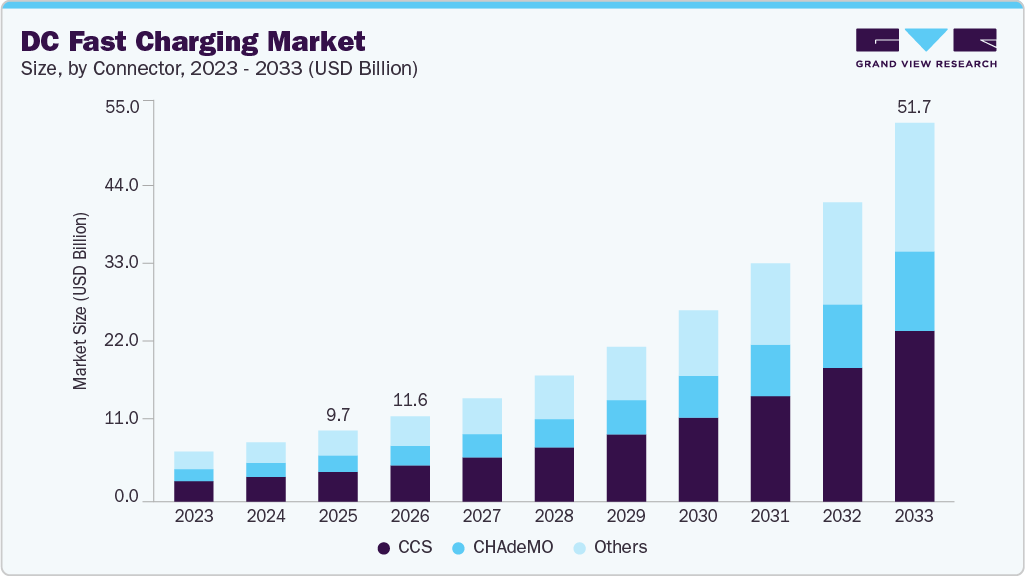
The global DC fast charging market size was estimated at USD 9.67 billion in 2025 and is projected to reach USD 51.67 billion by 2033, growing at a CAGR of 23.7% from 2026 to 2033. The market is undergoing rapid expansion, driven by the need to eliminate range anxiety and support long-distance electric travel.
Key Market Trends & Insights
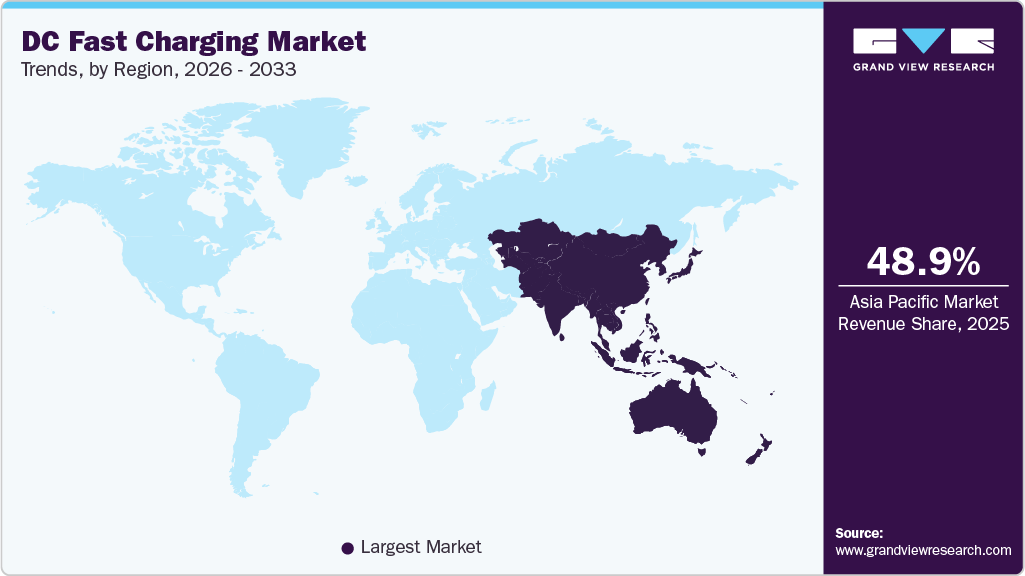
- The Asia Pacific DC fast charging market held a dominant position in 2025, accounting for a 48.98% share of the overall market.
- By connector, the CCS segment accounted for the largest share of 41.98% in 2025.
- In terms of charging infrastructure, the integrated segment held the largest market share in 2025.
- Based on power rating, the 50-150 kW segment accounted for the largest share in 2025.
- By application, the commercial segment accounted for the largest share in 2025.
Market Size & Forecast
- 2025 Market Size: USD 9.67 Billion
- 2033 Projected Market Size: USD 51.67 Billion
- CAGR (2026-2033): 23.7%
- Asia Pacific: Largest market in 2025
One of the key drivers of the DC fast charging market is the expansion of charging stations along highways and major transit routes. Most EV users prefer charging stops of 20-40 minutes rather than long charging sessions lasting several hours. To meet this need, fast chargers are increasingly installed at fuel stations and dedicated EV charging hubs, supporting smooth long-distance travel. In addition, locations such as intercity bus terminals and railway station parking areas are adopting DC fast chargers. These sites benefit from quick vehicle turnover, reduced waiting time, and improved traffic flow, which is accelerating demand for DC fast-charging infrastructure.The integration of faster and more efficient electric vehicle charging technology is accelerating market growth. DC fast chargers, ranging from 30 kW to 360 kW, enable a superior fast-charging experience for EV users. These chargers are commonly installed in commercial areas and are ideal for users who spend extended time away from home, including restaurants, shopping malls, and cafés. The growing demand for ultra-fast electric vehicle charging solutions is further supporting market expansion.
Despite strong growth prospects, several factors continue to restrain market expansion. DC fast charging requires significantly higher upfront capital investment than AC charging, as it requires specialized equipment and higher power capacities, resulting in higher installation and infrastructure costs. As a result, the expansion of DC fast charging infrastructure may face financial challenges, mainly in regions with limited funding or slower electric vehicle adoption.
Private investments raised by electric vehicle charging network operators are increasingly being directed toward the expansion of DC fast-charging infrastructure along highway corridors. For instance, in February 2026, Statiq raised approximately USD 18 million through a combination of debt and equity. This capital is planned to be used for the expansion of EV charging infrastructure, primarily through the installation of additional DC fast chargers along major highway corridors and the strengthening of presence across Tier-1 and Tier-2 cities. In addition, product reliability, with a target uptime of 99.9%, along with enhancements in hardware lifecycle management and the integration of advanced telematics systems, is also being supported to enable seamless network scaling. Such funding is expected to grow significantly in the market.
Connector Insights
The CCS segment dominated the market in 2025 and accounted for the largest share of 41.98%. The growing demand for faster, more efficient electric vehicle charging solutions is driving adoption of the CCS (Combined Charging System) segment. CCS enables high-power DC fast charging, typically delivering power levels of up to 150-350 kW, which significantly reduces charging times compared to conventional charging methods. Many EVs can be recharged to 80% in approximately 20-30 minutes, depending on the charger's output and the battery's size. In addition, CCS increasingly supports bidirectional charging (Vehicle-to-Grid, V2G), enabling EVs to return power to the grid. This capability enhances energy management, improves grid stability, and provides backup power during outages, supporting the expansion of advanced EV charging infrastructure.
The CHAdeMO segment is expected to grow at a significant CAGR during the forecast period. CHAdeMO connectors support a charging power of 50-100 kW and are less commonly used for ultra-fast charging than CCS systems. CHAdeMO is primarily used by electric vehicles that already have this connector, allowing continued use of existing charging infrastructure instead of requiring new installations. Several vehicles, including the Nissan Leaf and Toyota Prius Plug-In, still rely on CHAdeMO. Its early compatibility with Japanese EVs helped it gain traction in Europe, where it provided a reliable and accessible charging solution during the early stages of EV adoption.
Charging Infrastructure Insights
The integrated segment dominated the market in 2025. The growth of the integrated DC fast charging segment is being driven by the rising demand for fleet electrification solutions that reduce dependency on costly grid upgrades and improve energy management efficiency. Battery-integrated charging systems combine stationary energy storage with DC fast-charging hardware, enabling high-power output while minimizing peak grid demand. This configuration reduces infrastructure strain, lowers utility interconnection costs, and enhances deployment feasibility in grid-constrained locations. For instance, in September 2025, Orange EV partnered with OptiGrid to launch the Orange Juicer, a battery-integrated DC fast-charging solution designed specifically for fleet operations. The system integrates a 180-kWh stationary battery with DC fast-charging equipment to deliver high-power charging while drawing significantly less power from the grid. Such integrated solutions improve charging reliability during peak demand periods and support scalable fleet electrification, thereby accelerating the adoption of battery-backed DC fast charging infrastructure within the integrated segment.
The standalone segment is projected to grow at a significant CAGR over the forecast period. The standalone DC fast charging infrastructure comprises independent fast-charging stations that operate independently and are commonly installed at highways, fuel stations, malls, parking lots, and public areas. It supports various charging setups, making it a flexible solution for operators seeking better performance, easy installation, and higher returns on investment, all within a small space. The increasing adoption of EVs is fueling the growth of the segment. Several private charging network operators are investing in standalone DC fast chargers. Moreover, increasing government initiatives supporting charging infrastructure programs across various countries, such as India, Japan, and China, are further propelling the growth of the segment.
Power Rating Insights
The 50-150 kW segment held the largest market in 2025. The rising adoption of electric vehicles is driving demand for fast and space-efficient charging solutions. Delta Electronics has launched a new 50kW DC Wallbox fast EV charger in the U.S. at the Advanced Clean Transportation Expo. The charger is slim and lightweight, making it suitable for offices, parking lots, fleet centers, and busy urban areas with limited space. It can be installed on a wall or a pedestal for easy setup. The charger delivers fast and efficient charging with up to 50kW of power and can charge two vehicles at the same time. As EV adoption rises, this solution helps businesses and fleet operators reliably meet daily charging needs.
The above 350 KW segment is expected to maintain the fastest CAGR during the forecast period. The above 350 kW EV high-power charging (HPC) stations are gaining strong demand due to their modular design. These systems typically combine a central power unit with two charging posts, enabling simultaneous vehicle charging with a maximum output of 350 kW and 500 A per outlet under the CCS2 standard. This configuration makes them ideally suited for high-traffic, high-utilization charging locations, such as highways and commercial hubs.
Application Insights
The commercial segment dominated the market in 2025. The expansion of host-based and community-driven EV charging infrastructure is driving market growth in the commercial segment. For instance, in August 2025, DeCharge, a startup focused on electric vehicle charging, launched its operations in the United States to build a community-owned EV charging network. This model allows local businesses, property owners, and other hosts to install EV chargers at their locations and earn money when drivers use them. The company recently raised funding and plans to begin pilot deployments in key regions, aiming to expand the charging network across multiple states. By engaging local hosts and increasing the number of charging stations, this company aims to address the shortage of public EV chargers and support the growing demand for EV infrastructure.
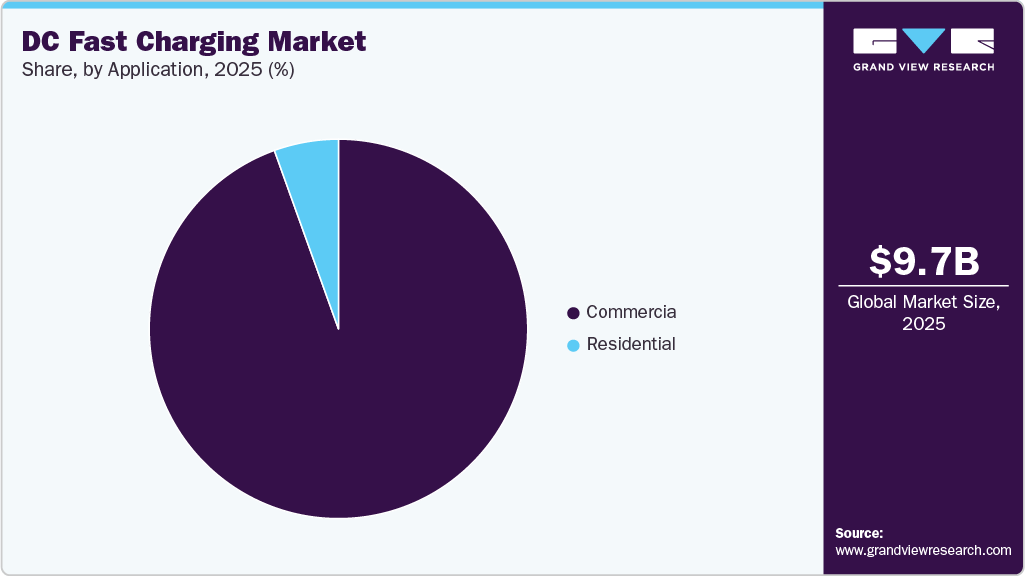
The residential segment is anticipated to grow rapidly during the forecast period. The demand for easy and convenient EV charging is driving growth in the residential segment. Among various locations, homes are the most preferred choice, as EV owners value convenience, privacy, and overnight charging. Charging at home allows users to start each day with a fully charged vehicle, reduces reliance on public charging stations, and is usually more affordable than public charging. With the increasing number of EVs on the road, more homeowners are installing personal chargers to support daily travel and commuting.
Regional Insights
The North America DC fast charging industry held the market share of 16.48% in 2025. DC fast chargers play a crucial role in EV infrastructure by addressing the growing demand for fast and reliable charging solutions that enable long-distance travel and minimize waiting times, unlike conventional AC chargers. This faster charging capability is crucial for EV users, ideal for a convenient, efficient travel experience, as improving vehicle range has significantly increased the need for recharging during extended journeys.
U.S. DC Fast Charging Market Trends
The U.S. DC fast charging industry held a significant position in the region in 2025, driven by record growth in installed charging ports. More than 18,000 new DC fast-charging ports were added during the year, representing approximately 30% year-over-year growth and bringing the total nationwide figure to 70,000 or more. Significant investments from private charging network operators, automakers, retailers, utilities, and public funding programs are accelerating infrastructure and supporting continued market expansion.
Europe DC Fast Charging Market Trends
The DC fast charging industry in Europe is expected to register a robust CAGR from 2026 to 2033, owing to the increasing demand for high-powered EV chargers. For instance, in January 2026, Delta launched its new 350 kW ultra-fast EV charger (HPC 350) in the EMEA region for electric cars, buses, trucks, and other heavy-duty vehicles. The charger is designed for places where the power grid is limited and where many vehicles need to charge frequently. It offers very fast charging and smart energy features that can automatically share power, connect to backend systems, and work easily with smart charging networks. The HPC 350 is suitable for charging operators, highway charging stations, fleet and logistics depots, fuel stations, and commercial or industrial sites. It is ideal for use at highway rest areas, petrol stations, and large public charging hubs, thereby meeting the growing demand for high-power, efficient, and scalable charging solutions to support rising EV adoption and reduce charging time.
The UK DC fast charging industry is expected to grow at a significant CAGR from 2026 to 2033, driven by the need for faster, more reliable public charging infrastructure. For instance, in December 2025, GRIDSERVE premiered new 400 kW‑capable EV chargers on its Electric Highway network, featuring ABB E‑mobility’s A400 ultra‑rapid charging units. These chargers represent a significant advancement in charging speed, reliability, and user experience for UK EV drivers.
The DC fast charging industry in Germany held a substantial market share in 2025. The expansion of the DC fast-charging network is accelerating due to rising demand for electric vehicle charging infrastructure. Charging networks are prioritizing the use of fast-charging locations where users can easily integrate charging into their everyday lives, including retail centers, urban areas, and motorways. As rising EV adoption grows, users are less focused on range anxiety and more towards the overall charging experience. For instance, in June 2025, EnBW significantly expanded the size and utilization of its HyperNet electric vehicle charging network, driven by consistently high demand. This expansion includes the development of the 50th sheltered fast-charging park and the increase in the number of fast-charging points in Germany. The company continues to enhance its products and services to align with customer expectations.
Asia Pacific DC Fast Charging Market Trends
The Asia Pacific DC fast charging market held a dominant position in 2025, accounting for a 48.98% share of the overall market and is expected to grow at the fastest CAGR of 24.4% over the forecast period. This growth is driven by the expanding electric vehicle charging network across the region and the increasing adoption of advanced EV models such as G6, G9, and X9. The G6, built on a next-generation full-domain 800V architecture, delivers ultra-fast charging, enabling higher power delivery and shorter charging times. Furthermore, the rising deployment of ultra-fast charging infrastructure in countries such as Singapore, Malaysia, and Thailand is further accelerating regional DC fast-charging market growth.
The India DC fast charging industry is expected to grow at a notable rate over the forecast period, supported by the rapid expansion of public EV charging infrastructure nationwide. Government initiatives such as PM E-DRIVE, which aims to have over 70,000 charging points within two years, are significantly accelerating market growth. In addition, the strategic installation of DC fast chargers in high-demand urban centers and along key highway corridors, including locations such as metro stations, airports, bus depots, and fuel stations, is helping to reduce range anxiety and further drive market expansion.
The DC fast charging industry in China held a substantial market share in 2025. Supporting government initiatives, including plans to install more than 100,000 high-speed EV chargers, associated with increasing investments in ultra-fast charging infrastructure exceeding 250 kW. The strategic advancement of slower chargers and the use of high-power chargers at high-traffic locations and key travel corridors are improving network efficiency, reducing range anxiety, and supporting China’s rapidly expanding electric vehicle fleet, thereby driving sustained growth in the market.
Key DC Fast Charging Company Insights
Some of the key companies in the DC fast charging industry include Tesla, ABB, ChargeZone, Electrify America, and EVgo, among others. Organizations are prioritizing the integration of advanced technologies to enhance their offerings and maintain a competitive edge. Therefore, key players are taking several strategic initiatives, such as mergers and acquisitions, business expansions, new product launches, and partnerships.
-
Tesla, Inc. is an electric vehicle and clean energy company known for electric cars and integrated charging infrastructure. The company’s product offerings include its proprietary Supercharger network, a widespread system of high-power chargers designed to support long-distance travel for Tesla vehicles. Superchargers can add up to roughly 200 miles of range in about 15 minutes, helping reduce downtime during trips by leveraging features like battery preconditioning and route planning through the Tesla app. The network spans tens of thousands of charging points worldwide, enabling convenient travel and lower fueling costs than gasoline. With automated plug-in charging, real-time stall availability, and broad placement along major routes and amenities, the Supercharger system enhances accessibility and reliability for Tesla drivers around the world.
-
ABB is a technology company committed to enabling reliable, smarter, and emission-free mobility for everyone. It offers a comprehensive EV charging portfolio that includes high-quality AC wallboxes, reliable DC fast-charging stations, compact, well-connected systems, and innovative on-demand charging solutions for electric buses. ABB Ability connected charging solutions have been designed to enable rapid global service support, proactive maintenance, and enhanced system reliability. These solutions are designed to be compatible with diverse charging infrastructure requirements and enable seamless, scalable deployment through digitally connected chargers, extensive network experience, and advanced energy and mobility management capabilities.
Key DC Fast Charging Companies:
The following key companies have been profiled for this study on the DC fast charging market.
- Tesla
- ABB
- ChargeZone
- Electrify America
- EVgo
- EVBox
- Schneider Electric
- Blink Charging Co.
- Bolt.Earth
- Tata Power
Recent Developments
-
In September 2025, ChargeZone, one of India’s prominent electric vehicle charging network operators, announced the acquisition of Zerovolt’s Wadala charging facility in Mumbai through an all-cash transaction, marking a significant consolidation in the country’s EV infrastructure sector. Along with this acquisition, ChargeZone integrated Zerovolt’s flagship charging hub into its existing network to strengthen its presence in a key transportation and logistics corridor. The facility has been focused on serving heavy commercial EVs, including electric buses and large fleet vehicles. The acquisition aims to enhance ChargeZone’s scale and service capability. In addition, Zerovolt plans to invest around ₹250 crore over the next two years to build an integrated EV electrification platform for commercial fleets and logistics operations, supporting the broader growth of India’s EV ecosystem.
-
In January 2026, Schneider Electric launched the StarCharge Fast 720, a high-power DC fast charging solution designed to support electrification across commercial, industrial, and public road-use applications. The new system delivers up to 720 kW of charging capacity, enabling simultaneous charging of multiple vehicles, including electric trucks, buses, and passenger cars. The solution incorporates a decentralized architecture with dynamic load management to improve grid efficiency and site flexibility. This launch aims to accelerate the deployment of high-power EV charging infrastructure, reduce charging times, and support the growing demand for scalable, reliable fast-charging solutions for diverse road users.
DC Fast Charging Market Report Scope
Report Attribute
Details
Market size value in 2026
USD 11.63 billion
Revenue forecast in 2033
USD 51.67 billion
Growth rate
CAGR of 23.7% from 2026 to 2033
Base year for estimation
2025
Historical data
2021 - 2024
Forecast period
2026 - 2033
Quantitative units
Revenue in USD million/billion and CAGR from 2026 to 2033
Report coverage
Revenue forecast, company ranking, competitive landscape, growth factors, and trends
Segments covered
Connector, charging infrastructure, power rating, application, region
Regional scope
North America; Europe; Asia Pacific; Latin America; Middle East and Africa
Country scope
U.S.; Canada; Mexico; Germany; UK; France; China; Japan; India; South Korea; Australia; Brazil; KSA; UAE; South Africa
Key companies profiled
Tesla; ABB; ChargeZone; Electrify America; EVgo; EVBox; Schneider Electric; Blink Charging Co.; Bolt.Earth; Tata Power
Customization scope
Free report customization (equivalent up to 8 analysts working days) with purchase. Addition or alteration to country, regional & segment scope.
Pricing and purchase options
Avail customized purchase options to meet your exact research needs. Explore purchase options
Global DC Fast Charging Market Report Segmentation
This report forecasts revenue growth at global, regional, and country levels and provides an analysis of the latest segmental trends in each of the sub-segments from 2021 to 2033. For this study, Grand View Research has segmented the global DC fast charging market report based on connector, charging infrastructure, power rating, application and region.
-
Connector Outlook (Revenue, USD Million, 2021 - 2033)
-
CHAdeMO
-
CCS
-
Others (GB/T, NACS)
-
-
Charging Infrastructure Outlook (Revenue, USD Million, 2021 - 2033)
-
Standalone
-
Integrated
-
-
Power Rating Outlook (Revenue, USD Million, 2021 - 2033)
-
≤50 kW
-
50 - 150 kW
-
150 - 350 kW
-
Above 350 kW
-
-
Application Outlook (Revenue, USD Million, 2021 - 2033)
-
Commercial
-
Destination Charging Stations
-
Highway Charging Stations
-
Bus Charging Stations
-
Fleet Charging Stations
-
Other Charging Stations
-
-
Residential
-
-
Regional Outlook (Revenue, USD Million, 2021 - 2033)
-
North America
-
U.S.
-
Canada
-
Mexico
-
-
Europe
-
Germany
-
UK
-
France
-
-
Asia Pacific
-
China
-
Japan
-
India
-
South Korea
-
Australia
-
-
Latin America
-
Brazil
-
-
Middle East and Africa (MEA)
-
KSA
-
UAE
-
South Africa
-
-
Frequently Asked Questions About This Report
b. The global DC fast charging market size was estimated at USD 9.67 billion in 2025 and is expected to reach USD 11.63 billion in 2026.
b. The global DC fast charging market is expected to grow at a compound annual growth rate of 23.7% from 2026 to 2033 to reach USD 51.67 billion by 2033.
b. The CCS segment dominated the market in 2025 and accounted for the largest share of 41.98% The growing demand for faster, more efficient electric vehicle charging solutions is driving adoption of the CCS (Combined Charging System) segment. CCS enables high-power CCS enables high-power DC fast charging, typically delivering power levels of up to 150–350 kW, which significantly reduces charging times compared to conventional charging methods.
b. Some of the key players in the market are Tesla, ABB, ChargeZone, Electrify America, EVgo, EVBox, Schneider Electric, Blink Charging Co., Bolt. Earth, Tata Power.
b. The DC fast charging market is being driven by rapidly increasing EV adoption and the parallel expansion of high-power charging networks to reduce charging time and support long-distance travel.


Share this report with your colleague or friend.
Need a Tailored Report?
Customize this report to your needs — add regions, segments, or data points, with 20% free customization.


ISO 9001:2015 & 27001:2022 Certified
We are GDPR and CCPA compliant! Your transaction & personal information is safe and secure. For more details, please read our privacy policy.
Trusted market insights - try a free sample
See how our reports are structured and why industry leaders rely on Grand View Research. Get a free sample or ask us to tailor this report to your needs.