- Home
- »
- Agrochemicals & Fertilizers
- »
-
Crop Protection Chemicals Market, Industry Report, 2033GVR Report cover
![Crop Protection Chemicals Market Size, Share & Trends Report]()
Crop Protection Chemicals Market (2026 - 2033) Size, Share & Trends Analysis Report By Product (Herbicides, Fungicides, Insecticides, Biopesticides), By Application (Cereals & Grains, Oilseeds & Pulses, Fruits & Vegetables), By Region, And Segment Forecasts
- Report ID: 978-1-68038-567-0
- Number of Report Pages: 84
- Format: PDF
- Historical Range: 2018 - 2024
- Forecast Period: 2026 - 2033
- Industry: Bulk Chemicals
- Report Summary
- Table of Contents
- Segmentation
- Methodology
- Download FREE Sample
-
 Download Sample Report
Crop Protection Chemicals Market Summary
The global crop protection chemicals market size was estimated at USD 50,218.3 million in 2025 and is projected to reach USD 76,496.4 million by 2033, growing at a CAGR of 5.4% from 2026 to 2033. The market growth is primarily driven by the rising need to enhance agricultural productivity and protect crops from pests, diseases, and weeds amid increasing global food demand.
Key Market Trends & Insights
- The Brazil crop protection chemicals market held a substantial share of 43.8% within the Latin America region in 2025.
- By product, herbicides segment remains the dominant product, accounting for the largest revenue share of 44.1% in 2025.
- By application, cereals & grains segment dominated the market with a revenue share of 41.7% in 2025.
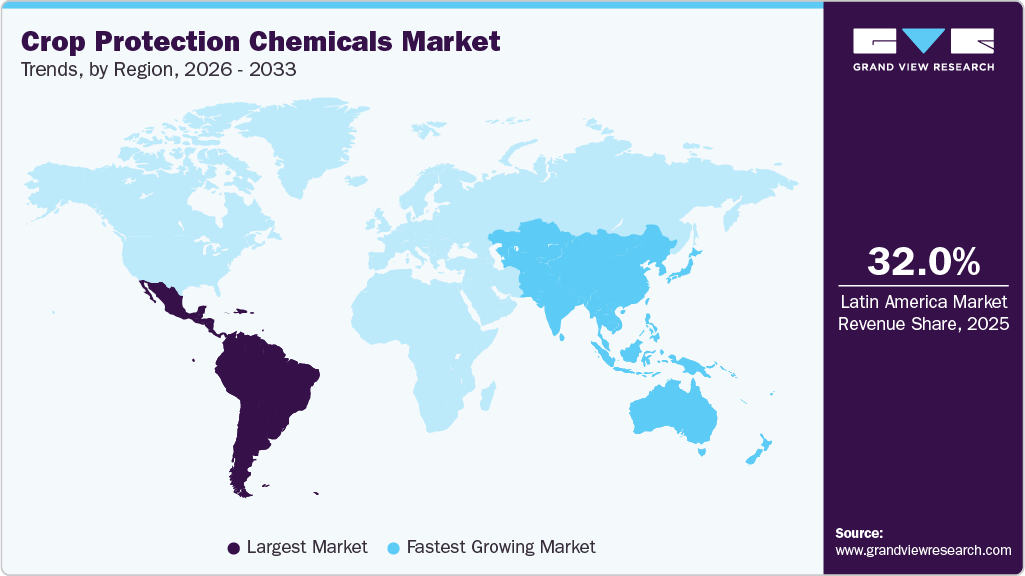
- Latin America crop protection chemicals market with the largest revenue share of 32.0% in 2025.
Market Size & Forecast
- 2025 Market Size: USD 50,218.3 Million
- 2033 Projected Market Size: USD 76,496.4 Million
- CAGR (2026-2033): 5.4%
- Latin America: Largest market in 2025
- Asia Pacific: Fastest growing market
Farmers, agribusinesses, and governments are placing greater emphasis on improving crop yields, reducing post-harvest losses, and ensuring food security. This growth is further supported by the expansion of commercial farming, the adoption of advanced crop protection solutions, and increasing awareness regarding effective pest and disease management practices across key agricultural regions.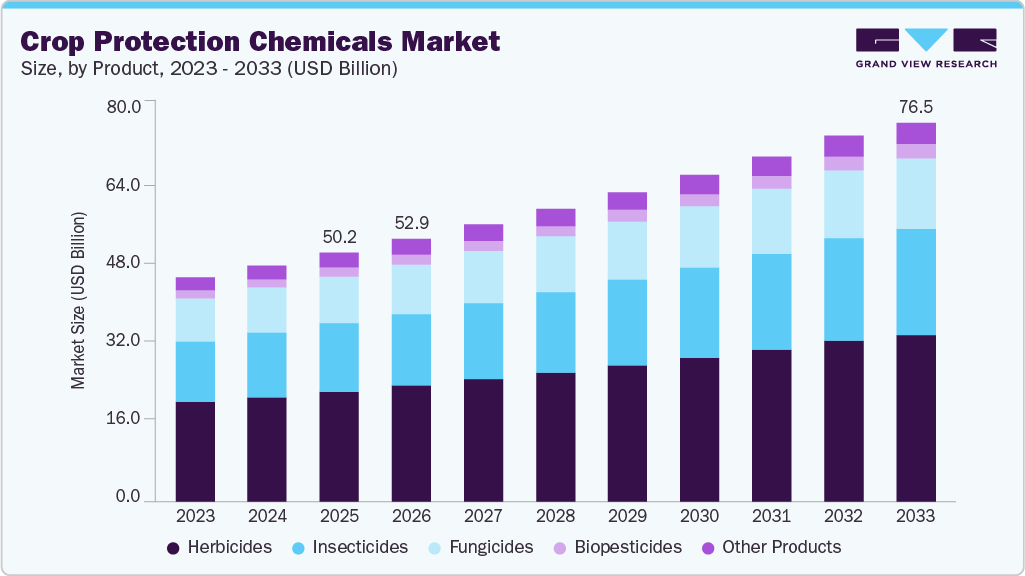
A key application driving the growth of the crop protection chemicals market is commercial agriculture, particularly in the cultivation of cereals, grains, oilseeds, and high-value crops. With increasing pressure to improve crop yields and reduce losses caused by pests, weeds, and diseases, farmers are adopting advanced crop protection solutions to enhance farm productivity and profitability. The use of selective herbicides, broad-spectrum insecticides, and effective fungicides improves crop health while optimizing input efficiency. In addition, agricultural producers are increasingly aligning with regulatory guidelines and integrated pest management (IPM) practices to ensure safe and responsible chemical usage. Consequently, large-scale and mechanized farming operations remain among the most commercially impactful application areas within the global crop protection chemicals market.
In horticulture and specialty crop production, including fruits, vegetables, and plantation crops, demand for crop protection chemicals is steadily increasing due to the high susceptibility of these crops to pests and diseases. Growers are increasingly adopting targeted and high-efficacy formulations that provide effective protection while minimizing residue levels and environmental impact. The growing focus on quality produce, export standards, and compliance with food safety regulations has further encouraged the use of advanced fungicides and insecticides. In addition, the gradual shift toward low-toxicity and biodegradable formulations supports sustainable farming practices and helps meet stringent regulatory and consumer requirements.
Market Concentration & Characteristics
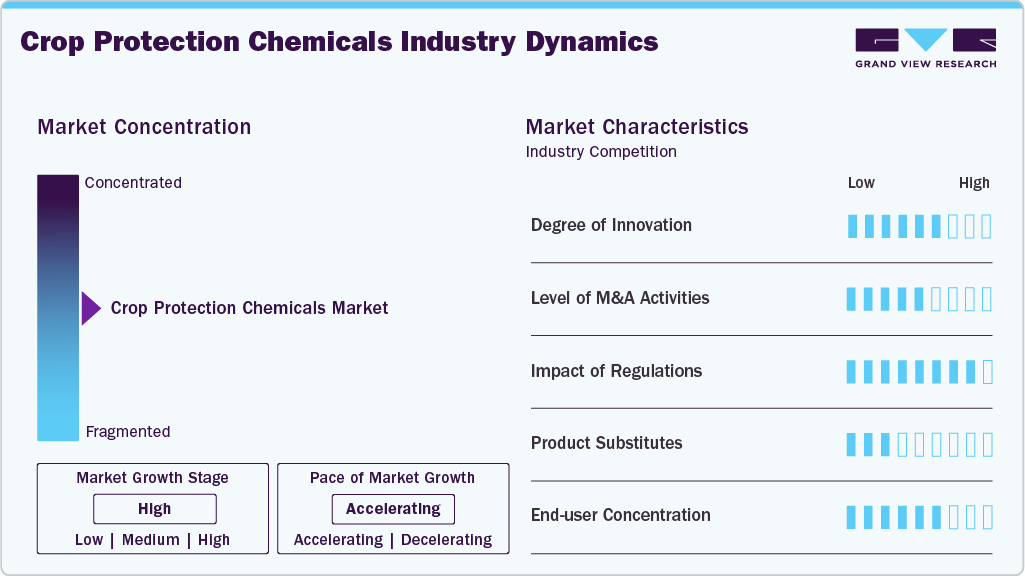
The crop protection chemicals market is moderately fragmented, with market leadership concentrated among several large, vertically integrated agrochemical manufacturers. These key players leverage economies of scale, strong in-house research and development capabilities, access to critical active ingredients, and extensive global distribution networks to maintain a competitive advantage. Their integration across the crop protection value chain from active ingredient development and formulation to packaging and distribution enables improved cost efficiency, consistent product quality, and reliable supply. This strategic positioning allows companies to effectively serve a broad range of agricultural applications, including cereals and grains, oilseeds, fruits and vegetables, and plantation crops, reinforcing their market presence and supporting the widespread adoption of advanced crop protection solutions worldwide.
At the same time, emerging players in Asia Pacific, Latin America, and the Middle East & Africa are steadily expanding their presence in the crop protection chemicals market by leveraging cost-efficient manufacturing capabilities, favorable climatic conditions for agricultural inputs, and rising domestic demand for effective crop protection solutions. These regional manufacturers are supported by targeted investments in formulation facilities, active ingredient production, and localized distribution networks strategically positioned near key agricultural regions. Their focus is on delivering cost-effective and scalable crop protection products across high-demand segments such as cereals and grains, oilseeds, fruits and vegetables, and plantation crops. This evolving landscape characterized by global consolidation among established multinational agrochemical companies alongside regionally driven expansion continues to reshape the competitive dynamics of the global crop protection chemicals market.
Product Insights
Herbicides segment remains the dominant product, accounting for the largest revenue share of 44.1% in 2025. This dominance is primarily attributed to the widespread need for effective weed management across major crops, including cereals, grains, and oilseeds, where weed infestation significantly impacts yield and crop quality. Herbicides offer cost-effective and efficient weed control solutions, supporting large-scale agricultural operations and reducing labor dependency. Their broad applicability, ease of use, and proven effectiveness have led to their extensive adoption across both developed and emerging agricultural markets.
Insecticides and fungicides continue to witness steady demand due to the growing prevalence of pest infestations and crop diseases driven by changing climatic conditions. Insecticides play a critical role in protecting crops from insects that cause direct yield losses, while fungicides are increasingly used to manage fungal diseases in high-value crops such as fruits, vegetables, and plantation crops. Furthermore, growing regulatory focus and sustainability initiatives are encouraging the gradual adoption of low-toxicity and bio-based crop protection products, which offer improved environmental profiles while maintaining effective pest and disease control. Collectively, these diverse product categories enable farmers to enhance crop productivity, manage resistance, and comply with evolving agricultural and environmental standards worldwide.
Application Insights
Cereals and grains represent the dominant application segment in the global crop protection chemicals market, accounting for the largest revenue share of 41.7% in 2025. The strong demand from this segment is driven by the large-scale cultivation of staple crops such as wheat, rice, corn, and barley, which are highly susceptible to weed competition, insect infestations, and fungal diseases. Given their critical role in global food security, farmers prioritize the use of crop protection chemicals to safeguard yields, improve crop quality, and ensure stable production levels. The extensive acreage under cereals and grains, combined with the need for cost-effective and efficient crop protection solutions, continues to support high product consumption in this segment.
In addition to cereals and grains, oilseeds and pulses, fruits and vegetables, and plantation crops contribute significantly to overall market demand. Fruits and vegetables, in particular, require intensive crop protection due to their sensitivity to pests and diseases and the need to meet strict quality and residue standards for domestic consumption and exports. Meanwhile, oilseeds and plantation crops benefit from targeted application of herbicides, insecticides, and fungicides to manage crop-specific challenges and improve productivity. Collectively, these application segments reinforce the sustained growth of the global crop protection chemicals market across diverse agricultural systems.
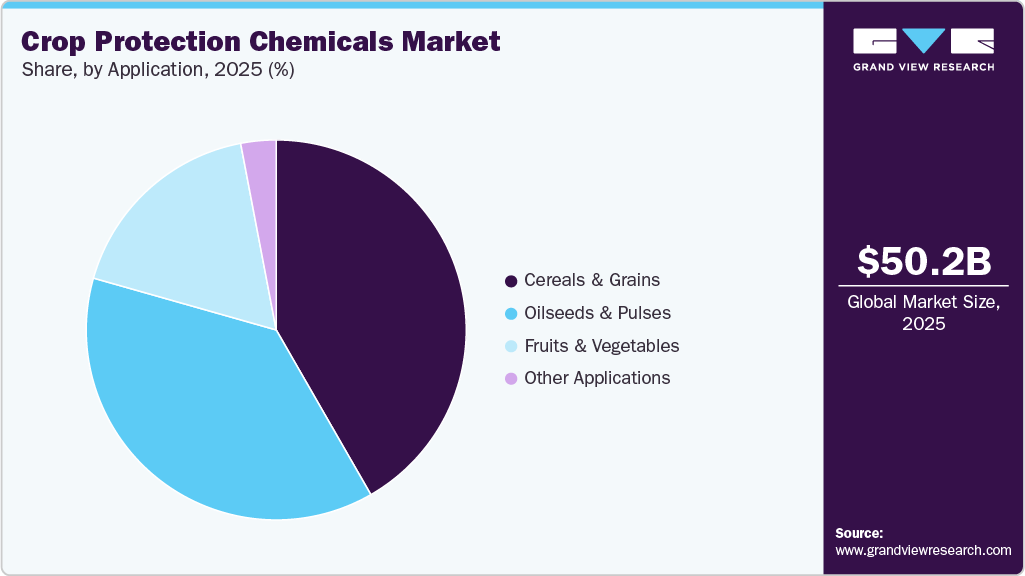
Oilseeds and pulses represent the second-largest application segment in the global crop protection chemicals market, driven by the increasing cultivation of crops such as soybean, rapeseed, sunflower, chickpea, and lentils across key agricultural regions. These crops are particularly vulnerable to weed competition, insect pressure, and fungal infections during critical growth stages, which necessitates the use of effective crop protection solutions. The application of herbicides, insecticides, and fungicides helps improve crop establishment, enhance yield stability, and protect oil and protein content, making crop protection chemicals an essential input for oilseeds and pulses cultivation.
In addition to yield protection, the use of crop protection chemicals in oilseeds and pulses aligns with broader sustainability and productivity objectives in modern agriculture. Targeted formulations and optimized application practices help reduce input losses, improve resistance management, and minimize environmental impact. Increasing adoption of integrated pest management practices and growing awareness of residue compliance further support the use of advanced crop protection solutions in this segment. As global demand for edible oils and plant-based proteins continues to rise, oilseeds and pulses remain a critical application area, supporting sustained demand within the global crop protection chemicals market.
Regional Insights
Latin America crop protection chemicals market dominated the global market, accounting for a 32.0% value share in 2025, driven primarily by the region’s extensive agricultural land base and large-scale cultivation of key commercial crops such as soybean, corn, sugarcane, and coffee. The region’s strong dependence on agriculture, combined with rising adoption of modern farming practices, has led to sustained demand for crop protection chemicals to manage weeds, pests, and crop diseases effectively. Countries such as Brazil and Argentina play a central role in regional market growth due to their high input-intensive farming systems and significant export-oriented agricultural production.
Growth in Latin America is further supported by increasing awareness among farmers regarding yield optimization, resistance management, and crop quality improvement. The widespread use of herbicides, insecticides, and fungicides across row crops and plantation agriculture has become an integral part of crop management practices in the region. In addition, supportive government policies, expanding distribution networks, and the presence of both multinational and regional agrochemical companies are improving product accessibility and adoption. Ongoing investments in agricultural technology and the gradual integration of precision farming practices continue to strengthen Latin America’s leading position in the global crop protection chemicals market.
Brazil Crop Protection Chemicals Market Trends
The Brazil crop protection chemicals market held a substantial share of 43.8% within the Latin America region in 2025, driven by the country’s large-scale cultivation of row crops such as soybean, corn, and sugarcane. Brazil’s highly mechanized and input-intensive agricultural system relies heavily on crop protection chemicals to manage weed pressure, insect infestations, and crop diseases across extensive farming areas. The widespread adoption of herbicides, insecticides, and fungicides is critical to maintaining high yield levels and supporting the country’s strong position in global agricultural exports.
The use of crop protection chemicals in Brazil is further supported by increasing awareness of integrated pest management practices, resistance management, and yield optimization among commercial farmers. Leading agrochemical companies are introducing advanced formulations with improved efficacy, selectivity, and environmental profiles to meet evolving regulatory requirements and sustainability goals. In addition, expanding distribution networks, favorable agro-climatic conditions, and ongoing investments in agricultural technology continue to reinforce Brazil’s dominant role in the Latin America crop protection chemicals market.
Asia Pacific Crop Protection Chemicals Market Trends
The Asia Pacific crop protection chemicals market emerged as the second-largest regional market, accounting for a 27.8% share in 2025 and the fastest growing market during forecast period, supported by extensive agricultural activity and rising adoption of modern crop management practices across the region. Countries such as China, India, Japan, and several Southeast Asian nations rely heavily on crop protection chemicals to safeguard yields of staple crops, including rice, wheat, and corn, as well as fruits and vegetables. The growing need to improve food security for a rapidly expanding population continues to drive demand for herbicides, insecticides, and fungicides across both smallholder and commercial farming systems.
Market growth in Asia Pacific is further strengthened by increasing government support for agricultural productivity, expanding awareness of integrated pest management practices, and improving access to crop protection products through well-established distribution networks. In addition, the presence of a large number of regional manufacturers and increasing investments by multinational agrochemical companies are enhancing product availability and affordability. Ongoing advancements in formulation technologies and the gradual adoption of precision agriculture tools are expected to further support the Asia Pacific crop protection chemicals market, reinforcing its position as the second-largest region globally.
China crop protection chemicals market has witnessed steady growth, driven by the need to enhance agricultural productivity while adhering to stringent environmental and food safety regulations. Farmers across the country rely on crop protection chemicals to manage weeds, insects, and crop diseases across major crops such as corn, soybean, wheat, and fruits and vegetables. The widespread adoption of modern farming practices and precision agriculture techniques has further increased demand for effective and targeted crop protection solutions.
Europe Crop Protection Chemicals Market Trends
Europe represents the third-largest regional market for crop protection chemicals, accounting for a value share of 18.1% in 2025. Market demand in the region is shaped by the need to maintain crop productivity while complying with some of the world’s most stringent environmental and food safety regulations. European farmers widely use crop protection chemicals to manage weeds, pests, and diseases across cereals, oilseeds, fruits, and vegetables, particularly in countries with large agricultural sectors such as France, Germany, Spain, and Italy.
Growth in the European market is increasingly influenced by regulatory frameworks that promote responsible chemical usage, including restrictions on high-risk active ingredients and tighter residue limits. This has accelerated the adoption of advanced formulations with improved selectivity, reduced toxicity, and lower environmental persistence. In addition, strong emphasis on integrated pest management practices, sustainable agriculture, and traceable food supply chains continues to shape product development and usage patterns. These factors collectively support Europe’s steady demand for crop protection chemicals while reinforcing the region’s role as a key, regulation-driven market within the global landscape.
Crop protection chemicals market in Germany growth is shaped by sustainable agriculture, integrated pest management practices, and the adoption of eco-friendly formulations with reduced toxicity and environmental persistence. Leading agrochemical companies are investing in advanced herbicides, insecticides, and fungicides that provide targeted protection while supporting regulatory compliance and minimizing ecological impact. Additionally, strong research and development infrastructure, government support for sustainable farming practices, and increasing awareness among farmers regarding efficient crop protection techniques continue to strengthen Germany’s position as a key market within Europe and the global crop protection chemicals landscape.
North America Crop Protection Chemicals Market Trends
Market growth in North America is further supported by regulatory oversight from agencies such as the U.S. Environmental Protection Agency (EPA) and Health Canada, which encourage the use of safer, low-toxicity, and environmentally friendly crop protection solutions. Farmers and agribusinesses are increasingly adopting advanced herbicides, insecticides, and fungicides to optimize yields, improve crop quality, and comply with food safety and sustainability standards. In addition, growing awareness of integrated pest management, precision agriculture, and environmentally responsible farming practices continues to drive demand for effective and targeted crop protection chemicals across North America.
Middle East and Africa Crop Protection Chemicals Market Trends
Demand for crop protection chemicals in MEA region is particularly strong in countries investing in large-scale commercial agriculture and export-oriented farming, where herbicides, insecticides, and fungicides are critical for managing weeds, pests, and crop diseases. In the Middle East, favorable climatic conditions and increasing investment in modern farming infrastructure support higher adoption of advanced crop protection solutions, while in Africa, rising awareness of food security, yield optimization, and sustainable farming practices is boosting market uptake. Additionally, growing foreign investment, technology partnerships, and knowledge transfer are expected to further accelerate the adoption of effective and environmentally responsible crop protection chemicals across the MEA region.
Key Crop Protection Chemicals Company Insights
-
BASF SE, headquartered in Ludwigshafen, Germany, is a leading and well-established player in the global crop protection chemicals market, leveraging decades of expertise in agrochemicals, specialty formulations, and sustainable farming solutions. The company offers a comprehensive portfolio of high-performance herbicides, insecticides, fungicides, and bio-based crop protection products designed for diverse agricultural applications, including cereals and grains, oilseeds and pulses, fruits and vegetables, and plantation crops. These solutions provide essential functionalities such as effective pest and weed control, disease management, crop yield enhancement, and resistance mitigation, helping farmers optimize productivity and maintain crop quality. BASF’s vertically integrated production network and extensive global supply chain enable the delivery of reliable, scalable, and high-quality crop protection solutions with strong regional adaptability.
Key Crop Protection Chemicals Companies:
The following key companies have been profiled for this study on the crop protection chemicals market.
- American Vanguard Corporation
- Arysta LifeSciences Corporation
- Bayer AG
- BASF SE
- FMC Corporation
- Corteva
- Dhr. Hansen Holding A/S
- UPL Limited
- Syngenta Group
- Sumitomo Chemical Co. Ltd.
Recent Developments
- In August 2025, Karnataka, UPL Sustainable Agri Solutions launched Brucia, a new post-emergent herbicide specifically for maize crops in India. The product offers farmers an effective, safe, and efficient solution against persistent and resistant weeds and is being made available through dealers and distributors across major maize-growing districts. Such product launches enhance adoption of advanced crop protection solutions, improve crop yields, and address resistance challenges, thereby driving growth in India and broader crop protection chemicals market.
Crop Protection Chemicals Market Report Scope
Report Attribute
Details
Market size value in 2026
USD 52,955.7 million
Revenue forecast in 2033
USD 76,496.4 million
Growth rate
CAGR of 5.4% from 2026 to 2033
Base year for estimation
2025
Historical data
2018 - 2024
Forecast period
2026 - 2033
Quantitative units
Revenue in USD million/billion, volume in kilotons, and CAGR from 2026 to 2033
Report coverage
Revenue forecast, company ranking, competitive landscape, growth factors, and trends
Segments covered
Product, application, region
Regional scope
North America; Europe; Asia Pacific; Middle East & Africa; Latin America
Country scope
U.S.; Canada; Mexico; Germany; France; Spain; Italy; UK; Eastern Europe; China; India; Japan; South Korea; Thailand; Australia; Indonesia; Brazil; Argentina; South Africa; Saudi Arabia
Key companies profiled
American Vanguard Corporation; Arysta LifeSciences Corporation; Bayer AG; BASF SE; FMC Corporation; Corteva; Dhr. Hansen Holding A/S; UPL Limited; Syngenta Group; Sumitomo Chemical Co. Ltd.
Customization scope
Free report customization (equivalent up to 8 analysts’ working days) with purchase. Addition or alteration to country, regional & segment scope.
Pricing and purchase options
Avail customized purchase options to meet your exact research needs. Explore purchase options
Global Crop Protection Chemicals Market Report Segmentation
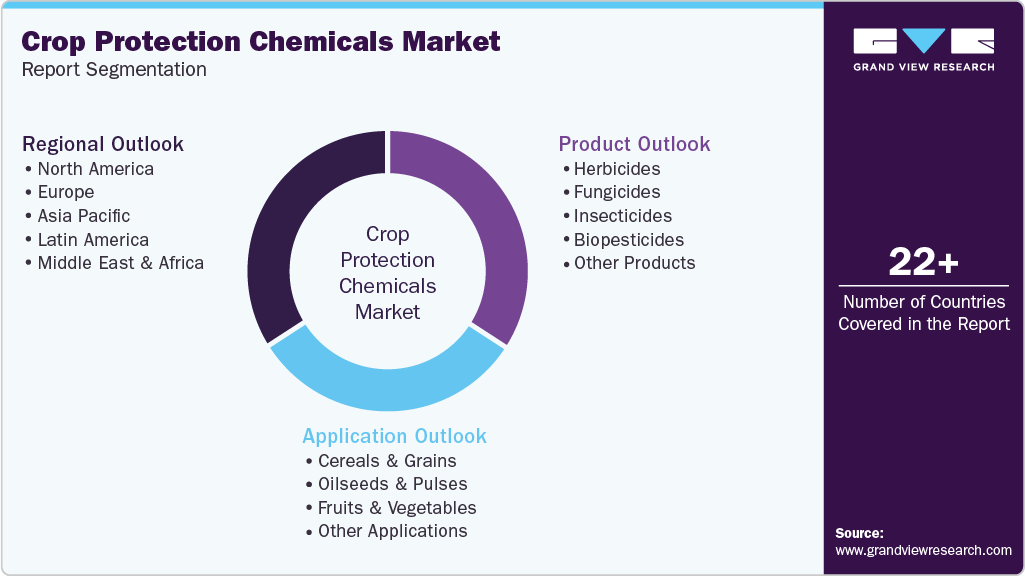
This report forecasts revenue growth at global, regional, and country levels and provides an analysis of the latest industry trends in each of the sub-segments from 2018 to 2033. For this study, Grand View Research has segmented the global crop protection chemicals market report based on product, application, and region:
-
Product Outlook (Revenue, USD Million; Volume, Kilotons, 2018 - 2033)
-
Herbicides
-
By Product
-
Selective
-
Non-selective
-
-
By Active Ingredients
-
Glyphosate
-
Atrazine
-
2,4-D
-
Other Active Herbicide Ingredients
-
-
-
Fungicides
-
By Active Ingredients
-
Chlorathalonil
-
Sulfur
-
PCNB
-
Maneb
-
Other Active Fungicide Ingredients
-
-
-
Insecticides
-
By Active Ingredients
-
Malathion
-
Carbaryl
-
Chlorpyrifos
-
Other Active Insecticide Ingredients
-
-
-
Biopesticides
-
Other Products
-
-
Application Outlook (Revenue, USD Million; Volume, Kilotons, 2018 - 2033)
-
Cereals & Grains
-
Oilseeds & Pulses
-
Fruits & Vegetables
-
Other Applications
-
-
Regional Outlook (Revenue, USD Million; Volume, Kilotons, 2018 - 2033)
-
North America
-
U.S.
-
Canada
-
Mexico
-
-
Europe
-
Germany
-
France
-
Spain
-
Italy
-
UK
-
Eastern Europe
-
-
Asia Pacific
-
China
-
India
-
Japan
-
South Korea
-
Indonesia
-
Thailand
-
Australia
-
-
Latin America
-
Brazil
-
Argentina
-
-
Middle East & Africa
-
Saudi Arabia
-
South Africa
-
-
Frequently Asked Questions About This Report
b. Key factors that are driving the development of new and more effective active ingredients, including biopesticides and environmentally friendly alternatives, enhance the efficacy of crop protection solutions while minimizing environmental impact.
b. The global crop protection chemicals market size was estimated at USD 50,218.3 million in 2025 and is expected to reach USD 52,955.7 million in 2026.
b. The global crop protection chemicals market is expected to grow at a compound annual growth rate of 5.4% from 2026 to 2033, reaching USD 76,496.4 million by 2033.
b. Latin America crop protection chemicals market dominated the global market, accounting for a 32.0% value share in 2025, Investment in modern farming practices is another critical driver of the crop protection chemicals market in these regions.
b. Some of the key players operating in the market include American Vanguard Corporation; Arysta LifeSciences Corporation; Bayer AG; BASF SE; FMC Corporation; Corteva; Dhr. Hansen Holding A/S; UPL Limited; Syngenta Group; Sumitomo Chemical Co. Ltd.


Share this report with your colleague or friend.
Need a Tailored Report?
Customize this report to your needs — add regions, segments, or data points, with 20% free customization.


ISO 9001:2015 & 27001:2022 Certified
We are GDPR and CCPA compliant! Your transaction & personal information is safe and secure. For more details, please read our privacy policy.
Trusted market insights - try a free sample
See how our reports are structured and why industry leaders rely on Grand View Research. Get a free sample or ask us to tailor this report to your needs.