- Home
- »
- Specialty Glass, Ceramic & Fiber
- »
-
Concrete Reinforcing Fiber Market Size & Share Report, 2033GVR Report cover
![Concrete Reinforcing Fiber Market Size, Share & Trends Report]()
Concrete Reinforcing Fiber Market (2026 - 2033) Size, Share & Trends Analysis Report By Product (PE, PP, Steel, Basalt), By Application (Infrastructure, Building & Construction, Industrial), By Region (North America, Europe, APAC, CSA, MEA), And Segment Forecasts
- Report ID: GVR-2-68038-757-5
- Number of Report Pages: 125
- Format: PDF
- Historical Range: 2021 - 2024
- Forecast Period: 2026 - 2033
- Industry: Advanced Materials
- Report Summary
- Table of Contents
- Interactive Charts
- Methodology
- Download FREE Sample
-
 Download Sample Report
Concrete Reinforcing Fiber Market Summary
The global concrete reinforcing fiber market size was estimated at USD 2.73 billion in 2025 and is projected to reach USD 5.22 billion by 2033, growing at a CAGR of 8.7% from 2026 to 2033. The demand for concrete reinforcing fibers is increasing due to rapid urbanization and large-scale infrastructure development across residential, commercial, and industrial construction.
Key Market Trends & Insights
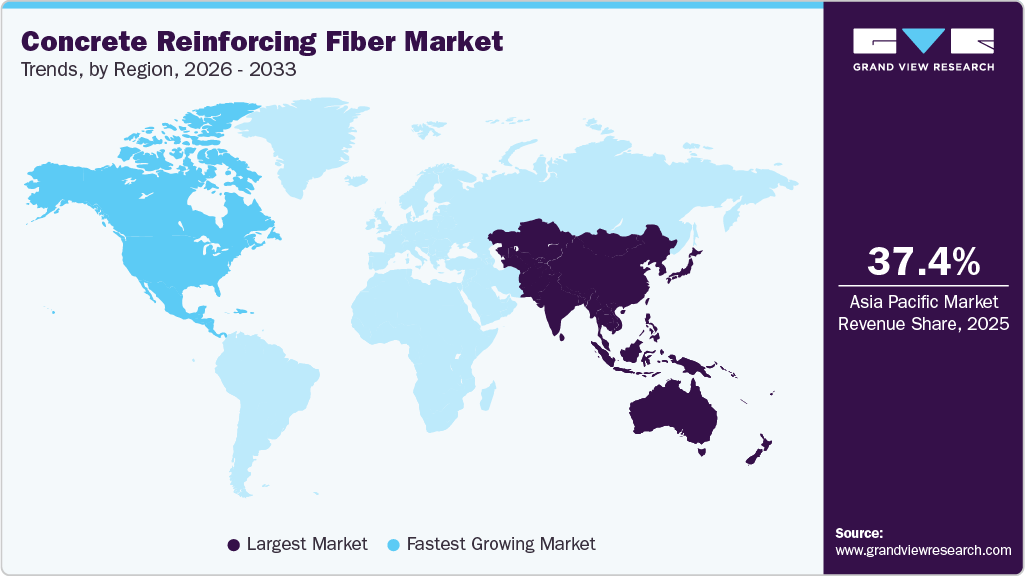
- Asia Pacific dominated the concrete reinforcing fiber market with the largest revenue share of 37.4% in 2025.
- By product, the basalt segment is expected to grow at the fastest CAGR of 10.4% over the forecast period.
- By application, the infrastructure segment is expected to grow at the fastest CAGR of 9.3% over the forecast period.
Market Size & Forecast
- 2025 Market Size: USD 2.73 Billion
- 2033 Projected Market Size: USD 5.22 Billion
- CAGR (2026-2033): 8.7%
- Asia Pacific: Largest market in 2025
- North America: Fastest growing market
These fibers enhance crack resistance, durability, and load-bearing capacity of concrete, making them suitable for modern high-performance structures. Growing adoption of precast concrete elements is further boosting demand, as fibers reduce the need for conventional steel reinforcement. Rising construction activities in emerging economies, especially in the Asia Pacific and the Middle East, are contributing significantly to market growth. The shift toward longer-lasting and low-maintenance construction materials is also supporting adoption.Key drivers include the need to improve concrete performance while reducing overall construction costs and labor dependency. Reinforcing fibers minimize shrinkage cracking and improve tensile strength, reducing reliance on traditional rebar and mesh systems. The growing use of fiber-reinforced concrete in infrastructure repair and rehabilitation projects is another major driver. Industrial and warehouse flooring applications are expanding due to rising logistics and e-commerce activities. Demand is also supported by faster construction timelines enabled by fiber-based solutions. Improved fire resistance and durability offered by synthetic and steel fibers enhance their appeal.
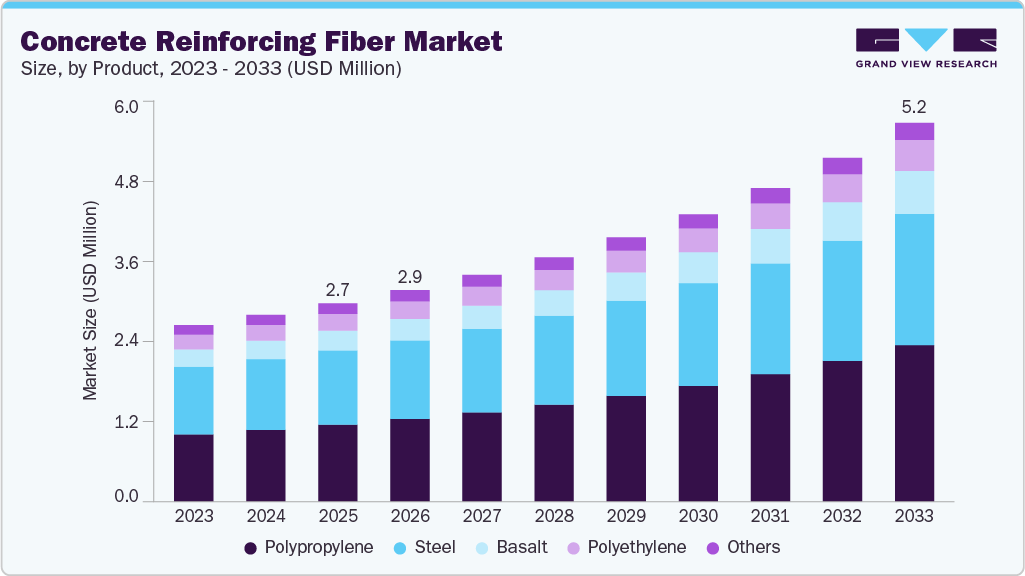
The market is witnessing increased innovation in synthetic and hybrid fiber formulations for improved performance. Advanced polypropylene, basalt, and glass fibers are gaining traction due to corrosion resistance and lightweight properties. Hybrid fiber systems combining steel and synthetic fibers are emerging to optimize strength and flexibility. Manufacturers are focusing on improving fiber dispersion and bonding characteristics within concrete mixes. The use of fibers in 3D-printed concrete is an emerging trend. Smart construction practices are encouraging ready-mix fiber-reinforced solutions. Continuous R&D is leading to cost-effective alternatives with enhanced durability.
Market Concentration & Characteristics
The concrete reinforcing fiber industry is moderately fragmented, with the presence of global manufacturers alongside strong regional players. Large companies benefit from integrated supply chains, extensive distribution networks, and strong relationships with construction firms. Regional suppliers cater to localized demand, particularly in developing markets. Competition is driven by product performance, pricing, and technical support capabilities. Entry barriers are moderate due to raw material availability and established customer relationships. Product differentiation through fiber type and application-specific solutions is common. Strategic partnerships with construction and ready-mix concrete companies strengthen market positioning.
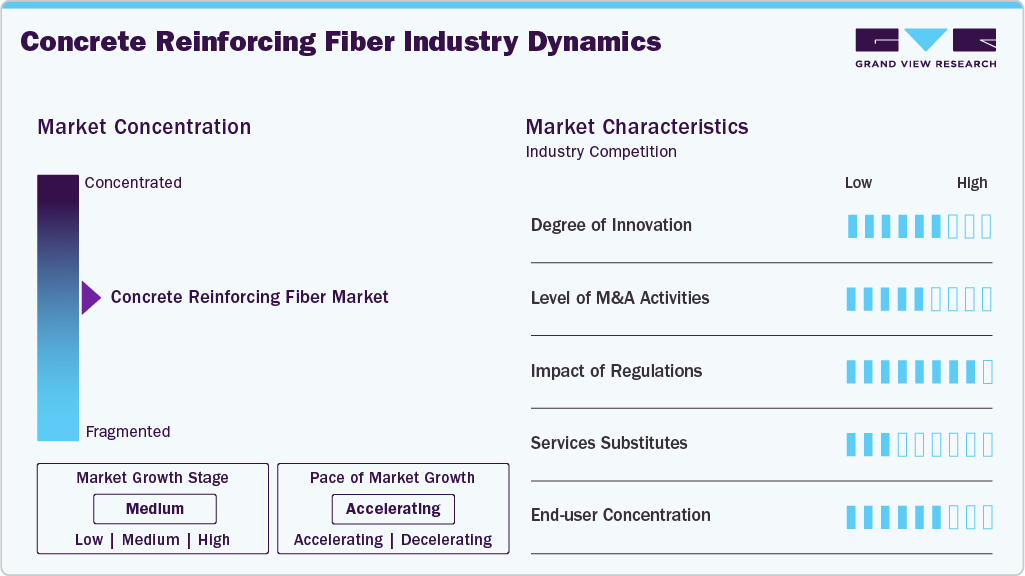
Traditional steel reinforcement bars and welded wire mesh remain the primary substitutes for reinforcing fibers. In structural applications requiring high load-bearing capacity, conventional reinforcement continues to dominate. However, fibers are increasingly used in combination with steel reinforcement rather than as a complete replacement. Advancements in high-performance concrete may reduce dependence on fibers in some applications. Cost sensitivity in price-driven markets poses a challenge for fiber adoption. Despite this, fibers offer advantages in crack control and durability that substitutes struggle to match.
Product Insights
Polypropylene (PP) dominated the market and accounted for a share of 38.8% in 2025. PP fibers are one of the most abundantly available forms of fibers. The hydrophobic nature of these fibers, which imparts corrosion-resistant properties to concrete material, is expected to boost the segment growth. These fibers have the ability to protect the concrete constructions from cracks, thus improving the overall strength of the structure. Furthermore, the reinforcement of polypropylene fibers improves the tensile strength and toughness of the material, thereby resulting in better deformation characteristics of the structure. The aforementioned factors are anticipated to result in a high demand for polypropylene fibers in construction applications over the forecast period.
Basalt is projected to grow at the fastest CAGR of 10.4% over the forecast period. Basalt fibers have the ability to improve up to 30% brand strength of concrete and the overall mass of the concrete product. Furthermore, the application of basalt fiber in concrete results in up to 40% reduction in delamination of concrete. Furthermore, properties including high damping and radio transparency associated with these fibers are expected to propel their demand in construction applications.
Application Insights
The infrastructure application segment dominated the market in 2025 with a revenue share of 44.9%. Fiber-reinforced concrete is used on a large scale in bridges, airports, canals, and roads, which is expected to drive the demand for fibers used for concrete reinforcement. Rising government spending on urban planning and management is expected to boost infrastructure growth, which, in turn, is anticipated to impact the market on a positive note. Fiber-reinforced concrete is widely utilized to tackle the corrosion issues associated with steel bars used in infrastructure construction. The use of fiber-reinforced concrete helps repair deteriorated beams & columns and strengthen structural components of bridges and other infrastructure structures. Furthermore, fiber-reinforced concrete offers crack resistance, superior load-bearing capacity, and excellent impact resistance to various infrastructure structures, including waterways, bridges, and pipelines.
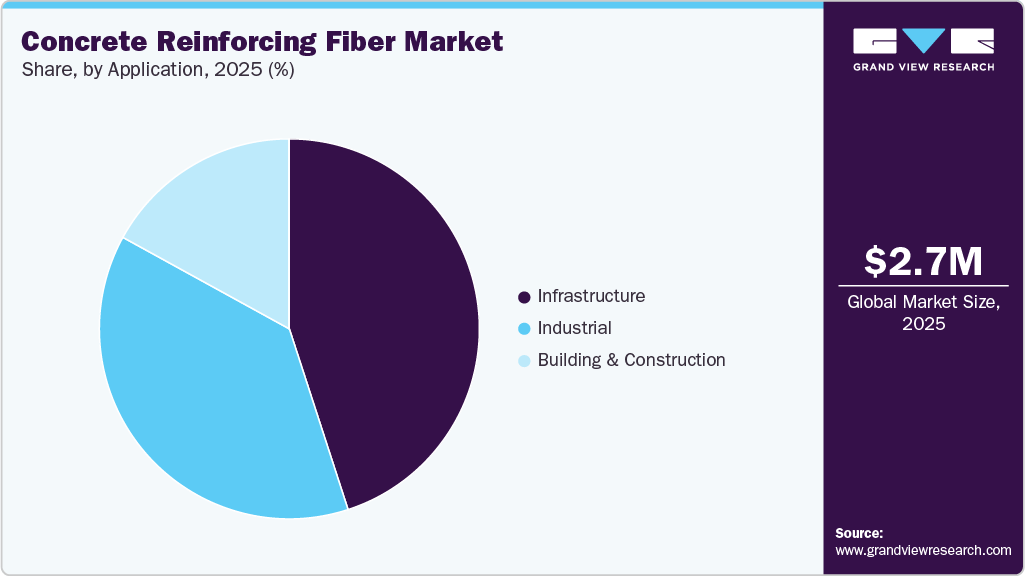
Building & construction, which is inclusive of residential apartments, individual houses, shopping malls & complexes, schools, offices, and government buildings, is one of the major consumers of concrete reinforcing fibers. The selection of the type of fiber used for this application is dependent on the purpose of the construction, budget, and construction type. Traditional concrete has been dominating this segment since the historic period, especially in the Asia Pacific. However, rising consumer awareness regarding the product benefits, such as improved durability and impact & load resistance, is expected to have a positive impact on market growth.
Regional Insights
Asia Pacific dominated the global concrete reinforcing fiber market and accounted for the largest revenue share of 37.4% in 2025, due to extensive infrastructure development and rapid urban expansion. High construction activity in transportation, housing, and industrial sectors drives demand. Cost-effective labor combined with large-scale government investments supports market growth. The region’s rising adoption of modern construction techniques further boosts fiber usage. Increasing precast concrete manufacturing contributes to higher demand. Urban redevelopment projects also support sustained growth.
China Concrete Reinforcing Fiber Market Trends
The concrete reinforcing fiber market in China leads regional demand due to massive investments in infrastructure, industrial parks, and urban redevelopment. Fiber-reinforced concrete is increasingly used in tunnels, bridges, and metro rail systems. The government focuses on durable and long-lasting infrastructure to support adoption. Domestic manufacturers benefit from economies of scale and strong supply chains. Industrial flooring applications are expanding rapidly. The use of fibers in precast and high-speed construction is increasing. China remains a key market growth engine.
North America Concrete Reinforcing Fiber Market Trends
The concrete reinforcing fiber market in North America shows steady growth supported by infrastructure renovation and repair projects. Aging bridges, highways, and public infrastructure are key demand drivers. Fiber-reinforced concrete is widely used in pavements, industrial floors, and residential construction. High adoption of advanced construction technologies supports market penetration. Sustainability and long-life performance requirements favor fiber use. The presence of established players strengthens market stability. Demand is driven more by quality enhancement than volume expansion.
The U.S. concrete reinforcing fiber market is driven by infrastructure modernization and increased industrial construction. Fibers are increasingly adopted in warehouse flooring due to the growth of logistics and e-commerce. Federal and state funding for infrastructure upgrades supports demand. Adoption in residential applications is also increasing. Emphasis on reducing construction time and maintenance costs favors fiber solutions. Technological advancements improve fiber compatibility with ready-mix concrete. The market shows stable, technology-led growth.
Europe Concrete Reinforcing Fiber Market Trends
The concrete reinforcing fiber market in Europe is driven by stringent construction standards and durability requirements. Fiber-reinforced concrete is widely used in tunnels, bridges, and transportation infrastructure. Sustainability regulations encourage longer-lasting construction materials. Demand is strong in precast and industrial flooring applications. High labor costs make fiber solutions attractive for reducing construction complexity. Renovation of aging infrastructure supports market growth. Western Europe contributes significantly to regional revenue.
Germany concrete reinforcing fiber market represents a mature but stable market driven by infrastructure maintenance and industrial construction. High-quality standards encourage the use of advanced fiber solutions. Industrial flooring and transport infrastructure are key application areas. Strong emphasis on engineering precision supports fiber adoption. Domestic manufacturers focus on innovation and performance optimization. Demand is supported by sustainability and durability goals. The market remains technology-driven rather than volume-driven.
Latin America Concrete Reinforcing Fiber Market Trends
The concrete reinforcing fiber market in Latin America is experiencing gradual growth driven by infrastructure development and urban housing projects. Brazil and Mexico lead regional demand. Fiber-reinforced concrete is increasingly used in roads and industrial facilities. Budget constraints influence product selection, favoring cost-effective fiber solutions. Public infrastructure investments support demand growth. Local manufacturers play a significant role in supply. The market shows moderate but improving adoption rates.
Middle East & Africa Concrete Reinforcing Fiber Market Trends
The concrete reinforcing fiber market in the Middle East & Africa is driven by large-scale construction and infrastructure projects. High demand from commercial buildings, airports, and transport networks supports fiber adoption. Fibers are used extensively in industrial flooring and precast applications. Government-led development initiatives boost market expansion. Hot climatic conditions increase demand for crack-resistant concrete solutions. The presence of mega-projects sustains demand momentum. The region shows strong growth potential over the forecast period.
Key Concrete Reinforcing Fiber Company Insights
Some of the key players operating in the market include BASF SE, Sika AG, Bekaert, and Owens Corning.
-
BASF SE is engaged in the manufacturing and distribution of chemicals for use in building & construction, pharmaceutical, and industrial applications. The company’s business segments include chemicals, agriculture, construction, automotive & transportation, electrical & electronics, energy & resources, furniture & wood, home care, and nutrition. Other segments are inclusive of packaging & printing, paints & coatings, pharmaceuticals, personal care & hygiene, plastic & rubber, pulp & paper, leather, and footwear & textile.
-
Bekaert produces and markets a number of products for metal-forming and coating technologies. It operates its business through four business units, namely wire, merchant products Europe, steel cord, and Bekaert advanced materials. Industries served by the company include automotive, construction, energy & utilities, agriculture, and consumer goods.
ABC Polymer Industries, LLC, Nycon Corporation, and Forta Corporation are some of the emerging market participants.
-
Forta Corporation produces and installs fiber reinforcements for concrete applications. It operates through four business segments, namely Forta concrete fiber, Forta asphalt fiber, Arisfor coatings & sealers, and Forta delivery systems.
-
Nycon Corporation develops, produces, and supplies reinforced fibers made of synthetic and steel. The products offered by the company are marketed globally through a network of sales experts. It has distribution facilities in Pennsylvania and Florida.
Key Concrete Reinforcing Fiber Companies:
The following key companies have been profiled for this study on the concrete reinforcing fiber market.
- BASF SE
- Bekaert
- Cemex S.A.B. de C.V.
- Sika AG
- ABC Polymer Industries, LLC
- Nycon Corporation
- Ultratech Concrete
- Owens Corning
- Forta Corporation
- The Euclid Chemical Company
Recent Developments
-
In March 2025, Bekaert inaugurated its India Concrete Expertise Centre, a cutting-edge facility at its Lonand, Maharashtra plant focused on advancing research and development of fiber-reinforced concrete applications, including the world’s first laboratory dedicated to testing steel fiber use in spray concrete.
Concrete Reinforcing Fiber Market Report Scope
Report Attribute
Details
Market size value in 2026
USD 2.91 billion
Revenue forecast in 2033
USD 5.22 billion
Growth rate
CAGR of 8.7% from 2026 to 2033
Base year for estimation
2025
Historical data
2021 - 2024
Forecast period
2026 - 2033
Quantitative units
Revenue in USD million/billion and CAGR from 2026 to 2033
Report coverage
Revenue forecast, company ranking, competitive landscape, growth factors, and trends
Segments covered
Product, Application, Region
Regional scope
North America; Europe; Asia Pacific; CSA; MEA
Country scope
U.S.; Canada; Mexico; Germany; UK; France; Italy; China; Japan; India; Brazil; Saudi Arabia
Key companies profiled
BASF SE; Bekaert; Cemex S.A.B. de C.V.; Sika AG; ABC Polymer Industries, LLC; Nycon Corporation; Ultratech Concrete; Owens Corning; Forta Corporation; The Euclid Chemical Company
Customization scope
Free report customization (equivalent up to 8 analysts working days) with purchase. Addition or alteration to country, regional & segment scope.
Pricing and purchase options
Avail customized purchase options to meet your exact research needs. Explore purchase options
Global Concrete Reinforcing Fiber Market Report Segmentation
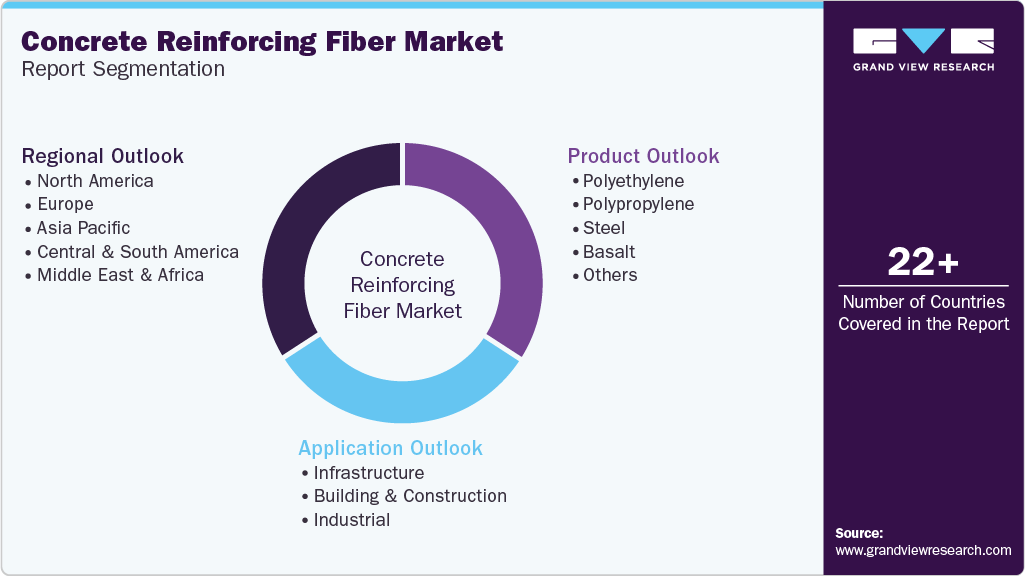
This report forecasts revenue growth at global, regional, and country levels and provides an analysis of the latest industry trends in each of the sub-segments from 2021 to 2033. For this study, Grand View Research has segmented the global concrete reinforcing fiber market report based on product, application, and region:
-
Product Outlook (Volume, Kilotons; Revenue, USD Million, 2021 - 2033)
-
Polyethylene
-
Polypropylene
-
Steel
-
Basalt
-
Others
-
-
Application Outlook (Volume, Kilotons; Revenue, USD Million, 2021 - 2033)
-
Infrastructure
-
Building & Construction
-
Industrial
-
-
Regional Outlook (Volume, Kilotons; Revenue, USD Million, 2021 - 2033)
-
North America
-
U.S.
-
Canada
-
Mexico
-
-
Europe
-
Germany
-
UK
-
France
-
Italy
-
-
Asia Pacific
-
China
-
Japan
-
India
-
-
Central & South America
-
Brazil
-
-
Middle East and Africa (MEA)
-
Saudi Arabia
-
-
Frequently Asked Questions About This Report
b. The key factors that are driving the concrete reinforcing fiber market include increasing construction activities, upward penetration in the construction industry, and the increasing need for non-corrosive materials in construction.
b. The infrastructure application segment dominated the market in 2025 with a revenue share of 44.9%.
b. Some of the key players operating in the BASF SE; Bekaert; Cemex S.A.B. de C.V.; Sika AG; ABC Polymer Industries, LLC; Nycon Corporation; Ultratech Concrete; Owens Corning; Forta Corporation; The Euclid Chemical Company
b. The global concrete reinforcing fiber market size was estimated at USD 2.73 billion in 2025 and is expected to reach USD 2.91 billion in 2026.
b. The global concrete reinforcing fiber market is expected to grow at a compound annual growth rate of 8.7% from 2026 to 2033 to reach USD 5.22 billion by 2033.


Share this report with your colleague or friend.
Need a Tailored Report?
Customize this report to your needs — add regions, segments, or data points, with 20% free customization.


ISO 9001:2015 & 27001:2022 Certified
We are GDPR and CCPA compliant! Your transaction & personal information is safe and secure. For more details, please read our privacy policy.
Trusted market insights - try a free sample
See how our reports are structured and why industry leaders rely on Grand View Research. Get a free sample or ask us to tailor this report to your needs.