- Home
- »
- Communication Services
- »
-
Compliance as a Service Market Size, Industry Report, 2033GVR Report cover
![Compliance as a Service Market Size, Share, & Trends Report]()
Compliance as a Service Market (2026 - 2033) Size, Share, & Trends Analysis Report By Component (Software, Services), By Compliance Type (Regulatory, Corporate), By Deployment, By Enterprise Size, By End Use, By Region, And Segment Forecasts
- Report ID: GVR-4-68040-878-2
- Number of Report Pages: 120
- Format: PDF
- Historical Range: 2021 - 2025
- Forecast Period: 2026 - 2033
- Industry: Technology
- Report Summary
- Table of Contents
- Segmentation
- Methodology
- Download FREE Sample
-
 Download Sample Report
Compliance as a Service Market Summary
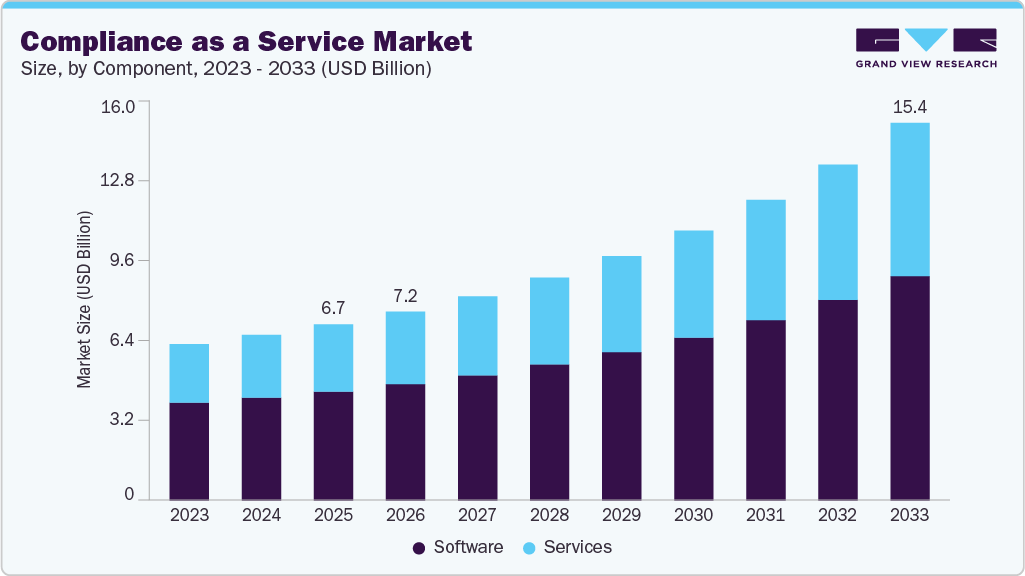
The global compliance as a service market size was estimated at USD 6.73 billion in 2025 and is projected to reach USD 15.35 billion by 2033, growing at a CAGR of 10.0% from 2026 to 2033. Rising demand for real-time audit readiness and documentation management is a key factor driving the market growth.
Key Market Trends & Insights
- North America held 34.2% revenue share of the global compliance as a service market.
- The U.S. compliance as a service market dominated in 2025.
- By component, software held the largest revenue share of above 69.17% in 2025.
- By compliance type, regulatory held the largest revenue share in 2025.
- By deployment, public cloud held the largest revenue share in 2025.
Market Size & Forecast
- 2025 Market Size: USD 6.73 Billion
- 2033 Projected Market Size: USD 15.35 Billion
- CAGR (2026 - 2033): 10.0%
- North America: Largest market in 2025
- Asia Pacific: Fastest growing market
The rapid acceleration of cloud adoption and digital transformation initiatives across industries is driving market growth. As enterprises migrate workloads, data, and applications to cloud and hybrid environments, maintaining consistent compliance visibility becomes more complex. Cloud environments are dynamic, with resources frequently provisioned and decommissioned, creating potential gaps in policy enforcement and audit tracking. Compliance as a Service(CaaS) platforms provide centralized oversight across multi-cloud and hybrid architectures, enabling organizations to maintain a continuous compliance posture despite operational agility. This capability is especially critical for sectors such as finance, healthcare, and telecommunications, where regulatory standards require demonstrable evidence of control implementation. The growth of remote work and distributed IT infrastructures further amplifies this need, as organizations require automated compliance monitoring beyond traditional on-premises boundaries.The increasing frequency and sophistication of cyber threats are another major driver fueling demand for compliance as a service. Regulatory frameworks increasingly mandate robust cybersecurity controls, incident response readiness, and continuous risk assessments. Organizations that fail to demonstrate adequate cybersecurity governance may face both regulatory penalties and loss of customer trust. CaaS providers integrate cybersecurity monitoring, vulnerability assessments, and risk-scoring mechanisms into compliance workflows, aligning security posture with regulatory obligations. This convergence of cybersecurity and compliance management reduces operational silos and enhances organizational resilience. As cyberattacks grow more complex and regulatory scrutiny intensifies following high-profile breaches, enterprises are prioritizing proactive compliance oversight supported by managed service providers.
The globalization of supply chains and third-party ecosystems further accelerates the adoption of CaaS solutions. Modern enterprises rely on extensive networks of vendors, contractors, and technology partners, each of whom may introduce compliance risk. Regulatory bodies increasingly require organizations to demonstrate oversight of their own operations and of third-party risk exposure. CaaS platforms enable continuous monitoring of vendor compliance status, contractual obligations, and data-handling practices. Automated third-party risk assessments and standardized reporting reduce the administrative burden of supplier audits while strengthening transparency in governance. As supply chains become more interconnected and digitalized, organizations view outsourced compliance management as a strategic enabler of risk mitigation.
The growing emphasis on corporate governance, transparency, and stakeholder accountability also drives the market. Investors, customers, and regulators expect companies to demonstrate measurable compliance with environmental, social, and governance (ESG) standards alongside traditional regulatory obligations. Compliance reporting has evolved from a back-office requirement to a strategic compliance type influencing brand reputation and investor confidence. CaaS providers facilitate automated documentation, policy tracking, and performance dashboards that support transparent disclosures. These tools enable leadership teams to assess risk exposure and align operational practices with governance commitments. As organizations face increasing scrutiny from shareholders and the public, maintaining consistent and verifiable compliance records becomes essential. Consequently, enterprises are adopting service-based compliance platforms to strengthen credibility and reinforce long-term sustainability strategies.
Component Insights
The software segment dominated the market with a share of 69.17% in 2025. The expansion of remote work and geographically dispersed operations drives the demand for software-driven compliance services. Organizations with distributed teams require centralized visibility into compliance posture regardless of employee location. Software platforms provide cloud-accessible dashboards that enable compliance officers to oversee activities across branches and subsidiaries in real time. Remote accessibility ensures consistent policy enforcement even when operations are decentralized. In addition, automated workflows facilitate collaboration among compliance, IT, and management teams without the need for physical documentation exchange. This digital-first compliance management approach aligns with broader trends in workplace transformation. As hybrid work environments become standard, software-based Compliance as a Service solutions continue to gain strategic importance.
The services segment is projected to be the fastest-growing segment from 2026 to 2033. The growing convergence of compliance and cybersecurity risk management is driving demand for service-oriented CaaS offerings. Many modern regulations require not only policy documentation but also active security risk mitigation and incident response readiness. Compliance service providers often combine advisory expertise with security assessments, penetration testing coordination, and oversight of vulnerability management. These integrated services help organizations align their cybersecurity posture with regulatory expectations in a structured and defensible manner. In addition, service providers assist in incident investigation and reporting processes to ensure regulatory communication requirements are fulfilled accurately and promptly. As cyber threats grow in frequency and sophistication, enterprises seek compliance partners capable of bridging regulatory obligations with technical security controls. This convergence drives sustained growth in compliance-focused managed services.
Compliance Type Insights
The regulatory compliance segment dominated the market with a revenue share in 2025. The increasing demand for audit readiness and defensible documentation is driving segment adoption. Regulatory authorities expect organizations to provide comprehensive evidence demonstrating the implementation and effectiveness of required controls. Traditional compliance methods relying on manual documentation, spreadsheets, and periodic assessments are insufficient in highly regulated sectors. Regulatory compliance-oriented CaaS platforms automate evidence collection, timestamp policy updates, and maintain centralized repositories of control documentation. This automation significantly reduces the time required to prepare for external audits and regulatory inspections. Moreover, service providers help organizations prepare for surprise audits and regulatory inquiries by conducting mock assessments and control validation exercises. As regulators demand more granular and transparent reporting, organizations turn to compliance service providers to ensure continuous readiness.
The data protection & privacy compliance segment is projected to grow significantly over the forecast period. The rising frequency and visibility of data breaches accelerate demand in this segment. High-profile incidents involving personal information leaks have heightened public awareness and regulatory enforcement intensity. Consumers are more sensitive than ever to how their data is handled, and regulators respond swiftly to privacy violations with substantial penalties and mandatory corrective actions. Compliance as a service providers help organizations establish structured incident response frameworks, breach notification workflows, and documentation practices aligned with privacy regulations. They also conduct privacy impact assessments and ongoing risk evaluations to reduce the likelihood of violations. This proactive management reduces reputational damage and financial risk. As cybersecurity threats continue to evolve, privacy compliance becomes inseparable from overall risk management strategies.
Deployment Insights
The public cloud segment dominated the market in 2025. The increasing integration of DevOps and cloud-native development practices drives demand for compliance automation in public cloud environments. Continuous integration and continuous deployment pipelines accelerate software delivery cycles, but they can inadvertently introduce compliance vulnerabilities if controls are not embedded early in development stages. Regulatory frameworks increasingly expect security and compliance to be integrated into system design, rather than applied retrospectively. CaaS providers support DevSecOps models by embedding automated compliance checks into development pipelines. This ensures that new workloads meet regulatory standards before deployment. By aligning compliance with agile development methodologies, organizations can maintain speed without compromising governance.
The hybrid cloud segment is expected to grow significantly over the forecast period. The growing need for unified risk management across distributed infrastructures is driving segment growth. Hybrid environments increase the attack surface by combining on-premises networks, private clouds, and public cloud services. Regulatory frameworks frequently require comprehensive risk assessments and continuous control validation across all operational assets. Disparate infrastructure layers can lead to fragmented compliance processes and inconsistent security postures. CaaS platforms centralize risk assessments, automate control testing, and provide consolidated reporting across hybrid ecosystems. This integrated visibility enhances the organization’s ability to identify vulnerabilities and proactively remediate issues. As hybrid infrastructures expand, enterprises rely on managed compliance services to maintain holistic risk governance.
Enterprise Size Insights
The large enterprise segment dominated the market in 2025. The strategic importance of audit readiness and continuous compliance assurance drives large enterprises to adopt advanced compliance services. Regulatory inspections and external audits can occur without extended notice, requiring immediate access to accurate documentation and evidence trails. Traditional periodic compliance reviews are no longer sufficient in dynamic regulatory environments. Compliance as a service solutions provide continuous monitoring, automated evidence collection, and real-time control validation. This ensures that enterprises remain audit-ready at all times rather than scrambling to prepare documentation reactively. The ability to demonstrate continuous compliance significantly reduces disruption during audits and strengthens stakeholder confidence. As regulatory expectations shift toward ongoing assurance models, large enterprises increasingly view Compliance as a Service as a foundational component of enterprise governance.
The small & medium enterprises segment is projected to be the fastest-growing segment from 2026 to 2033. Growing awareness of cybersecurity threats also drives SMEs toward CaaS adoption. Small and medium businesses are increasingly targeted by cybercriminals who perceive them as less protected than large enterprises. A single security breach can have devastating financial and reputational consequences for an SME, potentially threatening business continuity. Regulatory requirements often mandate specific cybersecurity controls, incident response procedures, and breach reporting protocols. CaaS providers integrate regulatory compliance with security governance, offering risk assessments, policy implementation support, and automated monitoring. This holistic approach strengthens both compliance posture and operational resilience. As SMEs recognize the financial risks associated with non-compliance and data breaches, investment in managed compliance services continues to grow.
End Use Insights
The BFSI segment dominated the market in 2025. The expansion of cross-border financial services and globalized banking operations is driving segment growth. Many financial institutions operate internationally, providing services across multiple regulatory jurisdictions with differing compliance standards. Managing divergent reporting requirements, transaction monitoring thresholds, and consumer protection laws across regions is operationally complex. CaaS providers offer centralized compliance frameworks that integrate jurisdiction-specific requirements into unified monitoring systems. This harmonized approach simplifies regulatory reporting and reduces the risk of inconsistencies across branches and subsidiaries. It also enhances transparency for global regulatory audits and cross-border supervisory reviews. As financial markets become more interconnected, scalable compliance solutions play a vital role in sustaining lawful global operations.
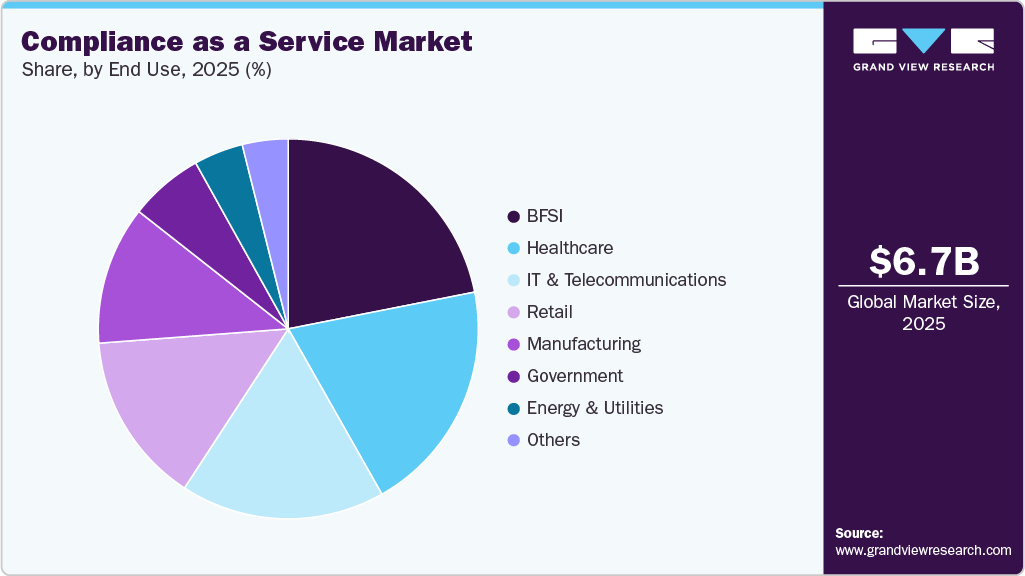
The IT & telecommunications segment is projected to be the fastest-growing segment from 2026 to 2033. The accelerating deployment of advanced technologies such as 5G, edge computing, cloud-native network compliance types, and Internet of Things ecosystems. These innovations expand network capabilities but also introduce new regulatory considerations related to data sovereignty, cybersecurity resilience, and cross-border data flows. Telecom operators must ensure that emerging technologies comply with national security directives and sector-specific regulations. The rapid pace of technological change can outstrip the capacity of internal compliance teams to interpret and implement new requirements effectively. CaaS providers deliver updated regulatory intelligence, automated risk assessments, and continuous control validation tailored to evolving network architectures. This ensures that innovation does not create unintended compliance gaps.
Regional Insights
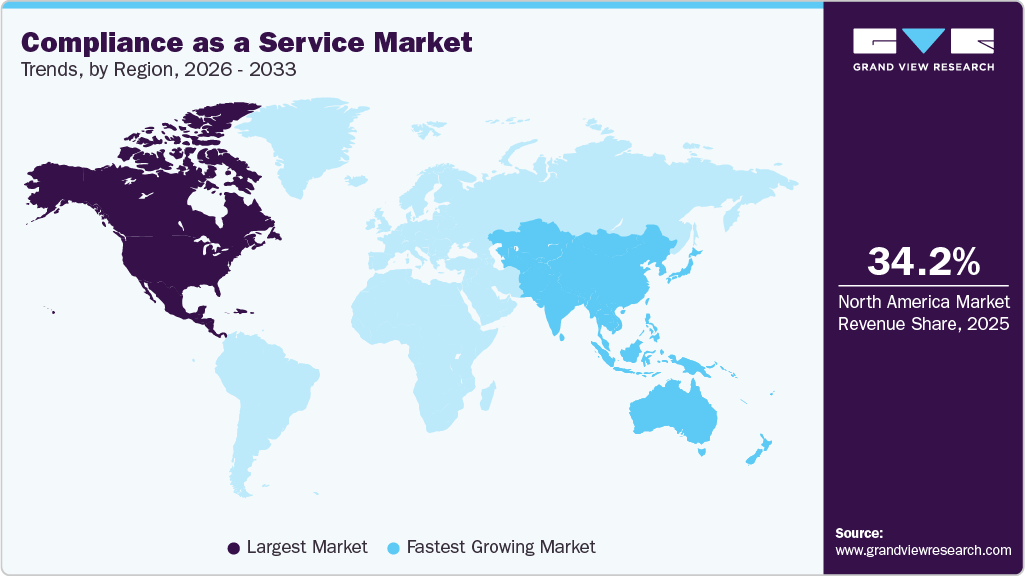
North America dominated the compliance as a service market with a market share of 34.2% in 2025. The expansion of cross-border trade and multinational business operations strengthens the need for managed compliance solutions. Many North American companies operate globally, interacting with customers, partners, and regulators across multiple jurisdictions. Cross-border data transfers, financial transactions, and supply chain operations introduce additional regulatory complexities. Organizations must demonstrate adherence not only to domestic regulations but also to international compliance frameworks. CaaS platforms centralize regulatory mapping and automate jurisdiction-specific reporting processes. This unified governance approach reduces fragmentation and enhances operational transparency.
U.S. Compliance as a Service Market Trends
The compliance as a service market in the U.S. dominated in 2025. The rapid pace of digital transformation across the U.S. economy fuels demand for managed compliance solutions. Businesses are expanding their use of cloud computing, artificial intelligence, digital payments, telehealth platforms, and remote work technologies to enhance competitiveness. While these technologies create operational efficiencies, they introduce new compliance complexities related to data governance, cybersecurity controls, and third-party risk management. The dynamic nature of digital ecosystems makes traditional compliance methods insufficient for maintaining continuous oversight. Compliance as a service providers integrate automated configuration monitoring and policy enforcement directly into digital infrastructures. This enables organizations to innovate without compromising regulatory alignment. As digital adoption accelerates across industries, compliance automation becomes increasingly critical.
Asia Pacific Compliance as a Service Market Trends
The compliance as a service market in the Asia Pacific is expected to be the fastest-growing segment, with a CAGR of 16.3% over the forecast period. The rising cybersecurity threat landscape in the region is a significant driver of market growth. Asia Pacific has seen a rise in ransomware attacks, financial fraud, data breaches, and critical infrastructure vulnerabilities. Governments are responding by tightening cybersecurity regulations and mandating stronger incident-reporting requirements. Organizations must demonstrate not only preventive security controls but also documented compliance with national cybersecurity standards. Compliance as a service platforms integrate regulatory compliance with cybersecurity monitoring, offering continuous control validation and automated audit trails. This strengthens organizational resilience while reducing the risk of regulatory penalties. As cyber threats become more sophisticated and frequent, compliance solutions serve as a key component of risk management strategies across industries.
China compliance as a service market has been growing significantly during the forecast period. The increasing enforcement activity and visible penalties for non-compliance drive segment growth. Chinese regulatory authorities have demonstrated a proactive approach to enforcing cybersecurity and data protection laws, including imposing fines and operational restrictions. Public enforcement actions create reputational risks and operational disruptions for organizations found in violation. Enterprises are therefore prioritizing preventive compliance strategies rather than reactive remediation efforts. CaaS platforms enable continuous compliance validation and automated reporting, reducing uncertainty regarding regulatory exposure. By maintaining structured audit trails and evidence documentation, organizations strengthen their ability to demonstrate due diligence.
Europe Compliance as a Service Market Trends
The compliance as a service market in Europe is anticipated to register considerable growth from 2026 to 2033. The widespread adoption of cloud computing, remote work technologies, and digital public services across Europe contributes to market expansion. Enterprises and public institutions are migrating workloads to public and hybrid cloud environments to enhance scalability and efficiency. However, cloud adoption introduces regulatory complexities related to data residency, access controls, and third-party risk management. Ensuring compliance across distributed digital ecosystems requires automated monitoring and unified governance frameworks. CaaS providers offer centralized dashboards and real-time policy enforcement tools tailored to cloud-based infrastructures. This enables organizations to maintain regulatory alignment while pursuing digital innovation.
The UK compliance as a service market is growing significantly during the forecast period. The expansion of cross-border trade and international partnerships strengthens the need for scalable compliance infrastructure. UK-based organizations often operate globally, engaging with markets across Europe, North America, and the Asia Pacific. Managing cross-border data transfers, financial transactions, and regulatory obligations requires harmonized governance systems. CaaS solutions centralize jurisdiction-specific requirements and automate reporting across multinational operations. This unified approach reduces fragmentation and enhances operational transparency. It also strengthens credibility with international regulators and business partners. As the UK continues to position itself as a globally connected economy, the market benefits from sustained demand driven by regulatory complexity, digital transformation, and governance expectations.
Key Compliance as a Service Company Insights
Some of the key companies operating in the market include Oracle Corporation, and IBM Corporation among others are some of the key players in the market.
-
DataGuard is a technology-driven company specializing in compliance, data protection, and information security management solutions. DataGuard’s product portfolio integrates software platforms with managed services to support end-to-end compliance management. Its solutions typically cover areas such as data protection compliance, information security management systems, risk assessments, policy management, audit preparation, and ongoing monitoring. The platform provides structured workflows, automated documentation, and centralized dashboards that allow organizations to track compliance status in real time. By embedding regulatory frameworks into digital tools, DataGuard helps businesses align with standards such as data protection regulations and internationally recognized information security certifications while reducing administrative burden.
-
Cloud4C is a global cloud managed services provider specializing in delivering secure, compliant, and scalable cloud transformation solutions for enterprises across industries such as banking, healthcare, government, and manufacturing. Cloud4C offers structured solutions that embed regulatory controls, monitoring mechanisms, and governance policies directly into cloud environments. Its product portfolio includes compliance management services aligned with international standards and sector-specific regulations, supported by automated monitoring tools and continuous risk assessments. Cloud4C helps organizations design compliant cloud architectures, implement security controls, manage audits, and maintain documentation required for certifications and regulatory reviews.
Key Compliance as a Service Companies:
The following key companies have been profiled for this study on the compliance as a service market.
- Cloud4C
- COE Security LLC
- Comhome Technology Solutions
- ControlCase LLC
- Corporate Technologies LLC
- Cyber Solutions Inc.
- DataGuard
- ESKA, Inc.
- GuidePoint Security LLC
- Rock Solid Technology Solutions
- Sattrix Information Security
- Securafy Inc.
- SupportSages Pvt Ltd.
- TENISITECH
- XBP Global
Recent Developments
-
In November 2025, Capgemini’s acquisition of Cloud4C significantly strengthens its compliance-as-a-service (CaaS) capabilities by integrating a 1,600-strong team specialized in platform-based services supported by AI-driven operations and advanced automation. Through this integration, Capgemini can deliver scalable, continuously monitored, and automated compliance frameworks embedded directly into cloud environments, enabling clients to meet regulatory, data governance, and industry-specific standards more efficiently. The enhanced cloud managed services portfolio now supports compliance-by-design architectures, where governance controls, risk monitoring, audit readiness, and regulatory reporting are embedded within managed cloud platforms rather than treated as standalone compliance types.
-
In June 2025, DataGuard signed a new agreement with QBS Software to further strengthen its position in the compliance as a service solution across Europe. Through this partnership, DataGuard is expanding access to its cloud-based compliance management platform, enabling a broader range of organizations to streamline risk governance, accelerate audit and certification timelines, and maintain continuous alignment with major regulatory and security frameworks. The collaboration enhances DataGuard’s ability to deliver scalable, subscription-based compliance solutions that reduce manual effort and improve real-time visibility into regulatory obligations.
-
In March 2025, ControlCase partnered with SupraITS, marking an important step forward in strengthening IT compliance and cybersecurity capabilities for managed service providers (MSPs) and their customers. Through this collaboration, SupraITS clients will benefit from seamless access to ControlCase’s comprehensive portfolio of certification and compliance services, including PCI DSS, SOC 2, CMMC, ISO standards, HIPAA, GDPR, and other regulatory frameworks.
Compliance as a Service Market Report Scope
Report Attribute
Details
Market size value in 2026
USD 7.16 billion
Revenue forecast in 2033
USD 15.35 billion
Growth rate
CAGR of 10.0% from 2026 to 2033
Actual data
2021 - 2025
Forecast period
2026 - 2033
Quantitative units
Revenue in USD million/billion and CAGR from 2026 to 2033
Report coverage
Revenue forecast, company ranking, competitive landscape, growth factors, and trends
Segments covered
Component, compliance type, deployment, enterprise size, end use, region
Regional scope
North America; Europe; Asia Pacific; Latin America; MEA
Country scope
U.S.; Canada; Mexico; UK; Germany; France; China; Japan; India; South Korea; Australia; Brazil; KSA; UAE; South Africa
Key companies profiled
Cloud4C; COE Security LLC; Comhome Technology Solutions; ControlCase LLC; Corporate Technologies LLC; Cyber Solutions Inc.; DataGuard; ESKA, Inc.; GuidePoint Security LLC; Rock Solid Technology Solutions; Sattrix Information Security; Securafy Inc.; SupportSages Pvt Ltd.; TENISITECH; XBP Global
Customization scope
Free report customization (equivalent up to 8 analysts working days) with purchase. Addition or alteration to country, regional & segment scope.
Pricing and purchase options
Avail customized purchase options to meet your exact research needs. Explore purchase options
Global Compliance as a Service Market Report Segmentation
This report forecasts revenue growth at global, regional, and country levels and offers qualitative and quantitative analysis of the market trends for each of the segments and sub-segments from 2021 to 2033. For this study, Grand View Research has segmented the global compliance as a service market based on component, compliance type, deployment, enterprise size, end use, and region:
-
Component Outlook (Revenue, USD Million, 2021 - 2033)
-
Software
-
Services
-
-
Compliance Type Outlook (Revenue, USD Million, 2021 - 2033)
-
Regulatory Compliance
-
Corporate Compliance
-
Data Protection & Privacy Compliance
-
Financial Compliance
-
Others
-
-
Deployment Outlook (Revenue, USD Million, 2021 - 2033)
-
Public Cloud
-
Private Cloud
-
Hybrid Cloud
-
-
Enterprise Size Outlook (Revenue, USD Million, 2021 - 2033)
-
Small & Medium Enterprises
-
Large Enterprise
-
-
End Use Outlook (Revenue, USD Million, 2021 - 2033)
-
BFSI
-
Retail
-
Healthcare
-
IT & Telecommunications
-
Government
-
Manufacturing
-
Energy & Utilities
-
Others
-
-
Regional Outlook (Revenue, USD Million, 2021 - 2033)
-
North America
-
U.S.
-
Canada
-
Mexico
-
-
Europe
-
UK
-
Germany
-
France
-
-
Asia Pacific
-
China
-
India
-
Japan
-
Australia
-
South Korea
-
-
Latin America
-
Brazil
-
-
Middle East & Africa
-
UAE
-
Saudi Arabia
-
South Africa
-
-
Frequently Asked Questions About This Report
b. The global compliance as a service market size was estimated at USD 6.73 billion in 2025 and is expected to reach USD 7.16 billion in 2026.
b. The global compliance as a service market is expected to grow at a compound annual growth rate of 10.0% from 2026 to 2033 to reach USD 15.35 billion by 2033.
b. The software segment dominated the compliance as a service market with a market share of 65% in 2025. The expansion of remote work and geographically dispersed operations drives the demand for software-driven compliance services.
b. Some key players operating in the market include Oracle Corporation, SAP SE, IBM Corporation, SAS Institute Inc., Anaplan, Inc., Unicorn Systems a.s., Epicor Software Corporation, Workday, Inc., OneStream, Board International, Wolters Kluwer N.V., Jedox, Prophix Software Inc., Acterys.
b. Factors such as rising demand for real-time audit readiness and documentation management and increasing cross-border operations requiring multi-jurisdiction compliance are the key factors driving the market growth.


Share this report with your colleague or friend.
Need a Tailored Report?
Customize this report to your needs — add regions, segments, or data points, with 20% free customization.


ISO 9001:2015 & 27001:2022 Certified
We are GDPR and CCPA compliant! Your transaction & personal information is safe and secure. For more details, please read our privacy policy.
Trusted market insights - try a free sample
See how our reports are structured and why industry leaders rely on Grand View Research. Get a free sample or ask us to tailor this report to your needs.