- Home
- »
- Communication Services
- »
-
Communication Surveillance Market, Industry Report, 2033GVR Report cover
![Communication Surveillance Market Size, Share & Trends Report]()
Communication Surveillance Market (2026 - 2033) Size, Share & Trends Analysis Report By Component, By Type (Electronic Communication Surveillance, Business Communications Surveillance), By Technology, By Deployment, By End User, By Region, And Segment Forecasts
- Report ID: GVR-4-68040-870-0
- Number of Report Pages: 130
- Format: PDF
- Historical Range: 2021 - 2024
- Forecast Period: 2026 - 2033
- Industry: Technology
- Report Summary
- Table of Contents
- Segmentation
- Methodology
- Download FREE Sample
-
 Download Sample Report
Communication Surveillance Market Summary
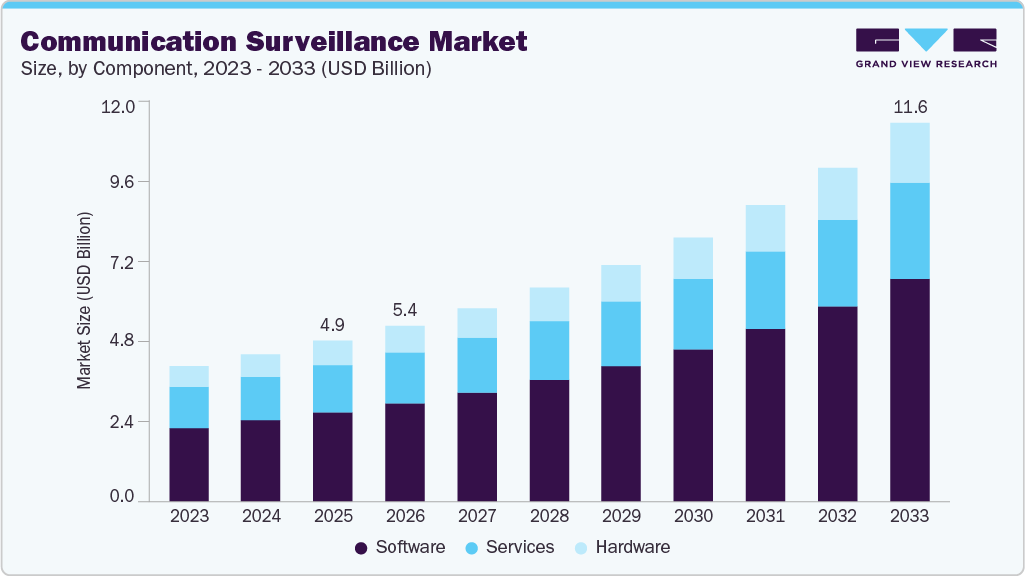
The global communication surveillance market size was estimated at USD 4.92 billion in 2025, and is projected to reach USD 11.59 billion by 2033, growing at a CAGR of 11.6% from 2026 to 2033.The escalating need for real-time monitoring and intelligence gathering across defense, law enforcement, and critical infrastructure sectors primarily drives this significant growth.
Key Market Trends & Insights
- The North America communication surveillance market accounted for a 38.3% global revenue share in 2025.
- The communication surveillance industry in the U.S. held a dominant position in 2025.
- By component, the software segment accounted for the largest share of 55.6% in 2025.
- By type, the government communications surveillance segment held the largest market share in 2025.
- By technology, the AI & NLP-based analysis segment dominated the market in 2025.
Market Size & Forecast
- 2025 Market Size: USD 4.92 Billion
- 2033 Projected Market Size: USD 11.59 Billion
- CAGR (2026-2033): 11.6%
- North America: Largest market in 2025
- Asia Pacific: Fastest-growing market in 2025
Rising cross-border threats, increasing cyber-enabled crimes, and the shift toward advanced IP-based communication channels have strengthened demand for sophisticated communication interception, analytics, and surveillance solutions. The rapid rise in online criminal activity has become a major force pushing governments and enforcement agencies to adopt more robust communication surveillance platforms. The FBI’s Internet Crime Complaint Center (IC3) continues to record surging complaint volumes and multi-billion-dollar financial losses in its annual releases, highlighting that criminals increasingly rely on digital communication channels to orchestrate fraud, extortion, and network intrusions. UNODC (United Nations Office on Drugs and Crime) reports also emphasize that cyber-enabled offenses now routinely cross borders, complicating investigations and increasing the need for real-time interception, metadata extraction, and digital evidence management tools. These developments are boosting the market for lawful intercept systems, encrypted communication monitoring, and forensic analytics offered to federal, state, and international enforcement bodies.The widespread shift to IP messaging apps, encrypted VoIP, and secure social media platforms has made traditional wiretapping mechanisms far less effective. ODNI (Office of the Director of National Intelligence) and U.S. congressional publications note that criminals increasingly exploit encrypted digital services to evade detection, creating investigative blind spots commonly referred to as “going dark.” Agencies such as DHS (Department of Homeland Security) document ongoing use and acquisition of telecommunications intercept technology in their Privacy Impact Assessments (PIAs), confirming a strong operational need for updated systems capable of accessing lawful communications content and metadata. These modernization pressures are propelling the market growth for IP-interception appliances, carrier-grade monitoring systems, and advanced protocol-analysis tools.
AI-enabled analytics have become a defining feature of modern surveillance environments. Government bodies, including the U.S. Department of Justice and OECD, have published guidance acknowledging both the opportunities and challenges of AI in criminal-justice ecosystems. As communication datasets expand exponentially, agencies increasingly prioritize tools that can automate voice-to-text transcription, detect anomalous communication patterns, and highlight high-risk signals with minimal human intervention. Federal procurement notices also reflect a growing preference for “AI-supported intelligence analysis” and automated triage features. This shift is boosting the market for integrated surveillance suites that combine interception, real-time analytics, and automated evidence processing.
Government cybersecurity agencies, including CISA (Cybersecurity and Infrastructure Security Agency), continue to advance nationwide resilience strategies, underscoring the need for improved monitoring of digital communication channels for both cyber and physical security. NIST’s special publications lay out stringent technical controls for secure communication, evidence protection, encryption, and device integrity, standards that buyers increasingly require vendors to meet. As agencies update their operational systems to comply with these federal controls, procurement budgets naturally shift toward compliant surveillance platforms with high-assurance data handling. This regulatory momentum is propelling the market growth, favoring capable suppliers that can meet federal standards and pushing smaller vendors toward partnerships or consolidation.
Oversight bodies and multilateral organizations, including UNODC, OECD, and national privacy offices, continue to highlight the need for transparency, minimization, and responsible use of surveillance technologies. U.S. DHS Privacy Impact Assessments repeatedly emphasize requirements such as data minimization, audit logs, approved access workflows, and proper incident reporting for systems that handle intercepted communications. These expectations are no longer optional; they are integral to procurement decisions and international project funding. As a result, vendors are embedding privacy-by-design features, automated redaction, consent controls, and detailed audit capabilities into their systems. This governance-driven shift is boosting the market, especially among buyers with strict compliance obligations or external oversight requirements.
Component Insights
The software segment led the communication surveillance market, accounting for the largest share of 55.6% in 2025, and is expected to grow at the fastest CAGR during the forecast period. Software is becoming the core engine of communication surveillance as buyers prioritize analytics-rich platforms over hardware-centric deployments. Vendors are integrating advanced correlation engines, AI-based prioritization, automated transcription, and encrypted-traffic analytics into unified dashboards used by investigators and compliance teams. Regulatory pressure for auditability, evidence integrity, and automated compliance reporting is boosting the adoption of software-driven surveillance ecosystems. The shift toward multi-source data fusion, voice, text, email, social media, and messaging apps further positions software as the decisive value layer in the market.
The hardware segment is expected to grow at a significant CAGR during the forecast period. Demand for communication surveillance hardware is rising as agencies seek faster, more resilient interception and signal-capture infrastructure. Modern monitoring environments require high-throughput probes, packet-inspection devices, encryption-handling modules, and multi-band receivers capable of extracting communication metadata across heterogeneous networks. Financial institutions, intelligence agencies, and telecom operators are replacing legacy hardware with modular, scalable appliances to improve real-time visibility across encrypted and IP-based channels. The shift toward hybrid communication ecosystems, mobile, VoIP, satellite, and dark-fiber networks, is propelling hardware modernization, especially in regions upgrading national security and lawful-intercept frameworks.
Type Insights
The government communications surveillance segment held the largest market share in 2025 and is expected to grow at a significant CAGR during the forecast period. Governments are accelerating investments in secure, classified communication surveillance systems designed to protect national command networks and detect unauthorized access to governmental messaging infrastructure. Modernization of intelligence-sharing channels, cross-border law-enforcement collaboration, and the strategic need to safeguard diplomatic communication are driving sustained spending in this segment. The proliferation of state-sponsored cyber operations has also pushed governments to procure surveillance tools capable of handling encrypted, anonymized, and multi-layered digital communication streams.
The electronic communication surveillance segment is expected to grow at the fastest CAGR during the forecast period. Electronic communication surveillance solutions are gaining traction as national security agencies and enterprises confront increasingly diversified threat vectors, from cyber-enabled fraud to coordinated digital espionage. The expansion of encrypted messaging platforms and the migration of voice traffic to IP networks have made packet-level visibility and metadata mapping essential. This category benefits from steady upgrades in spectrum monitoring, VoIP interception, and DPI (Deep Packet Inspection), all of which are propelling the market’s shift toward more sophisticated electronic surveillance frameworks.
Technology Insights
The AI & NLP-based analysis segment dominated the communication surveillance industry in 2025 and is expected to grow at a significant CAGR during the forecasted period. AI and natural-language processing are emerging as the most transformative technologies in communication surveillance. As communication volumes outpace human review capacities, AI engines are being used to classify conversations, detect anomalies, identify behavioral patterns, and extract actionable intelligence from multilingual datasets. NLP enables automatic entity extraction, contextual sentiment analysis, and thematic clustering, dramatically reducing investigative workload. The ability to swiftly sift through millions of voice notes, messages, and call records is boosting the adoption of AI-driven surveillance platforms across financial crime units, cyber-defense teams, and national security agencies.
The archiving and compliance storage segment is projected to grow at the fastest CAGR over the forecast period. The rise in global data-retention mandates, cross-border regulatory requirements, and strict audit obligations is pushing organizations toward secure archiving and compliance-focused storage solutions. Whether in banking, telecom, or public-sector operations, intercepted communications must be retained, indexed, encrypted, and retrievable under regulatory scrutiny. This has created strong demand for tamper-proof storage architectures with chain-of-custody controls and automated compliance workflows. Long-term retention laws and digital-evidence frameworks are propelling growth in this technology segment.
Deployment Insights
The on-premise segment dominated the communication surveillance market in 2025. On-premises deployments remain essential for agencies that require full physical control over surveillance infrastructure. Intelligence bodies, defense organizations, and financial institutions with high confidentiality needs continue to rely on in-house data centers to manage sensitive communication interception and evidence storage. The need to maintain air-gapped systems, highly restricted access environments, and custom security configurations is boosting the demand for on-premise systems despite the broader industry shift to the cloud.
The cloud segment is projected to grow at the fastest CAGR over the forecast period. Cloud-based surveillance systems are rapidly expanding as organizations pursue scalability, faster analytic processing, and lower upfront infrastructure costs. Cloud deployments support massive volumes of communication data, voice recordings, chat transcripts, and network logs, and enable real-time correlation across global data sources. Continuous software updates, elastic compute power for AI workloads, and seamless integration with distributed teams are propelling the migration of surveillance capabilities to secure cloud environments. Regulated industries are increasingly adopting sovereign cloud or compliance-attested cloud models to balance flexibility with data protection.
End User Insights
The regulators and government agencies segment dominated the market in 2025 and is projected to grow at a significant CAGR over the forecast period. Regulators and government agencies increasingly rely on communication surveillance to monitor systemic risks, enforce compliance, oversee financial markets, and support investigative operations. National security bodies use it for threat monitoring, while regulatory authorities deploy surveillance to ensure adherence to communication-control laws across banking, telecom, and public services. As digital ecosystems become more complex and as cross-border communication grows, these agencies require scalable, high-fidelity surveillance systems. This operational expansion is boosting long-term procurement trends within this end-user segment.
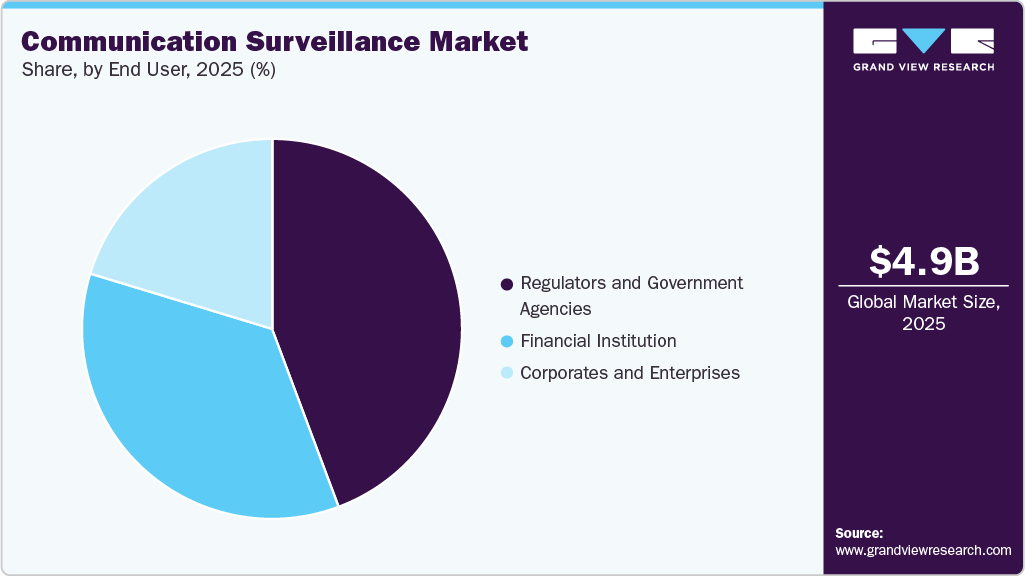
The financial institution segment is projected to grow at the fastest CAGR over the forecast period. Financial institutions face expanding regulatory scrutiny around insider trading, market manipulation, AML violations, and misconduct detection. Banks must capture and analyze emails, chats, mobile calls, collaboration platform messages, and remote work communication channels. This compliance-heavy environment is driving significant investment in communication surveillance systems capable of detecting risk-behavior patterns, identifying fraudulent intent, and ensuring audit-friendly retention of all monitored interactions. The adoption of hybrid work models and multi-platform communication tools has further intensified demand in this segment.
Regional Insights
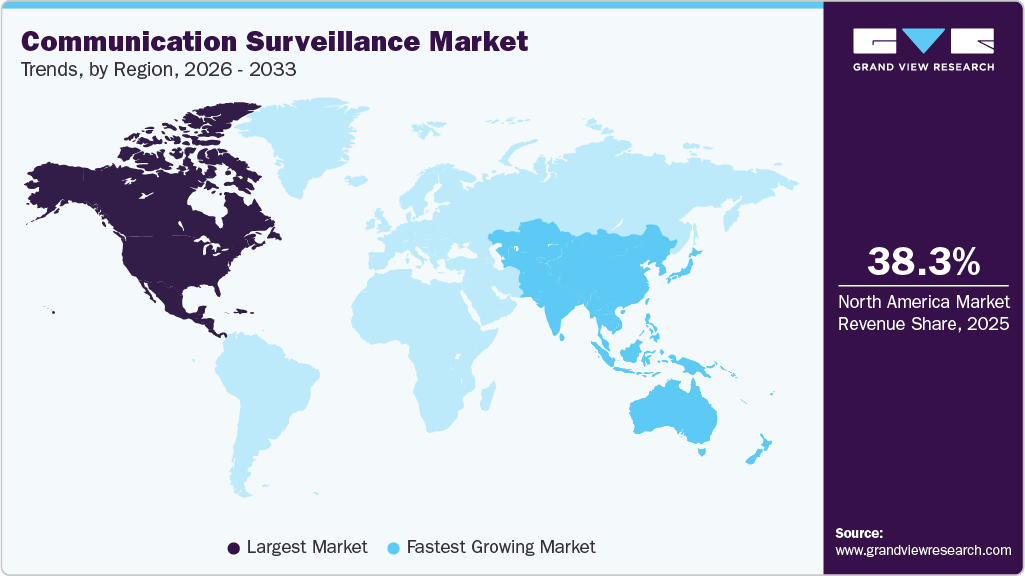
The North America communication surveillance market accounted for the largest share of 38.3% in 2025, driven by a mature regulatory environment and continuous modernization of public-safety and intelligence infrastructure. Law-enforcement agencies across the region are steadily upgrading to systems that can handle encrypted messaging, VoIP traffic, and rapidly expanding volumes of digital evidence. The region’s early adoption of 5G and cloud-native networks has also pushed surveillance platforms to evolve toward higher bandwidth, real-time analytics, and IP-centric monitoring. As a result, North America continues to represent a technologically progressive market where the emphasis is on speed, scalability, and compliance-ready communication monitoring.
U.S. Communication Surveillance Market Trends
The U.S. stands out as the most structured and legally codified market for communication surveillance solutions. Federal and state agencies operate within a clearly defined framework that governs how interceptions are authorized, executed, and audited. This legal clarity has led to sustained procurement of advanced interception probes, digital evidence platforms, and AI-enhanced analytics tools capable of operating under strict oversight. The rising sophistication of cyber-enabled crime, financial fraud, and cross-border communication threats is compelling agencies to invest in systems that integrate lawful intercept, voice analytics, and secure long-term storage. This environment reinforces the U.S. as a high-value market driven by operational demands, modernization cycles, and rigorous compliance expectations.
Europe Communication Surveillance Market Trends
The Europe communication surveillance industry was identified as a lucrative region in 2025. Europe’s communication surveillance landscape is shaped by a constant balancing act between national security needs and some of the world’s strongest privacy protections. Governments across the region are investing in updated interception systems that can capture IP-based traffic while also embedding strong audit trails, data minimization controls, and processing safeguards. The region’s ongoing digital transformation, especially the adoption of cloud communication platforms, cross-border data flows, and encrypted messaging, has intensified the need for compliant monitoring infrastructure. Europe’s market growth is therefore led by technologies that combine intelligence capabilities with transparent governance and strict data-handling standards.
The Germany communication surveillance market is expected to grow during the forecast period. Germany remains highly selective in adopting communication surveillance tools, largely due to strong constitutional safeguards and stringent oversight structures. Recent legal scrutiny has pushed security agencies to move away from broad monitoring and instead enhance the precision, auditability, and proportionality of their surveillance mechanisms. This shift is encouraging demand for highly targeted interception platforms, metadata-centric monitoring, and solutions that allow controlled access and detailed logging. Germany’s market is evolving toward tools that can meet both national security requirements and the country’s high standards for privacy and accountability.
The communication surveillance market in the UK is uniquely structured, governed by a comprehensive surveillance framework that outlines how interception, data retention, and equipment interference must be carried out. Continuous reviews of these rules have reinforced the importance of transparency, judicial approval, and independent oversight. As communication channels become more complex, from encrypted mobile apps to distributed cloud platforms, the UK is investing in modern interception systems capable of tracking high-risk interactions while maintaining strict procedural compliance. This dual focus on capability and accountability is strengthening demand for interoperable, audit-ready surveillance ecosystems.
Asia Pacific Communication Surveillance Market Trends
The Asia Pacific communication surveillance industry is expected to grow at the fastest CAGR during the forecast period, as governments respond to rising cybercrime, expanding telecom networks, and increasing geopolitical tensions. The rollout of 5G across major economies has accelerated the need for systems that can monitor high-volume, high-speed digital communication. In many APAC markets, modernization programs are underway to replace legacy surveillance infrastructure with AI-enabled, multi-channel solutions that can keep pace with encrypted and cross-border communication traffic. This combination of digital growth and security pressure is making APAC one of the fastest-evolving regions in the global market.
China’s communication surveillance market is characterized by large-scale, state-driven investment in digital surveillance and communication-monitoring infrastructure. With national security positioned as a core priority, the country continues to expand its interception capabilities, data-fusion platforms, and real-time analytics systems. The strong integration of surveillance into telecom and internet services, combined with ongoing upgrades to national communication networks, creates a sizable domestic market for high-capacity monitoring tools. China’s emphasis on centralized control and technical self-reliance further drives demand for domestically developed surveillance technologies.
The communication surveillance market in Japan is shaped by the country’s careful approach to security, privacy, and modernization. As cyber risks increase and digital communication platforms proliferate, Japanese agencies are strengthening their interception and monitoring capabilities. The expansion of fiber-optic networks, IoT devices, and cloud communication services has pushed the market toward tools that can analyze diverse, high-volume communication data. Japan’s focus on operational precision, technological reliability, and compliance with regulatory norms favors advanced systems that blend intelligence gathering with strict procedural controls.
India’s communication surveillance market is experiencing a significant transformation as the country updates its surveillance laws and strengthens its digital security ecosystem. New procedural rules governing lawful interception have clarified how agencies are authorized, how oversight committees function, and how communication data must be handled. These regulatory shifts come at a time when India's digital communication traffic, mobile messaging, social platforms, and fintech interactions are expanding at unprecedented speed. The combination of regulatory modernization and rising digital risk is driving strong demand for scalable, compliant surveillance platforms capable of managing encrypted and multi-channel communication streams.
Key Communication Surveillance Company Insights
Some of the major players in the global communication surveillance market include BAE Systems, Verint Systems, NICE, Utimaco, Ericsson, Cisco Systems, Nokia, Thales, Elbit Systems, and SS8, among others, due to their advanced lawful-interception platforms, high-performance network monitoring systems, integration with telecom infrastructure, and long-standing partnerships with intelligence agencies, defense organizations, telecom operators, and financial regulators. These companies continue to strengthen their market position by offering scalable interception, data analytics, encrypted communication monitoring, and AI-driven threat detection capabilities that support real-time intelligence gathering and regulatory compliance.
-
BAE Systems is one of the most established global defense and cybersecurity firms, offering a broad suite of communication intelligence and interception capabilities used by government security agencies worldwide. The company’s portfolio includes advanced SIGINT solutions, IP-based traffic monitoring tools, and secure communication analysis platforms designed to support lawful surveillance and counter-terrorism operations. BAE’s systems are widely adopted due to their ability to process large volumes of encrypted, high-speed digital communications across mobile, satellite, and IP networks. With strong government contracts and deep expertise in intelligence analytics, BAE Systems plays a critical role in enabling national security organizations to detect threats, analyze hostile communication patterns, and maintain secure operational environments.
-
Verint Systems is a key player in communication surveillance with its robust interception, decryption support, and communication analytics platforms. The company specializes in delivering integrated solutions for real-time monitoring of voice, video, and digital communications, particularly for law enforcement, intelligence communities, and public-safety agencies. Verint’s systems enable multi-channel surveillance, behavioral analysis, and automated intelligence extraction using AI-enhanced analytics. Its global deployments across telecom networks and government agencies make it a longstanding leader in both lawful interception and compliance-driven monitoring. The company’s architecture also supports the capture of encrypted communication, making it a preferred partner for agencies facing sophisticated cyber and terrorist threats.
Key Communication Surveillance Companies:
The following key companies have been profiled for this study on the communication surveillance market.
- BAE Systems
- Verint Systems
- NICE
- Utimaco
- Ericsson
- Cisco Systems
- Nokia
- Thales
- Elbit Systems
- SS8
Recent Developments
-
On June 27, 2025, SS8 Networks was acquired by Mill Point Capital LLC in a strategic move aimed at accelerating its expansion, strengthening its AI-driven surveillance capabilities, and enhancing its portfolio of investigative solutions for intelligence agencies and law-enforcement organizations.
-
On September 16, 2020, BAE Systems signed a five-year deal with a major North American communications service provider to deliver a 5G Stand-Alone Lawful Interception (LI) capability for its newly deployed 5G SA network, a milestone showing BAE’s leadership in embedding standardized interception modules in next-generation telecom infrastructure.
Communication Surveillance Market Report Scope
Report Attribute
Details
Market size value in 2026
USD 5.39 billion
Revenue forecast in 2033
USD 11.59 billion
Growth rate
CAGR of 11.6% from 2026 to 2033
Base year for estimation
2025
Historical data
2021 - 2024
Forecast period
2026 - 2033
Quantitative units
Revenue in USD million/billion and CAGR from 2026 to 2033
Report coverage
Revenue forecast, company ranking, competitive landscape, growth factors, and trends
Segments covered
Component, type, technology, deployment, end user, region
Regional scope
North America; Europe; Asia Pacific; Latin America; MEA
Country scope
U.S.; Canada; Mexico; Germany; UK; France; China; Japan; India; South Korea; Australia; Brazil; KSA; UAE; South Africa
Key companies profiled
BAE Systems; Verint Systems; NICE; Utimaco; Ericsson; Cisco Systems; Nokia; Thales; Elbit Systems; SS8
Customization scope
Free report customization (equivalent up to 8 analysts working days) with purchase. Addition or alteration to country, regional & segment scope.
Pricing and purchase options
Avail customized purchase options to meet your exact research needs. Explore purchase options
Global Communication Surveillance Market Report Segmentation
This report forecasts revenue growth at the global, regional, and country levels and provides an analysis of the latest industry trends in each of the sub-segments from 2021 to 2033. For this study, Grand View Research has segmented the global communication surveillance market report based on component, type, technology, deployment,end user, and region:
-
Component Outlook (Revenue, USD Million, 2021 - 2033)
-
Hardware
-
Software
-
Services
-
-
Type Outlook (Revenue, USD Million, 2021 - 2033)
-
Electronic Communication Surveillance
-
Business Communications Surveillance
-
Government Communications Surveillance
-
-
Technology Outlook (Revenue, USD Million, 2021 - 2033)
-
AI & NLP-based Analysis
-
Archiving and Compliance Storage
-
Real-Time Monitoring and Alerts
-
Behavioral Analytics and Pattern Detection
-
-
Deployment Outlook (Revenue, USD Million, 2021 - 2033)
-
On-premise
-
Cloud
-
-
End User Outlook (Revenue, USD Million, 2021 - 2033)
-
Financial Institution
-
Corporates and Enterprises
-
Regulators and Government Agencies
-
-
Regional Outlook (Revenue, USD Million, 2021 - 2033)
-
North America
-
U.S.
-
Canada
-
Mexico
-
-
Europe
-
Germany
-
UK
-
France
-
-
Asia Pacific
-
China
-
Japan
-
India
-
South Korea
-
Australia
-
-
Latin America
-
Brazil
-
-
Middle East and Africa (MEA)
-
KSA
-
UAE
-
South Africa
-
-
Frequently Asked Questions About This Report
b. North America held the largest market share of 38.3% in 2025, driven by a mature regulatory environment and continuous modernization of public-safety and intelligence infrastructure. Law-enforcement agencies across the region are steadily upgrading to systems that can handle encrypted messaging, VoIP traffic, and rapidly expanding volumes of digital evidence.
b. Some of the players in the market are BAE Systems, Verint Systems, NICE, Utimaco, Ericsson, Cisco Systems, Nokia, Thales, Elbit Systems, and SS8.
b. The key driving trend in the global communication surveillance market is the escalating need for real-time monitoring and intelligence gathering across defense, law enforcement, and critical infrastructure sectors. Rising cross-border threats, increasing cyber-enabled crimes, and the shift toward advanced IP-based communication channels have strengthened demand for sophisticated communication interception, analytics, and surveillance solutions.
b. The global communication surveillance Market size was estimated at USD 4.92 billion in 2025 and is expected to reach USD 5.39 billion in 2026.
b. The global communication surveillance Market size is expected to grow at a significant CAGR of 11.6% to reach USD 11.59 billion in 2033.


Share this report with your colleague or friend.
Need a Tailored Report?
Customize this report to your needs — add regions, segments, or data points, with 20% free customization.


ISO 9001:2015 & 27001:2022 Certified
We are GDPR and CCPA compliant! Your transaction & personal information is safe and secure. For more details, please read our privacy policy.
Trusted market insights - try a free sample
See how our reports are structured and why industry leaders rely on Grand View Research. Get a free sample or ask us to tailor this report to your needs.