- Home
- »
- Food Additives & Nutricosmetics
- »
-
Botanical Ingredients Market Size, Industry Report, 2033GVR Report cover
![Botanical Ingredients Market Size, Share & Trends Report]()
Botanical Ingredients Market (2026 - 2033) Size, Share & Trends Analysis Report By Form (Powder, Liquid), By Application (Food & Beverages, Dietary Supplements, Personal Care & Cosmetics), By Source (Herbs, Leaves, Spices, Flowers), By Region, And Segment Forecasts
- Report ID: GVR-4-68038-773-5
- Number of Report Pages: 80
- Format: PDF
- Historical Range: 2018 - 2024
- Forecast Period: 2026 - 2033
- Industry: Specialty & Chemicals
- Report Summary
- Table of Contents
- Segmentation
- Methodology
- Download FREE Sample
-
 Download Sample Report
Botanical Ingredients Market Summary
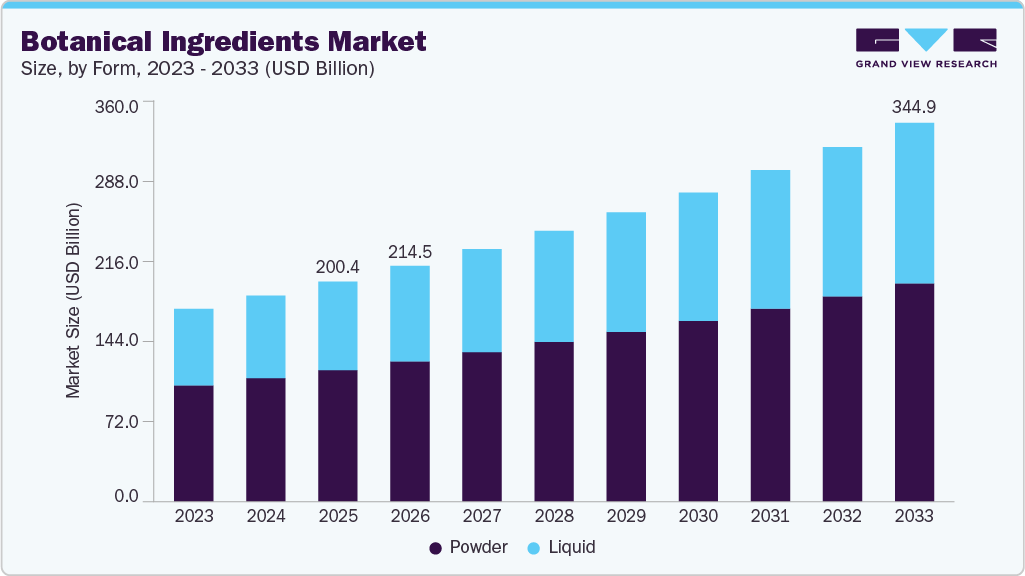
The global botanical ingredients market size was estimated at USD 200.42 billion in 2025 and is projected to reach USD 344.86 billion by 2033, growing at a CAGR of 7.0% from 2026 to 2033. The market is primarily driven by rising consumer preference for natural, clean-label, and plant-based products across food, nutraceutical, cosmetics, and pharmaceutical industries, coupled with growing awareness of preventive healthcare and wellness.
Key Market Trends & Insights
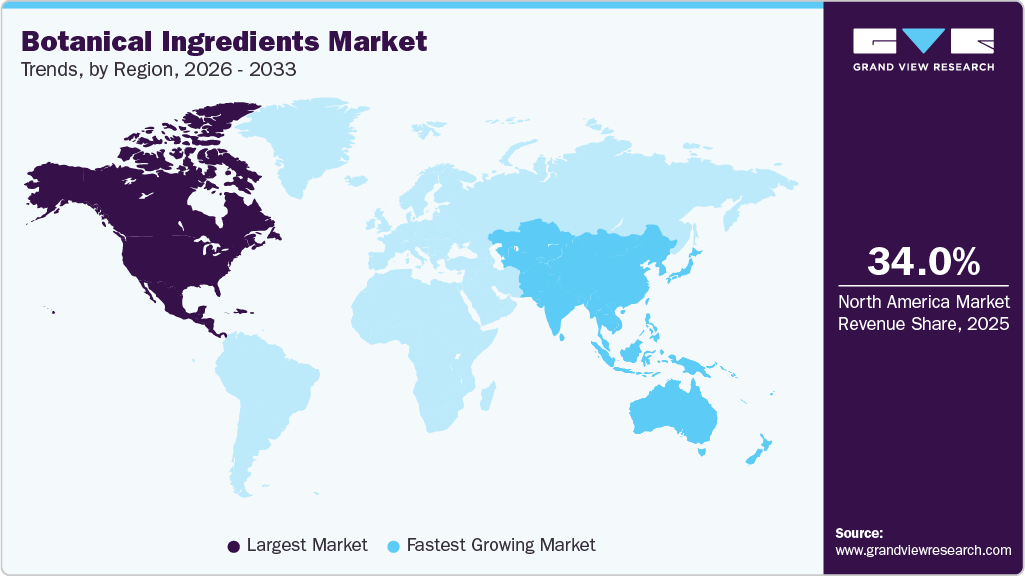
- North America dominated the global botanical ingredients market with the largest revenue share of 34.0% in 2025.
- The botanical ingredients market in the U.S. accounted for the largest market share in North America in 2025.
- By form, the powder segment led the market with the largest revenue share of 59.7% in 2025.
- By source, the spices segment led the market with the largest revenue share of 27.8% in 2025.
- By application, the food & beverages segment led the market with the largest revenue share of 33.7% in 2025.
Market Size & Forecast
- 2025 Market Size: USD 200.42 billion
- 2033 Projected Market Size: USD 344.86 billion
- CAGR (2026-2033): 7.0%
- North America: Largest market in 2025
- Asia Pacific: Fastest growing market
Increasing demand for functional foods, herbal supplements, and natural personal care products, along with supportive regulatory frameworks for herbal formulations in key markets such as the Asia Pacific and Europe, is accelerating the adoption of botanical ingredients. The expanding applications of botanicals as natural flavoring agents, preservatives, and bioactive compounds are strengthening their commercial relevance across multiple end-use industries.The market presents significant growth opportunities driven by the rapid expansion of the nutraceutical and functional beverage sectors, increasing penetration of botanicals in premium cosmetics and dermaceuticals, and rising demand for standardized and high-potency botanical extracts. Advancements in extraction technologies such as supercritical CO₂ and enzymatic extraction, along with growing investments in sustainable sourcing and organic certification, are enabling manufacturers to develop differentiated, high-value botanical ingredients. In addition, emerging markets in Asia Pacific, Central & South America, and the Middle East, supported by rising disposable incomes and growing acceptance of traditional herbal formulations, offer substantial untapped potential for market participants.
The market faces challenges related to raw material price volatility, supply chain disruptions, and variability in the quality and potency of botanical sources due to climatic conditions and agricultural practices. Stringent regulatory requirements, lack of global standardization in botanical ingredient specifications, and complex compliance procedures across regions increase operational and certification costs for manufacturers. Moreover, issues related to adulteration, traceability, and sustainability, along with intense competition from synthetic alternatives and private-label products, pose significant constraints on market growth and profitability.
Market Concentration & Characteristics
The global botanical ingredients industry is characterized by a moderately consolidated yet fragmented competitive structure, with multinational players dominating high-value segments while numerous regional and niche companies compete in specialized applications. Leading firms leverage diversified product portfolios, advanced extraction technologies, global sourcing networks, and strong R&D capabilities to maintain competitive advantage, while smaller players focus on organic, region-specific, and customized botanical solutions. Industry analyses indicate that top-tier companies control a significant share of the market, often around 65-70%, highlighting the strategic dominance of multinational ingredient manufacturers and their ability to shape pricing, innovation, and distribution dynamics.
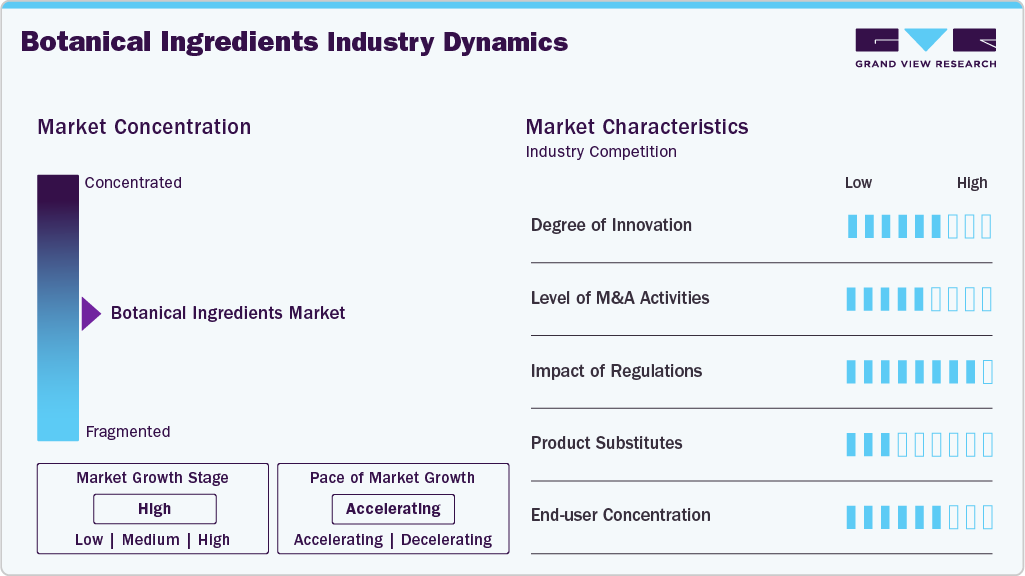
Competition is increasingly driven by innovation in extraction processes, clinical validation of botanical actives, sustainability initiatives, and strategic partnerships across food, nutraceutical, cosmetic, and pharmaceutical industries. Major players such as IFF, Givaudan (Naturex), Martin Bauer, and Indena compete on technological differentiation, product quality, and application expertise, while emerging players strengthen their positions through mergers, collaborations, and expansion of specialized botanical portfolios.
Form Insights
The powder segment led the market with the largest revenue share of 59.7% in 2025, primarily due to its superior stability, longer shelf life, ease of storage and transportation, and broad applicability across food, nutraceutical, pharmaceutical, and personal care formulations. Powdered botanical ingredients offer higher concentration of active compounds, consistent quality, and cost-efficient handling compared to liquid forms, making them the preferred choice for large-scale industrial applications such as dietary supplements, functional foods, herbal medicines, and cosmetic formulations. The widespread adoption of spray-drying and freeze-drying technologies has enhanced the scalability and commercial viability of powdered botanicals, further strengthening their dominance in the market.
The liquid segment is anticipated to grow at the fastest CAGR during the forecast period, driven by increasing demand from functional beverages, herbal syrups, tinctures, and cosmetic formulations that require rapid solubility and bioavailability. Liquid botanical ingredients enable faster absorption and easier formulation in ready-to-use products, aligning with the growing consumer preference for convenience and premium wellness products. However, challenges related to shorter shelf life, higher logistics costs, and stability issues compared to powders continue to limit their market penetration, positioning liquids as a high-growth but comparatively lower-share segment within the overall botanical ingredients industry.
Source Insights
The spices segment led the market with the largest revenue share of 27.8% in 2025, driven by their extensive use across food & beverages, nutraceuticals, pharmaceuticals, and personal care applications, combined with their high concentration of bioactive compounds and strong commercial value. Spices such as turmeric, ginger, cinnamon, pepper, and cardamom command premium pricing due to their multifunctional properties, including antioxidant, anti-inflammatory, antimicrobial, and flavor-enhancing attributes, which significantly increase their demand in functional foods and herbal formulations. Moreover, the strong global trade of spices, particularly from Asia Pacific, and their integration into both traditional and modern formulations have reinforced their dominant revc
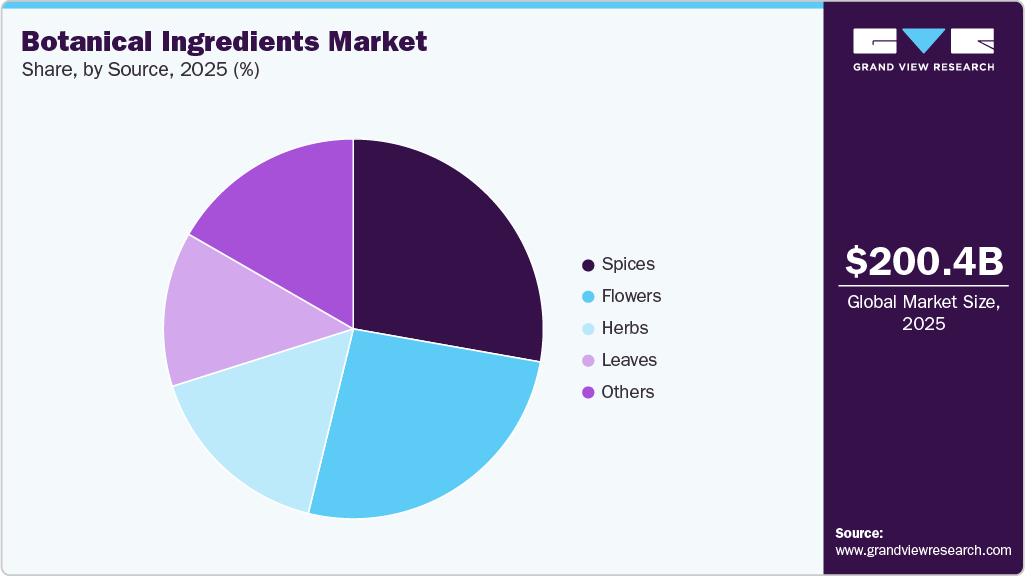
The herbs and leaves represent significant volume contributors to the market, supported by their widespread availability, lower extraction costs, and extensive use in herbal teas, dietary supplements, and natural cosmetics. Flowers are gaining traction due to their increasing adoption in premium cosmetics, aromatherapy, and fragrance applications, while other sources, including roots, bark, seeds, and fruits, are witnessing steady growth driven by innovation in extraction technologies and rising demand for diversified botanical actives. Collectively, the diversification of botanical sources and expanding end-use applications are reshaping the competitive dynamics of the market, with high-value spices leading in revenue and mass-volume plant parts such as herbs and leaves driving overall market volumes.
Application Insights
The food & beverages segment led the market with the largest revenue share of 33.7% in 2025, driven by the widespread integration of botanicals as natural flavoring agents, colorants, preservatives, and functional ingredients across a broad range of food and beverage products. Rising consumer demand for clean-label, plant-based, and functional products has significantly increased the adoption of botanical extracts in bakery & confectionery, sauces & dressings, and ready-to-eat foods, while the rapid growth of functional beverages, energy drinks, sports drinks, and herbal-infused juices has further accelerated market expansion.
Dietary supplements represent a high-growth application segment, supported by increasing health consciousness, aging populations, and the rising prevalence of lifestyle-related diseases, which are driving demand for herbal supplements and nutraceutical formulations. The personal care & cosmetics segment is expanding due to the growing adoption of botanical actives in skincare, haircare, and fragrance products, particularly in premium and organic categories, while pharmaceuticals continue to leverage botanicals in herbal drugs and OTC formulations. Other applications, including animal nutrition and aromatherapy, are witnessing steady uptake, collectively contributing to the diversification of end-use demand and strengthening the long-term growth trajectory of the global botanical ingredients industry.
Regional Insights
North America dominated the global botanical ingredients market with the largest revenue share of 34.0% in 2025, driven by strong demand for natural and clean-label products across food & beverages, dietary supplements, and personal care industries. The region benefits from advanced R&D capabilities, high consumer awareness regarding health and wellness, and the presence of leading multinational ingredient manufacturers. The well-established regulatory frameworks and robust distribution channels have supported the rapid commercialization of innovative botanical formulations, reinforcing North America’s dominant market position.
U.S. Botanical Ingredients Market Trends
The botanical ingredients market in the U.S. accounted for the largest market share in North America in 2025, driven by its large-scale nutraceutical and functional food industries, high per capita dietary supplement consumption, and strong innovation in natural personal care products. The country’s leadership is further supported by significant investments in botanical research, widespread adoption of herbal ingredients in mainstream consumer products, and the presence of global players with vertically integrated supply chains. The rising demand for plant-based and preventive healthcare solutions continues to accelerate market growth in the U.S.
Asia Pacific Botanical Ingredients Market Trends
The botanical ingredients market in the Asia Pacific is anticipated to grow at the fastest CAGR during the forecast period, supported by the abundant availability of raw materials, strong traditional medicine systems, and expanding food, pharmaceutical, and cosmetic industries. The region’s growth is driven by rising disposable incomes, increasing urbanization, and growing global demand for Asian-origin botanicals such as turmeric, ginger, ginseng, and herbal extracts. Furthermore, Asia Pacific’s role as a major production and export hub for botanical ingredients significantly enhances its competitive positioning in the global market.
The Chinabotanical ingredients market held a substantial share in Asia Pacific in 2025, underpinned by its extensive herbal medicine industry, large-scale cultivation of medicinal plants, and strong manufacturing capabilities. The country benefits from well-established traditional Chinese medicine (TCM) infrastructure and increasing integration of botanical ingredients into modern pharmaceuticals, functional foods, and cosmetics. In addition, China’s cost-efficient production, expanding export activities, and growing domestic demand for natural health products have strengthened its leadership within the regional market.
Europe Botanical Ingredients Market Trends
The botanical ingredients market in Europe is anticipated to grow at a significant CAGR during the forecast period, driven by stringent regulations on synthetic additives, strong consumer preference for organic and natural products, and the advanced cosmetic and pharmaceutical industries. The region’s growth is supported by increasing demand for certified organic botanicals, sustainable sourcing practices, and high-value applications in premium personal care and nutraceutical products. Moreover, the presence of established botanical ingredient manufacturers and strong regulatory standards has positioned Europe as a key market for high-quality botanical formulations.
The Germany botanical ingredients market is growing at a rapid pace, supported by its robust pharmaceutical and nutraceutical industries, strong tradition of herbal medicine, and high adoption of natural ingredients in consumer products. The country’s leadership is reinforced by advanced research infrastructure, strong quality standards, and the presence of leading botanical extract manufacturers. Furthermore, Germany’s role as a central hub for innovation and distribution of botanical ingredients across Europe continues to drive its market prominence.
Middle East & Africa Botanical Ingredients Market Trends
The botanical ingredients market in the Middle East & Africa is witnessing steady growth, driven by increasing consumer awareness of natural health products, expanding personal care and food industries, and growing adoption of herbal formulations. The region benefits from rising investments in wellness products, increasing penetration of functional foods, and the gradual modernization of the pharmaceutical and cosmetic sectors. In addition, the availability of indigenous botanical resources and the improvement of regulatory frameworks are creating new opportunities for market participants across the region.
Central & South America Botanical Ingredients Market Trends
The botanical ingredients market in Central & South America is emerging, supported by rich biodiversity, growing medicinal plant cultivation, and rising demand for natural food and cosmetic products. The region’s growth is driven by increasing export of botanical raw materials, expanding nutraceutical consumption, and rising investments in sustainable and organic ingredient sourcing. Moreover, countries such as Brazil and Mexico are strengthening their roles as key suppliers and consumers of botanical ingredients, enhancing the region’s long-term growth potential.
Key Botanical Ingredients Company Insights
Key players, such as Indesso, Lipoid Kosmetic AG, HollyFrontier Corporation, International Flavors & Fragrances, Inc., Bell Flavors & Fragrances, and Rutland Biodynamics Ltd., dominate the market.
- Indesso is a leading Indonesia-based manufacturer of natural ingredients, specializing in essential oils, botanical extracts, aroma chemicals, and food and wellness ingredients for the flavor, fragrance, food, cosmetic, and pharmaceutical industries. Founded in 1968, the company has evolved from a clove oil distiller into an integrated provider of natural-ingredient solutions, serving thousands of customers across more than 50 countries and leveraging strong R&D, sustainable sourcing, and vertically integrated manufacturing capabilities. Indesso’s diversified portfolio, advanced extraction technologies, and focus on innovation and traceable supply chains have positioned it as a key player in the global botanical ingredients value chain, particularly in high-value natural aroma and functional extracts.
Key Botanical Ingredients Companies:
The following key companies have been profiled for this study on the botanical ingredients market.
- Indesso
- Lipoid Kosmetic AG
- HollyFrontier Corporation
- International Flavors& Fragrances, Inc.
- Bell Flavors& Fragrances
- Rutland Biodynamics Ltd.
- Prakruti Sources Pvt. Ltd.
- AmbePhytoextractsPvt. Ltd.
- The Green Labs LLC
- Berje, Inc.
- The Herbarie at Stoney Hill Farm, Inc.
Recent Developments
-
In September 2025, IFF invested ~USD 12 million to expand its LMR Naturals site in Grasse, France, significantly increasing R&D capacity and accelerating the development of sustainable natural ingredients.
-
In May 2024, Indena and DSM-Firmenich introduced next-generation dietary supplement solutions combining botanicals with biotics, targeting gut health, brain health, and healthy aging applications.
Botanical Ingredients Market Report Scope
Report Attribute
Details
Market size value in 2026
USD 214.54 billion
Revenue forecast in 2033
USD 344.86 billion
Growth rate
CAGR of 7.0% from 2026 to 2033
Base year for estimation
2025
Historical data
2018 - 2024
Forecast period
2026 - 2033
Quantitative units
Revenue in USD million/billion, volume in kilotons and CAGR from 2025 to 2033
Report coverage
Revenue forecast, company ranking, competitive landscape, growth factors, and trends
Segments covered
Source, form, application, region
Regional scope
North America; Europe; Asia Pacific; Middle East & Africa; Central & South America
Country scope
U.S.; Canada; Mexico; Germany; UK; France; Italy; Spain; China; India; Japan; South Korea; Brazil; Argentina; UAE; Saudi Arabia
Key companies profiled
Indesso; Lipoid Kosmetic AG; HollyFrontier Corporation; International Flavors& Fragrances, Inc.; Bell Flavors& Fragrances; Rutland Biodynamics Ltd.; Prakruti Sources Pvt. Ltd.; AmbePhytoextractsPvt. Ltd.; The Green Labs LLC; Berje, Inc.; The Herbarie at Stoney Hill Farm, Inc.
Customization scope
Free report customization (equivalent to up to 8 analysts’ working days) with purchase. Addition or alteration to country, regional & segment scope.
Pricing and purchase options
Avail customized purchase options to meet your exact research needs. Explore purchase options
Global Botanical Ingredients Market Report Segmentation
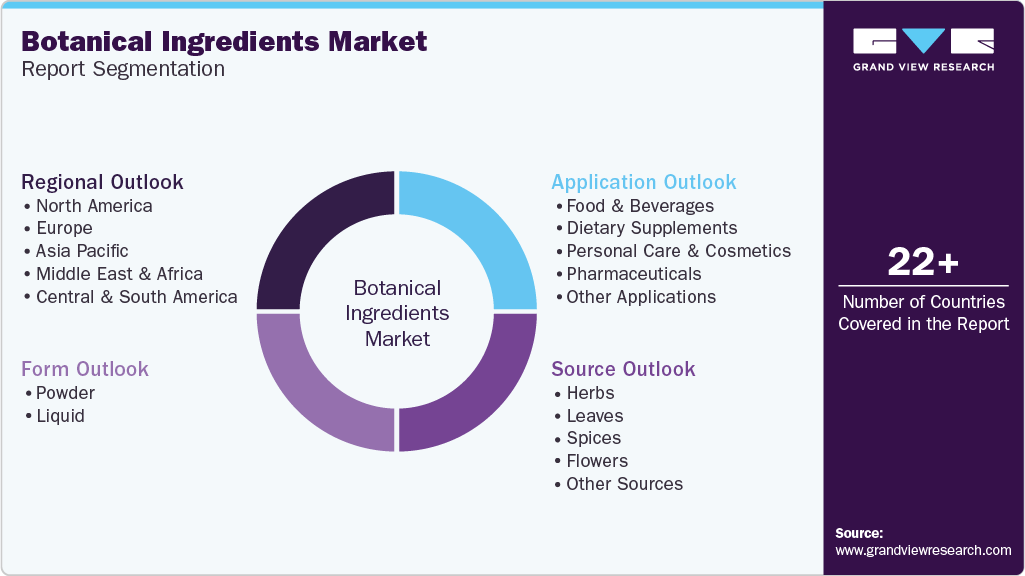
This report forecasts revenue growth at the global, regional, and country levels and provides an analysis of the latest industry trends across sub-segments from 2018 to 2033. For this study, Grand View Research has segmented the global botanical ingredients market report based on form, source, application, and region.
-
Form Outlook (Volume, Kilotons; Revenue, USD Million, 2018 - 2033)
-
Powder
-
Liquid
-
-
Source Outlook (Volume, Kilotons; Revenue, USD Million, 2018 - 2033)
-
Herbs
-
Leaves
-
Spices
-
Flowers
-
Other Sources
-
-
Application Outlook (Volume, Kilotons; Revenue, USD Million, 2018 - 2033)
-
Food & Beverages
-
Food
-
Bakery & Confectionery
-
Sauces & Dressings
-
Other Food Applications
-
-
Beverages
-
Energy Drinks
-
Sports Drinks
-
Functional Juices
-
Other Beverage Applications
-
-
-
Dietary Supplements
-
Personal Care & Cosmetics
-
Pharmaceuticals
-
Other Applications
-
-
Regional Outlook (Volume, Kilotons; Revenue, USD Million, 2018 - 2033)
-
North America
-
U.S.
-
Canada
-
Mexico
-
-
Europe
-
Germany
-
UK
-
France
-
Italy
-
-
Asia Pacific
-
China
-
India
-
Japan
-
Australia
-
South Korea
-
-
Middle East & Africa
-
Saudi Arabia
-
UAE
-
-
Central & South America
-
Brazil
-
Argentina
-
-
Frequently Asked Questions About This Report
b. The global botanical ingredients market size was estimated at USD 200.42 billion in 2025 and is expected to reach USD 214.54 billion in 2026.
b. The global botanical ingredients market is expected to grow at a compound annual growth rate of 7.0% from 2026 to 2033 to reach USD 344.86 billion by 2033.
b. The powder segment led the market with the largest revenue share of 59.7% in 2025, primarily due to its superior stability, longer shelf life, ease of storage and transportation, and broad applicability across food, nutraceutical, pharmaceutical, and personal care formulations
b. Some of the key players operating in the botanical ingredients market include Indesso, Lipoid Kosmetic AG, HollyFrontier Corporation, International Flavors& Fragrances, Inc., Bell Flavors& Fragrances, Rutland Biodynamics Ltd., Prakruti Sources Pvt. Ltd., AmbePhytoextractsPvt. Ltd., The Green Labs LLC, Berje, Inc., Lipoid Kosmetic AG, AmbePhytoextractsPvt. Ltd., Honeywell International Inc., Royal Dutch Shell P.L.C, and Mitsui Chemicals, Inc.
b. The global botanical ingredients market is driven by rising freshwater scarcity, rapid urbanization, and increasingly stringent regulations governing drinking water quality and wastewater discharge across municipal and industrial sectors. Growing demand for efficient water reuse, industrial process optimization, and asset protection in power, oil & gas, and manufacturing further supports sustained chemical consumption.


Share this report with your colleague or friend.
Need a Tailored Report?
Customize this report to your needs — add regions, segments, or data points, with 20% free customization.


ISO 9001:2015 & 27001:2022 Certified
We are GDPR and CCPA compliant! Your transaction & personal information is safe and secure. For more details, please read our privacy policy.
Trusted market insights - try a free sample
See how our reports are structured and why industry leaders rely on Grand View Research. Get a free sample or ask us to tailor this report to your needs.