- Home
- »
- Automotive & Transportation
- »
-
Blast Freezer Market Size And Share, Industry Report, 2033GVR Report cover
![Blast Freezer Market Size, Share & Trends Report]()
Blast Freezer Market (2026 - 2033) Size, Share & Trends Analysis Report By Type (Cabinet Freezers, Spiral Blast Freezers), By Capacity (Medium Capacity), By Distribution Channel, By Application, By End Use, By Region, And Segment Forecasts
- Report ID: GVR-4-68040-879-6
- Number of Report Pages: 130
- Format: PDF
- Historical Range: 2021 - 2025
- Forecast Period: 2026 - 2033
- Industry: Technology
- Report Summary
- Table of Contents
- Segmentation
- Methodology
- Download FREE Sample
-
 Download Sample Report
Blast Freezer Market Summary
The global blast freezer market size was estimated at USD 2.66 billion in 2025, and is projected to reach USD 6.43 billion by 2033, growing at a CAGR of 11.0% from 2026 to 2033. The growing demand for food safety and quality preservation in food processing and cold storage industries is anticipated to fuel the market growth.
Key Market Trends & Insights
- The Asia Pacific blast freezer market is dominant and fastest growing CAGR over the forecast period.
- By type, the tunnel blast freezers segment accounted for the largest share of 29.85% in 2025.
- By capacity, the medium capacity (100-500 kg/batch) segment held the dominating share in the market in 2025.
- By distribution channel, the direct sales segment accounted for the largest share in 2025.
- By application, the meat processing segment dominated the market in 2025.
Market Size & Forecast
- 2025 Market Size: USD 2.66 Billion
- 2033 Projected Market Size: USD 6.43 Billion
- CAGR (2026-2033): 11.0%
- North America: Largest market in 2025
- Asia Pacific: Fastest growing market
The increasing demand for frozen and convenience foods is driving market growth. Frozen meals, ready-to-eat products, canned foods, and snacks that require minimal preparation are increasingly preferred by consumers due to busy lifestyles. Moreover, food manufacturers are placing greater focus on producing high-quality, easy-to-prepare frozen and convenience foods with extended shelf life. This trend is driving the adoption of blast freezers, as food quality, safety, and freshness are maintained while manufacturers efficiently meet the rising demand for convenient food options.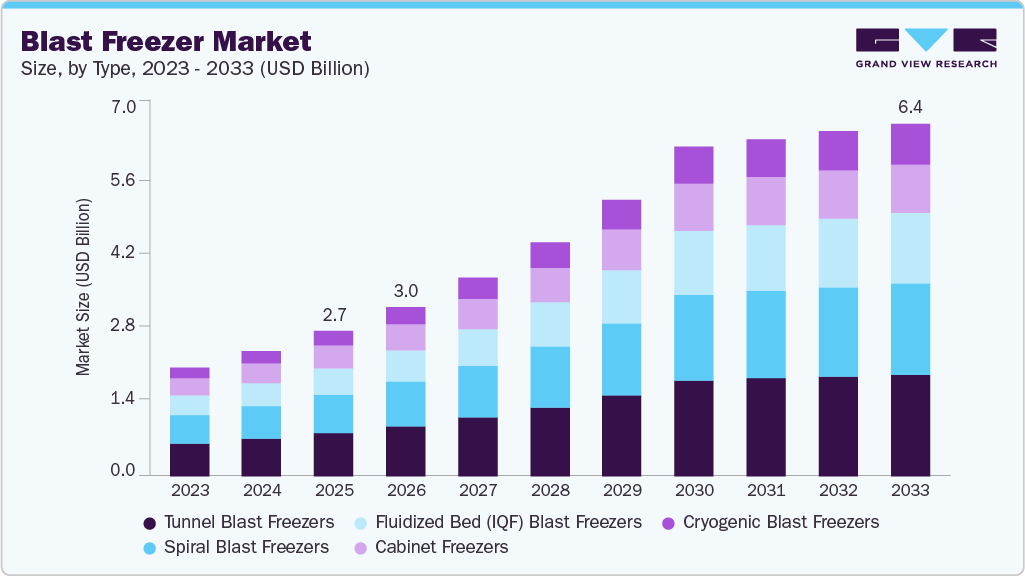
The blast freezer market is increasingly leveraging automation and digital temperature-monitoring solutions to improve freezing precision, reduce manual intervention, and enhance food safety and operational efficiency. For instance, in July 2025, Ndustrial, a software company, introduced ColdOS Sense, an advanced temperature monitoring solution for cold storage and frozen food facilities. The system utilizes real-time data analytics to provide continuous temperature visibility across warehouses, enabling faster issue identification and reducing reliance on manual inspections. ColdOS Sense helps operators improve compliance, optimize energy usage, and lower operational costs.
Governments and private players are focusing on large-scale cold storage and blast freezing facilities to stabilize the food supply, support farmers, and improve distribution efficiency. For instance, in January 2026, the Department of Agriculture is building a USD 9 million (PHP 500 million) cold storage facility to improve food security and support farmers in the region. The facility includes refrigerated warehouses, a blast freezer, processing and packing areas, and a solar power system to improve efficiency and reduce energy costs, allowing the store to store large quantities of meat and vegetables, helping stabilize the food supply and reduce spoilage. In addition, another USD 9 million (PHP 500 million) will be invested in a food hub to improve trading, distribution, and export opportunities for farmers and fishers
The regulatory environment around food safety temperature control continues to grow as greater emphasis is placed on preventing food contamination and foodborne illnesses. In the U.S., these requirements are mainly governed by the Food and Drug Administration under the Food Safety Modernization Act, which requires food companies to identify temperature-critical points, monitor them regularly, and maintain proper records. Regulations focus on keeping food out of the temperature danger zone through proper cooling, freezing, storage, and reheating practices, along with corrective actions when deviations occur. In addition, global food safety standards such as Safe Quality Food, BRCGS, and FSSC 22000 require strong temperature control programs and clear documentation to pass audits. Moreover, by leveraging digital compliance tools and regulations, businesses can reduce food safety risks, streamline compliance, and enhance food safety management.
High initial costs of blast freezers and associated infrastructure pose challenges for food processors, cold storage operators, and small businesses, especially in developing regions. In addition, the complexity of integrating blast freezers with existing refrigeration systems and production lines can hinder adoption. Maintenance requirements and the need for skilled technicians to operate advanced freezing systems further limit the rapid deployment of blast freezers in certain regions.
Type Insights
The tunnel blast freezers segment accounted for the largest share of 29.85% in 2025, driven by food processing and cold-chain enterprises upgrading from conventional batch freezers to high-speed, continuous tunnel freezing systems. Organizations seek efficient solutions that can rapidly freeze large volumes of products. Tunnel blast freezers offer faster freezing cycles, uniform temperature distribution, and higher throughput, making them attractive to meat, seafood, fruit, and vegetable processors. This transition is accelerating the replacement of older freezing equipment and driving sustained demand for modern tunnel blast freezer solutions.
The cryogenic blast freezers segment is expected to grow at the fastest CAGR during the forecast period. The adoption of cryogenic blast freezers is rising due to their ability to rapidly freeze products, retain texture, and maintain nutritional value, particularly in the food, biotech, and pharmaceutical industries. Many products, such as vaccines, blood plasma, biopharmaceuticals, and other sensitive biological materials, are frozen much faster using liquid nitrogen compared with conventional compressor-based freezers. Processing time, energy, and maintenance costs are reduced, as fewer moving parts are required. In addition, advanced cryogenic models allow precise temperature control, real-time monitoring, and data logging, enabling production efficiency and ensuring compliance with regulatory standards.
Capacity Insights
The medium capacity (100-500 kg/batch) segment held the dominating share in the market in 2025. The adoption of medium-capacity blast freezers is driven by their ability to rapidly freeze large batches of diverse food products while ensuring quality preservation and operational efficiency. One such product is the Electrolux Professional Blast Chiller/Freezer Crosswise 100 kg (20 GN 1/1), designed as a medium-capacity freezing solution for commercial kitchens and food service operations. Food products of up to 100 kg per cycle can be rapidly blast-frozen or chilled, enabling the preservation of texture, flavor, and nutritional value. The Crosswise design allows flexible utilization of GN 1/1 pans, making a wide range of products, including meats, seafood, prepared meals, and desserts, suitable for freezing with this unit.
The large capacity (above 500 kg/batch) segment is expected to grow at the fastest CAGR during the forecast period. The large-capacity blast freezer segment is being driven by the demand from industrial food processors and pharmaceutical companies for efficient freezing solutions that ensure product safety and high quality. These freezers are designed to support large-scale operations where substantial quantities of products must be processed rapidly. They are mostly used in seafood processing, meat packing, frozen food production, and pharmaceuticals. These freezers can handle thousands of pounds at once, are built to withstand continuous use, and feature advanced cooling systems to keep products fresh, thereby increasing the demand for freezing large quantities, maintaining product quality, and meeting safety standards.
Distribution Channel Insights
The direct sales segment accounted for the largest share 60.60% in 2025. Direct sales in the blast freezer market enable manufacturers to sell their freezers directly to food processors, cold storage operators, or seafood and frozen food companies without going through distributors or retailers. This method allows manufacturers to understand specific customer needs, offer customized solutions, and provide installation, training, and maintenance support. Direct sales are especially important for blast freezers because these machines are large, technical, and often customized for capacity, speed, or cooling type. By using direct sales, companies can ensure customers receive equipment suited to their production requirements, maintain quality and safety standards, and improve long-term relationships.
The online/e-commerce segment is projected to grow at the fastest CAGR over the forecast period. The online and e-commerce segment for blast freezers is growing as purchasing is easier and faster for businesses, including bakeries, food processors, and pharmaceutical companies. Customers can compare models, prices, and features online and get direct delivery with good after-sales support. The demand for blast freezers is rising owing to increasing need for quick, reliable, and cost-effective freezing solutions to maintain product quality, meet production schedules, and expand cold storage capabilities efficiently.
Application Insights
The meat processing segment dominated the market in 2025. The demand for meat processing, refrigeration, and blast freezer systems is increasing due to the growing need for food safety and hygiene. Meat processing facilities need reliable industrial refrigeration systems to keep meat safe, fresh, and compliant with food safety standards, supporting high-volume production and distribution.
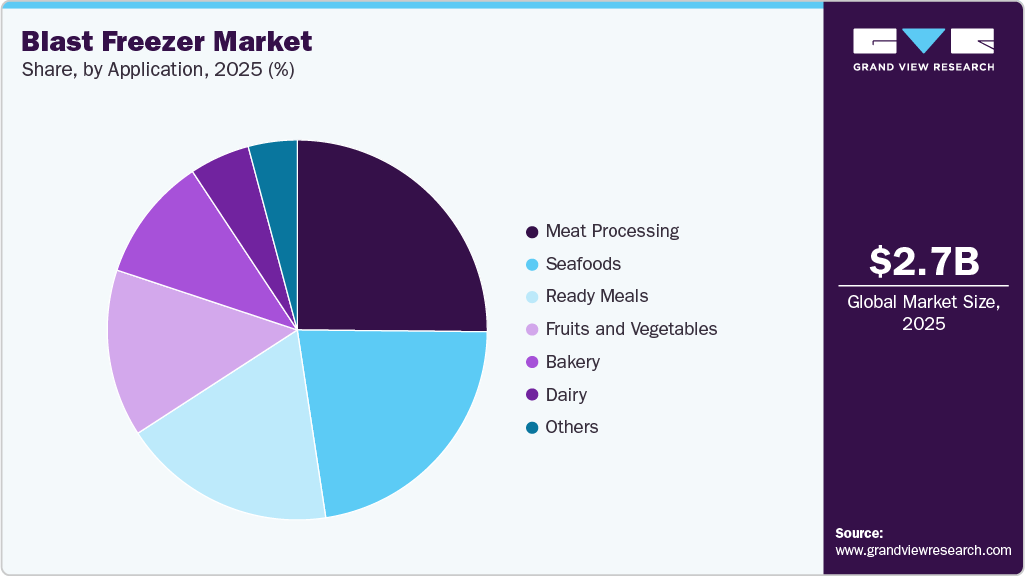
The seafood segment is expected to grow at the fastest CAGR over the forecast period. Seafood includes edible marine and freshwater products, including fish, crustaceans, and mollusks, which are consumed for their high nutritional value and protein content. One of the major factors driving growth in the seafood segment is increasing consumer demand for convenient, protein-rich, and long-shelf-life food options, as busy lifestyles and health trends push consumers toward frozen and ready-to-cook seafood products that maintain quality and nutrition.
End Use Insights
The food processing plants segment dominated and is expected to grow at the fastest CAGR over the forecast period. Food processing plants are increasingly focusing on operational efficiency to meet growing production and quality demands. Strategies such as implementing Lean Manufacturing principles, standardizing workflows, and optimizing material handling reduce waste and improve throughput. In addition, high-performance equipment and integrated process controls support smoother operations and higher productivity. These efficiency measures collectively strengthen the plant’s ability to process large volumes of perishable products, thereby the driving demand for supporting blast freezers, to maintain quality and extend shelf life.
The cold storage facilities segment held a significant share in the market in 2025. One of the major drivers of this segment is the rapid growth in consumption of frozen and temperature-sensitive products, which enables operators to scale up capacity and build out modern cold storage networks to meet demand. Several companies are investing in cold storage warehouses, which is fueling the growth in the segment. For instance, in 2025, Lineage, Inc, a warehouse company. bought four cold storage warehouses from Tyson Foods and, with Tyson as the main customer, built two new automated cold storage facilities as part of a combined plan valued at nearly USD 1 billion. It will also design, construct, and operate the two new next-generation cold storage facilities, which are expected to include advanced automation and support Tyson’s distribution needs. This expansion reflects strong demand for temperature-controlled storage capacity as food manufacturers and distributors move products and expand their cold storage networks.
Regional Insights
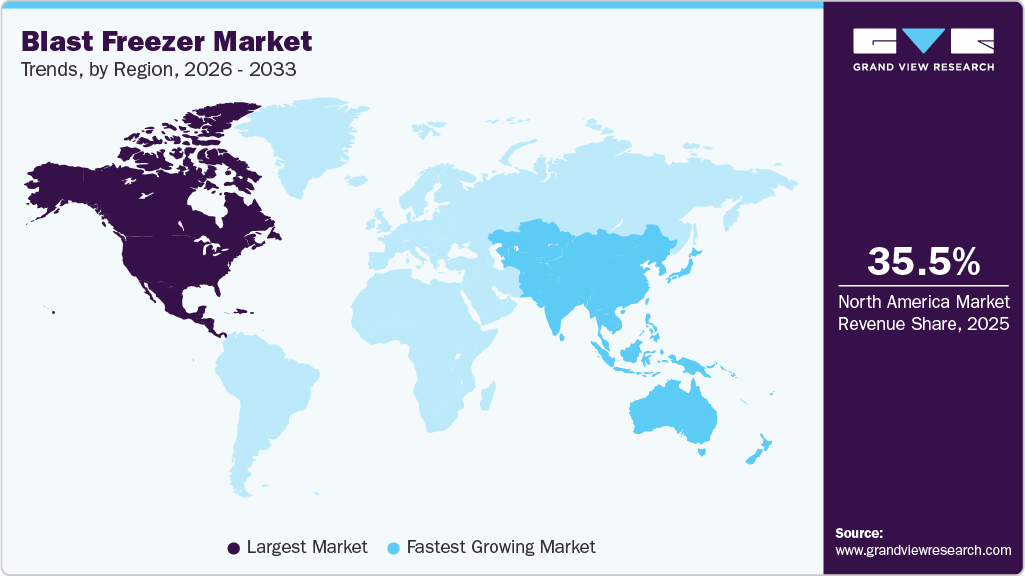
The North America blast freezer market held a significant share in 2025. The growing demand for temperature-controlled storage capacity in the food and beverage supply chain is driving the expansion of cold storage infrastructure across North America. For instance, in February 2026, DHL supply Chain, a logistics company partnered with RLCold, a cold storage facility, to build cold storage infrastructure to build cold-storage infrastructure. These new facilities will be equipped with technologies that help maintain accurate temperature control and improve the distribution of perishable goods. With this partnership company aims to create more than 5 million square feet of modern cold storage space designed to handle food and beverage products. Expanded cold chain infrastructure enhances reliability, allowing food producers to store and distribute perishable goods safely while meeting rising demand.
U.S. Blast Freezer Market Trends
The U.S. blast freezer market held a significant share in 2025. The increasing awareness of fitness has increased the demand for high-protein foods in the U.S. Consumers are placing greater emphasis on high-protein diets to support fitness goals, muscle health, and wellness, and many have increased their protein intake over recent years. As meat, poultry, and seafood are rich sources of complete protein, demand for these products has increased. Frozen meat has become a preferred option for many households because it offers longer shelf life, convenience for busy lifestyles, and consistent protein quality. In addition, frozen meat helps reduce food waste and simplifies meal planning, further supporting its growing adoption.
Europe Blast Freezer Market Trends
The Europe blast freezer industry is expected to grow rapidly in the coming years. The market is primarily driven by strict food safety regulations and the expansion of modern cold chain infrastructure across the region. Advanced blast freezing systems are being deployed in food processing plants, cold storage facilities, and logistics hubs to enable rapid temperature reduction, preserve product quality, and comply with stringent hygiene and temperature-control standards. Collaborative investments between food manufacturers and logistics providers are accelerating adoption.
The UK blast freezer industry is expected to grow rapidly in the coming years. The increasing demand for high-capacity, automated, and energy-efficient cold storage is driving investment in temperature-controlled logistics infrastructure in the UK. For instance, in April 2025, Magnavale Ltd, a provider of food cold storage solutions, inaugurated a fully automated warehouse worth USD 175 million (GBP 140 million) with a capacity of 101,000 pallets, establishing it as the largest single cold storage facility in the UK. The facility has been designed to provide seamless storage and distribution for food manufacturers, retailers, and suppliers, with advanced automation and renewable energy being integrated. These developments enable faster, more reliable handling of perishable goods, reduce spoilage, and support growth in the blast freezer market.
Asia Pacific Blast Freezer Market Trends
The Asia Pacific blast freezer market is dominant and the fastest growing CAGR over the forecast period. Growing demand for modern, temperature controlled cold chain infrastructure to support the efficient movement of perishable and temperature‑sensitive goods is driving investment and platform expansions across the Asia Pacific cold logistics sector. For instance, in December 2025, Stonepeak, private equity firm, launched Peregrine Cold Logistics, a new cold chain platform, to expand temperature controlled infrastructure across the Asia Pacific and the Gulf Cooperation Council (GCC) regions. The platform plans to acquire existing cold storage businesses and develop new facilities to support the movement of temperature‑sensitive and perishable goods throughout the supply chain. The initiative aims to deliver high‑quality storage capacity and ancillary logistics solutions by leveraging operational and technological expertise to meet rising standards for food safety, quality, and sustainable supply‑chain management. Such initiatives improve cold storage networks and meet the growing demand for modern, temperature controlled infrastructure in the region.
Government policies in China that expand cold storage and modernize refrigerated transport are driving growth in the country. These policies increase demand for temperature controlled equipment, such as blast freezers, cold storage facilities, and refrigerated trucks.. For instance, in February 2026, according to the China Federation of Logistics & Purchasing (CFLP), China’s total cold storage capacity reached 277 million cubic meters in 2025, a 5.5 % increase from the previous year, supported by government initiatives to expand the cold chain infrastructure.
Cold storage warehouses in Japan are experiencing strong growth driven by rising consumption of frozen foods and the growing need for efficient, temperature-controlled logistics. For instance, in March 2025, GLP Japan Inc. unveiled its new five‑storey facility which covers 46,000 square metres and costs about USD 101 million (15 billion yen) to build. It can keep products at temperatures from ‑25 °C to 10 °C and is already fully used by several tenants. GLP Japan Inc., plans to invest another USD 1.3 billion (200 billion yen), ,in the coming years to further expand cold storage. Moreover, the growing demand for frozen food and the need for modern cold chain infrastructure are driving investment in modern cold chain infrastructure in Japan.
Key Blast Freezer Company Insights
Some of the key companies in the blast freezer market include Air Products and Chemicals, Inc., GEA Group Aktiengesellschaft, LLC, Gram Equipment, Manitowoc Ice, MYCOM, and others. Organizations are focusing on increasing the customer base to gain a competitive edge in the industry. Therefore, key players are taking several strategic initiatives, such as mergers and acquisitions, and partnerships with other major companies.
-
Air Products and Chemicals, Inc. is a provider of industrial gases, related equipment, and services. The company’s product offerings include cryogenic freezing solutions and gas supply systems for food processing and cold chain applications, which can be integrated with blast freezer systems. The company has developed cryogenic freezing technologies that enable rapid freezing of food products, helping preserve quality, texture, and nutritional value. The solutions are compatible with several food processing operations and enable efficient freezing through the use of liquid nitrogen and carbon dioxide across industries such as meat, seafood, poultry, and ready-to-eat food processing.
-
GEA Group Aktiengesellschaft is a provider of industrial engineering solutions and refrigeration systems. The company’s product offerings include industrial blast freezers and freezing systems for use in food processing plants and cold chain facilities. The company has developed advanced blast freezing solutions that meet the large-scale, high-throughput freezing requirements of the food industry. The solutions are compatible with several food processing lines and enable rapid and uniform freezing of products such as meat, seafood, dairy, and ready-to-eat foods, helping preserve quality, texture, and shelf life.
Key Blast Freezer Companies:
The following key companies have been profiled for this study on the blast freezer market.
- Air Products and Chemicals, Inc.
- GEA Group Aktiengesellschaft
- Gram Equipment
- Manitowoc Ice
- MYCOM
- Irinox S.p.A.
- PORKKA
- Blue Cube Portable Cold Stores Ltd
- CRYOMETRIX
- JBT Marel
Recent Developments
-
In August 2025, Carrier Global Corporation announced the acquisition of Blaich Automation GmbH, a provider of integrated automation solutions for buildings and industrial systems. Blaich Automation GmbH develops smart control systems to help manage buildings and industrial facilities more efficiently. With this acquisition, Carrier established its first building-automation office in Germany, supporting the company’s expansion across Europe. Through this shift, customers in industries such as data centers, pharmaceuticals, and manufacturing can improve energy efficiency and implement automation solutions.
-
In December 2025, Hamilton Lane partnered with Slate Asset Management to acquire a majority stake in Cold‑Link Logistics. Cold-Link operates nine state-of-the-art cold storage facilities across the United States, offering temperature-controlled storage for food and other perishables. With this investment, it aims to support the expansion of Cold-Link’s infrastructure and strengthen the cold-chain logistics network that serves food producers and distributors. Moreover, the new investors provide capital and strategic support to drive future growth.
Blast Freezer Market Report Scope
Report Attribute
Details
Market size value in 2026
USD 3.10 billion
Revenue forecast in 2033
USD 6.43 billion
Growth rate
CAGR of 11.0% from 2026 to 2033
Base year for estimation
2025
Historical data
2021 - 2025
Forecast period
2026 - 2033
Quantitative units
Revenue in USD million/billion and CAGR from 2026 to 2033
Report coverage
Revenue forecast, company ranking, competitive landscape, growth factors, and trends
Segments covered
Type, capacity, distribution channel, application, end use, region
Regional scope
North America; Europe; Asia Pacific; Latin America; MEA
Country scope
U.S.; Canada; Mexico; Germany; UK; France; ; China; Japan; India; South Korea; Australia; Brazil; KSA; UAE; South Africa
Key companies profiled
Air Products and Chemicals, Inc.; GEA Group Aktiengesellschaft; Gram Equipment; Manitowoc Ice; MYCOM; Irinox S.p.A.; PORKKA; Blue Cube Portable Cold Stores Ltd; CRYOMETRIX; JBT Marel
Customization scope
Free report customization (equivalent up to 8 analysts working days) with purchase. Addition or alteration to country, regional & segment scope.
Pricing and purchase options
Avail customized purchase options to meet your exact research needs. Explore purchase options
Global Blast Freezer Market Report Segmentation
This report forecasts revenue growth at global, regional, and country levels and provides an analysis of the latest industry trends in each of the sub-segments from 2021 to 2033. For this study, Grand View Research has segmented the global blast freezer market report based on type, capacity, distribution channel, application, end use and region:
-
Type Outlook (Revenue, USD Million, 2021 - 2033)
-
Cabinet Freezers
-
Fluidized Bed (IQF) Blast Freezers
-
Tunnel Blast Freezers
-
Spiral Blast Freezers
-
Cryogenic Blast Freezers
-
-
Capacity Outlook (Revenue, USD Million, 2021 - 2033)
-
Small Capacity (Below 100 kg/batch)
-
Medium Capacity (100-500 kg/batch)
-
Large Capacity (Above 500 kg/batch)
-
-
Distribution Channel Outlook (Revenue, USD Million, 2021 - 2033)
-
Direct Sales
-
Distributors
-
Online / E-commerce
-
-
Application Outlook (Revenue, USD Million, 2021 - 2033)
-
Bakery
-
Dairy
-
Fruits and Vegetables
-
Meat Processing
-
Ready Meals
-
Seafoods
-
Others
-
-
End Use Outlook (Revenue, USD Million, 2021 - 2033)
-
Cold Storage Facilities
-
Food Processing Plants
-
Foodservice Operations
-
Retail & Supermarkets
-
Retail
-
Others
-
-
Regional Outlook (Revenue, USD Million, 2021 - 2033)
-
North America
-
U.S.
-
Canada
-
Mexico
-
-
Europe
-
Germany
-
UK
-
France
-
-
Asia Pacific
-
China
-
Japan
-
India
-
South Korea
-
Australia
-
-
Latin America
-
Brazil
-
-
Middle East and Africa (MEA)
-
KSA
-
UAE
-
South Africa
-
-
Frequently Asked Questions About This Report
b. The global blast freezer market size was estimated at USD 2.66 billion in 2025 and is expected to reach USD 3.10 billion in 2026
b. The tunnel blast freezers segment accounted for the largest share of 29.85% in 2025, driven by food processing and cold-chain enterprises upgrading from conventional batch freezers to high-speed, continuous tunnel freezing systems.
b. Some key players operating in the blast freezer market include Air Products and Chemicals, Inc.; GEA Group Aktiengesellschaft; Gram Equipment; Manitowoc Ice; MYCOM; Irinox S.p.A.; PORKKA; Blue Cube Portable Cold Stores Ltd; CRYOMETRIX; JBT Marel
b. The growing demand for food safety and quality preservation in food processing and cold storage industries is anticipated to fuel the market growth
b. The global blast freezer market is expected to grow at a compound annual growth rate of 11.0% from 2026 to 2033 to reach USD 6.43 billion by 2033.


Share this report with your colleague or friend.
Need a Tailored Report?
Customize this report to your needs — add regions, segments, or data points, with 20% free customization.


ISO 9001:2015 & 27001:2022 Certified
We are GDPR and CCPA compliant! Your transaction & personal information is safe and secure. For more details, please read our privacy policy.
Trusted market insights - try a free sample
See how our reports are structured and why industry leaders rely on Grand View Research. Get a free sample or ask us to tailor this report to your needs.