- Home
- »
- Biotechnology
- »
-
Bioremediation Market Size To Reach $42.11 Billion By 2033GVR Report cover
![Bioremediation Market Size, Share & Trends Report]()
Bioremediation Market (2026 - 2033) Size, Share & Trends Analysis Report By Type (In Situ, Ex Situ), By Technology (Biostimulation, Phytoremediation, Bioreactors), By Service (Soil Remediation, Oilfield Remediation), By Region, And Segment Forecasts
- Report ID: GVR-4-68039-955-6
- Number of Report Pages: 120
- Format: PDF
- Historical Range: 2021 - 2024
- Forecast Period: 2026 - 2033
- Industry: Healthcare
- Report Summary
- Table of Contents
- Segmentation
- Methodology
- Download FREE Sample
-
 Download Sample Report
Bioremediation Market Summary
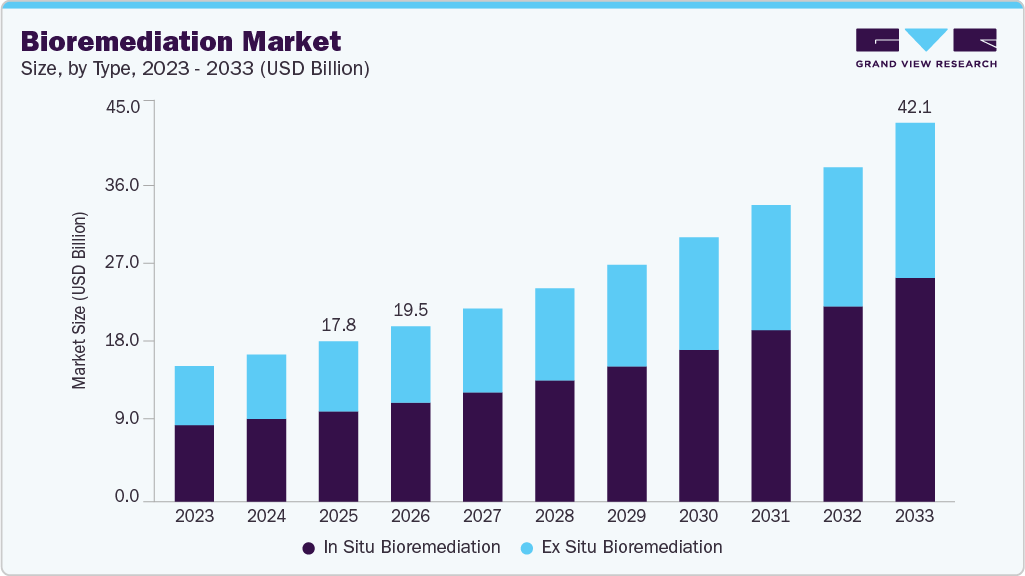
The global bioremediation market size was estimated at USD 17.81 billion in 2025 and is projected to reach USD 42.11 billion by 2033, growing at a CAGR of 11.63% from 2026 to 2033. The market is anticipated to grow due to rapid industrial development over the past few years, which has led to widespread contamination of environmental landscapes, including oceans, freshwater systems, forests & agricultural lands.
Key Market Trends & Insights
- North America dominated the global bioremediation market with the largest revenue share of 36.22% in 2025.
- The bioremediation industry in the U.S. accounted for the largest market revenue share in North America in 2025.
- By type, the in situ bioremediation segment led the market with the largest revenue share of 56.35% in 2025.
- By technology, the phytoremediation segment accounted for the largest market revenue share of 32.33% in 2025.
- By service, the soil remediation segment accounted for the largest market revenue share of 40.02% in 2025.
Market Size & Forecast
- 2025 Market Size: USD 17.81 Billion
- 2033 Projected Market Size: USD 42.11 Billion
- CAGR (2026-2033): 11.63%
- North America: Largest market in 2025
- Asia Pacific: Fastest growing market
Technological Advancements in Microbial and Enzyme-Based Solutions
Microbiology and environmental biotechnology developments have improved bioremediation capabilities, which are now developing into a major market force. The genetically enhanced microorganisms, together with enzyme technology solutions, enable more effective destruction of complex hazardous materials, which include hydrocarbons, pesticides, and heavy metals. The new technologies result in faster treatment processes together with more dependable outcomes, which lead to their increased use by industrial and governmental customers.
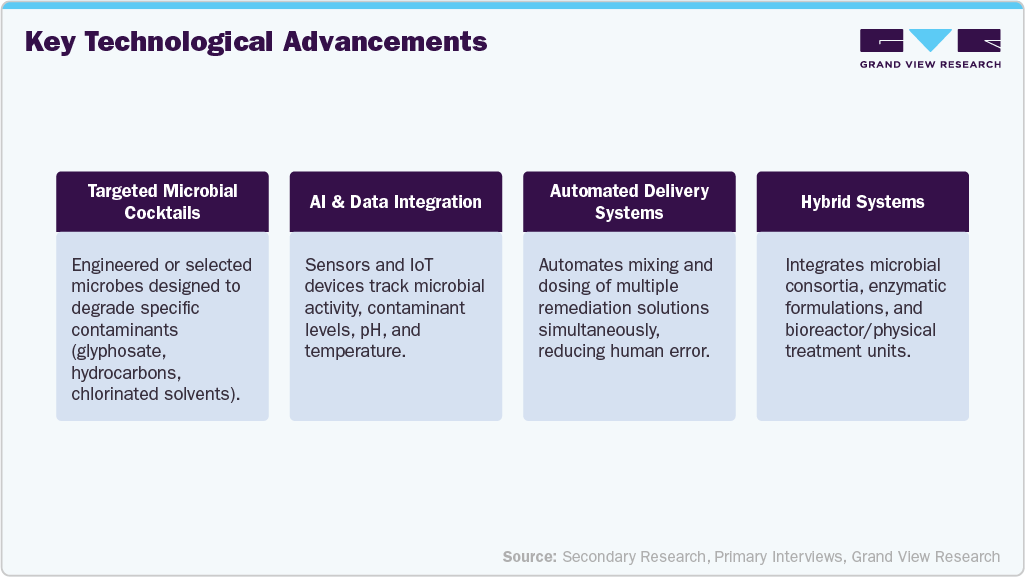
The increasing application of bioaugmentation and bio stimulation techniques has made bioremediation processes more adaptable to different locations while maintaining their ability to achieve site-specific results. The treatment of various soil, groundwater, and wastewater conditions becomes possible through the application of specialized microbes together with the precise control of nutrients and oxygen levels. The new developments make bioremediation processes more reliable in difficult environments, leading to their use as an affordable solution that meets environmental regulations and establishes permanent ecological benefits.
Stringent Environmental Regulations
Stricter environmental regulations across developed and emerging economies are driving demand for bioremediation. Agencies such as the U.S. EPA, the European Commission, and India’s CPCB are enforcing tighter limits on soil, groundwater, and wastewater contamination. As industries face mandatory site cleanup requirements and penalties for noncompliance, adoption of effective, compliant remediation technologies is increasing.
Bioremediation is increasingly preferred due to its alignment with regulatory goals for sustainability and minimal environmental impact. Compared to physical or chemical methods, it supports in situ treatment, reduces site disturbance, and promotes long-term ecological restoration. As regulations tighten and enforcement strengthens, industries and public authorities are turning to bioremediation as a cost-effective, regulation-compliant solution, supporting sustained market growth.
Market Concentration & Characteristics
The bioremediation industry demonstrates moderate to high innovation because engineered microbial strains, enzyme-based solutions, bioaugmentation, and biostimulation methods have introduced new technological advancements. The combination of real-time monitoring and data-driven site assessment methods has improved efficiency, reliability, and scalability. The research and development process, which relies on established biological processes, continues to expand treatment capabilities and application possibilities.
Several key market players, including Merck KGaA, Thermo Fisher Scientific, Inc., and Agilent Technologies, Inc., are actively engaged in mergers and acquisitions (M&A) to strengthen their market presence. These strategic initiatives enable companies to expand their geographic footprint, enter new regional markets, broaden product portfolios, and enhance technological capabilities.
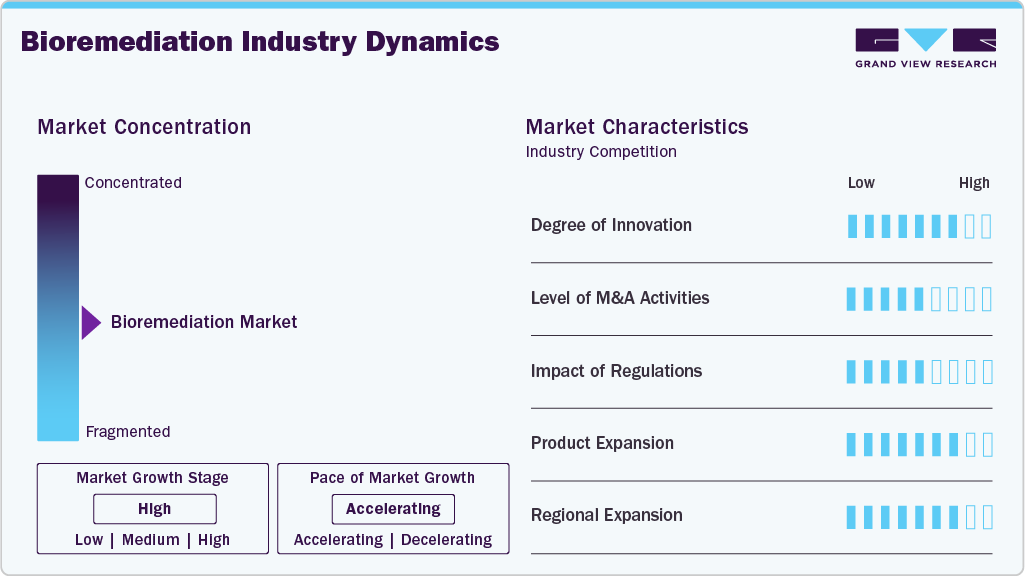
Stringent regulations in the bioremediation industry are driving the development of compliant systems that ensure accurate, traceable liquid handling across sectors such as healthcare and life sciences. Adherence to regulatory standards enhances data integrity, reproducibility, and overall quality control in automated liquid handling processes.
Product expansion in the bioremediation industry focuses on developing advanced, scalable systems with higher precision, improved throughput, and broader application compatibility, including genomics, cell biology, and clinical diagnostics, enabling vendors to strengthen market reach and competitiveness.
Regional expansion in the bioremediation industry focuses on entering emerging life sciences regions by strengthening local presence, improving distribution networks, and supporting growing demand from biotechnology, pharmaceutical, and diagnostic laboratories.
Type Insights
The in situ bioremediation segment accounted for the largest market revenue share of 56.35% in 2025 and is projected to register at the fastest CAGR during the forecast period, driven by its cost-effectiveness, minimal site disruption, and growing adoption in soil and groundwater contamination treatment.
The ex situ bioremediation segment is projected to witness at a significant CAGR from 2026 to 2033, through its superior treatment performance and improved operational management, and its expanding application in contaminated areas, which demand quick cleanup results, together with the development of engineered treatment solutions and the growing requirements for proper hazardous waste disposal methods.
Technology Insights
The phytoremediation segment led the market with the largest revenue share of 32.33% in 2025. Demand for technology is fueled by its applications for the removal of heavy metals, radionuclides, organic contaminants, and pesticides with the help of plants. It utilizes techniques such as rhizodegradation, rhizofiltration, phytovolatilization, phytoextraction, and phytostabilization to treat pollutants. The segment is expected to grow due to its low cost and sustainable removal of organic and inorganic contaminants from soil and water.
The fungal remediation segment is expected to grow at the fastest CAGR during the forecast period, driven by fungi’s strong metabolic capacity, tolerance to high pollutant levels, and ability to degrade recalcitrant contaminants through enzyme production, supporting increased adoption of these technologies.
Service Insights
The soil remediation segment led the market with the largest revenue share of 40.02% in 2025, driven by rising soil contamination from industrial activities and agricultural chemicals, and by growing regulatory requirements for land restoration and environmental protection, which necessitated the development of sustainable remediation technologies and brownfield site redevelopment projects worldwide.
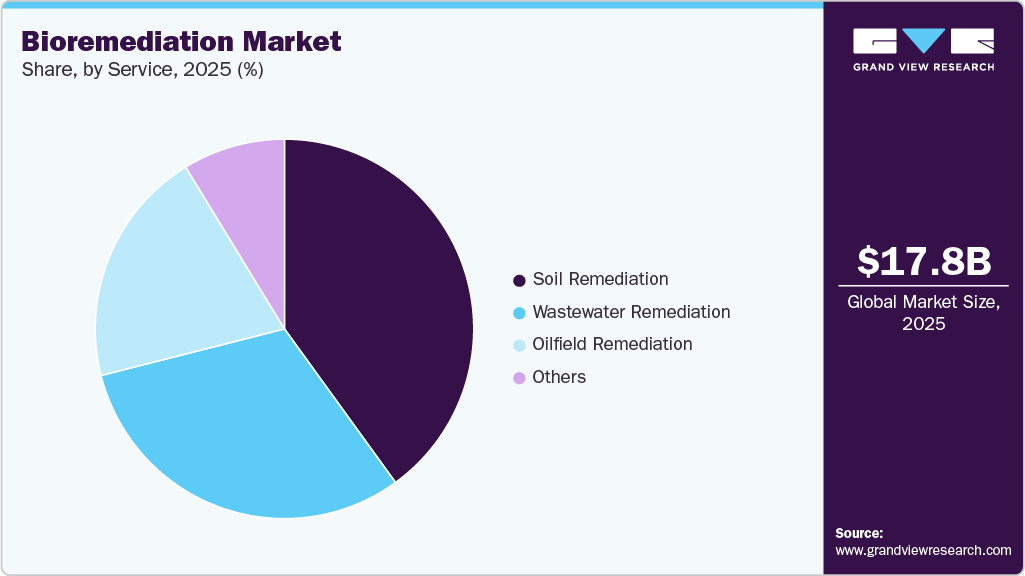
The oilfield remediation segment is expected to register the fastest CAGR during the forecast period, driven by increasing oil spill incidents, stricter environmental regulations, rising investments in effective treatment technologies for hydrocarbon-contaminated soil and water, expanding oil exploration activities, and a growing focus on sustainable site restoration practices globally.
Regional Insights
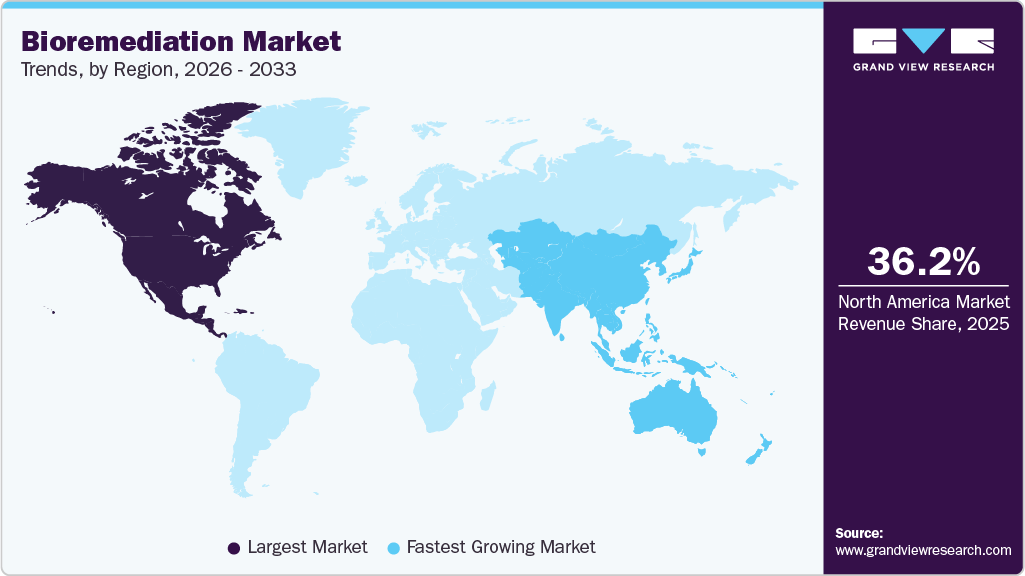
North dominated the global bioremediation market with the largest revenue share of 36.22% in 2025, because the region had strict environmental regulations, and the government provided substantial funding for cleanup programs. Increasing industrial demand for sustainable remediation in oil & gas, chemicals, and manufacturing sectors, coupled with advancements in microbial technologies, bioaugmentation methods, and real-time monitoring systems, is further supporting market expansion.
U.S. Bioremediation Market Trends
The bioremediation market in the U.S. accounted for the largest market revenue share in North America in 2025, due to strict environmental regulations, strong cleanup funding programs, rising industrial demand for sustainable remediation, and ongoing advancements in microbial treatment technologies.
Europe Bioremediation Market Trends
The bioremediation market in Europe is anticipated to grow at a significant CAGR during the forecast period, driven by stringent environmental regulations, increasing investments in sustainable remediation solutions, rising industrial contamination concerns, and strong government support for soil and groundwater restoration initiatives, along with growing adoption of eco-friendly technologies and expanding brownfield redevelopment projects across the region.
The UK bioremediation market is growing steadily due to strict environmental regulations, brownfield redevelopment, rising contamination concerns, and the increasing adoption of sustainable remediation technologies.
The bioremediation market in Germany is growing at a steady pace due to rising industrial and urban contamination, which is driving demand for eco-friendly, cost-effective solutions, especially in situ remediation. Technological advances in microbial treatments and ongoing investment in green technologies are further supporting market expansion.
Asia Pacific Bioremediation Market Trends
The bioremediation market in the Asia Pacific is expected to grow at the fastest CAGR of 13.60% throughout the forecast period, driven by rapid industrialization, rising environmental pollution levels, increasing government regulations, and growing investments in sustainable waste and soil remediation technologies across emerging economies.
The China bioremediation market is expanding because industrial sites and urban redevelopment projects need biological systems to treat their heavy metal, petroleum, and wastewater pollutants. The country develops its remediation capabilities while creating new business opportunities through improvements in microbial technologies, monitoring systems, and sustained funding.
The bioremediation market in Japan is expanding due to strict environmental regulations, government support, and demand from industrial wastewater sectors, with in‑situ microbial solutions and advanced biotech approaches, supported by digital monitoring, driving efficient remediation.
MEA Bioremediation Market Trends
The bioremediation market in the Middle East and Africa is growing due to the region's need to manage oil spills and industrial pollution, particularly in countries with extensive oil extraction activities. Countries like the UAE and South Africa are increasingly adopting bioremediation methods for soil and water contamination. The region also faces challenges, including water scarcity, which has led to a focus on sustainable solutions for pollution management.
The Kuwait bioremediation market is nascent, driven by growing environmental awareness, government initiatives, and increasing interest in microbial and eco-friendly remediation solutions.
Key Bioremediation Company Insights
The bioremediation industry features established players and emerging innovators leveraging advanced microbial technologies, strategic partnerships, and R&D. Companies like Newterra Ltd., Sumas Remediation, Probiosphere, Drylet, Xylem, Regenesis, Aquatech, Envirogen, MicroGen Biotech, and Oil Spill Eater offer diverse solutions for soil, water, and industrial waste remediation using proprietary microbes, enzymes, and bioaugmentation.
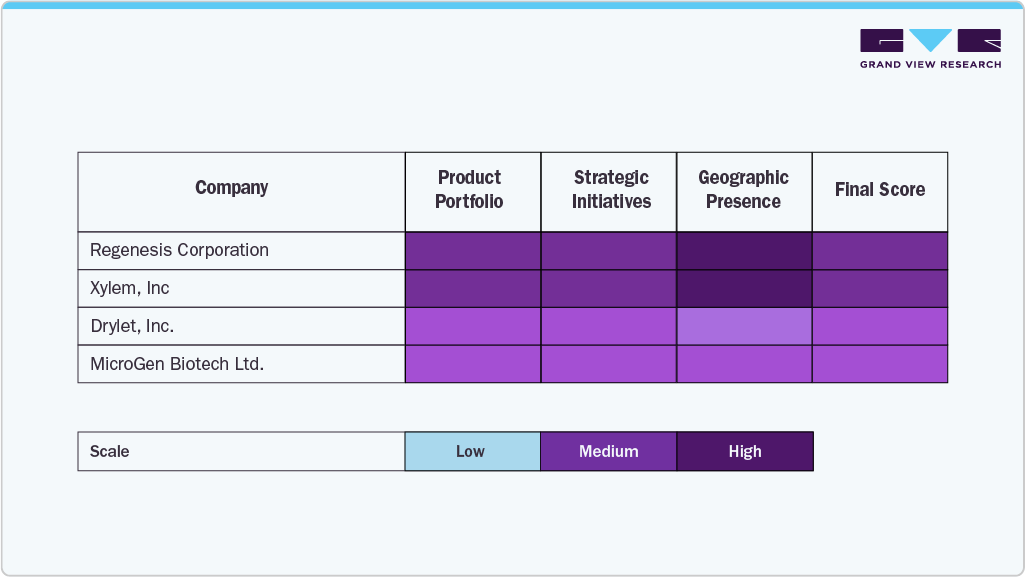
Companies like Probiosphere, Drylet, and MicroGen Biotech are growing through customized bioremediation and advanced monitoring, as the market is increasingly driven by efficiency, sustainability, and technological innovation.
Key Bioremediation Companies:
The following key companies have been profiled for this study on the bioremediation market.
- Newterra Ltd.
- Sumas Remediation Service Inc.
- Probiosphere, Inc.
- Drylet, Inc.
- Xylem, Inc
- Regenesis Corporation
- Aquatech International Corporation
- Envirogen Technologies, Inc.
- MicroGen Biotech Ltd.
- Oil Spill Eater International Inc.
Recent Developments
-
In July 2025, PCMC launched the second phase of bioremediation at Pune’s Moshi dump, aiming to reclaim 25 acres of waste by November 2026 using eco-friendly waste processing techniques.
-
In June 2024, in San Clemente, California, USA, REGENESIS launched the IBIS, an automated Inline Blending and Injection System, enhancing efficiency, accuracy, and safety in in‑situ soil and groundwater remediation.
-
In May 2023, in San Luis Obispo, California, USA, Ancient Organics Bioscience launched PaleoPower, an organic microbial product that degraded glyphosate in soil, restored the microbiome, and improved soil productivity.
Bioremediation Market Report Scope
Report Attribute
Details
Market size value in 2026
USD 19.50 billion
Revenue forecast in 2033
USD 42.11 billion
Growth rate
CAGR of 11.63% from 2026 to 2033
Base year for estimation
2025
Historical data
2021 - 2024
Forecast period
2026 - 2033
Quantitative units
Revenue in USD million/billion and CAGR from 2026 to 2033
Report coverage
Revenue forecast, company ranking, competitive landscape, growth factors, and trends
Segments covered
Type, technology, service, region
Regional scope
North America; Europe; Asia Pacific; Latin America; MEA
Country scope
U.S.; Canada; Mexico; UK; Germany; France; Italy; Spain; Denmark; Sweden; Norway; Japan; China; India; Australia; Thailand; South Korea; Brazil; Argentina; South Africa; Saudi Arabia; UAE; Kuwait
Key companies profiled
Newterra Ltd.; Sumas Remediation Service Inc.; Probiosphere, Inc.; Drylet, Inc.; Xylem, Inc; Regenesis Corporation; Aquatech International Corporation; Envirogen Technologies, Inc.; MicroGen Biotech Ltd.; Oil Spill Eater International Inc.
Customization scope
Free report customization (equivalent up to 8 analyst’s working days) with purchase. Addition or alteration to country, regional & segment scope.
Pricing and purchase options
Avail customized purchase options to meet your exact research needs. Explore purchase options
Global Bioremediation Market Report Segmentation
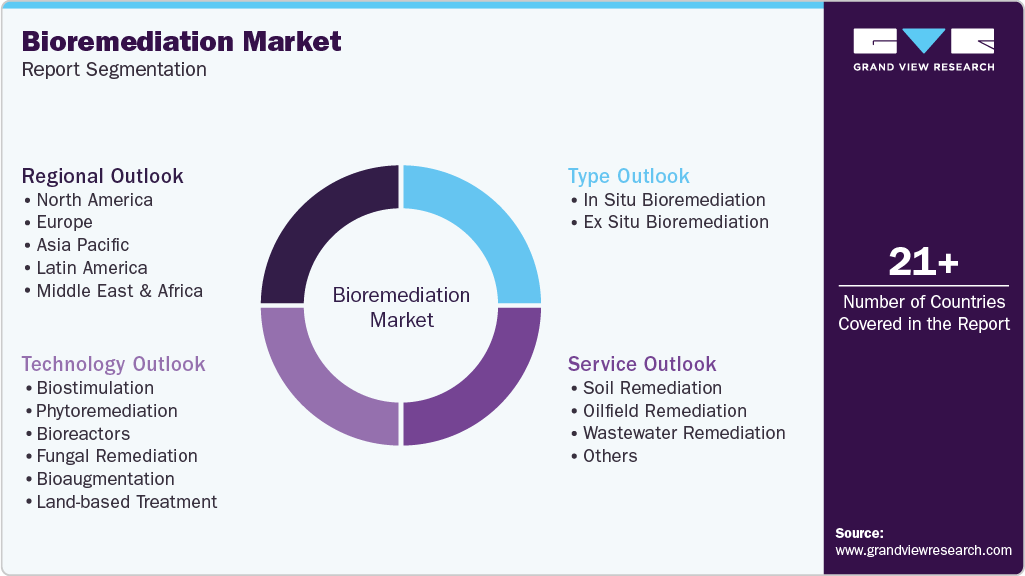
This report forecasts revenue growth and provides an analysis on the latest trends in each of the sub-segments from 2021 to 2033. For this report, Grand View Research has segmented the global bioremediation market report based on the type, technology, service, and region:
-
Type Outlook (Revenue, USD Million, 2021 - 2033)
-
In Situ Bioremediation
-
Ex Situ Bioremediation
-
-
Technology Outlook (Revenue, USD Million, 2021 - 2033)
-
Biostimulation
-
Phytoremediation
-
Bioreactors
-
Fungal Remediation
-
Bioaugmentation
-
Land-based Treatment
-
-
Service Outlook (Revenue, USD Million, 2021 - 2033)
-
Soil Remediation
-
Oilfield Remediation
-
Wastewater Remediation
-
Others
-
-
Regional Outlook (Revenue, USD Million, 2021 - 2033)
-
North America
-
U.S.
-
Canada
-
Mexico
-
-
Europe
-
UK
-
Germany
-
France
-
Italy
-
Spain
-
Denmark
-
Sweden
-
Norway
-
-
Asia Pacific
-
Japan
-
China
-
India
-
Australia
-
Thailand
-
South Korea
-
-
Latin America
-
Brazil
-
Argentina
-
-
Middle East and Africa
-
South Africa
-
Saudi Arabia
-
UAE
-
Kuwait
-
-
Frequently Asked Questions About This Report
b. Some key players operating in the bioremediation market include Newterra Ltd.; Sumas Remediation Service Inc.; Probiosphere, Inc.; Drylet, Inc.; Xylem, Inc; Regenesis Corporation; Aquatech International Corporation; Envirogen Technologies, Inc.; MicroGen Biotech Ltd.; Oil Spill Eater International Inc.
b. Key factors that are driving the bioremediation market growth include rapid growth in industrialization & increasing environmental deterioration, advancements in synthetic technologies, and increasing government support for bioremediation research and innovations.
b. The global bioremediation market size was estimated at USD 17.81 billion in 2025 and is expected to reach USD 19.50 billion in 2026.
b. The global bioremediation market is expected to grow at a compound annual growth rate of 11.63% from 2026 to 2033 to reach USD 42.11 billion by 2033.
b. North America dominated the bioremediation market with a share of 36.22% in 2025. This is attributable to the presence of sophisticated infrastructure, high industrial growth & waste production, and presence of key market players such as Regenesis Corporation, Probiosphere, Inc., and Xylem, Inc, among others.


Share this report with your colleague or friend.
Need a Tailored Report?
Customize this report to your needs — add regions, segments, or data points, with 20% free customization.


ISO 9001:2015 & 27001:2022 Certified
We are GDPR and CCPA compliant! Your transaction & personal information is safe and secure. For more details, please read our privacy policy.
Trusted market insights - try a free sample
See how our reports are structured and why industry leaders rely on Grand View Research. Get a free sample or ask us to tailor this report to your needs.