- Home
- »
- Smart Textiles
- »
-
Ballistic Protective Equipment Market, Industry Report, 2033GVR Report cover
![Ballistic Protective Equipment Market Size, Share & Trends Report]()
Ballistic Protective Equipment Market (2026 - 2033) Size, Share & Trends Analysis Report By Product (Head Protection, Soft Armor, Hard Armor), By Material Type (Aramid, Composites, UHMWPE, Steel), By End-use (Defense, Law Enforcement & Security, Commercial), By Region, And Segment Forecasts
- Report ID: GVR-1-68038-242-6
- Number of Report Pages: 150
- Format: PDF
- Historical Range: 2021 - 2024
- Forecast Period: 2026 - 2033
- Industry: Advanced Materials
- Report Summary
- Table of Contents
- Segmentation
- Methodology
- Download FREE Sample
-
 Download Sample Report
Ballistic Protective Equipment Market Summary
The global ballistic protective equipment market size was estimated at USD 5,600.4 million in 2025 and is projected to reach USD 9,209.9 million by 2033, growing at a CAGR of 6.0% from 2026 to 2033. The market is experiencing significant growth, driven by rising demand from sectors such as defense, law enforcement, and security agencies worldwide.
Key Market Trends & Insights
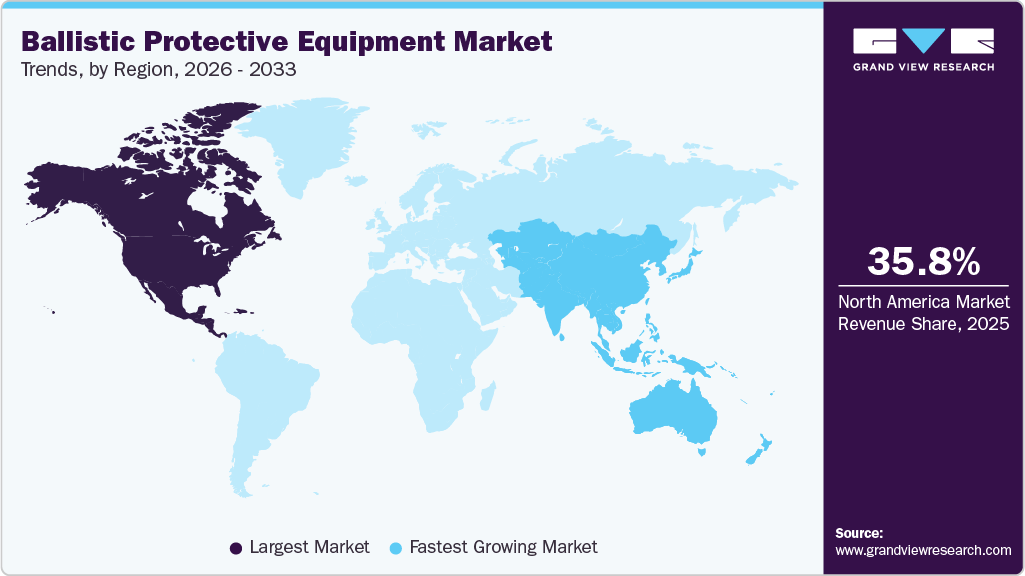
- North America dominated the ballistic protective equipment market with the largest revenue share of 35.8% in 2025.
- The market in U.S. is projected to grow at a robust CAGR of 5.9% from 2026 to 2033.
- By product, the soft armor segment captured the largest share of the global ballistic protective equipment market in 2025 accounting for 45.7%.
- By material, the UHMWPE segment accounted for a market share of 34.1% in 2025.
- By end-use, the defense segment dominated the ballistic protective equipment market in 2025, accounting for a 72.3% share.
Market Size & Forecast
- 2025 Market Size: USD 5,600.4 Million
- 2033 Projected Market Size: USD 9,209.9 Million
- CAGR (2026-2033): 6.0%
- North America: Largest market in 2025
- Asia Pacific: Fastest growing market
Ongoing geopolitical tensions, increasing investments in modernization of protective gear, and the need for lightweight, high-performance materials are fueling market expansion. Organizations are increasingly prioritizing ballistic equipment upgrades to enhance personnel safety and operational efficiency.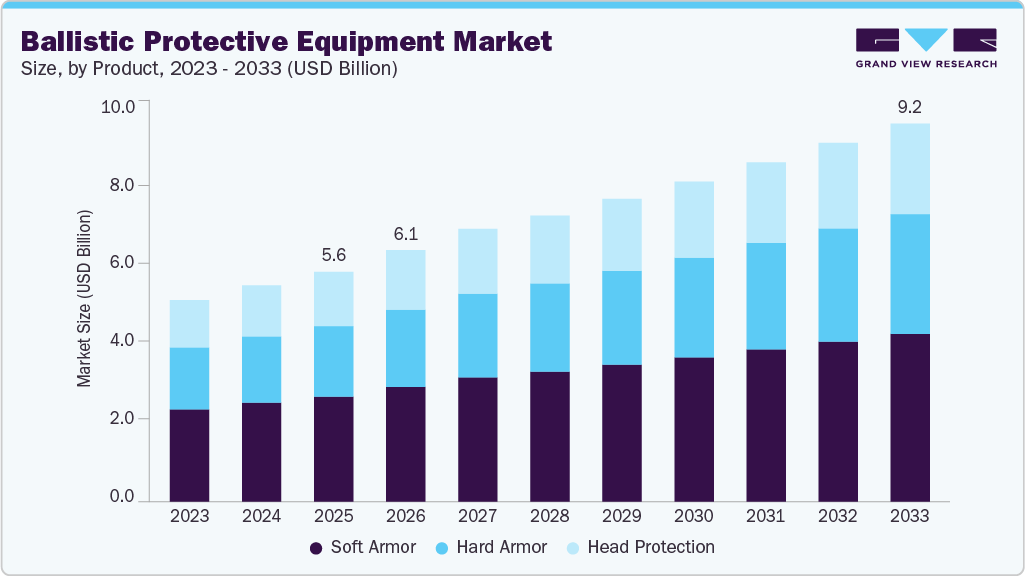
A significant factor driving the ballistic protective equipment market is the growing preference for technologically advanced and lightweight protective gear. Military forces and law enforcement agencies are increasingly prioritizing equipment that enhances mobility, comfort, and operational efficiency while maintaining high levels of ballistic protection. In addition, modernization programs across defense and law enforcement sectors emphasize equipment upgrades to meet evolving threat profiles. The demand for modular, multifunctional, and ergonomic designs aligns with operational flexibility and enhanced tactical performance.
Market Concentration & Characteristics
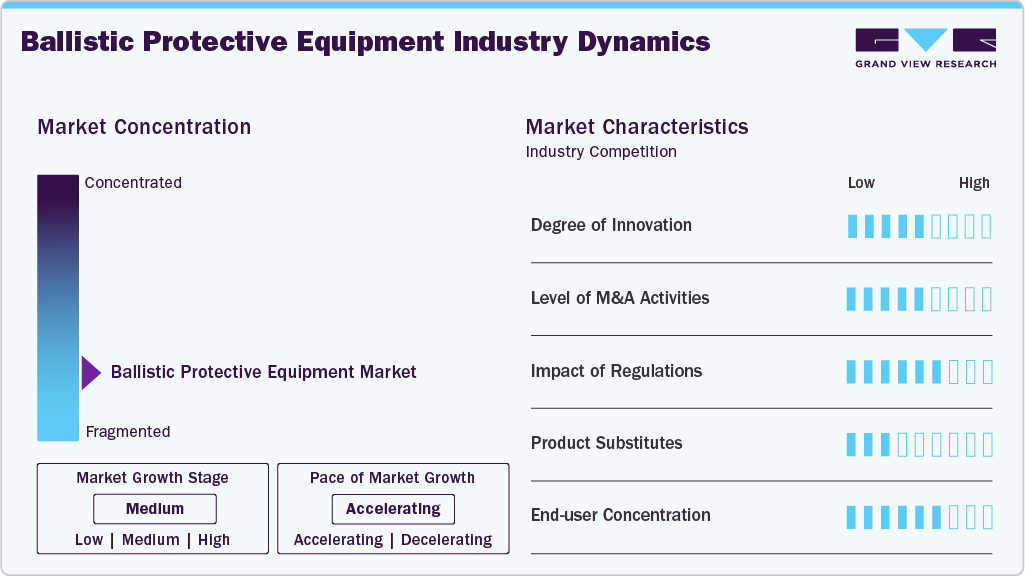
The global ballistic protective equipment market is fragmented, with a range of multinational corporations and numerous regional manufacturers and suppliers. While larger companies command notable market shares due to their R&D capabilities and extensive distribution, many small and medium-sized firms contribute to localized customization and innovation.
This competitive landscape fosters continuous application advancements, price competitiveness, and tailored solutions addressing specific end-use needs across defense, law enforcement, and commercial security segments. Innovation in material science and digitized manufacturing processes drives new application introductions, although large-scale application upgrades are mostly led by industry leaders. Regional specialization and compliance with local ballistic standards further diversify the market.
Government and international regulations significantly impact the ballistic protective equipment market. Standards set by agencies such as the U.S. National Institute of Justice (NIJ) and NATO define performance criteria that manufacturers must meet, influencing application design and lifecycle.
Increased enforcement of protection standards in military and law enforcement procurement incentivizes ongoing upgrades and modernization of ballistic gear. Regulatory pressure also encourages the adoption of environmentally safer materials and manufacturing processes. Non-compliance with these evolving standards can limit application acceptance and restrict sales, particularly in global markets with stringent certification requirements
Drivers, Opportunities & Restraints
The demand for lightweight, flexible, and high-performance ballistic protective equipment in defense and law enforcement is a crucial growth driver. Rising global security concerns and ongoing conflicts intensify the need for effective personal protection. Technological advancements in composite materials and modular armor systems further augment this demand by enhancing comfort and operational capabilities.
There are growing prospects in emerging economies investing in defense modernization and security infrastructure. Adoption of next-generation materials such as UHMWPE and hybrid composites presents manufacturers with innovation opportunities. Integration of smart sensors and IoT-enabled status monitoring in ballistic gear is an emerging trend, potentially transforming maintenance and operational efficiencies. Expanding private security sectors and demand for civilian protection in high-risk regions also offer notable market potential.
High costs of advanced ballistic materials and application technologies can limit accessibility, especially for smaller law enforcement agencies and commercial enterprises. Complex certification processes and regional regulatory disparities may delay application introductions. Supply chain challenges for specialty raw materials and geopolitical uncertainties can restrict timely deliveries and procurement cycles.
Product Insights
The soft armor segment captured the largest share of the global ballistic protective equipment market in 2025 accounting for 45.7% due to widespread adoption across defense, law enforcement, and private security sectors. Soft armor’s lightweight, flexible design makes it highly suitable for extended wear in urban policing, routine law enforcement duties, and crowd control, as well as among private security operators.
Head protection, encompassing advanced ballistic helmets, is expected to gain strong growth momentum amid defense modernization and urban counterterrorism operations. The proliferation of modular communication systems, integrated heads-up displays, and adaptable accessories are raising the value proposition of new-generation helmets. Adoption is also expanding among specialized police and tactical teams, driven by increased awareness of brain injury risks in dynamic combat and riot-control scenarios.
Material Type Insights
The UHMWPE segment accounted for a market share of 34.1% in 2025, military and law enforcement agencies increasingly prefer UHMWPE-based armor for its superior multi-hit resistance, durability, and comfort during extended operations. Advancements in manufacturing processes are making these materials more accessible and cost-effective, further accelerating adoption.
The aramid segment is gaining rapid traction in the ballistic protective equipment market, due to its tensile strength and widespread deployment in both soft and hard armor configurations. Its durability, combined with excellent resistance to impact and penetration, ensures aramid remains a trusted material for protective equipment across military, law enforcement, and security applications. However, the transition toward lighter-weight, multi-hit capable solutions is fueling rapid adoption of UHMWPE, especially for military contracts and high-mobility tactical units.
End-use Insights
The defense segment dominated the ballistic protective equipment market in 2025, accounting for a 72.3% share, driven by military modernization programs and rising geopolitical tensions worldwide. Armed forces are increasingly procuring advanced protective gear such as helmets, vests, and shields. Continuous defense investments across developed and emerging countries further support sustained demand for ballistic protection systems.
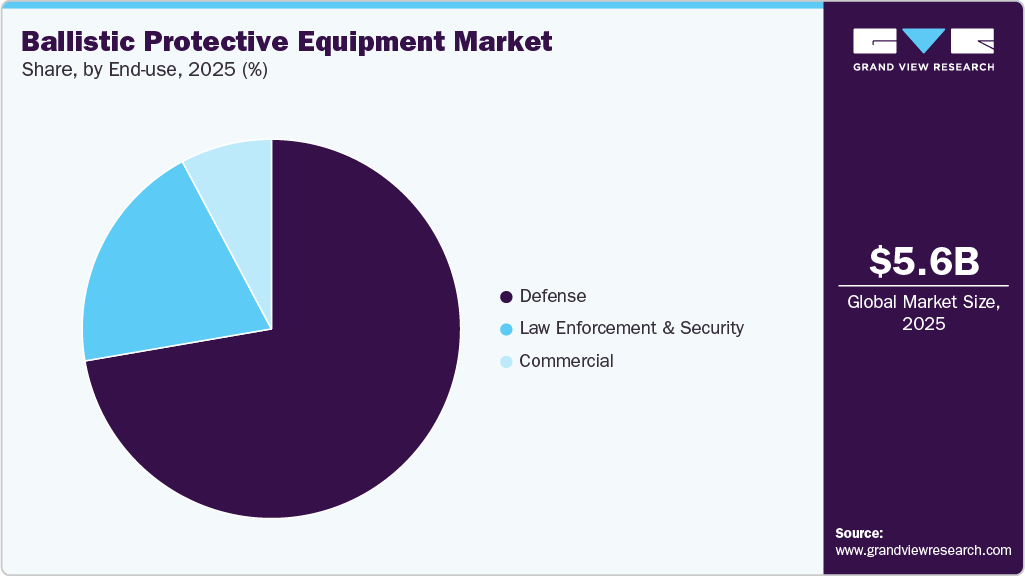
Law enforcement & security is the fastest-growing segment in the ballistic protective equipment market. This rapid expansion is propelled by rising civil unrest, elevated urban crime rates, and the increasing frequency of domestic counterterrorism initiatives. Consequently, governments and private security entities are prioritizing the enhanced protection of personnel, which has led to greater deployment of ballistic equipment including body armor, helmets, and shields to police forces, border control units, and special response.
Regional Insights
North America ballistic protective equipment dominated the global market in 2025 with share of 35.8%. The market is anticipated to achieve steady growth through the forecast period due to persistent investments in defense modernization, large scale law enforcement procurement, and heightened focus on domestic security infrastructure. Demand remains robust across both U.S. and Canada, with procurement cycles responding to upgrades in military and police protective gear, ongoing technological improvements, and increasing requirements for advanced modular systems.
U.S. Ballistic Protective Equipment Market Trends
The market in U.S. is projected to grow at a robust CAGR of 5.9% from 2026 to 2033. U.S. remains the global leader in the ballistic protective equipment market, driven by high defense budgets, large-scale military modernization, and substantial law enforcement procurement. Market growth is supported by consistent government initiatives for upgrading personal protection of both military and police forces, strong domestic manufacturing, and a robust innovation landscape focused on lighter, modular, and high-performance gear.
Europe Ballistic Protective Equipment Market Trends
Europe is poised for steady growth in the ballistic protective equipment market, driven by stringent safety regulations, NATO modernization programs, and increased demand from law enforcement and special forces. The Russia-Ukraine war has significantly accelerated defense spending and procurement across the region, further boosting market momentum. In addition, urban security initiatives, cross-border cooperation, and the adoption of next-generation materials continue to support growth.
Germany is expected to exhibit robust growth in the ballistic protective equipment market, reflecting heightened defense and security investment, modernization of armed and police forces, and the adoption of advanced material technologies. The market is characterized by strong regulatory frameworks, a competitive industrial base, and development of export-oriented protective solutions. Rising concerns over regional security and participation in multinational peacekeeping initiatives further accelerate demand. Projections indicate a consistent and healthy annual growth trajectory for Germany ballistic protection industry.
The UK ballistic protective equipment market is expanding notably, propelled by increased political unrest, higher defense spending, and investments in advanced personal protective gear for both military and specialized law enforcement units. Market momentum is supported by modernization programs, contracts for state-of-the-art ballistic systems, and growing civilian security needs. The UK is emphasizing supplier collaboration and continual innovation to satisfy stringent safety regulations in defense and homeland security applications.
Asia Pacific Ballistic Protective Equipment Market Trends
The Asia Pacific ballistic protective equipment market is forecast to be the fastest-growing regional market, fueled by rising defense budgets, extensive police modernization across emerging economies, and a growing emphasis on equipping personnel with lightweight, high-performance body armor. The shift toward localized manufacturing and operational readiness continues to drive strong demand in countries such as China, India, and South Korea.
China is experiencing strong growth in ballistic protective equipment driven by rapid military modernization, expansion of law enforcement agencies, and rising demand for advanced protective material in response to regional security challenges. Significant government investment in soldier survivability, R&D in next-generation materials, and aggressive scaling of domestic production fuel the market. Local manufacturers benefit from public procurement programs and growing internal demand across defense, police, and commercial sectors.
India market continues to expand, fueled by rising defense expenditure, ongoing border tensions, and the modernization of both military and paramilitary forces. The need for ballistic protection is propelled by internal security issues, insurgency, and terrorism threats, prompting continual upgrades in protective equipment for armed personnel. The emergence of domestic manufacturers and incentives for local procurement align with government priorities for self-reliance and export growth, supporting a dynamic market environment.
Middle East & Africa Ballistic Protective Equipment Market Trends
The Middle East & Africa region is expected to maintain a positive growth trajectory in the ballistic protective equipment market, driven by persistent geopolitical tensions, including the Iran-Israel and Israel-Palestine conflicts. Ongoing defense procurement cycles and rising urban security threats continue to fuel demand. Regional conflicts and international donor-backed stabilization efforts further reinforce investments in multi-threat protection for military, law enforcement, and border security forces.
Saudi Arabia market for ballistic protection is experiencing substantial expansion as defense and law enforcement agencies prioritize personnel safety amid evolving regional security threats. Investments in advanced body armor, vehicle protection, and tactical gear are prevalent, with a focus on lightweight, multi-level protective solutions. The sector is characterized by collaboration with global suppliers and efforts to localize key aspects of protective material, ensuring resilience and capability growth within the Kingdom’s security strategy.
Latin America Ballistic Protective Equipment Market Trends
The Latin American market is experiencing stable growth, supported by the expansion of public security programs and a gradual modernization of defense infrastructure. Regional instability and increased attention to peacekeeping, border security, and counter-crime efforts continue to encourage investment in body armor and protective solutions for both state forces and private security sectors.
The Brazil ballistic protective equipment market is supported by increasing investments in defense infrastructure, modernization of law enforcement agencies, and government initiatives targeting organized crime and urban violence. Growing civilian demand for personal protection in high-risk areas and opportunities for local manufacturing encourage sustained market expansion. Challenges include regulatory compliance and workforce specialization, but the sector is positioned for solid growth as national security priorities advance.
Key Ballistic Protective Equipment Company Insights
Some of the key players operating in the market include Galvion, ArmorSource LLC, MKU Limited, Point Blank Enterprise, Inc, and Mehler Vario System among others
-
Seyntex N.V. is a Belgium-based manufacturer of personal protective equipment and technical textiles. The company produces ballistic vests, plate carriers, helmets, and protective garments for military and law enforcement users. It also supplies camouflage fabrics and integrated soldier systems. Seyntex operates manufacturing facilities in Europe and focuses on compliance with international ballistic and quality standards.
-
Galvion develops head systems, power management devices, and ballistic protection equipment for defense and security forces. Its portfolio includes ballistic helmets, face protection, and modular accessories. The company integrates power and data capabilities into headborne systems to support communication and mounted equipment. Galvion serves military and law enforcement markets across multiple regions.
Key Ballistic Protective Equipment Companies:
The following key companies have been profiled for this study on the ballistic protective equipment market.
- Seyntex N.V.
- Galvion
- Safariland
- EnGarde body armor
- Point Blank Enterprise, Inc.
- NP Aerospace
- ArmorSource LLC
- Craig International Ballistics
- Protection Group Danmark
- Safe Life Defense
- Tactical Assault Gear (TAG)
- Hellweg International Pty. Ltd
- MKU Limited
- Mehler Vario System
Recent Developments
-
In February 2026, Galvion introduced the Batlskin Hellbender UL helmet, an ultra-lightweight ballistic head system designed for modern armed forces. The helmet is developed to support large-scale deployment and standardization across units while maintaining ballistic performance.
-
In February 2026, MKU Limited a joint venture with Sondos Advanced Industry, inaugurated at World Defense Expo, Riyadh. The partnership strengthens MKU’s commitment to Saudi Arabia’s local defense manufacturing and long-term capability development.
Ballistic Protective Equipment Market Report Scope
Report Attribute
Details
Market size value in 2026
USD 6,130.7 million
Revenue forecast in 2033
USD 9,209.9 million
Growth rate
CAGR of 6.0% from 2026 to 2033
Base year for estimation
2025
Historical data
2021 - 2024
Forecast period
2026 - 2033
Quantitative units
Revenue in USD million/billion and CAGR from 2026 to 2033
Report coverage
Revenue forecast, company market position analysis, competitive landscape, growth factors, and trends
Segments covered
Product, material type, end-use, region
Regional scope
North America; Europe; Asia Pacific; Latin America; MEA
Country scope
U.S.; Canada; Mexico; UK; Germany; France; Italy; Poland; Russia; Ukraine; China; Japan; India; Australia; South Korea; Taiwan; Singapore; Brazil; Argentina; Saudi Arabia; UAE; South Africa; Qatar; Israel
Key companies profiled
Seyntex N.V.; Galvion; Safariland; EnGarde body armor; Point Blank Enterprise, Inc.; NP Aerospace; ArmorSource LLC; Craig International Ballistics; Protection Group Danmark; Safe Life Defense; Tactical Assault Gear (TAG); Hellweg International Pty. Ltd; MKU Limited; Mehler Vario System
Customization scope
Free report customization (equivalent up to 8 analysts working days) with purchase. Addition or alteration to country, regional & segment scope.
Pricing and purchase options
Avail customized purchase options to meet your exact research needs. Explore purchase options
Global Ballistic Protective Equipment Market Report Segmentation
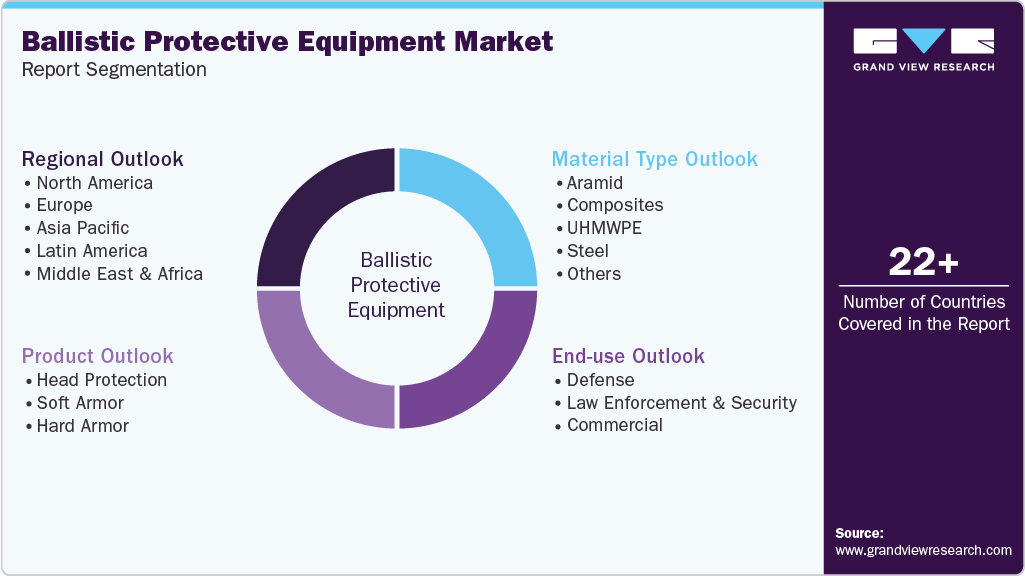
This report forecasts revenue growth at global, regional, and country levels and provides an analysis of the latest industry trends in each of the sub-segments from 2021 to 2033. For this study, Grand View Research has segmented the global ballistic protective equipment market report based on product, material type, end-use and region:
-
Product Outlook (Revenue; USD Million, 2021 - 2033)
-
Head protection
-
Soft armor
-
Hard armor
-
-
Material Type Outlook (Revenue; USD Million, 2021 - 2033)
-
Aramid
-
Composites
-
UHMWPE
-
Steel
-
Others
-
-
End-use Outlook (Revenue; USD Million, 2021 - 2033)
-
Defense
-
Law enforcement & security
-
Commercial
-
-
Regional Outlook (Revenue; USD Million, 2021 - 2033)
-
North America
-
U.S.
-
Canada
-
Mexico
-
-
Europe
-
Germany
-
France
-
Italy
-
Poland
-
UK
-
Russia
-
Ukraine
-
-
Asia Pacific
-
China
-
India
-
Japan
-
South Korea
-
Australia
-
Taiwan
-
Singapore
-
-
Latin America
-
Brazil
-
Argentina
-
-
Middle East and Africa
-
Saudi Arabia
-
UAE
-
South Africa
-
Qatar
-
Israel
-
-
Frequently Asked Questions About This Report
b. The global ballistic protective equipment market size was estimated at USD 5,600.4 million in 2025 and is expected to reach USD 6,130.7 million in 2026
b. The global ballistic protective equipment market is expected to grow at a compound annual growth rate of 6.0% from 2026 to 2033 to reach USD 9,209.9 million by 2033
b. Increasing concerns about improving army survival are expected to benefit market growth. Additionally, rising defense spending as a result of expanding regional economies, as well as increased competition among governments to demonstrate their power, are expected to fuel market growth.
b. The UHMWPE segment accounted for a market share of 34.1% in 2025, maintaining its relevance due to its tensile strength and widespread deployment in both soft and hard armor configurations. Its durability, combined with excellent resistance to impact and penetration, ensures aramid remains a trusted material for protective equipment across military, law enforcement, and security application
b. Some of the key players operating in the ballistic protective equipment market include Seyntex N.V., Galvion, Safariland, EnGarde body armor, Point Blank Enterprise, Inc., NP Aerospace, ArmorSource LLC, Craig International Ballistics, Protection Group Danmark, Safe Life Defense, Tactical Assault Gear (TAG), Hellweg International Pty. Ltd, MKU Limited, and Mehler Vario System.


Share this report with your colleague or friend.
Need a Tailored Report?
Customize this report to your needs — add regions, segments, or data points, with 20% free customization.


ISO 9001:2015 & 27001:2022 Certified
We are GDPR and CCPA compliant! Your transaction & personal information is safe and secure. For more details, please read our privacy policy.
Trusted market insights - try a free sample
See how our reports are structured and why industry leaders rely on Grand View Research. Get a free sample or ask us to tailor this report to your needs.