- Home
- »
- Clothing, Footwear & Accessories
- »
-
Baby Products Market Size & Share, Industry Report, 2033GVR Report cover
![Baby Products Market Size, Share & Trends Report]()
Baby Products Market (2026 - 2033) Size, Share & Trends Analysis Report By Product (Baby Cosmetics & Toiletries, Baby Food, Baby Toys & Play Equipment, Baby Feeding & Nursing), By Type (Mass, Premium), By Distribution Channel, By Region, And Segment Forecasts
- Report ID: GVR-1-68038-751-3
- Number of Report Pages: 100
- Format: PDF
- Historical Range: 2021 - 2025
- Forecast Period: 2026 - 2033
- Industry: Consumer Goods
- Report Summary
- Table of Contents
- Segmentation
- Methodology
- Download FREE Sample
-
 Download Sample Report
Baby Products Market Summary
The global baby products market size was estimated at USD 355.94 billion in 2025 and is projected to reach USD 579.52 billion by 2033, growing at a CAGR of 6.4% from 2026 to 2033. One of the primary factors driving market expansion is the shift in consumer preferences toward high-quality, utility-driven, and premium baby products.
Key Market Trends & Insights
- Asia Pacific dominated the baby products market with the largest revenue share of 43.7% in 2025.
- China baby products market held a revenue share of 32.0% of the Asia Pacific revenue in the year 2025.
- Based on product, baby cosmetics & toiletries led the market with the largest revenue share of 29.5% in 2025.
- Based on type, mass baby products led the market with the largest revenue share of 74.6% in 2025.
- Based on distribution channel, the hypermarkets & supermarkets led the market with the largest revenue share of 34.8% in 2025.
Market Size & Forecast
- 2025 Market Size: USD 355.94 Billion
- 2033 Projected Market Size: USD 579.52 Billion
- CAGR (2026-2033): 6.4%
- Asia Pacific: Largest market in 2025
Rising demand in the market is closely tied to parents managing daily constraints rather than aspirational buying. More dual-income households and nuclear families mean less time for home-based care, pushing demand for ready-to-use baby food, disposable hygiene products, and easy-to-handle gear such as lightweight strollers and baby carriers. In many urban and semi-urban areas, limited living space and frequent travel also drive preference for compact and multi-use products rather than multiple single-purpose items.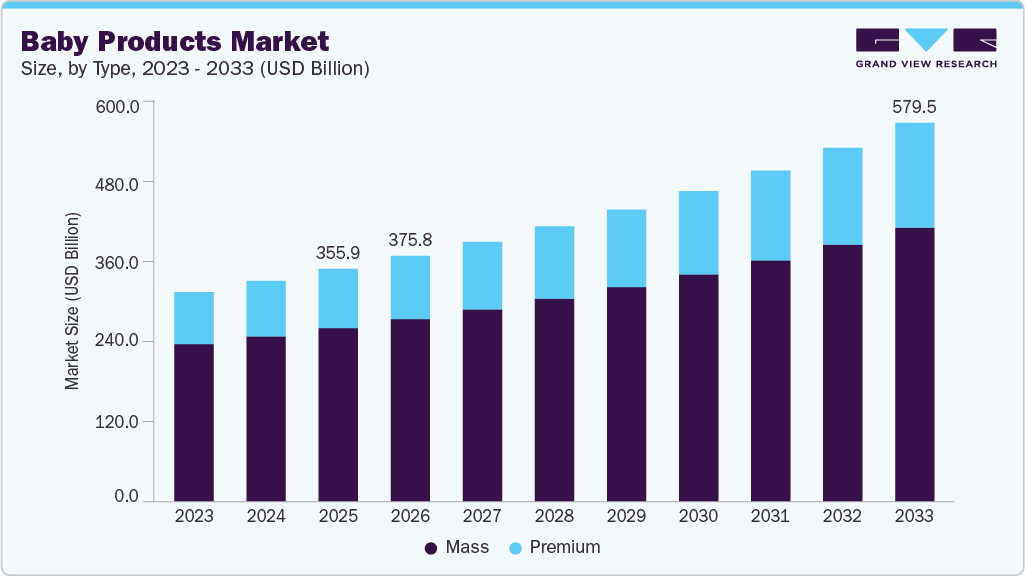
Health-related learning at the ground level is another strong driver. Parents increasingly respond to visible outcomes such as diaper rashes, skin allergies, or digestive issues rather than marketing claims. This has led to steady demand for better quality diapers, mild skincare, and fortified baby foods, even when they cost more than entry-level options. Pediatrician advice, hospital discharge kits, and word of mouth in local communities influence buying decisions far more than influencer-led branding, especially for newborn and infant care categories.
UNICEF and WHO surveys show aggressive formula marketing reaches over 51 % of parents and pregnant women globally, influencing feeding decisions and increasing formula and fortified baby food consumption even where breastfeeding rates are high. This reflects a real behavioural response to pervasive messaging combined with busy lifestyles, not just aspirational buying.
The market growth is strongly influenced by trust and convenience in parental purchasing decisions. According to ParentsandBrands, 62% of parents follow recommendations from other parents, and 41% consider health professional advice, showing that trusted guidance drives product adoption and repeat purchases. Convenience also fuels growth, with 43% buying baby products during regular supermarket trips and 38% using multi-brand online platforms, expanding reach and accessibility, and steadily increasing demand across hygiene, nutrition, and skincare categories.
Brand Share Analysis
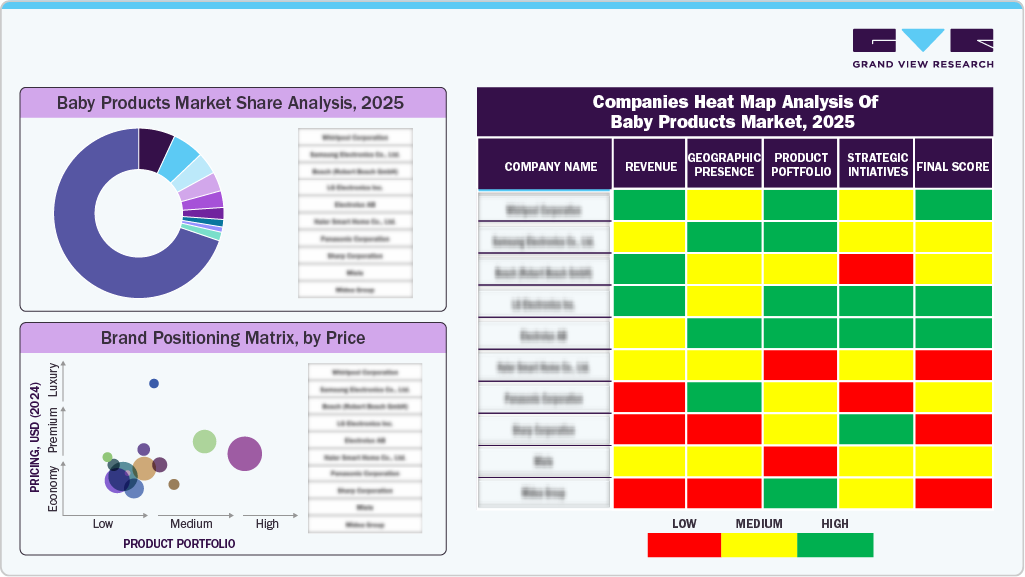
The global market is driven by a mix of established FMCG leaders, premium innovators, and regional or value-focused players, each targeting specific consumer needs and income segments.
-
Established global players: Procter & Gamble, Johnson & Johnson, Kimberly-Clark - dominate hygiene, skincare, and diaper segments with trusted brands, wide distribution, and strong brand loyalty.
-
Premium and specialized brands: HiPP, Ella’s Kitchen, BabyBjörn - focus on organic, chemical-free nutrition, specialized feeding gear, and ergonomically designed products, appealing to health-conscious and higher-income parents.
-
Lifestyle and boutique brands: Little Unicorn, Aden + Anais - combine functionality with aesthetic appeal in apparel, bedding, and accessories, targeting parents who value design and brand image.
-
Regional/value players: Local companies offer competitively priced diapers, wipes, and baby food, driving adoption among price-sensitive consumers while expanding reach in tier 2 and 3 cities.
Consumer Insights
Changing parenting habits and the growing use of digital platforms are influencing how consumers purchase baby care products. Parents increasingly rely on e-commerce platforms to compare product ingredients, safety certifications, and user reviews before making decisions on items such as diapers, wipes, skincare, and feeding accessories. According to a study cited in August 2025, nearly two-thirds of urban Indian households now buy baby care products online, compared with around 25% four years earlier, highlighting the rapid shift toward digital channels for infant essentials. Online platforms allow parents to access detailed product information and peer feedback, which plays an important role in building trust when selecting products for newborns and toddlers.
Product safety and ingredient transparency also play a crucial role in purchasing decisions during early childhood. 67% of parents prefer chemical-free or additive-free baby products until their child reaches two years of age, while 48% continue prioritising such formulations until age three. In addition, about 62% of households opt for premium baby care products during the first two years, reflecting the strong willingness among parents to spend more on items perceived as safer and gentler for infants. This heightened focus on ingredient safety and product quality continues to shape brand positioning and consumer loyalty within the baby products market.
Consumer Demographics and Household Type
-
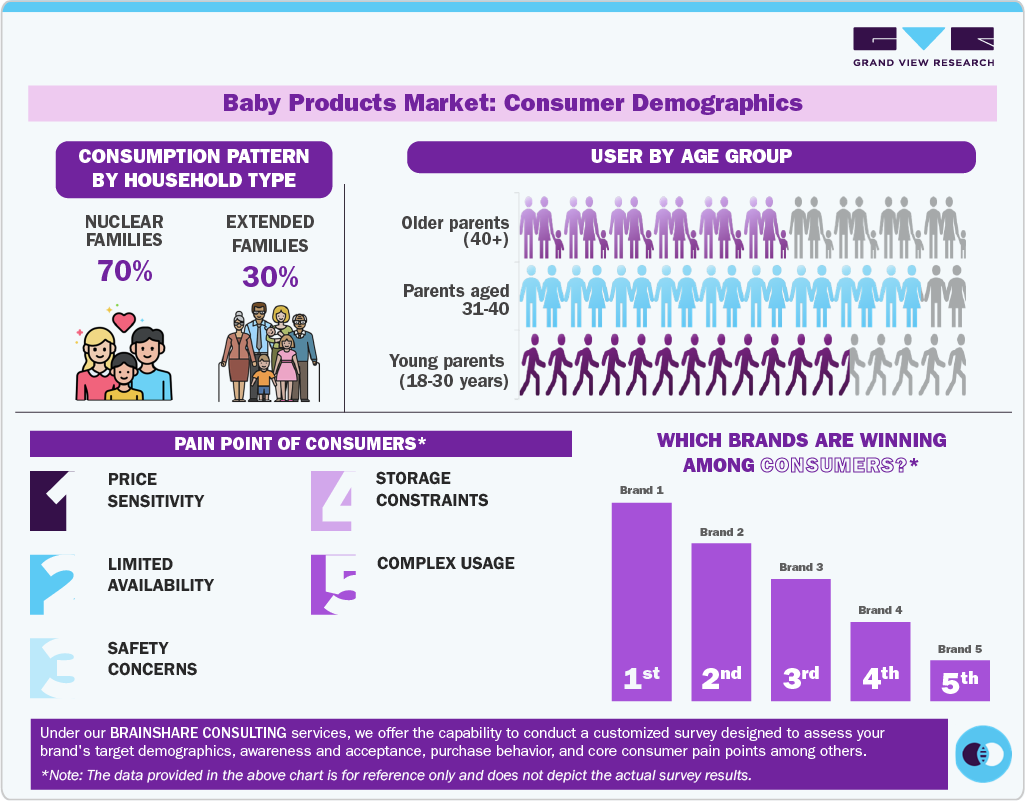
Nuclear families account for 70 % of users; extended families make up 30 %.
-
Smaller households prioritize convenience products like disposable diapers, ready-to-use baby food, and multi-functional gear.
-
Extended families buy in larger volumes and rely on trusted or familiar brands.
Parental Age
-
Parents aged 31-40 form the largest consumer group, focused on quality and safety.
-
Young parents (18-30) are digitally connected, open to premium and innovative products.
-
Older parents (40+) prefer established brands and reliable, safe options.
Consumer Pain Points
-
Price sensitivity - high cost of premium products.
-
Limited availability - difficulty finding organic, specialty, or niche items.
-
Safety concerns - skin reactions, toy hazards, or product reliability.
-
Storage constraints - bulky items challenging for small homes.
-
Complex usage - multi-functional or tech-enabled products can be confusing.
Brands Winning Among Consumers
Among brands, Pampers and Huggies lead in hygiene and diaper products due to reliability and widespread availability. Johnson & Johnson and HiPP perform strongly in skincare and baby nutrition, attracting safety- and health-conscious parents. Chicco is preferred for feeding, nursing, and baby gear, combining quality, functionality, and accessibility.
Products Insights
Baby cosmetics & toiletries led the market with the largest revenue share of 29.5% in 2025, due to the high frequency of daily-use products such as lotions, shampoos, and diaper creams. Increased hygiene awareness among urban consumers, coupled with strong brand presence and distribution across both retail and e-commerce channels, ensures consistent and recurring demand. For instance, in December 2025, India’s dermatology-led skincare brand Ceuticoz entered the baby care market with the launch of its Ceuticoz Baby range, a seven-SKU, pediatrician-approved skincare line for newborns and infants formulated without harsh chemicals and designed to be hypoallergenic, gentle, and suitable for sensitive skin.
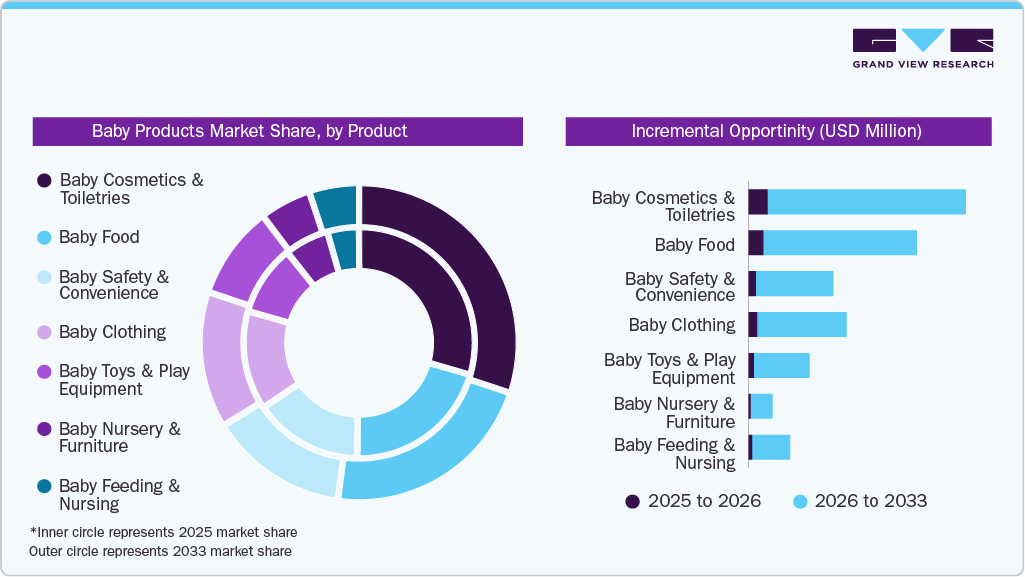
Baby feeding & nursing products are anticipated to witness the fastest growth in CAGR of 7.7% from 2026 to 2033, owing to rising dual-income households, heightened awareness of infant nutrition, and the adoption of convenience-oriented products such as bottles, breast pumps, and formula dispensers. Lifestyle shifts and the preference for fortified or specialized feeding solutions are driving accelerated demand in this category.
For instance, in August 2025, Philips India launched the Philips Avent Hands-free Electric Breast Pump during World Breastfeeding Week, under the #GiftOfFreedom campaign to offer greater comfort and convenience to nursing mothers.
Type Insights
Mass baby products led the market with the largest revenue share of 74.6% in 2025, due to their affordability and wide accessibility across urban and rural regions. High-volume essentials such as diapers, wipes, and basic baby care items cater to price-sensitive consumers, and extensive distribution through supermarkets, pharmacies, and e-commerce platforms ensures steady sales.
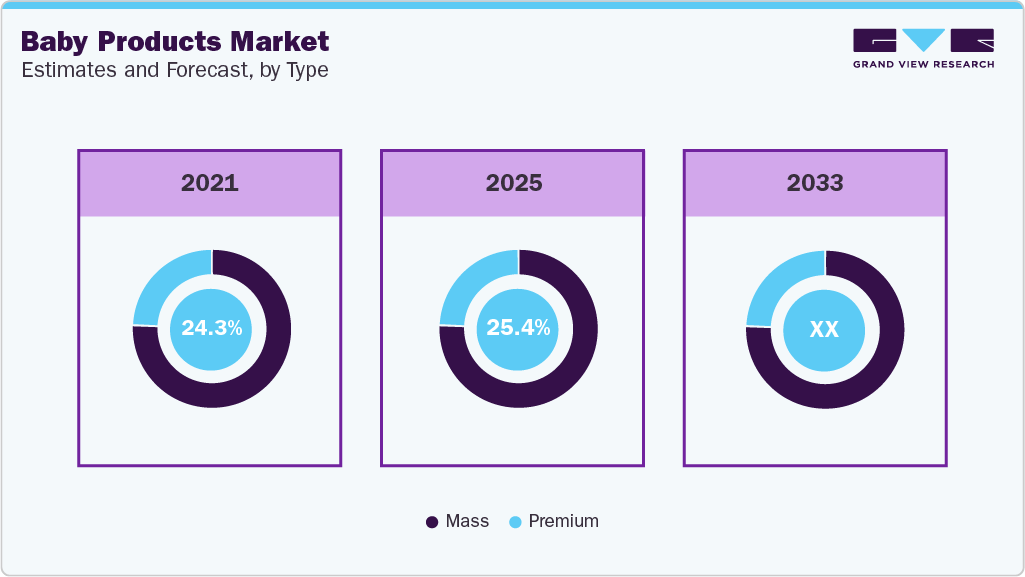
Premium baby products are expected to witness a CAGR of 7.0% from 2026 to 2033, driven by increasing dual incomes among parents, rising consumer preference for organic and high-quality formulations, and brand-led trust in safety and efficacy. Urban parents, particularly in dual-income households, are increasingly willing to pay a premium for enhanced features, natural ingredients, and convenience-focused offerings. For instance, in January 2026, Nuna expanded its premium baby gear range with the RAVA™ next Convertible Car Seat, offering easy installation, versatile rear-to-forward facing, and enhanced comfort and safety features.
Distribution Channel Insights
The sale of baby products through hypermarkets and supermarkets held a market share of 34.8% in 2025, due to their wide product assortment, competitive pricing, and convenience for bulk purchases. Parents often prefer one-stop shopping for essential baby items such as diapers, wipes, and formula, and promotions or loyalty programs further drive sales through these offline retail formats. For instance, in July 2025, infant nutrition brand ByHeart significantly expanded the availability of its “Best for Breastfed Babies” infant formula in the U.S., increasing distribution through Walmart from about 1,100 to over 2,800 stores.
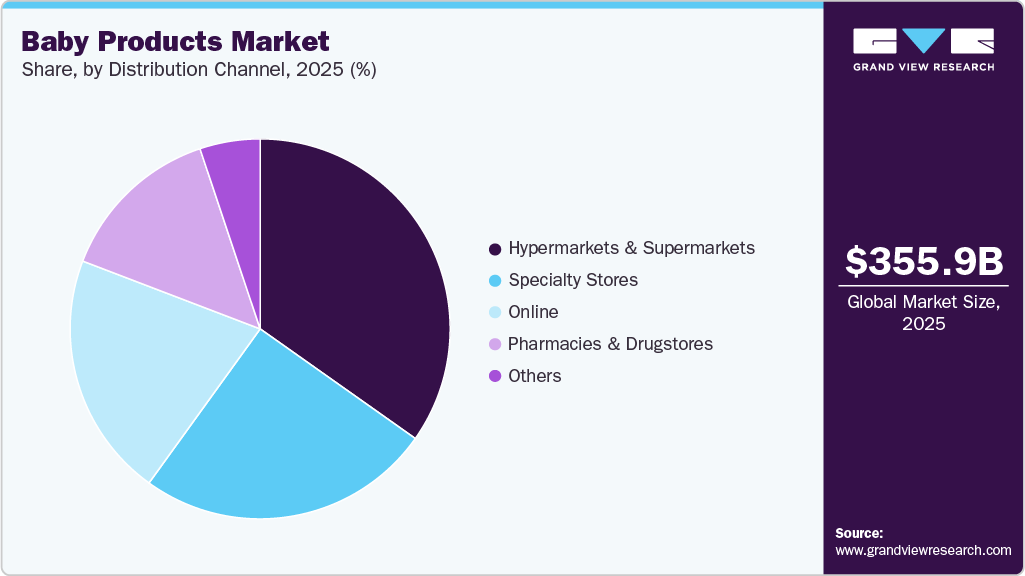
The sale of baby products through online channels is expected to grow at a CAGR of 7.6% from 2026 to 2033. The online segment is expected to grow rapidly as consumers increasingly value convenience, doorstep delivery, and access to a wider variety of products, including premium and niche brands. E-commerce platforms, brand-owned websites, and subscription services are expanding reach and fostering repeat purchases, particularly among tech-savvy and urban parents. For instance, in June 2024, Lifelong Online entered the baby care market in India by launching a dedicated baby products category featuring items such as wearable breast pumps, strollers, bottle warmers, collapsible bathtubs, anti-slip bathers, baby car seats, and potty seats.
Regional Insights
The North America baby products market held a revenue share of 14.7% of the global revenue in the year 2025. The market in North America is driven by widespread adoption of both mass-market and premium baby products, reflecting parents’ willingness to invest in quality, safety-certified, and specialized offerings. A well-developed retail ecosystem, including supermarkets, specialty baby stores, and pharmacies, combined with rapidly growing e-commerce penetration, ensures broad product accessibility and convenience. In addition, strong brand presence, frequent product innovation, and high trust in regulated baby care standards continue to support steady demand across the North America market.
U.S. Baby Products Market Trends
The baby products market in the U.S. held a revenue share of 69.8% of the North America revenue in the year 2025. The U.S. baby products industry is supported by ongoing product innovation, strong demand for convenience-oriented offerings such as ready-to-use and multifunctional baby products, and increasing interest in premium, organic, and clean-label baby care items. Urbanization and a rising number of dual-income households are further encouraging spending on value-added and time-saving baby products, reinforcing the U.S. dominant position within the market.
Mexico baby products market is expected to grow at a CAGR of 6.9% from 2026 to 2033. The Mexico baby products industry is driven by expanding urban populations, improving access to organized retail, and rising adoption of branded baby care products among young parents. Demand is also being supported by growing awareness of hygiene, safety, and product quality, leading to higher uptake of packaged baby food, diapers, skincare, and feeding accessories. In addition, increasing participation of women in the workforce and the gradual growth of dual-income households are encouraging spending on convenient and time-saving baby products.
Europe Baby Products Market Trends
The baby products market in Europe held a revenue share of 22.2% of the global revenue in the year 2025. Demand for baby products in the European region is driven by high adoption of premium and organic baby products, as parents increasingly prioritize certified, eco-friendly, and dermatologically tested offerings. Europe’s well-established retail network, including pharmacies, specialty baby stores, and supermarkets, combined with expanding e-commerce penetration, ensures wide product availability and convenience. In addition, the strong presence of established domestic and international brands, continuous product innovation, and high consumer trust in stringent European safety standards continue to support steady demand across the European market.
Germany baby products market held a revenue share of 22.1% of the European revenue in the year 2025. Demand for baby products in Germany is driven by high awareness of infant health and hygiene, along with widespread preference for certified, organic, and environmentally responsible baby products. German parents show strong trust in pharmacy-led and specialist retail channels, which reinforces demand for clinically tested and dermatologically approved baby care items. In addition, stable household spending, high acceptance of premium baby nutrition and skincare products, and continuous product innovation continue to support Germany’s leading position within the market.
The baby products market in Spain is expected to grow at a CAGR of 6.5% from 2026 to 2033. Demand for baby products in Spain is being shaped by parents prioritizing quality, safety, and nutrition, particularly for infant feeding and personal care products. Spain’s strong pharmacy and specialty retail network supports consistent access to trusted baby brands, while growing acceptance of organic and eco-friendly products is influencing purchasing decisions. Additionally, increased reliance on convenience-led solutions among working parents and the gradual growth of e-commerce adoption are supporting steady demand across the Spanish market.
Asia Pacific Baby Products Market Trends
The baby products market in the Asia Pacific held a notable revenue share of 43.7% of the global market in 2025. The market in this region is primarily driven by the number of working mothers and the increase in the birth rate in developing countries, including India and China. According to the EPRA International Journal of Economic and Business Review, the female workforce participation rate has increased by 4.1% over the last three decades, which in turn is providing a boost for various baby-related products such as baby food, baby cosmetics & toiletries, and baby safety & convenience. In addition, a rise in disposable income triggered the spending power of consumers, thereby uplifting product demand.
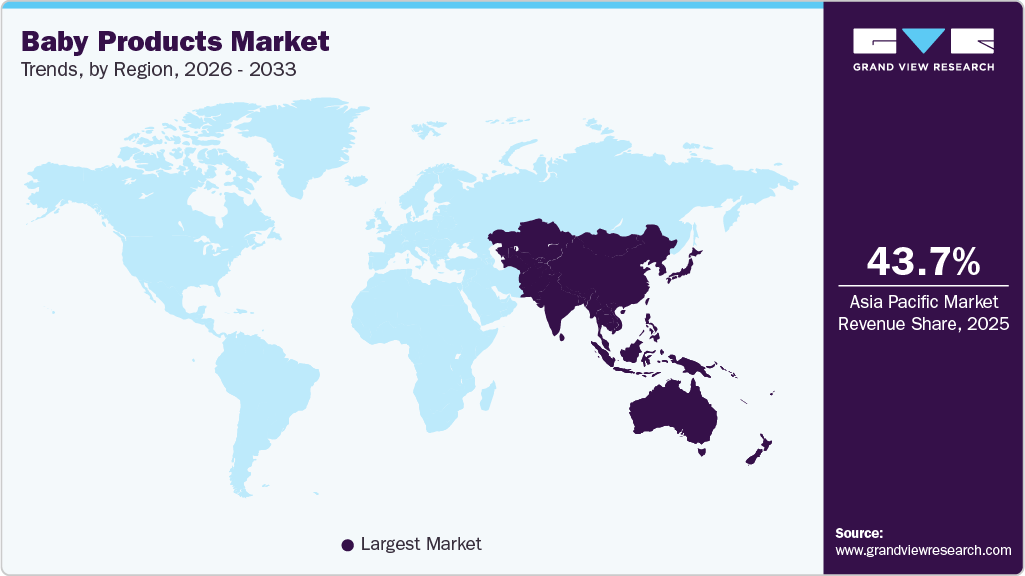
China baby products market held a revenue share of 32.0% of the Asia Pacific revenue in the year 2025. The baby products industry in China is being shaped by heightened parental focus on early childhood development, nutrition, and product safety, particularly following years of increased scrutiny around quality standards. Chinese parents show a strong preference for well-known domestic and international brands that emphasize traceability, certifications, and scientific formulation, especially in infant formula, diapers, and baby skincare. The market is also strongly influenced by China’s advanced digital ecosystem, where e-commerce platforms, livestream shopping, and parenting-focused social communities play a central role in product discovery and purchasing decisions.
The baby products market in India is expected to grow at a CAGR of 7.9% from 2026 to 2033. The growth of baby products in India is being driven by increasing nuclear households, later parenthood, and higher parental spending on infant well-being, particularly in urban and semi-urban regions. Indian consumers are increasingly opting for branded baby products that offer clear safety assurances, mild formulations, and compliance with pediatric standards, especially in diapers, baby toiletries, and feeding products. Additionally, the strong growth of direct-to-consumer baby brands, improved last-mile delivery, and greater product awareness through digital platforms are strengthening adoption across the Indian market.
Central & South America Baby Products Market Trends
The baby products market in Central & South America is expected to grow at a CAGR of 5.7% from 2026 to 2033. The Central & South America baby products industry is driven by younger parents seeking dependable and cost-effective baby care solutions, particularly in urban centers. Rising awareness of early childhood nutrition and hygiene is encouraging greater adoption of packaged baby food, diapers, and personal care products. The market is also benefiting from the expansion of modern trade formats, cross-border brand entry, and increased digital engagement, which are improving consumer exposure to a wider range of baby products.
Middle East & Africa Baby Products Market Trends
The baby products market in the Middle East & Africa is expected to grow at a CAGR of 6.1% from 2026 to 2033. The Middle East & Africa baby products industry is driven by increasing awareness of infant health, nutrition, and hygiene, alongside rising parental spending on baby care essentials. Expanding urban populations and gradual improvement in retail infrastructure are enhancing access to packaged baby food, diapers, and personal care products. In addition, growing adoption of modern retail formats, increasing penetration of e-commerce platforms, and wider availability of branded baby products are supporting consistent demand, reinforcing the steady expansion of the Middle East & Africa market.
Key Baby Products Companies:
The following key companies have been profiled for this study on the baby products market.
- Johnson & Johnson
- Procter & Gamble (Pampers)
- Kimberly‑Clark (Huggies)
- Nestlé (Gerber)
- Unilever
- Abbott Laboratories
- Danone
- Munchkin
- Graco
- BabyBjörn
Recent Developments
-
In January 2026, Ed‑a‑Mamma launched its “Your Baby Safe” range, highlighting gentle, dermatologically tested baby care products, with a campaign emphasizing safety and trust for parents.
-
In September 2025, Coterie expanded into baby skincare, launching gentle, dermatologist‑tested products designed for sensitive and eczema‑prone skin, meeting parent demand for safe daily-use care.
-
In October 2025, Georgian canning company Kula plans to launch a baby food line at the former HIPP factory in Agara, investing around 1.48 million USD (4 million GEL) in new equipment and production capacity. The move leverages Kula’s existing fruit processing expertise and local raw material sourcing to enter the infant food segment, with products initially targeting the domestic market and drawing on the company’s growing export footprint to about 30 countries.
Baby Products Market Report Scope
Report Attribute
Details
Market size value in 2026
USD 375.80 billion
Revenue forecast in 2033
USD 579.52 billion
Growth rate (revenue)
CAGR of 6.4% from 2026 to 2033
Actuals
2021 - 2025
Forecast period
2026 - 2033
Quantitative units
Revenue in USD million/billion, and CAGR from 2026 to 2033
Report coverage
Revenue forecast, company ranking, competitive landscape, growth factors, and trends
Segments covered
Product, type, distribution channel, region
Regional scope
North America; Europe; Asia Pacific; CSA; MEA
Country scope
U.S.; Canada; Mexico; UK; Germany; France; Italy; Spain; China; Japan; Australia & New Zealand; South Korea; Brazil; South Africa
Key companies profiled
Johnson & Johnson; Procter & Gamble (Pampers); Kimberly‑Clark (Huggies); Nestlé (Gerber); Unilever; Abbott Laboratories; Danone; Munchkin; Graco; BabyBjörn
Customization scope
Free report customization (equivalent up to 8 analysts working days) with purchase. Addition or alteration to country, regional & segment scope.
Pricing and purchase options
Avail customized purchase options to meet your exact research needs. Explore purchase options
Global Baby Products Market Report Segmentation
This report forecasts revenue growth at the global, regional, and country levels and provides an analysis of the latest industry trends and opportunities in each of the sub-segments from 2021 to 2033. For this study, Grand View Research has segmented the global baby products market report based on product, type, distribution channel, and region:
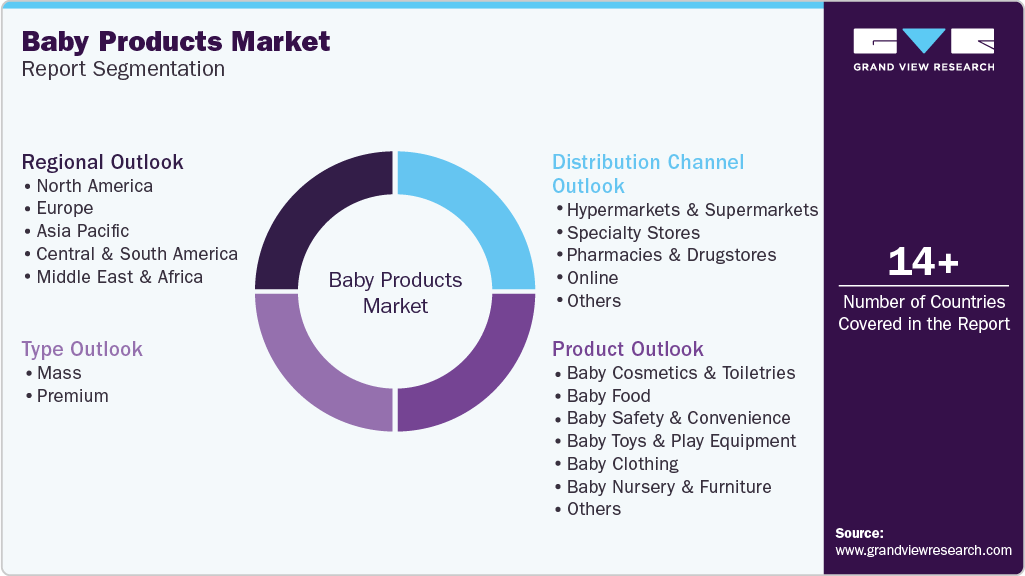
-
Product Outlook (Revenue, USD Million, 2021 - 2033)
-
Baby Cosmetics & Toiletries
-
Baby Skin Care Products
-
Bath Product
-
Baby Hair Care Products
-
Baby Diapers & Wipes
-
Other
-
-
Baby Food
-
Baby Milk Products
-
Frozen Baby Food
-
Baby Juice
-
Baby Food Snacks
-
Baby Food Cereals
-
Other
-
-
Baby Safety & Convenience
-
Baby Strollers
-
Baby Car Seats
-
Baby Monitors
-
Baby Proofing Products
-
Others
-
-
Baby Toys and Play Equipment
-
Rattles & Teethers
-
Stuffed Animals & Plush Toys
-
Baby Walkers
-
Others
-
-
Baby Clothing
-
Bodysuits
-
Tops
-
Bottoms
-
Others
-
-
Baby Nursery & Furniture
-
Cribs & Coats
-
Bassinets
-
High Chairs
-
Others
-
-
Baby Feeding & Nursing
-
Bottles & Nipples
-
Breast Pumps
-
Bottle Warmers & Sterilizers
-
Others
-
-
-
Type Outlook (Revenue, USD Million, 2021 - 2033)
-
Mass
-
Premium
-
-
Distribution Channel Outlook (Revenue, USD Million, 2021 - 2033)
-
Hypermarkets & Supermarkets
-
Specialty Stores
-
Pharmacies & Drugstores
-
Online
-
Others
-
-
Regional Outlook (Revenue, USD Million, 2021 - 2033)
-
North America
-
U.S.
-
Canada
-
Mexico
-
-
Europe
-
UK
-
Germany
-
France
-
Italy
-
Spain
-
-
Asia Pacific
-
China
-
Japan
-
India
-
Australia & New Zealand
-
South Korea
-
-
Central & South America
-
Brazil
-
-
Middle East & Africa
-
South Africa
-
-
Frequently Asked Questions About This Report
b. Some key players operating in the baby products market include Johnson & Johnson Services, Inc., Kimberly-Clark Corporation, Procter & Gamble, Unilever, Britax, Chicco, Dorel Industries, and Beiersdorf AG.
b. Key factors that are driving the market growth include the shift in consumer preferences toward high-quality, utility-driven, and premium baby products. Additionally, the significant increase in awareness among parents about baby health and hygiene is also driving market expansion.
b. U.K. baby products market size was valued at USD 4.26 billion in 2023 and is projected to grow at a CAGR of 4.0% over the forecast period. Influencer marketing and social media play a significant role in shaping consumer perceptions and purchasing decisions in the UK baby products market.
b. The global baby products market size was estimated at USD 355.94 billion in 2025 and is expected to reach USD 375.80 billion in 2026.
b. The global baby products market is expected to grow at a compounded growth rate of 6.4% from 2026 to 2033 to reach USD 579.52 billion by 2033.
b. Baby cosmetics & toiletries dominated the baby products market with a share of 29.48% in 2025 This is attributed to the increased purchase of products that contain anti-bacterial, anti-fungal, and antioxidant properties that are beneficial to baby skin driving the growth of the segment.


Share this report with your colleague or friend.
Need a Tailored Report?
Customize this report to your needs — add regions, segments, or data points, with 20% free customization.


ISO 9001:2015 & 27001:2022 Certified
We are GDPR and CCPA compliant! Your transaction & personal information is safe and secure. For more details, please read our privacy policy.
Trusted market insights - try a free sample
See how our reports are structured and why industry leaders rely on Grand View Research. Get a free sample or ask us to tailor this report to your needs.