Agricultural Micronutrients Market Summary
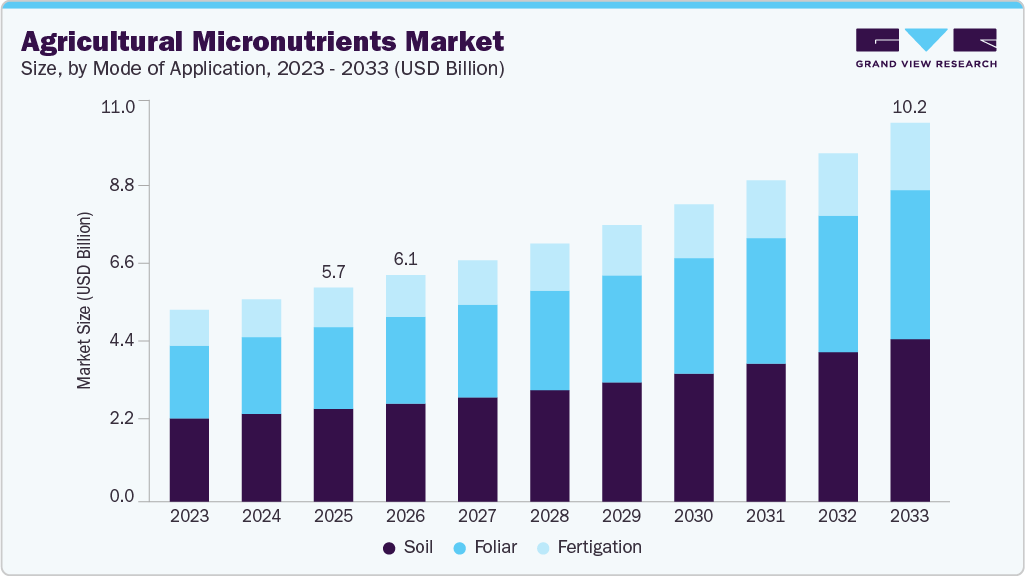
The global agricultural micronutrients market size was estimated at USD 5,739.8 million in 2025 and is projected to reach USD 10,161.5 million by 2033, growing at a CAGR of 7.6% from 2026 to 2033, driven by the increasing need to enhance crop productivity and ensure food security amid a growing global population. Farmers are adopting micronutrient fertilizers to optimize nutrient balance, improve plant health, and boost yields, particularly in staple crops such as cereals and oilseeds.
Key Market Trends & Insights
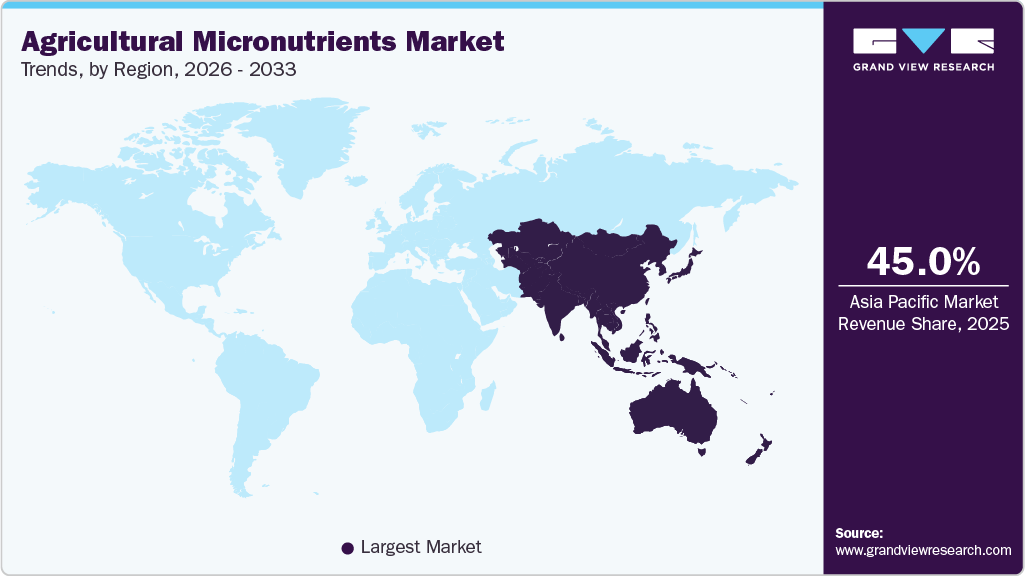
- Asia Pacific dominated the agricultural micronutrients market with the largest revenue share of 45.0% in 2025.
- The China agricultural micronutrients industry is expected to grow at the fastest CAGR of 7.7% from 2026 to 2033.
- By product, manganese is expected to grow at the fastest CAGR of 8.2% from 2026 to 2033 in terms of revenue.
- By form, chelated agriculture held the largest revenue share of 56.7% in 2025.
- By mode of application, foliar is expected to grow at the fastest CAGR of 8.0% from 2026 to 2033 in terms of revenue.
Market Size & Forecast
- 2025 Market Size: USD 5,739.8 Million
- 2033 Projected Market Size: USD 10,161.5 Million
- CAGR (2026-2033): 7.6%
- Asia Pacific: Largest Market in 2025
The integration of precision agriculture technologies, including soil testing, GPS-guided nutrient applications, and crop monitoring systems, is a key market driver. These technologies enable farmers to apply micronutrients more efficiently and accurately, minimizing wastage while enhancing nutrient absorption and crop performance. The use of precision tools also allows targeted application for high-value crops like fruits and vegetables, driving demand for specialized micronutrient formulations designed for optimal efficacy.
Emerging economies in Asia, Africa, and Latin America offer significant growth opportunities for the market. Increasing mechanization, modernization of farming practices, and rising awareness about soil nutrient deficiencies are driving the adoption of micronutrients. Manufacturers can capitalize on these markets by introducing cost-effective, region-specific formulations and establishing strong distribution networks to reach smallholders and commercial farms alike.
Market Concentration & Characteristics
The agricultural micronutrients industry exhibits a moderately concentrated structure, dominated by global leaders such as BASF, Yara International ASA, and a few specialized regional players. These companies maintain strong competitive positions through extensive R&D investments, proprietary micronutrient formulations, and broad distribution networks that enable them to serve both large-scale commercial farms and precision agriculture operations. Market concentration is reinforced by high entry barriers, including the need for technical expertise, regulatory compliance, and investment in production technologies, which limit the presence of new entrants.
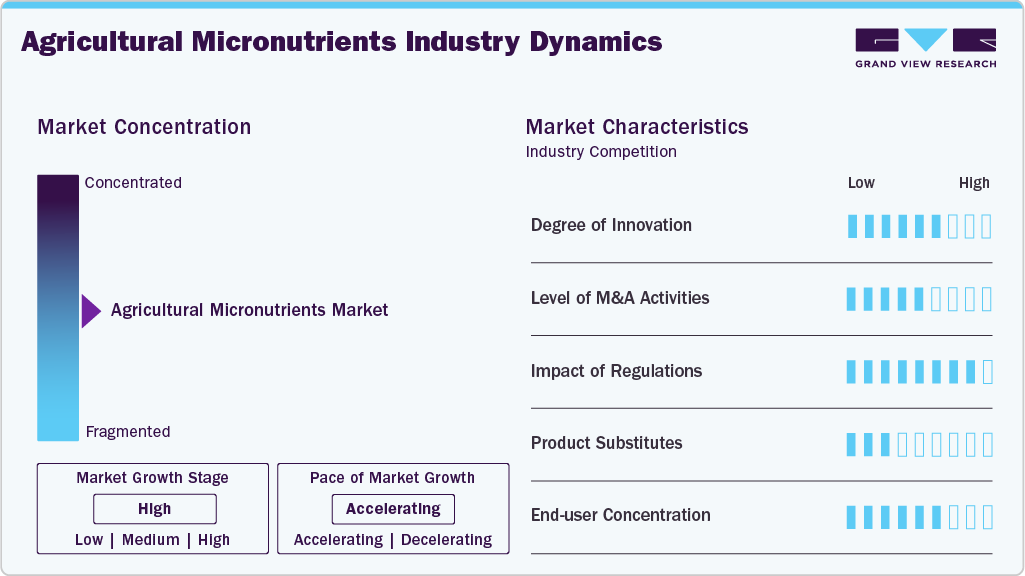
The market is characterized by a diverse product portfolio, including zinc, manganese, and other essential micronutrients, offered in multiple forms such as chelated and non-chelated, for soil and foliar applications. Demand patterns are highly influenced by crop type, regional agricultural practices, and government regulations promoting balanced fertilization and sustainable farming. In addition, market dynamics are shaped by ongoing technological innovation in micronutrient delivery systems, precision farming integration, and increasing awareness of soil nutrient deficiencies, which drive the adoption of advanced, crop-specific solutions.
Mode of Application Insights
Soil application dominated the global agricultural micronutrients industry with the largest revenue share of 43.3% in 2025, because it allows uniform nutrient distribution and long-term availability in the root zone. Farmers rely on soil-applied products to enhance root development and overall crop growth.
Foliar application is the fastest-growing segment with a revenue CAGR of 8.0%, due to its ability to quickly correct nutrient deficiencies during critical growth stages. Farmers increasingly use foliar sprays in fruits, vegetables, and horticultural crops where quality and appearance are key for market value.
Product Insights
The zinc segment dominated the global agricultural micronutrients industry with the largest revenue share of 42.6% in 2025, due to its critical role in enhancing enzyme activity, protein synthesis, and overall crop growth. Zinc fertilizers are widely used in cereals and staple crops to prevent stunted growth and improve grain quality.
The manganese segment is the fastest-growing segment with a revenue CAGR of 8.2%, as it plays a vital role in photosynthesis, chlorophyll formation, and disease resistance in crops. Increasing cultivation of high-value fruits, vegetables, and horticultural crops is driving demand for manganese-enriched fertilizers.
Form Insights
Chelated micronutrients dominated the global agricultural micronutrients industry with the largest revenue share of 56.7% in 2025, due to their superior solubility, stability, and enhanced bioavailability, which ensures consistent nutrient uptake even in challenging soil conditions. Farmers widely prefer chelated formulations to improve crop resilience and productivity.
Non-chelated micronutrients are experiencing fast growth with a revenue CAGR of 7.9%, due to their cost-effectiveness and suitability for bulk fertilizer blends. Farmers adopt non-chelated products for cereals, pulses, and oilseeds to supplement standard fertilization programs efficiently.
Crop Type Insights
Cereals dominated the global agricultural micronutrients industry with the largest revenue share of 47.1% in 2025, due to the sheer scale of cereal cultivation globally, including major crops like wheat, rice, and maize. These staple crops require consistent and precise micronutrient supplementation to ensure optimal growth, high yields, and improved grain quality. Farmers prioritize zinc, manganese, and other key micronutrients for cereals to prevent deficiencies that can cause stunted growth, poor kernel development, and reduced resilience to environmental stresses such as drought or high temperatures.
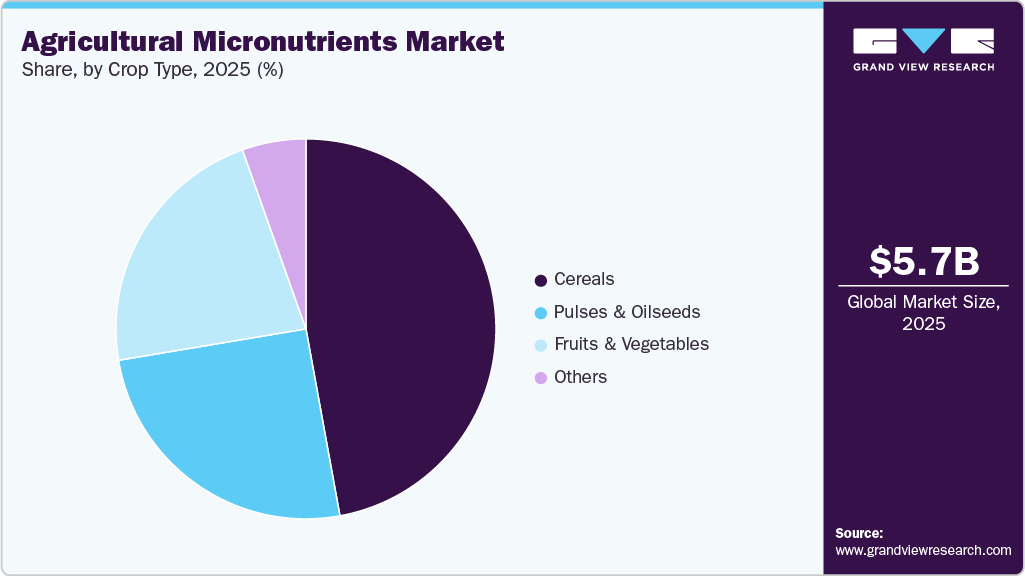
The fruit and vegetables segment is the fastest growing in the market with a revenue CAGR of 8.1%, driven by increasing consumer demand for high-quality, nutrient-rich produce. Micronutrients play a critical role in enhancing fruit size, color, flavor, and shelf life, which directly influences marketability and profitability, especially in export-oriented horticulture. Farmers increasingly invest in micronutrient applications to meet stringent quality standards and consumer expectations for appearance and nutritional content.
Regional Insights
Asia Pacific dominated the global agricultural micronutrients market with a 45.0% revenue share in 2025, driven by rapid population growth and rising food demand in countries such as China and India. Asia Pacific farmers adopt scientifically formulated products to address soil nutrient deficiencies and achieve consistent, high-quality harvests.
China Agricultural Micronutrients Market Trends
The agricultural micronutrients market in China accounted for a 50.2% revenue share in 2025. China’s market growth is fueled by government initiatives promoting food security and high-yield crop production. Chinese farmers adopt micronutrient fertilizers to improve soil fertility, crop yield, and produce quality in alignment with national agricultural objectives.
North America Agricultural Micronutrients Market Trends
The agricultural micronutrients market in North America is propelled by the adoption of precision agriculture technologies, including soil testing, GPS-guided application, and crop monitoring systems. These innovations enable North American farmers to apply micronutrients more efficiently, increasing crop yields and reducing input wastage.
The U.S. agricultural micronutrients marketis driven by precision agriculture and data-driven nutrient management. U.S. farmers rely on advanced soil testing, satellite imagery, and crop monitoring systems to optimize micronutrient application, increasing yields and resource efficiency.
Europe Agricultural Micronutrients Market Trends
The agricultural micronutrients market in Europe is strongly influenced by strict environmental and sustainability regulations that promote the adoption of eco-friendly, high-efficiency fertilizers. European farmers increasingly require products that enhance nutrient uptake while minimizing environmental impact, driving continuous innovation by manufacturers.
Germany agricultural micronutrients marketis propelled by strict environmental policies and regulations that promote sustainable fertilization practices. German farmers seek high-efficiency micronutrients that maintain soil health while complying with environmental standards.
Middle East & Africa Agricultural Micronutrients Market Trends
The agricultural micronutrients market in the MEA is driven by widespread soil nutrient deficiencies, which reduce crop yield and quality. Farmers in the Middle East & Africa increasingly rely on fortified fertilizers and micronutrient blends to improve soil fertility and crop performance.
Latin America Agricultural Micronutrients Market Trends
The agricultural micronutrients market in Latin America is fueled by the expansion of large-scale commercial farming operations in countries like Brazil and Argentina. Agribusinesses in Latin America increasingly seek crop-specific micronutrient solutions to improve productivity and quality of export-oriented crops.
Key Agricultural Micronutrients Company Insights
BASF and Yara International ASA dominate the market through global operations, advanced R&D, and agronomic expertise, delivering high-quality, crop-specific solutions at scale.
-
BASF holds a strong position in the market supported by its advanced formulation technologies, extensive R&D infrastructure, and integrated crop protection portfolio. The company focuses on high-efficiency chelated micronutrients and sustainable solutions, enabling improved nutrient uptake and consistent yields across diverse agricultural systems.
-
Yara International ASA maintains a leading presence in the market through its vertically integrated production, strong agronomic advisory services, and global distribution network. Its emphasis on precision nutrition and farmer-centric solutions supports optimized micronutrient application and long-term soil productivity.
Recent Developments
-
On October 9, 2025, Yara South Asia announced plans to launch innovative crop nutrition solutions, including advanced micronutrient and integrated nutrient products, in 2026. This expansion aims to strengthen its product portfolio and support sustainable farming practices.
Key Agricultural Micronutrients Companies:
The following key companies have been profiled for this study on the agricultural micronutrients market.
- BASF
- Yara International ASA
- The Mosaic Company
- Haifa Group
- Nutrien Ltd.
- Coromandel International Ltd.
- ICL Group Ltd.
- Nufarm Limited
- Compass Minerals International, Inc.
Agricultural Micronutrients Market Report Scope
|
Report Attribute
|
Details
|
|
Market size value in 2026
|
USD 6,077.3 million
|
|
Revenue forecast in 2033
|
USD 10,161.5 million
|
|
Growth rate
|
CAGR of 7.6% from 2026 to 2033
|
|
Base year for estimation
|
2025
|
|
Historical data
|
2018 - 2024
|
|
Forecast period
|
2026 - 2033
|
|
Quantitative units
|
Revenue in USD million/billion, volume in kilotons, and CAGR from 2026 to 2033
|
|
Report coverage
|
Revenue forecast, volume forecast, company ranking, competitive landscape, growth factors, and trends
|
|
Segments covered
|
Mode of application, product, form, crop type, region
|
|
Regional scope
|
North America; Europe; Asia Pacific; MEA; Latin America
|
|
Country scope
|
U.S.; Canada; Mexico; Germany; UK; France; Italy; Spain; China; India; Japan; South Korea; Brazil; Argentina; South Africa; Saudi Arabia
|
|
Key companies profiled
|
BASF; Yara International ASA; The Mosaic Company; Haifa Group; Nutrien Ltd.; Coromandel International Ltd.; ICL Group Ltd.; Nufarm Limited; Compass Minerals International, Inc.
|
|
Customization scope
|
Free report customization (equivalent up to 8 analysts’ working days) with purchase. Addition or alteration to country, regional & segment scope.
|
|
Pricing and purchase options
|
Avail customized purchase options to meet your exact research needs. Explore purchase options
|
Global Agricultural Micronutrients Market Report Segmentation
This report forecasts volume & revenue growth at global, regional, and country levels and provides an analysis of the latest industry trends in each of the sub-segments from 2018 to 2033. For this study, Grand View Research has segmented the global agricultural micronutrients market report based on form, crop type, product, mode of application, and region:
-
Mode of Application Outlook (Volume, Kilotons; Revenue, USD Million, 2018 - 2033)
-
Product Outlook (Volume, Kilotons; Revenue, USD Million, 2018 - 2033)
-
Zinc
-
Boron
-
Manganese
-
Molybdenum
-
Iron
-
Other Application
-
Form Outlook (Volume, Kilotons; Revenue, USD Million, 2018 - 2033)
-
Crop Type Outlook (Volume, Kilotons; Revenue, USD Million, 2018 - 2033)
-
Cereals
-
Pulses & Oilseeds
-
Fruits & Vegetables
-
Others
-
Regional Outlook (Volume, Kilotons; Revenue, USD Million, 2018 - 2033)
-
North America
-
Europe
-
Germany
-
UK
-
France
-
Italy
-
Spain
-
Asia Pacific
-
China
-
India
-
Japan
-
South Korea
-
Latin America
-
Middle East & Africa
-
Saudi Arabia
-
South Africa
Frequently Asked Questions About This Report
b. The global agricultural micronutrients market size was estimated at USD 5,739.8 million in 2025 and is expected to reach USD 6,077.3 million in 2026.
b. The global agricultural micronutrients market is expected to grow at a compound annual growth rate of 7.6% from 2026 to 2033 to reach USD 10,161.5 million by 2033.
b. Cereals segment dominated the global agricultural micronutrients industry with the largest revenue share of 47.1% in 2025, due to the sheer scale of cereal cultivation globally, including major crops like wheat, rice, and maize.
b. Some of the key players operating in the agricultural micronutrients market include BASF, Yara International ASA, The Mosaic Company, Haifa Group, Nutrien Ltd.., Coromandel International Ltd., Haicheng Guangling Refractory, Yingkou Magnesite Chemical Boron Group, and Ube Material Industries.
b. The agricultural micronutrients market is primarily driven by rising demand from refractory, steel, and construction industries, coupled with its growing use in environmental, agricultural, and healthcare applications. Increasing focus on high-performance materials, process efficiency, and sustainable manufacturing further accelerates MgO adoption across industrial value chains. Additionally, technological advancements in high-purity and reactive grades are expanding its role in next-generation industrial and green solutions.

 Download Sample Report