- Home
- »
- Communications Infrastructure
- »
-
5G Router Market Size, Share, Trends, Industry Report 2033GVR Report cover
![5G Router Market Size, Share & Trends Report]()
5G Router Market (2026 - 2033) Size, Share & Trends Analysis Report By Product Type (Indoor 5G Routers, Outdoor 5G Routers, Portable 5G Routers), By Application (Residential, Commercial, Industrial), By Connectivity (Standalone), By End Use, By Region, And Segment Forecasts
- Report ID: GVR-4-68040-875-5
- Number of Report Pages: 120
- Format: PDF
- Historical Range: 2021 - 2025
- Forecast Period: 2026 - 2033
- Industry: Technology
- Report Summary
- Table of Contents
- Segmentation
- Methodology
- Download FREE Sample
-
 Download Sample Report
5G Router Market Summary
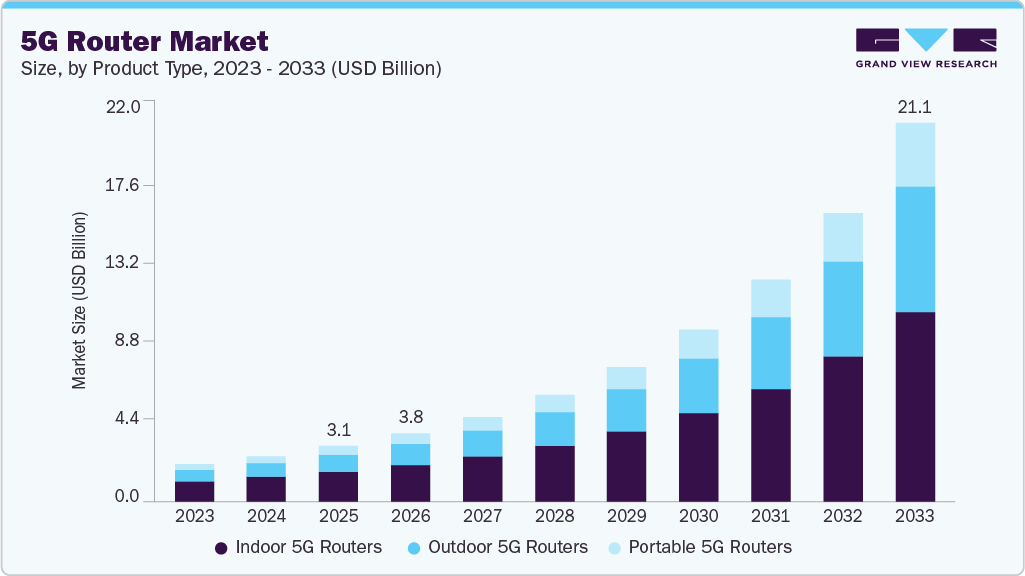
The global 5G router market size was estimated at USD 3.10 billion in 2025 and is projected to reach USD 21.07 billion by 2033, growing at a CAGR of 27.6% from 2026 to 2033. The rapid expansion of 5G network infrastructure and the rising demand for high-speed and low-latency internet connectivity are driving the growth of the 5G router industry.
Key Market Trends & Insights
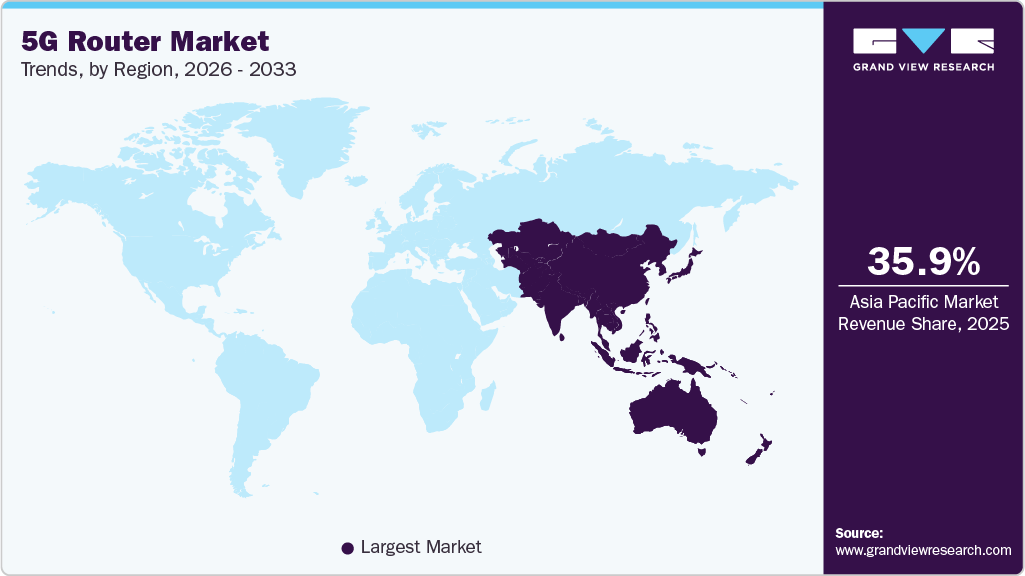
- The Asia Pacific 5G router market accounted for a 35.98% global share in 2025.
- The China 5G router industry held a dominant position in 2025.
- By product type, the indoor 5G routers segment held the largest share of 54.00% in 2025.
- By connectivity, the non-standalone segment dominated the market in 2025.
- By application, the residential segment held the largest market share in 2025.
Market Size & Forecast
- 2025 Market Size: USD 3.10 Billion
- 2033 Projected Market Size: USD 21.07 Billion
- CAGR (2026-2033): 27.6%
- Asia Pacific: Largest market in 2025
Significant investments by governments and telecom operators are expanding 5G coverage, thereby increasing the adoption of 5G routers for fixed wireless access (FWA) and home broadband. Moreover, higher bandwidth requirements from cloud computing, online gaming, video streaming, remote work, and the growing number of Internet of Things (IoT) and smart home devices are further accelerating the deployment.The 5G router industry’s growth is driven by the increasing adoption of connected devices and the ongoing development of smart cities. As the deployment of IoT devices, smart appliances, and fully connected enterprise systems continues to expand across both residential and commercial sectors, there is increasing demand for reliable and high-speed networking solutions. Moreover, the rising preference for remote work is intensifying the need for secure, scalable networking solutions in both homes and enterprises. This combination of technological adoption, urban digitalization, and evolving work patterns is driving the accelerated adoption of advanced 5G routers.
Rapid technological innovations are shaping the 5G router market, with several recent advancements. For instance, in March 2025, Sercomm Corporation, a broadband and networking equipment manufacturer, unveiled 5G FWA CPE and Artificial Intelligence (AI) ‑powered Wi‑Fi 7 routers at Mobile World Congress (MWC) 2025, integrating AI and cloud orchestration to enhance throughput and network performance. The multi-gigabit Wi-Fi 7 enables wider channel bandwidth and higher data rates, while advanced security features protect connected devices from cyber threats. These advancements demonstrate how AI-driven optimization and next-generation Wi‑Fi standards are enabling 5G routers to deliver faster speeds, lower latency, and more efficient performance for bandwidth-intensive applications and connected environments.
Telecom operators and governments are making significant investments to expand 5G infrastructure and related services. In March 2026, AT&T Inc., a telecommunications company, announced a USD 250 billion investment plan over five years to improve its 5G network and wireless services across the U.S., enabling the broader deployment of 5G solutions such as fixed wireless access and advanced CPE devices. Moreover, strategic collaborations between 5G router manufacturers and service providers are being strengthened to accelerate product deployment and adoption in both consumer and enterprise markets. For instance, in February 2025, Bharti Airtel Limited, a telecom provider, partnered with Nokia Corporation, a provider of networking and telecommunications infrastructure, and Qualcomm Inc., a developer of semiconductors and mobile communication technologies, to expand 5G FWA and Wi‑Fi solutions, thus deploying outdoor 5G gateways and high-speed broadband equipment in areas with limited fiber connectivity.
Government regulations and spectrum policies were introduced in countries such as the U.S., India, China, and the UK to accelerate the deployment of 5G networks and ensure the effective use of radio resources. For instance, in December 2025, India’s Department of Telecommunications (DoT) issued the National Frequency Allocation Plan 2025 (NFAP‑2025) to provide a modernized framework for spectrum management, identifying key mid‑band frequencies such as the 6,425-7,125 MHz band for 5G, 5G Advanced, and future technologies to support higher speeds and improved connectivity. Further, in January 2025, Ofcom in the UK implemented updated spectrum policy and licensing rules that introduced an interim application process for Shared Access Licences (SALs) in the 26 GHz mmWave band to improve access flexibility and enable more efficient spectrum use for innovative 5G devices and enterprise deployments. These regulations were launched to ensure efficient spectrum use, support rapid infrastructure rollout, improve broadband access, and create a predictable environment for industry investment.
High implementation costs and infrastructure limitations hinder the market growth in developing regions such as India, Brazil, and South Africa. The deployment of advanced IoT-enabled sensors, cloud-based monitoring systems, and automated tracking solutions is constrained by the substantial capital investment required, thereby making it difficult for small and medium-sized businesses to adopt these technologies. In addition, many developing regions face limitations in network infrastructure, including inadequate fiber backhaul and inconsistent broadband coverage, which can reduce the effectiveness of 5G deployment and slow the adoption of next-generation wireless solutions.
Product Type Insights
The indoor 5G routers segment accounted for the largest share of 54.00% in 2025. The adoption of indoor routers is being driven by the increasing demand for FWA solutions that can deliver high-speed internet without the need for fiber or cable infrastructure. Indoor 5G routers offer strong signal distribution and compatibility with multiple connected devices, which has supported their widespread usage in residential and commercial spaces. Several companies are developing indoor 5G routers with Wi-Fi 7 capabilities. For instance, in March 2025, Netgear Inc., a computer networking company, introduced the Nighthawk 5G Wi-Fi 7 router, designed for indoor high-performance connectivity, offering multi-gigabit speeds and improved support for smart home devices. Similarly, in January 2024, Zyxel Communications, a provider of networking and communication solutions, launched an advanced 5G NR router with Wi-Fi 7, designed to improve indoor connectivity and support high-bandwidth applications such as cloud gaming and ultra-HD streaming. Such initiatives are anticipated to support the segment growth.
The outdoor 5G routers segment is expected to grow at the fastest CAGR during the forecast period. Outdoor routers are typically installed on rooftops, poles, or building exteriors to capture stronger 5G signals from nearby base stations and distribute connectivity to homes and enterprises. Their adoption is being supported by the rapid expansion of FWA services and the need to extend broadband connectivity to suburban and rural locations. For instance, in January 2025, Inseego Corp, provider of wireless and IoT solutions, launched the Wavemaker FW3000 Outdoor 5G CPE, designed to deliver high-performance 5G connectivity for residential and enterprise FWA deployments. The device supports advanced 5G and LTE technologies to provide reliable broadband access in locations where traditional wired infrastructure is unavailable. Initiatives like this are driving the growing adoption of outdoor 5G routers across regions.
Application Insights
The residential segment dominated the 5G router market in 2025. 5G routers are widely adopted for home broadband connectivity, where high-speed internet is required to support multiple connected devices and bandwidth-intensive applications. In addition, the rising demand for remote work, online education, smart home ecosystems, and high-definition streaming services has strengthened the demandfor residential 5G routers that can reliably support multiple connected devices and bandwidth-intensive applications.
The industrial segment is projected to grow at the fastest CAGR over the forecast period. Industries including manufacturing, energy, logistics, and transportation are adopting 5G routers to improve operational efficiency and support digital transformation. Several companies have been actively enhancing industrial connectivity solutions to support digital transformation. For instance, in February 2024, Ericsson, a telecommunication company, strengthened its industrial 5G portfolio by focusing on private networks and 5G Advanced software to drive Industry 4.0. Key initiatives included launching the Private 5G Compact for enterprises, developing 5G-assisted SASE for secure connectivity, and releasing software to optimize network performance across manufacturing, logistics, and mining sectors, demonstrating the integration of industrial 5G routers into enterprise digitalization.
Connectivity Insights
The non-standalone (NSA) segment dominated the 5G router industry in 2025.NSA 5G routers operate by maintaining a 4G core network while connecting to 5G radio access networks, with lower capital expenditure and broad compatibility with legacy mobile systems. This approach has enabled operators to accelerate service availability and adoption among consumers and enterprises without waiting for fully standalone networks. As a result, NSA-capable 5G routers have been widely adopted across residential, commercial, and industrial applications to provide immediate high-speed connectivity in multiple regions.
The standalone (SA) segment is expected to grow at the fastest CAGR over the forecast period. SA architecture supports more efficient spectrum use and enables features such as edge computing, quality‑of‑service segmentation, and support for mission‑critical and enterprise applications. Several companies are developing standalone 5G solutions to capitalize on this growth. For instance, in March 2026, Vantiva, provider of technology products and services, launched Hawk 5G FWA Home Gateway, a next‑generation 5G FWA customer premises equipment designed specifically for 5G standalone networks. This device adds broader SA processing capabilities and Wi‑Fi 8 support, thus enabling operators to fully leverage standalone 5G performance for residential and enterprise broadband services.
End Use Insights
The telecom segment held the largest share in the 5G router market in 2025. Telecom operators have been investing in 5G infrastructure to meet rising consumer demand for high‑speed connectivity, enabling them to deliver broadband solutions without extensive fiber rollout. For instance, in January 2025, China’s Ministry of Industry and Information Technology confirmed plans to construct over 4.5 million additional 5G base stations. This initiative reflects large‑scale investments by operators such as China Mobile Communications Group Co., Ltd., China Telecom Corporation Limited, and China United Network Communications Group Co., Ltd., to expand 5G coverage across the country. In addition, the proliferation of 5G devices and higher mobile data usage has reinforced the need for 5G routers in both urban and underserved regions to help telecom companies maintain competitive service portfolios.
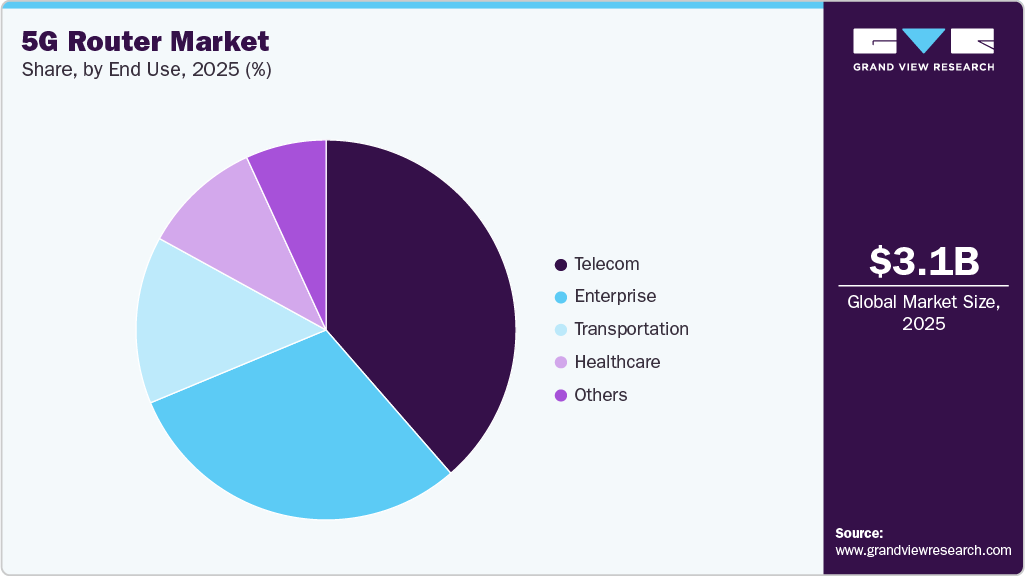
The enterprise segment is expected to grow at the fastest CAGR over the forecast period. The growth is attributed to the increasing deployment of private 5G networks and secure connectivity solutions that support industrial automation and real‑time IoT applications. Enterprises are adopting 5G routers and dedicated network infrastructure to improve operational efficiency and enable advanced use cases such as smart manufacturing, logistics, and large-scale enterprise connectivity. This trend highlights the rising enterprise demand for high-performance, secure wireless connectivity that conventional public networks and Wi‑Fi alone cannot fully address, thus positioning 5G routers as critical components in enterprise digital transformation initiatives.
Regional Insights
The North America 5G router market held a significant share in 2025. The market has been shaped by the widespread deployment of 5G fixed wireless access customer‑premises equipment (CPE), including 5G routers that deliver high‑speed broadband over cellular networks. According to the Global Mobile Suppliers Association, North America reported that 93 % of FWA CPE shipments in 2025 were 5G‑enabled, indicating that nearly all fixed wireless devices shipped in the region now support 5G connectivity. This highlights the continued strong focus of operators in North America on expanding 5G-based fixed wireless networks. In addition, the region has witnessed substantial investments by service providers to expand 5G coverage in both urban and rural areas, enabling homes and businesses to access high-speed broadband without traditional wired infrastructure. For instance, in July 2025, T‑Mobile USA, Inc. completed a USD 2 billion network expansion across Florida to increase 5G coverage and capacity for residents and businesses in both urban and rural communities by upgrading and adding new cell sites.
U.S. 5G Router Market Trends
The U.S. 5G router industry held a dominant position in 2025. The Federal Communications Commission (FCC) has actively facilitated spectrum allocation for 5G networks, including mid-band and mmWave frequencies, to enable service providers to deploy high-speed 5G FWA solutions in both residential and commercial sectors. In addition, major carriers have launched initiatives to expand 5G broadband services to underserved and rural areas, deploying 5G routers as key customer-premises equipment to provide reliable high-speed internet without relying on traditional wired infrastructure. For instance, in October 2025, Verizon Communications Inc., a telecommunications company, expanded its Home Internet services to additional communities across the U.S., including the launch of a new affordable Home Internet Lite plan to connect customers with limited access or seeking a low-cost option. The U.S. market is also being influenced by the growing adoption of smart home devices and enterprise connectivity solutions, which rely on 5G routers to deliver reliable, high-capacity broadband services.
Europe 5G Router Market Trends
The Europe 5G router industry was identified as a lucrative region in 2025. The deployment of 5G FWA solutions is being prioritized in Europe to improve internet connectivity in urban, semi-urban, and suburban areas, where traditional wired broadband may be limited. In this setup, 5G routers serve as the primary customer-premises equipment, that enables households and businesses to access high-speed, reliable internet directly over 5G networks. Further, the rising adoption of smart devices and IoT applications is increasing demand for these routers, as they provide low-latency, multi-device connectivity.
The UK 5G router market is expected to grow rapidly in the coming years. The market is shaped by regulatory measures issued by Ofcom, which have allocated mid-band and mmWave spectrum specifically for 5G services, enabling faster network rollout and supporting the adoption of 5G home and enterprise routers. In March 2025, Vodafone UK announced the expansion of its 5G Home Broadband service to over 3 million households, with 5G routers being deployed to provide high-speed internet to areas lacking fiber infrastructure. Further, in May 2025, Vodafone Group PLC UK and Hutchison 3G UK Limited, the telecommunications companies, merged to form the combined entity VodafoneThree, which committed to a USD 14.76 billion, 10-year investment plan to expand 5G coverage, targeting 99 % nationwide coverage by 2030. As of June 2025, the network already covers significant portions of the UK, with plans for widespread 5G standalone availability for homes and businesses.
The 5G router market in Germany is expected to grow during the forecast period. In Germany, telecommunications companies such as Deutsche Telekom AG and Vodafone Group Plc have been investing in 5G FWA networks to expand broadband access, particularly in suburban and rural areas. In January 2025, Deutsche Telekom AG launched its nationwide 5G home internet service using 5G routers capable of delivering speeds up to 1 Gbps, aiming to provide an alternative to traditional DSL and cable connections while improving coverage in underserved areas. These initiatives have encouraged consumer adoption of 5G routers to support both residential and enterprise connectivity, and reinforced Europe’s position as a rapidly evolving market for 5G networking solutions.
Asia Pacific 5G Router Market Trends
The Asia Pacific 5G router industry is expected to grow at the fastest CAGR of 28.5% over the forecast period. The growth is attributed to government support for digital connectivity in countries such as China, Japan, and South Korea, as well as increasing demand for high-speed broadband across the residential and enterprise sectors. For instance, in September 2024, the Government of India expanded its Digital India initiative to accelerate nationwide 5G adoption and improve digital connectivity. In addition, the expansion of smart cities and IoT ecosystems is driving increased demand for advanced connectivity solutions. In February 2025, Singapore’s Smart Nation program continued the rollout of smart infrastructure projects integrating IoT-enabled services across transportation, healthcare, and urban management. These developments are encouraging the adoption of 5G FWA solutions, in which 5G routers are increasingly used as key customer-premises equipment to deliver high-speed and reliable internet connectivity.
The China 5G router market is expected to grow rapidly in the coming years. The market is being supported by extensive 5G network deployment and continuous infrastructure investments by telecom operators. In May 2025, the Ministry of Industry and Information Technology (MIIT) reported that China had deployed over 3.8 million 5G base stations, accounting for a significant share of global 5G infrastructure. This large-scale network expansion has enabled broader adoption of 5G broadband services and devices, including 5G routers used for home and enterprise connectivity.
The 5G router market in Japan is being supported by strong operator initiatives and technological advancements in wireless communication. In February 2025, NTT DOCOMO, a telecommunication company, in partnership with Space Compass Corporation, a provider of space-integrated computing network services, and NEC Corporation, an IT and electronics company, has been actively expanding its network capabilities, focusing on both high-speed urban 5G and future "beyond 5G" solutions. Such developments are enabling households and businesses to use 5G routers for reliable internet access, particularly in areas with limited fiber connectivity, thereby supporting the market growth.
Key 5G Router Company Insights
Some of the key companies in the 5G Router market include Huawei Technologies Co., Ltd., Netgear, Inc., ZTE Corporation, Samsung Electronics Co., Ltd., and others. Organizations are focusing on increasing the customer base to gain a competitive edge in the industry. Therefore, key players are taking several strategic initiatives, such as mergers and acquisitions, and partnerships with other major companies.
-
Huawei Technologies Co., Ltd. is the provider of telecommunications equipment and networking solutions, with a strong presence in wireless infrastructure, enterprise networking, and consumer devices. The company plays a significant role in the development and commercialization of 5G technologies worldwide. In the 5G router industry, Huawei Device Co., Ltd. offers a wide portfolio of products designed for home broadband, enterprise connectivity, and industrial applications. Its 5G routers are widely recognized for high-speed connectivity, advanced antenna technology, and integration with 5G standalone and non-standalone networks. Telecom operators and enterprises use Huawei’s solutions to enable fixed wireless access, smart homes, and remote connectivity.
-
ZTE Corporation is a telecommunications equipment and technology solutions provider specializing in wireless networks, broadband access, and cloud infrastructure. The company has established a strong footprint in the global 5G ecosystem through continuous investments in network technologies and partnerships with telecom operators. In the 5G router market, the company offers a range of cost-effective, high-performance routers for residential, enterprise, and industrial environments. Its 5G routers support ultra-fast data speeds, low latency connectivity, and advanced network management capabilities, making them suitable for fixed wireless access, smart city deployments, and enterprise networking.
Key 5G Router Companies:
The following key companies have been profiled for this study on the 5G router market.
- Huawei Device Co., Ltd.
- Netgear, Inc.
- ZTE Corporation
- Samsung Electronics Co., Ltd.
- TP-Link Systems Inc.
- Cisco Systems Inc.
- ASUSTeK Computer Inc.
- Digi International
- Linksys Holdings, Inc.
- D-Link Systems, Inc.
Recent Developments
-
In March 2026, ZTE Corporation introduced new 5G-Advanced CPE routers, including the G6 Ultra and G6 Max, featuring AI-powered Wi-Fi 8 technology and speeds of up to 10 Gbps. These next-generation routers were developed to improve indoor connectivity and expand fixed wireless access solutions for homes and enterprises.
-
In November 2025, Netgear Inc. announced the Nighthawk 5G M7 portable router, designed to deliver multi-gigabit connectivity using 5G and Wi-Fi 7 technologies. The device supports up to 3.6 Gbps and can connect up to 32 devices simultaneously, targeting remote workers, travelers, and enterprises that require portable, high-speed internet connectivity.
5G Router Market Report Scope
Report Attribute
Details
Market size value in 2026
USD 3.82 billion
Revenue forecast in 2033
USD 21.07 billion
Growth rate
CAGR of 27.6% from 2026 to 2033
Base year for estimation
2025
Historical data
2021 - 2025
Forecast period
2026 - 2033
Quantitative units
Revenue in USD million/billion and CAGR from 2026 to 2033
Report coverage
Revenue forecast, company ranking, competitive landscape, growth factors, and trends
Segments covered
Product type, application, connectivity, end use, region
Regional scope
North America; Europe; Asia Pacific; Latin America; MEA
Country scope
U.S.; Canada; Mexico; Germany; UK; France; China; Japan; India; South Korea; Australia; Brazil; KSA; UAE; South Africa
Key companies profiled
Huawei Technologies Co., Ltd.; Netgear, Inc.; ZTE Corporation; Samsung Electronics Co., Ltd.; TP-Link Systems Inc.; Cisco Systems Inc.; ASUSTeK Computer Inc.; Digi International; Linksys Holdings, Inc.; D-Link Systems, Inc.
Customization scope
Free report customization (equivalent up to 8 analysts working days) with purchase. Addition or alteration to country, regional & segment scope.
Pricing and purchase options
Avail customized purchase options to meet your exact research needs. Explore purchase options
Global 5G Router Market Report Segmentation
This report forecasts revenue growth at the global, regional, and country levels and provides an analysis of the latest industry trends in each of the sub-segments from 2021 to 2033. For this study, Grand View Research has segmented the global 5G router market report based on product type, application, connectivity, end use, and region:
-
Product Type Outlook (Revenue, USD Billion, 2021 - 2033)
-
Indoor 5G Routers
-
Outdoor 5G Routers
-
Portable 5G Routers
-
-
Application Outlook (Revenue, USD Billion, 2021 - 2033)
-
Residential
-
Commercial
-
Industrial
-
Others
-
-
Connectivity Outlook (Revenue, USD Billion, 2021 - 2033)
-
Standalone
-
Non-Standalone
-
-
End Use Outlook (Revenue, USD Billion, 2021 - 2033)
-
Telecom
-
Enterprises
-
Transportation
-
Healthcare
-
Others
-
-
Regional Outlook (Revenue, USD Billion, 2021 - 2033)
-
North America
-
U.S.
-
Canada
-
Mexico
-
-
Europe
-
Germany
-
UK
-
France
-
-
Asia Pacific
-
China
-
Japan
-
India
-
South Korea
-
Australia
-
-
Latin America
-
Brazil
-
-
Middle East and Africa (MEA)
-
KSA
-
UAE
-
South Africa
-
-
Frequently Asked Questions About This Report
b. The global 5G router market is expected to grow at a compound annual growth rate of 27.6% from 2026 to 2033 to reach USD 21.07 billion by 2033.
b. Indoor 5G routers segment dominated the 5G router market with a share of 54.00% in 2025. The adoption of indoor routers is being driven by the increasing demand for FWA solutions that can deliver high-speed internet without the need for fiber or cable infrastructure.
b. Some key players operating in the 5G router market include Huawei Device Co., Ltd., Netgear, Inc., ZTE Corporation, Samsung Electronics Co., Ltd., TP-Link Systems Inc., Cisco Systems Inc., ASUSTeK Computer Inc., Digi International, Linksys Holdings, Inc., D-Link Systems, Inc.
b. The global 5G router market size was estimated at USD 3.10 billion in 2025 and is expected to reach USD 3.82 billion in 2026.
b. The rapid expansion of 5G network infrastructure and the rising demand for high-speed and low-latency internet connectivity are driving the growth of the 5G router market.


Share this report with your colleague or friend.
Need a Tailored Report?
Customize this report to your needs — add regions, segments, or data points, with 20% free customization.


ISO 9001:2015 & 27001:2022 Certified
We are GDPR and CCPA compliant! Your transaction & personal information is safe and secure. For more details, please read our privacy policy.
Trusted market insights - try a free sample
See how our reports are structured and why industry leaders rely on Grand View Research. Get a free sample or ask us to tailor this report to your needs.