
- Home
- »
- Homecare & Decor
- »
-
Wall Art Market Size, Share & Trends, Industry Report, 2033GVR Report cover
![Wall Art Market Size, Share & Trends Report]()
Wall Art Market (2026 - 2033) Size, Share & Trends Analysis Report by Type (Wallpapers / Stickers/Wall Coverings, Hangings, Frameworks, Décor Shelves), By Application (Residential, Commercial), By Sales Channel (Offline, Online), By Region, And Segment Forecasts
- Report ID: GVR-4-68040-071-3
- Number of Report Pages: 110
- Format: PDF
- Historical Range: 2021 - 2025
- Forecast Period: 2026 - 2033
- Industry: Consumer Goods
- Report Summary
- Table of Contents
- Interactive Charts
- Methodology
- Download FREE Sample
-
 Download Sample Report
Wall Art Market Summary
The global wall art market size was estimated at USD 61.01 billion in 2025 and is expected to reach USD 99.15 billion by 2033, growing at a CAGR of 6.4% from 2026 to 2033. The growth of the market is primarily driven by rising demand for ready-to-install home décor products, increased penetration of e-commerce sales, and the expansion of residential construction worldwide.
Key Market Trends & Insights
- Asia Pacificled the global wall art market and accounted for a share of 47.8% in 2025.
- By type, wallpapers/stickers/wall coverings led the wall art market and accounted for a share of 38.9% in 2025.
- By application, residentialled the wall art market and accounted for a share of 70.5% in 2025.
- By sales channel, offlineled the wall art market and accounted for a share of 67.8% in 2025.
Market Size & Forecast
- 2025 Market Size: USD 61.01 Billion
- 2033 Projected Market Size: USD 99.15 Billion
- CAGR (2026-2033): 6.4%
- Asia Pacific: Largest market in 2025
Consumer preferences play a pivotal role in shaping market dynamics, as shifts in tastes and preferences can profoundly affect product demand. Within of interior design industry, wall art holds a vital position, and fluctuations in interior design trends can significantly influence the demand for various categories of wall art. Understanding and adapting to evolving consumer preferences is imperative for businesses in the wall art industry, enabling them to respond effectively to market demands and maintain a competitive edge.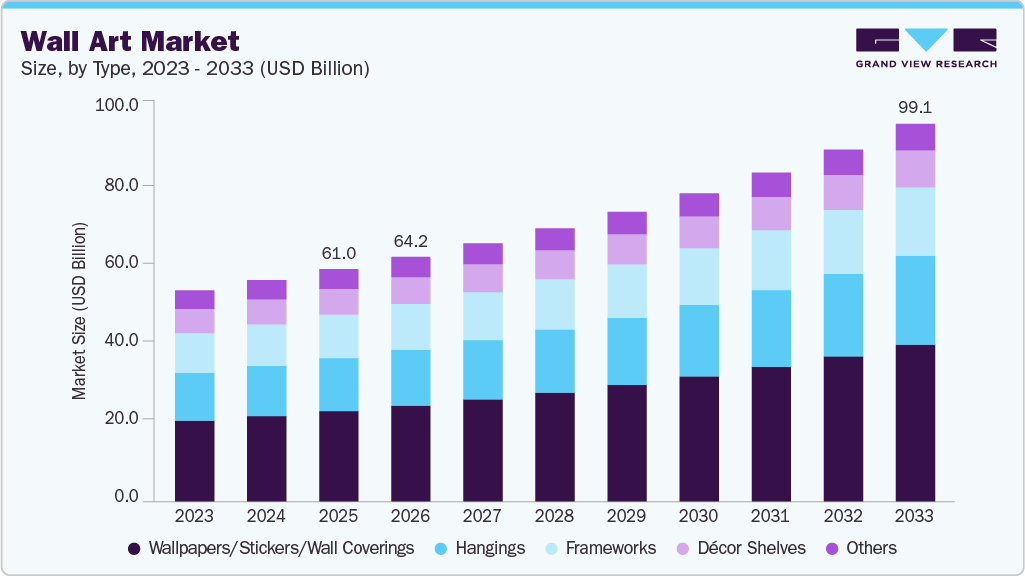
A growing preference for minimalism is shaping consumer behavior in the home décor market, driving higher demand for simple, clean, and understated wall art that enhances spaces without creating visual clutter. Minimalist pieces such as abstract prints, neutral palettes, and subtle designs align with modern lifestyles that prioritize functionality, calmness, and organized interiors. According to data published in 2025, 56% of Americans prefer minimalism over maximalism (23%), highlighting a clear shift toward cleaner aesthetics and presenting strong growth opportunities for businesses to expand minimalist wall art offerings to meet evolving preferences.
Consumers today are increasingly seeking a wide variety of home décor products that enable them to personalize their living spaces and reflect their individual tastes and lifestyles. Instead of choosing generic, mass-produced items, many prefer customizable wall art with diverse themes, adjustable sizes, colors, and formats that can be tailored to specific interiors. The growing DIY culture further supports this shift toward personalization, as homeowners take a more hands-on approach to improving and styling their homes. For instance, a Frontdoor survey in early 2025 found that 74% of Americans plan to undertake at least one DIY home project during the year, highlighting strong consumer engagement in home upgrades. Collectively with social media influence and rising homeownership, these trends encourage brands to offer made-to-order, modular, and flexible décor solutions to meet evolving expectations better.
Consumer Insights
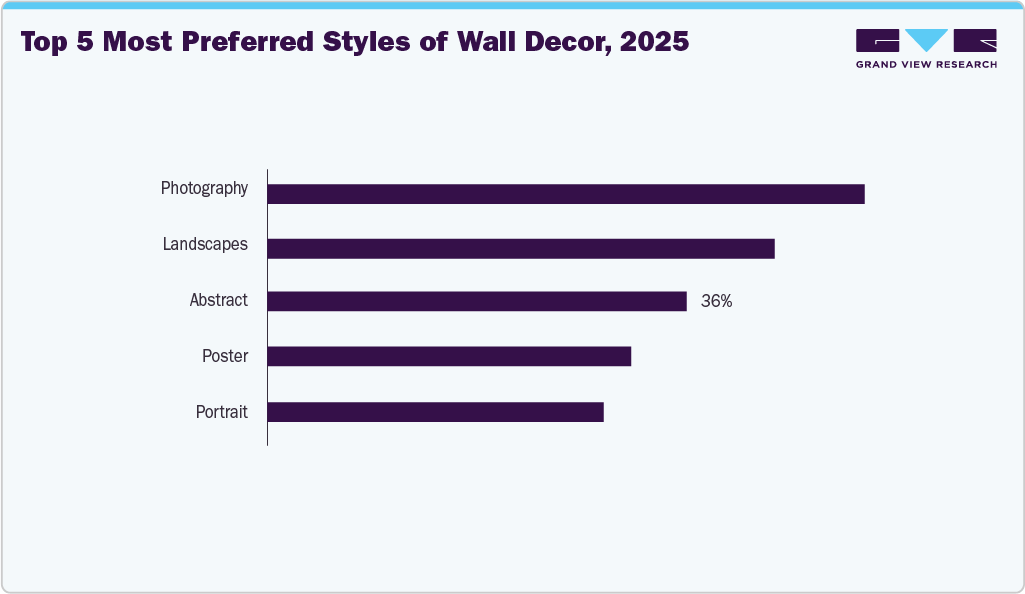
Consumers’ preferences in wall décor are increasingly centered on personalization, simplicity, and functionality, with many favoring designs that reflect their individual style while complementing modern interiors. Minimalist art, neutral palettes, abstract compositions, and nature-inspired themes are especially popular as they create calm, clutter-free environments. According to the 2025 global survey, 62% of homeowners prefer photography-based wall art, 49% choose landscapes to introduce natural scenery, and 36% select abstract designs, indicating strong demand for visually soothing yet expressive décor. At the same time, buyers look for customizable options, such as varied sizes, modular sets, and framed or peel-and-stick formats, that offer flexibility and easy installation, particularly among renters and DIY enthusiasts, encouraging brands to provide versatile, tailored wall art solutions.
Type Insights
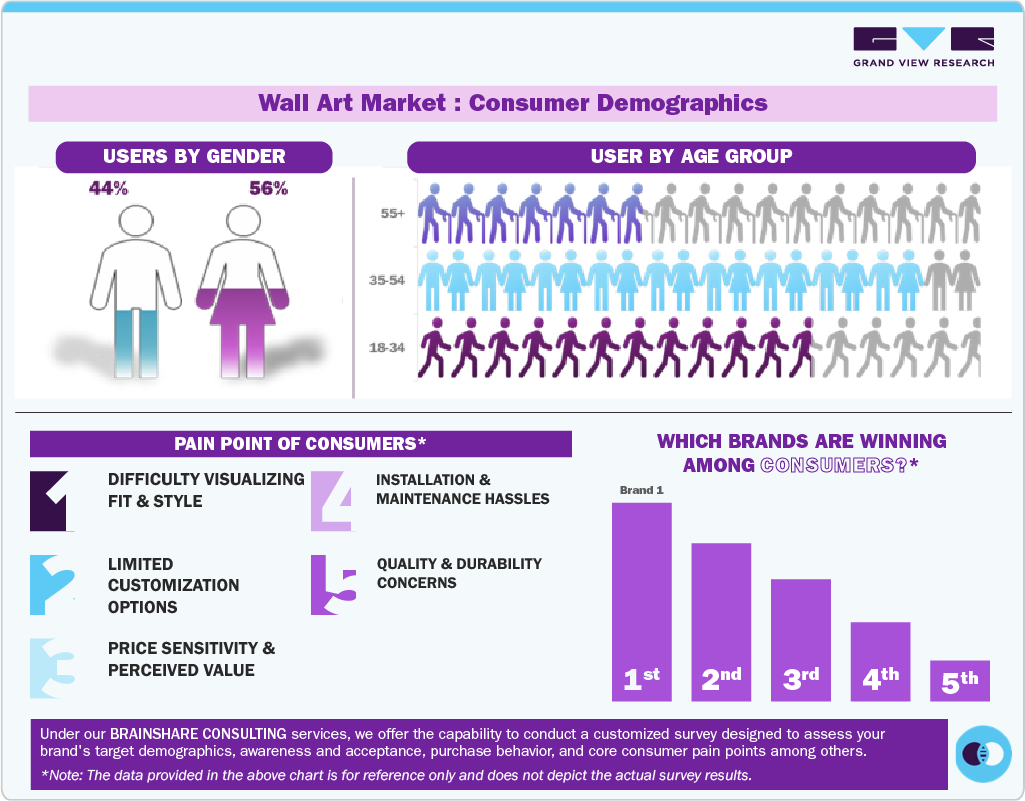
Wallpapers/Stickers/Wall Coverings held the largest revenue share of the wall art industry in 2025, accounting for a share of 38.9%. They offer a practical, affordable, and high-impact way for consumers to transform entire spaces quickly. Unlike traditional framed art that decorates only small areas, wall coverings can refresh full walls, creating a bold visual statement with minimal effort and cost. Their ease of installation and removal, especially in peel-and-stick formats, make them highly attractive to renters, DIY homeowners, and younger consumers who frequently update interiors without permanent changes.
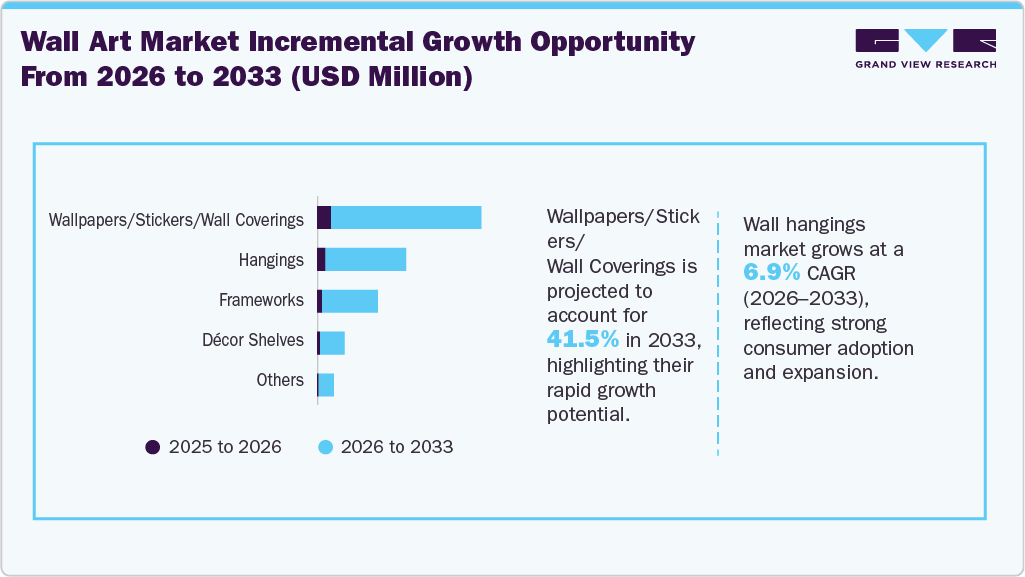
Wall hangings is anticipated to witness a CAGR of 6.9% from 2026 to 2033. Woven wall hangings are a popular and versatile form of wall art, made using traditional weaving techniques with a modern twist. These can be made of natural fibers such as wool, cotton, or linen and customized with a range of colors, textures, and patterns. For instance, West Elm offers a range of woven wall hangings made using natural fibers such as cotton, wool, and jute. These hangings feature modern designs and textures and are available in a range of sizes and styles.
Application Insights
Residential segment held the largest revenue share of the wall art industry in 2025, accounting for a share of 70.5%. Home décor purchases are primarily driven by individual homeowners and renters who continuously invest in enhancing the comfort, aesthetics, and personalization of their living spaces. Rising homeownership, increased renovation and DIY activities, and the influence of social media and interior design inspiration have further encouraged spending on wall art, including paintings, prints, wallpapers, stickers, and wall hangings.
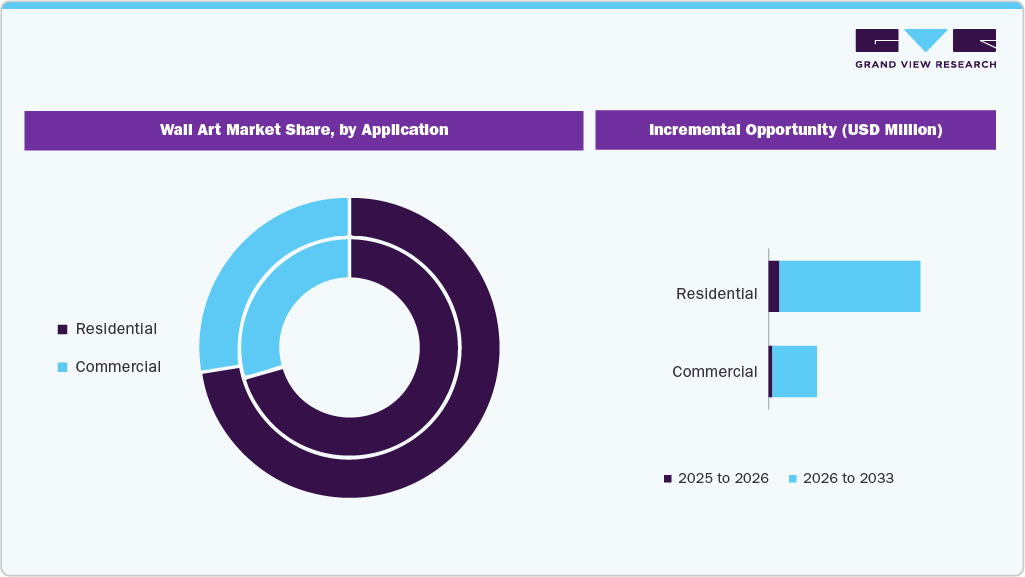
Commercial segment is anticipated to witness a CAGR of 5.5% from 2026 to 2033. Wall art products are primarily used in offices and corporate spaces, hotels and hospitality, educational institutions, stores, and shops. The rising number of hotels and restaurants, and the growth of the travel and tourism industry worldwide, have widened the commercial application scope of wall art. The expansion of commercial spaces, such as malls, retail stores, and offices, is driving growing demand for wall art products.
Sales Channel Insights
Offline sales held the largest revenue share of the wall art industry in 2025, accounting for a share of 67.8%. The growth is driven by rising demand for unique, personalized wall art products. Specialty stores often offer a wide range of products unavailable in mass-market retailers, providing consumers with access to unique and customized designs. In addition, specialty stores often provide a higher level of expertise and customer service, helping consumers to find the right products and providing guidance on how to display and care for their wall art.
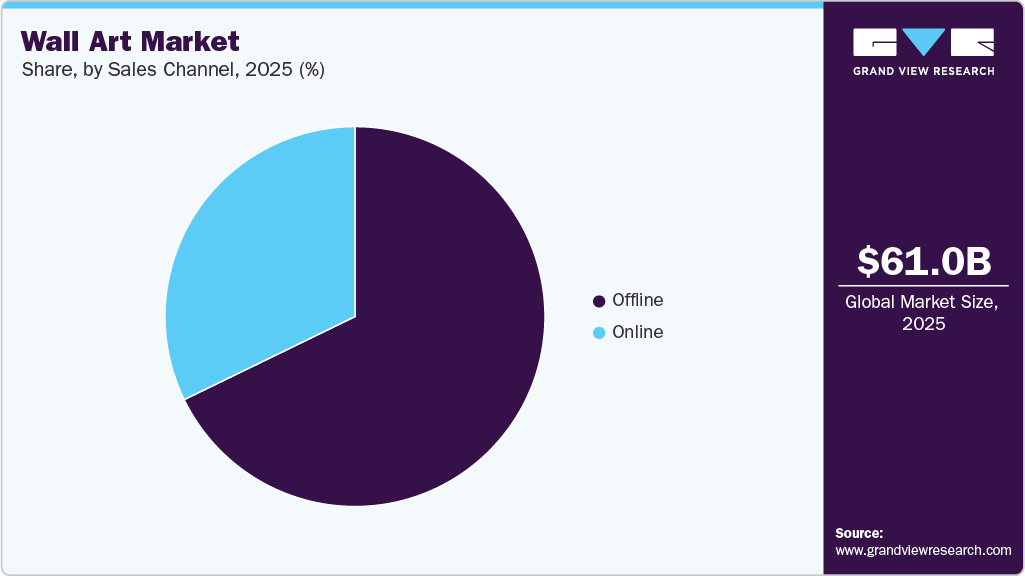
The online sales are anticipated to witness a CAGR of 7.1% from 2026 to 2033. The ease of ordering these products online has led manufacturers to sell them through e-commerce portals. Consumers purchase unique and trendy wall art through prominent e-commerce portals such as Hygge & West (Propitious Jackson Inc.), Wallshoppe, Graham & Brown Ltd, Elle Gibson, Flavor Paper, Mitchell Black, Etsy, Inc., Chasing Paper, Wayfair LLC, Hovia, and Urban Outfitters. The e-commerce industry has experienced tremendous growth in recent years, driven by technological advancements and changing consumer behavior.
Regional Insights
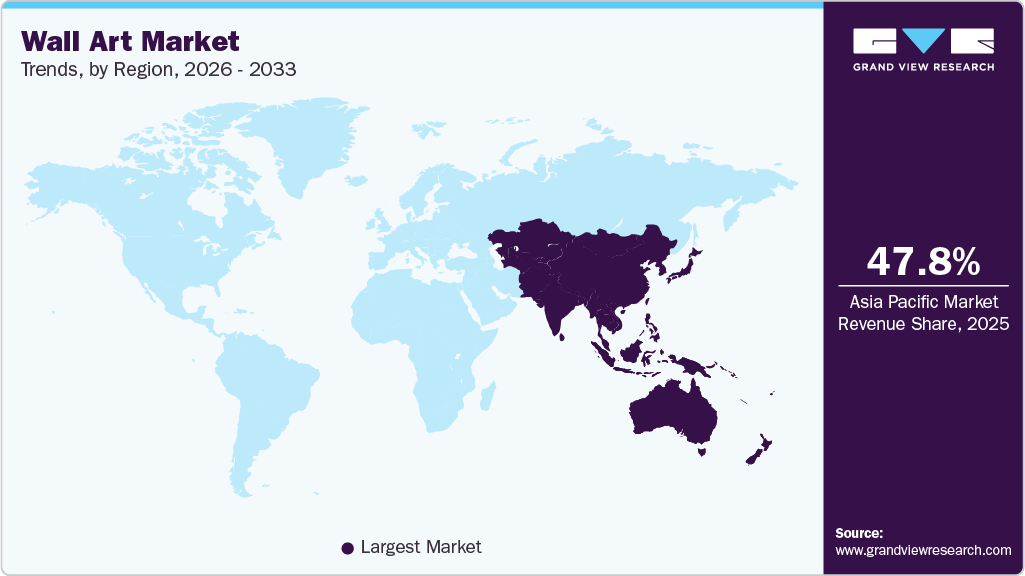
The Asia Pacific wall art market held a market share of 47.8% of the global revenue in 2025. Rapid urbanization across major Asia-Pacific cities such as Mumbai, Shanghai, and Bangkok is driving a steady rise in nuclear households, apartment living, and modern residential developments, which, in turn, boost spending on home aesthetics. As disposable incomes grow, consumers increasingly view their homes as lifestyle spaces rather than purely functional ones, prompting greater investment in interior décor, such as wall art, framed prints, murals, and personalized pieces. Wall décor offers an affordable yet impactful way to enhance visual appeal, express personal identity, and upgrade compact urban spaces, making it a popular choice among young professionals and first-time homeowners. Consequently, higher purchasing power, combined with urban living aspirations, is directly translating into stronger demand for stylish, customizable wall art products.
China Wall Art Market Trends
The wall art market in China was valued at USD 6.9 billion in 2025. Continued urbanization and the steady delivery of new residential units, particularly in Tier 1 and emerging Tier 2 cities, have created a large base of first-time homeowners and renters seeking affordable interior personalization solutions that elevate compact living spaces without major renovation costs. As middle-class households expand and per-capita disposable income increases, consumers are allocating more discretionary spending toward home aesthetics, viewing wall décor as a cost-effective way to signal taste, cultural identity, and social status. The rapid penetration of e-commerce platforms such as Alibaba Group and JD.com has significantly improved product accessibility, customization options, and price transparency, while livestream commerce and social discovery platforms such as Douyin have accelerated trend diffusion and impulse purchases through influencer-led home styling content.
India’s wall art market growth is driven by the country’s consumers, who are increasingly treating their homes as an extension of their lifestyle and identity, rather than merely as functional living spaces. With rising disposable incomes and greater exposure to global design inspiration through social media and e-commerce platforms, homeowners are investing in visually appealing interiors that reflect personal taste. Instead of relying solely on paint or basic finishes, many prefer wall art, framed prints, murals, decals, and curated gallery walls to add character and warmth.
Seasonal and festive occasions also play a significant role in shaping décor demand in India, particularly during celebrations like Diwali, when households traditionally upgrade and beautify their homes. During these periods, consumers actively purchase decorative wall hangings, handcrafted art, spiritual motifs, themed décor items, and textured wall art to add depth and visual richness to their interiors, reflecting growing interest in textured wall art market for quick home makeovers. This creates noticeable spikes in short-term spending on aesthetic upgrades, with many buyers choosing affordable, easy-to-install wall décor and textured finishes to achieve an instant transformation. Such culturally driven purchasing behavior not only boosts seasonal sales but also reinforces the importance of wall art and textured wall décor as accessible, meaningful, and increasingly popular elements of home decoration.
North America Wall Art Market Trends
Interior design trends across North America are shaping wall art demand, as homeowners increasingly use décor to create expressive, visually engaging living spaces rather than minimalist, neutral interiors. The shift toward minimalism, textured finishes, and statement pieces has elevated wall art from a secondary accessory to a central design element that defines a room's mood and personality. Consumers are choosing oversized canvases, gallery walls, murals, and distinctive prints to add color, depth, and character, resulting in higher spending on decorative wall solutions and more frequent style updates aligned with evolving home aesthetics.
The strong do-it-yourself (DIY) home décor culture in the U.S. continues to significantly influence the wall art market, as homeowners increasingly opt for hands-on, budget-friendly upgrades rather than costly full-scale remodels. Inspired by social media, design blogs, and home makeover content, many consumers undertake minor aesthetic improvements such as building gallery walls, installing peel-and-stick wallpaper, painting murals, or creating personalized artwork. This behavior aligns with broader renovation activity: The New York Post 2025 poll found that 43% of respondents renovated their homes in the past year, while 32% planned renovations for 2026, highlighting sustained investment in home improvement. Notably, 59% of these projects focused on interior upgrades, which often include décor updates such as wall finishes, artwork, and accent features-directly supporting demand for wall art products.
At the same time, DIY culture is driving a shift toward customization, flexibility, and self-expression, benefiting brands that offer modular or easy-to-install décor solutions. Rather than purchasing a single permanent statement piece, many households prefer affordable prints, frames, decals, and craft-based art that can be swapped out seasonally or refreshed as tastes change. This trend is transforming wall art into a recurring lifestyle purchase, where consumers continuously experiment with styles and personalize their spaces, driving consistent, repeat demand across the U.S. wall décor market.
Europe Wall Art Market Trends
The Europe wall art market is anticipated to witness a CAGR of 6.5% from 2026 to 2033. Across Europe, evolving interior design influences are creating highly diverse preferences for wall art, as consumers embrace both bold and calming aesthetics depending on their lifestyle and space, supporting growth in the textured wall art market. On one hand, vibrant “city glow” styles, featuring neon accents, pop-art prints, statement pieces, and layered textured wall art installations, appeal to urban households seeking energetic, contemporary interiors with substantial visual depth. At the same time, “cottage flow” themes with botanical motifs, earthy tones, rustic finishes, and natural textured wall décor elements such as wood panels, woven hangings, and relief art appeal to those seeking cozy, nature-inspired environments.
Additionally, high-street retailers are making these trend-driven looks more accessible through affordable frames, minimalist prints, and modular décor collections, enabling shoppers to mix and match and refresh wall art seasonally easily. This combination of stylistic variety and price accessibility is encouraging more frequent purchases and experimentation, strengthening wall art’s role as a flexible and everyday design element in European homes.
Sustainability has effectively shifted from being an optional feature to a defining purchase factor for many UK consumers. People are paying closer attention to the environmental impact of home products, including prints, frames, and wall décor materials, and are more likely to favour brands that prioritise eco-friendly practices. A 2025 YouGov study found that 74 percent of UK consumers consider sustainability when making home and lifestyle purchases. In 2026, this trend is expected to push personalised print and wall art suppliers to be more transparent about materials, inks, and production methods to meet rising consumer expectations.
Wall Art Market in Germanyis witnessing growth as wall art and décor purchases are strongly influenced by a preference for durability, simplicity, and high-quality materials, reflecting the country’s long-standing design philosophy centered on functionality and craftsmanship. Consumers typically gravitate toward minimalist, clean-lined pieces, such as neutral-toned prints, subtle graphics, and well-crafted framed artworks, that enhance interiors without overwhelming the space. Rather than trend-driven or purely decorative items, buyers favor long-lasting solutions like sturdy canvas art, premium wall coverings, and solid wood or metal frames that combine aesthetic appeal with everyday practicality.
Latin America Wall Art Market Trends
Across Brazil, Mexico, and Colombia, wall décor preferences are shaped by a distinctive blend of traditional cultural heritage and contemporary design influences, resulting in interiors that feature vibrant colors, bold patterns, and eclectic art styles, while also supporting growth in the tufted wall art market. Consumers often incorporate handcrafted pieces, mural-inspired graphics, expressive prints, and increasingly tufted wall art and textile-based décor that add texture and depth while reflecting local identity and craftsmanship. Major art events such as ZⓈONAMACO and ARTBO further reinforce these tastes by showcasing both classic and contemporary works, elevating regional artists, and exposing buyers to diverse artistic expressions. This cultural cross-pollination encourages households to treat wall art not just as decoration but as a storytelling element, driving demand for distinctive, tactile, and culturally resonant décor pieces, including innovative offerings within the tufted wall art market across Latin American homes.
Middle East & Africa Wall Art Market Trends
Across the Middle East and Africa, particularly in the United Arab Emirates, Saudi Arabia, Egypt, South Africa, and Nigeria, wall décor preferences reflect a dynamic fusion of heritage craftsmanship and modern design aesthetics. Traditional art forms such as Al-Qatt Al-Asiri, known for its bold geometric wall paintings, and Khayamiya textiles highlight the region’s long-standing decorative traditions. At the same time, contemporary influences from urban exhibitions such as Dubai Design Week introduce global styles and innovative materials. This blend encourages consumers to adopt eclectic, design-led wall art that balances cultural identity with modern sophistication, driving demand for décor pieces that serve both as artistic statements and reflections of local heritage.
Key Wall Art Company Insights
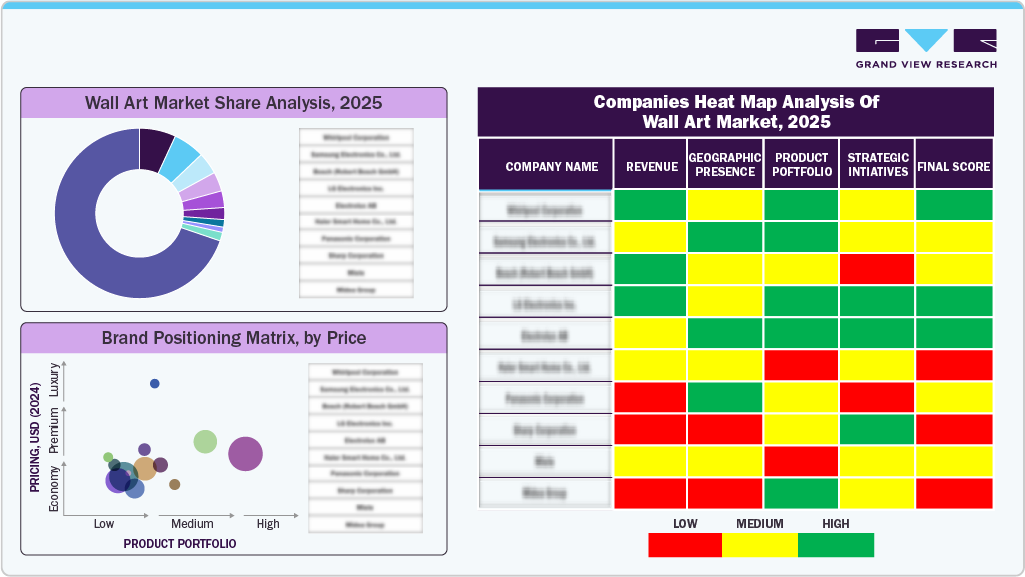
Leading players in the wall art market include VGL Group, Art.com Inc., Uprise Art LLC. The global wall art market is highly competitive, with established home décor brands, independent artists, specialty décor stores, interior design studios, and digital direct-to-consumer platforms expanding across physical retail outlets, lifestyle stores, exhibitions, and online marketplaces. Companies are increasingly focusing on premium designs, limited-edition collections, customizable prints, and trend-driven aesthetics to appeal to evolving consumer preferences across styles such as abstract, minimalist, nature-inspired, and contemporary art.
Key Wall Art Companies:
The following key companies have been profiled for this study on the wall art market.
- VGL Group
- Art.com Inc.
- Uprise Art LLC
- Saatchi Art Limited
- Society6 LLC
- Minted LLC
- Artsy Inc
- 1stdibs.com Inc.
- Artnet Worldwide Corporation
- Artspace LLC
Recent Developments
-
In November 2025, GrandMix announced the launch of an exclusive home décor collection designed to elevate modern interiors with pieces that balance style and functionality. The new range includes a premium selection of wall art with both contemporary and classic designs, tailored to enhance various décor themes, alongside complementary products such as innovative bathroom storage solutions, rustic indoor firewood racks, and sleek luggage stands for homes and guest spaces.
-
In November 2025, Woven Image unveiled its new Soundstyle decorative wall panels, designed to combine aesthetic appeal with acoustic comfort for modern interiors. These lightweight architectural panels address the common challenge of noise and echo in open-plan homes by absorbing sound while also enhancing visual style through a range of textured designs and neutral tones that fit contemporary décor themes.
Wall Art Market Report Scope
Report Attribute
Details
Market size value in 2026
USD 64.22 billion
Revenue Forecast in 2033
USD 99.15 billion
Growth rate (Revenue)
CAGR of 6.4% from 2026 to 2033
Actual data
2021 - 2025
Forecast period
2026 - 2033
Quantitative units
Revenue in USD million/billion, and CAGR from 2026 to 2033
Report coverage
Revenue forecast, company ranking, competitive landscape, growth factors, and trends
Segments covered
Type, application, sales channel, region
Region Covered
North America; Europe; Asia Pacific; Latin America; and Middle East & Africa
Country Covered
U.S.; Canada; Mexico; UK; Germany; France; Spain; Italy; China; Japan; India ; South Korea; Australia & New Zealand; Brazil; South Africa
Key companies profiled
VGL Group; Art.com Inc.; Uprise Art LLC; Saatchi Art Limited; Society6 LLC; Minted LLC; Artsy Inc; 1stdibs.com Inc.; Artnet Worldwide Corporation; Artspace LLC
Customization scope
Free report customization (equivalent up to 8 analysts’ working days) with purchase. Addition or alteration to country, regional & segment scope.
Pricing and purchase options
Avail customized purchase options to meet your exact research needs. Explore purchase options
Global Wall Art Market Report Segmentation
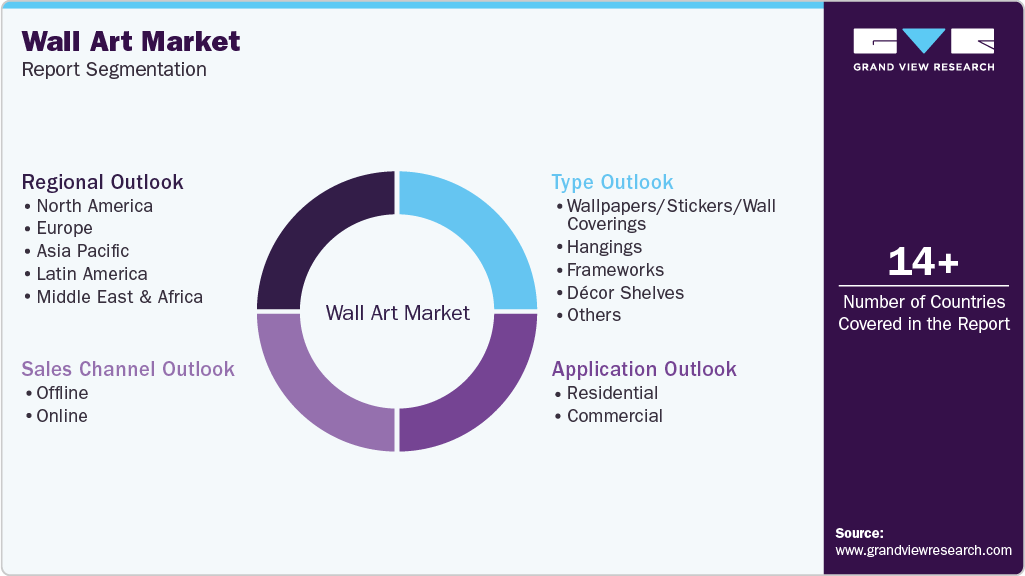
This report forecasts revenue growth at global, regional, and country levels and provides an analysis of the latest trends and opportunities in each sub-segment from 2021 to 2033. For this study, Grand View Research has segmented the wall art market by type, application, sales channel, and region:
-
Type Outlook (Revenue, USD Million, 2021 - 2033)
-
Wallpapers/Stickers/Wall Coverings
-
Hangings
-
Frameworks
-
Décor Shelves
-
Others
-
-
Application Outlook (Revenue, USD Million, 2021 - 2033)
-
Residential
-
Commercial
-
-
Sales Channel Outlook (Revenue, USD Million, 2021 - 2033)
-
Offline
-
Hypermarkets and Supermarkets
-
Specialty Stores
-
Others
-
-
Online
-
-
Regional Outlook (Revenue, USD Million, 2021 - 2033)
-
North America
-
U.S.
-
Canada
-
Mexico
-
-
Europe
-
UK
-
Germany
-
France
-
Spain
-
Italy
-
-
Asia Pacific
-
China
-
Japan
-
India
-
South Korea
-
Australia & New Zealand
-
-
Latin America
-
Brazil
-
-
Middle East and Africa (MEA)
-
South Africa
-
-
Frequently Asked Questions About This Report
b. The global wall art market was estimated at USD 61.01 billion in 2025 and is expected to reach USD 64.22 billion in 2026.
b. The global wall art market is expected to grow at a compound annual growth rate of 6.4% from 2026 to 2033 to reach USD 99.15 billion by 2033.
b. Some of the key players operating in the wall art market include VGL Group, Art.com Inc., Uprise Art LLC, Saatchi Art Limited, Society6 LLC, Minted LLC, Artsy Inc, 1stdibs.com Inc., Artnet Worldwide Corporation, and Artspace LLC.
b. Key factors that are driving the wall art market growth include rising demand for ready-to-install home décor products, increasing penetration for e-commerce sales, and rising growth of residential construction across the globe.
b. Asia Pacific dominated the wall art market with a share of around 47.83% in 2025. The growth of the regional market is driven on account of growth in home real estate, lifestyle, and hospitality sectors.


Share this report with your colleague or friend.
Need a Tailored Report?
Customize this report to your needs — add regions, segments, or data points, with 20% free customization.


ISO 9001:2015 & 27001:2022 Certified
We are GDPR and CCPA compliant! Your transaction & personal information is safe and secure. For more details, please read our privacy policy.
Trusted market insights - try a free sample
See how our reports are structured and why industry leaders rely on Grand View Research. Get a free sample or ask us to tailor this report to your needs.












